

The DOI matches its Crossref record; 76 of the 76 references it cites were found in a registry or an index.
Experimental evolution with E. coli in diverse resource environments. I. Fluctuating environments promote divergence of replicate populations
Open accessAbstract
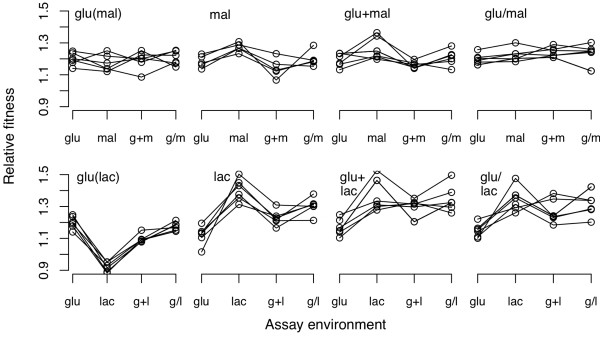
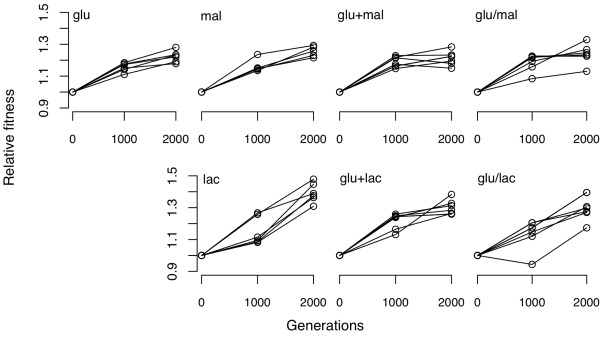
BACKGROUND: Environmental conditions affect the topology of the adaptive landscape and thus the trajectories followed by evolving populations. For example, a heterogeneous environment might lead to a more rugged adaptive landscape, making it more likely that replicate populations would evolve toward distinct adaptive peaks, relative to a uniform environment. To date, the influence of environmental variability on evolutionary dynamics has received relatively little experimental study. RESULTS: We report findings from an experiment designed to test the effects of environmental variability on the adaptation and divergence of replicate populations of E. coli. A total of 42 populations evolved for 2000 generations in 7 environmental regimes that differed in the number, identity, and presentation of the limiting resource. Regimes were organized in two sets, having the sugars glucose and maltose singly and in combination, or glucose and lactose singly and in combination. Combinations of sugars were presented either simultaneously or as temporally fluctuating resource regimes. This design allowed us to compare the effects of resource identity and presentation on the evolutionary trajectories followed by replicate populations. After 2000 generations, the fitness of all populations had increased relative to the common ancestor, but to different extents. Populations evolved in glucose improved the least, whereas populations evolving in maltose or lactose increased the most in their respective sets. Among-population divergence also differed across regimes, with variation higher in those groups that evolved in fluctuating environments than in those that faced constant resource regimens. This divergence under the fluctuating conditions increased between 1000 and 2000 generations, consistent with replicate populations evolving toward distinct adaptive peaks. CONCLUSIONS: These results support the hypothesis that environmental heterogeneity can give rise to more rugged adaptive landscapes, which in turn promote evolutionary diversification. These results also demonstrate that this effect depends on the form of environmental heterogeneity, with greater divergence when the pairs of resources fluctuated temporally rather than being presented simultaneously.
Overview
The claims and statistics of this paper haven’t been checked yet.
Run the check — free, no account needed. It reads the open-access text and checks the sources it cites.
Integrity signals
Registry
Cites
Statistics
Figures
Verification
Claims the paper makes
The claims and statistics of this paper haven’t been checked yet.
Run the check — free, no account needed. It reads the open-access text and checks the sources it cites.
Claims other papers make about this one
Each is checked against this paper’s own text: does it say what the citing paper says it does?
In the citing paper
“Besides insights into co-evolutionary behavior, this approach can be exploited in order to increase antibiotic production such as in the case of co-cultivation of Streptomyces clavuligerus and Staphylococcus aureus[55].”
From Adaptive laboratory evolution—Principles and applications for biotechnology (2013) · cites this paper as [55]
Self-check
Percentages, sums and reported differences re-computed from the paper’s own numbers.
The self-check needs the paper’s full text.
Citations
Cites
Analyzing Tables of Statistical Tests
Rice, W. R. (1989) · Evolution · doi:10.2307/2409177 · Cited by 14,571
ANALYZING TABLES OF STATISTICAL TESTS
Rice, W. R. (1989) · Evolution · doi:10.1111/j.1558-5646.1989.tb04220.x · Cited by 14,437
The Origins of Order: Self-Organization and Selection in Evolution
Kauffman, S. A. (1993) · doi:10.1093/oso/9780195079517.001.0001 · Cited by 7,855
The Ecology of Adaptive Radiation
Schluter, D. (2000) · doi:10.1093/oso/9780198505235.001.0001 · Cited by 4,974
The comparative method in evolutionary biology
Harvey, P., & Pagel, M. (1991) · Choice Reviews Online · doi:10.5860/choice.29-5104 · Cited by 4,778
The Comparative Method in Evolutionary Biology
Harvey, P. H., & Pagel, M. D. (1991) · doi:10.1093/oso/9780198546412.001.0001 · Cited by 4,337
Escherichia Coli and Salmonella: Typhimurium Cellular and Molecular Biology
Neidhardt, F. C., & Ingraham, J. L. (1987) · Medical Entomology and Zoology · Cited by 4,089
THE MAJOR FEATURES OF EVOLUTION
Olson, E. C., & Simpson, G. G. (1954) · Evolution · doi:10.2307/2405671 · Cited by 2,029
Funnekotter, B. (2005) · Amsterdam University Press eBooks · doi:10.1017/9789048505418.012 · Cited by 1,672
Lenski, R. E., Rose, M. R., Simpson, S. C., & Tadler, S. C. (1991) · The American Naturalist · doi:10.1086/285289 · Cited by 1,587
Self-citationEvolution Experiments with Microorganisms: The Dynamics and Genetic Bases of Adaptation
Elena, S. F., & Lenski, R. E. (2003) · Nature Reviews Genetics · doi:10.1038/nrg1088 · Cited by 1,386
Self-citationAdaptive radiation in a heterogeneous environment
Rainey, P., & Travisano, M. (1998) · Nature · doi:10.1038/27900 · Cited by 1,256
Genome evolution and adaptation in a long-term experiment with Escherichia coli
Barrick, J. E., Yu, D. S., Yoon, S. H., Jeong, H., Oh, T. K., Schneider, D., Lenski, R. E., & Kim, J. F. (2009) · Nature · doi:10.1038/nature08480 · Cited by 1,184
Self-citationBlount, Z. D., Borland, C. Z., & Lenski, R. E. (2008) · Proceedings of the National Academy of Sciences · doi:10.1073/pnas.0803151105 · Cited by 840
Self-citationPERSPECTIVE: SIGN EPISTASIS AND GENETIC COSTRAINT ON EVOLUTIONARY TRAJECTORIES
Weinreich, D. M., Watson, R. A. R., & Chao, L. (2005) · Evolution · doi:10.1554/04-272 · Cited by 690
Levin, B. R., Perrot, V., & Walker, N. (2000) · Genetics · doi:10.1093/genetics/154.3.985 · Cited by 630
Empirical fitness landscapes reveal accessible evolutionary paths
Poelwijk, F. J., Kiviet, D. J., Weinreich, D. M., & Tans, S. J. (2007) · Nature · doi:10.1038/nature05451 · Cited by 578
The population genetics of ecological specialization in evolving Escherichia coli populations
Cooper, V. S., & Lenski, R. E. (2000) · Nature · doi:10.1038/35037572 · Cited by 519 · cited 2×
“Moreover, the patterns of correlated responses in 12 populations, again founded from the same ancestral strain, indicate that pleiotropic effects of beneficial mutations have been more important than mutation accumulation by drift or hitchhiking in explaining patterns of phenotypic evolution over 20,000 generations [1…”
BackgroundSelf-citationExperimental Tests of the Roles of Adaptation, Chance, and History in Evolution
Travisano, M., Mongold, J. A., Bennett, A. F., & Lenski, R. E. (1995) · Science · doi:10.1126/science.7809610 · Cited by 503
Self-citationMULTIPLE FITNESS PEAKS AND EPISTASIS
Whitlock, M. C., Phillips, P. C., Moore, F. B. ‐., & Tonsor, S. J. (1995) · Annual Review of Ecology and Systematics · doi:10.1146/annurev.es.26.110195.003125 · Cited by 496
Effects of Environment on Compensatory Mutations to Ameliorate Costs of Antibiotic Resistance
Björkman, J., Нагаев, И. Ю., Berg, O. G., Hughes, D., & Andersson, D. I. (2000) · Science · doi:10.1126/science.287.5457.1479 · Cited by 449
Parallel changes in gene expression after 20,000 generations of evolution in Escherichia coli
Cooper, T. F., Rozen, D. E., & Lenski, R. E. (2003) · Proceedings of the National Academy of Sciences · doi:10.1073/pnas.0334340100 · Cited by 440
Self-citationStebbins, G. L., & Wright, S. (1977) · Systematic Botany · doi:10.2307/2418471 · Cited by 433
Whitlock, M. C. (1996) · The American Naturalist · doi:10.1086/285902 · Cited by 381
Different Trajectories of Parallel Evolution During Viral Adaptation
Wichman, H. A., Badgett, M. R., Scott, L., Boulianne, C. M., & Bull, J. J. (1999) · Science · doi:10.1126/science.285.5426.422 · Cited by 378
Surfaces of Selective Value Revisited
Wright, S. (1988) · The American Naturalist · doi:10.1086/284777 · Cited by 325
Tests of parallel molecular evolution in a long-term experiment with Escherichia coli
Woods, R. J., Schneider, D., Winkworth, C. L., Riley, M. A., & Lenski, R. E. (2006) · Proceedings of the National Academy of Sciences · doi:10.1073/pnas.0602917103 · Cited by 316
Self-citationCooper, V. S., Schneider, D., Blot, M., & Lenski, R. E. (2001) · Journal of Bacteriology · doi:10.1128/jb.183.9.2834-2841.2001 · Cited by 279
Self-citationCost of Host Radiation in an RNA Virus
Turner, P. E., & Elena, S. F. (2000) · Genetics · doi:10.1093/genetics/156.4.1465 · Cited by 263
Experimental results and evolutionary deductions
Wright, S. (1977) · University of Chicago Press eBooks · Cited by 262
RAPID EVOLUTIONARY ESCAPE BY LARGE POPULATIONS FROM LOCAL FITNESS PEAKS IS LIKELY IN NATURE
Weinreich, D. M., & Chao, L. (2005) · Evolution · doi:10.1111/j.0014-3820.2005.tb01769.x · Cited by 254
Vasi, F., Travisano, M., & Lenski, R. E. (1994) · The American Naturalist · doi:10.1086/285685 · Cited by 253
Self-citationTravisano, M., & Lenski, R. E. (1996) · Genetics · doi:10.1093/genetics/143.1.15 · Cited by 230
Self-citationEVOLUTIONARY ADAPTATION TO TEMPERATURE II. THERMAL NICHES OF EXPERIMENTAL LINES OF ESCHERICHIA COLI
Bennett, A. F., & Lenski, R. E. (1993) · Evolution · doi:10.1111/j.1558-5646.1993.tb01194.x · Cited by 207
Self-citationBuckling, A. G. J., MacLean, R. C., Brockhurst, M. A., & Colegrave, N. (2009) · Nature · doi:10.1038/nature07892 · Cited by 204
Understanding the Evolutionary Fate of Finite Populations: The Dynamics of Mutational Effects
Silander, O., Tenaillon, O., & Chao, L. (2007) · PLoS Biology · doi:10.1371/journal.pbio.0050094 · Cited by 204
Friesen, M., Saxer, G., Travisano, M., & Doebeli, M. (2004) · Evolution · doi:10.1111/j.0014-3820.2004.tb01642.x · Cited by 198
Experimental Tests for an Evolutionary Trade-off between Growth Rate and Yield in E. coli
Novak, M., Pfeiffer, T., Lenski, R. E., Sauer, U., & Bonhoeffer, S. (2006) · The American Naturalist · doi:10.1086/506527 · Cited by 187
Self-citationSexual Recombination and the Power of Natural Selection
Rice, W. R., & Chippindale, A. K. (2001) · Science · doi:10.1126/science.1061380 · Cited by 182
Evidence for multiple adaptive peaks from populations of bacteria evolving in a structured habitat.
Korona, R., Nakatsu, C. H., Forney, L. J., & Lenski, R. E. (1994) · Proceedings of the National Academy of Sciences · doi:10.1073/pnas.91.19.9037 · Cited by 179
Self-citationGenome-wide Mutational Diversity in an Evolving Population of Escherichia coliPreprint
Barrick, J. E., & Lenski, R. E. (2009) · Cold Spring Harbor Symposia on Quantitative Biology · doi:10.1101/sqb.2009.74.018 · Cited by 174
Self-citationMutational order: a major stochastic process in evolution
Mani, G. S., & Clarke, B. C. (1990) · Proceedings of the Royal Society B Biological Sciences · doi:10.1098/rspb.1990.0025 · Cited by 172
Lenski, R. E. (1988) · Evolution · doi:10.1111/j.1558-5646.1988.tb04150.x · Cited by 168
Self-citationReboud, X., & Bell, G. (1997) · Heredity · doi:10.1038/hdy.1997.79 · Cited by 161
Kinetics of the simultaneous utilization of sugar mixtures by Escherichia coli in continuous culture
Lendenmann, U., Snozzi, M., & Egli, T. W. (1996) · Applied and Environmental Microbiology · doi:10.1128/aem.62.5.1493-1499.1996 · Cited by 151
Pervasive compensatory adaptation inEscherichia coli
Moore, F. B. ‐., Rozen, D. E., & Lenski, R. E. (2000) · Proceedings of the Royal Society B Biological Sciences · doi:10.1098/rspb.2000.1030 · Cited by 132
Self-citationTravisano, M., Vasi, F., & Lenski, R. E. (1995) · Evolution · doi:10.1111/j.1558-5646.1995.tb05970.x · Cited by 126
Self-citationPLEIOTROPIC EFFECTS OF BENEFICIAL MUTATIONS IN ESCHERICHIA COLI
Ostrowski, E. A., Rozen, D. E., & Lenski, R. E. (2005) · Evolution · doi:10.1111/j.0014-3820.2005.tb00944.x · Cited by 124
Self-citationThe dynamics of adaptation on correlated fitness landscapes
Kryazhimskiy, S., Tkačik, G., & Plotkin, J. B. (2009) · Proceedings of the National Academy of Sciences · doi:10.1073/pnas.0905497106 · Cited by 120
Pélosi, L., Kühn, L., Guetta, D., Garin, J., Geiselmann, J., Lenski, R. E., & Schneider, D. (2006) · Genetics · doi:10.1534/genetics.105.049619 · Cited by 112
Self-citationExperimental Evolution of Pseudomonas fluorescens in Simple and Complex Environments
Barrett, R. D. H., MacLean, R. C., & Bell, G. (2005) · The American Naturalist · doi:10.1086/444440 · Cited by 111
Experimental evolution recapitulates natural evolution
Wichman, H. A., Scott, L., Yarber, C. D., & Bull, J. J. (2000) · Philosophical Transactions of the Royal Society B Biological Sciences · doi:10.1098/rstb.2000.0731 · Cited by 107
CAN UNIFORM SELECTION RETARD RANDOM GENETIC DIVERGENCE BETWEEN ISOLATED CONSPECIFIC POPULATIONS?
Cohan, F. M. (1984) · Evolution · doi:10.1111/j.1558-5646.1984.tb00315.x · Cited by 107
On the experimental evolution of specialization and diversity in heterogeneous environments
Jasmin, J., & Kassen, R. (2007) · Ecology Letters · doi:10.1111/j.1461-0248.2007.01021.x · Cited by 99
Habets, M. G. J. L., Rozen, D. E., Hoekstra, R. F., & de Visser, J. A. G. M. (2006) · Ecology Letters · doi:10.1111/j.1461-0248.2006.00955.x · Cited by 96
Kassen, R., & Bell, G. (1998) · Heredity · doi:10.1046/j.1365-2540.1998.00329.x · Cited by 94
Evolutionary Adaptation to Temperature II. Thermal Niches of Experimental Lines of Escherichia coli
Bennett, A. F., & Lenski, R. E. (1993) · Evolution · doi:10.2307/2410113 · Cited by 77
Self-citationTravisano, M., Vasi, F., & Lenski, R. E. (1995) · Evolution · doi:10.2307/2410304 · Cited by 76
Self-citationLenski, R. E. (1988) · Evolution · doi:10.2307/2409029 · Cited by 73
Self-citationExperimental evolution in Chlamydomonas II. Genetic variation in strongly contrasted environments
Bell, G., & Reboud, X. (1997) · Heredity · doi:10.1038/hdy.1997.78 · Cited by 70
Murine macrophage behavior on peptide-grafted polyethyleneglycol-containing networks
Kao, W. J., & Hubbell, J. A. (1998) · Biotechnology and Bioengineering · doi:10.1002/(sici)1097-0290(19980705)59:1 · Cited by 59
Parallel and Divergent Genotypic Evolution in Experimental Populations of Ralstonia sp
Nakatsu, C. H., Korona, R., Lenski, R. E., de Bruijn, F. J., Marsh, T. L., & Forney, L. J. (1998) · Journal of Bacteriology · doi:10.1128/jb.180.17.4325-4331.1998 · Cited by 58
Self-citationMicrobial experiments on adaptive landscapes
Colegrave, N., & Buckling, A. (2005) · BioEssays · doi:10.1002/bies.20292 · Cited by 56
Divergent evolution during an experimental adaptive radiation
MacLean, R. C., & Bell, G. (2003) · Proceedings of the Royal Society B Biological Sciences · doi:10.1098/rspb.2003.2408 · Cited by 55
Adaptation to structurally different environments
Korona, R. (1996) · Proceedings of the Royal Society B Biological Sciences · doi:10.1098/rspb.1996.0243 · Cited by 48
Friesen, M., Saxer, G., Travisano, M., et al. (2004) · Evolution · doi:10.1554/03-369 · Cited by 44
Can Uniform Selection Retard Random Genetic Divergence Between Isolated Conspecific Populations?
Cohan, F. M. (1984) · Evolution · doi:10.2307/2408699 · Cited by 44
Evolutionary traction: the cost of adaptation and the evolution of sex
Hadany, L., & Feldman, M. W. (2005) · Journal of Evolutionary Biology · doi:10.1111/j.1420-9101.2004.00858.x · Cited by 41
Unparallel diversification in bacterial microcosms
Tyerman, J., Havard, N., Saxer, G., Travisano, M., & Doebeli, M. (2005) · Proceedings of the Royal Society B Biological Sciences · doi:10.1098/rspb.2005.3068 · Cited by 36
PLEIOTROPIC EFFECTS OF BENEFICIAL MUTATIONS IN ESCHERICHIA COLI
Ostrowski, E. A., Rozen, D. E., & Lenski, R. E. (2005) · Evolution · doi:10.1554/05-116.1 · Cited by 24
Self-citationReboud, X., & Bell, G. (1997) · Heredity · doi:10.1038/sj.hdy.6881210 · Cited by 23
Theoretical analysis of divergence in mean fitness between initially identical populations
Johnson, P. A., Lenski, R. E., & Hoppensteadt, F. C. (1995) · Proceedings of the Royal Society B Biological Sciences · doi:10.1098/rspb.1995.0019 · Cited by 20
Self-citationTHE DYNAMICS OF DIVERSIFICATION IN EVOLVING PSEUDOMONAS POPULATIONS
Barrett, R. D. H., & Bell, G. (2006) · Evolution · doi:10.1111/j.0014-3820.2006.tb01130.x · Cited by 20
Experimental evolution in Chlamydomonas II. Genetic variation in strongly contrasted environments
Bell, G., & Reboud, X. (1997) · Heredity · doi:10.1038/sj.hdy.6881200 · Cited by 11
Kassen, R., & Bell, G. (1998) · Heredity · doi:10.1038/sj.hdy.6883290 · Cited by 6
THE DYNAMICS OF DIVERSIFICATION IN EVOLVING PSEUDOMONAS POPULATIONS
Barrett, R. D. H., & Bell, G. (2006) · Evolution · doi:10.1554/05-673.1 · Cited by 4
Research works printed but not linked: 1
- Kauffman SA The Origins of Order 1993 New York: Oxford Univ. Press
Cited by
Sorted by citations
Cellular Decision Making and Biological Noise: From Microbes to Mammals
Balázsi, G., van Oudenaarden, A., & Collins, J. J. (2011) · Cell · doi:10.1016/j.cell.2011.01.030 · Cited by 1,017
Adaptive laboratory evolution—Principles and applications for biotechnology
Dragosits, M., & Mattanovich, D. (2013) · Microbial Cell Factories · doi:10.1186/1475-2859-12-64 · Cited by 827
Contingency and determinism in evolution: Replaying life’s tape
Blount, Z. D., Lenski, R. E., & Losos, J. B. (2018) · Science · doi:10.1126/science.aam5979 · Cited by 590
Self-citationEnvironmental fluctuations and their effects on microbial communities, populations and individuals
Nguyen, J., Lara‐Gutiérrez, J., & Stocker, R. (2020) · FEMS Microbiology Reviews · doi:10.1093/femsre/fuaa068 · Cited by 338
de Visser, J. A. G. M., Cooper, T. F., & Elena, S. F. (2011) · Proceedings of the Royal Society B Biological Sciences · doi:10.1098/rspb.2011.1537 · Cited by 213
Self-citation
Metadata
- Authors
- Cooper, T. F., & Lenski, R. E.
- Affiliations
- University of Houston (US)
- Michigan State University (US)
- Corresponding author
- Cooper, Tim F
- Venue
- BMC Evolutionary Biology
- Published
- 2010
- Volume
- 10
- Issue
- 1
- Pages
- 11
- ISSN
- 1471-2148 (ISSN-L)
- PMC
- PMC2827396
- OpenAlex
- W2007287937
- Cited by
- 129
- References
- 68
- Citations by year
- 2026: 8 · 2025: 2 · 2024: 7 · 2023: 5 · 2022: 9 · 2021: 11 · 2020: 11 · 2019: 7 · 2018: 4 · 2017: 8 · 2016: 9 · 2015: 10 · 2014: 10 · 2013: 8 · 2012: 10
- FWCI
- 5.03
- Type
- journal article
- Language
- en
- Open access
- gold
- doi.org
- Licence
- cc-by
- Locations
- BMC Evolutionary Biology (publishedVersion, cc-by)
- PubMed Central (publishedVersion, cc-by)
- PubMed (publishedVersion)
- DOAJ (DOAJ: Directory of Open Access Journals) (submittedVersion, cc-by-sa)
- Funders
- National Science Foundation
- Defense Advanced Research Projects Agency
- Topics
- Life Sciences › Biochemistry, Genetics and Molecular Biology › Genetics › Evolution and Genetic Dynamics
- Social Sciences › Cultural Studies › Language and cultural evolution
- Physical Sciences › Earth and Planetary Sciences › Paleontology › Evolution and Paleontology Studies
- Keywords
- experimental evolution, Escherichia coli, environmental variability, environmental heterogeneity, population divergence, resource competition, glucose, maltose, lactose, evolutionary trajectories, fitness
- MeSH terms
- Adaptation, Physiological, Analysis of Variance, Culture Media, Environment, Escherichia coli, Genetics, Population, Evolution, Molecular, Genetic Fitness
About these checks
Registry, retraction, Cites and statistics results are computed, not judged, with one exception: a printed reference that no index lists is read once by a model before it counts as a citation error. Claims are extracted by a model and kept only when their quote appears verbatim in the text; each cited source is then checked, with a model’s help, for whether it says what the claim relies on. Those verdicts can be wrong — read the claim’s quote and the cited source before relying on one.
Statistics and arithmetic are recomputed, not judged.
Confidence bands are shown only for fields calibrated on our annotated test set. None is calibrated yet, so no band is shown.
What counts as a claim ›How we measure confidence ›How we check this ›
Are you an author, or do you see a problem with this page? Request a review
