

Detecting the symplesiomorphy trap: a multigene phylogenetic analysis of terebelliform annelids
Open accessThe DOI matches its Crossref record; 70 of the 72 references it cites were found in a registry or an index, and 1 are not checked yet.
Abstract
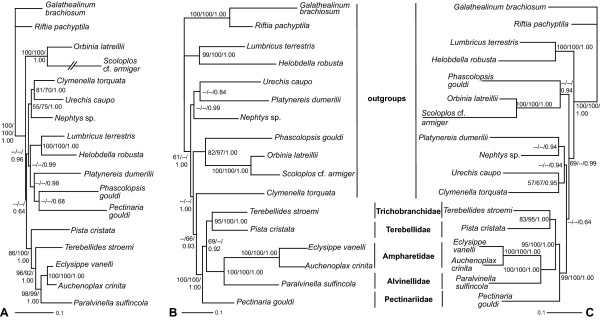
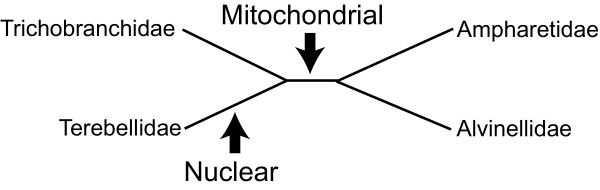
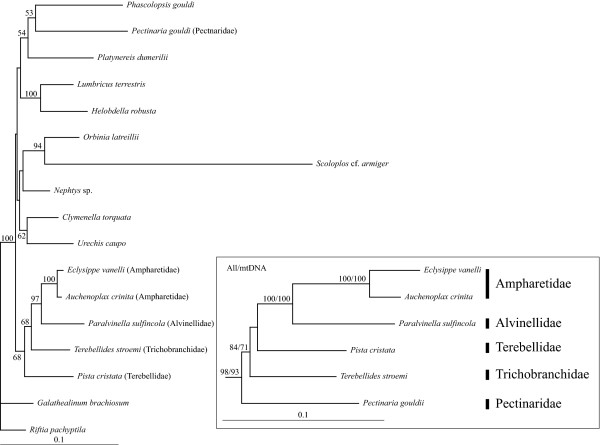
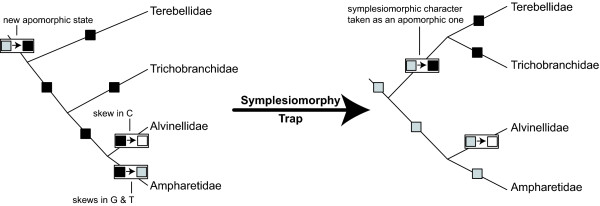
Background: For phylogenetic reconstructions, conflict in signal is a potential problem for tree reconstruction. For instance, molecular data from different cellular components, such as the mitochondrion and nucleus, may be inconsistent with each other. Mammalian studies provide one such case of conflict where mitochondrial data, which display compositional biases, support the Marsupionta hypothesis, but nuclear data confirm the Theria hypothesis. Most observations of compositional biases in tree reconstruction have focused on lineages with different composition than the majority of the lineages under analysis. However in some situations, the position of taxa that lack compositional bias may be influenced rather than the position of taxa that possess compositional bias. This situation is due to apparent symplesiomorphic characters and known as "the symplesiomorphy trap". Results: Herein, we report an example of the sympleisomorphy trap and how to detect it. Worms within Terebelliformia (sensu Rouse & Pleijel 2001) are mainly tube-dwelling annelids comprising five 'families': Alvinellidae, Ampharetidae, Terebellidae, Trichobranchidae and Pectinariidae. Using mitochondrial genomic data, as well as data from the nuclear 18S, 28S rDNA and elongation factor-1α genes, we revealed incongruence between mitochondrial and nuclear data regarding the placement of Trichobranchidae. Mitochondrial data favored a sister relationship between Terebellidae and Trichobranchidae, but nuclear data placed Trichobranchidae as sister to an Ampharetidae/Alvinellidae clade. Both positions have been proposed based on morphological data. Conclusions: Our investigation revealed that mitochondrial data of Ampharetidae and Alvinellidae exhibited strong compositional biases. However, these biases resulted in a misplacement of Trichobranchidae, rather than Alvinellidae and Ampharetidae. Herein, we document that Trichobranchidae was apparently caught in the symplesiomorphy trap suggesting that in certain situations even homologies can be misleading.
Overview
The claims and statistics of this paper haven’t been checked yet.
Free: it reads the open-access text and checks the first 5 claims that cite a source we can check. Create a free account to check every claim.
Integrity signals
Registry
Cites
Statistics
Figures
Verification
Claims the paper makes
The claims and statistics of this paper haven’t been checked yet.
Free: it reads the open-access text and checks the first 5 claims that cite a source we can check. Create a free account to check every claim.
Self-check
Percentages, sums and reported differences re-computed from the paper’s own numbers.
The self-check needs the paper’s full text.
Citations
Cites
Basic local alignment search tool
Altschul, S. F., Gish, W., Miller, W., Myers, E. W., & Lipman, D. J. (1990) · Journal of Molecular Biology · doi:10.1006/jmbi.1990.9999 · Cited by 98,669 · cited 1×
“Protein-coding genes and ribosomal RNA genes were identified by BLAST [26].”
Thompson, J. (1997) · Nucleic Acids Research · doi:10.1093/nar/25.24.4876 · Cited by 38,993 · cited 1×
“Clustal X [28] under default settings was used to align rRNA genes.”
MethodMRBAYES: Bayesian inference of phylogenetic trees.
Huelsenbeck, J. P., & Ronquist, F. (2001) · Bioinformatics · doi:10.1093/bioinformatics/17.8.754 · Cited by 21,937 · cited 1×
“2 [36] and ran for 5*10(6) (mitochondrial and nuclear) or 2*10(6) (combined) generations, respectively, with 2 runs of 4 chains (3 heated and 1 cold).”
BackgroundMODELTEST: testing the model of DNA substitution.
Posada, D., & Crandall, K. A. (1998) · Bioinformatics · doi:10.1093/bioinformatics/14.9.817 · Cited by 19,820 · cited 2×
“GTR+Γ+I models were selected under the AIC in MrModeltest [37,38] for 18S and 28S rDNA, EF-1a, cox1, cox2, cob, nad1, nad3, and nad4, GTR+I models for both 12S and 16S rDNA, GTR+Γ model for cox3, and HKY+Γ model for nad2, nad4L and nad5.”
MethodtRNAscan-SE: A Program for Improved Detection of Transfer RNA Genes in Genomic Sequence
Lowe, T. M., & Eddy, S. R. (1997) · Nucleic Acids Research · doi:10.1093/nar/25.5.955 · Cited by 10,905 · cited 1×
“edu/ tRNAscan-SE/, [27]] under default settings and source = “mito/chloroplast”, or by hand based on their potential secondary structures and anticodon sequences.”
BackgroundSelection of Conserved Blocks from Multiple Alignments for Their Use in Phylogenetic Analysis
Castresana, J. (2000) · Molecular Biology and Evolution · doi:10.1093/oxfordjournals.molbev.a026334 · Cited by 10,508 · cited 1×
“91b [29] was used to identify ambiguous aligned regions in the rRNA genes.”
MethodA Rapid Bootstrap Algorithm for the RAxML Web Servers
Stamatakis, A., Hoover, P., & Rougemont, J. (2008) · Systematic Biology · doi:10.1080/10635150802429642 · Cited by 7,028 · cited 5×
“8 [35] using a GTR+Γ+I model for each individual gene and 200 bootstrap replicates followed by a best tree search.”
MethodInfluentialAn approximately unbiased test of phylogenetic tree selection
Shimodaira, H. (2002) · Systematic Biology · doi:10.1080/10635150290069913 · Cited by 2,791 · cited 1×
“To further understand congruence and incongruence in our datasets, the Approximately Unbiased (AU) topology test of CONSEL [41,42] was employed to assess support for alternative hypotheses.”
MethodMoore, D. S., Hillis, D. M., Moritz, C., & Mable, B. K. (1996) · Copeia · doi:10.2307/1447682 · Cited by 2,371
CONSEL: for assessing the confidence of phylogenetic tree selection
Shimodaira, H., & Hasegawa, M. (2001) · Bioinformatics · doi:10.1093/bioinformatics/17.12.1246 · Cited by 2,041 · cited 1×
“To further understand congruence and incongruence in our datasets, the Approximately Unbiased (AU) topology test of CONSEL [41,42] was employed to assess support for alternative hypotheses.”
MethodBroad phylogenomic sampling improves resolution of the animal tree of life
Dunn, C. W., Hejnol, A., Matus, D. Q., Pang, K., Browne, W. E., Smith, S. A., Seaver, E., Rouse, G. W., Obst, M., Edgecombe, G. D., et al. (2008) · Nature · doi:10.1038/nature06614 · Cited by 1,921 · cited 1×
“, [1-4]], and phylogenies based on multiple datasets (i.”
BackgroundPatterns of nucleotide composition at fourfold degenerate sites of animal mitochondrial genomes
Perna, N., & Kocher, T. (1995) · Journal of Molecular Evolution · doi:10.1007/bf00186547 · Cited by 1,865 · cited 1×
“Perna and Kocher [54] introduced the A-T and G-C skews for an individual strand of nucleic acids.”
BackgroundMacclade: Analysis of Phylogeny and Character Evolution/Version 3
Maddison, W. P., & Maddison, D. R. (1992) · Medical Entomology and Zoology · Cited by 1,448
DNASTAR's Lasergene Sequence Analysis Software
Burland, T. G. (2003) · Bioinformatics Methods and Protocols · doi:10.1385/1-59259-192-2:71 · Cited by 1,244 · cited 2×
“Sequences were edited and aligned using DNASTAR™ Lasergene programs SeqMan and MegAlign [25].”
MethodMitochondrial DNA as a marker of molecular diversity: a reappraisal
GALTIER, N., NABHOLZ, B., GLÉMIN, S., & HURST, G. D. D. (2009) · Molecular Ecology · doi:10.1111/j.1365-294x.2009.04380.x · Cited by 1,178 · cited 1×
“, [5]].”
A review of long-branch attraction
Bergsten, J. (2005) · Cladistics · doi:10.1111/j.1096-0031.2005.00059.x · Cited by 1,162 · cited 3×
“Finally, we also tested if exclusion of biased taxa in turn would alter the results [56], but there was no noticeable effect.”
BackgroundMethodSelecting the Best-Fit Model of Nucleotide Substitution
Posada, D., & Crandall, K. A. (2001) · Systematic Biology · doi:10.1080/10635150118469 · Cited by 937 · cited 2×
“GTR+Γ+I models were selected under the AIC in MrModeltest [37,38] for 18S and 28S rDNA, EF-1a, cox1, cox2, cob, nad1, nad3, and nad4, GTR+I models for both 12S and 16S rDNA, GTR+Γ model for cox3, and HKY+Γ model for nad2, nad4L and nad5.”
MethodGood genes, oxidative stress and condition–dependent sexual signals
Schantz, T. V., Bensch, S., Grahn, M., Hasselquist, D., & Wittzell, H. (1999) · Proceedings of the Royal Society of London. Series B: Biological Sciences · doi:10.1098/rspb.1999.0597 · Cited by 886
ROUSE, G. W., & FAUCHALD, K. (1997) · Zoologica Scripta · doi:10.1111/j.1463-6409.1997.tb00412.x · Cited by 688 · cited 3×
“, [18,69,73]], until now strong support by molecular data [e.”
BackgroundSelecting the Best-Fit Model of Nucleotide Substitution
Posada, D., & Crandall, K. A. (2001) · Systematic Biology · doi:10.1080/106351501750435121 · Cited by 598
Hassanin, A., Léger, N., & Deutsch, J. (2005) · Systematic Biology · doi:10.1080/10635150590947843 · Cited by 519 · cited 1×
“, [15,45-53]].”
Asymmetrical directional mutation pressure in the mitochondrial genome of mammals
Reyes, A., Gissi, C., Pesole, G., & Saccone, C. (1998) · Molecular Biology and Evolution · doi:10.1093/oxfordjournals.molbev.a026011 · Cited by 414 · cited 4×
“In mammals, this is due to spontaneous deamination of cytosine to uracil and adenine to hypoxanthine on the complementary strand during replication of mitochondrial genomes [55].”
BackgroundInfluentialPhylogenomic analyses unravel annelid evolution
Struck, T. H., Paul, C., Hill, N., Hartmann, S., Hösel, C., Kube, M., Lieb, B., Meyer, A., Tiedemann, R., Purschke, G., et al. (2011) · Nature · doi:10.1038/nature09864 · Cited by 406 · cited 1×
“, [1-4]], and phylogenies based on multiple datasets (i.”
BackgroundSelf-citationAnnelid phylogeny and the status of Sipuncula and Echiura
Struck, T. H., Schult, N., Kusen, T., Hickman, E., Bleidorn, C., McHugh, D., & Halanych, K. M. (2007) · BMC Evolutionary Biology · doi:10.1186/1471-2148-7-57 · Cited by 341
Self-citationCompositional Bias May Affect Both DNA-Based and Protein-Based Phylogenetic Reconstructions
Foster, P. G., & Hickey, D. A. (1999) · Journal of Molecular Evolution · doi:10.1007/pl00006471 · Cited by 337 · cited 1×
“, [15,45-53]].”
Species Sampling Has a Major Impact on Phylogenetic Inference
Lecointre, G., Philippe, H., Lê, H. L. V., & Le Guyader, H. (1993) · Molecular Phylogenetics and Evolution · doi:10.1006/mpev.1993.1021 · Cited by 333 · cited 2×
“Increased sampling may allow better adjustment to biases along the branches [58,59].”
BackgroundThe root of the mammalian tree inferred from whole mitochondrial genomes
Phillips, M. J., & Penny, D. (2003) · Molecular Phylogenetics and Evolution · doi:10.1016/s1055-7903(03)00057-5 · Cited by 287 · cited 8×
“This is similar to the situation found in mammals though their guanine frequency can be considerably lower [15,55,63,64].”
BackgroundMethodInfluentialA molecular phylogeny of annelids
Rousset, V., Pleijel, F., Rouse, G. W., Erséus, C., & Siddall, M. E. (2007) · Cladistics · doi:10.1111/j.1096-0031.2006.00128.x · Cited by 281
Interordinal Relationships of Birds and Other Reptiles Based on Whole Mitochondrial Genomes
Mindell, D. P., Sorenson, M. D., Dimcheff, D. E., Hasegawa, M., Ast, J. C., & Yuri, T. (1999) · Systematic Biology · doi:10.1080/106351599260490 · Cited by 255 · cited 1×
“, [15,45-53]].”
Janke, A., Xu, X., & Arnason, U. (1997) · Proceedings of the National Academy of Sciences · doi:10.1073/pnas.94.4.1276 · Cited by 246 · cited 1×
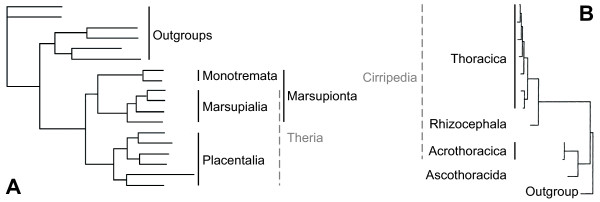
“In the case of mammals, mitochondrial data strongly support the Marsupionta hypothesis placing Marsupialia as sister to Monotremata (Figure 1A) [6-11], whereas the Theria hypothesis, which places Marsupialia with Placentalia, has been strongly supported by both morphological and nuclear data [e.”
Result(1978) · Elsevier eBooks · doi:10.1016/b978-0-12-303850-0.x5001-0 · Cited by 237 · cited 1×
“, [12-14]].”
Complete mitochondrial genome suggests diapsid affinities of turtles
Zardoya, R., & Meyer, A. (1998) · Proceedings of the National Academy of Sciences · doi:10.1073/pnas.95.24.14226 · Cited by 228 · cited 1×
“In the case of mammals, mitochondrial data strongly support the Marsupionta hypothesis placing Marsupialia as sister to Monotremata (Figure 1A) [6-11], whereas the Theria hypothesis, which places Marsupialia with Placentalia, has been strongly supported by both morphological and nuclear data [e.”
ResultKumazawa, Y., Ota, H., Nishida, M., & Ozawa, T. (1998) · Genetics · doi:10.1093/genetics/150.1.313 · Cited by 226
Secondary structure and patterns of evolution among mammalian mitochondrial 12S rRNA molecules
Springer, M. S., & Douzery, E. (1996) · Journal of Molecular Evolution · doi:10.1007/bf02339010 · Cited by 210
Strand Asymmetry in Human Mitochondrial DNA Mutations
Tanaka, M., & Ozawa, T. (1994) · Genomics · doi:10.1006/geno.1994.1391 · Cited by 204 · cited 1×
“The former deamination occurs more often than the latter [65] explaining the low level of guanines in mammals on the coding strand and the stronger bias observed in pyrimidines than in purines, because the low guanine frequency allows for little variation [15].”
BackgroundStruck, T. H., Purschke, G., & Halanych, K. M. (2006) · Systematic Biology · doi:10.1080/10635150500354910 · Cited by 167
Self-citationNonstationary Evolution and Compositional Heterogeneity in Beetle Mitochondrial Phylogenomics
Sheffield, N. C., Song, H., Cameron, S. L., & Whiting, M. F. (2009) · Systematic Biology · doi:10.1093/sysbio/syp037 · Cited by 166
Boore, J. L., & Staton, J. L. (2002) · Molecular Biology and Evolution · doi:10.1093/oxfordjournals.molbev.a004065 · Cited by 163 · cited 1×
“gouldi (Additional File 1) and in some but not all sipunculids [70-72].”
BackgroundWägele, J., & Mayer, C. (2007) · BMC Evolutionary Biology · doi:10.1186/1471-2148-7-147 · Cited by 152 · cited 9×
“In the Cirripedia example by Wägele and Mayer [17] (Figure 1B), Acrothoracica and Ascothoracida grouped together due to symplesiomorphic characters because of the long branch uniting the remaining Cirripedia.”
BackgroundMethodInfluentialMalmgrén, A. J. (1866) · Biodiversity Heritage Library (Smithsonian Institution) · doi:10.5281/zenodo.16052761 · Cited by 141
Foundations of phylogenetic systematics
Wägele, J. W. (2005) · Medical Entomology and Zoology · Cited by 137
The mitochondrial genome of a monotreme—the platypus (Ornithrohynchus anatinus)
Janke, A., Gemmell, N. J., Feldmaier-Fuchs, G., von Haeseler, A., & Pääbo, S. (1996) · Journal of Molecular Evolution · doi:10.1007/bf02198841 · Cited by 120
Zur Kenntnis der terebellomorphen Polychaeten
Hessle, C. (1917) · Biodiversity Heritage Library (Smithsonian Institution) · Cited by 120
Cao, Y., Fujiwara, M., Nikaido, M., Okada, N., & Hasegawa, M. (2000) · Gene · doi:10.1016/s0378-1119(00)00427-3 · Cited by 111
Spiralian Phylogenomics Supports the Resurrection of Bryozoa Comprising Ectoprocta and Entoprocta
Hausdorf, B., Helmkampf, M., Meyer, A., Witek, A., Herlyn, H., Bruchhaus, I., Hankeln, T., Struck, T. H., & Lieb, B. (2007) · Molecular Biology and Evolution · doi:10.1093/molbev/msm214 · Cited by 109 · cited 1×
“, [1-4]], and phylogenies based on multiple datasets (i.”
BackgroundSelf-citationHärlid, A., & Arnason, U. (1999) · Proceedings of the Royal Society of London. Series B: Biological Sciences · doi:10.1098/rspb.1999.0638 · Cited by 107
Killian, J. K., Buckley, T. R., Stewart, N., Munday, B. L., & Jirtle, R. L. (2001) · Mammalian Genome · doi:10.1007/s003350020026 · Cited by 101 · cited 1×
“, [12-14]].”
Struck, T. H., Nesnidal, M. P., Purschke, G., & Halanych, K. M. (2008) · Molecular Phylogenetics and Evolution · doi:10.1016/j.ympev.2008.05.015 · Cited by 93 · cited 2×
“Pectinaria gouldi, as well as Phascolopsis gouldi, exhibit long branches in nuclear rRNA data [[19,57] and see also Additional File 2].”
BackgroundSelf-citationSpears, T., Abele, L. G., & Applegate, M. (1994) · Journal of Crustacean Biology · doi:10.1163/193724094x00614 · Cited by 92
Schmitz, J., Ohme, M., & Zischler, H. (2002) · Molecular Biology and Evolution · doi:10.1093/oxfordjournals.molbev.a004110 · Cited by 89 · cited 1×
“, [15,45-53]].”
Shen, X., Ma, X., Ren, J., & Zhao, F. (2009) · BMC Genomics · doi:10.1186/1471-2164-10-136 · Cited by 89 · cited 1×
“gouldi (Additional File 1) and in some but not all sipunculids [70-72].”
BackgroundMilinkovitch, M. C., LeDuc, R. G., Adachi, J., Farnir, F., Georges, M., & Hasegawa, M. (1996) · Genetics · doi:10.1093/genetics/144.4.1817 · Cited by 86
Mwinyi, A., Meyer, A., Bleidorn, C., Lieb, B., Bartolomaeus, T., & Podsiadlowski, L. (2009) · BMC Genomics · doi:10.1186/1471-2164-10-27 · Cited by 83 · cited 1×
“gouldi (Additional File 1) and in some but not all sipunculids [70-72].”
BackgroundJanke, A., Magnell, O., Wieczorek, G., Westerman, M., & Árnason, Ú. (2002) · Journal of Molecular Evolution · doi:10.1007/s00239-001-0019-8 · Cited by 83 · cited 1×
“In the case of mammals, mitochondrial data strongly support the Marsupionta hypothesis placing Marsupialia as sister to Monotremata (Figure 1A) [6-11], whereas the Theria hypothesis, which places Marsupialia with Placentalia, has been strongly supported by both morphological and nuclear data [e.”
ResultThe platypus put in its place: Molecular systematics
Penny, D., & Hasegawa, M. (1997) · Nature · doi:10.1038/42352 · Cited by 77
Spears, T., Abele, L. G., & Applegate, M. A. (1994) · Journal of Crustacean Biology · doi:10.2307/1548858 · Cited by 70
Zhong, M., Struck, T. H., & Halanych, K. M. (2008) · Gene · doi:10.1016/j.gene.2008.02.020 · Cited by 67 · cited 9×
“Thus, no unequivocal character supports a sistergroup relationship of Terebellidae and Trichobranchidae.”
BackgroundMethodInfluentialSelf-citationPhillips, M. J., Lin, Y.-H., Harrison, G., & Penny, D. (2001) · Proceedings of the Royal Society of London. Series B: Biological Sciences · doi:10.1098/rspb.2001.1677 · Cited by 63 · cited 1×
“This is similar to the situation found in mammals though their guanine frequency can be considerably lower [15,55,63,64].”
Gowri-Shankar, V., & Rattray, M. (2007) · Molecular Biology and Evolution · doi:10.1093/molbev/msm046 · Cited by 55 · cited 1×
“0 [40] to allow usage of different compositional vectors along branches of the tree.”
BackgroundHolthe (1986) · BRILL eBooks · doi:10.1163/9789004627222 · Cited by 55
Mouchaty, S. K., Gullberg, A., Janke, A., & Árnason, Ú. (2000) · Zoologica Scripta · doi:10.1046/j.1463-6409.2000.00045.x · Cited by 51
Spectral Analysis, Systematic Bias, and the Evolution of Chloroplasts
Lockhart, P. J., Howe, C. J., Barbrook, A. C., Larkum, A., & Penny, D. (1999) · Molecular Biology and Evolution · doi:10.1093/oxfordjournals.molbev.a026139 · Cited by 50 · cited 1×
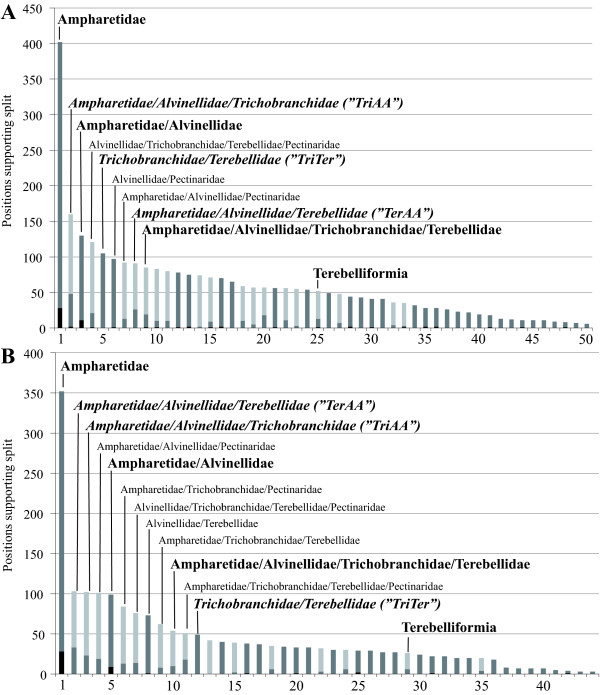
“We conducted spectral analyses to gain further insights into the support for specific bipartitions (or splits) [43,44] because they have been useful in the detection of the symplesiomorphy trap [17].”
MethodDordel, J., Fisse, F., Purschke, G., & Struck, T. H. (2010) · Journal of Zoological Systematics and Evolutionary Research · doi:10.1111/j.1439-0469.2010.00567.x · Cited by 48 · cited 1×
“, [1-4]], and phylogenies based on multiple datasets (i.”
BackgroundSelf-citationErosion of phylogenetic signal in tunicate mitochondrial genomes on different levels of analysis
Stach, T., Braband, A., & Podsiadłowski, L. (2010) · Molecular Phylogenetics and Evolution · doi:10.1016/j.ympev.2010.03.011 · Cited by 43 · cited 1×
“, [15,45-53]].”
Rousset, V., Rouse, G. W., Féral, J., Desbruyères, D., & Pleijel, F. (2003) · Zoologica Scripta · doi:10.1046/j.1463-6409.2003.00110.x · Cited by 41 · cited 7×
“Thus, no unequivocal character supports a sistergroup relationship of Terebellidae and Trichobranchidae.”
ResultInfluentialPérez‐Losada, M., Crandall, K. A., Kolbasov, G. A., & Hoeg, J. T. (2002) · Journal of Crustacean Biology · doi:10.1651/0278-0372(2002)022[0661:rotrat]2.0.co;2 · Cited by 40
Testing the phylogeny of swordtail fishes using split decomposition and spectral analysis
Lockhart, P. J., Penny, D., & Meyer, A. (1995) · Journal of Molecular Evolution · doi:10.1007/bf00175825 · Cited by 36 · cited 1×
“We conducted spectral analyses to gain further insights into the support for specific bipartitions (or splits) [43,44] because they have been useful in the detection of the symplesiomorphy trap [17].”
MethodGlasby, C. J., HUTCHINGS, P. A., & Hall, K. (2004) · Journal of the Marine Biological Association of the United Kingdom · doi:10.1017/s0025315404010252h · Cited by 35 · cited 8×
“Thus, no unequivocal character supports a sistergroup relationship of Terebellidae and Trichobranchidae.”
BackgroundResultInfluentialLee, M., Shroff, R., Cooper, S. J., & Hope, R. M. (1999) · Molecular Phylogenetics and Evolution · doi:10.1006/mpev.1999.0610 · Cited by 21
Longhorn, S. J., Foster, P. G., & Vogler, A. P. (2007) · Cladistics · doi:10.1111/j.1096-0031.2006.00132.x · Cited by 18 · cited 1×
“, [15,45-53]].”
(2001)
Research works printed but not linked: 6
- Rouse GW Pleijel F Polychaetes 2001 Oxford: University Press
- Maddison DR Maddison WP MacClade4: Analysis of Phylogeny and Character Evolution, version 4.0 2002 Sunderland, MA: Sinauer Associates
- Rambaut A The Use of Temporally Sampled DNA Sequences in Phylogenetic Analysis 1996 Oxford, UK: Oxford University
- Nylander JAA MrModeltest Evolutionary Biology Centre 2002 Uppsala University: Program distributed by the author
- Nylander JAA MrModeltest v2 Evolutionary Biology Centre 2004 Uppsala University: Program distributed by the author
- Desbruyères D Laubier L Alvinella pompejana gen. sp. nov., Ampharetidae abberant des sources hydrothermales de la ride Est-Pacifique Oceanol Acta 1980 3 267 274
Cited by
Error, signal, and the placement of Ctenophora sister to all other animals
Whelan, N. V., Kocot, K. M., Moroz, L. L., & Halanych, K. M. (2015) · Proceedings of the National Academy of Sciences · doi:10.1073/pnas.1503453112 · Cited by 331
“Full dataset “Certain” paralogs removed “Uncertain” & “certain” paralogs removed Taxa with high LB scores removed Heterogeneous genes removed Lowest half RCFV genes Taxa with high LB scores removed Heterogeneous genes removed Lowest half RCFV genes Genes with high LB scores removed Genes with high LB scores removed Ou…”
MethodSelf-citationIlluminating the Base of the Annelid Tree Using Transcriptomics
Weigert, A., Helm, C., Meyer, M., Nickel, B., Arendt, D., Hausdorf, B., Santos, S. R., Halanych, K. M., Purschke, G., Bleidorn, C., et al. (2014) · Molecular Biology and Evolution · doi:10.1093/molbev/msu080 · Cited by 304
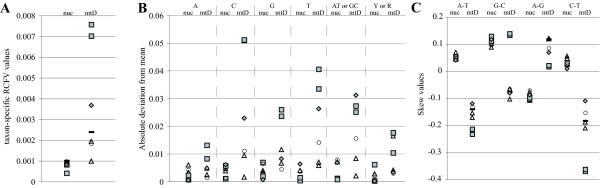
“To assess base composition heterogeneity, we employed taxon-specific RCFV values that determine the absolute deviation of the base composition of a taxon from the mean across all taxa (Zhong et al. 2011).”
MethodSelf-citationCtenophore relationships and their placement as the sister group to all other animals
Whelan, N. V., Kocot, K. M., Moroz, T. P., Mukherjee, K., Williams, P., Paulay, G., Moroz, L. L., & Halanych, K. M. (2017) · Nature Ecology & Evolution · doi:10.1038/s41559-017-0331-3 · Cited by 263
Self-citationPhylogenomics of Lophotrochozoa with Consideration of Systematic Error
Kocot, K. M., Struck, T. H., Merkel, J., Waits, D. S., Todt, C., Brannock, P. M., Weese, D. A., Cannon, J. T., Moroz, L. L., Lieb, B., et al. (2016) · Systematic Biology · doi:10.1093/sysbio/syw079 · Cited by 208
“We supplemented existing data with 32 new transcriptomes spanning the diversity of Lophotrochozoa and constructed a new set of Lophotrochozoa-specific core orthologs.”
BackgroundResultInfluentialSelf-citationPlatyzoan Paraphyly Based on Phylogenomic Data Supports a Noncoelomate Ancestry of Spiralia
Struck, T. H., Wey-Fabrizius, A. R., Golombek, A., Hering, L., Weigert, A., Bleidorn, C., Klebow, S., Iakovenko, N., Hausdorf, B., Petersen, M., et al. (2014) · Molecular Biology and Evolution · doi:10.1093/molbev/msu143 · Cited by 178
Self-citation
Metadata
- Authors
- Zhong, M., Hansen, B., Nesnidal, M., Golombek, A., Halanych, K. M., & Struck, T. H.
- Affiliations
- Auburn University (US)
- Osnabrück University (DE)
- Corresponding author
- Struck, Torsten H
- Venue
- BMC Evolutionary Biology
- Published
- 2011-12
- Volume
- 11
- Issue
- 1
- Pages
- 369-369
- ISSN
- 1471-2148 (ISSN-L)
- PMC
- PMC3282830
- OpenAlex
- W2010274549
- Semantic Scholar
- 03c0e2645c3fa52335acbd2ad280fe34d8dfa5c1
- Cited by
- 73
- References
- 72
- Citations by year
- 2026: 1 · 2025: 4 · 2024: 8 · 2023: 8 · 2022: 6 · 2021: 3 · 2020: 6 · 2019: 6 · 2018: 3 · 2017: 6 · 2016: 7 · 2015: 7 · 2014: 4 · 2013: 4
- FWCI
- 2.74
- Type
- journal article
- Language
- en
- Open access
- gold
- doi.org
- Licence
- cc-by
- Locations
- BMC Evolutionary Biology (publishedVersion, cc-by)
- PubMed Central (publishedVersion, cc-by)
- PubMed (publishedVersion)
- DOAJ (DOAJ: Directory of Open Access Journals) (submittedVersion, cc-by-sa)
- Funders
- National Science Foundation (0120646, 1036537)
- Deutsche Forschungsgemeinschaft
- Topics
- Life Sciences › Agricultural and Biological Sciences › Ecology, Evolution, Behavior and Systematics › Invertebrate Taxonomy and Ecology
- Life Sciences › Biochemistry, Genetics and Molecular Biology › Molecular Biology › Genomics and Phylogenetic Studies
- Physical Sciences › Earth and Planetary Sciences › Oceanography › Marine Biology and Ecology Research
- Keywords
- Terebelliformia, Terebellidae, Trichobranchidae, Alvinellidae, Ampharetidae, Pectinariidae, compositional bias, phylogenetic incongruence, homology, multilocus phylogeny, mitochondrial genome, ribosomal DNA, elongation factor 1-alpha
- MeSH terms
- Animals, Annelida, Bayes Theorem, Cell Nucleus, DNA, Mitochondrial, DNA, Ribosomal, Biological Evolution, Models, Genetic, Phylogeny, Likelihood Functions, Sequence Analysis, DNA, Aquatic Organisms
About these checks
Registry, retraction, Cites and statistics results are computed, not judged, with one exception: a printed reference that no index lists is read once by a model before it counts as a citation error. Claims are extracted by a model and kept only when their quote appears verbatim in the text; each cited source is then checked, with a model’s help, for whether it says what the claim relies on. Those verdicts can be wrong — read the claim’s quote and the cited source before relying on one.
Statistics and arithmetic are recomputed, not judged.
Confidence bands are shown only for fields calibrated on our annotated test set. None is calibrated yet, so no band is shown.
What counts as a claim ›How we measure confidence ›How we check this ›
Are you an author, or do you see a problem with this page? Request a review
Data sources
Bibliographic data: Semantic Scholar, OpenAlex, Crossref.
Contains information from the Semantic Scholar Academic Graph Datasets, made available under the ODC Attribution License (ODC-BY 1.0).
Semantic Scholar’s data is described in: Kinney, R., et al. (2023). The Semantic Scholar Open Data Platform. arXiv:2301.10140.
