

The DOI matches its Crossref record; 46 of the 46 references it cites were found in a registry or an index.
Characterization of the neurohypophysial hormone gene loci in elephant shark and the Japanese lamprey: origin of the vertebrate neurohypophysial hormone genes
Open accessAbstract
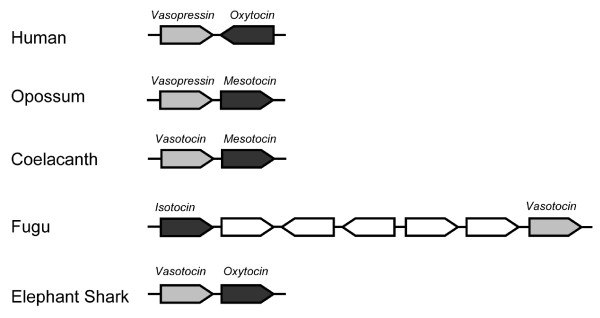
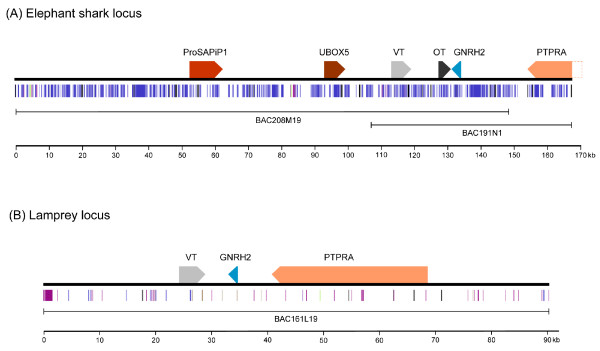
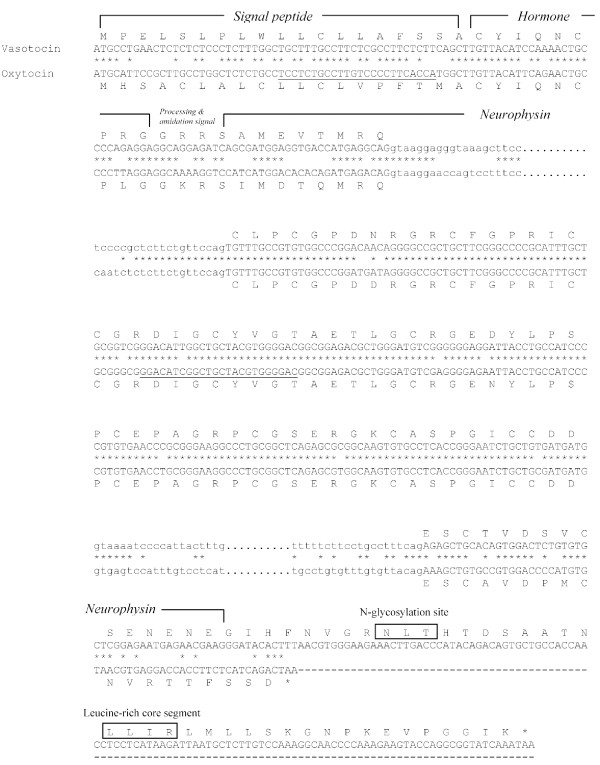
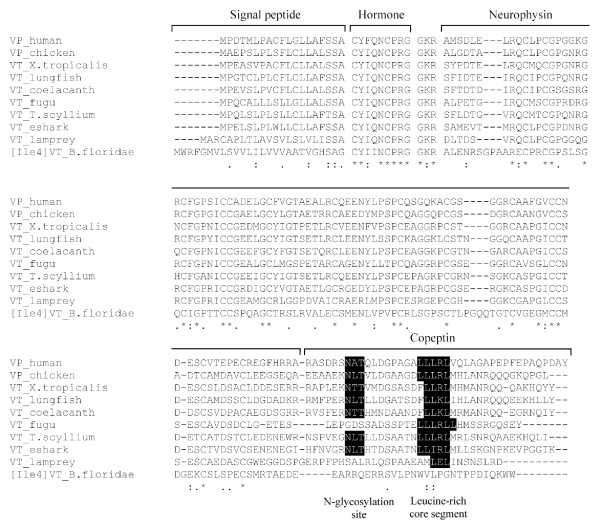
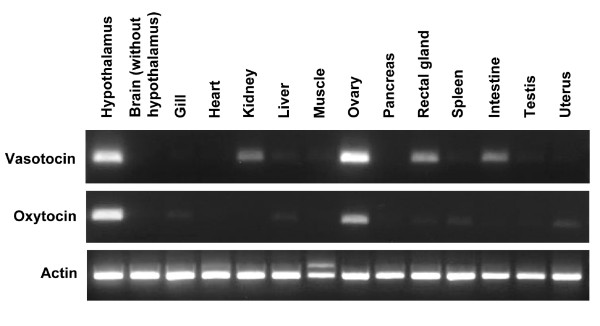
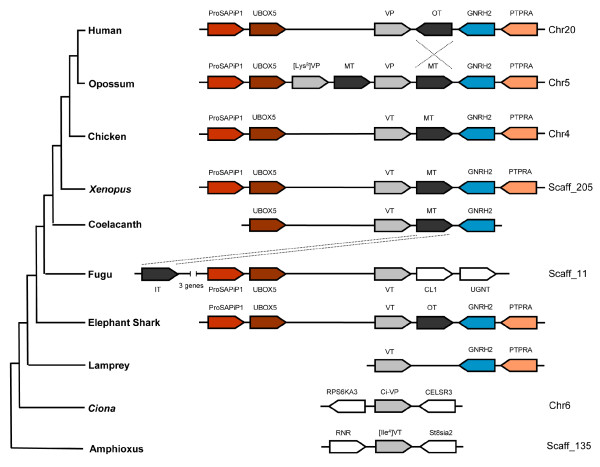
BACKGROUND: Vasopressin and oxytocin are mammalian neurohypophysial hormones with distinct functions. Vasopressin is involved mainly in osmoregulation and oxytocin is involved primarily in parturition and lactation. Jawed vertebrates contain at least one homolog each of vasopressin and oxytocin, whereas only a vasopressin-family hormone, vasotocin, has been identified in jawless vertebrates. The genes encoding vasopressin and oxytocin are closely linked tail-to-tail in eutherian mammals whereas their homologs in chicken, Xenopus and coelacanth (vasotocin and mesotocin) are linked tail-to-head. In contrast, their pufferfish homologs, vasotocin and isotocin, are located on the same strand of DNA with isotocin located upstream of vasotocin and separated by five genes. These differences in the arrangement of the two genes in different bony vertebrate lineages raise questions about their origin and ancestral arrangement. To trace the origin of these genes, we have sequenced BAC clones from the neurohypophysial gene loci in a cartilaginous fish, the elephant shark (Callorhinchus milii), and in a jawless vertebrate, the Japanese lamprey (Lethenteron japonicum). We have also analyzed the neurohypophysial hormone gene locus in an invertebrate chordate, the amphioxus (Branchiostoma floridae). RESULTS: The elephant shark neurohypophysial hormone genes encode vasotocin and oxytocin, and are linked tail-to-head like their homologs in coelacanth and non-eutherian tetrapods. Besides the hypothalamus, the two genes are also expressed in the ovary. In addition, the vasotocin gene is expressed in the kidney, rectal gland and intestine. These expression profiles indicate a paracrine role for the two hormones. The lamprey locus contains a single neurohypophysial hormone gene, the vasotocin. The synteny of genes in the lamprey locus is conserved in elephant shark, coelacanth and tetrapods but disrupted in teleost fishes. The amphioxus locus encodes a single neurohypophysial hormone, designated as [Ile4]vasotocin. CONCLUSION: The vasopressin- and oxytocin-family of neurohypophysial hormones evolved in a common ancestor of jawed vertebrates through tandem duplication of the ancestral vasotocin gene. The duplicated genes were linked tail-to-head like their homologs in elephant shark, coelacanth and non-eutherian tetrapods. In contrast to the conserved linkage of the neurohypophysial genes in these vertebrates, the neurohypophysial hormone gene locus has experienced extensive rearrangements in the teleost lineage.
Overview
The claims and statistics of this paper haven’t been checked yet.
Run the check — free, no account needed. It reads the open-access text and checks the sources it cites.
Integrity signals
Registry
Cites
Statistics
Figures
Verification
Claims the paper makes
The claims and statistics of this paper haven’t been checked yet.
Run the check — free, no account needed. It reads the open-access text and checks the sources it cites.
Self-check
Percentages, sums and reported differences re-computed from the paper’s own numbers.
The self-check needs the paper’s full text.
Citations
Cites
Thompson, J. (1997) · Nucleic Acids Research · doi:10.1093/nar/25.24.4876 · Cited by 38,685
The Physiology of Reproduction
Legendre, M., & Jalabert, B. (1988) · Annals of Internal Medicine · doi:10.7326/0003-4819-109-2-176_1 · Cited by 7,876
The oxytocin receptor system: structure, function, and regulation
Gimpl, G., & Fahrenholz, F. (2001) · Physiological Reviews · doi:10.1152/physrev.2001.81.2.629 · Cited by 3,089
Jaillon, O., Aury, J.-M., Brunet, F., Petit, J.-L., Stange-Thomann, N., Mauceli, E., Bouneau, L., Fischer, C., Ozouf-Costaz, C., Bernot, A., et al. (2004) · Nature · doi:10.1038/nature03025 · Cited by 1,966
The amphioxus genome and the evolution of the chordate karyotype
Putnam, N. H., Butts, T., Ferrier, D. E. K., Furlong, R. F., Hellsten, U., Kawashima, T., Robinson‐Rechavi, M., Shoguchi, E., Terry, A., Yu, J., et al. (2008) · Nature · doi:10.1038/nature06967 · Cited by 1,595
The genome of the model beetle and pest Tribolium castaneum
Richards, S., Gibbs, R. A., Weinstock, G. M., Gibbs, R. A., Muzny, D. M., Attaway, T., Bell, S., Buhay, C., Chandrabose, M. N., Chavez, D., et al. (2008) · Nature · doi:10.1038/nature06784 · Cited by 1,378
Predictive Identification of Exonic Splicing Enhancers in Human Genes
Fairbrother, W. G., Yeh, R., Sharp, P. A., & Burge, C. B. (2002) · Science · doi:10.1126/science.1073774 · Cited by 1,020
(1971) · Annals of Internal Medicine · doi:10.7326/0003-4819-75-4-654_2 · Cited by 720
Christoffels, A. G., Koh, E. G. L., Chia, J.-M., Brenner, S., Aparicio, S. A. J. R., & Venkatesh, B. (2004) · Molecular Biology and Evolution · doi:10.1093/molbev/msh114 · Cited by 546
Self-citationLi, B., Predel, R., Neupert, S., Hauser, F., Tanaka, Y., Cazzamali, G., Williamson, M. P., Arakane, Y., Verleyen, P., Schoofs, L., et al. (2007) · Genome Research · doi:10.1101/gr.6714008 · Cited by 370
Survey Sequencing and Comparative Analysis of the Elephant Shark (Callorhinchus milii) Genome
Venkatesh, B., Kirkness, E. F., Loh, Y. E., Halpern, A. L., Lee, A., Johnson, J. H., Dandona, N., Viswanathan, L., Tay, A., Venter, J. C., et al. (2007) · PLoS Biology · doi:10.1371/journal.pbio.0050101 · Cited by 315
Self-citationRapidly evolving fish genomes and teleost diversity
Ravi, V., & Venkatesh, B. (2008) · Current Opinion in Genetics & Development · doi:10.1016/j.gde.2008.11.001 · Cited by 287
Self-citationIdentification of an arginine vasopressin-like diuretic hormone from Locustamigratoria
Proux, J. P., Miller, C. A., Li, J. P., Carney, R. L., Girardie, A., DELAAGE, M. A., & Schooley, D. A. (1987) · Biochemical and Biophysical Research Communications · doi:10.1016/0006-291x(87)91621-4 · Cited by 220
Cruz, L. J., de Santos, V., Zafaralla, G. C., Ramilo, C. A., Zeikus, R. D., Gray, W. R., & Olivera, B. M. (1987) · Journal of Biological Chemistry · doi:10.1016/s0021-9258(18)47661-2 · Cited by 218
Neuropeptide families and their receptors: evolutionary perspectives
Hoyle, C. H. V. (1999) · Brain Research · doi:10.1016/s0006-8993(99)01975-7 · Cited by 198
Ruppert, S., Scherer, G., & Schütz, G. (1984) · Nature · doi:10.1038/308554a0 · Cited by 185
Cloning and identification of an oxytocin/vasopressin-like receptor and its ligand from insects
Stafflinger, E., Hansen, K. K., Hauser, F., Schneider, M., Cazzamali, G., Williamson, M. P., & Grimmelikhuijzen, C. J. P. (2008) · Proceedings of the National Academy of Sciences · doi:10.1073/pnas.0710897105 · Cited by 180
Scales of thelodont and shark-like fishes from the Ordovician of Colorado
Sansom, I. J., Smith, M. M., & Smith, M. M. (1996) · Nature · doi:10.1038/379628a0 · Cited by 141
van Kesteren, R. E., Smit, A. B., Dirks, R. W., de With, N. D., Geraerts, W. P., & Joosse, J. (1992) · Proceedings of the National Academy of Sciences · doi:10.1073/pnas.89.10.4593 · Cited by 120
Mohr, E., Bahnsen, U., Kiessling, C., & Richter, D. (1988) · FEBS Letters · doi:10.1016/0014-5793(88)81003-2 · Cited by 115
Annetocin: An Oxytocin-Related Peptide Isolated from the Earthworm, Eisenia foetida
Oumi, T., Ukena, K., Matsushima, O., IKEDA, T., Fujita, T., Minakata, H., & Nomoto, K. (1994) · Biochemical and Biophysical Research Communications · doi:10.1006/bbrc.1994.1055 · Cited by 109
Young, 3., & Gainer, H. (2003) · Neuroendocrinology · doi:10.1159/000073702 · Cited by 103
Vasopressin and Oxytocin Gene Expression in Rat Testis*
Foo, N.-C., Carter, D., Murphy, D., & Ivell, R. (1991) · Endocrinology · doi:10.1210/endo-128-4-2118 · Cited by 86
Modern look for ancient lamprey
Janvier, P. (2006) · Nature · doi:10.1038/443921a · Cited by 85
Salzet, M., Bulet, P., DORSSELAER, A. V., & Malecha, J. (1993) · European Journal of Biochemistry · doi:10.1111/j.1432-1033.1993.tb18319.x · Cited by 84
Takuwa‐Kuroda, K., Ukena, K., Kanda, A., & Minakata, H. (2003) · Regulatory Peptides · doi:10.1016/s0167-0115(03)00151-4 · Cited by 75
Reich, G. (1992) · Neuroscience Letters · doi:10.1016/0304-3940(92)90514-8 · Cited by 74
Kawada, T., Sekiguchi, T., Itoh, Y., Ogasawara, M., & Satake, H. (2008) · Peptides · doi:10.1016/j.peptides.2008.05.030 · Cited by 71
Heierhorst, J., Lederis, K. P., & Richter, D. (1992) · Proceedings of the National Academy of Sciences · doi:10.1073/pnas.89.15.6798 · Cited by 66
Neurohypophysial hormones of dogfish, Triakis scyllium: structures and salinity-dependent secretion
Hyodo, S., Tsukada, T., & Takei, Y. (2004) · General and Comparative Endocrinology · doi:10.1016/j.ygcen.2004.05.009 · Cited by 59
Gwee, P.-C., Amemiya, C. T., Brenner, S., & Venkatesh, B. (2008) · BMC Evolutionary Biology · doi:10.1186/1471-2148-8-93 · Cited by 57
Self-citationA compact cartilaginous fish model genome
Venkatesh, B., Tay, A., Dandona, N., Patil, J. G., & Brenner, S. (2005) · Current Biology · doi:10.1016/j.cub.2005.01.021 · Cited by 53
Self-citationUnique Form and Osmoregulatory Function of a Neurohypophysial Hormone in a Urochordate
Ukena, K., Ukena, K., & Hikosaka, A. (2008) · Endocrinology · doi:10.1210/en.2008-0607 · Cited by 52
Suzuki, M., Kubokawa, K., Nagasawa, H., & Urano, A. (1995) · Journal of Molecular Endocrinology · doi:10.1677/jme.0.0140067 · Cited by 49
Isolation of Lys-conopressin-G from the venom of the worm-hunting snail, Conus imperialis
Nielsen, D. B., Dykert, J., Rivier, J. E., & McIntosh, J. M. (1994) · Toxicon · doi:10.1016/0041-0101(94)90009-4 · Cited by 49
Lane, T. F., Sower, S. A., & Kawauchi, H. (1988) · General and Comparative Endocrinology · doi:10.1016/0016-6480(88)90104-9 · Cited by 41
In Vivo Gene Transfer Studies on the Regulation and Function of the Vasopressin and Oxytocin Genes
Murphy, D., & Wells, S. E. (2003) · Journal of Neuroendocrinology · doi:10.1046/j.1365-2826.2003.00964.x · Cited by 38
Fields, R. L., House, S. B., & Gainer, H. (2003) · Journal of Neuroscience · doi:10.1523/jneurosci.23-21-07801.2003 · Cited by 36
Hyodo, S., Bell, J. D., Healy, J. M., Kaneko, T., Hasegawa, S., Takei, Y., Donald, J. A., & Toop, T. (2007) · Journal of Experimental Biology · doi:10.1242/jeb.003418 · Cited by 32
Regulation of interrenal gland steroidogenesis in the Atlantic stingray (Dasyatis sabina)
Nunez, S., & Trant, J. M. (1999) · Journal of Experimental Zoology · doi:10.1002/(sici)1097-010x(19991001)284:5 · Cited by 32
McMaster, D., Kobayashi, Y., & Lederis, K. P. (1992) · Peptides · doi:10.1016/0196-9781(92)90069-f · Cited by 29
Davies, J., Waller, S., Zeng, Q., Wells, S. E., & Murphy, D. (2003) · Journal of Neuroendocrinology · doi:10.1046/j.1365-2826.2003.00865.x · Cited by 25
van Kesteren, R. E., Smit, A. B., de With, N. D., van Minnen, J., Dirks, R. W., van der Schors, R. C., & JOOSSE, J. (1992) · Progress in brain research · doi:10.1016/s0079-6123(08)61164-4 · Cited by 23
Identification of Vasopressin mRNA in Rat Aorta
Simon, J. S., & Kasson, B. G. (1995) · Hypertension · doi:10.1161/01.hyp.25.5.1030 · Cited by 19
Michel, G., Chauvet, J., Chauvet, M. T., Clarke, C., Bern, H. A., & Acher, R. (1993) · General and Comparative Endocrinology · doi:10.1006/gcen.1993.1162 · Cited by 15
Méchaly, I., Macari, F., Lautier, C., Serrano, J., Cros, G. H., & Grigorescu, F. (1998) · European Journal of Endocrinology · doi:10.1530/eje.0.1390123 · Cited by 10
Research works printed but not linked: 1
- Bell JD: Fisheries and reproductive biology of the elephant fish (Callorhinchus milii) in southern Australia. Honours Thesis. 2003, Warnnambool, Victoria, Australia Deakin University
Cited by
Sorted by citations
Oxytocin, Neural Plasticity, and Social Behavior
Froemke, R. C., & Young, L. J. (2021) · Annual Review of Neuroscience · doi:10.1146/annurev-neuro-102320-102847 · Cited by 480
“Oxytocin and vasopressin peptides likewise derive from a common ancestral gene via duplication (Gwee et al. 2009) and transposition (Theofanopoulou et al. 2020) around the same time.”
BackgroundEvolution of neuropeptide signalling systems
Elphick, M. R., Mirabeau, O., & Larhammar, D. (2018) · Journal of Experimental Biology · doi:10.1242/jeb.151092 · Cited by 264
Evolution of GnRH: Diving deeper
Roch, G. J., Busby, E. R., & Sherwood, N. M. (2011) · General and Comparative Endocrinology · doi:10.1016/j.ygcen.2010.12.014 · Cited by 225
An Allostatic Theory of Oxytocin
Quintana, D. S., & Guastella, A. J. (2020) · Trends in Cognitive Sciences · doi:10.1016/j.tics.2020.03.008 · Cited by 223
The gonadotropin-releasing hormones: Lessons from fish
Muñoz‐Cueto, J. A., Zmora, N., Paullada‐Salmerón, J. A., Marvel, M., Mañanós, E. L., & Zohar, Y. (2020) · General and Comparative Endocrinology · doi:10.1016/j.ygcen.2020.113422 · Cited by 147
Metadata
- Authors
- Gwee, P.-C., Tay, B.-H., Brenner, S., & Venkatesh, B.
- Affiliations
- Agency for Science, Technology and Research (SG)
- Corresponding author
- Venkatesh, Byrappa
- ORCID
- Venkatesh, Byrappa
- Venue
- BMC Evolutionary Biology
- Published
- 2009-02-26
- Volume
- 9
- Issue
- 1
- Pages
- 47-47
- ISSN
- 1471-2148 (ISSN-L)
- PMC
- PMC2656470
- OpenAlex
- W2166928111
- Cited by
- 109
- References
- 46
- Citations by year
- 2026: 2 · 2025: 4 · 2024: 4 · 2023: 7 · 2022: 10 · 2021: 11 · 2020: 10 · 2019: 2 · 2018: 5 · 2017: 1 · 2016: 7 · 2015: 7 · 2014: 3 · 2013: 10 · 2012: 9
- FWCI
- 10.84
- Type
- journal article
- Language
- en
- Open access
- gold
- doi.org
- Licence
- cc-by
- Locations
- BMC Evolutionary Biology (publishedVersion, cc-by)
- PubMed Central (publishedVersion, cc-by)
- PubMed (publishedVersion)
- National University of Singapore (submittedVersion, cc-by)
- DOAJ (DOAJ: Directory of Open Access Journals) (submittedVersion, cc-by-sa)
- Funders
- Agency for Science, Technology and Research
- National University of Singapore
- Biomedical Research Council
- Topics
- Life Sciences › Neuroscience › Endocrine and Autonomic Systems › Neuroendocrine regulation and behavior
- Life Sciences › Biochemistry, Genetics and Molecular Biology › Molecular Biology › Developmental Biology and Gene Regulation
- Life Sciences › Neuroscience › Cellular and Molecular Neuroscience › Neuropeptides and Animal Physiology
- Keywords
- neurohypophyseal hormones, arginine vasotocin, oxytocin, vasopressin, elephant shark, Callorhinchus milii, Lethenteron japonicum, amphioxus, Branchiostoma floridae, synteny, gene duplication
- MeSH terms
- Amino Acid Sequence, Animals, Base Sequence, Cloning, Molecular, Lampreys, Molecular Sequence Data, Oxytocin, Pituitary Hormones, Posterior, Sharks, Vasotocin, Sequence Alignment, Conserved Sequence, Sequence Analysis, DNA, Evolution, Molecular, Gene Duplication, Gene Expression Profiling, Synteny, Chordata
About these checks
Registry, retraction, Cites and statistics results are computed, not judged, with one exception: a printed reference that no index lists is read once by a model before it counts as a citation error. Claims are extracted by a model and kept only when their quote appears verbatim in the text; each cited source is then checked, with a model’s help, for whether it says what the claim relies on. Those verdicts can be wrong — read the claim’s quote and the cited source before relying on one.
Statistics and arithmetic are recomputed, not judged.
Confidence bands are shown only for fields calibrated on our annotated test set. None is calibrated yet, so no band is shown.
What counts as a claim ›How we measure confidence ›How we check this ›
Are you an author, or do you see a problem with this page? Request a review
