

The DOI matches its Crossref record; 75 of the 75 references it cites were found in a registry or an index.
Gut microbiota dysbiosis and bacterial community assembly associated with cholesterol gallstones in large-scale study
Open accessAbstract
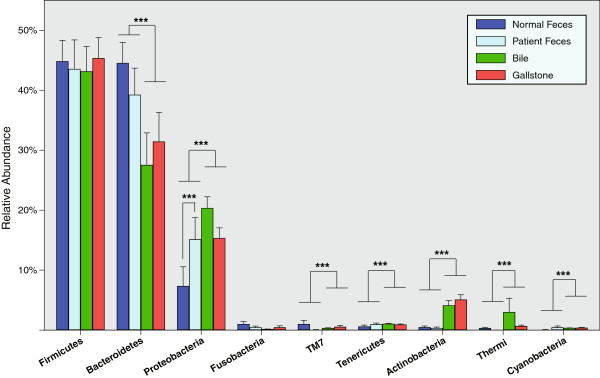
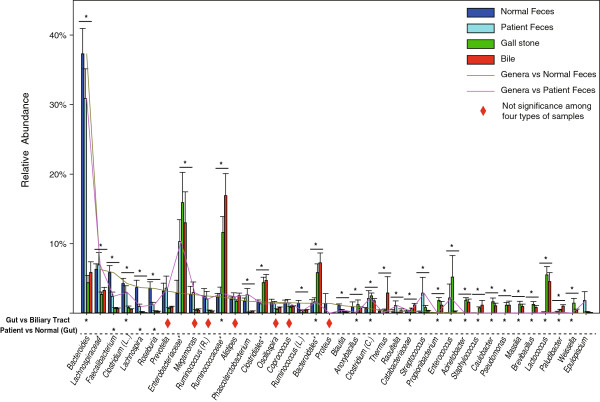
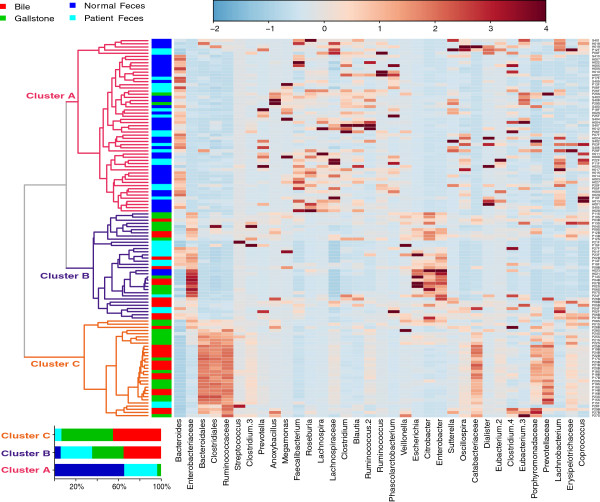
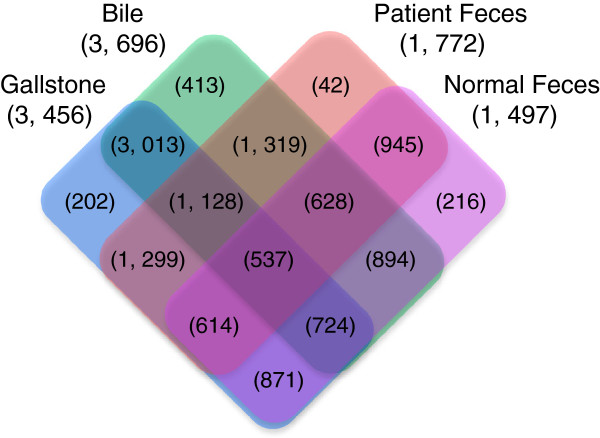
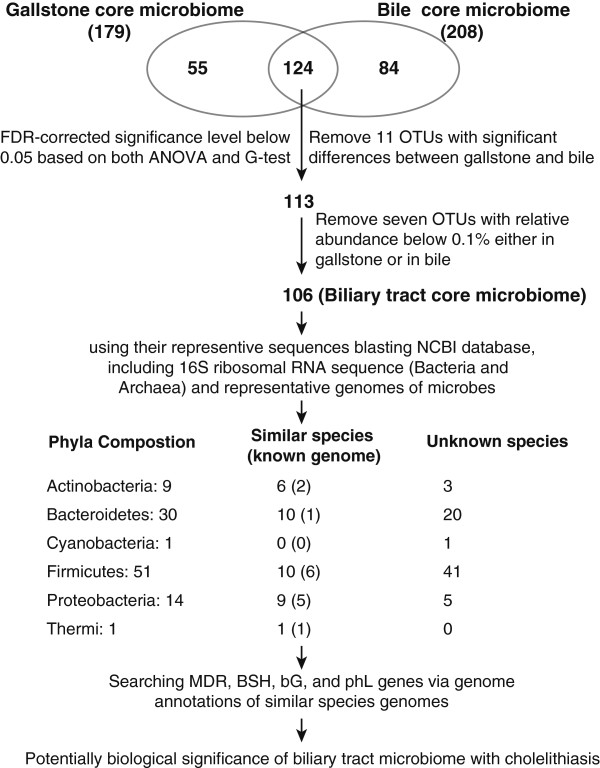
BACKGROUND: Elucidating gut microbiota among gallstone patients as well as the complex bacterial colonization of cholesterol gallstones may help in both the prediction and subsequent lowered risk of cholelithiasis. To this end, we studied the composition of bacterial communities of gut, bile, and gallstones from 29 gallstone patients as well as the gut of 38 normal individuals, examining and analyzing some 299, 217 bacterial 16S rRNA gene sequences from 120 samples. RESULTS: First, as compared with normal individuals, in gallstone patients there were significant (P < 0.001) increases of gut bacterial phylum Proteobacteria and decreases of three gut bacterial genera, Faecalibacterium, Lachnospira, and Roseburia. Second, about 70% of gut bacterial operational taxonomic units (OTUs) from gallstone patients were detectable in the biliary tract and bacteria diversity of biliary tract was significantly (P < 0.001) higher than that of gut. Third, analysis of the biliary tract core microbiome (represented by 106 bacteria OTUs) among gallstone patients showed that 33.96% (36/106) of constituents can be matched to known bacterial species (15 of which have publicly available genomes). A genome-wide search of MDR, BSH, bG, and phL genes purpotedly associated with the formation of cholesterol gallstones showed that all 15 species with known genomes (e.g., Propionibacterium acnes, Bacteroides vulgates, and Pseudomonas putida) contained at least contained one of the four genes. This finding could potentially provide underlying information needed to explain the association between biliary tract microbiota and the formation of cholesterol gallstones. CONCLUSIONS: To the best of our knowledge, this is the first study to discover gut microbiota dysbiosis among gallstone patients, the presence of which may be a key contributor to the complex bacteria community assembly linked with the presence of cholesterol gallstones. Likewise, this study also provides the first large-scale glimpse of biliary tract microbiota potentially associated with cholesterol gallstones. Such a characterization of the biliary tract core microbiome has potentially important biological and medical implications regarding the role of bacteria in the formation cholesterol gallstones.
Overview
The claims and statistics of this paper haven’t been checked yet.
Run the check — free, no account needed. It reads the open-access text and checks the sources it cites.
Integrity signals
Registry
Cites
Statistics
Figures
Verification
Claims the paper makes
The claims and statistics of this paper haven’t been checked yet.
Run the check — free, no account needed. It reads the open-access text and checks the sources it cites.
Claims other papers make about this one
Each is checked against this paper’s own text: does it say what the citing paper says it does?
In the citing paper
“Decrease in Lachnospira abundance was recently highlighted in the gut microbiota of subjects with cholesterol gallstones 62 as well as in the rectal mucosa of patients with HIV, 63”
From High-level adherence to a Mediterranean diet beneficially impacts the gut microbiota and associated metabolome (2016) · cites this paper as [62]
Self-check
Percentages, sums and reported differences re-computed from the paper’s own numbers.
The self-check needs the paper’s full text.
Citations
Cites
QIIME allows analysis of high-throughput community sequencing data
Caporaso, J. G., Kuczynski, J., Stombaugh, J., Bittinger, K., Bushman, F. D., Costello, E. K., Fierer, N., Peña, A. G., Goodrich, J. K., Gordon, J. I., et al. (2010) · Nature Methods · doi:10.1038/nmeth.f.303 · Cited by 34,887
Naive Bayesian Classifier for Rapid Assignment of rRNA Sequences into the New Bacterial Taxonomy
Wang, Q., Garrity, G. M., Tiedje, J. M., & Cole, J. R. (2007) · Applied and Environmental Microbiology · doi:10.1128/aem.00062-07 · Cited by 20,145
A human gut microbial gene catalogue established by metagenomic sequencing
MetaHIT Consortium, Qin, J., Li, R., Raes, J., Arumugam, M., Burgdorf, K. S., Manichanh, C., Nielsen, T., Pons, N., Levenez, F., et al. (2010) · Nature · doi:10.1038/nature08821 · Cited by 11,624
Diversity of the Human Intestinal Microbial Flora
Eckburg, P. B., Bik, E. M., Bernstein, C. N., Purdom, E., Dethlefsen, L., Sargent, M., Gill, S. R., Nelson, K. E., & Relman, D. A. (2005) · Science · doi:10.1126/science.1110591 · Cited by 7,913
Enterotypes of the human gut microbiome
MetaHIT Consortium (additional members), Arumugam, M., Raes, J., Pelletier, E., Le Paslier, D., Yamada, T., Mende, D. R., Fernandes, G. R., Tap, J., Bruls, T., et al. (2011) · Nature · doi:10.1038/nature09944 · Cited by 7,548
A metagenome-wide association study of gut microbiota in type 2 diabetes
Qin, J., Li, Y., Cai, Z., Li, S., Zhu, J., Zhang, F., Liang, S., Zhang, W., Guan, Y., Shen, D., et al. (2012) · Nature · doi:10.1038/nature11450 · Cited by 6,762
Self-citationGut microbiota in health and disease
Sekirov, I., Russell, S. L., Antunes, L. C. M., & Finlay, B. B. (2010) · Physiological Reviews · doi:10.1152/physrev.00045.2009 · Cited by 4,182
Bacterial Community Variation in Human Body Habitats Across Space and Time
Costello, E. K., Lauber, C. L., Hamady, M., Fierer, N., Gordon, J. I., & Knight, R. (2009) · Science · doi:10.1126/science.1177486 · Cited by 3,231
Lozupone, C., Hamady, M., Kelley, S. T., & Knight, R. D. (2007) · Applied and Environmental Microbiology · doi:10.1128/aem.01996-06 · Cited by 2,717
Inflammasome-mediated dysbiosis regulates progression of NAFLD and obesity
Henao-Mejia, J., Elinav, E., Jin, C., Hao, L., Mehal, W. Z., Strowig, T., Thaiss, C. A., Kau, A. L., Eisenbarth, S. C., Jurczak, M. J., et al. (2012) · Nature · doi:10.1038/nature10809 · Cited by 2,435
Cited by
Sorted by citations
De Filippis, F., Pellegrini, N., Vannini, L., Jeffery, I. B., La Storia, A., Laghi, L., Serrazanetti, D. I., Di Cagno, R., Ferrocino, I., Lazzi, C., et al. (2016) · Gut · doi:10.1136/gutjnl-2015-309957 · Cited by 1,638
Lammert, F., Gurusamy, K., Ko, C. W., Miquel, J.-F., Méndez-Sánchez, N., Portincasa, P., van Erpecum, K. J., van Laarhoven, C. J., & Wang, D. Q.-H. (2016) · Nature Reviews Disease Primers · doi:10.1038/nrdp.2016.24 · Cited by 822
Roseburia Spp.: A Marker of Health?
Tamanai‐Shacoori, Z., Smida, I., Bousarghin, L., Loréal, O., Meuric, V., Fong, S. B., Bonnaure‐Mallet, M., & Jolivet‐Gougeon, A. (2017) · Future Microbiology · doi:10.2217/fmb-2016-0130 · Cited by 767
Akkermansia muciniphila in the Human Gastrointestinal Tract: When, Where, and How?
Geerlings, S. Y., Kostopoulos, I., de Vos, W. M., & Belzer, C. (2018) · Microorganisms · doi:10.3390/microorganisms6030075 · Cited by 465
Application of metagenomics in the human gut microbiome
Wang, W., Xu, S., Ren, Z., Tao, L., Jiang, J., & Zheng, S. (2015) · World Journal of Gastroenterology · doi:10.3748/wjg.v21.i3.803 · Cited by 419
Metadata
- Authors
- Wu, T., Zhang, Z., Liu, B., Hou, D., Liang, Y., Zhang, J., & Shi, P.
- Affiliations
- Kunming Institute of Zoology (CN)
- First Affiliated Hospital of Kunming Medical University (CN)
- Kunming Medical University (CN)
- Corresponding author
- Zhang, Jie
- Shi, Peng
- Venue
- BMC Genomics
- Published
- 2013-10-01
- Volume
- 14
- Issue
- 1
- Pages
- 669-669
- ISSN
- 1471-2164 (ISSN-L)
- PMC
- PMC3851472
- OpenAlex
- W2116463764
- Cited by
- 234
- References
- 74
- Citations by year
- 2026: 13 · 2025: 20 · 2024: 29 · 2023: 29 · 2022: 29 · 2021: 29 · 2020: 19 · 2019: 17 · 2018: 15 · 2017: 10 · 2016: 12 · 2015: 9 · 2014: 3
- FWCI
- 3.58
- Type
- journal article
- Language
- en
- Open access
- gold
- doi.org
- Licence
- cc-by
- Locations
- BMC Genomics (publishedVersion, cc-by)
- Europe PMC (PubMed Central) (publishedVersion, cc-by)
- PubMed Central (publishedVersion, cc-by)
- PubMed (publishedVersion)
- Funders
- National Natural Science Foundation of China (31100916)
- Chinese Academy of Sciences
- Natural Science Foundation of Yunnan Province
- Institute of Zoology, Chinese Academy of Sciences
- Kunming Institute of Zoology, Chinese Academy of Sciences
- Topics
- Life Sciences › Biochemistry, Genetics and Molecular Biology › Molecular Biology › Gut microbiota and health
- Health Sciences › Medicine › Gastroenterology › Gallbladder and Bile Duct Disorders
- Physical Sciences › Environmental Science › Ecology › Microbial Community Ecology and Physiology
- Keywords
- cholesterol gallstones, gallstones, gut dysbiosis, bacterial community assembly, Proteobacteria, Faecalibacterium, Lachnospira, Roseburia, MDR genes
- MeSH terms
- Bacteria, Biliary Tract, Cholesterol, Female, Humans, Male, Middle Aged, Phylogeny, Gastrointestinal Tract, Gallstones, Metagenomics, Microbiota, Dysbiosis
About these checks
Registry, retraction, Cites and statistics results are computed, not judged, with one exception: a printed reference that no index lists is read once by a model before it counts as a citation error. Claims are extracted by a model and kept only when their quote appears verbatim in the text; each cited source is then checked, with a model’s help, for whether it says what the claim relies on. Those verdicts can be wrong — read the claim’s quote and the cited source before relying on one.
Statistics and arithmetic are recomputed, not judged.
Confidence bands are shown only for fields calibrated on our annotated test set. None is calibrated yet, so no band is shown.
What counts as a claim ›How we measure confidence ›How we check this ›
Are you an author, or do you see a problem with this page? Request a review
