

The DOI matches its Crossref record; 52 of the 53 references it cites were found in a registry or an index.
Are women better mindreaders? Sex differences in neural correlates of mentalizing detected with functional MRI
Open accessAbstract
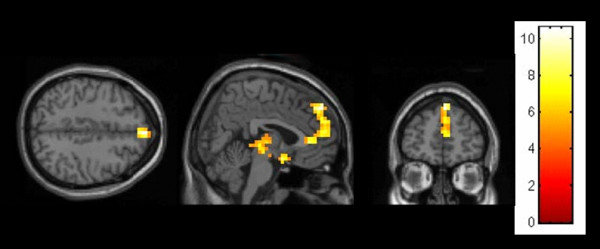
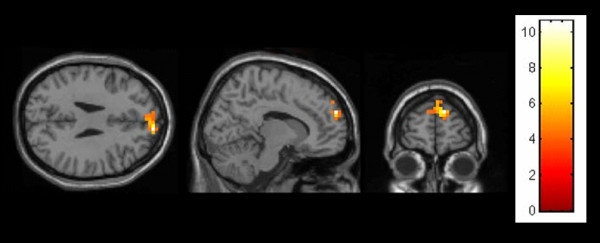
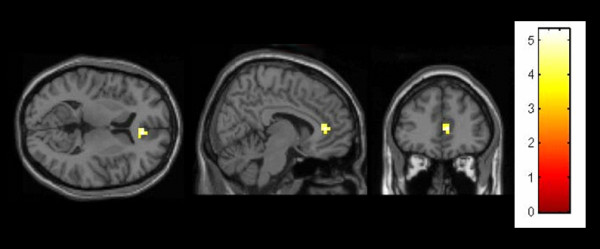
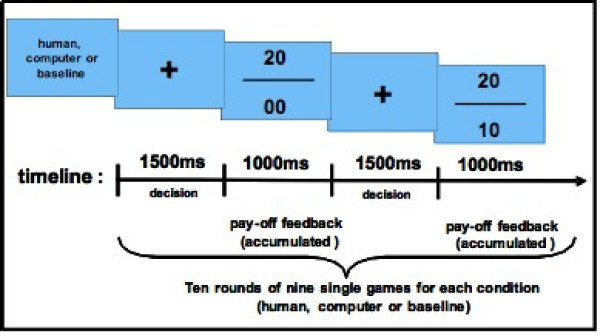
BACKGROUND: The ability to mentalize, i.e. develop a Theory of Mind (ToM), enables us to anticipate and build a model of the thoughts, emotions and intentions of others. It has long been hypothesised that women differ from men in their mentalizing abilities. In the present fMRI study we examined the impact of (1) gender (women vs. men) and (2) game partner (human vs. computer) on ToM associated neural activity in the medial prefrontal cortex. Groups of men (n = 12) and women (n = 12) interacted in an iterated classical prisoner's dilemma forced choice situation with alleged human and computer partners who were outside the scanner. RESULTS: Both the conditions of playing against putative human as well as computer partners led to activity increases in mPFC, ACC and rTPJ, constituting the classic ToM network. However, mPFC/ACC activity was more pronounced when participants believed they were playing against the alleged human partner. Differences in the medial frontal lobe activation related to the sex of the participants could be demonstrated for the human partner > computer partner contrast. CONCLUSION: Our data demonstrate differences in medial prefrontal brain activation during a ToM task depending on both the gender of participants and the game partner.
Overview
The claims and statistics of this paper haven’t been checked yet.
Run the check — free, no account needed. It reads the open-access text and checks the sources it cites.
Integrity signals
Registry
Cites
Statistics
Figures
Verification
Claims the paper makes
The claims and statistics of this paper haven’t been checked yet.
Run the check — free, no account needed. It reads the open-access text and checks the sources it cites.
Claims other papers make about this one
Each is checked against this paper’s own text: does it say what the citing paper says it does?
The source backs part of the claim, not all of it — or backs it for a different population, condition or comparison.
In the citing paper
“Furthermore, studies of sex differences in social cognition have mainly focused on emotional expression perception and mental state reasoning with little emphasis placed on imitation (Krach et al., 2009;Russell, Tchanturia, Rahman, & Schmidt, 2007;Rahman, Wilson, & Abrahams, 2004;Campbell et al., 2002;Thayer & Johnsen, 2000).”
From Functional Specificity and Sex Differences in the Neural Circuits Supporting the Inhibition of Automatic Imitation (2018) · cites this paper as Krach et al., 2009
Experimental — accuracy not yet measured
Self-check
Percentages, sums and reported differences re-computed from the paper’s own numbers.
The self-check needs the paper’s full text.
Citations
Cites
The assessment and analysis of handedness: The Edinburgh inventory
Oldfield, R. C. (1971) · Neuropsychologia · doi:10.1016/0028-3932(71)90067-4 · Cited by 35,900
Co-Planar Stereotaxic Atlas of the Human Brain
Talairach, J., & Tournoux, P. (1988) · Medical Entomology and Zoology · Cited by 11,798
Does the chimpanzee have a theory of mind?
Premack, D., & Woodruff, G. (1978) · Behavioral and Brain Sciences · doi:10.1017/s0140525x00076512 · Cited by 8,743
Co-planar stereotaxic atlas of the human brain
Laitinen, L. (1989) · Clinical Neurology and Neurosurgery · doi:10.1016/0303-8467(89)90128-5 · Cited by 7,565
(1987) · Medical Entomology and Zoology · Cited by 4,269
Frith, C., & Frith, U. (2005) · Current Biology · doi:10.1016/j.cub.2005.08.041 · Cited by 3,561
The Halstead-Reitan neuropsychological test battery: Theory and clinical interpretation
Reitan, R. M., & Wolfson, D. E. (1993) · Medical Entomology and Zoology · Cited by 3,413
The functional architecture of human empathy
Decety, J., & Jackson, P. L. (2004) · Behavioral and Cognitive Neuroscience Reviews · doi:10.1177/1534582304267187 · Cited by 3,407 · cited 1×
“Empathy describes the sensitive perception of feelings and emotions of others [1], while Theory-of-Mind refers to the more cognitive aspect of inferring intentions, goals or desires of others [2].”
BackgroundPeople thinking about thinking peopleThe role of the temporo-parietal junction in “theory of mind”
Saxe, R., & Kanwisher, N. (2003) · NeuroImage · doi:10.1016/s1053-8119(03)00230-1 · Cited by 2,316 · cited 10×
“Parameter estimates extracted at the local maximum activation in the ACC region [x = 8, y = 39, z = 5] neither correlated with pay-off outcomes during the human-computer nor during the human-human interaction (rhuman-computer = .07; p > .05; rhuman-human = .26; p > .05).”
BackgroundInfluentialDevelopment and neurophysiology of mentalizing
Frith, U., & Frith, C. D. (2003) · Philosophical Transactions of the Royal Society of London. Series B: Biological Sciences · doi:10.1098/rstb.2002.1218 · Cited by 2,306
Cited by
Sorted by citations
Fractionating theory of mind: a meta-analysis of functional brain imaging studies
Schurz, M., Radua, J., Aichhorn, M., Richlan, F., & Perner, J. (2014) · Neuroscience & Biobehavioral Reviews · doi:10.1016/j.neubiorev.2014.01.009 · Cited by 1,656
The Neural Bases of Social Cognition and Story Comprehension
Mar, R. A. (2011) · Annual Review of Psychology · doi:10.1146/annurev-psych-120709-145406 · Cited by 950
Schurz, M., Raduà, J., Tholen, M. G., Maliske, L., Margulies, D. S., Mars, R. B., Sallet, J., & Kanske, P. (2020) · Psychological Bulletin · doi:10.1037/bul0000303 · Cited by 702
Social cognition and the cerebellum: A meta-analysis of over 350 fMRI studies
Overwalle, F. V., Baetens, K., Mariën, P., & Vandekerckhove, M. M. P. (2013) · NeuroImage · doi:10.1016/j.neuroimage.2013.09.033 · Cited by 484
Social cognition and the cerebellum: A meta‐analytic connectivity analysis
Overwalle, F. V., D’aes, T., & Mariën, P. (2015) · Human Brain Mapping · doi:10.1002/hbm.23002 · Cited by 220
Metadata
- Authors
- Krach, S., Blümel, I., Marjoram, D., Lataster, T., Krabbendam, L., Weber, J., van Os, J., & Kircher, T.
- Affiliations
- Philipps University of Marburg (DE)
- Universitätsklinikum Aachen (DE)
- University of Glasgow (GB)
- Maastricht University (NL)
- Columbia University (US)
- Corresponding author
- Krach, Sören
- Venue
- BMC Neuroscience
- Published
- 2009-02-04
- Volume
- 10
- Issue
- 1
- Pages
- 9-9
- ISSN
- 1471-2202 (ISSN-L)
- PMC
- PMC2667181
- OpenAlex
- W2031956151
- Cited by
- 101
- References
- 53
- Citations by year
- 2025: 4 · 2024: 7 · 2023: 9 · 2022: 1 · 2021: 9 · 2020: 8 · 2019: 3 · 2018: 9 · 2017: 6 · 2016: 9 · 2015: 6 · 2014: 4 · 2013: 7 · 2012: 8
- FWCI
- 11.13
- Type
- journal article
- Language
- en
- Open access
- gold
- doi.org
- Licence
- Locations
- BMC Neuroscience (publishedVersion, cc-by)
- PubMed Central (publishedVersion, cc-by)
- PubMed (publishedVersion)
- VU Research Portal (publishedVersion, other-oa)
- Digital Academic REpository of VU University Amsterdam (Vrije Universiteit Amsterdam) (submittedVersion)
- DOAJ (DOAJ: Directory of Open Access Journals) (submittedVersion, cc-by-sa)
- RWTH Publications (RWTH Aachen) (submittedVersion, cc-by)
- Data Archiving and Networked Services (DANS) (submittedVersion, other-oa)
- Funders
- Bundesministerium für Bildung und Forschung (01GW0751)
- RWTH Aachen University
- Medizinische Fakultät, RWTH Aachen University
- Topics
- Social Sciences › Psychology › Developmental and Educational Psychology › Child and Animal Learning Development
- Social Sciences › Psychology › Social Psychology › Action Observation and Synchronization
- Life Sciences › Neuroscience › Cognitive Neuroscience › Face Recognition and Perception
- Keywords
- theory of mind, mentalization, sex differences, gender differences, medial prefrontal cortex, anterior cingulate cortex, right temporoparietal junction, human-computer interaction, iterated prisoner's dilemma, social cognition, neural correlates
- MeSH terms
- Adult, Analysis of Variance, Brain, Brain Mapping, Female, Humans, Interpersonal Relations, Magnetic Resonance Imaging, Male, Mental Processes, Surveys and Questionnaires, Reaction Time, Sex Characteristics, Social Perception, User-Computer Interface, Young Adult
About these checks
Registry, retraction, Cites and statistics results are computed, not judged, with one exception: a printed reference that no index lists is read once by a model before it counts as a citation error. Claims are extracted by a model and kept only when their quote appears verbatim in the text; each cited source is then checked, with a model’s help, for whether it says what the claim relies on. Those verdicts can be wrong — read the claim’s quote and the cited source before relying on one.
Statistics and arithmetic are recomputed, not judged.
Confidence bands are shown only for fields calibrated on our annotated test set. None is calibrated yet, so no band is shown.
What counts as a claim ›How we measure confidence ›How we check this ›
Are you an author, or do you see a problem with this page? Request a review
