

The DOI matches its Crossref record; 20 of the 20 references it cites were found in a registry or an index.
Effects of affective picture viewing on postural control.
Open accessAbstract
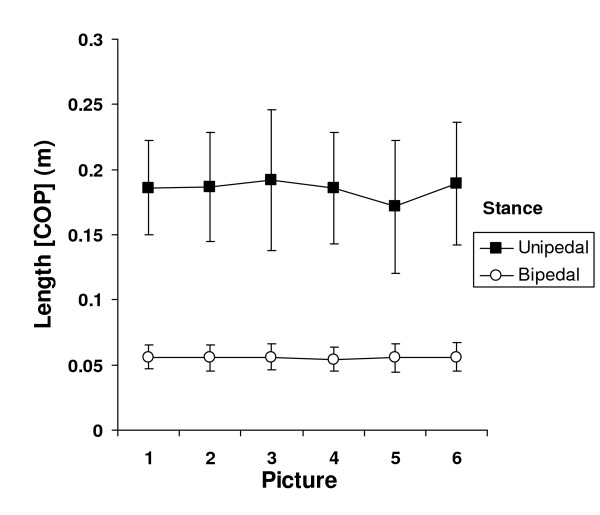
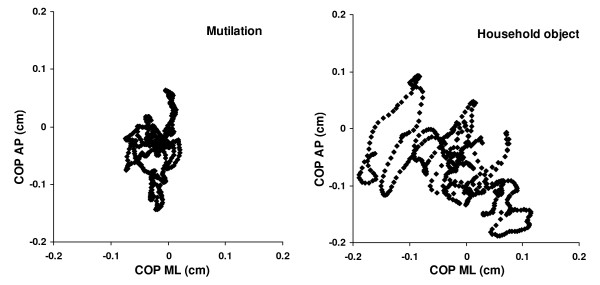
BACKGROUND: Emotion theory holds that unpleasant events prime withdrawal actions, whereas pleasant events prime approach actions. Recent studies have suggested that passive viewing of emotion eliciting images results in postural adjustments, which become manifest as changes in body center of pressure (COP) trajectories. From those studies it appears that posture is modulated most when viewing pictures with negative valence. The present experiment was conducted to test the hypothesis that pictures with negative valence have a greater impact on postural control than neutral or positive ones. Thirty-four healthy subjects passively viewed a series of emotion eliciting images, while standing either in a bipedal or unipedal stance on a force plate. The images were adopted from the International Affective Picture System (IAPS). We analysed mean and variability of the COP and the length of the associated sway path as a function of emotion. RESULTS: The mean position of the COP was unaffected by emotion, but unipedal stance resulted in overall greater body sway than bipedal stance. We found a modest effect of emotion on COP: viewing pictures of mutilation resulted in a smaller sway path, but only in unipedal stance. We obtained valence and arousal ratings of the images with an independent sample of viewers. These subjects rated the unpleasant images as significantly less pleasant than neutral images, and the pleasant images as significantly more pleasant than neutral images. However, the subjects rated the images as overall less pleasant and less arousing than viewers in a closely comparable American study, pointing to unknown differences in viewer characteristics. CONCLUSION: Overall, viewing emotion eliciting images had little effect on body sway. Our finding of a reduction in sway path length when viewing pictures of mutilation was indicative of a freezing strategy, i.e. fear bradycardia. The results are consistent with current knowledge about the neuroanatomical organization of the emotion system and the neural control of behavior.
Overview
The claims and statistics of this paper haven’t been checked yet.
Run the check — free, no account needed. It reads the open-access text and checks the sources it cites.
Integrity signals
Registry
Cites
Statistics
Figures
Verification
Claims the paper makes
The claims and statistics of this paper haven’t been checked yet.
Run the check — free, no account needed. It reads the open-access text and checks the sources it cites.
Self-check
Percentages, sums and reported differences re-computed from the paper’s own numbers.
The self-check needs the paper’s full text.
Citations
Cites
The expression of the emotions in man and animals.
Darwin, C. D. (1872) · J. Murray eBooks · doi:10.1037/10001-000 · Cited by 12,120
(2005) · CTIT technical reports series · Cited by 5,307
The Emotional Brain: The Mysterious Underpinnings of Emotional Life
LeDoux, J. E. (2004) · Medical Entomology and Zoology · Cited by 4,212
Functional architecture of basal ganglia circuits: neural substrates of parallel processing
Alexander, G. E., & Crutcher, M. D. (1990) · Trends in Neurosciences · doi:10.1016/0166-2236(90)90107-l · Cited by 4,131
Alexander, G. E., Crutcher, M. D., & DeLong, M. R. (1990) · PubMed · Cited by 2,422
Emotion and motivation I: Defensive and appetitive reactions in picture processing.
Bradley, M. M., Codispoti, M., Cuthbert, B. N., & Lang, P. J. (2001) · Emotion · doi:10.1037/1528-3542.1.3.276 · Cited by 2,224
(1991) · Progress in Brain Research · doi:10.1016/s0079-6123(08)62678-3 · Cited by 1,961
Emotion, motivation, and anxiety: brain mechanisms and psychophysiology
Lang, P. J., Bradley, M. M., & Cuthbert, B. N. (1998) · Biological Psychiatry · doi:10.1016/s0006-3223(98)00275-3 · Cited by 1,043
Marks, I. M. (1987) · Cited by 978
The Expression of Emotion in Man and Animals
Darwin, C. D. (2020) · Cited by 649
Research works printed but not linked: 1
- Kandel ER, Schwartz JH, Jessell TM: Principles of neuroscience. 2000, New York: McGraw-Hill, 4
Cited by
Sorted by citations
Kozlowska, K., Walker, P., McLean, L., & Carrive, P. (2015) · Harvard Review of Psychiatry · doi:10.1097/hrp.0000000000000065 · Cited by 468
Facing Freeze: Social Threat Induces Bodily Freeze in Humans
Roelofs, K., Hagenaars, M. A., & Stins, J. (2010) · Psychological Science · doi:10.1177/0956797610384746 · Cited by 288
Self-citationUpdating freeze: Aligning animal and human research
Hagenaars, M. A., Oitzl, M., & Roelofs, K. (2014) · Neuroscience & Biobehavioral Reviews · doi:10.1016/j.neubiorev.2014.07.021 · Cited by 260
Mazaheri, M., Coenen, P., Parnianpour, M., Kiers, H., & van Dieën, J. H. (2012) · Gait & Posture · doi:10.1016/j.gaitpost.2012.06.013 · Cited by 154
Fear bradycardia and activation of the human periaqueductal grey
Hermans, E. J., Henckens, M. J. A. G., Roelofs, K., & Fernández, G. (2013) · NeuroImage · doi:10.1016/j.neuroimage.2012.10.063 · Cited by 151
Metadata
- Authors
- Stins, J. F., & Beek, P. J.
- Affiliations
- Amsterdam Movement Sciences (NL)
- Corresponding author
- Stins, John F
- Venue
- BMC Neuroscience
- Published
- 2007-10-04
- Volume
- 8
- Issue
- 1
- Pages
- 83-83
- ISSN
- 1471-2202 (ISSN-L)
- PMC
- PMC2082031
- OpenAlex
- W2141114152
- Cited by
- 114
- References
- 20
- Citations by year
- 2026: 6 · 2025: 8 · 2024: 5 · 2023: 8 · 2022: 3 · 2021: 8 · 2020: 6 · 2019: 4 · 2018: 4 · 2017: 11 · 2016: 8 · 2015: 11 · 2014: 8 · 2013: 8 · 2012: 7
- FWCI
- 2.06
- Type
- journal article
- Language
- en
- Open access
- gold
- doi.org
- Licence
- Locations
- BMC Neuroscience (publishedVersion, cc-by)
- PubMed Central (publishedVersion, cc-by)
- PubMed (publishedVersion)
- VU Research Portal (publishedVersion, other-oa)
- Digital Academic REpository of VU University Amsterdam (Vrije Universiteit Amsterdam) (submittedVersion)
- DOAJ (DOAJ: Directory of Open Access Journals) (submittedVersion, cc-by-sa)
- Data Archiving and Networked Services (DANS) (submittedVersion, other-oa)
- Topics
- Health Sciences › Health Professions › Physical Therapy, Sports Therapy and Rehabilitation › Balance, Gait, and Falls Prevention
- Life Sciences › Neuroscience › Cognitive Neuroscience › Motor Control and Adaptation
- Health Sciences › Medicine › Cardiology and Cardiovascular Medicine › Heart Rate Variability and Autonomic Control
- Keywords
- postural control, emotional valence, center of pressure, postural sway, single-leg stance, bipedal stance, freezing behavior, approach-avoidance behavior, International Affective Picture System, emotion induction
- MeSH terms
- Adolescent, Adult, Arousal, Emotions, Fear, Female, Humans, Limbic System, Male, Photic Stimulation, Posture, Psychomotor Performance
About these checks
Registry, retraction, Cites and statistics results are computed, not judged, with one exception: a printed reference that no index lists is read once by a model before it counts as a citation error. Claims are extracted by a model and kept only when their quote appears verbatim in the text; each cited source is then checked, with a model’s help, for whether it says what the claim relies on. Those verdicts can be wrong — read the claim’s quote and the cited source before relying on one.
Statistics and arithmetic are recomputed, not judged.
Confidence bands are shown only for fields calibrated on our annotated test set. None is calibrated yet, so no band is shown.
What counts as a claim ›How we measure confidence ›How we check this ›
Are you an author, or do you see a problem with this page? Request a review
