

The DOI matches its Crossref record; 36 of the 36 references it cites were found in a registry or an index.
A randomised trial and economic evaluation of the effect of response mode on response rate, response bias, and item non-response in a survey of doctors
Open accessAbstract
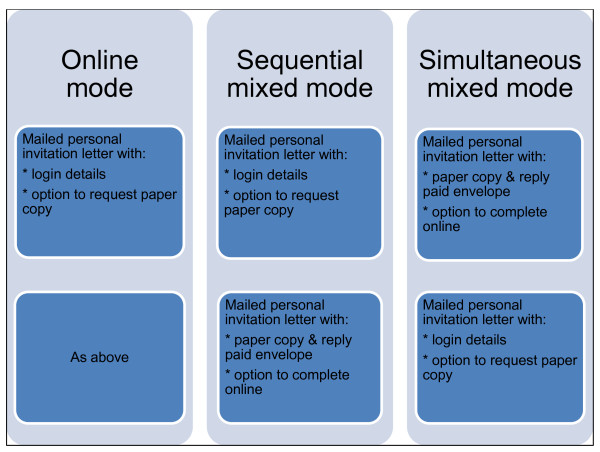
Background: Surveys of doctors are an important data collection method in health services research. Ways to improve response rates, minimise survey response bias and item non-response, within a given budget, have not previously been addressed in the same study. The aim of this paper is to compare the effects and costs of three different modes of survey administration in a national survey of doctors. Methods: A stratified random sample of 4.9% (2,702/54,160) of doctors undertaking clinical practice was drawn from a national directory of all doctors in Australia. Stratification was by four doctor types: general practitioners, specialists, specialists-in-training, and hospital non-specialists, and by six rural/remote categories. A three-arm parallel trial design with equal randomisation across arms was used. Doctors were randomly allocated to: online questionnaire (902); simultaneous mixed mode (a paper questionnaire and login details sent together) (900); or, sequential mixed mode (online followed by a paper questionnaire with the reminder) (900). Analysis was by intention to treat, as within each primary mode, doctors could choose either paper or online. Primary outcome measures were response rate, survey response bias, item non-response, and cost. Results: The online mode had a response rate 12.95%, followed by the simultaneous mixed mode with 19.7%, and the sequential mixed mode with 20.7%. After adjusting for observed differences between the groups, the online mode had a 7 percentage point lower response rate compared to the simultaneous mixed mode, and a 7.7 percentage point lower response rate compared to sequential mixed mode. The difference in response rate between the sequential and simultaneous modes was not statistically significant. Both mixed modes showed evidence of response bias, whilst the characteristics of online respondents were similar to the population. However, the online mode had a higher rate of item non-response compared to both mixed modes. The total cost of the online survey was 38% lower than simultaneous mixed mode and 22% lower than sequential mixed mode. The cost of the sequential mixed mode was 14% lower than simultaneous mixed mode. Compared to the online mode, the sequential mixed mode was the most cost-effective, although exhibiting some evidence of response bias. Conclusions: Decisions on which survey mode to use depend on response rates, response bias, item non-response and costs. The sequential mixed mode appears to be the most cost-effective mode of survey administration for surveys of the population of doctors, if one is prepared to accept a degree of response bias. Online surveys are not yet suitable to be used exclusively for surveys of the doctor population.
Overview
The claims and statistics of this paper haven’t been checked yet.
Run the check — free, no account needed. It reads the open-access text and checks the sources it cites.
Integrity signals
Registry
Cites
Statistics
Figures
Verification
Claims the paper makes
The claims and statistics of this paper haven’t been checked yet.
Run the check — free, no account needed. It reads the open-access text and checks the sources it cites.
Claims other papers make about this one
Each is checked against this paper’s own text: does it say what the citing paper says it does?
The cited source says what the claim attributes to it.
In the citing paper
“The findings of the study are weakened by the modest response rate of 12.5%, though this is similar to that obtained by other studies using online collection [27,42].”
From How Doctors View and Use Social Media: A National Survey (2014) · cites this paper as [42]
Self-check
Percentages, sums and reported differences re-computed from the paper’s own numbers.
The self-check needs the paper’s full text.
Citations
Cites
Methods for the Economic Evaluation of Health Care Programmes
Drummond, M. E., Sculpher, M. J., Torrance, G. W., O’Brien, B. J., & Stoddart, G. L. (2005) · doi:10.1093/oso/9780198529446.001.0001 · Cited by 13,648
Pharmacological interventions for somatoform disorders in adults
Kleinstäuber, M., Witthöft, M., Steffanowski, A., van Marwijk, H., Hiller, W., & Lambert, M. J. (2014) · Cochrane Database of Systematic Reviews · doi:10.1002/14651858.cd010628.pub2 · Cited by 11,369
Response rates to mail surveys published in medical journals
Asch, D. A., Jedrziewski, M. K., & Christakis, N. A. (1997) · Journal of Clinical Epidemiology · doi:10.1016/s0895-4356(97)00126-1 · Cited by 2,110
Increasing response rates to postal questionnaires: systematic review
Edwards, P. J., Roberts, I., Clarke, M. J., DiGuiseppi, C. G., Pratap, S., Wentz, R., & Kwan, I. (2002) · BMJ · doi:10.1136/bmj.324.7347.1183 · Cited by 1,915
The Impact of Nonresponse Rates on Nonresponse Bias: A Meta-Analysis
Groves, R. M., & Peytcheva, E. (2008) · Public Opinion Quarterly · doi:10.1093/poq/nfn011 · Cited by 1,441
Methods to increase response to postal and electronic questionnaires
Edwards, P. J., Roberts, I., Clarke, M. J., DiGuiseppi, C., Wentz, R., Kwan, I., Cooper, R., Felix, L. M., & Pratap, S. (2009) · Cochrane Database of Systematic Reviews · doi:10.1002/14651858.mr000008.pub4 · Cited by 1,379
Comparing Response Rates from Web and Mail Surveys: A Meta-Analysis
Shih, T.-H., & Fan, X. (2008) · Field Methods · doi:10.1177/1525822x08317085 · Cited by 1,159
International Handbook of Survey Methodology
(2012) · Routledge eBooks · doi:10.4324/9780203843123 · Cited by 1,068
Web Surveys versus other Survey Modes: A Meta-Analysis Comparing Response Rates
Manfreda, K. L., Bošnjak, M., Berzelak, J., Haas, I., & Vehovar, V. (2008) · International Journal of Market Research · doi:10.1177/147078530805000107 · Cited by 1,003
To mix or not to mix data collection modes in surveys.
de Leeuw, E. D. (2005) · Journal of Official Statistics · Cited by 808
Methodologies for Improving Response Rates in Surveys of Physicians
VanGeest, J. B., Johnson, T. P., & Welch, V. L. L. (2007) · Evaluation & the Health Professions · doi:10.1177/0163278707307899 · Cited by 697
Reported response rates to mailed physician questionnaires.
Cummings, S., Konrad, T., & Savitz, L. (2020) · PubMed · doi:10.17615/e1d3-9q29 · Cited by 687
Heerwegh, D., & Loosveldt, G. (2008) · Public Opinion Quarterly · doi:10.1093/poq/nfn045 · Cited by 361
Barclay, S. (2002) · Family Practice · doi:10.1093/fampra/19.1.105 · Cited by 301
Comparison of E-mail, Fax, and Postal Surveys of Pediatricians
McMahon, S. R., Iwamoto, M., Massoudi, M. S., Yusuf, H. R., Stevenson, J. M., David, F., Chu, S. Y., & Pickering, L. K. (2003) · PEDIATRICS · doi:10.1542/peds.111.4.e299 · Cited by 284
Indicators for the representativeness of survey response
Schouten, B., Cobben, F., & Bethlehem, J. G. (2009) · UvA-DARE (University of Amsterdam) · Cited by 273
(2002) · Age and Ageing · doi:10.1093/ageing/31.suppl_1.29 · Cited by 268
Grava-Gubins, I., & Scott, S. E. (2008) · PubMed Central · Cited by 242
A Comparison of Response Rate, Response Time, and Costs of Mail and Electronic Surveys
Shannon, D., & Bradshaw, C. C. (2002) · The Journal of Experimental Education · doi:10.1080/00220970209599505 · Cited by 196
Joyce, C., Scott, A., Jeon, S., Humphreys, J. S., Kalb, G. R. J., Witt, J. C., & Leahy, A. (2010) · BMC Health Services Research · doi:10.1186/1472-6963-10-50 · Cited by 163
Self-citationResponse Rates for Mixed-Mode Surveys Using Mail and E-mail/Web
Converse, P. D., Wolfe, E. W., Huang, X., & Oswald, F. L. (2008) · American Journal of Evaluation · doi:10.1177/1098214007313228 · Cited by 141
A very low response rate in an on‐line survey of medical practitioners
Aitken, C. K., Power, R. M., & Dwyer, R. (2008) · Australian and New Zealand Journal of Public Health · doi:10.1111/j.1753-6405.2008.00232.x · Cited by 134
Mixing Web and Mail Methods in a Survey of Physicians
Beebe, T. J., Locke, G. R., Barnes, S. A., Davern, M. E., & Anderson, K. J. (2006) · Health Services Research · doi:10.1111/j.1475-6773.2006.00652.x · Cited by 132
Unit (non)response in Web-based access panel surveys: An extended planned-behavior approach
Bošnjak, M., Tuten, T. L., & Wittmann, W. W. (2005) · Psychology and Marketing · doi:10.1002/mar.20070 · Cited by 127
James, K. M., Ziegenfuss, J. Y., Tilburt, J. C., Harris, A. M., & Beebe, T. J. (2010) · Health Services Research · doi:10.1111/j.1475-6773.2010.01181.x · Cited by 107
Lusk, C. M., Delclos, G. L., Burau, K. D., Drawhorn, D. D., & Aday, L. A. (2007) · Evaluation & the Health Professions · doi:10.1177/0163278707300634 · Cited by 79
Nonresponse Bias and Cost-Effectiveness in a Norwegian Survey of Family Physicians
Bjertnæs, Ø. A., Garratt, A., & Botten, G. (2007) · Evaluation & the Health Professions · doi:10.1177/0163278707311874 · Cited by 72
Larson, P. D., & Chow, G. (2002) · Industrial Marketing Management · doi:10.1016/s0019-8501(02)00277-8 · Cited by 69
Combining Web-Based and Mail Surveys Improves Response Rates: A PBRN Study From PRIME Net
Kroth, P. J., Mcpherson, L., Leverence, R. R., Pace, W. D., Daniels, E., Rhyne, R. L., & Williams, R. L. (2009) · The Annals of Family Medicine · doi:10.1370/afm.944 · Cited by 69
Medicine in Australia: Balancing Employment and Life (MABEL)
Yan, W., Cheng, T. C., Scott, A., Joyce, C., Humphreys, J., Kalb, G. R. J., & Leahy, A. (2011) · Australian Economic Review · doi:10.1111/j.1467-8462.2010.00627.x · Cited by 60
Self-citationLynn, P. J. (2015) · Routledge eBooks · doi:10.4324/9780203843123.ch3 · Cited by 52
Increasing Mail Survey Response Rates from an Industrial Population
Erdogan, B. Z., & Baker, M. J. (2002) · Industrial Marketing Management · doi:10.1016/s0019-8501(00)00117-6 · Cited by 48
Factors Associated With Response Rates in a National Survey of Primary Care Physicians
Parsons, J., Warnecke, R. B., Czaja, R., Barnsley, J. M., & Kaluzny, A. D. (1994) · Evaluation Review · doi:10.1177/0193841x9401800607 · Cited by 46
Impact Of Differential Response Rates On The Quality Of Data Collected In The CTS Physician Survey
Schoenman, J. A., Berk, M. L., Feldman, J. J., & Singer, A. (2003) · Evaluation & the Health Professions · doi:10.1177/0163278702250077 · Cited by 36
Cost-Effectiveness of a Lottery for Increasing Physicians’ Responses to a Mail Survey
Baron, G., Wals, P. D., & Milord, F. (2001) · Evaluation & the Health Professions · doi:10.1177/01632780122034777 · Cited by 31
Papke (1996) · doi:10.1002/(sici)1099-1255(199611)11:6
Research works printed but not linked: 2
- Millar M, O'Neill A, Dillman D: Are mode preferences real?. 2009, Pullman: Washington State University
- Australian Bureau of Statistics: ASGC remoteness classification: purpose and use. 2003, Canberra: ABS
Cited by
Sorted by citations
Enhancing Surveys of Health Care Professionals
Cho, Y. I., Johnson, T. P., & VanGeest, J. B. (2013) · Evaluation & the Health Professions · doi:10.1177/0163278713496425 · Cited by 489
Global Overview of Response Rates in Patient and Health Care Professional Surveys in Surgery
Meyer, V. M., Benjamens, S., Moumni, M. E., Lange, J. F. M., & Pol, R. A. (2020) · Annals of Surgery · doi:10.1097/sla.0000000000004078 · Cited by 404
Ebert, J. F., Huibers, L., Christensen, B., & Christensen, M. B. (2018) · Journal of Medical Internet Research · doi:10.2196/jmir.8353 · Cited by 377
Scientists’ Prioritization of Communication Objectives for Public Engagement
Dudo, A. D., & Besley, J. C. (2016) · PLoS ONE · doi:10.1371/journal.pone.0148867 · Cited by 329
Perceptions of gender-based discrimination during surgical training and practice
Shannon, A. B., Battista, A., Plankey, M. W., Johnson, L. B., & Marshall, M. B. (2015) · Medical Education Online · doi:10.3402/meo.v20.25923 · Cited by 308
Metadata
- Authors
- Scott, A., Jeon, S.-H., Joyce, C. M., Humphreys, J. S., Kalb, G., Witt, J., & Leahy, A.
- Affiliations
- The University of Melbourne (AU)
- The Alfred Hospital (AU)
- Monash University (AU)
- University of Manitoba (CA)
- Corresponding author
- Joyce, Catherine M
- ORCID
- Venue
- BMC Medical Research Methodology
- Published
- 2011-09-05
- Volume
- 11
- Issue
- 1
- Pages
- 126-126
- ISSN
- 1471-2288 (ISSN-L)
- PMC
- PMC3231767
- OpenAlex
- W2056264205
- Cited by
- 244
- References
- 36
- Citations by year
- 2026: 4 · 2025: 8 · 2024: 17 · 2023: 20 · 2022: 24 · 2021: 20 · 2020: 24 · 2019: 17 · 2018: 23 · 2017: 13 · 2016: 20 · 2015: 17 · 2014: 21 · 2013: 10 · 2012: 5
- FWCI
- 39.64
- Type
- journal article
- Language
- en
- Open access
- gold
- doi.org
- Licence
- Locations
- BMC Medical Research Methodology (publishedVersion, cc-by)
- Europe PMC (PubMed Central) (publishedVersion, cc-by)
- PubMed Central (publishedVersion, cc-by)
- PubMed (publishedVersion)
- Minerva Access (University of Melbourne) (submittedVersion, cc-by)
- DOAJ (DOAJ: Directory of Open Access Journals) (submittedVersion, cc-by-sa)
- Funders
- Monash University
- University of Melbourne
- Medical Research Council
- National Health and Medical Research Council (454799)
- Topics
- Social Sciences › Sociology and Political Science › Survey Methodology and Nonresponse
- Physical Sciences › Mathematics › Statistics and Probability › Survey Sampling and Estimation Techniques
- Physical Sciences › Mathematics › Statistics and Probability › Census and Population Estimation
- Keywords
- survey mode, online surveys, paper-based questionnaires, response rate, response bias, item nonresponse, cost-effectiveness, physicians, survey administration, general practitioners, specialists, Canada
- MeSH terms
- Adult, Aged, Australia, Cost-Benefit Analysis, Female, Humans, Job Satisfaction, Longitudinal Studies, Male, Middle Aged, Motivation, Physicians, Surveys and Questionnaires, Odds Ratio, Health Care Surveys
About these checks
Registry, retraction, Cites and statistics results are computed, not judged, with one exception: a printed reference that no index lists is read once by a model before it counts as a citation error. Claims are extracted by a model and kept only when their quote appears verbatim in the text; each cited source is then checked, with a model’s help, for whether it says what the claim relies on. Those verdicts can be wrong — read the claim’s quote and the cited source before relying on one.
Statistics and arithmetic are recomputed, not judged.
Confidence bands are shown only for fields calibrated on our annotated test set. None is calibrated yet, so no band is shown.
What counts as a claim ›How we measure confidence ›How we check this ›
Are you an author, or do you see a problem with this page? Request a review
