

The DOI matches its Crossref record; 57 of the 58 references it cites were found in a registry or an index, and 1 are not checked yet.
How to handle mortality when investigating length of hospital stay and time to clinical stability
Open accessAbstract
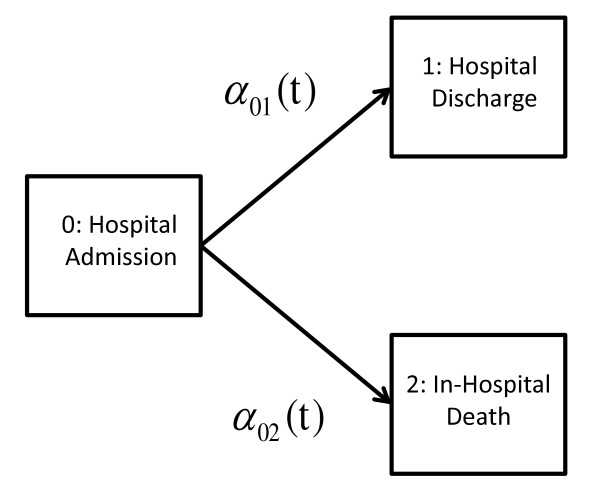
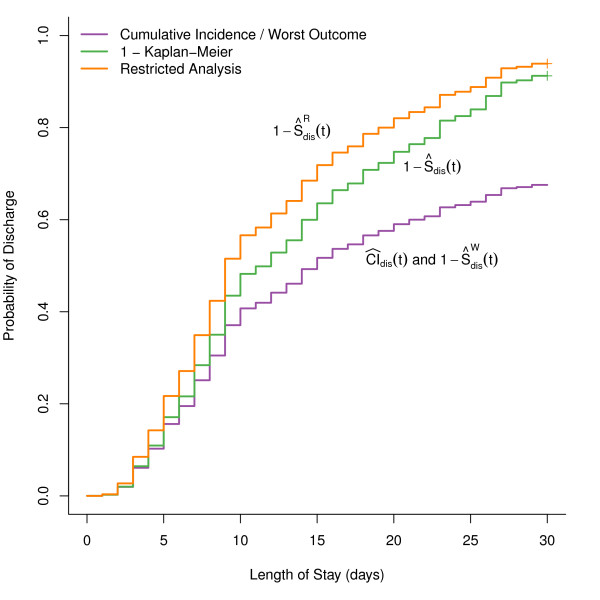
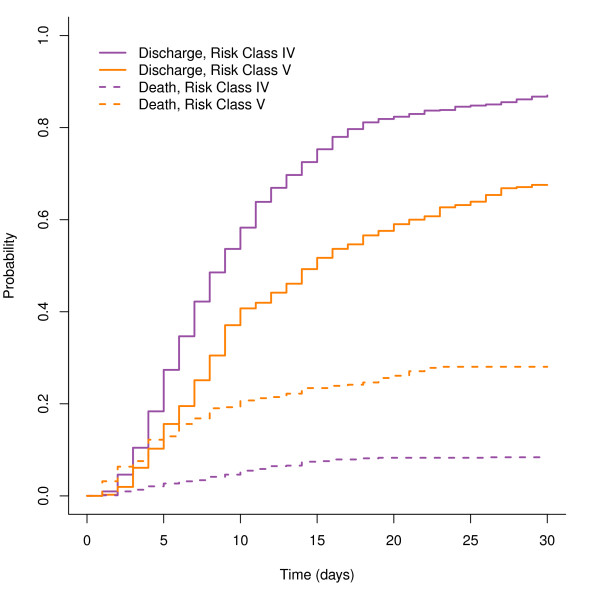
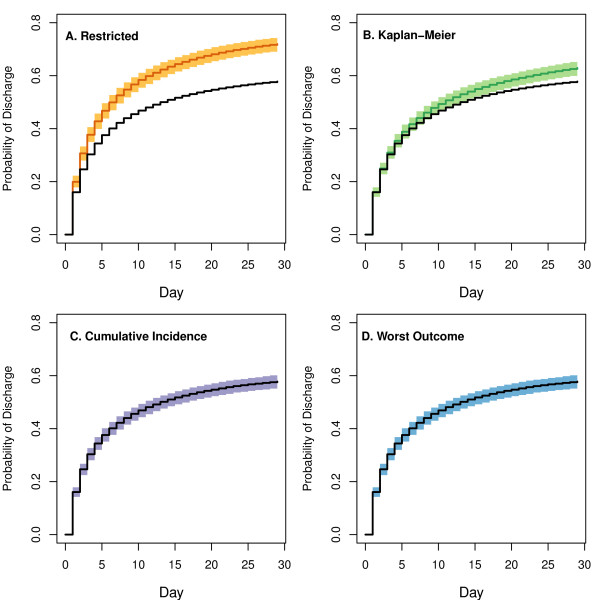
BACKGROUND: Hospital length of stay (LOS) and time for a patient to reach clinical stability (TCS) have increasingly become important outcomes when investigating ways in which to combat Community Acquired Pneumonia (CAP). Difficulties arise when deciding how to handle in-hospital mortality. Ad-hoc approaches that are commonly used to handle time to event outcomes with mortality can give disparate results and provide conflicting conclusions based on the same data. To ensure compatibility among studies investigating these outcomes, this type of data should be handled in a consistent and appropriate fashion. METHODS: Using both simulated data and data from the international Community Acquired Pneumonia Organization (CAPO) database, we evaluate two ad-hoc approaches for handling mortality when estimating the probability of hospital discharge and clinical stability: 1) restricting analysis to those patients who lived, and 2) assigning individuals who die the "worst" outcome (right-censoring them at the longest recorded LOS or TCS). Estimated probability distributions based on these approaches are compared with right-censoring the individuals who died at time of death (the complement of the Kaplan-Meier (KM) estimator), and treating death as a competing risk (the cumulative incidence estimator). Tests for differences in probability distributions based on the four methods are also contrasted. RESULTS: The two ad-hoc approaches give different estimates of the probability of discharge and clinical stability. Analysis restricted to patients who survived is conceptually problematic, as estimation is conditioned on events that happen at a future time. Estimation based on assigning those patients who died the worst outcome (longest LOS and TCS) coincides with the complement of the KM estimator based on the subdistribution hazard, which has been previously shown to be equivalent to the cumulative incidence estimator. However, in either case the time to in-hospital mortality is ignored, preventing simultaneous assessment of patient mortality in addition to LOS and/or TCS. The power to detect differences in underlying hazards of discharge between patient populations differs for test statistics based on the four approaches, and depends on the underlying hazard ratio of mortality between the patient groups. CONCLUSIONS: Treating death as a competing risk gives estimators which address the clinical questions of interest, and allows for simultaneous modelling of both in-hospital mortality and TCS / LOS. This article advocates treating mortality as a competing risk when investigating other time related outcomes.
Overview
The claims and statistics of this paper haven’t been checked yet.
Run the check — free, no account needed. It reads the open-access text and checks the sources it cites.
Integrity signals
Registry
Cites
Statistics
Figures
Verification
Claims the paper makes
The claims and statistics of this paper haven’t been checked yet.
Run the check — free, no account needed. It reads the open-access text and checks the sources it cites.
Claims other papers make about this one
Each is checked against this paper’s own text: does it say what the citing paper says it does?
The cited source doesn’t support the claim as written.
In the citing paper
“Multivariable models were used to compare periods, adjusting for relevant patient characteristics.”
From Lab efficiency and improvements in the management of bloodstream infections: a before and after study (2025) · cites this paper as [5]
Checked by a reasoning model — may be wrong.
Experimental — accuracy not yet measured
Self-check
Percentages, sums and reported differences re-computed from the paper’s own numbers.
The self-check needs the paper’s full text.
Citations
Cites
R: A Language and Environment for Statistical Computing
R Core Team (2000) · doi:10.32614/r.manuals · Cited by 355,893
Nonparametric Estimation from Incomplete Observations
Kaplan, E. L., & Meier, P. (1992) · Springer series in statistics · doi:10.1007/978-1-4612-4380-9_25 · Cited by 45,239
Regression Models and Life-Tables
Cox, D. R. (1972) · Journal of the Royal Statistical Society Series B: Statistical Methodology · doi:10.1111/j.2517-6161.1972.tb00899.x · Cited by 39,793
Nonparametric Estimation from Incomplete Observations
Kaplan, E. L., & Meier, P. (1958) · Journal of the American Statistical Association · doi:10.1080/01621459.1958.10501452 · Cited by 39,158
A Proportional Hazards Model for the Subdistribution of a Competing Risk
Fine, J. P., & Gray, R. J. (1999) · Journal of the American Statistical Association · doi:10.1080/01621459.1999.10474144 · Cited by 14,290
The Statistical Analysis of Failure Time Data.
Aitkin, M. A., Kalbfleisch, J. D., & Prentice, R. L. (1981) · Biometrics · doi:10.2307/2530581 · Cited by 9,875
A Class of $K$-Sample Tests for Comparing the Cumulative Incidence of a Competing Risk
Gray, R. J. (1988) · The Annals of Statistics · doi:10.1214/aos/1176350951 · Cited by 4,957
A Prediction Rule to Identify Low-Risk Patients with Community-Acquired Pneumonia
Fine, M. J., Auble, T. E., Yealy, D. M., Hanusa, B. H., Weissfeld, L. A., Singer, D. E., Coley, C. M., Marrie, T. J., & Kapoor, W. N. (1997) · New England Journal of Medicine · doi:10.1056/nejm199701233360402 · Cited by 4,592
Survival Analysis Techniques for Censored and Truncated Data
Rao, M. B., Klein, J. P., & Moeschberger, M. L. (1998) · Technometrics · doi:10.2307/1270658 · Cited by 3,617
The Statistical Analysis of Failure Time Data
Kalbfleisch, J. D., & Prentice, R. L. (2002) · Wiley Series in Probability and Statistics · doi:10.1002/9781118032985 · Cited by 3,219
Cited by
Sorted by citations
Adjunctive glucocorticoid therapy in patients with septic shock.
Venkatesh, B., Finfer, S., Cohen, J., Rajbhandari, D., Arabi, Y., Bellomo, R., Billot, L., Correa, M., Glass, P., Harward, M., et al. (2018) · New England Journal of Medicine · doi:10.1056/nejmoa1705835 · Cited by 1,037
Ferrando, C., Suárez-Sipmann, F., Mellado-Artigas, R., Hernández, M., Gea, A., Arruti, E., Aldecoa, C., Martínez‐Palli, G., Martínez‐González, M. Á., Slutsky, A. S., et al. (2020) · Intensive Care Medicine · doi:10.1007/s00134-020-06192-2 · Cited by 451
Bramante, C. T., Ingraham, N. E., Murray, T. A., Marmor, S., Hovertsen, S., Gronski, J., McNeil, C., Feng, R., Guzman, G., Abdelwahab, N., et al. (2020) · The Lancet Healthy Longevity · doi:10.1016/s2666-7568(20)30033-7 · Cited by 285
Avouac, J., Drumez, É., HACHULLA, E., Séror, R., Georgin‐Lavialle, S., Mahou, S. E., Pertuiset, É., Pham, T., Marotte, H., Servettaz, A., et al. (2021) · The Lancet Rheumatology · doi:10.1016/s2665-9913(21)00059-x · Cited by 275
Bai, A. D., Showler, A., Burry, L. D., Steinberg, M., Ricciuto, D. R., Fernandes, T., Chiu, A., Raybardhan, S., Science, M. E., Fernando, E., et al. (2015) · Clinical Infectious Diseases · doi:10.1093/cid/civ120 · Cited by 253
Metadata
- Authors
- Brock, G. N., Barnes, C., Ramirez, J. A., & Myers, J.
- Affiliations
- University of Louisville (US)
- Corresponding author
- Brock, Guy N
- Myers, John
- Venue
- BMC Medical Research Methodology
- Published
- 2011-10-26
- Volume
- 11
- Issue
- 1
- Pages
- 144-144
- ISSN
- 1471-2288 (ISSN-L)
- PMC
- PMC3269825
- OpenAlex
- W1965493147
- Cited by
- 138
- References
- 58
- Citations by year
- 2026: 6 · 2025: 10 · 2024: 12 · 2023: 10 · 2022: 24 · 2021: 19 · 2020: 17 · 2019: 8 · 2018: 8 · 2017: 13 · 2016: 5 · 2015: 5
- FWCI
- 0.00
- Type
- journal article
- Language
- en
- Open access
- gold
- doi.org
- Licence
- Locations
- BMC Medical Research Methodology (publishedVersion, cc-by)
- Europe PMC (PubMed Central) (publishedVersion, cc-by)
- PubMed Central (publishedVersion, cc-by)
- PubMed (publishedVersion)
- DOAJ (DOAJ: Directory of Open Access Journals) (submittedVersion, cc-by-sa)
- Funders
- National Institutes of Health (ES014443)
- U.S. Public Health Service (P02 728 0800015499, RSGHP-09-099-01)
- National Institute of Environmental Health Sciences (P30ES014443)
- National Institute of Dental and Craniofacial Research (P20-RR/DE177702)
- National Institute for Occupational Safety and Health (1r03oh008957-01a2)
- Topics
- Health Sciences › Medicine › Epidemiology › Pneumonia and Respiratory Infections
- Physical Sciences › Mathematics › Statistics and Probability › Statistical Methods in Epidemiology
- Physical Sciences › Mathematics › Statistics and Probability › Statistical Methods in Clinical Trials
- Keywords
- community-acquired pneumonia, length of hospital stay, time to clinical stability, in-hospital mortality, competing risks, right censoring, hospital discharge, time-to-event outcomes, Kaplan-Meier estimator, statistical power
- MeSH terms
- Algorithms, Computer Simulation, Follow-Up Studies, Humans, Length of Stay, Patient Discharge, Pneumonia, Risk Factors, Time Factors, Models, Statistical, Treatment Outcome, Hospital Mortality, Community-Acquired Infections, Kaplan-Meier Estimate
About these checks
Registry, retraction, Cites and statistics results are computed, not judged, with one exception: a printed reference that no index lists is read once by a model before it counts as a citation error. Claims are extracted by a model and kept only when their quote appears verbatim in the text; each cited source is then checked, with a model’s help, for whether it says what the claim relies on. Those verdicts can be wrong — read the claim’s quote and the cited source before relying on one.
Statistics and arithmetic are recomputed, not judged.
Confidence bands are shown only for fields calibrated on our annotated test set. None is calibrated yet, so no band is shown.
What counts as a claim ›How we measure confidence ›How we check this ›
Are you an author, or do you see a problem with this page? Request a review
