

The DOI matches its Crossref record; 28 of the 28 references it cites were found in a registry or an index.
Methodological criteria for the assessment of moderators in systematic reviews of randomised controlled trials: a consensus study.
Open accessAbstract
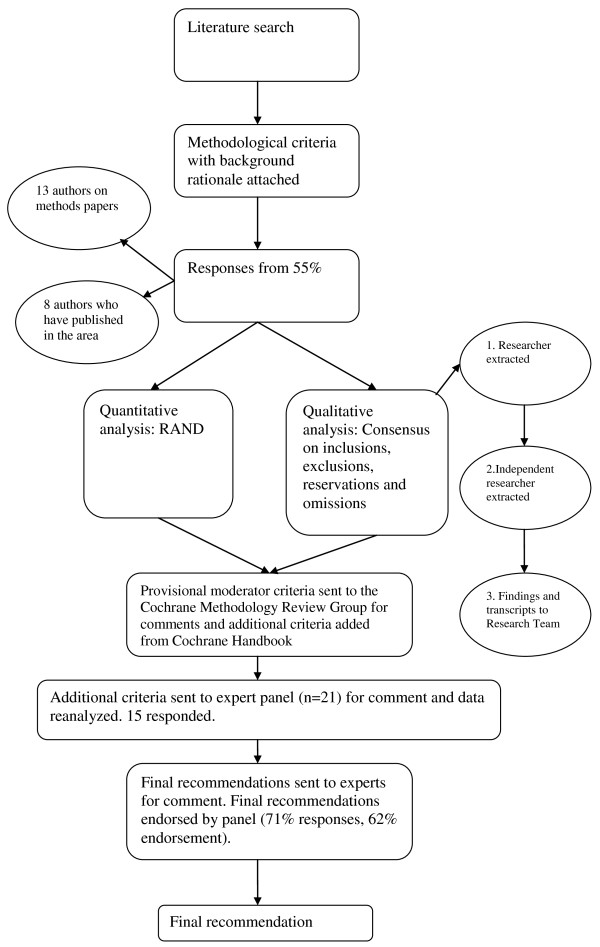
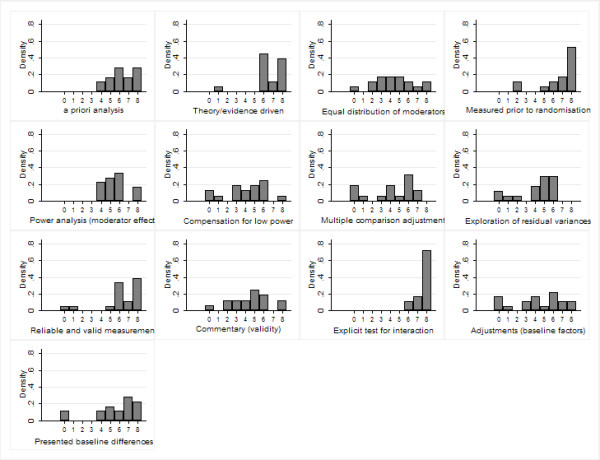
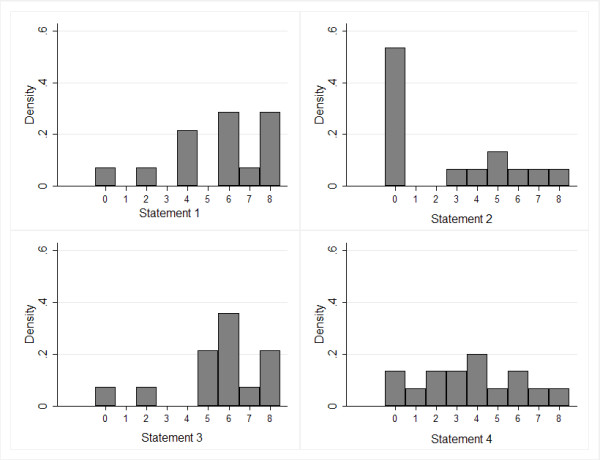
BACKGROUND: Current methodological guidelines provide advice about the assessment of sub-group analysis within RCTs, but do not specify explicit criteria for assessment. Our objective was to provide researchers with a set of criteria that will facilitate the grading of evidence for moderators, in systematic reviews. METHOD: We developed a set of criteria from methodological manuscripts (n = 18) using snowballing technique, and electronic database searches. Criteria were reviewed by an international Delphi panel (n = 21), comprising authors who have published methodological papers in this area, and researchers who have been active in the study of sub-group analysis in RCTs. We used the Research ANd Development/University of California Los Angeles appropriateness method to assess consensus on the quantitative data. Free responses were coded for consensus and disagreement. In a subsequent round additional criteria were extracted from the Cochrane Reviewers' Handbook, and the process was repeated. RESULTS: The recommendations are that meta-analysts report both confirmatory and exploratory findings for sub-groups analysis. Confirmatory findings must only come from studies in which a specific theory/evidence based a-priori statement is made. Exploratory findings may be used to inform future/subsequent trials. However, for inclusion in the meta-analysis of moderators, the following additional criteria should be applied to each study: Baseline factors should be measured prior to randomisation, measurement of baseline factors should be of adequate reliability and validity, and a specific test of the interaction between baseline factors and interventions must be presented. CONCLUSIONS: There is consensus from a group of 21 international experts that methodological criteria to assess moderators within systematic reviews of RCTs is both timely and necessary. The consensus from the experts resulted in five criteria divided into two groups when synthesising evidence: confirmatory findings to support hypotheses about moderators and exploratory findings to inform future research. These recommendations are discussed in reference to previous recommendations for evaluating and reporting moderator studies.
Overview
The claims and statistics of this paper haven’t been checked yet.
Run the check — free, no account needed. It reads the open-access text and checks the sources it cites.
Integrity signals
Registry
Cites
Statistics
Figures
Verification
Claims the paper makes
The claims and statistics of this paper haven’t been checked yet.
Run the check — free, no account needed. It reads the open-access text and checks the sources it cites.
Claims other papers make about this one
Each is checked against this paper’s own text: does it say what the citing paper says it does?
The cited source says what the claim attributes to it.
In the citing paper
“Both moderators and predictors of change should be measured prior to treatment randomization (Turner et al., 2007; Pincus et al., 2011).”
From Positive psychological wellbeing is required for online self-help acceptance and commitment therapy for chronic pain to be effective (2016) · cites this paper as Pincus et al., 2011
The cited source says what the claim attributes to it.
In the citing paper
“However, our study is in accordance with the methodological requirements of exploratory moderator analyses [68].”
From How and for whom does web-based acceptance and commitment therapy work? Mediation and moderation analyses of web-based ACT for depressive symptoms (2016) · cites this paper as [68]
Self-check
Percentages, sums and reported differences re-computed from the paper’s own numbers.
The self-check needs the paper’s full text.
Citations
Cites
Baron, R. M., & Kenny, D. A. (1986) · Journal of Personality and Social Psychology · doi:10.1037/0022-3514.51.6.1173 · Cited by 91,532
Cochrane Handbook for Systematic Reviews of Interventions: Cochrane Book Series
(2008) · doi:10.1002/9780470712184 · Cited by 25,048
A comparison of methods to test mediation and other intervening variable effects
MacKinnon, D. P., Lockwood, C. M., Hoffman, J. M., West, S. G., & Sheets, V. (2002) · Psychological Methods · doi:10.1037/1082-989x.7.1.83 · Cited by 9,406
Moher, D., Hopewell, S., Schulz, K. F., Montori, V., Gotzsche, P. C., Devereaux, P. J., Elbourne, D., Egger, M., & Altman, D. G. (2010) · BMJ · doi:10.1136/bmj.c869 · Cited by 8,883
Edwards, J. R., & Lambert, L. S. (2007) · Psychological Methods · doi:10.1037/1082-989x.12.1.1 · Cited by 4,711
Cole, D. A., & Maxwell, S. E. (2003) · Journal of Abnormal Psychology · doi:10.1037/0021-843x.112.4.558 · Cited by 3,605
Systematic reviews: CRD's guidance for undertaking reviews in health care
Tacconelli, E. (2010) · The Lancet Infectious Diseases · doi:10.1016/s1473-3099(10)70065-7 · Cited by 3,270
Statistical difficulties of detecting interactions and moderator effects.
McClelland, G. H., & Judd, C. M. (1993) · Psychological Bulletin · doi:10.1037/0033-2909.114.2.376 · Cited by 3,270
Mediators and Moderators of Treatment Effects in Randomized Clinical Trials
Kraemer, H. C., Wilson, G. T., Fairburn, C. G., & Agras, W. S. (2002) · Archives of General Psychiatry · doi:10.1001/archpsyc.59.10.877 · Cited by 2,562 · cited 1×
“We have adopted definitions from Kraemer and colleagues [1], which clearly describes how participant factors affect outcome:”
(2001) · Defense Technical Information Center (DTIC) · Cited by 2,158
Research works printed but not linked: 2
- Higgins JPT, Green S: Cochrane Handbook for Systematic Reviews of Interventions. Version 502 [updated September 2009]. 2009, The Cochrane Collaboration, 2009
- Fitch K: The Rand/UCLA appropriateness method user's manual. Santa Monica: Rand, c2001. 1991
Cited by
Sorted by citations
Items 101–161 of 161
Self-harm in individuals who experience binge eating disorder: A systematic review and meta-analysis
Moore, E., Clements, C., Flattery, E., Bhutta, A., & Taylor, P. J. (2025) · Journal of Eating Disorders · doi:10.1186/s40337-025-01379-8 · Cited by 4
Üzüm, B., & Özbek, R. (2024) · Turkish Journal of Education · doi:10.19128/turje.1283335 · Cited by 4
Obomsawin, A., Pejic, S. R., & Koziol, C. (2025) · Hormones and Behavior · doi:10.1016/j.yhbeh.2025.105775 · Cited by 3
Baysal, Y. E., Mutlu, F., & Nacaroğlu, O. (2023) · International Journal of Psychology and Educational Studies · doi:10.52380/ijpes.2023.10.1.512 · Cited by 3
Clausen, S. H., Heerey, J., Hartvigsen, J., Kemp, J. L., & Arnbak, B. (2023) · BMJ Open · doi:10.1136/bmjopen-2022-065373 · Cited by 3
Bradshaw, E. L. (2019) · Research Bank (Australian Catholic University) · doi:10.26199/5d788114864b0 · Cited by 4
Konci, G., Langer, L., Müller, M., Nduku, P. M., Pampolina, J., Prowse, M., & Reumann, A. (2025) · European Journal of Development Research · doi:10.1057/s41287-025-00715-7 · Cited by 2
Soukouli, I., Karagkounis, T., Mylonas, K. S., Kalathas, T., Poulia, K., Kokkinos, A. D., & Marinaki, S. (2025) · Journal of Clinical Medicine · doi:10.3390/jcm14248943 · Cited by 2
Effect Modifiers of Graded Sensorimotor Retraining for Chronic Low Back Pain
Venter, M., McAuley, J. H., Hansford, H. J., Ryan, M. L., Bagg, M. K., Wand, B. M., & Cashin, A. G. (2026) · JAMA Network Open · doi:10.1001/jamanetworkopen.2025.52787 · Cited by 2
Farivar, A., Bowden, J. L., Bennell, K. L., Briggs, A. M., Bunker, S. J., Hinman, R. S., Egerton, T., French, S. D., Pirotta, M. V., Schuck, K., et al. (2025) · Arthritis Care & Research · doi:10.1002/acr.25564 · Cited by 2
Konan, N., & Bakır, A. A. (2022) · International Journal on Lifelong Education and Leadership · doi:10.25233/ijlel.1186444 · Cited by 2
The competence of physiotherapists to deliver a cognitive behavioural approach for low back pain
Hansen, Z. (2026) · Warwick Research Archive Portal (University of Warwick) · doi:10.82444/warw.33646315 · Cited by 2
Treatment Effect Modifiers for Return-to-Work in Patients With Musculoskeletal Disorders
Venter, M., Grotle, M., Øiestad, B. E., Aanesen, F., Tingulstad, A., Rysstad, T. L., Ferraro, M. C., McAuley, J. H., & Cashin, A. G. (2024) · Journal of Pain · doi:10.1016/j.jpain.2024.104556 · Cited by 2
The prevalence of aggressive obsessions in youth with obsessive-compulsive disorder: A meta-analysis
Bishop, O. C., Hiscock, B. B., Morris, Q., Lahey, C. A., Corran, C., Krause, S., Fawcett, J. M., & Fawcett, E. J. (2025) · Journal of Obsessive-Compulsive and Related Disorders · doi:10.1016/j.jocrd.2025.100963 · Cited by 1
Methodological guidance for individual participant data meta-analyses: a systematic review
Otalike, E. G., Clarke, M. J., Akhter, F., Veroniki, A. A., Kandala, N., & Gagnier, J. J. (2025) · Journal of Clinical Epidemiology · doi:10.1016/j.jclinepi.2025.112089 · Cited by 1
Booth, S., Cavatassi, R., Curtis, B., Kim, D., Langer, L., Mapitsa, C. B., Nduku, P. M., Prowse, M., Puri, J., Robertsen, J., et al. (2025) · European Journal of Development Research · doi:10.1057/s41287-025-00727-3 · Cited by 1
Bertie, L., Mackinnon, A. J., McDermott, E. A., O’Gradey‐Lee, M., Kikas, K., Tomlinson, M., & Hudson, J. L. (2026) · Clinical Child and Family Psychology Review · doi:10.1007/s10567-026-00564-8 · Cited by 1
Gückel, T., Prior, K., Newton, N. C., Karin, E., Gex, K. S., Sercombe, J., & Stapinski, L. A. (2026) · Behaviour Research and Therapy · doi:10.1016/j.brat.2026.105006 · Cited by 1
Smith, M. L., Oldenhof, E., Byrne, J. E. M., McNeill, I. M., Sweetman, A., & Staiger, P. K. (2026) · Sleep Medicine Reviews · doi:10.1016/j.smrv.2026.102269 · Cited by 1
Fors, M. (2023) · Linköping University medical dissertations · doi:10.3384/9789180752077 · Cited by 1
Keskin, F., & Selvı, M. (2024) · Gazi Üniversitesi Gazi Eğitim Fakültesi Dergisi · doi:10.17152/gefad.1362544 · Cited by 1
Goger, P., Nam, R. J., Lowry, N. J., Cha, C. B., Ribeiro, J. D., Huang, X., & Fox, K. R. (2025) · Journal of Applied Research on Children Informing Policy for Children at Risk · doi:10.58464/2155-5834.1543
McRobert, C. J., Hill, J. C., Hay, E. M., & van der Windt, D. (2020) · European Journal of Physiotherapy · doi:10.1080/21679169.2020.1752304 · Cited by 1
Ortuondo, E. M., Zubizarreta, A., Saitua, J. M., Sarabia, C. S., & Arratibel, J. Z. (2013) · Revista de Neurología · doi:10.33588/rn.5706.2013199
Morain, S. R. (2014) · Digital Access to Scholarship at Harvard (DASH) (Harvard University)
Broome, M. R., Heron, J., & Barry, E. (2014) · The British Journal of Psychiatry · doi:10.1192/bjp.bp.112.122804
Shea, S., Kothari, D., Teresi, J. A., Eimicke, J. P., Lantigua, R., Palmas, W., & Weinstock, R. S. (2013)
Prediktion av utfall utifrån terapeutskattningar tidigt i internetförmedlad KBT mot insomni
von Plauen, R. (2015) · KTH Publication Database DiVA (KTH Royal Institute of Technology)
Prognostic indicators for patients with degenerative lumbar spinal stenosis
Burgstaller, J. M. (2016) · Research Publications (Maastricht University) · doi:10.26481/dis.20161212jb
Riley, R. D., Tierney, J. F., & Stewart, L. A. (2021) · Wiley eBooks · doi:10.1002/9781119333784.refs2
Adisso, É. L., Taljaard, M., Rivest, L., Zomahoun, H. T. V., Durand, P. J., & Légaré, F. (2020) · Research Square · doi:10.21203/rs.3.rs-133475/v1
Interaction analyses: Enhancing understanding of chronic low back pain
Rabey, M. I., Kendell, M., Shea, Y. L., Mattinson, D., Koh, Y. F. N., Seow, K. C., & Beales, D. J. (2023) · Musculoskeletal Science and Practice · doi:10.1016/j.msksp.2023.102728
Ezcurra, C. M. (2023) · Research Publications (Maastricht University) · doi:10.26481/dis.20230629ce
Cihodaru-Ștefanache, Ș., & Podina, I. R. (2023) · Proceedings of the World Congress on Electrical Engineering and Computer Systems and Science · doi:10.11159/mhci23.109
Elias, A. L., Seward, N., & Lund, C. (2023) · Cambridge Prisms Global Mental Health · doi:10.1017/gmh.2024.3.pr10
Elias, A. L., Seward, N., & Lund, C. (2023) · Cambridge Prisms Global Mental Health · doi:10.1017/gmh.2024.3.pr9
Elias, A. L., Seward, N., & Lund, C. (2023) · Cambridge Prisms Global Mental Health · doi:10.1017/gmh.2024.3.pr8
Elias, A. L., Seward, N., & Lund, C. (2023) · Cambridge Prisms Global Mental Health · doi:10.1017/gmh.2024.3.pr7
Elias, A. L. (2023) · Cambridge Prisms Global Mental Health · doi:10.1017/gmh.2024.3.pr6
Elias, A. L., Seward, N., & Lund, C. (2023) · Cambridge Prisms Global Mental Health · doi:10.1017/gmh.2024.3.pr5
Elias, A. L., Seward, N., & Lund, C. (2023) · Cambridge Prisms Global Mental Health · doi:10.1017/gmh.2024.3.pr4
Elias, A. L., Seward, N., & Lund, C. (2023) · Cambridge Prisms Global Mental Health · doi:10.1017/gmh.2024.3.pr3
Elias, A. L., Seward, N., & Lund, C. (2023) · Cambridge Prisms Global Mental Health · doi:10.1017/gmh.2024.3.pr2
Elias, A. L. (2023) · Cambridge Prisms Global Mental Health · doi:10.1017/gmh.2024.3.pr1
Construct validity of the Child Abuse Potential Inventory: A meta-analytic review
Milner, J. S., Ammar, J., Gibson, C., Menon, S. V., & Crouch, J. L. (2025) · Child Abuse & Neglect · doi:10.1016/j.chiabu.2025.107586 · Cited by 1
Simons, J., Jaspers, E., & van Tubergen, F. (2025) · International Journal of Intercultural Relations · doi:10.1016/j.ijintrel.2025.102320
Hee, S. W., Mistry, D., Friede, T., Lamb, S. E., Stallard, N., Underwood, M. R., & Patel, S. (2021) · Figshare · doi:10.6084/m9.figshare.14053321
Self-citationHolm, L. V., Vach, W., Jarbøl, D. E., Christensen, H. W., Søndergaard, J., & Hestbæk, L. (2021) · Figshare · doi:10.6084/m9.figshare.14450848
Hee, S. W., Mistry, D., Friede, T., Lamb, S. E., Stallard, N., Underwood, M. R., & Patel, S. (2021) · Figshare · doi:10.6084/m9.figshare.14053324
Self-citationHee, S. W., Mistry, D., Friede, T., Lamb, S. E., Stallard, N., Underwood, M. R., & Patel, S. (2021) · Figshare · doi:10.6084/m9.figshare.14053318
Self-citationYavuz, Ş., Üzüm, B., & Pesen, A. (2025) · The Journal of International Lingual Social and Educational Sciences · doi:10.34137/jilses.1728049
Ribeiro, D. C., Lamb, S. E., & Abbott, J. H. (2026) · Arthritis Care & Research · doi:10.1002/acr.80021
Developing appropriateness criteria for arterial catheters in adult intensive care unit patients
Levido, A., Bernstein, S. J., Laupland, K. B., Edwards, F., Alizadehsani, R., Horowitz, J. K., Ullman, A. J., & Keogh, S. J. (2026) · Australian Critical Care · doi:10.1016/j.aucc.2026.101568
Defining Expanded Episode-Based Surgical Quality Measurement
Mott, N. M., Benítez, T. M., Connochie, D. M., Klamerus, M. L., Bernstein, S. J., Kerr, E. A., Ibrahim, A. M., Harris, A. H. S., Rosen, A. K., Howard, R., et al. (2026) · JAMA Network Open · doi:10.1001/jamanetworkopen.2026.6176
Liu, F., Leonard, S., Xiao, Z., & Lennox, C. (2026) · Journal of Psychiatric Research · doi:10.1016/j.jpsychires.2026.05.007
Gupta, P., & Chauhan, S. (2026) · Behaviour and Information Technology · doi:10.1080/0144929x.2026.2682279 · Cited by 2
Hong, S., & Lee, Y. (2026) · Journal of Criminal Justice · doi:10.1016/j.jcrimjus.2026.102714
Jardas, E. S., Howard, J., & Lorenzo‐Luaces, L. (2026) · Clinical Psychological Science · doi:10.1177/21677026261473154
Neves, V. V., Larbi, N. A. O. O., Acabchuk, R. L., Haygood, L. N., Rajasankar, V., Goldberg, S. B., Sun, S., Hoge, E. A., Brewer, J. A., Li, C., et al. (2026) · medRxiv · doi:10.64898/2026.10.21.26366048
Metadata
- Authors
- Pincus, T., Miles, C., Froud, R., Underwood, M., Carnes, D., & Taylor, S. J.
- Affiliations
- University of London (GB)
- Queen Mary University of London (GB)
- University of Warwick (GB)
- Corresponding author
- Pincus, Tamar
- Venue
- BMC Medical Research Methodology
- Published
- 2011-01-31
- Volume
- 11
- Issue
- 1
- Pages
- 14-14
- ISSN
- 1471-2288 (ISSN-L)
- PMC
- PMC3044921
- OpenAlex
- W2111680408
- Cited by
- 161
- References
- 28
- Citations by year
- 2026: 14 · 2025: 15 · 2024: 9 · 2023: 22 · 2022: 8 · 2021: 14 · 2020: 14 · 2019: 10 · 2018: 2 · 2017: 15 · 2016: 10 · 2015: 9 · 2014: 7 · 2013: 8 · 2012: 2
- FWCI
- 1.48
- Type
- journal article
- Language
- en
- Open access
- gold
- doi.org
- Licence
- Locations
- BMC Medical Research Methodology (publishedVersion, cc-by)
- PubMed Central (publishedVersion, cc-by)
- PubMed (publishedVersion)
- Warwick Research Archive Portal (University of Warwick) (acceptedVersion)
- DOAJ (DOAJ: Directory of Open Access Journals) (submittedVersion)
- ePrints Soton (University of Southampton) (submittedVersion)
- Queen Mary Research Online (Queen Mary University of London) (submittedVersion, cc-by)
- Royal Holloway Digital Repository (Royal Holloway University of London) (submittedVersion)
- Royal Holloway Digital Repository (Royal Holloway University of London) (submittedVersion, cc-by)
- Funders
- Arizona State University
- University of Washington
- Université Laval
- Queen Mary University of London
- Advantage West Midlands
- National Institute for Health and Care Research (RP-PG-0707-10189)
- Keele University
- Programme Grants for Applied Research
- Topics
- Social Sciences › Decision Sciences › Statistics, Probability and Uncertainty › Meta-analysis and systematic reviews
- Social Sciences › Sociology and Political Science › Delphi Technique in Research
- Physical Sciences › Mathematics › Statistics and Probability › Statistical Methods in Clinical Trials
- Keywords
- moderators, subgroup analysis, randomized controlled trials, methodological quality criteria, level of evidence, interaction testing, consensus recommendations
- MeSH terms
- Humans, Review Literature as Topic, Sampling Studies, Meta-Analysis as Topic, Effect Modifier, Epidemiologic, Randomized Controlled Trials as Topic, Databases, Bibliographic, Treatment Outcome, Consensus
About these checks
Registry, retraction, Cites and statistics results are computed, not judged, with one exception: a printed reference that no index lists is read once by a model before it counts as a citation error. Claims are extracted by a model and kept only when their quote appears verbatim in the text; each cited source is then checked, with a model’s help, for whether it says what the claim relies on. Those verdicts can be wrong — read the claim’s quote and the cited source before relying on one.
Statistics and arithmetic are recomputed, not judged.
Confidence bands are shown only for fields calibrated on our annotated test set. None is calibrated yet, so no band is shown.
What counts as a claim ›How we measure confidence ›How we check this ›
Are you an author, or do you see a problem with this page? Request a review
