

The DOI matches its Crossref record; 72 of the 74 references it cites were found in a registry or an index; 39 of the 67 sources its claims cite were checked for support.
How and for whom does web-based acceptance and commitment therapy work? Mediation and moderation analyses of web-based ACT for depressive symptoms
Open accessAbstract
Background: Acceptance and Commitment Therapy (ACT) has been demonstrated to be effective in reducing depressive symptoms. However, little is known how and for whom therapeutic change occurs, specifically in web-based interventions. This study focuses on the mediators, moderators and predictors of change during a web-based ACT intervention. Methods: Data from 236 adults from the general population with mild to moderate depressive symptoms, randomized to either web-based ACT (n=82) or one of two control conditions (web-based Expressive Writing (EW; n=67) and a waiting list (n=87)), were analysed. Single and multiple mediation analyses, and exploratory linear regression analyses were performed using PROCESS and linear regression analyses, to examine mediators, moderators and predictors on pre- to post- and follow-up treatment change of depressive symptoms. Results: The treatment effect of ACT versus the waiting list was mediated by psychological flexibility and two mindfulness facets. The treatment effect of ACT versus EW was not significantly mediated. The moderator analyses demonstrated that the effects of web-based ACT did not vary according to baseline patient characteristics when compared to both control groups. However, higher baseline depressive symptoms and positive mental health and lower baseline anxiety were identified as predictors of outcome across all conditions. Similar results are found for follow-up. Conclusions: The findings of this study corroborate the evidence that psychological flexibility and mindfulness are distinct process mechanisms that mediate the effects of web-based ACT intervention. The results indicate that there are no restrictions to the allocation of web-based ACT intervention and that web-based ACT can work for different subpopulations. Trial registration: Netherlands Trial Register NTR2736. Registered 6 February 2011. © 2016 Pots et al.
Overview
CoChat Summary
## TL;DR
This study examined mediators, moderators, and predictors of change in a web-based ACT intervention for depressive symptoms using data from 236 adults randomized to ACT, expressive writing, or waiting list. Psychological flexibility and mindfulness processes mediated ACT’s effects versus waiting list, while no baseline characteristics moderated ACT’s effects versus either control group.
## Key findings
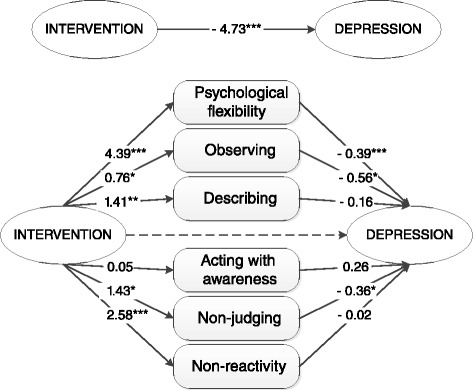
- In mediation analyses versus waiting list, web-based ACT showed a significantly greater post-treatment improvement in depressive symptoms (total treatment effect β = −4.73, p < .001), and indirect effects through psychological flexibility and mindfulness facets were significant.
- In the multiple mediation model versus waiting list, three mediators remained significant post-treatment: psychological flexibility (indirect effect β = −1.691, 95% CI −2.96 to −0.76), observing (β = −0.428, 95% CI −1.17 to −0.02), and non-judging of inner experience (β = −0.518, 95% CI −1.52 to −0.10).
- Versus expressive writing, the total treatment effect at post-treatment was also significant (β = −2.70, p = 0.030), but in the multiple mediation model no significant mediators remained; in simple mediation, non-reactivity to inner experience was the only consistent mediator across follow-up analyses.
- Moderator analyses found no significant moderators for ACT versus waiting list or ACT versus expressive writing, except current disorder at baseline for ACT versus expressive writing at 12 months; predictor analyses found higher baseline depressive symptoms and positive mental health/psychological well-being predicted greater improvement, while higher baseline anxiety predicted less improvement.
## Methods
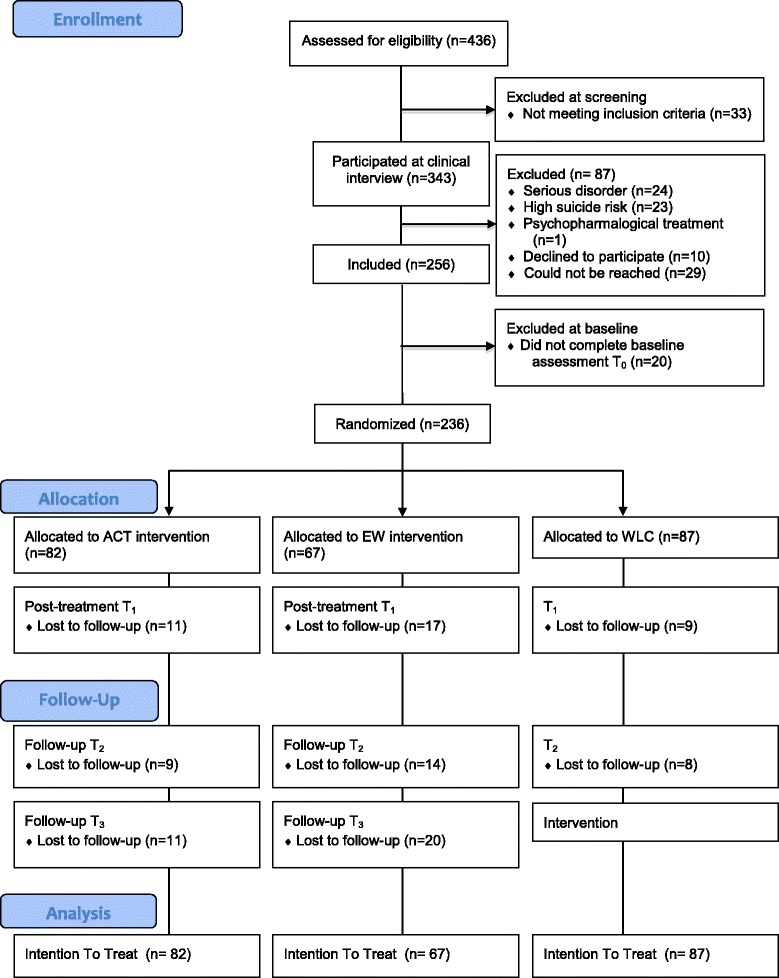
- Secondary analysis of an RCT sample of 236 adults from the general Dutch population with mild to moderate depressive symptoms, randomized to web-based ACT (n = 82), web-based expressive writing (n = 67), or waiting list (n = 87).
- Intervention: ACT used the “Living to the full” protocol with nine online modules over 9–12 weeks plus weekly e-mail counselling; expressive writing also had nine online sessions and e-mail counselling.
- Analyses used intention-to-treat with EM imputation for missing continuous data, PROCESS for mediation/moderation, and linear regression for predictors, with outcomes assessed at baseline, post-treatment, 6 months, and 12 months.
## Limitations
- The paper states the RCT was not powered for moderator analyses, so null moderation findings may reflect inadequate statistical power.
- The mediation analyses used baseline-to-follow-up change scores for both processes and outcomes, which the paper says precluded evaluation of temporal precedence.
- The sample was predominantly female, highly educated, and recruited from the general Dutch community, which the paper says limits generalizability to gender and education; this also makes the sample relatively homogeneous, which may have reduced the chance of detecting moderators.
- Evident from the text: the study’s process measures focused on broad constructs (psychological flexibility and mindfulness) rather than more specific ACT processes, so mechanism-specific conclusions are limited.
Model-written summary. Check it against the paper before relying on it.
Integrity signals
Registry
Cites
Statistics
Figures
Verification
Claims the paper makes
31 Valid · 1 Not valid · 6 Not checked · 53 Own results and interpretations
The sources with a verdict support this claim; the rest weren’t checked yet, have no full text we could read, or their verdicts aren’t rated yet.
In the paper
“Acceptance and Commitment Therapy (ACT) has been demonstrated to be effective in reducing depressive symptoms.”
- Also stated in: § Background Acceptance and Commitment Therapy (ACT) is an empirically based behavioural cognitive therapy that uses acceptance and mindfulness strategies together with commitment and behaviour change strategies, to increase the ability to act in accordance with personal values in the presence of life adversities [1, 2]. The effectiveness of ACT in reducing depressive symptoms has been established in several recent meta-analyses [3–5]. In addition, there is growing evidence for the efficacy of web-based ACT interventions [6–11]. Besides evaluating the efficacy and effectiveness of psychological treatments, randomized controlled trials can be valuable in revealing how (i.e., mediators) and for whom (i.e., moderators) therapeutic change occurs. Mediators and moderators are important to the further optimization of treatments and their clinical and cost-effectiveness. Specifically, knowledge of mediators of change enables treatment components to be included that are crucial to recovery [12]. Furthermore, both nonspecific treatment predictors and specific treatment moderators indicate who benefits from treatment, or under which conditions treatment works best [13]. Moderators and predictors can help tailor interventions to different subpopulations with possibly different causal mechanisms of disorders and ultimately improve clinical decision about treatment [13, 14]. Research into potential mediators and moderators of action in web-based ACT interventions is however in its infancy. The focus of this study is therefore on the possible mediators, moderators and predictors of change during a web-based ACT intervention. The central therapeutic mechanism in ACT is psychological flexibility, which is the ability to act in accordance with intrinsically motivating values or goals while being in contact with the present moment [1, 2]. People who are psychological flexible also score high on acceptance, which is seen as a more effective strategy for regulating negative emotions and thoughts than experiential avoidance, i.e., the persistent and generally fruitless attempts to avoid unwanted private experiences such as feelings, thoughts, and bodily sensations [1, 15, 16]. In the model underlying ACT psychological flexibility is defined by six interrelated therapeutic processes: acceptance, cognitive defusion, contact with the present moment, self-as-context, values, and committed action. Mindfulness is taught in the context of the first four processes of the ACT model, where exercises are used to enhance an observing and non-judging self, together with the awareness and acceptance of unwanted private experiences such as thoughts and feelings. Mindfulness is often referred to as intentionally paying attention to present moment experiences in a non-judgemental way [17]. Mindfulness, as measured by the Five Facet Mindfulness Questionnaire (FFMQ), is conceptualized in several facets, which are observing (noticing or attending to internal and external experiences), describing (labelling internal experiences with words), acting with awareness (attending to one’s activities of the moment), non-judging of inner experience (taking a non-evaluative stance toward thoughts and feelings), and non-reactivity to inner experience (allowing thoughts and feelings to come and go). Baer et al. [18] stated that non-reactivity and non-judging may be seen as ways of operationalizing acceptance. They found a correlation of r = .49 between the Acceptance and Action Questionnaire-II (AAQ-II; measuring psychological flexibility) and the non-judging facet of the FFMQ. Although the AAQ-II and FFMQ are not meant to measure the same construct, Fledderus et al. [19] found that the AAQ-II was positively related to mindfulness facets and positive mental health and negatively related to depression and anxiety. The mindfulness facets correlated significantly with the AAQ-II, with – in agreement with Bear [18] - the strongest relation between AAQ-II and non-judging. The strongest relation between AAQ-II and non-judging (r = .54) suggest that the AAQ-II and the non-judging facet of the FFMQ measure are related but distinct constructs. The results also showed that the AAQ-II explains additional variance in relevant outcomes such as depression, anxiety, and positive mental health. To date, there are several studies that have suggested that augmented mindfulness mediates the effects of an ACT intervention (e.g., [20–22]). Research into psychological flexibility as a mediator in ACT interventions confirms that psychological flexibility is a core component of the theoretical framework of ACT (e.g., [1, 15, 20, 23, 24]). As opposed to face-to-face, web-based interventions offer advantages in availability and accessibility, but non-adherence or high drop-out is an issue [25, 26]. Some researchers have suggested that in web-based interventions specificity of effects can account for the higher drop-out rates that are common in web-based interventions [14, 25]. Given this higher specificity of effects and possible individual variability in self-support via web-based interventions, it is important to study moderators and predictors. Yet, little is known about the moderators of change of web-based ACT interventions, and research into moderator and predictor analyses of web-based ACT interventions for depressions is lacking. There is some limited research on moderators and predictors in face-to-face ACT interventions for anxiety, indicating that factors such as socio-demographic characteristics do not moderate or predict outcome, and that factors such as mood disorder comorbidity may be predictors and/or moderators [24, 27, 28]. Also, a study by Flaxman and Bond [29] on worksite stress management training (SMT), based on ACT, showed that the impact of SMT was significantly moderated by baseline distress. For mediators of change, the number of studies doing formal mediational analyses of psychological flexibility and mindfulness in web-based ACT interventions is small [7, 30]. In the study of Trompetter et al. [30] improvements in psychological flexibility mediated the effect of web-based ACT on psychological distress, further substantiating that psychological flexibility is a core component of the ACT model. Also, Bricker et al. [7] found that acceptance processes mediated the effects on smoking cessation through greater acceptance of physical urges, cognitions, and emotions. The aim of the current study was to identify mediators, moderators and predictors of participant improvement in the web-based ACT intervention in a recently published randomized controlled trial (RCT) [11]. The primary objective was to test the hypothesis that pre- to post-treatment changes in psychological flexibility and mindfulness mediated the effects of the web-based ACT intervention on depressive symptoms. A second objective was to explore which participant baseline characteristics and baseline symptoms moderated or predicted treatment effects. These latter analyses were considered exploratory given the lack of research so far. · boosted
“The effectiveness of ACT in reducing depressive symptoms has been established in several recent meta-analyses [3–5].”
§ How and for whom does web-based acceptance and commitment therapy work? Mediation and moderation analyses of web-based ACT for depressive symptoms > Abstract > Background
What the sources say
- Not checked — no full text of the sourcecites [3] Öst LG. The efficacy of acceptance and commitment therapy: an updated systematic review and meta-analysis. Behav Res Ther. 2014;61:105–21. source
- Not matchedcites [4] Ruiz FJ. A review of acceptance and commitment therapy (ACT) empirical evidence: correlational, experimental psychopathology, component and outcome studies. Int J Psychol Psychol Ther. 2010;10:125–62.
Couldn’t be matched to a paper in Crossref, so it can’t be checked.
- Supportedcites [5] A-Tjak JGL, Davis ML, Morina N, Powers MB, Smits JAJ, Emmelkamp PMG. A meta-analysis of the efficacy of acceptance and commitment therapy for clinically relevant mental and physical health problems. Psychother Psychosom. 2015;84:30–6. source
The Discussion reports that ACT outperformed control conditions on symptom-related outcomes and explicitly says the findings support its use in treating depression. The paper does not claim ACT is more effective than established treatments, but the citing sentence does not make that comparison. (LLM, conf=0.88)
boostedstates a cause- Asserted: passes — The authors put it forward as true.
- Checkable: passes — It can be checked against evidence.
- Load-bearing: passes — The paper’s conclusions depend on it.
- Based: passes — The paper gives a reason why it holds.
- Also stated in: § Background Acceptance and Commitment Therapy (ACT) is an empirically based behavioural cognitive therapy that uses acceptance and mindfulness strategies together with commitment and behaviour change strategies, to increase the ability to act in accordance with personal values in the presence of life adversities [1, 2]. The effectiveness of ACT in reducing depressive symptoms has been established in several recent meta-analyses [3–5]. In addition, there is growing evidence for the efficacy of web-based ACT interventions [6–11]. Besides evaluating the efficacy and effectiveness of psychological treatments, randomized controlled trials can be valuable in revealing how (i.e., mediators) and for whom (i.e., moderators) therapeutic change occurs. Mediators and moderators are important to the further optimization of treatments and their clinical and cost-effectiveness. Specifically, knowledge of mediators of change enables treatment components to be included that are crucial to recovery [12]. Furthermore, both nonspecific treatment predictors and specific treatment moderators indicate who benefits from treatment, or under which conditions treatment works best [13]. Moderators and predictors can help tailor interventions to different subpopulations with possibly different causal mechanisms of disorders and ultimately improve clinical decision about treatment [13, 14]. Research into potential mediators and moderators of action in web-based ACT interventions is however in its infancy. The focus of this study is therefore on the possible mediators, moderators and predictors of change during a web-based ACT intervention. The central therapeutic mechanism in ACT is psychological flexibility, which is the ability to act in accordance with intrinsically motivating values or goals while being in contact with the present moment [1, 2]. People who are psychological flexible also score high on acceptance, which is seen as a more effective strategy for regulating negative emotions and thoughts than experiential avoidance, i.e., the persistent and generally fruitless attempts to avoid unwanted private experiences such as feelings, thoughts, and bodily sensations [1, 15, 16]. In the model underlying ACT psychological flexibility is defined by six interrelated therapeutic processes: acceptance, cognitive defusion, contact with the present moment, self-as-context, values, and committed action. Mindfulness is taught in the context of the first four processes of the ACT model, where exercises are used to enhance an observing and non-judging self, together with the awareness and acceptance of unwanted private experiences such as thoughts and feelings. Mindfulness is often referred to as intentionally paying attention to present moment experiences in a non-judgemental way [17]. Mindfulness, as measured by the Five Facet Mindfulness Questionnaire (FFMQ), is conceptualized in several facets, which are observing (noticing or attending to internal and external experiences), describing (labelling internal experiences with words), acting with awareness (attending to one’s activities of the moment), non-judging of inner experience (taking a non-evaluative stance toward thoughts and feelings), and non-reactivity to inner experience (allowing thoughts and feelings to come and go). Baer et al. [18] stated that non-reactivity and non-judging may be seen as ways of operationalizing acceptance. They found a correlation of r = .49 between the Acceptance and Action Questionnaire-II (AAQ-II; measuring psychological flexibility) and the non-judging facet of the FFMQ. Although the AAQ-II and FFMQ are not meant to measure the same construct, Fledderus et al. [19] found that the AAQ-II was positively related to mindfulness facets and positive mental health and negatively related to depression and anxiety. The mindfulness facets correlated significantly with the AAQ-II, with – in agreement with Bear [18] - the strongest relation between AAQ-II and non-judging. The strongest relation between AAQ-II and non-judging (r = .54) suggest that the AAQ-II and the non-judging facet of the FFMQ measure are related but distinct constructs. The results also showed that the AAQ-II explains additional variance in relevant outcomes such as depression, anxiety, and positive mental health. To date, there are several studies that have suggested that augmented mindfulness mediates the effects of an ACT intervention (e.g., [20–22]). Research into psychological flexibility as a mediator in ACT interventions confirms that psychological flexibility is a core component of the theoretical framework of ACT (e.g., [1, 15, 20, 23, 24]). As opposed to face-to-face, web-based interventions offer advantages in availability and accessibility, but non-adherence or high drop-out is an issue [25, 26]. Some researchers have suggested that in web-based interventions specificity of effects can account for the higher drop-out rates that are common in web-based interventions [14, 25]. Given this higher specificity of effects and possible individual variability in self-support via web-based interventions, it is important to study moderators and predictors. Yet, little is known about the moderators of change of web-based ACT interventions, and research into moderator and predictor analyses of web-based ACT interventions for depressions is lacking. There is some limited research on moderators and predictors in face-to-face ACT interventions for anxiety, indicating that factors such as socio-demographic characteristics do not moderate or predict outcome, and that factors such as mood disorder comorbidity may be predictors and/or moderators [24, 27, 28]. Also, a study by Flaxman and Bond [29] on worksite stress management training (SMT), based on ACT, showed that the impact of SMT was significantly moderated by baseline distress. For mediators of change, the number of studies doing formal mediational analyses of psychological flexibility and mindfulness in web-based ACT interventions is small [7, 30]. In the study of Trompetter et al. [30] improvements in psychological flexibility mediated the effect of web-based ACT on psychological distress, further substantiating that psychological flexibility is a core component of the ACT model. Also, Bricker et al. [7] found that acceptance processes mediated the effects on smoking cessation through greater acceptance of physical urges, cognitions, and emotions. The aim of the current study was to identify mediators, moderators and predictors of participant improvement in the web-based ACT intervention in a recently published randomized controlled trial (RCT) [11]. The primary objective was to test the hypothesis that pre- to post-treatment changes in psychological flexibility and mindfulness mediated the effects of the web-based ACT intervention on depressive symptoms. A second objective was to explore which participant baseline characteristics and baseline symptoms moderated or predicted treatment effects. These latter analyses were considered exploratory given the lack of research so far. · boosted
The sources with a verdict support this claim; the rest weren’t checked yet, have no full text we could read, or their verdicts aren’t rated yet.
In the paper
“In addition, there is growing evidence for the efficacy of web-based ACT interventions [6–11].”
§ How and for whom does web-based acceptance and commitment therapy work? Mediation and moderation analyses of web-based ACT for depressive symptoms > Background Acceptance and Commitment Therapy (ACT) is an empirically based behavioural cognitive therapy that uses acceptance and mindfulness strategies together with commitment and behaviour change strategies, to increase the ability to act in accordance with personal values in the presence of life adversities [1, 2]. The effectiveness of ACT in reducing depressive symptoms has been established in several recent meta-analyses [3–5]. In addition, there is growing evidence for the efficacy of web-based ACT interventions [6–11]. Besides evaluating the efficacy and effectiveness of psychological treatments, randomized controlled trials can be valuable in revealing how (i.e., mediators) and for whom (i.e., moderators) therapeutic change occurs. Mediators and moderators are important to the further optimization of treatments and their clinical and cost-effectiveness. Specifically, knowledge of mediators of change enables treatment components to be included that are crucial to recovery [12]. Furthermore, both nonspecific treatment predictors and specific treatment moderators indicate who benefits from treatment, or under which conditions treatment works best [13]. Moderators and predictors can help tailor interventions to different subpopulations with possibly different causal mechanisms of disorders and ultimately improve clinical decision about treatment [13, 14]. Research into potential mediators and moderators of action in web-based ACT interventions is however in its infancy. The focus of this study is therefore on the possible mediators, moderators and predictors of change during a web-based ACT intervention. The central therapeutic mechanism in ACT is psychological flexibility, which is the ability to act in accordance with intrinsically motivating values or goals while being in contact with the present moment [1, 2]. People who are psychological flexible also score high on acceptance, which is seen as a more effective strategy for regulating negative emotions and thoughts than experiential avoidance, i.e., the persistent and generally fruitless attempts to avoid unwanted private experiences such as feelings, thoughts, and bodily sensations [1, 15, 16]. In the model underlying ACT psychological flexibility is defined by six interrelated therapeutic processes: acceptance, cognitive defusion, contact with the present moment, self-as-context, values, and committed action. Mindfulness is taught in the context of the first four processes of the ACT model, where exercises are used to enhance an observing and non-judging self, together with the awareness and acceptance of unwanted private experiences such as thoughts and feelings. Mindfulness is often referred to as intentionally paying attention to present moment experiences in a non-judgemental way [17]. Mindfulness, as measured by the Five Facet Mindfulness Questionnaire (FFMQ), is conceptualized in several facets, which are observing (noticing or attending to internal and external experiences), describing (labelling internal experiences with words), acting with awareness (attending to one’s activities of the moment), non-judging of inner experience (taking a non-evaluative stance toward thoughts and feelings), and non-reactivity to inner experience (allowing thoughts and feelings to come and go). Baer et al. [18] stated that non-reactivity and non-judging may be seen as ways of operationalizing acceptance. They found a correlation of r = .49 between the Acceptance and Action Questionnaire-II (AAQ-II; measuring psychological flexibility) and the non-judging facet of the FFMQ. Although the AAQ-II and FFMQ are not meant to measure the same construct, Fledderus et al. [19] found that the AAQ-II was positively related to mindfulness facets and positive mental health and negatively related to depression and anxiety. The mindfulness facets correlated significantly with the AAQ-II, with – in agreement with Bear [18] - the strongest relation between AAQ-II and non-judging. The strongest relation between AAQ-II and non-judging (r = .54) suggest that the AAQ-II and the non-judging facet of the FFMQ measure are related but distinct constructs. The results also showed that the AAQ-II explains additional variance in relevant outcomes such as depression, anxiety, and positive mental health. To date, there are several studies that have suggested that augmented mindfulness mediates the effects of an ACT intervention (e.g., [20–22]). Research into psychological flexibility as a mediator in ACT interventions confirms that psychological flexibility is a core component of the theoretical framework of ACT (e.g., [1, 15, 20, 23, 24]). As opposed to face-to-face, web-based interventions offer advantages in availability and accessibility, but non-adherence or high drop-out is an issue [25, 26]. Some researchers have suggested that in web-based interventions specificity of effects can account for the higher drop-out rates that are common in web-based interventions [14, 25]. Given this higher specificity of effects and possible individual variability in self-support via web-based interventions, it is important to study moderators and predictors. Yet, little is known about the moderators of change of web-based ACT interventions, and research into moderator and predictor analyses of web-based ACT interventions for depressions is lacking. There is some limited research on moderators and predictors in face-to-face ACT interventions for anxiety, indicating that factors such as socio-demographic characteristics do not moderate or predict outcome, and that factors such as mood disorder comorbidity may be predictors and/or moderators [24, 27, 28]. Also, a study by Flaxman and Bond [29] on worksite stress management training (SMT), based on ACT, showed that the impact of SMT was significantly moderated by baseline distress. For mediators of change, the number of studies doing formal mediational analyses of psychological flexibility and mindfulness in web-based ACT interventions is small [7, 30]. In the study of Trompetter et al. [30] improvements in psychological flexibility mediated the effect of web-based ACT on psychological distress, further substantiating that psychological flexibility is a core component of the ACT model. Also, Bricker et al. [7] found that acceptance processes mediated the effects on smoking cessation through greater acceptance of physical urges, cognitions, and emotions. The aim of the current study was to identify mediators, moderators and predictors of participant improvement in the web-based ACT intervention in a recently published randomized controlled trial (RCT) [11]. The primary objective was to test the hypothesis that pre- to post-treatment changes in psychological flexibility and mindfulness mediated the effects of the web-based ACT intervention on depressive symptoms. A second objective was to explore which participant baseline characteristics and baseline symptoms moderated or predicted treatment effects. These latter analyses were considered exploratory given the lack of research so far.
What the sources say
- Not checked — no full text of the sourcecites [6] Trompetter HR, Bohlmeijer ET, Veehof MM, Schreurs KMG. Internet-based guided self-help intervention for chronic pain based on Acceptance and Commitment Therapy: a randomized controlled trial. J Behav Med. in press. source
- Not checked — no full text of the sourcecites [7] Bricker J, Wyszynski C, Comstock B, Heffner JL. Pilot randomized controlled trial of web-based acceptance and commitment therapy for smoking cessation. Nicotine Tob Res. 2013;15:1756–64. source
- Not checked — no full text of the sourcecites [8] Buhrman M, Skoglund A, Husell J, Bergström K, Gordh T, Hursti T, et al. Guided internet-delivered acceptance and commitment therapy for chronic pain patients: a randomized controlled trial. Behav Res Ther. 2013;51:307–15. source
- Not checked — no full text of the sourcecites [9] Hesser H, Gustafsson T, Lundén C, Henrikson O, Fattahi K, Johnsson E, et al. A randomized controlled trial of internet-delivered cognitive behavior therapy and acceptance and commitment therapy in the treatment of tinnitus. J Consult Clin Psychol. 2012;80:649–61. source
- Not checked — no full text of the sourcecites [10] Lappalainen P, Granlund A, Siltanen S, Ahonen S, Vitikainen M, Tolvanen A, et al. ACT internet-based vs face-to-face? A randomized controlled trial of two ways to deliver acceptance and commitment therapy for depressive symptoms: an 18-month follow-up. Behav Res Ther. 2014;61:43–54. source
- Supportedcites [11] Pots WTM, Fledderus M, Meulenbeek PAM, Klooster ten PM, Schreurs KM, Bohlmeijer ET. Acceptance and commitment therapy as a web-based intervention for depressive symptoms: randomised controlled trial. The British Journal of Psychiatry. 2015;doi: 10.1192/bjp.bp.114.146068 . source
The Discussion reports that this web-based ACT intervention was significantly more effective than both control conditions in the short term for adults with mild to moderate depressive symptoms. The Study implications say ACT can be effective as a web-based public mental health intervention in this population, so the trial contributes evidence to the cited broad statement. (LLM, conf=0.91)
plainstates a cause- Asserted: passes — The authors put it forward as true.
- Checkable: passes — It can be checked against evidence.
- Load-bearing: unclear — It is unclear whether the paper’s conclusions depend on it.
- Based: passes — The paper gives a reason why it holds.
The cited sources support only part of this claim — read each source’s verdict below.
In the paper
“Research into psychological flexibility as a mediator in ACT interventions confirms that psychological flexibility is a core component of the theoretical framework of ACT (e.g., [1, 15, 20, 23, 24]).”
§ How and for whom does web-based acceptance and commitment therapy work? Mediation and moderation analyses of web-based ACT for depressive symptoms > Background Acceptance and Commitment Therapy (ACT) is an empirically based behavioural cognitive therapy that uses acceptance and mindfulness strategies together with commitment and behaviour change strategies, to increase the ability to act in accordance with personal values in the presence of life adversities [1, 2]. The effectiveness of ACT in reducing depressive symptoms has been established in several recent meta-analyses [3–5]. In addition, there is growing evidence for the efficacy of web-based ACT interventions [6–11]. Besides evaluating the efficacy and effectiveness of psychological treatments, randomized controlled trials can be valuable in revealing how (i.e., mediators) and for whom (i.e., moderators) therapeutic change occurs. Mediators and moderators are important to the further optimization of treatments and their clinical and cost-effectiveness. Specifically, knowledge of mediators of change enables treatment components to be included that are crucial to recovery [12]. Furthermore, both nonspecific treatment predictors and specific treatment moderators indicate who benefits from treatment, or under which conditions treatment works best [13]. Moderators and predictors can help tailor interventions to different subpopulations with possibly different causal mechanisms of disorders and ultimately improve clinical decision about treatment [13, 14]. Research into potential mediators and moderators of action in web-based ACT interventions is however in its infancy. The focus of this study is therefore on the possible mediators, moderators and predictors of change during a web-based ACT intervention. The central therapeutic mechanism in ACT is psychological flexibility, which is the ability to act in accordance with intrinsically motivating values or goals while being in contact with the present moment [1, 2]. People who are psychological flexible also score high on acceptance, which is seen as a more effective strategy for regulating negative emotions and thoughts than experiential avoidance, i.e., the persistent and generally fruitless attempts to avoid unwanted private experiences such as feelings, thoughts, and bodily sensations [1, 15, 16]. In the model underlying ACT psychological flexibility is defined by six interrelated therapeutic processes: acceptance, cognitive defusion, contact with the present moment, self-as-context, values, and committed action. Mindfulness is taught in the context of the first four processes of the ACT model, where exercises are used to enhance an observing and non-judging self, together with the awareness and acceptance of unwanted private experiences such as thoughts and feelings. Mindfulness is often referred to as intentionally paying attention to present moment experiences in a non-judgemental way [17]. Mindfulness, as measured by the Five Facet Mindfulness Questionnaire (FFMQ), is conceptualized in several facets, which are observing (noticing or attending to internal and external experiences), describing (labelling internal experiences with words), acting with awareness (attending to one’s activities of the moment), non-judging of inner experience (taking a non-evaluative stance toward thoughts and feelings), and non-reactivity to inner experience (allowing thoughts and feelings to come and go). Baer et al. [18] stated that non-reactivity and non-judging may be seen as ways of operationalizing acceptance. They found a correlation of r = .49 between the Acceptance and Action Questionnaire-II (AAQ-II; measuring psychological flexibility) and the non-judging facet of the FFMQ. Although the AAQ-II and FFMQ are not meant to measure the same construct, Fledderus et al. [19] found that the AAQ-II was positively related to mindfulness facets and positive mental health and negatively related to depression and anxiety. The mindfulness facets correlated significantly with the AAQ-II, with – in agreement with Bear [18] - the strongest relation between AAQ-II and non-judging. The strongest relation between AAQ-II and non-judging (r = .54) suggest that the AAQ-II and the non-judging facet of the FFMQ measure are related but distinct constructs. The results also showed that the AAQ-II explains additional variance in relevant outcomes such as depression, anxiety, and positive mental health. To date, there are several studies that have suggested that augmented mindfulness mediates the effects of an ACT intervention (e.g., [20–22]). Research into psychological flexibility as a mediator in ACT interventions confirms that psychological flexibility is a core component of the theoretical framework of ACT (e.g., [1, 15, 20, 23, 24]). As opposed to face-to-face, web-based interventions offer advantages in availability and accessibility, but non-adherence or high drop-out is an issue [25, 26]. Some researchers have suggested that in web-based interventions specificity of effects can account for the higher drop-out rates that are common in web-based interventions [14, 25]. Given this higher specificity of effects and possible individual variability in self-support via web-based interventions, it is important to study moderators and predictors. Yet, little is known about the moderators of change of web-based ACT interventions, and research into moderator and predictor analyses of web-based ACT interventions for depressions is lacking. There is some limited research on moderators and predictors in face-to-face ACT interventions for anxiety, indicating that factors such as socio-demographic characteristics do not moderate or predict outcome, and that factors such as mood disorder comorbidity may be predictors and/or moderators [24, 27, 28]. Also, a study by Flaxman and Bond [29] on worksite stress management training (SMT), based on ACT, showed that the impact of SMT was significantly moderated by baseline distress. For mediators of change, the number of studies doing formal mediational analyses of psychological flexibility and mindfulness in web-based ACT interventions is small [7, 30]. In the study of Trompetter et al. [30] improvements in psychological flexibility mediated the effect of web-based ACT on psychological distress, further substantiating that psychological flexibility is a core component of the ACT model. Also, Bricker et al. [7] found that acceptance processes mediated the effects on smoking cessation through greater acceptance of physical urges, cognitions, and emotions. The aim of the current study was to identify mediators, moderators and predictors of participant improvement in the web-based ACT intervention in a recently published randomized controlled trial (RCT) [11]. The primary objective was to test the hypothesis that pre- to post-treatment changes in psychological flexibility and mindfulness mediated the effects of the web-based ACT intervention on depressive symptoms. A second objective was to explore which participant baseline characteristics and baseline symptoms moderated or predicted treatment effects. These latter analyses were considered exploratory given the lack of research so far.
What the sources say
- Partly supportedcites [1] Hayes SC, Luoma JB, Bond FW, Masuda A, Lillis J. Acceptance and commitment therapy: model, processes and outcomes. Behav Res Ther. 2006;44:1–25. sourceExperimental — accuracy not yet measured
The Six core processes of ACT section (p. 7) explicitly makes increasing psychological flexibility ACT’s general goal, and Mediational studies (p. 17) reports an ACT trial in which an AAQ measure of flexibility mediated outcomes. But the summary of mediation evidence (p. 20) calls the findings early and qualified by methodological weaknesses; it says they seem supportive, rather than confirming the model. (LLM, conf=0.86)
- Partly supportedcites [15] Kashdan TB, Rottenberg J. Psychological flexibility as a fundamental aspect of health. Clin Psychol Rev. 2010;30:865–78. sourceExperimental — accuracy not yet measured
In Recommendations for Future Research (page unavailable), the review describes ACT as an intervention that explicitly addresses psychological flexibility, supporting its centrality to ACT. The Mental and Behavioral Response Shifts section reports that early changes in flexibility were associated with later treatment outcomes, but the cited passages do not establish that flexibility mediated ACT intervention effects. The claim’s mediation-based confirmation therefore goes beyond this source. (LLM, conf=0.84)
- Not checked — no full text of the sourcecites [20] Forman EM, Chapman JE, Herbert JD, Goetter EM, Yuen EK, Moitra E. Using session-by-session measurement to compare mechanisms of action for acceptance and commitment therapy and cognitive therapy. Behav Ther. 2012;43:341–54. source
- Not checked — no full text of the sourcecites [23] Wicksell RK, Olsson GL, Hayes SC. Mediators of change in acceptance and commitment therapy for pediatric chronic pain. Pain. 2011;152:2792–801. source
- Partly supportedcites [24] Niles AN, Burklund LJ, Arch JJ, Lieberman MD, Saxbe D, Craske MG. Cognitive mediators of treatment for social anxiety disorder: comparing acceptance and commitment therapy and cognitive-behavioral therapy. Behav Ther. 2014;45:664–77. sourceExperimental — accuracy not yet measured
The ‘Evidence for Treatment Mediators in CBT and ACT’ section describes increasing psychological flexibility as an ultimate goal of ACT. The Discussion reports that reduced experiential avoidance mediated outcomes in ACT for social anxiety disorder, but the study tested experiential avoidance rather than psychological flexibility as a whole. (LLM, conf=0.82)
boostedstates an association- Asserted: passes — The authors put it forward as true.
- Checkable: passes — It can be checked against evidence.
- Load-bearing: passes — The paper’s conclusions depend on it.
- Based: passes — The paper gives a reason why it holds.
- Partly supported
Every source the paper cites for this claim was checked and supports it.
In the paper
“As opposed to face-to-face, web-based interventions offer advantages in availability and accessibility, but non-adherence or high drop-out is an issue [25, 26].”
§ How and for whom does web-based acceptance and commitment therapy work? Mediation and moderation analyses of web-based ACT for depressive symptoms > Background Acceptance and Commitment Therapy (ACT) is an empirically based behavioural cognitive therapy that uses acceptance and mindfulness strategies together with commitment and behaviour change strategies, to increase the ability to act in accordance with personal values in the presence of life adversities [1, 2]. The effectiveness of ACT in reducing depressive symptoms has been established in several recent meta-analyses [3–5]. In addition, there is growing evidence for the efficacy of web-based ACT interventions [6–11]. Besides evaluating the efficacy and effectiveness of psychological treatments, randomized controlled trials can be valuable in revealing how (i.e., mediators) and for whom (i.e., moderators) therapeutic change occurs. Mediators and moderators are important to the further optimization of treatments and their clinical and cost-effectiveness. Specifically, knowledge of mediators of change enables treatment components to be included that are crucial to recovery [12]. Furthermore, both nonspecific treatment predictors and specific treatment moderators indicate who benefits from treatment, or under which conditions treatment works best [13]. Moderators and predictors can help tailor interventions to different subpopulations with possibly different causal mechanisms of disorders and ultimately improve clinical decision about treatment [13, 14]. Research into potential mediators and moderators of action in web-based ACT interventions is however in its infancy. The focus of this study is therefore on the possible mediators, moderators and predictors of change during a web-based ACT intervention. The central therapeutic mechanism in ACT is psychological flexibility, which is the ability to act in accordance with intrinsically motivating values or goals while being in contact with the present moment [1, 2]. People who are psychological flexible also score high on acceptance, which is seen as a more effective strategy for regulating negative emotions and thoughts than experiential avoidance, i.e., the persistent and generally fruitless attempts to avoid unwanted private experiences such as feelings, thoughts, and bodily sensations [1, 15, 16]. In the model underlying ACT psychological flexibility is defined by six interrelated therapeutic processes: acceptance, cognitive defusion, contact with the present moment, self-as-context, values, and committed action. Mindfulness is taught in the context of the first four processes of the ACT model, where exercises are used to enhance an observing and non-judging self, together with the awareness and acceptance of unwanted private experiences such as thoughts and feelings. Mindfulness is often referred to as intentionally paying attention to present moment experiences in a non-judgemental way [17]. Mindfulness, as measured by the Five Facet Mindfulness Questionnaire (FFMQ), is conceptualized in several facets, which are observing (noticing or attending to internal and external experiences), describing (labelling internal experiences with words), acting with awareness (attending to one’s activities of the moment), non-judging of inner experience (taking a non-evaluative stance toward thoughts and feelings), and non-reactivity to inner experience (allowing thoughts and feelings to come and go). Baer et al. [18] stated that non-reactivity and non-judging may be seen as ways of operationalizing acceptance. They found a correlation of r = .49 between the Acceptance and Action Questionnaire-II (AAQ-II; measuring psychological flexibility) and the non-judging facet of the FFMQ. Although the AAQ-II and FFMQ are not meant to measure the same construct, Fledderus et al. [19] found that the AAQ-II was positively related to mindfulness facets and positive mental health and negatively related to depression and anxiety. The mindfulness facets correlated significantly with the AAQ-II, with – in agreement with Bear [18] - the strongest relation between AAQ-II and non-judging. The strongest relation between AAQ-II and non-judging (r = .54) suggest that the AAQ-II and the non-judging facet of the FFMQ measure are related but distinct constructs. The results also showed that the AAQ-II explains additional variance in relevant outcomes such as depression, anxiety, and positive mental health. To date, there are several studies that have suggested that augmented mindfulness mediates the effects of an ACT intervention (e.g., [20–22]). Research into psychological flexibility as a mediator in ACT interventions confirms that psychological flexibility is a core component of the theoretical framework of ACT (e.g., [1, 15, 20, 23, 24]). As opposed to face-to-face, web-based interventions offer advantages in availability and accessibility, but non-adherence or high drop-out is an issue [25, 26]. Some researchers have suggested that in web-based interventions specificity of effects can account for the higher drop-out rates that are common in web-based interventions [14, 25]. Given this higher specificity of effects and possible individual variability in self-support via web-based interventions, it is important to study moderators and predictors. Yet, little is known about the moderators of change of web-based ACT interventions, and research into moderator and predictor analyses of web-based ACT interventions for depressions is lacking. There is some limited research on moderators and predictors in face-to-face ACT interventions for anxiety, indicating that factors such as socio-demographic characteristics do not moderate or predict outcome, and that factors such as mood disorder comorbidity may be predictors and/or moderators [24, 27, 28]. Also, a study by Flaxman and Bond [29] on worksite stress management training (SMT), based on ACT, showed that the impact of SMT was significantly moderated by baseline distress. For mediators of change, the number of studies doing formal mediational analyses of psychological flexibility and mindfulness in web-based ACT interventions is small [7, 30]. In the study of Trompetter et al. [30] improvements in psychological flexibility mediated the effect of web-based ACT on psychological distress, further substantiating that psychological flexibility is a core component of the ACT model. Also, Bricker et al. [7] found that acceptance processes mediated the effects on smoking cessation through greater acceptance of physical urges, cognitions, and emotions. The aim of the current study was to identify mediators, moderators and predictors of participant improvement in the web-based ACT intervention in a recently published randomized controlled trial (RCT) [11]. The primary objective was to test the hypothesis that pre- to post-treatment changes in psychological flexibility and mindfulness mediated the effects of the web-based ACT intervention on depressive symptoms. A second objective was to explore which participant baseline characteristics and baseline symptoms moderated or predicted treatment effects. These latter analyses were considered exploratory given the lack of research so far.
What the sources say
- Supportedcites [25] Christensen H, Griffiths KM, Farrer L. Adherence in internet interventions for anxiety and depression. J Med Internet Res. 2009;11:e13. source
The Results report attrition of approximately 1–50% in randomized trials of Web interventions, while the Conclusions note that dropout is higher on open-access sites. This supports the claim that non-adherence or dropout is an issue, without implying that rates are equally high in every setting. (LLM, conf=0.90)
- Supportedcites [26] Eysenbach G. The law of attrition. J Med Internet Res. 2005;7:e11. source
In “The Law of Attrition (Or: Why Do eHealth Users Discontinue Usage?),” the paper calls participants stopping use or being lost to follow-up a fundamental challenge in evaluating eHealth applications. It also describes substantial nonuse in intervention groups, supporting the cited claim about non-adherence and high dropout in web-based interventions. (LLM, conf=0.94)
plain- Asserted: passes — The authors put it forward as true.
- Checkable: passes — It can be checked against evidence.
- Load-bearing: passes — The paper’s conclusions depend on it.
- Based: passes — The paper gives a reason why it holds.
- Supported
The cited sources support only part of this claim — read each source’s verdict below.
In the paper
“For mediators of change, the number of studies doing formal mediational analyses of psychological flexibility and mindfulness in web-based ACT interventions is small [7, 30].”
§ How and for whom does web-based acceptance and commitment therapy work? Mediation and moderation analyses of web-based ACT for depressive symptoms > Background Acceptance and Commitment Therapy (ACT) is an empirically based behavioural cognitive therapy that uses acceptance and mindfulness strategies together with commitment and behaviour change strategies, to increase the ability to act in accordance with personal values in the presence of life adversities [1, 2]. The effectiveness of ACT in reducing depressive symptoms has been established in several recent meta-analyses [3–5]. In addition, there is growing evidence for the efficacy of web-based ACT interventions [6–11]. Besides evaluating the efficacy and effectiveness of psychological treatments, randomized controlled trials can be valuable in revealing how (i.e., mediators) and for whom (i.e., moderators) therapeutic change occurs. Mediators and moderators are important to the further optimization of treatments and their clinical and cost-effectiveness. Specifically, knowledge of mediators of change enables treatment components to be included that are crucial to recovery [12]. Furthermore, both nonspecific treatment predictors and specific treatment moderators indicate who benefits from treatment, or under which conditions treatment works best [13]. Moderators and predictors can help tailor interventions to different subpopulations with possibly different causal mechanisms of disorders and ultimately improve clinical decision about treatment [13, 14]. Research into potential mediators and moderators of action in web-based ACT interventions is however in its infancy. The focus of this study is therefore on the possible mediators, moderators and predictors of change during a web-based ACT intervention. The central therapeutic mechanism in ACT is psychological flexibility, which is the ability to act in accordance with intrinsically motivating values or goals while being in contact with the present moment [1, 2]. People who are psychological flexible also score high on acceptance, which is seen as a more effective strategy for regulating negative emotions and thoughts than experiential avoidance, i.e., the persistent and generally fruitless attempts to avoid unwanted private experiences such as feelings, thoughts, and bodily sensations [1, 15, 16]. In the model underlying ACT psychological flexibility is defined by six interrelated therapeutic processes: acceptance, cognitive defusion, contact with the present moment, self-as-context, values, and committed action. Mindfulness is taught in the context of the first four processes of the ACT model, where exercises are used to enhance an observing and non-judging self, together with the awareness and acceptance of unwanted private experiences such as thoughts and feelings. Mindfulness is often referred to as intentionally paying attention to present moment experiences in a non-judgemental way [17]. Mindfulness, as measured by the Five Facet Mindfulness Questionnaire (FFMQ), is conceptualized in several facets, which are observing (noticing or attending to internal and external experiences), describing (labelling internal experiences with words), acting with awareness (attending to one’s activities of the moment), non-judging of inner experience (taking a non-evaluative stance toward thoughts and feelings), and non-reactivity to inner experience (allowing thoughts and feelings to come and go). Baer et al. [18] stated that non-reactivity and non-judging may be seen as ways of operationalizing acceptance. They found a correlation of r = .49 between the Acceptance and Action Questionnaire-II (AAQ-II; measuring psychological flexibility) and the non-judging facet of the FFMQ. Although the AAQ-II and FFMQ are not meant to measure the same construct, Fledderus et al. [19] found that the AAQ-II was positively related to mindfulness facets and positive mental health and negatively related to depression and anxiety. The mindfulness facets correlated significantly with the AAQ-II, with – in agreement with Bear [18] - the strongest relation between AAQ-II and non-judging. The strongest relation between AAQ-II and non-judging (r = .54) suggest that the AAQ-II and the non-judging facet of the FFMQ measure are related but distinct constructs. The results also showed that the AAQ-II explains additional variance in relevant outcomes such as depression, anxiety, and positive mental health. To date, there are several studies that have suggested that augmented mindfulness mediates the effects of an ACT intervention (e.g., [20–22]). Research into psychological flexibility as a mediator in ACT interventions confirms that psychological flexibility is a core component of the theoretical framework of ACT (e.g., [1, 15, 20, 23, 24]). As opposed to face-to-face, web-based interventions offer advantages in availability and accessibility, but non-adherence or high drop-out is an issue [25, 26]. Some researchers have suggested that in web-based interventions specificity of effects can account for the higher drop-out rates that are common in web-based interventions [14, 25]. Given this higher specificity of effects and possible individual variability in self-support via web-based interventions, it is important to study moderators and predictors. Yet, little is known about the moderators of change of web-based ACT interventions, and research into moderator and predictor analyses of web-based ACT interventions for depressions is lacking. There is some limited research on moderators and predictors in face-to-face ACT interventions for anxiety, indicating that factors such as socio-demographic characteristics do not moderate or predict outcome, and that factors such as mood disorder comorbidity may be predictors and/or moderators [24, 27, 28]. Also, a study by Flaxman and Bond [29] on worksite stress management training (SMT), based on ACT, showed that the impact of SMT was significantly moderated by baseline distress. For mediators of change, the number of studies doing formal mediational analyses of psychological flexibility and mindfulness in web-based ACT interventions is small [7, 30]. In the study of Trompetter et al. [30] improvements in psychological flexibility mediated the effect of web-based ACT on psychological distress, further substantiating that psychological flexibility is a core component of the ACT model. Also, Bricker et al. [7] found that acceptance processes mediated the effects on smoking cessation through greater acceptance of physical urges, cognitions, and emotions. The aim of the current study was to identify mediators, moderators and predictors of participant improvement in the web-based ACT intervention in a recently published randomized controlled trial (RCT) [11]. The primary objective was to test the hypothesis that pre- to post-treatment changes in psychological flexibility and mindfulness mediated the effects of the web-based ACT intervention on depressive symptoms. A second objective was to explore which participant baseline characteristics and baseline symptoms moderated or predicted treatment effects. These latter analyses were considered exploratory given the lack of research so far.
What the sources say
- Not checked — no full text of the sourcecites [7] Bricker J, Wyszynski C, Comstock B, Heffner JL. Pilot randomized controlled trial of web-based acceptance and commitment therapy for smoking cessation. Nicotine Tob Res. 2013;15:1756–64. source
- Partly supportedcites [30] Trompetter HR, Bohlmeijer ET, Fox JP, Schreurs KMG. Psychological flexibility and catastrophizing as associated change mechanisms during online Acceptance & Commitment Therapy for chronic pain. Behav Res Ther. 2015;74:50–9. doi: 10.1016/j.brat.2015.09.001 . sourceExperimental — accuracy not yet measured
The Introduction (page unavailable) says knowledge from other randomized trials of mediating mechanisms in ACT for chronic pain is lacking, and describes this paper’s analysis of psychological flexibility in an internet-based intervention. That supports a scarcity claim in the narrower chronic-pain context, but the paper does not establish that few web-based ACT studies formally analyze both psychological flexibility and mindfulness as mediators. (LLM, conf=0.84)
plain- Asserted: passes — The authors put it forward as true.
- Checkable: passes — It can be checked against evidence.
- Load-bearing: passes — The paper’s conclusions depend on it.
- Based: passes — The paper gives a reason why it holds.
48 more claims · 8 with their cited sources checked
Create a free account to see all 91 claims and every source verdict.
- Probably not a substantial claim. 27
- It may state two separate claims as one. 16
Claims other papers make about this one
Each is checked against this paper’s own text: does it say what the citing paper says it does?
The source backs part of the claim, not all of it — or backs it for a different population, condition or comparison.
In the citing paper
“Data from other ACT studies also support the mediating role of hypothesized processes of change, including psychological flexibility, valued action, and aspects of mindfulness, on various outcomes (e.g., symptom severity, functioning, quality of life; Cederberg et al., 2016; Hayes et al., 2010; Pots et al., 2016; Twohig et al., 2015).”
From The role of psychological flexibility in acceptance-enhanced behavior therapy for trichotillomania: Moderation and mediation findings (2023) · cites this paper as Pots et al., 2016
Experimental — accuracy not yet measuredThe source backs part of the claim, not all of it — or backs it for a different population, condition or comparison.
In the citing paper
“One study found that mindfulness was the main mediator of the effect of ACT on depression symptoms [32].”
From Effects and Mechanisms of a Web- and Mobile-Based Acceptance and Commitment Therapy Intervention for Anxiety and Depression Symptoms in Nurses: Fully Decentralized Randomized Controlled Trial. (2023) · cites this paper as [32]
Experimental — accuracy not yet measuredThe source backs part of the claim, not all of it — or backs it for a different population, condition or comparison.
In the citing paper
“a growing body of studies have begun to examine psychological flexibility and inflexibility as possible mechanisms of action, showing promising results”
From Examining domains of psychological flexibility and inflexibility as treatment mechanisms in acceptance and commitment therapy: A comprehensive systematic and meta-analytic review (2024) · cites this paper as Pots et al., 2016
Experimental — accuracy not yet measuredThe cited source says what the claim attributes to it.
In the citing paper
“ACT has shown treatment benefits for depressive symptoms (Bohlmeijer et al., 2011; Pots et al., 2016)”
From Examining domains of psychological flexibility and inflexibility as treatment mechanisms in acceptance and commitment therapy: A comprehensive systematic and meta-analytic review (2024) · cites this paper as Pots et al., 2016
In the citing paper
“Both types of interventions can improve a person’s quality of life, pain acceptance, functioning, and self-efficacy while also having the potential to reduce pain, depressive symptoms, and distress [10-18].”
From A User-Centered Approach to an Evidence-Based Electronic Health Pain Management Intervention for People With Chronic Pain: Design and Development of EPIO (2020) · cites this paper as [18]
Citations
Cites
The CES-D Scale: A Self-Report Depression Scale for Research in the General Population
Radloff, L. S. (1977) · Applied Psychological Measurement · doi:10.1177/014662167700100306 · Cited by 53,267
Maximum Likelihood from Incomplete Data Via the EM Algorithm
Dempster, A. P., Laird, N. M., & Rubin, D. B. (1977) · Journal of the Royal Statistical Society Series B: Statistical Methodology · doi:10.1111/j.2517-6161.1977.tb01600.x · Cited by 50,444 · cited 1×
“ITT analyses were performed using the SPSS Missing Value Analysis to impute all missing data on the continuous measures with the expectation-maximization (EM) method [50].”
MethodThe Hospital Anxiety and Depression Scale
Zigmond, A. S., & Snaith, R. P. (1983) · Acta Psychiatrica Scandinavica · doi:10.1111/j.1600-0447.1983.tb09716.x · Cited by 47,139
(1998) · The Journal of Clinical Psychiatry · Cited by 19,139
Depression and quality of life in older persons: A review
Sivertsen, H., Bjørkløf, G. H., Engedal, K., Selbæk, G., & Helvik, A.-S. (2015) · Dementia and Geriatric Cognitive Disorders · doi:10.1159/000437299 · Cited by 14,152
(1998) · PubMed · Cited by 10,216
Using Self-Report Assessment Methods to Explore Facets of Mindfulness
Baer, R. A., Smith, G. T., Hopkins, J., Krietemeyer, J., & Toney, L. (2006) · Assessment · doi:10.1177/1073191105283504 · Cited by 7,511 · cited 3×
“Facet scores range from 4 to 25 (except for observing, which ranges from 4 to 20), with higher scores indicating more mindfulness [18, 45].”
BackgroundMethod(2008) · Medical Entomology and Zoology · Cited by 7,477
Introduction to mediation, moderation, and conditional process analysis :
Hayes, A. F., & names (2015) · Cited by 7,004
Acceptance and commitment therapy: model, processes and outcomes
Hayes, S. C., Luoma, J. B., Bond, F. W., Masuda, A., & Lillis, J. (2006) · Behaviour Research and Therapy · doi:10.1016/j.brat.2005.06.006 · Cited by 6,587 · cited 3×
“Background Acceptance and Commitment Therapy (ACT) is an empirically based behavioural cognitive therapy that uses acceptance and mindfulness strategies together with commitment and behaviour change strategies, to increase the ability to act in accordance with personal values in the presence of life adversities [1, 2].”
Background
Research works printed but not linked: 2
- Hayes SC, Strosahl KD, Wilson KG. Acceptance and commitment therapy: the process and practice of mindful change. New York: Guilford Press; 2011.
- Bohlmeijer E, Hulsbergen M. A beginner’s guide to mindfulness: live in the moment. Oxford: Open University Press; 2013.
Cited by
Acceptance and Commitment Therapy as a Treatment for Anxiety and Depression
Twohig, M. P., & Levin, M. E. (2017) · Psychiatric Clinics of North America · doi:10.1016/j.psc.2017.08.009 · Cited by 268
“PF mediated ACT vs. WL treatment effects but not ACT vs. EW (Pots et al., 2016b) CT/CBT Comparison Conditions Forman et al., 2007 (2012) N = 132 US college students seeking therapy with depression and/or anxiety, Individual ACT vs. CT CT = ACT at post on depression, CT > ACT at 18 month FU (f =…”
BackgroundMethodAkbari, M., Seydavi, M., Hosseini, Z. S., Krafft, J., & Levin, M. E. (2022) · Journal of Contextual Behavioral Science · doi:10.1016/j.jcbs.2022.03.007 · Cited by 155
Johannsen, M., Nissen, E. R., Lundorff, M., & O'Toole, M. S. (2022) · Clinical Psychology Review · doi:10.1016/j.cpr.2022.102156 · Cited by 116
Domhardt, M., Steubl, L., Boettcher, J., Buntrock, C., Karyotaki, E., Ebert, D. D., Cuijpers, P., & Baumeister, H. (2021) · Clinical Psychology Review · doi:10.1016/j.cpr.2020.101953 · Cited by 106
“…et al., 2014; Forand et al., 2018; Hirsch et al., 2018; Lamers et al., 2015; Newby, Williams, & Andrews, 2014; Pictet, Jermann, & Ceschi, 2016; Pots, Trompetter, Schreurs, & Bohlmeijer, 2016; Seeley et al., 2019; Terides et al., 2017; van der Zanden, Galindo-Garre, Curie, Kramer, & Cuijpers,…”
French, K., Golijani-Moghaddam, N., & Schröder, T. (2017) · Journal of Contextual Behavioral Science · doi:10.1016/j.jcbs.2017.08.002 · Cited by 100
Metadata
- Authors
- Pots, W. T. M., Trompetter, H. R., Schreurs, K. M. G., & Bohlmeijer, E. T.
- Affiliations
- Dimence (NL)
- University of Twente (NL)
- Roessingh Research and Development (NL)
- Corresponding author
- Pots, Wendy T. M.
- Venue
- BMC Psychiatry
- Published
- 2016-05-23
- Volume
- 16
- Issue
- 1
- Pages
- 158-158
- ISSN
- 1471-244X (ISSN-L)
- PMC
- PMC4878002
- OpenAlex
- W2408169896
- Cited by
- 46
- References
- 74
- Citations by year
- 2026: 2 · 2025: 4 · 2024: 6 · 2023: 9 · 2022: 5 · 2021: 3 · 2020: 6 · 2019: 5 · 2018: 4 · 2017: 2
- FWCI
- 4.90
- Type
- journal article
- Language
- en
- Open access
- gold
- doi.org
- Licence
- cc-by
- Locations
- BMC Psychiatry (publishedVersion, cc-by)
- PubMed Central (publishedVersion, cc-by)
- PubMed (publishedVersion)
- University of Twente Research Information (submittedVersion, cc-by)
- University of Twente Research Information (submittedVersion, other-oa)
- Topics
- Social Sciences › Psychology › Clinical Psychology › Mindfulness and Compassion Interventions
- Social Sciences › Psychology › Applied Psychology › Digital Mental Health Interventions
- Social Sciences › Psychology › Experimental and Cognitive Psychology › Anxiety, Depression, Psychometrics, Treatment, Cognitive Processes
- Keywords
- acceptance and commitment therapy, online intervention, depressive symptoms, psychological flexibility, mindfulness, expressive writing, treatment moderators, prognostic factors, baseline anxiety, online therapy
- MeSH terms
- Adult, Aged, Depression, Female, Humans, Male, Mental Health, Middle Aged, Netherlands, Waiting Lists, Treatment Outcome, Remote Consultation, Internet, Young Adult, Mindfulness, Acceptance and Commitment Therapy
About these checks
Registry, retraction, Cites and statistics results are computed, not judged, with one exception: a printed reference that no index lists is read once by a model before it counts as a citation error. Claims are extracted by a model and kept only when their quote appears verbatim in the text; each cited source is then checked, with a model’s help, for whether it says what the claim relies on. Those verdicts can be wrong — read the claim’s quote and the cited source before relying on one.
The claim verdicts this report counts are experimental: their accuracy is not yet measured.
A language model drew the claims from the paper on 2026-10-11, under version 3 of the claim definition (model deepseek-v4.1-flash, prompt extract-v3).
A second model labelled each claim on 2026-10-11 (model jev-1.13-20260917, definition revision gold-guideline-v0.2).
Cited sources are checked with a language model’s help (gpt-6-sol).
Statistics and arithmetic are recomputed, not judged.
Confidence bands are shown only for fields calibrated on our annotated test set. None is calibrated yet, so no band is shown.
What counts as a claim ›How we measure confidence ›How we check this ›
Are you an author, or do you see a problem with this page? Request a review
How to cite
Cite CoChat for the checks on this page, and the paper for its own findings.
- This page
- CoChat. (2026). Citation check: How and for whom does web-based acceptance and commitment therapy work? Mediation and moderation analyses of web-based ACT for depressive symptoms. https://app.cochat.ai/papers/10.1186/s12888-016-0841-6
- The paper
- Pots, W. T. M., Trompetter, H. R., Schreurs, K. M. G., & Bohlmeijer, E. T. (2016). How and for whom does web-based acceptance and commitment therapy work? Mediation and moderation analyses of web-based ACT for depressive symptoms. BMC Psychiatry. https://doi.org/10.1186/s12888-016-0841-6
Data sources
Bibliographic data: Semantic Scholar, OpenAlex, Crossref.
Contains information from the Semantic Scholar Academic Graph Datasets, made available under the ODC Attribution License (ODC-BY 1.0).
Semantic Scholar’s data is described in: Kinney, R., et al. (2023). The Semantic Scholar Open Data Platform. arXiv:2301.10140.
