

The DOI matches its Crossref record; 62 of the 63 references it cites were found in a registry or an index.
To test or not to test: Preliminary assessment of normality when comparing two independent samples
Open accessAbstract
BACKGROUND: Student's two-sample t test is generally used for comparing the means of two independent samples, for example, two treatment arms. Under the null hypothesis, the t test assumes that the two samples arise from the same normally distributed population with unknown variance. Adequate control of the Type I error requires that the normality assumption holds, which is often examined by means of a preliminary Shapiro-Wilk test. The following two-stage procedure is widely accepted: If the preliminary test for normality is not significant, the t test is used; if the preliminary test rejects the null hypothesis of normality, a nonparametric test is applied in the main analysis. METHODS: Equally sized samples were drawn from exponential, uniform, and normal distributions. The two-sample t test was conducted if either both samples (Strategy I) or the collapsed set of residuals from both samples (Strategy II) had passed the preliminary Shapiro-Wilk test for normality; otherwise, Mann-Whitney's U test was conducted. By simulation, we separately estimated the conditional Type I error probabilities for the parametric and nonparametric part of the two-stage procedure. Finally, we assessed the overall Type I error rate and the power of the two-stage procedure as a whole. RESULTS: Preliminary testing for normality seriously altered the conditional Type I error rates of the subsequent main analysis for both parametric and nonparametric tests. We discuss possible explanations for the observed results, the most important one being the selection mechanism due to the preliminary test. Interestingly, the overall Type I error rate and power of the entire two-stage procedure remained within acceptable limits. CONCLUSION: The two-stage procedure might be considered incorrect from a formal perspective; nevertheless, in the investigated examples, this procedure seemed to satisfactorily maintain the nominal significance level and had acceptable power properties.
Overview
The claims and statistics of this paper haven’t been checked yet.
Run the check — free, no account needed. It reads the open-access text and checks the sources it cites.
Integrity signals
Registry
Cites
Statistics
Figures
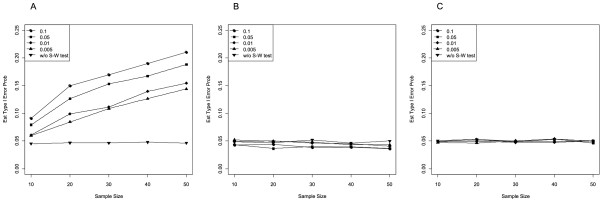
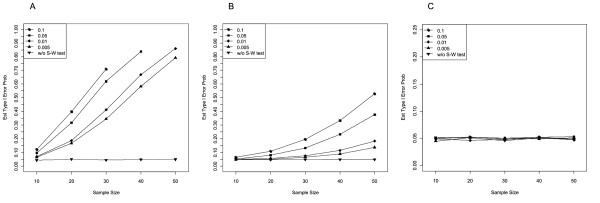
Verification
Claims the paper makes
The claims and statistics of this paper haven’t been checked yet.
Run the check — free, no account needed. It reads the open-access text and checks the sources it cites.
Claims other papers make about this one
Each is checked against this paper’s own text: does it say what the citing paper says it does?
The source backs part of the claim, not all of it — or backs it for a different population, condition or comparison.
In the citing paper
“The sample of each group was large enough, and comparisons were not affected by the shape of the error distribution and no transformation was applied [27].”
From Effects of short-term breathing exercises on respiratory recovery in patients with COVID-19: a quasi-experimental study (2022) · cites this paper as [27]
Experimental — accuracy not yet measured
Self-check
Percentages, sums and reported differences re-computed from the paper’s own numbers.
The self-check needs the paper’s full text.
Citations
Cites
R: A Language and Environment for Statistical Computing
R Core Team (2000) · doi:10.32614/r.manuals · Cited by 355,893
Practical Statistics for Medical Research.
Walter, S., & Altman, D. G. (1992) · Biometrics · doi:10.2307/2532320 · Cited by 11,666
Practical Statistics for Medical Research
Altman, D. G. (1990) · doi:10.1201/9780429258589 · Cited by 10,668
Moher, D., Schulz, K. F., & Altman, D. G. (2001) · The Lancet · doi:10.1016/s0140-6736(00)04337-3 · Cited by 5,373
Practical Statistics for Medical Research.
Bartko, J. J., & Altman, D. G. (1992) · Journal of the American Statistical Association · doi:10.2307/2290246 · Cited by 4,834
Fundamentals of Biostatistics.
(1969) · Annals of Internal Medicine · doi:10.7326/0003-4819-70-4-873 · Cited by 4,573
Moher, D., Schulz, K. F., & Altman, D. G. (2001) · BMC Medical Research Methodology · doi:10.1186/1471-2288-1-2 · Cited by 2,755
Statistical Methods in Medical Research
Armitage, P., Berry, G., & Matthews, J. N. S. (2002) · Wiley eBooks · doi:10.1002/9780470773666 · Cited by 1,638
Fundamentals of Biostatistics.
Cornell, R. G., & ROSNER, B. A. (1987) · Journal of the American Statistical Association · doi:10.2307/2289416 · Cited by 1,613
The unicorn, the normal curve, and other improbable creatures.
Micceri, T. (1989) · Psychological Bulletin · doi:10.1037/0033-2909.105.1.156 · Cited by 1,487
Research works printed but not linked: 3
- New England Journal of Medicine: Guidelines for manuscript submission. (Retrieved from http://www.nejm.org/page/author-center/manuscript-submission ); 2011
- Pappas PA, DePuy V: An overview of non-parametric tests in SAS: When, why and how. Proceeding of the. SouthEast SAS Users Group Conference (SESUG 2004): Paper TU04. 2004, Miami, FL, SouthEast SAS Users Group, 1-5.
- ICH E3: Structure and content of clinical study reports. 1995, International Conference on Harmonisation, London, UK
Cited by
Sorted by citations
Beyond Bar and Line Graphs: Time for a New Data Presentation Paradigm
Weissgerber, T. L., Milic, N. M., Winham, S. J., & Garovic, V. D. (2015) · PLoS Biology · doi:10.1371/journal.pbio.1002128 · Cited by 752
Annweiler, G., Corvaisier, M., Gautier, J., Dubée, V., Legrand, É., Sacco, G., & Annweiler, C. (2020) · Nutrients · doi:10.3390/nu12113377 · Cited by 257
Parametric or Non-parametric: Skewness to Test Normality for Mean Comparison
Orçan, F. (2020) · International Journal of Assessment Tools in Education · doi:10.21449/ijate.656077 · Cited by 232
Vitamin D and survival in COVID-19 patients: A quasi-experimental study
Annweiler, C., Hanotte, B., de l’Eprevier, C. G., Sabatier, J., Lafaie, L., & Célarier, T. (2020) · The Journal of Steroid Biochemistry and Molecular Biology · doi:10.1016/j.jsbmb.2020.105771 · Cited by 228
Simpson, J., Loh, Z., Ullah, M. A., Lynch, J. P., Werder, R. B., Collinson, N., Zhang, V., Dondelinger, Y., Bertrand, M. J. M., Everard, M. L., et al. (2020) · American Journal of Respiratory and Critical Care Medicine · doi:10.1164/rccm.201906-1149oc · Cited by 124
Metadata
- Authors
- Rochon, J., Gondan, M., & Kieser, M.
- Affiliations
- Heidelberg University (DE)
- Corresponding author
- Rochon, Justine
- Venue
- BMC Medical Research Methodology
- Published
- 2012-06-19
- Volume
- 12
- Issue
- 1
- Pages
- 81-81
- ISSN
- 1471-2288 (ISSN-L)
- PMC
- PMC3444333
- OpenAlex
- W2162286641
- Cited by
- 296
- References
- 63
- Citations by year
- 2026: 28 · 2025: 44 · 2024: 35 · 2023: 25 · 2022: 33 · 2021: 37 · 2020: 24 · 2019: 15 · 2018: 13 · 2017: 10 · 2016: 9 · 2015: 13 · 2014: 6 · 2013: 3 · 2012: 1
- FWCI
- 7.03
- Type
- journal article
- Language
- en
- Open access
- gold
- doi.org
- Licence
- Locations
- BMC Medical Research Methodology (publishedVersion, cc-by)
- Europe PMC (PubMed Central) (publishedVersion, cc-by)
- PubMed Central (publishedVersion, cc-by)
- PubMed (publishedVersion)
- Research at the University of Copenhagen (University of Copenhagen) (publishedVersion, other-oa)
- DOAJ (DOAJ: Directory of Open Access Journals) (submittedVersion, cc-by-sa)
- Topics
- Physical Sciences › Mathematics › Statistics and Probability › Probability and Statistical Research
- Physical Sciences › Mathematics › Statistics and Probability › Statistical Distribution Estimation and Applications
- Physical Sciences › Mathematics › Statistics and Probability › Statistical Methods in Clinical Trials
- Keywords
- two-sample t-test, normality testing, Shapiro-Wilk test, two-stage procedure, selection bias, Mann-Whitney test, nonparametric tests, statistical power, independent samples, exponential distribution, uniform distribution
- MeSH terms
- Computer Simulation, Data Interpretation, Statistical, Humans, Models, Statistical, Selection Bias, Normal Distribution, Statistics, Nonparametric
About these checks
Registry, retraction, Cites and statistics results are computed, not judged, with one exception: a printed reference that no index lists is read once by a model before it counts as a citation error. Claims are extracted by a model and kept only when their quote appears verbatim in the text; each cited source is then checked, with a model’s help, for whether it says what the claim relies on. Those verdicts can be wrong — read the claim’s quote and the cited source before relying on one.
Statistics and arithmetic are recomputed, not judged.
Confidence bands are shown only for fields calibrated on our annotated test set. None is calibrated yet, so no band is shown.
What counts as a claim ›How we measure confidence ›How we check this ›
Are you an author, or do you see a problem with this page? Request a review
