

The DOI matches its Crossref record; 39 of the 39 references it cites were found in a registry or an index.
Rapid appraisal of barriers to the diagnosis and management of patients with dementia in primary care: a systematic review
Open accessAbstract
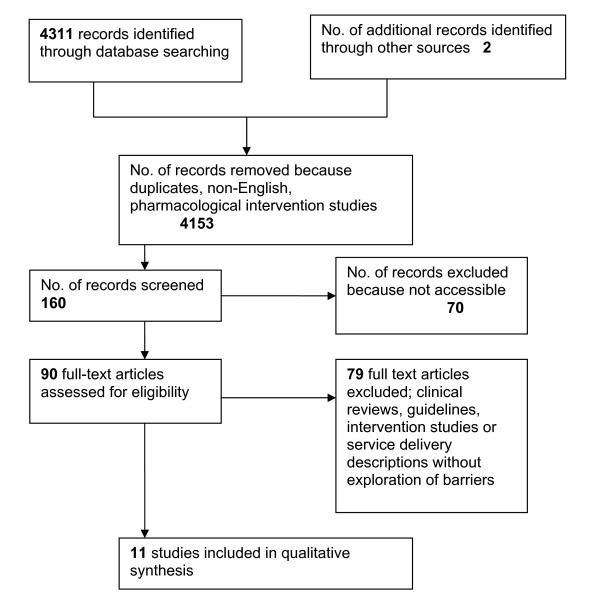
BACKGROUND: The diagnosis of dementia in primary care is perceived as a problem across countries and systems, resulting in delayed recognition and adverse outcomes for patients and their carers. Improving its early detection is an area identified for development in the English National Dementia Strategy 2009; there are thought to be multiple benefits to the patient, family, and resources by doing this. The aim of this review was to carry out a rapid appraisal in order to inform the implementation of this policy. METHOD: Publications in English up to August 2009 relating to barriers to the recognition of dementia, were identified by a broad search strategy, using electronic databases MEDLINE, EMBASE, and psycINFO. Exclusion criteria included non-English language, studies about pharmacological interventions or screening instruments, and settings without primary care. RESULTS: Eleven empirical studies were found: 3 quantitative, 6 qualitative, and 2 with mixed methodologies. The main themes from the qualitative studies were found to be lack of support, time constraints, financial constraints, stigma, diagnostic uncertainty, and disclosing the diagnosis. Quantitative studies yielded diverse results about knowledge, service support, time constraints, and confidence. The factors identified in qualitative and quantitative studies were grouped into 3 categories: patient factors, GP factors and system characteristics. CONCLUSION: Much can still be done in the way of service development and provision, GP training and education, and the eradication of stigma attached to dementia, to improve the early detection and management of dementia. Implementation of dementia strategies should include attention to all three categories of barriers. Further research should focus on their interaction, using different methods from studies to date.
Overview
The claims and statistics of this paper haven’t been checked yet.
Run the check — free, no account needed. It reads the open-access text and checks the sources it cites.
Integrity signals
Registry
Cites
Statistics
Figures
Verification
Claims the paper makes
The claims and statistics of this paper haven’t been checked yet.
Run the check — free, no account needed. It reads the open-access text and checks the sources it cites.
Claims other papers make about this one
Each is checked against this paper’s own text: does it say what the citing paper says it does?
The cited source says what the claim attributes to it.
In the citing paper
“Personal style, defined as the perceived fit between the intervention and the preferred style of clinical practice, such as clinicians’ communication style [78, 79], personality [54] and philosophical opposition to the intervention [69, 76], were presented exclusively as barriers.”
From Achieving change in primary care—causes of the evidence to practice gap: systematic reviews of reviews (2015) · cites this paper as [79]
The check wasn’t confident either way, so it gives no verdict — never disputed.
In the citing paper
“Perceptions of barriers may be socially constructed, and addressing them may not necessarily improve implementation [79].”
From Achieving change in primary care—causes of the evidence to practice gap: systematic reviews of reviews (2015) · cites this paper as [79]
Experimental — accuracy not yet measured
Self-check
Percentages, sums and reported differences re-computed from the paper’s own numbers.
The self-check needs the paper’s full text.
Citations
Cites
Preferred Reporting Items for Systematic Reviews and Meta-Analyses: the PRISMA statement
Moher, D., Liberati, A., Tetzlaff, J., Altman, D. G., & for the PRISMA Group (2009) · BMJ · doi:10.1136/bmj.b2535 · Cited by 83,823
Preferred reporting items for systematic reviews and meta-analyses: the PRISMA Statement.
(2009) · PubMed Central · Cited by 44,859
Dixon-Woods, M., Cavers, D., Agarwal, S., Annandale, E., Arthur, A., Harvey, J., Hsu, R., Katbamna, S., Olsen, R., Smith, L., et al. (2006) · BMC Medical Research Methodology · doi:10.1186/1471-2288-6-35 · Cited by 2,289
Living Well with Dementia: A National Dementia Strategy
(2009) · PsycEXTRA Dataset · doi:10.1037/e608082011-001 · Cited by 1,119
Rogers, S. L., & Friedhoff, L. T. (1996) · Dementia and Geriatric Cognitive Disorders · doi:10.1159/000106895 · Cited by 743
Evidence based policy: proceed with careCommentary: research must be taken seriously
Black, N. A., & Donald, A. (2001) · BMJ · doi:10.1136/bmj.323.7307.275 · Cited by 588 · cited 1×
“Influencing policy development and implementation is now an issue for researchers in all those countries with government-driven dementia strategies, and as Black has pointed out [25], timing is important: "Windows of opportunity to make change open up only rarely and briefly, when policy makers' values happen to coinc…”
BackgroundNon-communicable diseases must have greater priority, says WHO
Zarocostas, J. (2009) · British medical journal · doi:10.1136/bmj.b2857 · Cited by 391
Turner, S., Iliffe, S., Downs, M., Wilcock, J., Bryans, M., Levin, E., Keady, J., & O'Carroll, R. (2004) · Age and Ageing · doi:10.1093/ageing/afh140 · Cited by 375 · cited 7×
“The response rates of the studies ranged from 28% (n = 127) [30] to 67% (n = 153) [16].”
BackgroundResultInfluentialSelf-citationDiagnosing Dementia: Perspectives of Primary Care Physicians
Boise, L., Camicioli, R. M., Morgan, D. L., Rose, J. H., & Congleton, L. (1999) · The Gerontologist · doi:10.1093/geront/39.4.457 · Cited by 329 · cited 1×
“Despite this, early detection of dementia is difficult to achieve in primary care across different health care systems [16-18] with diagnosis taking between 18 to 30 months, and in the extreme, up to 4 years [19].”
BackgroundPractice constraints, behavioral problems, and dementia care: primary care physicians' perspectives
Hinton, L., Franz, C. E., Reddy, G., Flores, Y., Kravitz, R. L., & Barker, J. C. (2007) · Journal of General Internal Medicine · doi:10.1007/s11606-007-0317-y · Cited by 268 · cited 5×
“Inadequate financial remuneration (especially in countries where PCPs are paid according to services they provide) was proposed by PCPs as a barrier in the qualitative research [33,28,31,34], and was confirmed in one quantitative study (46% of PCPs in Turner et al [30]).”
BackgroundResultInfluential
Research works printed but not linked: 5
- Alzheimer's Disease International: Global Alzheimer's Disease Charter. 2009, (accessed 12/04/10), [ http://www.globalcharter.org/charter.php ]
- Levin E, Sinclair I, Gorbach P: Families Confusion, & Old Age. 1989, Aldershot: Gower
- The Audit Commission: Forget me not: developing mental health services for older people in England. 2000, London, The Audit Commission
- National Audit Office: Improving services and support for people with dementia. 2007, London: TSO
- Public Accounts Committee: Sixth report of session 2007-8: Improving services and support for people with dementia. 2008, London: TSO
Cited by
Sorted by citations
2015 Alzheimer's disease facts and figures
Alzheimer's Association (2015) · Alzheimer s & Dementia · doi:10.1016/j.jalz.2015.02.003 · Cited by 1,684
Lau, R., Stevenson, F., Ong, B. N., Dziedzic, K., Treweek, S., Eldridge, S., Everitt, H., Kennedy, A., Qureshi, N., Rogers, A., et al. (2015) · Implementation Science · doi:10.1186/s13012-016-0396-4 · Cited by 533
“Koch T 2010 [79] Rapid appraisal of barriers to the diagnosis and management of patients with dementia in primary care: a systematic review Systematic review To systematically investigate current evidence about the barriers to dementia diagnosis in primary care Inclusion criteria Studies related to barriers to the rec…”
BackgroundMethodInfluentialTimely Diagnosis for Alzheimer’s Disease: A Literature Review on Benefits and Challenges
Dubois, B., Padovani, A., Scheltens, P., Rossi, A., & Dell’Agnello, G. (2015) · Journal of Alzheimer s Disease · doi:10.3233/jad-150692 · Cited by 565
“ally be harmful to patients [39, 73–75].”
Cognitive assessment tools for mild cognitive impairment screening
Zhuang, L., Yang, Y. W., & Gao, J. (2019) · Journal of Neurology · doi:10.1007/s00415-019-09506-7 · Cited by 226
“Amnestic subtypes are associated with higher risk of progression to Alzheimer’s disease (AD), compared with non-amnestic subtypes [13].”
BackgroundMitchell, A. J., Meader, N., & Pentzek, M. (2011) · Acta Psychiatrica Scandinavica · doi:10.1111/j.1600-0447.2011.01730.x · Cited by 199
Metadata
- Authors
- the EVIDEM-ED project, Koch, T., & Iliffe, S.
- Affiliations
- The Royal Free Hospital (GB)
- Corresponding author
- Koch, Tamar
- ORCID
- Iliffe, Steve
- Venue
- BMC Family Practice
- Published
- 2010-07-01
- Volume
- 11
- Issue
- 1
- Pages
- 52-52
- ISSN
- 1471-2296 (ISSN-L)
- PMC
- PMC2909966
- OpenAlex
- W2049017668
- Cited by
- 275
- References
- 39
- Citations by year
- 2026: 15 · 2025: 19 · 2024: 15 · 2023: 12 · 2022: 25 · 2021: 15 · 2020: 26 · 2019: 24 · 2018: 23 · 2017: 8 · 2016: 11 · 2015: 19 · 2014: 15 · 2013: 23 · 2012: 15
- FWCI
- 2.18
- Type
- journal article
- Language
- en
- Open access
- gold
- doi.org
- Licence
- Locations
- BMC Family Practice (publishedVersion, cc-by)
- PubMed Central (publishedVersion, cc-by)
- PubMed (publishedVersion)
- DOAJ (DOAJ: Directory of Open Access Journals) (submittedVersion, cc-by-sa)
- Funders
- National Institute for Health and Care Research (RP-PG-0606-1005)
- Topics
- Health Sciences › Medicine › Psychiatry and Mental health › Dementia and Cognitive Impairment Research
- Health Sciences › Medicine › Family Practice › Primary Care and Health Outcomes
- Health Sciences › Health Professions › General Health Professions › Patient-Provider Communication in Healthcare
- Keywords
- dementia, barriers to diagnosis, early detection, primary care, general practitioners, dementia stigma, diagnostic uncertainty, diagnosis disclosure, general practice training, time constraints, financial constraints, National Dementia Strategy, dementia management
- MeSH terms
- Attitude of Health Personnel, Dementia, Humans, Primary Health Care, Disease Management, Early Diagnosis
About these checks
Registry, retraction, Cites and statistics results are computed, not judged, with one exception: a printed reference that no index lists is read once by a model before it counts as a citation error. Claims are extracted by a model and kept only when their quote appears verbatim in the text; each cited source is then checked, with a model’s help, for whether it says what the claim relies on. Those verdicts can be wrong — read the claim’s quote and the cited source before relying on one.
Statistics and arithmetic are recomputed, not judged.
Confidence bands are shown only for fields calibrated on our annotated test set. None is calibrated yet, so no band is shown.
What counts as a claim ›How we measure confidence ›How we check this ›
Are you an author, or do you see a problem with this page? Request a review
