

The DOI matches its Crossref record; 39 of the 39 references it cites were found in a registry or an index.
Rapid appraisal of barriers to the diagnosis and management of patients with dementia in primary care: a systematic review
Open accessAbstract
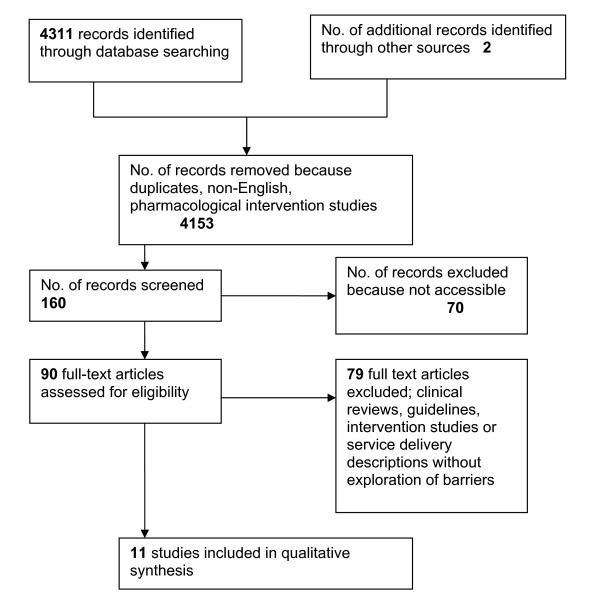
BACKGROUND: The diagnosis of dementia in primary care is perceived as a problem across countries and systems, resulting in delayed recognition and adverse outcomes for patients and their carers. Improving its early detection is an area identified for development in the English National Dementia Strategy 2009; there are thought to be multiple benefits to the patient, family, and resources by doing this. The aim of this review was to carry out a rapid appraisal in order to inform the implementation of this policy. METHOD: Publications in English up to August 2009 relating to barriers to the recognition of dementia, were identified by a broad search strategy, using electronic databases MEDLINE, EMBASE, and psycINFO. Exclusion criteria included non-English language, studies about pharmacological interventions or screening instruments, and settings without primary care. RESULTS: Eleven empirical studies were found: 3 quantitative, 6 qualitative, and 2 with mixed methodologies. The main themes from the qualitative studies were found to be lack of support, time constraints, financial constraints, stigma, diagnostic uncertainty, and disclosing the diagnosis. Quantitative studies yielded diverse results about knowledge, service support, time constraints, and confidence. The factors identified in qualitative and quantitative studies were grouped into 3 categories: patient factors, GP factors and system characteristics. CONCLUSION: Much can still be done in the way of service development and provision, GP training and education, and the eradication of stigma attached to dementia, to improve the early detection and management of dementia. Implementation of dementia strategies should include attention to all three categories of barriers. Further research should focus on their interaction, using different methods from studies to date.
Overview
The claims and statistics of this paper haven’t been checked yet.
Run the check — free, no account needed. It reads the open-access text and checks the sources it cites.
Integrity signals
Registry
Cites
Statistics
Figures
Verification
Claims the paper makes
The claims and statistics of this paper haven’t been checked yet.
Run the check — free, no account needed. It reads the open-access text and checks the sources it cites.
Claims other papers make about this one
Each is checked against this paper’s own text: does it say what the citing paper says it does?
The cited source says what the claim attributes to it.
In the citing paper
“Personal style, defined as the perceived fit between the intervention and the preferred style of clinical practice, such as clinicians’ communication style [78, 79], personality [54] and philosophical opposition to the intervention [69, 76], were presented exclusively as barriers.”
From Achieving change in primary care—causes of the evidence to practice gap: systematic reviews of reviews (2015) · cites this paper as [79]
The check wasn’t confident either way, so it gives no verdict — never disputed.
In the citing paper
“Perceptions of barriers may be socially constructed, and addressing them may not necessarily improve implementation [79].”
From Achieving change in primary care—causes of the evidence to practice gap: systematic reviews of reviews (2015) · cites this paper as [79]
Experimental — accuracy not yet measured
Self-check
Percentages, sums and reported differences re-computed from the paper’s own numbers.
The self-check needs the paper’s full text.
Citations
Cites
Preferred Reporting Items for Systematic Reviews and Meta-Analyses: the PRISMA statement
Moher, D., Liberati, A., Tetzlaff, J., Altman, D. G., & for the PRISMA Group (2009) · BMJ · doi:10.1136/bmj.b2535 · Cited by 83,823
Preferred reporting items for systematic reviews and meta-analyses: the PRISMA Statement.
(2009) · PubMed Central · Cited by 44,859
Dixon-Woods, M., Cavers, D., Agarwal, S., Annandale, E., Arthur, A., Harvey, J., Hsu, R., Katbamna, S., Olsen, R., Smith, L., et al. (2006) · BMC Medical Research Methodology · doi:10.1186/1471-2288-6-35 · Cited by 2,289
Living Well with Dementia: A National Dementia Strategy
(2009) · PsycEXTRA Dataset · doi:10.1037/e608082011-001 · Cited by 1,119
Rogers, S. L., & Friedhoff, L. T. (1996) · Dementia and Geriatric Cognitive Disorders · doi:10.1159/000106895 · Cited by 743
Evidence based policy: proceed with careCommentary: research must be taken seriously
Black, N. A., & Donald, A. (2001) · BMJ · doi:10.1136/bmj.323.7307.275 · Cited by 588 · cited 1×
“Influencing policy development and implementation is now an issue for researchers in all those countries with government-driven dementia strategies, and as Black has pointed out [25], timing is important: "Windows of opportunity to make change open up only rarely and briefly, when policy makers' values happen to coinc…”
BackgroundNon-communicable diseases must have greater priority, says WHO
Zarocostas, J. (2009) · British medical journal · doi:10.1136/bmj.b2857 · Cited by 391
Turner, S., Iliffe, S., Downs, M., Wilcock, J., Bryans, M., Levin, E., Keady, J., & O'Carroll, R. (2004) · Age and Ageing · doi:10.1093/ageing/afh140 · Cited by 375 · cited 7×
“The response rates of the studies ranged from 28% (n = 127) [30] to 67% (n = 153) [16].”
BackgroundResultInfluentialSelf-citationDiagnosing Dementia: Perspectives of Primary Care Physicians
Boise, L., Camicioli, R. M., Morgan, D. L., Rose, J. H., & Congleton, L. (1999) · The Gerontologist · doi:10.1093/geront/39.4.457 · Cited by 329 · cited 1×
“Despite this, early detection of dementia is difficult to achieve in primary care across different health care systems [16-18] with diagnosis taking between 18 to 30 months, and in the extreme, up to 4 years [19].”
BackgroundPractice constraints, behavioral problems, and dementia care: primary care physicians' perspectives
Hinton, L., Franz, C. E., Reddy, G., Flores, Y., Kravitz, R. L., & Barker, J. C. (2007) · Journal of General Internal Medicine · doi:10.1007/s11606-007-0317-y · Cited by 268 · cited 5×
“Inadequate financial remuneration (especially in countries where PCPs are paid according to services they provide) was proposed by PCPs as a barrier in the qualitative research [33,28,31,34], and was confirmed in one quantitative study (46% of PCPs in Turner et al [30]).”
BackgroundResultInfluential
Research works printed but not linked: 5
- Alzheimer's Disease International: Global Alzheimer's Disease Charter. 2009, (accessed 12/04/10), [ http://www.globalcharter.org/charter.php ]
- Levin E, Sinclair I, Gorbach P: Families Confusion, & Old Age. 1989, Aldershot: Gower
- The Audit Commission: Forget me not: developing mental health services for older people in England. 2000, London, The Audit Commission
- National Audit Office: Improving services and support for people with dementia. 2007, London: TSO
- Public Accounts Committee: Sixth report of session 2007-8: Improving services and support for people with dementia. 2008, London: TSO
Cited by
Sorted by citations
2015 Alzheimer's disease facts and figures
Alzheimer's Association (2015) · Alzheimer s & Dementia · doi:10.1016/j.jalz.2015.02.003 · Cited by 1,684
Lau, R., Stevenson, F., Ong, B. N., Dziedzic, K., Treweek, S., Eldridge, S., Everitt, H., Kennedy, A., Qureshi, N., Rogers, A., et al. (2015) · Implementation Science · doi:10.1186/s13012-016-0396-4 · Cited by 533
“Koch T 2010 [79] Rapid appraisal of barriers to the diagnosis and management of patients with dementia in primary care: a systematic review Systematic review To systematically investigate current evidence about the barriers to dementia diagnosis in primary care Inclusion criteria Studies related to barriers to the rec…”
BackgroundMethodInfluentialTimely Diagnosis for Alzheimer’s Disease: A Literature Review on Benefits and Challenges
Dubois, B., Padovani, A., Scheltens, P., Rossi, A., & Dell’Agnello, G. (2015) · Journal of Alzheimer s Disease · doi:10.3233/jad-150692 · Cited by 565
“ally be harmful to patients [39, 73–75].”
Cognitive assessment tools for mild cognitive impairment screening
Zhuang, L., Yang, Y. W., & Gao, J. (2019) · Journal of Neurology · doi:10.1007/s00415-019-09506-7 · Cited by 226
“Amnestic subtypes are associated with higher risk of progression to Alzheimer’s disease (AD), compared with non-amnestic subtypes [13].”
BackgroundMitchell, A. J., Meader, N., & Pentzek, M. (2011) · Acta Psychiatrica Scandinavica · doi:10.1111/j.1600-0447.2011.01730.x · Cited by 199
Aminzadeh, F., Molnar, F., Dalziel, W. B., & Ayotte, D. (2012) · Canadian Geriatrics Journal · doi:10.5770/cgj.15.42 · Cited by 189
“90 primary care.(7,9,13,31,54) Promoting a more active management role in primary care would require the use of more adequate reimbursement systems that would make it more realistic for PCP to take the time needed to effectively assess, monitor, and manage dementia and other co-morbidities among their frail older pati…”
BackgroundTime to diagnosis and factors affecting diagnostic delay in amyotrophic lateral sclerosis
Richards, D., Morren, J. A., & Pioro, E. P. (2020) · Journal of the Neurological Sciences · doi:10.1016/j.jns.2020.117054 · Cited by 185
Primary Care Physicians’ Perceived Barriers to Optimal Dementia Care: A Systematic Review
Mansfield, E. L., Noble, N., Sanson‐Fisher, R., Mazza, D., & Bryant, J. (2018) · The Gerontologist · doi:10.1093/geront/gny067 · Cited by 144
Savva, G. M., & Arthur, A. J. (2015) · Age and Ageing · doi:10.1093/ageing/afv020 · Cited by 138
Reducing the Stigma Associated with Dementia: Approaches and Goals
Mukadam, N., & Livingston, G. (2012) · Aging Health · doi:10.2217/ahe.12.42 · Cited by 134
Clinical practice guidelines for dementia in Australia
Laver, K., Cumming, R. G., Dyer, S. M., Agar, M. R., Anstey, K. J., Beattie, E., Brodaty, H., Broe, T., Clemson, L. M., Crotty, M., et al. (2016) · The Medical Journal of Australia · doi:10.5694/mja15.01339 · Cited by 136
“A number of barriers to care have been identified when accessing primary care.[41] These are attributed to a variety of reasons including patient factors (such as perceived stigma), general practitioner factors (such as diagnostic uncertainty) and system characteristics (such as time constraints).”
BackgroundBurgener, S. C., Buckwalter, K., Perkhounkova, Y., & Liu, M. F. (2013) · Dementia · doi:10.1177/1471301213504202 · Cited by 112
“Initial evidence suggests that the stigma of dementia has been associated with delays in or lack of accurate diagnosis and treatment, potentially negatively impacting on disease progression and management (Koch & Iliffe, 2010).”
Backgroundvan den Dungen, P., van Marwijk, H., van der Horst, H. E., van Charante, E. P. M., Vroomen, J. L. M., van de Ven, P. M., & van Hout, H. P. J. (2011) · International Journal of Geriatric Psychiatry · doi:10.1002/gps.2726 · Cited by 111
“Another area deserving further attention is the development of educational interventions with more emphasis on FPs’ perceptions of their own suitability and capability to diagnose dementia, their skills to communicate the diagnosis and the importance of early diagnosis (Iliffe et al., 2009; Koch and Iliffe, 2010).”
BackgroundBucholc, M., Ding, X., Wang, H., Glass, D. H., Wang, H., Prasad, G., Maguire, L., Bjourson, A. J., McClean, P. L., Todd, S., et al. (2019) · Expert Systems with Applications · doi:10.1016/j.eswa.2019.04.022 · Cited by 106
Weitzman, E. R., Kelemen, S., Kaci, L., & Mandl, K. D. (2012) · BMC Medical Informatics and Decision Making · doi:10.1186/1472-6947-12-39 · Cited by 103
“Stigma and discrimination are well-documented [39-43] making reticence a self-protecting impulse for some respondents.”
BackgroundMurphy, K., O’Connor, D. A., Browning, C. J., French, S. D., Michie, S., Francis, J., Russell, G. M., Workman, B., Flicker, L. A., Eccles, M., et al. (2014) · Implementation Science · doi:10.1186/1748-5908-9-31 · Cited by 101
Dementia: Stigma and Its Effects
Benbow, S., & Jolley, D. J. (2012) · Neurodegenerative Disease Management · doi:10.2217/nmt.12.7 · Cited by 93
Cheng, S., LAM, L. C. W., Chan, L. C. K., Law, A. C. B., Fung, A. W. T., Chan, W. C., Tam, C. W. C., & Chan, W.-M. (2011) · International Psychogeriatrics · doi:10.1017/s1041610211000834 · Cited by 92
“In a recent review of the barriers to diagnosis and management of patients with dementia, stigma was identified as one of the major themes affecting helpseeking (Koch and Iliffe, 2010).”
BackgroundPreferences regarding disclosure of a diagnosis of dementia: a systematic review
van den Dungen, P., van Kuijk, L., van Marwijk, H., van der Wouden, J. C., van Charante, E. P. M., van der Horst, H. E., & van Hout, H. P. J. (2014) · International Psychogeriatrics · doi:10.1017/s1041610214000969 · Cited by 90
Relationships between quality of life and family function in caregiver
Rodríguez‐Sánchez, E., Peñaranda, A. P., Losada‐Baltar, A., Pérez-Arechaederra, D., Gómez-Marcos, M. Á., Patino-Alonso, M. C., & García‐Ortiz, L. (2011) · BMC Family Practice · doi:10.1186/1471-2296-12-19 · Cited by 90
Primary Care Practitioner Perspectives on the Role of Primary Care in Dementia Diagnosis and Care
Sideman, A. B., Ma, M. J., de Jesús, A. H., Alagappan, C., Razon, N., Dohan, D. P., Chodos, A. H., Al‐Rousan, T., Alving, L. I., Segal‐Gidan, F., et al. (2023) · JAMA Network Open · doi:10.1001/jamanetworkopen.2023.36030 · Cited by 93
Werner, P., Karnieli‐Miller, O., & Eidelman, S. (2012) · Alzheimer s & Dementia · doi:10.1016/j.jalz.2012.02.006 · Cited by 88
“The same group of researchers in an article Ducharme et al [64] Canada 13 primary caregivers of persons with dementia who have received the diagnosis in the previous 6 months Development and qualitative assessment of a psychoeducational intervention program for caregivers after the diagnosis The feasibility, acceptabi…”
BackgroundResultInfluentialShao, Y., Zeng, Q. T., Chen, K. K., Shutes‐David, A., Thielke, S. M., & Tsuang, D. W. (2019) · BMC Medical Informatics and Decision Making · doi:10.1186/s12911-019-0846-4 · Cited by 83
Improving access to dementia services for people from minority ethnic groups
Mukadam, N., Cooper, C., & Livingston, G. (2013) · Current Opinion in Psychiatry · doi:10.1097/yco.0b013e32835ee668 · Cited by 77
“General practitioners are sometimes reluctant to diagnose dementia, as they assume the patient would not wish to receive the diagnosis because of stigma [22] or because of their own feelings that a diagnosis is pointless [23].”
BackgroundDifficulties in disclosing the diagnosis of dementia: a qualitative study in general practice
Phillips, J., Pond, C. D., Paterson, N. E., Howell, C., Shell, A., Stocks, N. P., Goode, S. M., & Marley, J. E. (2012) · British Journal of General Practice · doi:10.3399/bjgp12x653598 · Cited by 75
Foley, T., Boyle, S., Jennings, A., & Smithson, W. H. (2017) · BMC Family Practice · doi:10.1186/s12875-017-0639-8 · Cited by 74
“GPs have described barriers to care that include inadequate support services, a lack of time, financial constraints, concerns regarding stigma and also diagnostic and disclosure uncertainty [9].”
BackgroundA Framework for Rigorous Qualitative Research as a Component of Mixed Method Rapid-Cycle Evaluation
Skillman, M., Cross‐Barnet, C., Singer, R., Rotondo, C., Ruiz, S., & Moiduddin, A. (2018) · Qualitative Health Research · doi:10.1177/1049732318795675 · Cited by 74
“Methods described previously have generally focused on evaluating a specific program or topic (Koch & Iliffe, 2010; Murray, 1999; Rowa-Dewar et al., 2008; Schneeweiss et al., 2015; Taylor et al., 2014; Trotter et al., 2001).”
Chan, C., Fage, B. A., Burton, J. K., Smailagic, N., Gill, S. S., Herrmann, N., Nikolaou, V., Quinn, T. J., Noel-Storr, A. H., & Seitz, D. P. (2019) · Cochrane Database of Systematic Reviews · doi:10.1002/14651858.cd011414.pub2 · Cited by 71
Diagnosis and management of dementia in primary care: exploratory study.
Parmar, J., Dobbs, B., McKay, R., Kirwan, C., Cooper, T., Marin, A., & Gupta, N. (2014) · Europe PMC (PubMed Central) · Cited by 68
Iliffe, S., Wilcock, J., Drennan, V. M., Goodman, C. M., Griffin, M., Knapp, M. R. J., Lowery, D., Manthorpe, J., Rait, G., & Warner, J. P. (2015) · Programme Grants for Applied Research · doi:10.3310/pgfar03030 · Cited by 66
Self-citationCreating excellence in dementia care: A research review for Ireland's national dementia strategy
Cahill, S. M., O’Shea, E., & Pierce, M. (2012) · Lenus, The Irish Health Repository (Dr Steevens Hospital Library) · Cited by 64
CBT for Older People: An Introduction
Laidlaw, K. (2015) · SAGE Publications Ltd eBooks · doi:10.4135/9781473910799 · Cited by 61
Jennings, A., Foley, T., Walsh, K. A., Coffey, A., Browne, J. P., & Bradley, C. (2018) · International Journal of Geriatric Psychiatry · doi:10.1002/gps.4918 · Cited by 62
“National strategies developed to address the increased prevalence of dementia(4) have emphasised the role of GPs in successful implementation(5-7) but dementia care in the community can be challenging.(8,9) In common with their hospital‐based colleagues,(10) General practitioners find the management of the behavioural…”
BackgroundDementia diagnosis and management: a narrative review of changing practice
Koch, T., & Iliffe, S. (2011) · British Journal of General Practice · doi:10.3399/bjgp11x588493 · Cited by 55
Self-citationSurvey in Shanghai communities: the public awareness of and attitude towards dementia
Li, X., Wenli, F. A. N. G., Su, N., Liu, Y., Xiao, S., & Xiao, Z. (2011) · Psychogeriatrics · doi:10.1111/j.1479-8301.2010.00349.x · Cited by 55
Judge, D., Roberts, J. S., Khandker, R. K., Ambegaonkar, B. M., & Black, C. M. (2019) · International Journal of Alzheimer s Disease · doi:10.1155/2019/4942562 · Cited by 55
Moore, V., & Cahill, S. M. (2012) · Aging & Mental Health · doi:10.1080/13607863.2012.692763 · Cited by 54
“Koch and Iliffe ( 2010b ) suggest that rather than simply increasing clinical knowledge, educational interventions for GPs' should ideally be attitudinal, focusing on GPs' perceptions of their suitability and ability to diagnose and the value of doing so in a timely way.”
BackgroundGeneral practitioners’ attitudes towards early diagnosis of dementia: a cross-sectional survey
Giezendanner, S., Monsch, A. U., Kressig, R. W., Mueller, Y. K., Streit, S., Essig, S., Zeller, A., & Bally, K. (2019) · BMC Family Practice · doi:10.1186/s12875-019-0956-1 · Cited by 54
Understanding cognition in older patients with cancer
Karuturi, M. S., Wong, M. L., Hsu, T., Kimmick, G. G., Lichtman, S. M., Holmes, H. M., Inouye, S. K., Dale, W., Loh, K. P., Whitehead, M., et al. (2016) · Journal of Geriatric Oncology · doi:10.1016/j.jgo.2016.04.004 · Cited by 53
Perceived barriers to self-management for people with dementia in the early stages
Martin, F., Turner, A., WALLACE, L. M., Choudhry, K., & Bradbury, N. (2012) · Dementia · doi:10.1177/1471301211434677 · Cited by 52
Judge, D., Roberts, J. S., Khandker, R. K., Ambegaonkar, B. M., & Black, C. M. (2019) · International Journal of Alzheimer s Disease · doi:10.1155/2019/3637954 · Cited by 52
“A common theme in prior studies is that patients and family members often believe that symptoms of cognitive decline are part of normal aging [2, 5, 6, 11].”
BackgroundInfluentialChronic disease self-management support for persons with dementia, in a clinical setting
Ibrahim, J. E., Anderson, L., MacPhail, A., Lovell, J. J., Davis, M.-C., & Winbolt, M. (2017) · Journal of Multidisciplinary Healthcare · doi:10.2147/jmdh.s121626 · Cited by 51
“47 Belief that the carer is able to manage all health-related issues.”
Time to Diagnosis in Dementia: A Systematic Review With Meta‐Analysis
Kusoro, O., Roche, M., Casado, R. D. P., Leung, P., & Orgeta, V. (2025) · International Journal of Geriatric Psychiatry · doi:10.1002/gps.70129 · Cited by 49
“Dementia is a complex syndrome, making the recognition of the condition challenging for people with dementia, their families and healthcare providers [14, 15].”
Health care transitions for persons living with dementia and their caregivers
Ashbourne, J., Boscart, V., Meyer, S., Tong, C. E., & Stolee, P. (2021) · BMC Geriatrics · doi:10.1186/s12877-021-02235-5 · Cited by 49
“reality of many practitioners as well [54, 55].”
Petrazzuoli, F., Vinker, S., Koskela, T., Frese, T., Buono, N., Soler, J. K., Ahrensberg, J. M., Аsenova, R., Boreu, Q. F., Peker, G. C., et al. (2017) · International Psychogeriatrics · doi:10.1017/s1041610217000552 · Cited by 48
“According to our 2015 survey, European PCPs seemed to be willing to start dementia investigations and assessments, but time constraints was the major barrier (van Hout et al., 2000; Turner et al., 2004; Hinton et al., 2007; Bradford et al., 2009; Koch and Iliffe, 2010a; Parmar et al., 2014).”
Featherstone, K., Northcott, A., Harden, J., Dening, K. H., Tope, R., Bale, S., & Bridges, J. (2019) · Health Services and Delivery Research · doi:10.3310/hsdr07110 · Cited by 53
Undiagnosed dementia in primary care: a record linkage study
Aldus, C. F., Arthur, A. J., Dennington-Price, A., Millac, P. A. H., Richmond, P., Dening, T., Fox, C., Matthews, F. E., Robinson, L. A., Stephan, B. C. M., et al. (2020) · Health Services and Delivery Research · doi:10.3310/hsdr08200 · Cited by 46
“Unadjusted (95% CI) Adjusted (95% CI) Inpatient visits to hospital, n (%) 0 44 (83) 22 (76) 1+ 9 (17) 7 (24) 1.”
Jennings, A., Linehan, M., & Foley, T. (2018) · BMC Family Practice · doi:10.1186/s12875-018-0853-z · Cited by 45
Managing Shame: A Grounded Theory of How Stigma Manifests in Families Living With Dementia
Lopez, R. P., Rose, K. M., Kenney, L. E., Sanborn, V. E., & Davis, J. D. (2019) · Journal of the American Psychiatric Nurses Association · doi:10.1177/1078390319832965 · Cited by 50
“In addition, a systematic review found that stigma was a barrier to both diagnosis and treatment (Koch & Iliffe, 2010).”
BackgroundZygouris, S., Iliadou, P., Lazarou, E., Giakoumis, D., Votis, K., Alexiadis, A., Triantafyllidis, A. K., Segkouli, S., Tzovaras, D. K., Tsiatsos, Τ., et al. (2020) · Journal of Alzheimer s Disease · doi:10.3233/jad-200880 · Cited by 44
The potential of case management for people with dementia: a commentary
Koch, T., Iliffe, S., Manthorpe, J., Stephens, B., Fox, C., Robinson, L. A., Livingston, G., Coulton, S., Knapp, M. R. J., Chew-Graham, C. A., et al. (2012) · International Journal of Geriatric Psychiatry · doi:10.1002/gps.3783 · Cited by 43
“The interaction of doctor, patient, family, and system barriers to recognising and responding to this syndrome may explain why providing timely, responsive, and appropriate clinical care has been difficult (Koch & Iliffe, 2010).”
BackgroundSelf-citationInformal caregivers' hopes and expectations of a referral to a memory clinic
Morgan, D., Walls-Ingram, S., Cammer, A. L., O’Connell, M. E., Crossley, M., Bello-Haas, V. P. M. D., Forbes, D. A., Innes, A., Kirk, A., & Stewart, N. J. (2013) · Social Science & Medicine · doi:10.1016/j.socscimed.2013.11.023 · Cited by 43
Role Expectations in Dementia Care Among Family Physicians and Specialists
Hum, S., Cohen, C. A., Persaud, M., Lee, J., Drummond, N., Dalziel, W. B., & Pimlott, N. (2014) · Canadian Geriatrics Journal · doi:10.5770/cgj.17.110 · Cited by 41
“(10,13,14) While lack of time in the standard 10–15 minute primary care office visit and inadequate financial reimbursement were cited as barriers in the provision of patient and caregiver education and support,(20-22) our study also demonstrated that fragmentation in the availability and/or access to home care and so…”
BackgroundThe Unforgettables: a chorus for people with dementia with their family members and friends
Mittelman, M. S., Papayannopoulou, P. M., Vernooij-Dassen, M., Moniz-Cook, E. D., & Jeon, Y.-H. (2018) · International Psychogeriatrics · doi:10.1017/s1041610217001867 · Cited by 41
“Stigma has been identified as a major barrier to seeking a diagnostic evaluation (Koch and Iliffe, 2010; Batsch and Mittelman, 2012), and reflects an unfortunate perception in society that reinforces the isolation of people with dementia.”
Fortinsky, R. H., Delaney, C., Harel, O., Pasquale, K. M., Schjavland, E., Lynch, J., Kleppinger, A., & Crumb, S. (2014) · Research in Gerontological Nursing · doi:10.3928/19404921-20140113-01 · Cited by 40
“Many studies have demonstrated gaps in care provided by primary care physicians (PCPs) to older adults with dementia in the United States and elsewhere (Callahan, Hendrie, & Tierney, 1995; Fortinsky, 1998; Fortinsky, Leighton, & Wasson, 1995; Koch & Iliffe, 2010).”
BackgroundCarer Experience Supporting Someone With Dementia and Cancer: A Narrative Approach
Witham, G., Haigh, C. A., Mitchell, D., & Beddow, A. (2017) · Qualitative Health Research · doi:10.1177/1049732317736285 · Cited by 40
“…a reluctance to diagnose by general practitioners due to a fear of stigma (Werner, Goldstein, & Buchbinder, 2010), time limitations that negatively affect on their ability to formally assess people, and diagnostic uncertainty (Bradford, Kunik, Schulz, Williams, & Singh, 2009; Koch & Iliffe, 2010).”
BackgroundBarriers and Best Practices in Disclosing a Dementia Diagnosis: A Clinician Interview Study
Wollney, E. N., Armstrong, M. J., Bedenfield, N., Rosselli, M., Curiel, R. E., Kitaigorodsky, M., Levy, X., & Bylund, C. L. (2022) · Health Services Insights · doi:10.1177/11786329221141829 · Cited by 39
An evaluation of primary care led dementia diagnostic services in Bristol
Dodd, E., Cheston, R., Fear, T., Brown, E., Fox, C., Morley, C., Jefferies, R., & Gray, R. J. (2014) · BMC Health Services Research · doi:10.1186/s12913-014-0592-3 · Cited by 39
A systematic review of interventions to detect dementia or cognitive impairment
Mukadam, N., Cooper, C., Kherani, N., & Livingston, G. (2014) · International Journal of Geriatric Psychiatry · doi:10.1002/gps.4184 · Cited by 38
“Previous systematic reviews, which focussed on interventions to improve primary care dementia diagnosis and management (Koch et al., 2010; Perry et al., 2011), found that educational interventions, particularly those requiring active participation, increased the likelihood of GPs suspecting…”
BackgroundWang, M., Shao, S., Li, J., Liu, Y., Xu, X., & Du, J. (2018) · BMC Family Practice · doi:10.1186/s12875-018-0890-7 · Cited by 39
“General practitioners in Western countries perceived lack of knowledge of early diagnostic, and some of them seemed to attach stigma to the condition of dementia by assuming that the caregiver/patient did not want a diagnosis until the symptoms were so severe that it was inevitable [48].”
BackgroundInterprofessional education in community-based Alzheimer’s disease diagnosis and treatment
McCaffrey, R. G., Tappen, R. M., Lichtstein, D. M., & Friedland, M. (2013) · Journal of Interprofessional Care · doi:10.3109/13561820.2013.817384 · Cited by 35
“…implications for primary healthcare providers, including physicians and nurse practitioners, who play a significant role in early detection, diagnosis and treatment of dementia as well as assisting patients and families to cope with the burdens of this progressive disease (Koch & Lliffe, 2010).”
BackgroundBartfay, E., Bartfay, W. J., & Gorey, K. M. (2013) · International Journal of Geriatric Psychiatry · doi:10.1002/gps.3934 · Cited by 35
“Koch and Iliffe (2010) put forward a mounting evidence of missed diagnosis of dementia in the primary care settings.”
BackgroundDiagnosis of dementia in Australia: a narrative review of services and models of care
Ng, N. S. Q., & Ward, S. A. (2018) · Australian Health Review · doi:10.1071/ah17167 · Cited by 36
Hwang, A. B., Boes, S., Nyffeler, T., & Schuepfer, G. (2019) · PLoS ONE · doi:10.1371/journal.pone.0219569 · Cited by 38
Hsiao, H., Liu, Z., Xu, L., Huang, Y., & Chi, I. (2015) · Gerontology & Geriatrics Education · doi:10.1080/02701960.2014.990152 · Cited by 35
Stewart, T. V., Loskutova, N., Galliher, J. M., Warshaw, G. A., Coombs, L., Staton, E. W., Huff, J., & Pace, W. D. (2014) · The Journal of the American Board of Family Medicine · doi:10.3122/jabfm.2014.02.120284 · Cited by 36
“The reasons for this delay are complex: clinicians may not recognize early symptoms; patients, clinicians, and families may deny or fail to recognize cognitive concerns as part of the dementia process; the public and clinicians may believe that cognitive impairment is normal in aging; and interventions by caregivers m…”
BackgroundAnalysis of Barriers to Cognitive Screening in Rural Populations in the United States
Wiese, L. K., Williams, C. L., & Tappen, R. M. (2014) · Advances in Nursing Science · doi:10.1097/ans.0000000000000049 · Cited by 33
Attitudes to diagnosis and management in dementia care: views of future general practitioners
Tang, E. Y. H., Birdi, R., & Robinson, L. A. (2016) · International Psychogeriatrics · doi:10.1017/s1041610216001204 · Cited by 33
Sannemann, L., Müller, T., Waterink, L., Zwan, M. D., Wimo, A. B., Stomrud, E., Pinó, S., Arrufat, J., Rodríguez‐Gómez, O., Benaque, A., et al. (2021) · Alzheimer s & Dementia Diagnosis Assessment & Disease Monitoring · doi:10.1002/dad2.12130 · Cited by 32
The unmet palliative care needs of those dying with dementia
Dempsey, L., Dowling, M., Larkin, P. J., & Murphy, K. (2015) · International Journal of Palliative Nursing · doi:10.12968/ijpn.2015.21.3.126 · Cited by 33
“Koch and Iliffe (2010) identified that dementia is not diagnosed in time and there is a reluctance to diagnose dementia due to diagnostic uncertainty, fear of labelling or stigma within families or the community, lack of support, time and financial constraints.”
Diagnosing dementia in Dutch general practice: a qualitative study of GPs’ practices and views
Prins, A., Hemke, F., Pols, J. J., & van Charante, E. P. M. (2016) · British Journal of General Practice · doi:10.3399/bjgp16x685237 · Cited by 32
Neural correlates of altered insight in frontotemporal dementia: a systematic review
Muñoz‐Neira, C., Tedde, A., Coulthard, E. J., Thai, N. J., & Pennington, C. M. (2019) · NeuroImage Clinical · doi:10.1016/j.nicl.2019.102066 · Cited by 32
“Aside from this, the heterogeneity of the pathology that causes FTD (Cairns et al., 2007; Mackenzie et al., 2009; Mackenzie et al., 2010; Kovacs, 2016) can result in syndromes characterised by different symptoms, either predominantly behavioural, language associated or motor (Rascovsky et al.,…”
Jeffares, I., Rohde, D., Doyle, F., Horgan, F., & Hickey, A. (2022) · BMC Health Services Research · doi:10.1186/s12913-022-07837-2 · Cited by 31
Barriers for access and utilization of dementia care services in Europe: a systematic review
Sorrentino, M., Fiorilla, C., Mercogliano, M., Stilo, I., Esposito, F., Moccia, M., Lavorgna, L., Salvatore, E., Sormani, M. P., Majeed, A., et al. (2025) · BMC Geriatrics · doi:10.1186/s12877-025-05805-z · Cited by 31
Veneziani, F., Panza, F., Solfrizzi, V., Capozzo, R., Barulli, M. R., Leo, A., Lozupone, M., Fontana, A., Arcuti, S., Copetti, M., et al. (2016) · International Psychogeriatrics · doi:10.1017/s1041610216000041 · Cited by 27
Ensuring the Success of Interprofessional Teams: Key Lessons Learned in Memory Clinics
Lee, L., Hillier, L. M., & Weston, W. W. (2014) · Canadian Journal on Aging / La Revue canadienne du vieillissement · doi:10.1017/s0714980813000652 · Cited by 27
“A systematic review of barriers to dementia diagnosis in primary care identifi ed challenges at three levels: patient or societal factors, physician factors, and system factors (Koch & Iliffe, 2010 ).”
BackgroundIslam, M. M., Parkinson, A., Burns, K., Woods, M., & Yen, L. E. (2020) · International Journal of Nursing Studies · doi:10.1016/j.ijnurstu.2020.103550 · Cited by 27
Timely Diagnosis of Dementia: Can we do better?
Phillips, J., & Pond, D. (2011) · Cited by 27
Time to Diagnosis and Factors Affecting Diagnostic Delay in Amyotrophic Lateral Sclerosis
Richards, D., Morren, J. A., & Pioro, E. P. (2021) · Exon Publications eBooks · doi:10.36255/exonpublications.amyotrophiclateralsclerosis.diagnosticdelay.2021 · Cited by 28
Lü, Y., Liu, C., Fawkes, S. A., Wang, Z., & Yu, D. (2022) · BMC Family Practice · doi:10.1186/s12875-022-01716-9 · Cited by 29
Ptacek, S. G., Modéer, I. N., Kåreholt, I., Fereshtehnejad, S., Farahmand, B. Y., Religa, D., & Eriksdotter, M. (2016) · Age and Ageing · doi:10.1093/ageing/afw189 · Cited by 26
“Patient barriers, such as lack of knowledge and fear of stigma, could delay help-seeking behaviours [19].”
BackgroundWang, J., Xiao, L. D., & Li, X. (2018) · Aging & Mental Health · doi:10.1080/13607863.2018.1426717 · Cited by 26
“As dementia management and care cover a wide spectrum ranging from prevention to palliative care, one-off education or training is unlikely to have much impact (Aminzadeh et al., 2012; Koch et al., 2010).”
BackgroundPond, D. C., Mate, K. E., Stocks, N., Gunn, J. M., Disler, P. B., Magin, P. J., Marley, J. E., Paterson, N., Horton, G. L., Goode, S. M., et al. (2018) · BMJ Open · doi:10.1136/bmjopen-2017-021125 · Cited by 25
Imre, N., Balogh, R., Papp, E., Kovács, I., Heim, S., Karádi, K., Hajnal, F., Kálmán, J., & Pákáski, M. (2019) · Educational Gerontology · doi:10.1080/03601277.2019.1660137 · Cited by 24
“Early and accurate diagnosis, however, requires a number of factors (Koch & Iliffe, 2010), including enough time for patient consultations, suitable conditions for performing cognitive examinations, and naturally, adequate knowledge on dementia from GPs. Lack of knowledge on dementia was found to…”
BackgroundCreavin, S., Noel-Storr, A. H., Langdon, R., Richard, E., Creavin, A. L., Cullum, S. J., Purdy, S., & Ben‐Shlomo, Y. (2022) · Cochrane Database of Systematic Reviews · doi:10.1002/14651858.cd012558.pub2 · Cited by 30
“GPs report lack of time as a barrier to diagnosing dementia (Koch 2010) and report oJen relying on personal observations to make the diagnosis (O'Connor 1993) whereas pen-and-paper tests are used by a minority of people (Pond 2013).”
BackgroundNegotiating access to a diagnosis of dementia: Implications for policies in health and social care
Koehn, S. D., Badger, M., Cohen, C. A., McCleary, L., & Drummond, N. (2014) · Dementia · doi:10.1177/1471301214563551 · Cited by 25
“Previous research suggests that although PsWD and their families rely on their primary care physician for access to care, physicians may not think they have the training or time to implement these resources with patients (Hum et al., 2014; Koch & Iliffe, 2010; Schoenmakers et al., 2009).”
BackgroundDiagnostic communication in the memory clinic: a conversation analytic perspective
Peel, E. (2015) · Aging & Mental Health · doi:10.1080/13607863.2014.1003289 · Cited by 24
“Appointments with 29 patients and accompanying persons were recorded, and the corpus was repeatedly listened to, in conjunction with the transcripts in order to identify the segments of talk where there was an action hearable as diagnostic delivery, that is where the clinician is evaluating the…”
BackgroundMethodDementia Coding, Workup, and Treatment in the VA New England Healthcare System
Cho, K., GAGNON, D. R., Driver, J. A., Altincatal, A., Kosik, N., Lanes, S., & Lawler, E. V. (2014) · International Journal of Alzheimer s Disease · doi:10.1155/2014/821894 · Cited by 23
“The obstacles to dementia diagnosis in primary care are well documented and include important systems issues such as time constraints and lack of support services [12].”
BackgroundInfluence of rurality on diagnosing dementia in Australian general practice
Greenway‐Crombie, A. M., Snow, P. C., Disler, P. B., Davis, S. J., & Pond, D. C. (2012) · Australian Journal of Primary Health · doi:10.1071/py12008 · Cited by 23
“There is also reluctance by GPs to disclose thediagnosis of dementia due topatient and familydenial of the diagnosis and the potential damage to the patient doctor relationship (Koch and Iliffe 2010).”
BackgroundInfluentialDiagnosing Alzheimer’s disease: are we any nearer to useful biomarker-based, non-invasive tests?
Fletcher, L. C. B., Burke, K. E., Caine, P., Rinne, N., Braniff, C. A., Davis, H., Miles, K., & Packer, C. (2013) · Europe PMC (PubMed Central) · doi:10.3205/hta000107 · Cited by 23
“Because of diagnostic uncertainty, particularly in early disease, there is an unmet need for a validated, sensitive, noninvasive, relatively cheap and easily applied test that could distinguish, or help to distinguish, between pathological and age-related cognitive decline, and perhaps between the different underlying…”
BackgroundFrailty Screening and Case-Finding for Complex Chronic Conditions in Older Adults in Primary Care
Lee, L. S., Patel, T., Hillier, L. M., Locklin, J., Milligan, J., Pefanis, J., Costa, A. P., Lee, J. J., Slonim, K., Giangregorio, L., et al. (2018) · Geriatrics · doi:10.3390/geriatrics3030039 · Cited by 24
Zerafa, N., & Scerri, C. (2016) · International Journal of Clinical Pharmacy · doi:10.1007/s11096-016-0380-8 · Cited by 23
“However, as reported elsewhere with respect to management of dementia patients in primary care [19], our data suggests that learning from experience cannot be relied on as an effective educational tool.”
BackgroundBentley, M., Kerr, R. H., Ginger, M., & Karagoz, J. (2019) · Australian Journal of Primary Health · doi:10.1071/py18079 · Cited by 22
Mini-Cog for the detection of dementia within a primary care setting
Seitz, D. P., Chan, C., Newton, H. T., Gill, S. S., Herrmann, N., Smailagic, N., Nikolaou, V., & Fage, B. A. (2021) · Cochrane Database of Systematic Reviews · doi:10.1002/14651858.cd011415.pub3 · Cited by 28
Lanzi, A. M., Saylor, A. K., & Cohen, M. L. (2022) · American Journal of Speech-Language Pathology · doi:10.1044/2022_ajslp-21-00266 · Cited by 22
Schütze, H., Shell, A., & Brodaty, H. (2018) · BMC Medical Education · doi:10.1186/s12909-018-1295-y · Cited by 22
Lee, J., Kim, J., Park, A., Hong, R.-K., Ko, M., Heo, M., Kim, H., & Chung, J. Y. (2023) · Journal of Alzheimer s Disease · doi:10.3233/jad-221299 · Cited by 21
“CCT can overcome the primary drawbacks of conventional interventions in clinical settings, which are mostly face-to-face interactions using pen-and-paper exercises or oral tasks [23] that require intensive monetary, time, and space resources and the challenge of monitoring patient adherence [24].”
BackgroundLinden, I., Hevink, M., Wolfs, C. A. G., Perry, M., Dirksen, C. D., & Ponds, R. (2022) · Aging & Mental Health · doi:10.1080/13607863.2022.2084505 · Cited by 21
“(3) Barriers mentioned by GPs to discuss starting a diagnostic trajectory for dementia may be solved, when this knowledge is implemented in HCPs’ (communication) training (Aminzadeh et al., 2012; Koch & Iliffe, 2010; Mansfield et al., 2019).”
BackgroundGjøra, L., Strand, B. H., Bergh, S., Bosnes, I., Johannessen, A., Livingston, G., Skjellegrind, H. K., & Selbæk, G. (2024) · Journal of Alzheimer s Disease · doi:10.3233/jad-240037 · Cited by 21
“Family physicians might avoid disclosing the diagnosis to the patient or the family, due to the former’s concerns about consequences for the patient-physician relationship [42].”
BackgroundLee, L. S., Hillier, L. M., & Weston, W. W. (2017) · Gerontology & Geriatrics Education · doi:10.1080/02701960.2017.1373350 · Cited by 23
“The barriers to providing high-quality dementia care in primary care have been well documented (Aminzadeh, Molnar, Dalziel, & Ayotte, 2012; Koch & Iliffe, 2010).”
Background
Metadata
- Authors
- the EVIDEM-ED project, Koch, T., & Iliffe, S.
- Affiliations
- The Royal Free Hospital (GB)
- Corresponding author
- Koch, Tamar
- ORCID
- Iliffe, Steve
- Venue
- BMC Family Practice
- Published
- 2010-07-01
- Volume
- 11
- Issue
- 1
- Pages
- 52-52
- ISSN
- 1471-2296 (ISSN-L)
- PMC
- PMC2909966
- OpenAlex
- W2049017668
- Cited by
- 275
- References
- 39
- Citations by year
- 2026: 15 · 2025: 19 · 2024: 15 · 2023: 12 · 2022: 25 · 2021: 15 · 2020: 26 · 2019: 24 · 2018: 23 · 2017: 8 · 2016: 11 · 2015: 19 · 2014: 15 · 2013: 23 · 2012: 15
- FWCI
- 2.18
- Type
- journal article
- Language
- en
- Open access
- gold
- doi.org
- Licence
- Locations
- BMC Family Practice (publishedVersion, cc-by)
- PubMed Central (publishedVersion, cc-by)
- PubMed (publishedVersion)
- DOAJ (DOAJ: Directory of Open Access Journals) (submittedVersion, cc-by-sa)
- Funders
- National Institute for Health and Care Research (RP-PG-0606-1005)
- Topics
- Health Sciences › Medicine › Psychiatry and Mental health › Dementia and Cognitive Impairment Research
- Health Sciences › Medicine › Family Practice › Primary Care and Health Outcomes
- Health Sciences › Health Professions › General Health Professions › Patient-Provider Communication in Healthcare
- Keywords
- dementia, barriers to diagnosis, early detection, primary care, general practitioners, dementia stigma, diagnostic uncertainty, diagnosis disclosure, general practice training, time constraints, financial constraints, National Dementia Strategy, dementia management
- MeSH terms
- Attitude of Health Personnel, Dementia, Humans, Primary Health Care, Disease Management, Early Diagnosis
About these checks
Registry, retraction, Cites and statistics results are computed, not judged, with one exception: a printed reference that no index lists is read once by a model before it counts as a citation error. Claims are extracted by a model and kept only when their quote appears verbatim in the text; each cited source is then checked, with a model’s help, for whether it says what the claim relies on. Those verdicts can be wrong — read the claim’s quote and the cited source before relying on one.
Statistics and arithmetic are recomputed, not judged.
Confidence bands are shown only for fields calibrated on our annotated test set. None is calibrated yet, so no band is shown.
What counts as a claim ›How we measure confidence ›How we check this ›
Are you an author, or do you see a problem with this page? Request a review
