

The DOI matches its Crossref record; 33 of the 34 references it cites were found in a registry or an index.
Residual effects of muscle strength and muscle power training and detraining on physical function in community-dwelling prefrail older adults: a randomized controlled trial.
Open accessAbstract
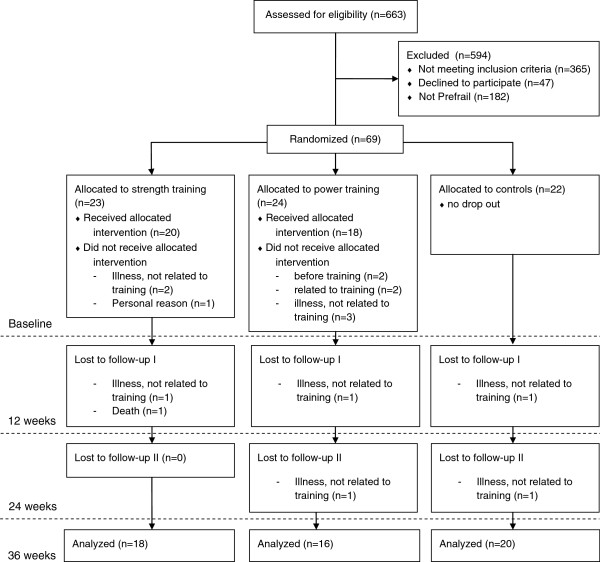
BACKGROUND: Although resistance exercise interventions have been shown to be beneficial in prefrail or frail older adults it remains unclear whether there are residual effects when the training is followed by a period of detraining. The aim of this study was to establish the sustainability of a muscle power or muscle strength training effect in prefrail older adults following training and detraining. METHODS: 69 prefrail community-dwelling older adults, aged 65-94 years were randomly assigned into three groups: muscle strength training (ST), muscle power training (PT) or controls. The exercise interventions were performed for 60 minutes, twice a week over 12 weeks. Physical function (Short Physical Performance Battery=SPPB), muscle power (sit-to-stand transfer=STS), self-reported function (SF-LLFDI) and appendicular lean mass (aLM) were measured at baseline and at 12, 24 and 36 weeks after the start of the intervention. RESULTS: For the SPPB, significant intervention effects were found at 12 weeks in both exercise groups (ST: p = 0.0047; PT: p = 0.0043). There were no statistically significant effects at 24 and 36 weeks. In the ST group, the SPPB declined continuously after stop of exercising whereas the PT group and controls remained unchanged. No effects were found for muscle power, SF-LLFDI and aLM. CONCLUSIONS: The results showed that both intervention types are equally effective at 12 weeks but did not result in statistically significant residual effects when the training is followed by a period of detraining. The unchanged SPPB score at 24 and 36 weeks in the PT group indicates that muscle power training might be more beneficial than muscle strength training. However, more research is needed on the residual effects of both interventions. Taken the drop-out rates (PT: 33%, ST: 21%) into account, muscle power training should also be used more carefully in prefrail older adults. TRIAL REGISTRATION: This trial has been registered with clinicaltrials.gov (NCT00783159)
Overview
The claims and statistics of this paper haven’t been checked yet.
Run the check — free, no account needed. It reads the open-access text and checks the sources it cites.
Integrity signals
Registry
Cites
Statistics
Figures
Verification
Claims the paper makes
The claims and statistics of this paper haven’t been checked yet.
Run the check — free, no account needed. It reads the open-access text and checks the sources it cites.
Claims other papers make about this one
Each is checked against this paper’s own text: does it say what the citing paper says it does?
The cited source says what the claim attributes to it.
In the citing paper
“Most of the studies (14 of 20 [70%]) enrolled community-living older adults who were well functioning, and 6 RCTs recruited older adults with low to moderate functioning.30,33,39,50,51”
From Comparison of Power Training vs Traditional Strength Training on Physical Function in Older Adults: A Systematic Review and Meta-analysis (2022) · cites this paper as [39]
The check wasn’t confident either way, so it gives no verdict — never disputed.
In the citing paper
“Most of the studies (14 of 20 [70%]) enrolled community-living older adults who were well functioning, and 6 RCTs recruited older adults with low to moderate functioning.30,33,39,50,51”
From Comparison of Power Training vs Traditional Strength Training on Physical Function in Older Adults: A Systematic Review and Meta-analysis (2022) · cites this paper as [39]
Experimental — accuracy not yet measuredThe check wasn’t confident either way, so it gives no verdict — never disputed.
In the citing paper
“Five studies were considered to have ‘good’ internal validity [3, 30, 33, 35, 38], 8 studies were classified as ‘poor’ to ‘fair’ [4, 5, 9, 29, 31, 32, 37, 39], and 1 study was classified as having ‘poor’ interal validity [7].”
From Effectiveness of power training compared to strength training in older adults: a systematic review and meta-analysis (2022) · cites this paper as [38]
Experimental — accuracy not yet measured
Self-check
Percentages, sums and reported differences re-computed from the paper’s own numbers.
The self-check needs the paper’s full text.
Citations
Cites
Folstein, M. F., Folstein, S. E., & McHugh, P. R. (1975) · Journal of Psychiatric Research · doi:10.1016/0022-3956(75)90026-6 · Cited by 88,282
The CES-D Scale: A Self-Report Depression Scale for Research in the General Population
Radloff, L. S. (1977) · Applied Psychological Measurement · doi:10.1177/014662167700100306 · Cited by 53,267
Frailty in Older Adults: Evidence for a Phenotype
Fried, L. P., Tangen, C. M., Walston, J., Newman, A. B., Hirsch, C., Gottdiener, J., Seeman, T., Tracy, R., Kop, W. J., Burke, G., et al. (2001) · The Journals of Gerontology Series A: Biological Sciences and Medical Sciences · doi:10.1093/gerona/56.3.m146 · Cited by 24,907
Development and validation of a geriatric depression screening scale: a preliminary report
Yesavage, J. A., Brink, T. L., Rose, T. L., Lum, O., Huang, V., Adey, M., & Leirer, V. O. (1982) · Journal of Psychiatric Research · doi:10.1016/0022-3956(82)90033-4 · Cited by 15,025
Guralnik, J. M., Simonsick, E. M., Ferrucci, L., Glynn, R. J., Berkman, L. F., Blazer, D. G., Scherr, P. A., & Wallace, R. B. (1994) · Journal of Gerontology · doi:10.1093/geronj/49.2.m85 · Cited by 9,792
Meaningful change and responsiveness in common physical performance measures in older adults.
Perera, S., Mody, S. H., Woodman, R. C., & Studenski, S. A. (2006) · Journal of the American Geriatrics Society · doi:10.1111/j.1532-5415.2006.00701.x · Cited by 2,513
A questionnaire for the assessment of leisure time physical activities
Taylor, H. L., Jacobs, D. R., Schucker, B., Knudsen, J., Leon, A. S., & Debacker, G. (1978) · Journal of Chronic Diseases · doi:10.1016/0021-9681(78)90058-9 · Cited by 1,848
Fried, L. P. (2001) · Journals of Gerontology Series A-biological Sciences and Medical Sciences · Cited by 1,103
Frailty Syndrome: A Transitional State in a Dynamic Process
Lang, P. O., Michel, J., & Zekry, D. (2009) · Gerontology · doi:10.1159/000211949 · Cited by 697
The LIFE Study Investigators* [*See Appendix for List of LIFE Study Investigators] (2006) · The Journals of Gerontology Series A · doi:10.1093/gerona/61.11.1157 · Cited by 668
Cited by
Sorted by citations
Items 101–141 of 141
Strength training for older adults
小山, 真., & 山田, 実. (2024) · Nippon Ronen Igakkai Zasshi Japanese Journal of Geriatrics · doi:10.3143/geriatrics.61.271 · Cited by 1
Caroline, A., Cabral, A., Magalhães, Í. K. M., Borba-Pinheiro, C. J., & Dantas, H. M. (2014)
Physical functioning among community-dwelling older people
Tikkanen, P. (2015) · UEF eRepo (University of Eastern Finland)
Moreira, O. C. (2018) · Buleria (Universidad de León) · doi:10.18002/10612/8008
Han, S. Y., Ko, Y., Kim, H. R., & Kim, J. (2019) · Research in Community and Public Health Nursing · doi:10.12799/jkachn.2019.30.2.243
Yamada, M. (2020) · Nihon Kikan Shokudoka Gakkai Kaiho · doi:10.2468/jbes.71.372
Tou, N. X., Wee, S. L., Seah, W. T., Ng, D. H. M., Pang, B. W. J., Lau, L. K., & Ng, T. P. (2020) · doi:10.21203/rs.3.rs-39672/v1
[A case of radiation sickness due to internal irradiation].
Ei, S., Shamov, V. P., & Malykhin, V. M. (1967) · PubMed
Implication of Exercise for Healthy Longevity in Older People
Yamada, M., & Arai, H. (2022) · Topics in Geriatric Rehabilitation · doi:10.1097/tgr.0000000000000350
Reimers, C. D., & Knapp, G. (2015) · Elsevier eBooks · doi:10.1016/b978-3-437-24265-6.00009-3
Reimers, C. D. (2013) · Elsevier eBooks · doi:10.1016/b978-3-437-31610-4.00015-1
Rodrigues, R., Bonetti, P. S., Coelho, A. R., Imperador, A., Tiggemann, C. L., & Dias, C. P. (2016) · Revista Brasileira de Ciência e Movimento · doi:10.18511/0103-1716/rbcm.v24n3p45-52
Clinical Practice Guidelines for Sarcopenia
実, 山. (2019) · Nippon Ronen Igakkai Zasshi Japanese Journal of Geriatrics · doi:10.3143/geriatrics.56.217
Sarcopenia: Current Topics and Future Perspective
Yamada, M., Kinoshita, K., Satake, S., Matsui, Y., & Arai, H. (2022) · Springer eBooks · doi:10.1007/978-981-16-7977-3_12
Sarcopenia and Physical Performance in Patients with Cancer
Tanaka, S., & Tatematsu, N. (2022) · Springer eBooks · doi:10.1007/978-981-19-6710-8_23
Polo-Ferrero, L. (2023) · Gredos (University of Salamanca) · doi:10.14201/gredos.155732
Lim, H., Jani, N. D. B., Pang, W. T., & Lim, E. C. W. (2024) · Figshare · doi:10.6084/m9.figshare.26747525
Lim, H., Jani, N. D. B., Pang, W. T., & Lim, E. C. W. (2024) · Figshare · doi:10.6084/m9.figshare.26747516
el Hadouchi, M., Kiers, H., de Vries, R., Veenhof, C., & van Dieën, J. H. (2022) · Figshare · doi:10.6084/m9.figshare.20479764
Lim, H., Jani, N. D. B., Pang, W. T., & Lim, E. C. W. (2024) · Figshare · doi:10.6084/m9.figshare.26241189
el Hadouchi, M., Kiers, H., de Vries, R., Veenhof, C., & van Dieën, J. H. (2022) · Figshare · doi:10.6084/m9.figshare.20479743
Lim, H., Jani, N. D. B., Pang, W. T., & Lim, E. C. W. (2024) · Figshare · doi:10.6084/m9.figshare.26747531
Lim, H., Jani, N. D. B., Pang, W. T., & Lim, E. C. W. (2024) · Figshare · doi:10.6084/m9.figshare.26747528
el Hadouchi, M., Kiers, H., de Vries, R., Veenhof, C., & van Dieën, J. H. (2022) · Figshare · doi:10.6084/m9.figshare.20479761
el Hadouchi, M., Kiers, H., de Vries, R., Veenhof, C., & van Dieën, J. H. (2022) · Figshare · doi:10.6084/m9.figshare.20479752
Lim, H., Jani, N. D. B., Pang, W. T., & Lim, E. C. W. (2024) · Figshare · doi:10.6084/m9.figshare.26747519
el Hadouchi, M., Kiers, H., de Vries, R., Veenhof, C., & van Dieën, J. H. (2022) · Figshare · doi:10.6084/m9.figshare.20479758
el Hadouchi, M., Kiers, H., de Vries, R., Veenhof, C., & van Dieën, J. H. (2022) · Figshare · doi:10.6084/m9.figshare.20479755
Lim, H., Jani, N. D. B., Pang, W. T., & Lim, E. C. W. (2024) · Figshare · doi:10.6084/m9.figshare.26747522
el Hadouchi, M., Kiers, H., de Vries, R., Veenhof, C., & van Dieën, J. H. (2022) · Figshare · doi:10.6084/m9.figshare.20479746
el Hadouchi, M., Kiers, H., de Vries, R., Veenhof, C., & van Dieën, J. H. (2022) · Figshare · doi:10.6084/m9.figshare.20479749
Lim, H., Jani, N. D. B., Pang, W. T., & Lim, E. C. W. (2024) · Figshare · doi:10.6084/m9.figshare.26241300
A powerlifting-based exercise program for community-dwelling older adults: A case series
de Lucena, E. G. P., Cannavan, L. G. P., Mendes, G. S., Silva, G. B., & Uchida, M. C. (2025) · Journal of Bodywork and Movement Therapies · doi:10.1016/j.jbmt.2025.12.034
Warneke, K., Stotz, A., Konrad, A., & Zech, A. (2026) · Frontiers in Aging · doi:10.3389/fragi.2026.1736517
Self-citationMartins, A. D., Batalha, N. M. P., Fernandes, O., Oliveira, R. F. S., Gonçalves, B. V., & Brito, J. P. (2026) · Sport Sciences for Health · doi:10.1007/s11332-026-01715-8
Shitara, H., Tajika, T., Takasawa, E., & Chikuda, H. (2026) · Geriatrics · doi:10.3390/geriatrics11030056
Buendía‐Romero, Á., Gutiérrez-Reguero, H., Romero-Valia, L., Higueras-Liébana, E., Garcia‐Aguirre, M., García-Albín, D., Artalejo, Á. R., Bertos, A. T., García‐García, F. J., Alegre, L. M., et al. (2026) · Frontiers in Aging · doi:10.3389/fragi.2026.1827269 · Cited by 1
Luo, D., Qin, X., Yan, J., Yan, Y., Liang, J., Hu, Q., Guo, X., Liu, L., & Tian, H. (2026) · Archives of Gerontology and Geriatrics · doi:10.1016/j.archger.2026.106440
VanSwearingen, J. M., Perera, S., & Brach, J. S. (2026) · Age and Ageing · doi:10.1093/ageing/afag312
Sarcopenia and Osteoporosis: What Orthopaedic Surgeons Should Know
Sieber, C. C. (2014) · Springer eBooks · doi:10.1007/978-3-642-54030-1_3
Self-citation
Metadata
- Authors
- Zech, A., Drey, M., Freiberger, E., Hentschke, C., Bauer, J. M., Sieber, C. C., & Pfeifer, K.
- Affiliations
- Universität Hamburg (DE)
- Friedrich-Alexander-Universität Erlangen-Nürnberg (DE)
- Corresponding author
- Zech, Astrid
- Venue
- BMC Geriatrics
- Published
- 2012-11-07
- Volume
- 12
- Issue
- 1
- Pages
- 68-68
- ISSN
- 1471-2318 (ISSN-L)
- PMC
- PMC3538686
- OpenAlex
- W2128918644
- Cited by
- 141
- References
- 34
- Citations by year
- 2026: 8 · 2025: 9 · 2024: 17 · 2023: 6 · 2022: 23 · 2021: 9 · 2020: 10 · 2019: 11 · 2018: 9 · 2017: 11 · 2016: 8 · 2015: 9 · 2014: 7 · 2013: 3
- FWCI
- 4.07
- Type
- journal article
- Language
- en
- Open access
- gold
- doi.org
- Licence
- Locations
- BMC Geriatrics (publishedVersion, cc-by)
- PubMed Central (publishedVersion, cc-by)
- PubMed (publishedVersion)
- DOAJ (DOAJ: Directory of Open Access Journals) (submittedVersion, cc-by-sa)
- OPUS FAU (Kooperativer Bibliotheksverbund Berlin-Brandenburg (KOBV), on behalf of the Universitätsbibliothek Erlangen-Nürnberg) (submittedVersion, other-oa)
- Funders
- Robert Bosch Stiftung
- Topics
- Health Sciences › Medicine › Physiology (medical) › Nutrition and Health in Aging
- Health Sciences › Medicine › Geriatrics and Gerontology › Frailty in Older Adults
- Health Sciences › Health Professions › Physical Therapy, Sports Therapy and Rehabilitation › Balance, Gait, and Falls Prevention
- Keywords
- pre-frailty, older adults, resistance training, muscle power training, detraining, residual effects, physical function, Short Physical Performance Battery, sit-to-stand, appendicular lean mass, community-dwelling older adults
- MeSH terms
- Aged, Aged, 80 and over, Exercise Therapy, Female, Follow-Up Studies, Humans, Male, Physical Fitness, Residence Characteristics, Frail Elderly, Treatment Outcome, Muscle Strength, Resistance Training
About these checks
Registry, retraction, Cites and statistics results are computed, not judged, with one exception: a printed reference that no index lists is read once by a model before it counts as a citation error. Claims are extracted by a model and kept only when their quote appears verbatim in the text; each cited source is then checked, with a model’s help, for whether it says what the claim relies on. Those verdicts can be wrong — read the claim’s quote and the cited source before relying on one.
Statistics and arithmetic are recomputed, not judged.
Confidence bands are shown only for fields calibrated on our annotated test set. None is calibrated yet, so no band is shown.
What counts as a claim ›How we measure confidence ›How we check this ›
Are you an author, or do you see a problem with this page? Request a review
