

The effect of homocysteine-lowering with B-vitamins on osteoporotic fractures in patients with cerebrovascular disease: substudy of VITATOPS, a randomised placebo-controlled trial
Open accessThe DOI matches its Crossref record; 30 of the 30 references it cites were found in a registry or an index.
Abstract
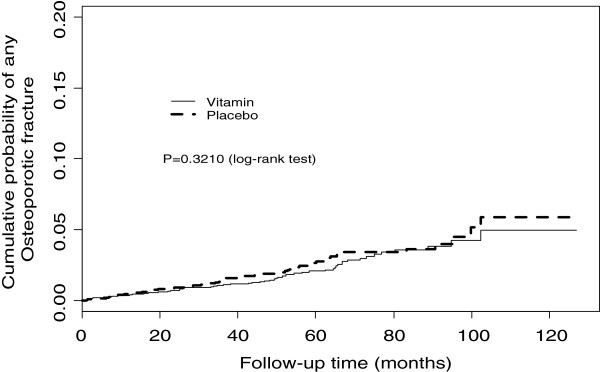
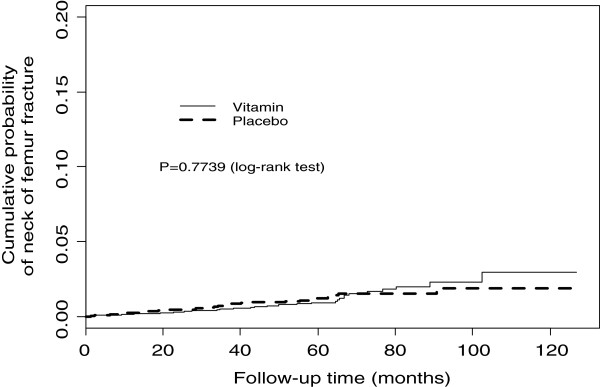
BACKGROUND: Homocysteine has been postulated as a novel, potentially reversible risk factor for osteoporosis and related fractures. We evaluated whether homocysteine-lowering therapy with B-vitamins in patients with symptomatic cerebrovascular disease reduced the incidence of osteoporotic fractures. METHODS: VITAmins To Prevent Stroke (VITATOPS) was a prospective randomised double-blind placebo-controlled trial in which 8,164 patients with recent (within 7 months) stroke or transient ischemic attack were randomly allocated to double-blind treatment with one tablet daily of either placebo (n = 4,075) or B-vitamins (folic acid 2 mg, vitamin B6 25 mg, vitamin B12 500 μg; n = 4,089). Patients were reviewed every six months. Any osteoporotic fracture and osteoporotic hip fractures were secondary outcome events, and were reviewed by a masked adjudication committee. Analysis was by intention to treat. Logistic regression was used to identify independent predictors of fracture. RESULTS: Participants had a mean age of 62.6 years (SD 12.5 years) and 64% were male, 42% of Western European descent and 75% were functionally independent (Oxford Handicap Scale of two or less). After a median duration of 2.8 years therapy and 3.4 years follow-up, there was no significant difference in the incidence of any osteoporotic fracture between participants assigned B-vitamins (67 [1.64%]) and placebo (78 [1.91%]; risk ratio [RR] 0.86, 95% confidence interval [CI] 0.62-1.18) or the incidence of hip fractures (34 [0.83%] B-vitamins vs. 36 [0.88%] placebo; RR 0.94, 95% CI 0.59-1.5). There was no significant impact of B-vitamin therapy on time to first fracture. Baseline homocysteine levels did not predict any osteoporotic fracture (p =0.43). Independent predictors of any osteoporotic fracture were female sex, age > 64 years, Western European ethnicity and use of anti-osteoporosis medication at randomization (all p < 0.01). CONCLUSIONS: Once daily treatment with B-vitamins had no effect on incidence of osteoporotic fractures during a median of 3.4 years follow-up in patients with cerebrovascular disease. A modest effect of B-vitamin therapy is not excluded due to the low numbers of fracture outcome events.
Overview
The claims and statistics of this paper haven’t been checked yet.
Free: it reads the open-access text and checks the first 5 claims that cite a source we can check. Create a free account to check every claim.
Integrity signals
Registry
Cites
Statistics
Figures
Verification
Claims the paper makes
The claims and statistics of this paper haven’t been checked yet.
Free: it reads the open-access text and checks the first 5 claims that cite a source we can check. Create a free account to check every claim.
Claims other papers make about this one
Each is checked against this paper’s own text: does it say what the citing paper says it does?
The cited source says what the claim attributes to it.
In the citing paper
“In another eight RCTs (not shown in table 3), the authors cited affected trial reports to draw attention to the disparities between their own findings and those reported.66–73”
From An investigation into the impact and implications of published papers from retracted research: systematic search of affected literature (2019) · cites this paper as [67]
Experimental — accuracy not yet measured
Self-check
Percentages, sums and reported differences re-computed from the paper’s own numbers.
The self-check needs the paper’s full text.
Citations
Cites
1 retracted
Sato, Y., Honda, Y., Iwamoto, J., Kanoko, T., & Satoh, K. (2005) · JAMA · doi:10.1001/jama.293.9.1082 · Cited by 2 · cited 4×
“The only positive intervention study to date was undertaken in 628 elderly Japanese patients with significant residual hemiplegia at least one year following stroke [23].”
BackgroundResultInfluentialRetractedOsteoporosis Prevention, Diagnosis, and Therapy
NIH Consensus Development Panel on Osteoporosis Prevention, D. (2001) · JAMA: The Journal of the American Medical Association · doi:10.1001/jama.285.6.785 · Cited by 5,529
Incidence and Economic Burden of Osteoporosis-Related Fractures in the United States, 2005–2025
Burge, R., Dawson-Hughes, B., Solomon, D. H., Wong, J. B., King, A., & Tosteson, A. (2007) · Journal of Bone and Mineral Research · doi:10.1359/jbmr.061113 · Cited by 4,026
Homocysteine Lowering with Folic Acid and B Vitamins in Vascular Disease
(2006) · New England Journal of Medicine · doi:10.1056/nejmoa060900 · Cited by 1,729
Homocysteine Levels and the Risk of Osteoporotic Fracture
van Meurs, J. B. J., Dhonukshe-Rutten, R. A. M., Pluijm, S. M. F., van der Klift, M., de Jonge, R., Lindemans, J., de Groot, L. C. P. G. M., Hofman, A., Witteman, J. C. M., van Leeuwen, J. P. T. M., et al. (2004) · New England Journal of Medicine · doi:10.1056/nejmoa032546 · Cited by 740
Homocysteine as a Predictive Factor for Hip Fracture in Older Persons
McLean, R. R., Jacques, P. F., Selhub, J., Tucker, K. L., Samelson, E. J., Broe, K. E., Hannan, M. T., Cupples, L. A., & Kiel, D. P. (2004) · New England Journal of Medicine · doi:10.1056/nejmoa032739 · Cited by 589
Hippisley-Cox, J., & Coupland, C. (2009) · BMJ · doi:10.1136/bmj.b4229 · Cited by 479
(2005) · The American Journal of Clinical Nutrition · doi:10.1093/ajcn/82.4.806 · Cited by 451
Adverse Outcomes of Osteoporotic Fractures in the General Population
Melton, L. J. (2003) · Journal of Bone and Mineral Research · doi:10.1359/jbmr.2003.18.6.1139 · Cited by 423
Stanger, O., Herrmann, W., Pietrzik, K., Fowler, B., Geisel, J., Dierkes, J., & Weger, M. (2003) · Clinical Chemistry and Laboratory Medicine · doi:10.1515/cclm.2003.214 · Cited by 254
Dhonukshe-Rutten, R. A., Pluijm, S. M., de Groot, L. C., Lips, P., Smit, J. H., & van Staveren, W. A. (2005) · Journal of Bone and Mineral Research · doi:10.1359/jbmr.050202 · Cited by 206
Epidemiology and direct medical costs of osteoporotic fractures in men and women in Switzerland
Lippuner, K., Golder, M., & Greiner, R.-A. (2004) · Osteoporosis International · doi:10.1007/s00198-004-1696-0 · Cited by 170
Gjesdal, C. G., Vollset, S. E., Ueland, P. M., Refsum, H., Meyer, H. E., & Tell, G. S. (2007) · Journal of Bone and Mineral Research · doi:10.1359/jbmr.070210 · Cited by 149
(2002) · Cerebrovascular Diseases · doi:10.1159/000047761 · Cited by 137
McLean, R. R., Jacques, P. F., Selhub, J., Fredman, L., Tucker, K. L., Samelson, E. J., Kiel, D. P., Cupples, L. A., & Hannan, M. T. (2008) · The Journal of Clinical Endocrinology & Metabolism · doi:10.1210/jc.2007-2710 · Cited by 128
Herrmann, M., Peter Schmidt, J., Umanskaya, N., Wagner, A., Taban-Shomal, O., Widmann, T., Colaianni, G., Wildemann, B., & Herrmann, W. (2007) · Clinical Chemical Laboratory Medicine · doi:10.1515/cclm.2007.362 · Cited by 124 · cited 3×
“An increased plasma concentration of total homocysteine (tHcy) has been postulated as a novel, potentially treatable risk factor for osteoporotic fractures, including hip fractures [2,6-8].”
BackgroundAssociations Between Homocysteine, Bone Turnover, BMD, Mortality, and Fracture Risk in Elderly Women
Gerdhem, P., Ivaska, K. K., Isaksson, A., Pettersson, K., Väänänen, H. K., Obrant, K. J., & Åkesson, K. (2007) · Journal of Bone and Mineral Research · doi:10.1359/jbmr.061003 · Cited by 115
Homocysteine – a newly recognised risk factor for osteoporosis
Herrmann, M., Widmann, T., & Herrmann, W. (2005) · Clinical Chemistry and Laboratory Medicine (CCLM) · doi:10.1515/cclm.2005.194 · Cited by 101
van Wijngaarden, J. P., Dhonukshe-Rutten, R. A., van Schoor, N. M., van der Velde, N., Swart, K. M., Enneman, A. W., van Dijk, S. C., Brouwer-Brolsma, E. M., Zillikens, M. C., van Meurs, J. B., et al. (2011) · BMC Geriatrics · doi:10.1186/1471-2318-11-80 · Cited by 95
Green, T. J., McMahon, J. A., Skeaff, C. M., Williams, S. M., & Whiting, S. J. (2007) · The American Journal of Clinical Nutrition · doi:10.1093/ajcn/85.2.460 · Cited by 56 · cited 2×
“Four RCTs have examined the effect of B-vitamins on biomarkers of bone turnover but have been limited by the use of surrogate outcomes for fracture risk, lack of statistical power due to the inclusion of small numbers of subjects and/or use of healthy volunteers [17-20].”
BackgroundResultHerrmann, M., Umanskaya, N., Traber, L., Schmidt-Gayk, H., Menke, W., Lanzer, G., Lenhart, M., Peter Schmidt, J., & Herrmann, W. (2007) · Clinical Chemical Laboratory Medicine · doi:10.1515/cclm.2007.352 · Cited by 55 · cited 2×
“Four RCTs have examined the effect of B-vitamins on biomarkers of bone turnover but have been limited by the use of surrogate outcomes for fracture risk, lack of statistical power due to the inclusion of small numbers of subjects and/or use of healthy volunteers [17-20].”
BackgroundResultHomocysteine and Osteoporotic Fractures — Culprit or Bystander?
Raisz, L. G. (2004) · New England Journal of Medicine · doi:10.1056/nejme048030 · Cited by 51
Randomized Clinical Trial of Homocysteine Level–Lowering Therapy and Fractures
Sawka, A. M., Ray, J. G., Yi, Q., Josse, R. G., & Lonn, E. (2007) · Archives of Internal Medicine · doi:10.1001/archinte.167.19.2136 · Cited by 47 · cited 3×
“3 μmol/L in HOPE-2) compared with placebo [20,21].”
BackgroundResultSelf-citationKeser, I., Ilich, J. Z., Vrkić, N., Giljević, Z., & Barić, I. C. (2013) · Nutrition Research · doi:10.1016/j.nutres.2013.01.002 · Cited by 44
Bone tissue and hyperhomocysteinemia
Levasseur, R. (2009) · Joint Bone Spine · doi:10.1016/j.jbspin.2008.11.002 · Cited by 42
Folate supplementation does not affect biochemical markers of bone turnover.
Herrmann, M., Stanger, O., Paulweber, B., Hufnagl, C., & Herrmann, W. (2006) · PubMed · Cited by 34
Homocysteine and Fracture Prevention
van Meurs, J. B. J., & Uitterlinden, A. G. (2005) · JAMA · doi:10.1001/jama.293.9.1121 · Cited by 18
The complex mutual connection between stroke and bone health
Moayyeri, A., Al‐Rawi, Y., & Myint, P. K. (2010) · Archives of Biochemistry and Biophysics · doi:10.1016/j.abb.2010.06.023 · Cited by 9
Vitamin B supplements for prevention of stroke
Sandercock, P. A. (2010) · The Lancet Neurology · doi:10.1016/s1474-4422(10)70188-5 · Cited by 2
Cited by
Homocysteine and age-associated disorders
Ostrakhovitch, E. A., & Tabibzadeh, S. (2019) · Ageing Research Reviews · doi:10.1016/j.arr.2018.10.010 · Cited by 183
Causes, Consequences and Public Health Implications of Low B-Vitamin Status in Ageing
Porter, K. M., Hoey, L., Hughes, C., Ward, M., & McNulty, H. (2016) · Nutrients · doi:10.3390/nu8110725 · Cited by 161
B Vitamins, Homocysteine and Bone Health
Fratoni, V., & Brandi, M. L. (2015) · Nutrients · doi:10.3390/nu7042176 · Cited by 155
B-Vitamins and Bone Health–A Review of the Current Evidence
Dai, Z., & Koh, W. (2015) · Nutrients · doi:10.3390/nu7053322 · Cited by 115
Dietary Approaches for Bone Health: Lessons from the Framingham Osteoporosis Study
Sahni, S., Mangano, K. M., McLean, R. R., Hannan, M. T., & Kiel, D. P. (2015) · Current Osteoporosis Reports · doi:10.1007/s11914-015-0272-1 · Cited by 105
Metadata
- Authors
- Gommans, J., Yi, Q., Eikelboom, J. W., Hankey, G. J., Chen, C., & Rodgers, H.
- Affiliations
- Hawke's Bay Hospital (NZ)
- Canadian Blood Services (CA)
- McMaster University (CA)
- The University of Western Australia (AU)
- National University of Singapore (SG)
- Newcastle University (GB)
- Corresponding author
- Gommans, John
- Venue
- BMC Geriatrics
- Published
- 2013-09-03
- Volume
- 13
- Issue
- 1
- Pages
- 88-88
- ISSN
- 1471-2318 (ISSN-L)
- PMC
- PMC3848681
- OpenAlex
- W2015427312
- Cited by
- 42
- References
- 30
- Citations by year
- 2025: 1 · 2024: 4 · 2022: 2 · 2021: 3 · 2020: 7 · 2019: 3 · 2018: 4 · 2017: 5 · 2016: 2 · 2015: 9 · 2014: 2
- FWCI
- 3.56
- Type
- journal article
- Language
- en
- Open access
- gold
- doi.org
- Licence
- Locations
- BMC Geriatrics (publishedVersion, cc-by)
- Europe PMC (PubMed Central) (publishedVersion, cc-by)
- PubMed Central (publishedVersion, cc-by)
- UWA Profiles and Research Repository (UWA) (publishedVersion, other-oa)
- PubMed (publishedVersion)
- National University of Singapore (submittedVersion)
- Newcastle University ePrints (Newcastle Univesity) (cc-by)
- Funders
- Royal Perth Hospital Medical Research Foundation
- National Institute for Health and Care Research (NF-SI-0507-10249)
- National Heart Foundation of Australia
- Medical Research Council
- National Health and Medical Research Council
- National Medical Research Council
- Biomedical Research Council
- Topics
- Health Sciences › Nursing › Nutrition and Dietetics › Folate and B Vitamins Research
- Health Sciences › Medicine › Orthopedics and Sports Medicine › Bone health and osteoporosis research
- Health Sciences › Medicine › Endocrinology, Diabetes and Metabolism › Menopause: Health Impacts and Treatments
- Keywords
- homocysteine, vitamin B supplementation, folic acid, vitamin B6, vitamin B12, osteoporotic fractures, hip fracture, cerebrovascular disease, stroke, transient ischemic attack, fracture risk factors, osteoporosis drugs, fracture prevention, sex differences, ethnicity, age, time to fracture
- MeSH terms
- Aged, Cerebrovascular Disorders, Double-Blind Method, Female, Follow-Up Studies, Homocysteine, Humans, Male, Middle Aged, Prospective Studies, Vitamin B Complex, Biomarkers, Treatment Outcome, Stroke, Osteoporotic Fractures
About these checks
Registry, retraction, Cites and statistics results are computed, not judged, with one exception: a printed reference that no index lists is read once by a model before it counts as a citation error. Claims are extracted by a model and kept only when their quote appears verbatim in the text; each cited source is then checked, with a model’s help, for whether it says what the claim relies on. Those verdicts can be wrong — read the claim’s quote and the cited source before relying on one.
Statistics and arithmetic are recomputed, not judged.
Confidence bands are shown only for fields calibrated on our annotated test set. None is calibrated yet, so no band is shown.
What counts as a claim ›How we measure confidence ›How we check this ›
Are you an author, or do you see a problem with this page? Request a review
Data sources
Bibliographic data: Semantic Scholar, OpenAlex, Crossref.
Contains information from the Semantic Scholar Academic Graph Datasets, made available under the ODC Attribution License (ODC-BY 1.0).
Semantic Scholar’s data is described in: Kinney, R., et al. (2023). The Semantic Scholar Open Data Platform. arXiv:2301.10140.
