

Group B streptococcal carriage, serotype distribution and antibiotic susceptibilities in pregnant women at the time of delivery in a refugee population on the Thai-Myanmar border
Open accessThe DOI matches its Crossref record; 28 of the 29 references it cites were found in a registry or an index.
Abstract
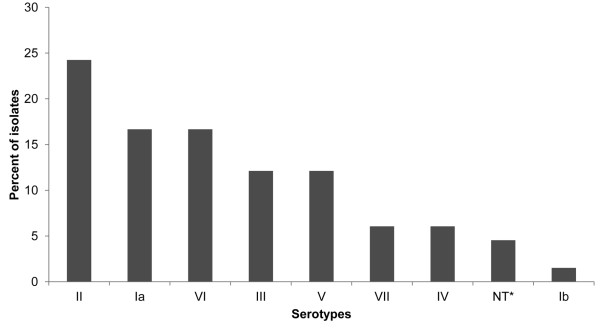
BACKGROUND: Group B Streptococcus (GBS) is the leading cause of neonatal sepsis in the developed world. Little is known about its epidemiology in the developing world, where the majority of deaths from neonatal infections occur. Maternal carriage of GBS is a prerequisite for the development of early onset GBS neonatal sepsis but there is a paucity of carriage data published from the developing world, in particular South East Asia. METHODS: We undertook a cross sectional study over a 13 month period in a remote South East Asian setting on the Thai-Myanmar border. During labour, 549 mothers had a combined vaginal rectal swab taken for GBS culture. All swabs underwent both conventional culture as well as PCR for GBS detection. Cultured GBS isolates were serotyped by latex agglutination, those that were negative or had a weak positive reaction and those that were PCR positive but culture negative were additionally tested using multiplex PCR based on the detection of GBS capsular polysaccharide genes. RESULTS: The GBS carriage rate was 12.0% (95% CI: 9.4-15.0), with 8.6% positive by both culture and PCR and an additional 3.5% positive by PCR alone. Serotypes, Ia, Ib, II, III, IV, V, VI and VII were identified, with II the predominant serotype. All GBS isolates were susceptible to penicillin, ceftriaxone and vancomycin and 43/47 (91.5%) were susceptible to erythromycin and clindamycin. CONCLUSIONS: GBS carriage is not uncommon in pregnant women living on the Thai-Myanmar border with a large range of serotypes represented.
Overview
The claims and statistics of this paper haven’t been checked yet.
Free: it reads the open-access text and checks the first 5 claims that cite a source we can check. Create a free account to check every claim.
Integrity signals
Registry
Cites
Statistics
Figures
Verification
Claims the paper makes
The claims and statistics of this paper haven’t been checked yet.
Free: it reads the open-access text and checks the first 5 claims that cite a source we can check. Create a free account to check every claim.
Claims other papers make about this one
Each is checked against this paper’s own text: does it say what the citing paper says it does?
The source backs part of the claim, not all of it — or backs it for a different population, condition or comparison.
In the citing paper
“This prevalence is not significantly different to that found in a GBS carriage study described previously in this population (12.0%; p = 0.3) [30].”
From A three year descriptive study of early onset neonatal sepsis in a refugee population on the Thailand Myanmar border (2013) · cites this paper as [30]
Experimental — accuracy not yet measuredThe source backs part of the claim, not all of it — or backs it for a different population, condition or comparison.
In the citing paper
“Systematic screening for Group B streptococcus in pregnancy is not proposed, although carrier status in this population is not uncommon (12%) (56).”
From Born too soon in a resource-limited setting: A 10-year mixed methods review of a special care baby unit for refugees and migrants on the Myanmar-Thailand border (2023) · cites this paper as [56]
Experimental — accuracy not yet measuredThe cited source says what the claim attributes to it.
In the citing paper
“This was significantly higher than the proportion of women who had PROM in a previously published study on GBS carriage, in the same population (17.0% versus 7.3% p < 0.001 [30]).”
From A three year descriptive study of early onset neonatal sepsis in a refugee population on the Thailand Myanmar border (2013) · cites this paper as [30]
Self-check
Percentages, sums and reported differences re-computed from the paper’s own numbers.
The self-check needs the paper’s full text.
Citations
Cites
Clinical and Laboratory Standards Institute
(2019) · Springer Reference Medizin · doi:10.1007/978-3-662-48986-4_300416 · Cited by 5,091
4 million neonatal deaths: When? Where? Why?
Lawn, J. E., Cousens, S., & Zupan, J. (2005) · The Lancet · doi:10.1016/s0140-6736(05)71048-5 · Cited by 3,670 · cited 1×
“Each year four million neonates die from neonatal sepsis, the majority in the first week of life in the developing world [1].”
BackgroundPrevention of perinatal group B streptococcal disease--revised guidelines from CDC, 2010.
Schrag, S. D., Gorwitz, R. J., Fultz-Butts, K., & Schuchat, A. (2002) · PubMed · Cited by 3,387
Group B Streptococcal Disease in the Era of Intrapartum Antibiotic Prophylaxis
Schrag, S. J., Zywicki, S., Farley, M. M., Reingold, A. L., Harrison, L. H., Lefkowitz, L. B., Hadler, J. L., Danila, R., Cieslak, P. R., & Schuchat, A. (2000) · New England Journal of Medicine · doi:10.1056/nejm200001063420103 · Cited by 1,024
Bacteremia among Children Admitted to a Rural Hospital in Kenya
Berkley, J. A., Lowe, B. S., Mwangi, I., Williams, T., Bauni, E., Mwarumba, S., Ngetsa, C., Slack, M. P. E., Njenga, S., Hart, C. A., et al. (2005) · New England Journal of Medicine · doi:10.1056/nejmoa040275 · Cited by 851 · cited 1×
“Historically, infection with GBS has been reported to be rare in the developing world; however its importance as a cause of neonatal sepsis in these countries is being increasingly recognised [4-9].”
BackgroundEpidemiology of Group B Streptococcal Disease in the United States: Shifting Paradigms
Schuchat, A. (1998) · Clinical Microbiology Reviews · doi:10.1128/cmr.11.3.497 · Cited by 609 · cited 6×
“Transmission is thought to occur just before or during birth when GBS ascends the genital tract into the amniotic fluid where it is aspirated or ingested by the infant [12].”
BackgroundInfluentialNeonatal sepsis: an international perspective
Vergnano, S., Sharland, M., Kazembe, P., Mwansambo, C., & Heath, P. T. (2005) · Archives of Disease in Childhood - Fetal and Neonatal Edition · doi:10.1136/adc.2002.022863 · Cited by 503 · cited 1×
“Historically, infection with GBS has been reported to be rare in the developing world; however its importance as a cause of neonatal sepsis in these countries is being increasingly recognised [4-9].”
BackgroundSelf-citationSchuchat, A. (1999) · The Lancet · doi:10.1016/s0140-6736(98)07128-1 · Cited by 386
Rapid Detection of Group B Streptococci in Pregnant Women at Delivery
Bergeron, M. G., Ke, D., Ménard, C., François, F. J., Gagnon, M., Bernier, M., Ouellette, M., Roy, P. H., Marcoux, S., & Fraser, W. D. (2000) · New England Journal of Medicine · doi:10.1056/nejm200007203430303 · Cited by 294 · cited 5×
“An estimated 20-30% of women are colonized by GBS in developed countries; however there is a paucity of data regarding GBS colonization in the developing world and in particular South East Asia [10-12].”
BackgroundInfluentialDevelopment of Conventional and Real-Time PCR Assays for the Rapid Detection of Group B Streptococci
Ke, D., Ménard, C., Picard, F. J., Boissinot, M., Ouellette, M., Roy, P. H., & Bergeron, M. G. (2000) · Clinical Chemistry · doi:10.1093/clinchem/46.3.324 · Cited by 214 · cited 2×
“The real-time cfb gene PCR protocol developed by Ke et al. was modified for use with a Rotorgene 6000 instrument (Corbett Life Science, Australia) [20].”
Method
Cited by
Russell, N. J., Seale, A. C., O’Driscoll, M., O’Sullivan, C., Bianchi-Jassir, F., Gonzalez-Guarin, J., Lawn, J. E., Baker, C. J., Bartlett, L., Cutland, C., et al. (2017) · Clinical Infectious Diseases · doi:10.1093/cid/cix658 · Cited by 552
Self-citationAn overview of global GBS epidemiology
Le Doare, K., & Heath, P. T. (2013) · Vaccine · doi:10.1016/j.vaccine.2013.01.009 · Cited by 349
Self-citationGroup B Streptococcus ( Streptococcus agalactiae )
Raabe, V. N., & Shane, A. L. (2019) · Microbiology Spectrum · doi:10.1128/microbiolspec.gpp3-0007-2018 · Cited by 330
Seale, A. C., Blencowe, H., Manu, A. A., Nair, H., Bahl, R., Qazi, S. A., Zaidi, A. K., Berkley, J. A., Cousens, S. N., & Lawn, J. E. (2014) · The Lancet Infectious Diseases · doi:10.1016/s1473-3099(14)70804-7 · Cited by 326
Kwatra, G., Cunnington, M. C., Merrall, E., Adrian, P. V., Ip, M., Klugman, K. P., Tam, W. H., & Madhi, S. A. (2016) · The Lancet Infectious Diseases · doi:10.1016/s1473-3099(16)30055-x · Cited by 234
Perinatal Streptococcus agalactiae Epidemiology and Surveillance Targets
Furfaro, L. L., Chang, B. J., & Payne, M. S. (2018) · Clinical Microbiology Reviews · doi:10.1128/cmr.00049-18 · Cited by 138
“The predominance of this serotype was observed in pregnant women at the Thai-Myanmar border, where 24% of isolates recovered were CPS II, as reported by Turner and others (30).”
BackgroundTeatero, S., Ferrieri, P., Martín, I., Demczuk, W., McGeer, A., & Fittipaldi, N. (2016) · Journal of Clinical Microbiology · doi:10.1128/jcm.01615-16 · Cited by 117
Kobayashi, M., Vekemans, J., Baker, C. J., Ratner, A. J., Doaré, K. L., & Schrag, S. J. (2016) · F1000Research · doi:10.12688/f1000research.9363.1 · Cited by 101
Eskandarian, N., Ismail, Z., Neela, V. K., van Belkum, A., Desa, M. N. M., & Nordin, S. A. (2014) · European Journal of Clinical Microbiology & Infectious Diseases · doi:10.1007/s10096-014-2265-x · Cited by 78
Botelho, A. C. N., de Oliveira, J. G., Damasco, A. P., dos Santos, K. T. B., Ferreira, A. F. M., Taddeucci-Rocha, G., Marinho, P. S., Bornia, R. G., Pinto, T. C. A., Américo, M. A., et al. (2018) · PLoS ONE · doi:10.1371/journal.pone.0196925 · Cited by 63
Biasi-Garbin, R. P., Otaguiri, E. S., Morey, A. T., da Silva, M. F., Morguette, A. E. B., Lancheros, C. A. C., Kian, D., Perugini, M. R. E., Nakazato, G., Durán, N., et al. (2015) · Evidence-based Complementary and Alternative Medicine · doi:10.1155/2015/861497 · Cited by 64
Comparison of PCR and serotyping of Group B Streptococcus in pregnant women: The Oslo GBS-study
Brigtsen, A. K., Dedi, L., Melby, K. K., Holberg‐Petersen, M., Radtke, A., Lyng, R. V., Andresen, L. L., Jacobsen, A. F., Fugelseth, D., & Whitelaw, A. C. (2014) · Journal of Microbiological Methods · doi:10.1016/j.mimet.2014.11.001 · Cited by 41
“(Lu et al., 2013; Stokholm et al., 2013; Turner et al., 2012).”
MethodResultInfluentialNkembe, N. M., Kamga, H. G., Abange, W. B., Betbeui, A. C., & Njotang, P. N. (2018) · BMC Research Notes · doi:10.1186/s13104-018-3589-x · Cited by 37
Jauneikaite, E., Kapatai, G., Davies, F., Gozar, I., Coelho, J., Bamford, K. B., Simone, B., Begum, L., Katiyo, S., Patel, B., et al. (2018) · Clinical Infectious Diseases · doi:10.1093/cid/ciy174 · Cited by 32
Eskandarian, N., Neela, V. K., Ismail, Z., Puzi, S. M., Hamat, R. A., Desa, M. N. M., & Nordin, S. A. (2013) · International Journal of Infectious Diseases · doi:10.1016/j.ijid.2013.01.011 · Cited by 27
Unveiling the dynamics of the breast milk microbiome: impact of lactation stage and gestational age
Singh, P., Almohannadi, N., Murugesan, S., Almarzooqi, F. M. A. F., Kabeer, B. S. A., Marr, A. K., Kino, T., Brummaier, T., Terranegra, A., McGready, R. M., et al. (2023) · Journal of Translational Medicine · doi:10.1186/s12967-023-04656-9 · Cited by 29
Self-citationLin, H., Chen, C., Chiang, K.-H., Yen, T., Ho, C., Hwang, K., Su, B., Lin, H.-C., Li, T., & Lu, J. (2014) · Journal of Microbiology Immunology and Infection · doi:10.1016/j.jmii.2014.11.002 · Cited by 29
Evaluation of chromID strepto B as a screening media for Streptococcus agalactiae
Morita, T., Feng, D., Kamio, Y., Kanno, I., Somaya, T., Imai, K., Inoue, M., Fujiwara, M., & Miyauchi, A. (2014) · BMC Infectious Diseases · doi:10.1186/1471-2334-14-46 · Cited by 26
“3% of pregnant women [2-4].”
Turner, C., Turner, P., Hoogenboom, G., Aye Mya Thein, N., McGready, R., Phakaudom, K., De Zoysa, A., Efstratiou, A., Heath, P. T., & Nosten, F. (2013) · BMC Infectious Diseases · doi:10.1186/1471-2334-13-601 · Cited by 21
“In addition to culture, an aliquot of LIM broth culture was used for detection of GBS by PCR, as previously described [30].”
MethodSelf-citationPathogenic Mechanism, Detection Methods and Clinical Significance of Group B Streptococcus
Yuan, X., Liu, H.-Z., Liu, J., Sun, Y., & Song, Y. S. (2021) · Future Microbiology · doi:10.2217/fmb-2020-0189 · Cited by 27
Ali, M. M., Asrat, D., Fenta, D. A., Chaka, T. E., & Woldeamanuel, Y. (2020) · Scientific Reports · doi:10.1038/s41598-020-66474-z · Cited by 25
Mohamed, A. M., Khan, M. A., Faiz, A., Ahmad, J., Khidir, E. B., Basalamah, M. A., & Aslam, A. (2020) · Infection and Chemotherapy · doi:10.3947/ic.2020.52.1.70 · Cited by 19
“Multiple limitations to latex agglutination-based serotyping have been documented, of which immunological crossreaction is the most common [22-25].”
BackgroundInfluentialJafari, S., Dehghani, M., Nasirizadeh, N., & Baghersad, M. H. (2019) · International Journal of Dairy Technology · doi:10.1111/1471-0307.12620 · Cited by 17
Akkaneesermsaeng, W., Petpichetchian, C., Yingkachorn, M., & Sasithorn, S. (2019) · Journal of Obstetrics and Gynaecology · doi:10.1080/01443615.2019.1587597 · Cited by 19
“…bacterium colonised in the genitourinary and gastrointestinal tracts of pregnant women with varying prevalence that ranges from 2.3 to 32.9% (Lim et al. 1986; Adair et al. 2003; Orret 2003; Kovavisarach et al. 2007; Namavar et al. 2008; Sharmila et al. 2011; Turner et al. 2012; Woldu et al. 2014).”
BackgroundResultInfluentialLi, X., Gao, W., Jia, Z., Yao, K., Yang, J., Tong, J., & Wang, Y. (2023) · Infection and Drug Resistance · doi:10.2147/idr.s395942 · Cited by 14
“In Southeast Asian countries such as Thailand and Burma, the major serotype was type II.(17) In US and European countries, the predominant serotype was Ia, II, III, and V, while that in Latin America the predominant serotype was III.”
BackgroundWang, Y., Lu, C.-C., Chiu, C.-H., Wang, M.-H., Yang, T., & Chu, C. (2015) · Journal of Microbiology Immunology and Infection · doi:10.1016/j.jmii.2015.05.022 · Cited by 11
Group BStreptococcus(Streptococcus agalactiae)
Raabe, V., & Shane, A. L. (2019) · ASM Press eBooks · doi:10.1128/9781683670131.ch14 · Cited by 11
Liébana-Martos, M. D. C., Cabrera, J. J., Rodríguez‐Granger, J., Miranda-Casas, C., Sampedro, A., Fernández, J. G., Rosa-Fraile, M., & Navarro‐Marí, J. M. (2014) · Enfermedades Infecciosas y Microbiología Clínica · doi:10.1016/j.eimc.2014.02.023 · Cited by 9
Silva, M. M., Silva, É. A., Oliveira, C. N. T., Santos, M. L. C., Souza, C. L., de Melo, F. F., & Oliveira, M. V. (2023) · Maternal-Fetal Medicine · doi:10.1097/fm9.0000000000000174 · Cited by 8
Takayama, Y., Matsui, H., Adachi, Y., Nihonyanagi, S., Wada, T., Mochizuki, J., Unno, N., & Hanaki, H. (2017) · Journal of Infection and Chemotherapy · doi:10.1016/j.jiac.2017.07.001 · Cited by 8
Yasini, M., Moniri, R., Ghorbaali, Z., Ansaripour, L., Movahedinejad, M., & Yadegarsalehi, M. (2014) · Cited by 6
Hashmi, A., Darakamon, M. C., Aung, K. K., Mu, M., Misa, P., Jittamala, P., Chu, C., Phyo, A. P., Turner, C., Nosten, F., et al. (2023) · Frontiers in Public Health · doi:10.3389/fpubh.2023.1144642 · Cited by 4
“Systematic screening for Group B streptococcus in pregnancy is not proposed, although carrier status in this population is not uncommon (12%) (56).”
BackgroundSelf-citationGroup B Streptococcal Carriage Rate in Vagina of Pregnant Women in Third Trimester in Lomé, Togo
Salou, M., Anoumou, Y. D., Biova, A. –. H. A., Ekouévi, D. K., Dossim, S., Kpatcha, K., Yehadji, D., Y.Tufa, N., Akpadza, K., & Prince-David, M. (2015) · World Journal of Preventive Medicine · doi:10.12691/jpm-3-1-2 · Cited by 4
Herbert, J. A., Thomas, S. R., Brookes, C., Turner, C. L., Turner, P., Nosten, F. H., Doaré, K. L., Hudson, M., Heath, P. T., GORRINGE, A. R., et al. (2015) · Clinical and Vaccine Immunology · doi:10.1128/cvi.00803-14 · Cited by 8
“Data were also collected on the GBS carriage status of the mother at the time of birth, which was assessed by culture of vaginal and rectal swabs (18).”
BackgroundMethodSelf-citationMarhash, A. D., Nabat, Z. N., & Abbas, N. A. (2024) · Journal of microbiology epidemiology immunobiology · doi:10.36233/0372-9311-515 · Cited by 2
Nguyen, V. L., Dao, H. N., Van, L. T. H., Nguyen, A. V., Ha, V. T. T., Nguyen, Q. T. N., Do, H. T., Sơn, N. T., & Ánh, Đ. N. (2025) · Therapeutic Advances in Infectious Disease · doi:10.1177/20499361251365028 · Cited by 2
“11,12 Global data have indicated that the serotype distribution of GBS varies depending on different geographical locations, sociodemographic characteristics of the participants, the source of the bacterial isolates, and the period of data collection.”
Takang, W. A., Obichemti, E. T., Florent, F. Y., Ujambeng, U. V., & Forlemu, A. A. (2022) · Open Journal of Obstetrics and Gynecology · doi:10.4236/ojog.2022.128074 · Cited by 3
Muthanna, A., Sulaiman, N., Dzaraly, N. D., Al‐Obaidi, M. M. J., Nordin, S. A., Azmai, M. N. A., & Desa, M. N. M. (2025) · Asian Pacific Journal of Tropical Medicine · doi:10.4103/apjtm.apjtm_171_25 · Cited by 2
Maternal Immunization: Protecting Vulnerable Populations
Englund, J. A. (2016) · Elsevier eBooks · doi:10.1016/b978-0-12-802174-3.00010-2 · Cited by 1
Sangeetha, A., Devi, S., Subramanian, A., Daniel, M. L., & Anandh, P. (2023) · Journal of Tropical Medicine · doi:10.1155/2023/9910380 · Cited by 1
Group B streptococcal carriage among pregnant women and its implications
Kandi, V. (2015) · International Journal of Reproduction Contraception Obstetrics and Gynecology · doi:10.5455/2320-1770.ijrcog20150403
Madzivhandila, M. (2014) · University of the Witwatersrand, Johannesburg Institutional Repository on DSpace (University of the Witwatersrand, Johannesburg) · Cited by 1
Furfaro, L. L. (2019) · UWA Profiles and Research Repository (University of Western Australia) · doi:10.26182/5cd28171b6884
“Predominance of this serotype was observed in pregnant women at the Thai-Myanmar border, where 24% of isolates recovered were CPS II as reported by Turner and others (Turner et al. 2012).”
ResultIssues during Labour for Migrant Populations
Mamopoulos, A. M., Tsakiridis, I. G., & Athanasiadis, A. P. (2021) · Cambridge University Press eBooks · doi:10.1017/9781108863049.045
Singh, P., Almohannadi, N., Murugesan, S., Almarzooqi, F., Kabeer, B. S. A., Marr, A. K., Kino, T., Brummaier, T., Terranegra, A., McGready, R., et al. (2024) · Figshare · doi:10.6084/m9.figshare.26636487
Self-citationSingh, P., Almohannadi, N., Murugesan, S., Almarzooqi, F., Kabeer, B. S. A., Marr, A. K., Kino, T., Brummaier, T., Terranegra, A., McGready, R., et al. (2023) · Figshare · doi:10.6084/m9.figshare.26636484
Self-citationNguyen-Thi, T.-A., Nguyen, H.-P., Do-Hoang, T.-A., Tran, M., Le, T.-L., & Vu-Quang, H. (2026) · Asian Pacific Journal of Tropical Medicine · doi:10.4103/apjtm.apjtm_497_25
Performance evaluation of clinical diagnostic kits for Group B Streptococcus available in China
Su, R., Chen, X., Lu, S., Zhou, Y., Liu, Y., Huang, Q., Zhang, Y., Zheng, X., Li, M., Hou, W., et al. (2026) · Microbiology Spectrum · doi:10.1128/spectrum.00137-26
“The global distribution of these serotypes exhibits significant geographical variation (1, 5, 6), which correlates with differences in virulence and disease manifestations (7, 8).”
Metadata
- Authors
- Turner, C., Turner, P., Po, L., Maner, N., De Zoysa, A., Afshar, B., Efstratiou, A., Heath, P. T., & Nosten, F.
- Affiliations
- Shoklo Malaria Research Unit (TH)
- University of Oxford (GB)
- Health Protection Agency (GB)
- St George's, University of London (GB)
- Corresponding author
- Turner, Claudia
- Venue
- BMC Infectious Diseases
- Published
- 2012-02-08
- Volume
- 12
- Issue
- 1
- Pages
- 34-34
- ISSN
- 1471-2334 (ISSN-L)
- PMC
- PMC3315410
- OpenAlex
- W2129479898
- Cited by
- 48
- References
- 29
- Citations by year
- 2026: 2 · 2025: 2 · 2024: 2 · 2023: 6 · 2022: 1 · 2021: 2 · 2020: 2 · 2019: 5 · 2018: 4 · 2017: 2 · 2016: 4 · 2015: 5 · 2014: 8 · 2013: 3
- FWCI
- 4.94
- Type
- journal article
- Language
- en
- Open access
- gold
- doi.org
- Licence
- cc-by
- creativecommons.org/licenses/by/2.0 (tdm)
- Locations
- BMC Infectious Diseases (publishedVersion, cc-by)
- Europe PMC (PubMed Central) (publishedVersion, cc-by)
- PubMed Central (publishedVersion, cc-by)
- PubMed (publishedVersion)
- St George's Online Research Archive (St George's University of London) (acceptedVersion)
- DOAJ (DOAJ: Directory of Open Access Journals) (submittedVersion)
- Greater South Information System
- Funders
- Li Ka Shing Foundation
- Wellcome Trust (077166, 083735, 089275, 077166/Z/05)
- University of Oxford
- Topics
- Health Sciences › Medicine › Pediatrics, Perinatology and Child Health › Neonatal and Maternal Infections
- Health Sciences › Medicine › Infectious Diseases › Streptococcal Infections and Treatments
- Life Sciences › Immunology and Microbiology › Microbiology › Bacterial Infections and Vaccines
- Keywords
- Streptococcus agalactiae, maternal carriage, pregnant women, serotype distribution, antibiotic susceptibility, neonatal sepsis, refugees, Thai-Myanmar border, capsular polysaccharide genes, early-onset GBS disease
- MeSH terms
- Anti-Bacterial Agents, Asia, Asia, Southeastern, Myanmar, Carrier State, Cross-Sectional Studies, Female, Humans, Infant, Newborn, Microbial Sensitivity Tests, Perineum, Pregnancy, Pregnancy Complications, Infectious, Rectum, Refugees, Serotyping, Streptococcal Infections, Streptococcus agalactiae, Thailand, Vagina, Prevalence
About these checks
Registry, retraction, Cites and statistics results are computed, not judged, with one exception: a printed reference that no index lists is read once by a model before it counts as a citation error. Claims are extracted by a model and kept only when their quote appears verbatim in the text; each cited source is then checked, with a model’s help, for whether it says what the claim relies on. Those verdicts can be wrong — read the claim’s quote and the cited source before relying on one.
Statistics and arithmetic are recomputed, not judged.
Confidence bands are shown only for fields calibrated on our annotated test set. None is calibrated yet, so no band is shown.
What counts as a claim ›How we measure confidence ›How we check this ›
Are you an author, or do you see a problem with this page? Request a review
Data sources
Bibliographic data: Semantic Scholar, OpenAlex, Crossref.
Contains information from the Semantic Scholar Academic Graph Datasets, made available under the ODC Attribution License (ODC-BY 1.0).
Semantic Scholar’s data is described in: Kinney, R., et al. (2023). The Semantic Scholar Open Data Platform. arXiv:2301.10140.
