

Hospital days, hospitalization costs, and inpatient mortality among patients with mucormycosis: a retrospective analysis of US hospital discharge data
Open accessThe DOI matches its Crossref record; 17 of the 17 references it cites were found in a registry or an index.
Abstract
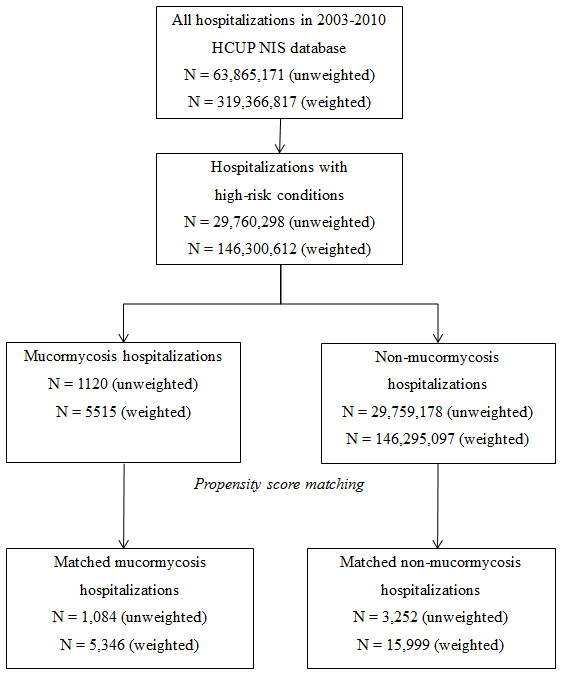
BACKGROUND: Mucormycosis is a rare and potentially fatal fungal infection occurring primarily in severely immunosuppressed patients. Because it is so rare, reports in the literature are mainly limited to case reports or small case series. The aim of this study was to evaluate inpatient mortality, length of stay (LOS), and costs among a matched sample of high-risk patients with and without mucormycosis in a large nationally representative database. METHODS: We conducted a retrospective analysis using the 2003-2010 Healthcare Cost and Utilization Project - Nationwide Inpatient Sample (HCUP-NIS). The NIS is a nationally representative 20% sample of hospitalizations from acute care United States (US) hospitals, with survey weights available to compute national estimates. We classified hospitalizations into four mutually exclusive risk categories for mucormycosis: A- severely immunocompromised, B- critically ill, C- mildly/moderately immunocompromised, D- major surgery or pneumonia. Mucormycosis hospitalizations ("cases") were identified by ICD-9-CM code 117.7. Non-mucormycosis hospitalizations ("non-cases") were propensity-score matched to cases 3:1. We examined demographics, clinical characteristics, and hospital outcomes (mortality, LOS, costs). Weighted results were reported. RESULTS: From 319,366,817 total hospitalizations, 5,346 cases were matched to 15,999 non-cases. Cases and non-cases did not differ significantly in age (49.6 vs. 49.7 years), female sex (40.5% vs. 41.0%), White race (53.3% vs. 55.9%) or high-risk group (A-49.1% vs. 49.0%, B-20.0% vs. 21.8%, C-25.5% vs. 23.8%, D-5.5% vs. 5.4%). Cases experienced significantly higher mortality (22.1% vs. 4.4%, P<0.001), with mean LOS and total costs more than 3-fold higher (24.5 vs. 8.0 days and $90,272 vs. $25,746; both P<0.001). CONCLUSIONS: In a national hospital database, hospitalizations with mucormycosis had significantly higher inpatient mortality, LOS, and hospital costs than matched hospitalizations without mucormycosis. Findings suggest that interventions to prevent or more effectively treat mucormycosis are needed.
Overview
The claims and statistics of this paper haven’t been checked yet.
Free: it reads the open-access text and checks the first 5 claims that cite a source we can check. Create a free account to check every claim.
Integrity signals
Registry
Cites
Statistics
Figures
Verification
Claims the paper makes
The claims and statistics of this paper haven’t been checked yet.
Free: it reads the open-access text and checks the first 5 claims that cite a source we can check. Create a free account to check every claim.
Claims other papers make about this one
Each is checked against this paper’s own text: does it say what the citing paper says it does?
The cited source says what the claim attributes to it.
In the citing paper
“Other studies also support our findings that mucormycosis, though a rare disease, consistently results in high average hospitalization costs (>$100,000 in this study) due to its severity and long length of stay [10, 22].”
From Estimation of Direct Healthcare Costs of Fungal Diseases in the United States (2019) · cites this paper as [10]
Self-check
Percentages, sums and reported differences re-computed from the paper’s own numbers.
The self-check needs the paper’s full text.
Citations
Cites
Comorbidity measures for use with administrative data.
Elixhauser, A., Steiner, C., Harris, D. R., & Coffey, R. M. (1998) · Medical Care · doi:10.1097/00005650-199801000-00004 · Cited by 9,921 · cited 2×
“We included demographic (age at admission, sex, race, median household income, payer type, and year of admission), clinical (high-risk category, Elixhauser comorbidities [16], number of listed discharge diagnoses, receipt of abdominal procedure/surgery, and total number of listed procedures), hospital (geographic regi…”
BackgroundEpidemiology and Outcome of Zygomycosis: A Review of 929 Reported Cases
Roden, M. M., Zaoutis, T. E., Buchanan, W. L., Knudsen, T. A., Sarkisova, T. A., Schaufele, R. L., Sein, M., Sein, T., Chiou, C. C., Chu, J. H., et al. (2005) · Clinical Infectious Diseases · doi:10.1086/432579 · Cited by 3,044 · cited 2×
“Immunosuppression is a common predisposing factor for mucormycosis, with the infection generally limited to patients with hematological malignancies or hematopoietic stem cell transplants, solidorgan transplants, and diabetes [1-5].”
BackgroundPappas, P. G., Alexander, B. D., Andes, D. R., Hadley, S., Kauffman, C. A., Freifeld, A., Anaissie, E. J., Brumble, L. M., Herwaldt, L., Ito, J., et al. (2010) · Clinical Infectious Diseases · doi:10.1086/651262 · Cited by 1,570
Kontoyiannis, D. P., Marr, K. A., Park, B. J., Alexander, B. D., Anaissie, E. J., Walsh, T. J., Ito, J., Andes, D. R., Baddley, J. W., Brown, J. M., et al. (2010) · Clinical Infectious Diseases · doi:10.1086/651263 · Cited by 1,456 · cited 1×
“Between 2001 and 2005, analyses of data from the Transplant Associated Infections Surveillance Network (TRANSNET), showed that mucormycosis represented 8% and 2% of IFIs found in patients receiving hematopoietic stem cell and solid organ transplant recipients, respectively [6,7].”
MethodNeofytos, D., Horn, D., Anaissie, E., Steinbach, W., Olyaei, A., Fishman, J., Pfaller, M., Chang, C., Webster, K., & Marr, K. (2009) · Clinical Infectious Diseases · doi:10.1086/595846 · Cited by 801 · cited 5×
“[2] All high-risk groups were mutually exclusive; ordered here by prevalence post-matching.”
BackgroundMethodInfluentialSkiada, A., Pagano, L., Groll, A., Zimmerli, S., Dupont, B., Lagrou, K., Lass-Florl, C., Bouza, E., Klimko, N., Gaustad, P., et al. (2011) · Clinical Microbiology and Infection · doi:10.1111/j.1469-0691.2010.03456.x · Cited by 748
Invasive Non- Aspergillus Mold Infections in Transplant Recipients, United States, 2001–2006
Park, B. J., Pappas, P. G., Wannemuehler, K. A., Alexander, B. D., Anaissie, E. J., Andes, D. R., Baddley, J. W., Brown, J. M., Brumble, L. M., Freifeld, A. G., et al. (2011) · Emerging Infectious Diseases · doi:10.3201/eid1710.110087 · Cited by 321
Healthcare-Associated Mucormycosis
Rammaert, B., Lanternier, F., Zahar, J.-R., Dannaoui, E., Bougnoux, M.-E., Lecuit, M., & Lortholary, O. (2012) · Clinical Infectious Diseases · doi:10.1093/cid/cir867 · Cited by 282 · cited 3×
“To date, mucormycosis has been studied in small and narrowly defined populations or as a subgroup within a larger sample of patients with IFIs, resulting in sample sizes of 200 cases or fewer [2-4,11-13,15].”
BackgroundSingh, N., Aguado, J. M., Bonatti, H., Forrest, G., Gupta, K. L., Safdar, N., John, G. T., Pursell, K. J., Muñoz, P., Patel, R., et al. (2009) · The Journal of Infectious Diseases · doi:10.1086/605445 · Cited by 233
Forty-one recent cases of invasive zygomycosis from a global clinical registry
Ruping, M. J. G. T., Heinz, W. J., Kindo, A. J., Rickerts, V., Lass-Florl, C., Beisel, C., Herbrecht, R., Roth, Y., Silling, G., Ullmann, A. J., et al. (2010) · Journal of Antimicrobial Chemotherapy · doi:10.1093/jac/dkp430 · Cited by 201 · cited 1×
“More recent publications from Europe and Asia highlight the increasing recognition of mucormycosis around the globe, and also present data supporting a shift from such traditional risk factors, with hematological malignancies as the most common underlying condition [8-10].”
BackgroundMenzin, J., Meyers, J. L., Friedman, M., Perfect, J. R., Langston, A. A., Danna, R. P., & Papadopoulos, G. (2009) · American Journal of Health-System Pharmacy · doi:10.2146/ajhp080325 · Cited by 151 · cited 4×
“To date, mucormycosis has been studied in small and narrowly defined populations or as a subgroup within a larger sample of patients with IFIs, resulting in sample sizes of 200 cases or fewer [2-4,11-13,15].”
BackgroundMethodResultInfluentialSelf-citationEpidemiology of mucormycosis in Europe
Petrikkos, G. L., Skiada, A., & Drogari‐Apiranthitou, M. (2014) · Clinical Microbiology and Infection · doi:10.1111/1469-0691.12563 · Cited by 91 · cited 1×
“More recent publications from Europe and Asia highlight the increasing recognition of mucormycosis around the globe, and also present data supporting a shift from such traditional risk factors, with hematological malignancies as the most common underlying condition [8-10].”
BackgroundPulmonary Zygomycosis in Solid Organ Transplant Recipients in the Current Era
Sun, H., Aguado, J. M., Bonatti, H., Forrest, G. N., Gupta, K. L., Safdar, N., John, G. T., Pursell, K. J., Muñóz, P., Patel, R., et al. (2009) · American Journal of Transplantation · doi:10.1111/j.1600-6143.2009.02754.x · Cited by 82 · cited 2×
“To date, mucormycosis has been studied in small and narrowly defined populations or as a subgroup within a larger sample of patients with IFIs, resulting in sample sizes of 200 cases or fewer [2-4,11-13,15].”
BackgroundCost of invasive fungal infections in the era of new diagnostics and expanded treatment options
Ashley, E. D., Drew, R., Johnson, M., Danna, R., Dabrowski, D., Walker, V., Prasad, M., Alexander, B., Papadopoulos, G., & Perfect, J. (2012) · Pharmacotherapy: The Journal of Human Pharmacology and Drug Therapy · doi:10.1002/j.1875-9114.2012.01124 · Cited by 62
Hammond, S. P., Baden, L. R., & Marty, F. M. (2011) · Antimicrobial Agents and Chemotherapy · doi:10.1128/aac.00536-11 · Cited by 48 · cited 6×
“Immunosuppression is a common predisposing factor for mucormycosis, with the infection generally limited to patients with hematological malignancies or hematopoietic stem cell transplants, solidorgan transplants, and diabetes [1-5].”
BackgroundMethodInfluentialEconomic burden of mucormycosis in the United States: can a vaccine be cost-effective?
Ibrahim, A. S., Edwards, J. E., Bryant, R. E., & Spellberg, B. J. (2008) · Medical Mycology · doi:10.1080/13693780802326001 · Cited by 26 · cited 1×
“Hospitalizations for mucormycosis are also associated with prolonged hospital length of stay, substantial use of intensive care services, and excess costs of over $30,000 [13-15].”
BackgroundD’Agostino (1998) · doi:10.1002/(sici)1097-0258(19981015)17:19<2265::aid-sim918>3.0.co;2-b
Cited by
Challenges in the diagnosis and treatment of mucormycosis
Skiada, A., Lass-Floerl, C., Klimko, N., Ibrahim, A., Roilides, E., & Petrikkos, G. (2018) · Medical Mycology · doi:10.1093/mmy/myx101 · Cited by 568
Estimation of Direct Healthcare Costs of Fungal Diseases in the United States
Benedict, K., Jackson, B. R., Chiller, T., & Beer, K. D. (2019) · Clinical Infectious Diseases · doi:10.1093/cid/ciy776 · Cited by 438
“Other studies also support our findings that mucormycosis, though a rare disease, consistently results in high average hospitalization costs (>$100 000 in this study) due to its severity and long length of stay [10, 22].”
ResultSipsas, N. V., Gamaletsou, M. N., Anastasopoulou, A., & Kontoyiannis, D. P. (2018) · Journal of Fungi · doi:10.3390/jof4030090 · Cited by 183
“Although mucormycosis represents a rare disease, its consequences are devastating, since it is associated with unacceptably high mortality rates, ranging from 20–50% if localised, up to 70–90% in cases of disseminated disease [2,19,20].”
BackgroundZhou, Y.-F., Luo, B.-A., & Qin, L.-L. (2019) · Medicine · doi:10.1097/md.0000000000017252 · Cited by 167
Kontoyiannis, D. P., Yang, H., Song, J., Kelkar, S. S., Yang, X., Azie, N., Harrington, R., Fan, A., Lee, E., & Spalding, J. R. (2016) · BMC Infectious Diseases · doi:10.1186/s12879-016-2023-z · Cited by 132
“A study using data from 2003-2010, reported an in-hospital mortality rate of 22% among inpatient mucormycosis cases [5].”
BackgroundMethodInfluential
Metadata
- Authors
- Zilberberg, M. D., Shorr, A. F., Huang, H., Chaudhari, P., Paly, V. F., & Menzin, J.
- Affiliations
- University of Massachusetts Amherst (US)
- MedStar Washington Hospital Center (US)
- Astellas Pharma (United States) (US)
- Corresponding author
- Menzin, Joseph
- Venue
- BMC Infectious Diseases
- Published
- 2014-06-05
- Volume
- 14
- Issue
- 1
- Pages
- 310-310
- ISSN
- 1471-2334 (ISSN-L)
- PMC
- PMC4061526
- OpenAlex
- W2138399709
- Semantic Scholar
- 3e8ca6c8f1cd7adb39c8837860e307fb9ef21d63
- Cited by
- 62
- References
- 17
- Citations by year
- 2026: 2 · 2025: 4 · 2024: 4 · 2023: 5 · 2022: 10 · 2021: 9 · 2020: 5 · 2019: 3 · 2018: 10 · 2017: 4 · 2016: 3 · 2015: 1 · 2014: 2
- FWCI
- 2.34
- Type
- journal article
- Language
- en
- Open access
- gold
- doi.org
- Licence
- Locations
- BMC Infectious Diseases (publishedVersion, cc-by)
- PubMed Central (publishedVersion, cc-by)
- PubMed (publishedVersion)
- Topics
- Health Sciences › Medicine › Infectious Diseases › Antifungal resistance and susceptibility
- Health Sciences › Medicine › Infectious Diseases › Fungal Infections and Studies
- Health Sciences › Medicine › Infectious Diseases › Infectious Diseases and Mycology
- Keywords
- mucormycosis, in-hospital mortality, length of hospital stay, hospital costs, immunocompromised patients, critically ill patients, fungal infection, hospital discharge data, propensity score matching, health care costs, pneumonia, major surgery, mortality risk factors, hospitalization risk factors, United States hospitals
- MeSH terms
- Adult, Aged, Aged, 80 and over, Female, Humans, Length of Stay, Male, Middle Aged, Mucormycosis, Patient Discharge, Retrospective Studies, United States, Databases, Factual, Hospital Mortality, Hospital Costs
About these checks
Registry, retraction, Cites and statistics results are computed, not judged, with one exception: a printed reference that no index lists is read once by a model before it counts as a citation error. Claims are extracted by a model and kept only when their quote appears verbatim in the text; each cited source is then checked, with a model’s help, for whether it says what the claim relies on. Those verdicts can be wrong — read the claim’s quote and the cited source before relying on one.
Statistics and arithmetic are recomputed, not judged.
Confidence bands are shown only for fields calibrated on our annotated test set. None is calibrated yet, so no band is shown.
What counts as a claim ›How we measure confidence ›How we check this ›
Are you an author, or do you see a problem with this page? Request a review
Data sources
Bibliographic data: Semantic Scholar, OpenAlex, Crossref.
Contains information from the Semantic Scholar Academic Graph Datasets, made available under the ODC Attribution License (ODC-BY 1.0).
Semantic Scholar’s data is described in: Kinney, R., et al. (2023). The Semantic Scholar Open Data Platform. arXiv:2301.10140.
