

Rural-to-urban migrants are at high risk of sexually transmitted and viral hepatitis infections in China: a systematic review and meta-analysis
Open accessThe DOI matches its Crossref record; 62 of the 62 references it cites were found in a registry or an index.
Abstract
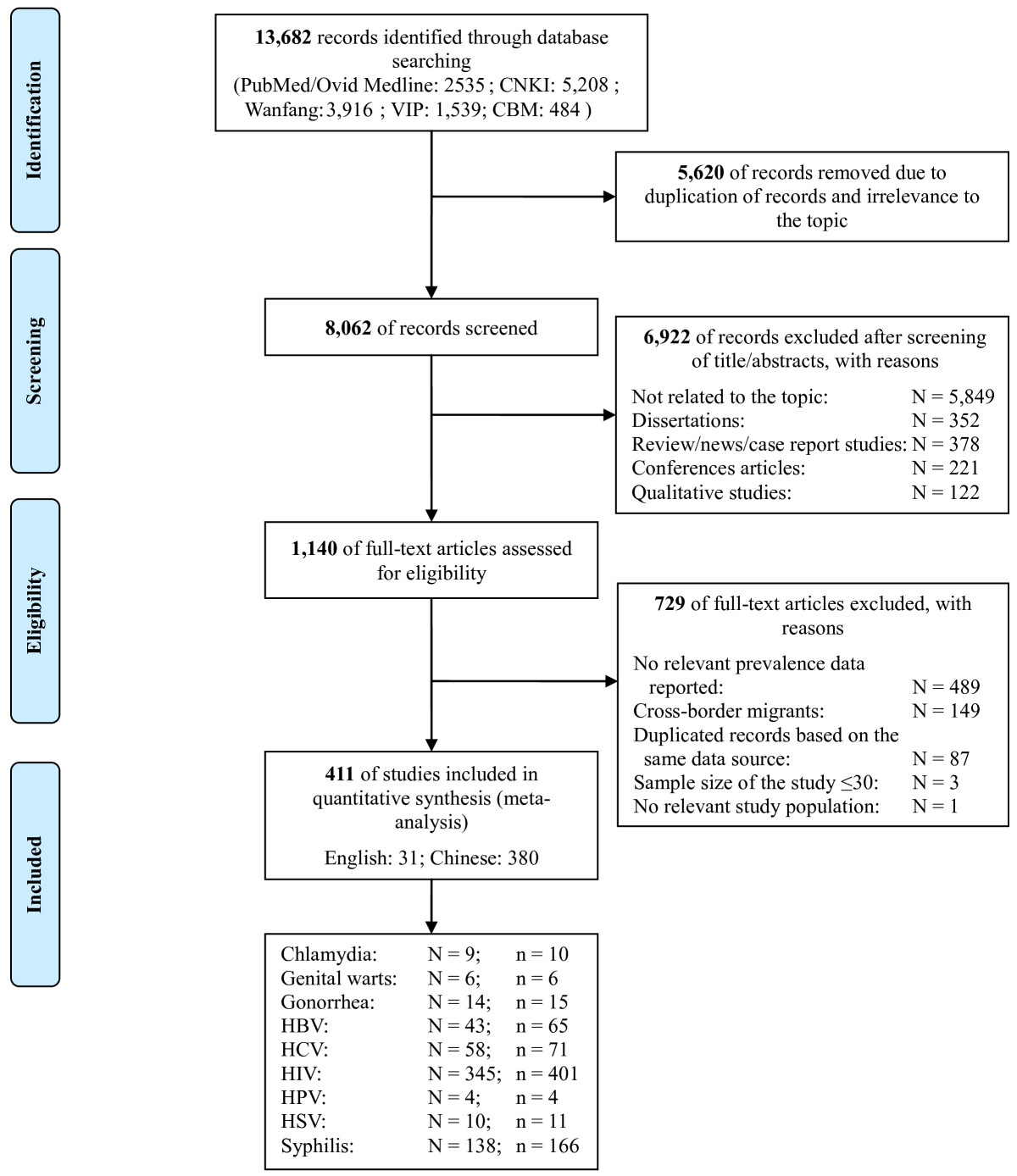
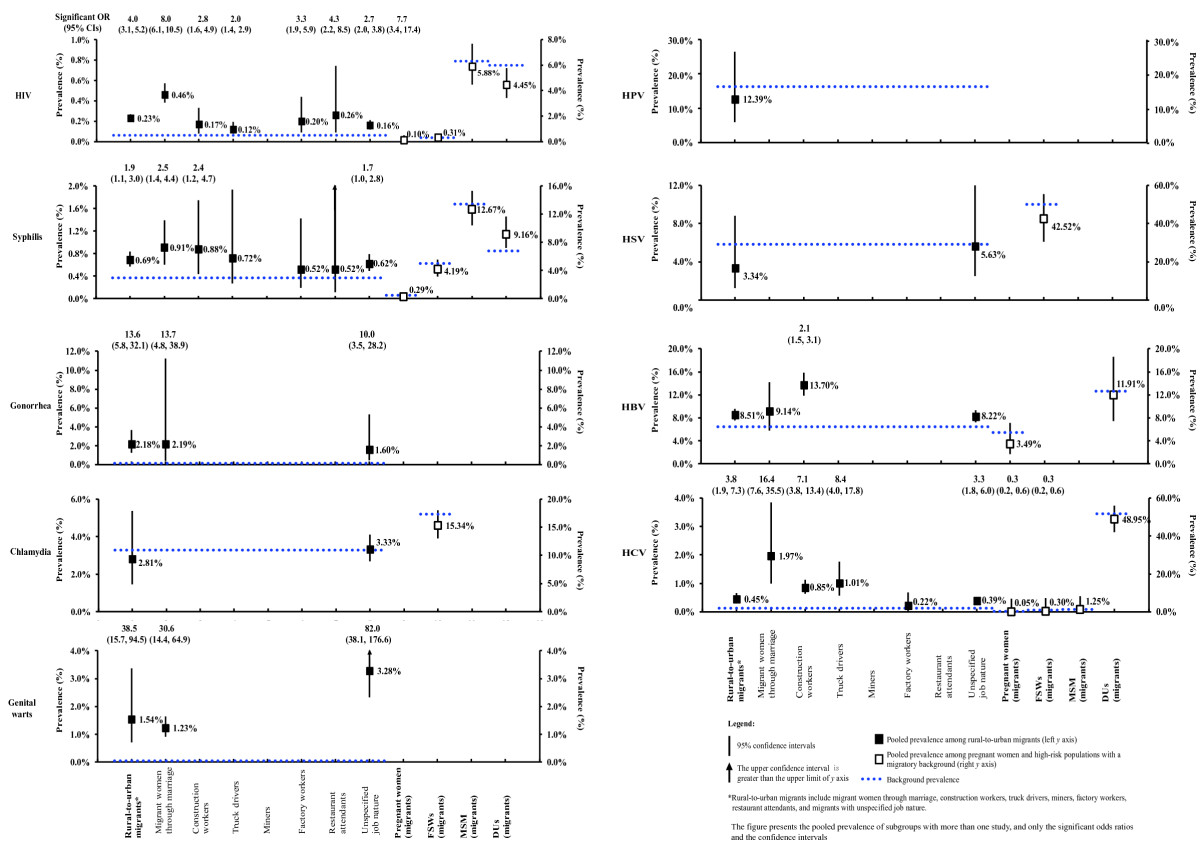
BACKGROUND: Rapid economic development in urban China has led to a mass migration of surplus rural residents into urban areas for better employment opportunities. This study aims to identify prevalence levels and risks of sexually transmitted infections (STIs) and hepatitis among the rural-to-urban migrant population in China. METHODS: Chinese and English literature databases were searched for studies reporting prevalence of HIV, STIs and viral hepatitis among rural-to-urban migrants in China between 1990 and 2013. The estimates were summarised through a systematic review and meta-analysis. The risks of infection were compared between migrants and the general Chinese population. RESULTS: We identified a total of 411 eligible studies. The prevalence of HIV, syphilis, gonorrhea, genital warts and HCV among migrants were 0.23% (0.20-0.27%), 0.69% (0.57-0.84%), 2.18% (1.30-3.64%), 1.54% (0.70-3.36%) and 0.45% (0.31-3.65%), representing 4.0 (3.1-5.2), 1.9 (1.1-3.0), 13.6 (5.8-32.1), 38.5 (15.7-94.5) and 3.8 (1.9-7.3) higher odds of infection than among the general population. Construction workers, long-distance truck drivers and migrant women through marriage were migrant subgroups that were highly susceptible to STIs and hepatitis. HIV prevalence among migrant pregnant women (0.10%, 0.02-0.49%) was significantly higher than that of pregnant women in the general Chinese population (OR = 7.7, 3.4-17.4). However, no significant differences were observed in STIs and hepatitis between overall female sex workers (FSWs), men who have sex with men (MSM) and drug users (DUs), and the corresponding subgroups with a migratory background. CONCLUSIONS: Rural-to-urban migrants have a higher risk of STIs and hepatitis than the general Chinese population, but a migratory background does not increase the infection risks of STIs and hepatitis in FSWs, MSM and DUs.
Overview
The claims and statistics of this paper haven’t been checked yet.
Free: it reads the open-access text and checks the first 5 claims that cite a source we can check. Create a free account to check every claim.
Integrity signals
Registry
Cites
Statistics
Figures
Verification
Claims the paper makes
The claims and statistics of this paper haven’t been checked yet.
Free: it reads the open-access text and checks the first 5 claims that cite a source we can check. Create a free account to check every claim.
Claims other papers make about this one
Each is checked against this paper’s own text: does it say what the citing paper says it does?
The cited source says what the claim attributes to it.
In the citing paper
“the infection rate of syphilis among migrants is 0.69% (95% CI: 0.57%-0.84%), approximately 1.9 times that of the general population (OR = 1.9, 95% CI: 1.1-3.0) [42]”
From prevalence of syphilis among pregnant women in China: a systematic review and meta-analysis (2026) · cites this paper as [42]
Self-check
Percentages, sums and reported differences re-computed from the paper’s own numbers.
The self-check needs the paper’s full text.
Citations
Cites
Preferred Reporting Items for Systematic Reviews and Meta-Analyses: the PRISMA statement
Moher, D., Liberati, A., Tetzlaff, J., Altman, D. G., & for the PRISMA Group (2009) · BMJ · doi:10.1136/bmj.b2535 · Cited by 83,823
Preferred Reporting Items for Systematic Reviews and Meta-Analyses: The PRISMA Statement
Moher, D., Liberati, A., Tetzlaff, J., & Altman, D. G. (2009) · Journal of Clinical Epidemiology · doi:10.1016/j.jclinepi.2009.06.005 · Cited by 19,575
Operating characteristics of a rank correlation test for publication bias
Begg, C. B., & Mazumdar, M. (1994) · Biometrics · doi:10.2307/2533446 · Cited by 16,955 · cited 1×
“A Begg and Mazumdar rank correlation test was used to assess publication bias [49].”
MethodBorenstein, M., Hedges, L. V., Higgins, J. P. T., & Rothstein, H. R. (2009) · doi:10.1002/9780470743386 · Cited by 14,225
Preferred reporting items for systematic reviews and meta-analyses: The PRISMA statement
Moher, D., Liberati, A., Tetzlaff, J., & Altman, D. G. (2010) · International Journal of Surgery · doi:10.1016/j.ijsu.2010.02.007 · Cited by 12,156
Borenstein, M., Hedges, L. V., Higgins, J. P. T., & Rothstein, H. R. (2021) · doi:10.1002/9781119558378 · Cited by 9,799
Epidemiology and natural history of HCV infection
Hajarizadeh, B., Grebely, J., & Dore, G. J. (2013) · Nature Reviews Gastroenterology & Hepatology · doi:10.1038/nrgastro.2013.107 · Cited by 994 · cited 1×
“As the most populous country in the world, China has witnessed rapidly emerging STIs and hepatitis epidemics in recent decades [8-10].”
BackgroundGuidelines for evaluating prevalence studies
Boyle, M. H. (1998) · Evidence Based Mental Health · doi:10.1136/ebmh.1.2.37 · Cited by 313
High frequency of SEN virus infection in thalassemic patients and healthy blood donors in Iran
Karimi-Rastehkenari, A., & Bouzari, M. (2010) · Virology Journal · doi:10.1186/1743-422x-7-1 · Cited by 215
Health Status and Access to Health Care of Migrant Workers in China
Hesketh, T., Jun, Y. X., Lu, L., & Mei, W. H. (2008) · Public Health Reports® · doi:10.1177/003335490812300211 · Cited by 195 · cited 1×
“The majority of the migrant population is male, less educated and works in low-skilled and low-paid jobs [15,16].”
Backgroundvan den Hoek, A., Yuliang, F., Dukers, N. H. T. M., Zhiheng, C., Jiangting, F., Lina, Z., & Xiuxing, Z. (2001) · AIDS · doi:10.1097/00002030-200104130-00011 · Cited by 189
Risk of HIV/AIDS in China: subpopulations of special importance
Qian, Z. H. (2005) · Sexually Transmitted Infections · doi:10.1136/sti.2004.014258 · Cited by 171 · cited 1×
“migrants may also enter the commercial sex industry [18-22].”
BackgroundXia, X., Luo, J., Bai, J., & Yu, R. (2008) · Public Health · doi:10.1016/j.puhe.2008.01.014 · Cited by 158
HIV Prevention With Mexican Migrants: Review, Critique, and Recommendations
Organista, K. C., Carrillo, H., & Ayala, G. (2004) · JAIDS Journal of Acquired Immune Deficiency Syndromes · doi:10.1097/01.qai.0000141250.08475.91 · Cited by 152 · cited 1×
“Others have suggested that socio-economic status and disease burden at place of origin may be stronger determinants of STI status [34-38].”
BackgroundChow, E. P. F., Wilson, D. P., & Zhang, L. (2011) · BMC Infectious Diseases · doi:10.1186/1471-2334-11-242 · Cited by 135 · cited 1×
“Among DUs and MSM, having multiple sexual partners and unprotected sex, and using unsafe intravenous needle are the major risk factors for STIs and hepatitis [68-71].”
BackgroundSelf-citationWork stress, life stress, and smoking among rural–urban migrant workers in China
Cui, X., Rockett, I. R. H., Yang, T., & Cao, R. (2012) · BMC Public Health · doi:10.1186/1471-2458-12-979 · Cited by 129 · cited 1×
“Due to rapid economic development in urban China, many surplus rural residents migrate to urban areas for better employment opportunities [12].”
BackgroundQian, H., Schumacher, J. E., Chen, H. T., & Ruan, Y. (2006) · Harm Reduction Journal · doi:10.1186/1477-7517-3-4 · Cited by 127 · cited 1×
“and poor perception about the transmission of STIs and hepatitis [64] among migrant pregnant women remain as”
BackgroundSystematic review of HIV and HCV infection among drug users in China
Bao, Y.-P., & Zm, L. (2009) · International Journal of STD & AIDS · doi:10.1258/ijsa.2008.008362 · Cited by 118 · cited 1×
“Demographic studies have suggested that most of these women come from a less-developed Southwest and Northwest China which geographically overlap with areas of high STIs and HCV transmission [56-59].”
BackgroundRole of Immigrants and Migrants in Emerging Infectious Diseases
Barnett, E. D., & Walker, P. F. (2008) · Medical Clinics of North America · doi:10.1016/j.mcna.2008.07.001 · Cited by 105 · cited 1×
“Others have suggested that socio-economic status and disease burden at place of origin may be stronger determinants of STI status [34-38].”
BackgroundZhang, L., & Wilson, D. P. (2012) · PLoS ONE · doi:10.1371/journal.pone.0031076 · Cited by 95 · cited 1×
“As the most populous country in the world, China has witnessed rapidly emerging STIs and hepatitis epidemics in recent decades [8-10].”
BackgroundSelf-citationChina’s Syphilis Epidemic: A Systematic Review of Seroprevalence Studies
Lin, C. C., Gao, X., Chen, X., Chen, Q., & Cohen, M. S. (2006) · Sexually Transmitted Diseases · doi:10.1097/01.olq.0000222703.12018.58 · Cited by 95 · cited 1×
“Although HIV, syphilis, gonorrhea and hepatitis are notifiable under the current infectious disease case reporting system, only an estimated 10% of cases were reported [41].”
BackgroundPlatt, L., Grenfell, P., Fletcher, A., Sorhaindo, A., Jolley, E., Rhodes, T., & Bonell, C. (2013) · Sexually Transmitted Infections · doi:10.1136/sextrans-2012-050491 · Cited by 90 · cited 1×
“This highlights the importance of the local contexts in mediating infection risks among migrants [39,40].”
BackgroundWong, W. C. W., Tam, S. M., & Leung, P. W. S. (2007) · Journal of Travel Medicine · doi:10.1111/j.1708-8305.2006.00085.x · Cited by 80 · cited 1×
“In particular, consistent with previous findings [29,30], a high level of STIs and HCV infection has been reported in this analysis, The migratory status and risky sexual behaviors among long-distance truck drivers may both contribute to the greater risk of STIs [52,53] In addition, long-distance truck drivers are fou…”
ResultReaching and Identifying the STD/HIV Risk of Sex Workers in Beijing
Rogers, S. J., Ying, L., Xin, Y. T., Fung, K., & Kaufman, J. (2002) · AIDS Education and Prevention · doi:10.1521/aeap.14.3.217.23892 · Cited by 80 · cited 1×
“migrants may also enter the commercial sex industry [18-22].”
BackgroundZhang, L., Chow, E. P. F., Jahn, H. J., Kraemer, A., & Wilson, D. P. (2013) · Sexually Transmitted Diseases · doi:10.1097/olq.0b013e318281134f · Cited by 75 · cited 3×
“International studies have indicated that migrants are more susceptible to STIs and hepatitis than local residents [29-32].”
BackgroundResultSelf-citationHIV risks among two types of male migrants in Shanghai, China: money boys vs. general male migrants
He, N., Wong, F. Y., Huang, Z. J., Ding, Y., Fu, C., Smith, B. D., Young, D., & Jiang, Q. (2007) · AIDS · doi:10.1097/01.aids.0000304700.85379.f3 · Cited by 75
Chow, E. P. F., Wilson, D. P., & Zhang, L. (2011) · AIDS and Behavior · doi:10.1007/s10461-011-9935-9 · Cited by 74 · cited 1×
“Among DUs and MSM, having multiple sexual partners and unprotected sex, and using unsafe intravenous needle are the major risk factors for STIs and hepatitis [68-71].”
BackgroundSelf-citationChow, E. P. F., Tucker, J. D., Wong, F. Y., Nehl, E. J., Wang, Y., Zhuang, X., & Zhang, L. (2014) · PLoS ONE · doi:10.1371/journal.pone.0089959 · Cited by 71 · cited 1×
“As the most populous country in the world, China has witnessed rapidly emerging STIs and hepatitis epidemics in recent decades [8-10].”
BackgroundSelf-citationWorkplace and HIV-related sexual behaviours and perceptions among female migrant workers
Yang, H., Li, X., STANTON, B. F., Fang, X., Lin, D., Mao, R., Liu, H., Chen, X., & Severson, R. K. (2005) · AIDS Care · doi:10.1080/09540120500099902 · Cited by 63 · cited 1×
“Approximately 10% of female migrants have participated in sex work during their stay in urban areas and consistent condom use with clients is low (15%) [23].”
BackgroundFolch, C., Esteve, A., Sanclemente, C., Martró, E., Lugo, R., Molinos, S., Gonzalez, V., Ausina, V., & Casabona, J. (2008) · Sexually Transmitted Diseases · doi:10.1097/olq.0b013e31815a848d · Cited by 62
Substance use and HIV risks among male heterosexual and ‘money boy’ migrants in Shanghai, China
He, N., Wong, F. Y., Huang, Z. J., Thompson, E. E., & Fu, C. (2006) · AIDS Care · doi:10.1080/09540120600888394 · Cited by 59 · cited 1×
“An estimated 2-12% of migrants use illicit drugs [25-27].”
BackgroundWang, W., Wei, C., Buchholz, M. E., Martin, M., Smith, B. D., Huang, Z., & Wong, F. Y. (2010) · International Journal of STD & AIDS · doi:10.1258/ijsa.2009.008518 · Cited by 53 · cited 1×
“Being away from their spouses, migrants, especially male migrants, are more likely to participate in extramarital sex [17].”
BackgroundChow, E. P. F., Iu, K. I., Fu, X., Wilson, D. P., & Zhang, L. (2012) · PLoS ONE · doi:10.1371/journal.pone.0048025 · Cited by 51
Self-citationOjeda, V. D., Strathdee, S. A., Lozada, R., Rusch, M. L. A., Fraga, M., Orozovich, P., Magis-Rodriguez, C., De La Torre, A., Amaro, H., Cornelius, W., et al. (2009) · Sexually Transmitted Infections · doi:10.1136/sti.2008.032979 · Cited by 47
High risk populations and HIV-1 infection in China
Zhu, T. F., Chun Hui, W. A. N. G., Lin, P., & He, N. (2005) · Cell Research · doi:10.1038/sj.cr.7290358 · Cited by 43 · cited 1×
“migrants may also enter the commercial sex industry [18-22].”
BackgroundZhang, L., Chow, E. P. F., & Wilson, D. P. (2012) · BMC Public Health · doi:10.1186/1471-2458-12-546 · Cited by 43
Self-citationPan, X., Zhu, Y., Wang, Q., Zheng, H. W., Chen, X., Su, J., Peng, Z., Yu, R., & Wang, N. (2013) · PLoS ONE · doi:10.1371/journal.pone.0057258 · Cited by 42 · cited 1×
“An estimated 2-12% of migrants use illicit drugs [25-27].”
BackgroundXiridou, M., van Veen, M., Coutinho, R. A., & Prins, M. (2010) · AIDS · doi:10.1097/qad.0b013e32833a6071 · Cited by 39
HIV-Related High-Risk Behaviors among Chinese Migrant Construction Laborers in Nantong, Jiangsu
Zhuang, X., Wu, Z., Poundstone, K. E., Yang, C., Zhong, Y., & Jiang, S. (2012) · PLoS ONE · doi:10.1371/journal.pone.0031986 · Cited by 36
He, N. (2007) · PubMed · Cited by 31
Zhuang, X., Wang, Y., Chow, E. P. F., Liang, Y., Wilson, D. P., & Zhang, L. (2012) · Drug and Alcohol Dependence · doi:10.1016/j.drugalcdep.2012.05.028 · Cited by 31
Self-citationMmbaga, E. J., Leyna, G. H., Hussain, A., Mnyika, K. S., Sam, N. E., & Klepp, K. (2008) · International Journal of Infectious Diseases · doi:10.1016/j.ijid.2008.02.007 · Cited by 31 · cited 1×
“International studies have indicated that migrants are more susceptible to STIs and hepatitis than local residents [29-32].”
BackgroundZhang, X., Chow, E. P. F., Wilson, D. P., Sun, X., Zhao, R., Zhang, J., Jing, J., & Zhang, L. (2012) · International Journal of Infectious Diseases · doi:10.1016/j.ijid.2012.07.018 · Cited by 24 · cited 2×
“International studies have indicated that migrants are more susceptible to STIs and hepatitis than local residents [29-32].”
BackgroundResultSelf-citationPopulation movement can sustain STI prevalence in remote Australian indigenous communities
Hui, B. B., Gray, R. T., Wilson, D. P., Ward, J. S., Smith, A., Philip, D. J., Law, M. G., Hocking, J. S., & Regan, D. G. (2013) · BMC Infectious Diseases · doi:10.1186/1471-2334-13-188 · Cited by 22 · cited 1×
“and facilitated their transmission [14].”
Sexually Transmitted Infections Among Female Sex Workers in Hong Kong: The Role of Migration Status
Wong, W. C. W., Yim, Y. L., & Lynn, H. (2010) · Journal of Travel Medicine · doi:10.1111/j.1708-8305.2010.00453.x · Cited by 22 · cited 1×
“International studies have indicated that migrants are more susceptible to STIs and hepatitis than local residents [29-32].”
BackgroundLiu, Y., Li, X., Zhang, L., Li, S., Jiang, S., & STANTON, B. F. (2012) · The European Journal of Contraception & Reproductive Health Care · doi:10.3109/13625187.2012.662544 · Cited by 22 · cited 1×
“The high mobility of migrants has facilitated the transmission of STIs and hepatitis across China [28,29].”
BackgroundSelf-citationTrends in High-Risk Sexual Behaviors among General Population Groups in China: A Systematic Review
Cai, R., Richardus, J. H., Looman, C. W. N., & de Vlas, S. J. (2013) · PLoS ONE · doi:10.1371/journal.pone.0079320 · Cited by 21 · cited 1×
“We did not find strong evidence for significant temporal variation of disease prevalence (consistent with a previous study [72]), but we acknowledge that the differences in specificity and sensitivity of diagnosis tests may have contributed to the heterogeneities in prevalence levels.”
ResultLi, B., Zhao, Q., Zhang, X., Wu, L., Chen, T., Liang, Z., Xu, L., & Yu, S. (2013) · BMC Public Health · doi:10.1186/1471-2458-13-591 · Cited by 20
HIV and STI Prevalence and Determinants among Male Migrant Workers in India
Dave, S. S., Copas, A. J., Richens, J., White, R. G., Kosambiya, J. K., Desai, V. K., & Stephenson, J. (2012) · PLoS ONE · doi:10.1371/journal.pone.0043576 · Cited by 17 · cited 1×
“This highlights the importance of the local contexts in mediating infection risks among migrants [39,40].”
BackgroundEstimation and projection of the HIV epidemic trend among the migrant population in China.
Meng, X., Wang, L., Chan, S., Reilly, K. H., Peng, Z., Guo, W., Ding, G., Ding, Z., & Qin, Q. (2011) · PubMed · doi:10.3967/0895-3988.2011.04.004 · Cited by 16 · cited 1×
“Despite the establishment of the parallel STI sentinel surveillance system with 1,318 sites by 2009, very few reports on nationwide STI prevalence among migrants have been published [42].”
BackgroundSocial Mobility of Migrant Peasant Workers in China
Han, K., Huang, C.-C., & Han, W. (2011) · Sociology Mind · doi:10.4236/sm.2011.14026 · Cited by 16 · cited 1×
“The majority of the migrant population is male, less educated and works in low-skilled and low-paid jobs [15,16].”
BackgroundMigration and Illicit Drug Use Among Two Types of Male Migrants in Shanghai, China
Wong, F. Y., He, N., Huang, Z., Young, D., O’Conor, C., Ding, Y., Fu, C., & Arayasirikul, S. (2010) · Journal of Psychoactive Drugs · doi:10.1080/02791072.2010.10399780 · Cited by 16
Hepatitis C virus infection in Brazilian long-distance truck drivers
de Freitas, N. R., Teles, S. A., Matos, M. A., Lopes, C. L. R., Reis, N. R. S., do Espírito-Santo, M. P., Lampe, E., & Martins, R. M. B. (2010) · Virology Journal · doi:10.1186/1743-422x-7-205 · Cited by 13 · cited 1×
“In particular, consistent with previous findings [29,30], a high level of STIs and HCV infection has been reported in this analysis, The migratory status and risky sexual behaviors among long-distance truck drivers may both contribute to the greater risk of STIs [52,53] In addition, long-distance truck drivers are fou…”
ResultHepatitis C virus: molecular and epidemiological evidence of male-to-female transmission
Cavalheiro, N. D. P., Rosa, A. D. L., Elagin, S. A., Tengan, F. M., & Barone, A. A. (2010) · The Brazilian Journal of Infectious Diseases · doi:10.1590/s1413-86702010000500001 · Cited by 12 · cited 1×
“An increasing body of evidence indicates that these hepatitis infections can also be transmitted sexually [3-6].”
BackgroundHow patterns of migration can influence the heterosexual transmission of HIV in The Netherlands
Xiridou, M., van Veen, M., Prins, M., & Coutinho, R. A. (2011) · Sexually Transmitted Infections · doi:10.1136/sti.2010.048512 · Cited by 9 · cited 1×
“Others have suggested that socio-economic status and disease burden at place of origin may be stronger determinants of STI status [34-38].”
BackgroundSome useful concepts and terms used in articles about treatment
Szatmári, P. (1998) · Evidence-Based Mental Health · doi:10.1136/ebmh.1.2.39 · Cited by 7
EVALUATION OF EFFECTIVENESS ON PREVENTION OF HIV MOTHER -TO -CHILD TRANSMISSION
Zhang, L. (2009) · Xiandai yufang yixue · Cited by 5
Self-citationPan, X., Yang, J., Chen, L., & Xu, Y. (2010) · PubMed · Cited by 3
Self-citationSex, Drugs, and Hepatitis C Virus in Men Who Have Sex With Men: Evidence for Permucosal Transmission
Kim, A. Y., & Chung, R. T. (2007) · Gastroenterology · doi:10.1053/j.gastro.2007.09.040 · Cited by 2 · cited 1×
“An increasing body of evidence indicates that these hepatitis infections can also be transmitted sexually [3-6].”
BackgroundSexual Transmission of Hepatitis C Virus Among Female Sex Workers in India
Barua, P., Laskar, N. B., Medhi, G. K., Apum, B., & Mahanta, J. (2008) · International Journal of Infectious Diseases · doi:10.1016/j.ijid.2008.05.1096 · Cited by 2 · cited 1×
“An increasing body of evidence indicates that these hepatitis infections can also be transmitted sexually [3-6].”
BackgroundDemographic characteristics of immigrant women in a rural district of Shandong province
Lv, F. (2006) · Chinese Journal of AIDS & STD · Cited by 2
Research works printed but not linked: 12
- Prevention CCfDCa National report of notifiable diseases in China (2007–2013) National Report of Notifiable Diseases in China 2013
- The Department Services and Management of Migrant Population of National Population and Family Planning Commission of China Report on China's migrant population development 2012 Beijing China Population Publishing House;
- Zheng L Zhu J Tian P Chen Y Song Y Chen Y Sexual behaviors and associated factors among unmarried female migratory workers in Guangzhou Chin J Fam Plann 2000 60 162 164
- Chan KW “Internal Labor Migration in China: Trends, Geography and Policies” United Nations Population Division, Population Distribution, Urbanization, Internal Migration and Development: An International Perspective 2012 New York United Nations 81 102
- Jiang X Exploratory study influencing condom on HIV related sexual risk behaviors and factors influencing condom use behaviour change among floating population 2008 Beijing Chinese Center for Disease Control and Prevention
- Changhe F Wei H Desen Y The third national epidemiological survey on illicit drug use at six high prevalence areas in China (part III: social demographics of illicit drug use) Chin J Drug Depend 2004 13 2 133 138
- Fan X Evaluation on effectiveness of HIV/AIDS health education among the immigrant women in the rual areas 2009 Anhui Anhui Medical University
- Xie Z The current status of HIV/AIDS epidemic in Jinan city and the effect of immigrant women on its epidemic 2007 Shandong Shandong University
- Health M AIDS Prevention Mother to Child Transmission of Syphilis and Hepatitis B Work Plan 2011 Beijing Health Mo
- Peng Y Zhu Q Hu J Sun D Wang Q Wang C Wang W Jiang Y Evaluation on a model of HIV/AIDS prevention of mother-to-child transmission in Henan Province Matern Child Health Care Chin 2008 23 26 3654 3655
- Qin M Qian L Cheng L Jia Y Cai Q HIV management among migrant pregnant women in Kunming: policy implications Chin J Publ Health Manag 2012 28 1 121 123
- Bao C Analysis on the characteristic of migrant population in 286 cities in China Popul Res 2007 31 6 67 75
Cited by
A research agenda for aging in China in the 21st century
Fang, E. F., Scheibye-Knudsen, M., Jahn, H. J., Li, J., Ling, L., Guo, H., Zhu, X., Preedy, V., Lu, H., Bohr, V. A., et al. (2015) · Ageing Research Reviews · doi:10.1016/j.arr.2015.08.003 · Cited by 721
Self-citationJi, J. S., Zhu, A., Lv, Y., & Shi, X. (2020) · The Lancet Planetary Health · doi:10.1016/s2542-5196(20)30027-9 · Cited by 210
Syphilis: Re-emergence of an old foe
Stamm, L. V. (2016) · Microbial Cell · doi:10.15698/mic2016.09.523 · Cited by 164
Zhao, J., Chen, L., Chaillon, A., Zheng, C., Cai, W., Yang, Z., Li, G., Gan, Y., Wang, X., Hu, Y., et al. (2016) · Scientific Reports · doi:10.1038/srep28703 · Cited by 71
Zhu, B., Liu, J., Fu, Y., Zhang, B., & Mao, Y. (2018) · International Journal of Environmental Research and Public Health · doi:10.3390/ijerph15040661 · Cited by 62
“In addition, in the contexts of growing mobility and increasingly open attitudes towards sex, the young people and adolescents, men who have sex with men (MSM), female sex workers (FSW), drug users and also the mobile populations should be paid more attention [32,33].”
Background
Metadata
- Authors
- Zou, X., Chow, E. P., Zhao, P., Xu, Y., Ling, L., & Zhang, L.
- Affiliations
- Sun Yat-sen University (CN)
- The Alfred Hospital (AU)
- Corresponding author
- Ling, Li
- Zhang, Lei
- Venue
- BMC Infectious Diseases
- Published
- 2014-09-08
- Volume
- 14
- Issue
- 1
- Pages
- 490-490
- ISSN
- 1471-2334 (ISSN-L)
- PMC
- PMC4169821
- OpenAlex
- W2010498685
- Cited by
- 70
- References
- 62
- Citations by year
- 2026: 4 · 2025: 5 · 2024: 4 · 2023: 3 · 2022: 9 · 2021: 4 · 2020: 7 · 2019: 6 · 2018: 7 · 2017: 10 · 2016: 7 · 2015: 4
- FWCI
- 4.52
- Type
- journal article
- Language
- en
- Open access
- gold
- doi.org
- Licence
- Locations
- BMC Infectious Diseases (publishedVersion, cc-by)
- Europe PMC (PubMed Central) (publishedVersion, other-oa)
- PubMed Central (publishedVersion, cc-by)
- PubMed (publishedVersion)
- Minerva Access (University of Melbourne) (submittedVersion, cc-by)
- Funders
- China Medical Board (12-111)
- University of New South Wales
- National Natural Science Foundation of China (71173245)
- Topics
- Health Sciences › Medicine › Public Health, Environmental and Occupational Health › HIV, TB, and STIs Epidemiology
- Health Sciences › Medicine › Infectious Diseases › HIV/AIDS Research and Interventions
- Social Sciences › Sociology and Political Science › Migration, Identity, and Health
- Keywords
- rural-urban migration, sexually transmitted infections, viral hepatitis, HIV prevalence, syphilis, gonorrhea, genital warts, hepatitis C, migrant workers, migrant pregnant women, female sex workers, men who have sex with men, drug users, infection risk, China
- MeSH terms
- Adult, China, Chlamydia Infections, Female, Hepatitis, Humans, Male, Rural Population, Sexually Transmitted Diseases, Transients and Migrants, Urban Population
About these checks
Registry, retraction, Cites and statistics results are computed, not judged, with one exception: a printed reference that no index lists is read once by a model before it counts as a citation error. Claims are extracted by a model and kept only when their quote appears verbatim in the text; each cited source is then checked, with a model’s help, for whether it says what the claim relies on. Those verdicts can be wrong — read the claim’s quote and the cited source before relying on one.
Statistics and arithmetic are recomputed, not judged.
Confidence bands are shown only for fields calibrated on our annotated test set. None is calibrated yet, so no band is shown.
What counts as a claim ›How we measure confidence ›How we check this ›
Are you an author, or do you see a problem with this page? Request a review
Data sources
Bibliographic data: Semantic Scholar, OpenAlex, Crossref.
Contains information from the Semantic Scholar Academic Graph Datasets, made available under the ODC Attribution License (ODC-BY 1.0).
Semantic Scholar’s data is described in: Kinney, R., et al. (2023). The Semantic Scholar Open Data Platform. arXiv:2301.10140.
