

The DOI matches its Crossref record; 38 of the 39 references it cites were found in a registry or an index.
APOE ε4 lowers age at onset and is a high risk factor for Alzheimer's disease; A case control study from central Norway
Open accessAbstract
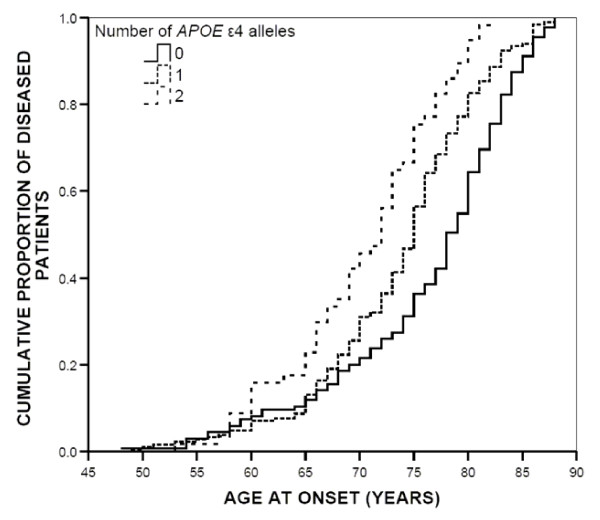
BACKGROUND: The objective of this study was to analyze factors influencing the risk and timing of Alzheimer's disease (AD) in central Norway. The APOE epsilon4 allele is the only consistently identified risk factor for late onset Alzheimer's disease (LOAD). We have described the allele frequencies of the apolipoprotein E gene (APOE) in a large population of patients with AD compared to the frequencies in a cognitively-normal control group, and estimated the effect of the APOE epsilon4 allele on the risk and the age at onset of AD in this population. METHODS: 376 patients diagnosed with AD and 561 cognitively-normal control individuals with no known first degree relatives with dementia were genotyped for the APOE alleles. Allele frequencies and genotypes in patients and control individuals were compared. Odds Ratio for developing AD in different genotypes was calculated. RESULTS: Odds Ratio (OR) for developing AD was significantly increased in carriers of the APOE epsilon4 allele compared to individuals with the APOE epsilon3/epsilon3 genotype. Individuals carrying APOE epsilon4/epsilon4 had OR of 12.9 for developing AD, while carriers of APOE epsilon2/epsilon4 and APOE epsilon3/epsilon4 had OR of 3.2 and 4.2 respectively. The effect of the APOE epsilon4 allele was weaker with increasing age. Carrying the APOE epsilon2 allele showed no significant protective effect against AD and did not influence age at onset of the disease. Onset in LOAD patients was significantly reduced in a dose dependent manner from 78.4 years in patients without the APOE epsilon4 allele, to 75.3 in carriers of one APOE epsilon4 allele and 72.9 in carriers of two APOE epsilon4 alleles. Age at onset in early onset AD (EOAD) was not influenced by APOE epsilon4 alleles. CONCLUSION: APOE epsilon4 is a very strong risk factor for AD in the population of central Norway, and lowers age at onset of LOAD significantly.
Overview
The claims and statistics of this paper haven’t been checked yet.
Run the check — free, no account needed. It reads the open-access text and checks the sources it cites.
Integrity signals
Registry
Cites
Statistics
Figures
Verification
Claims the paper makes
The claims and statistics of this paper haven’t been checked yet.
Run the check — free, no account needed. It reads the open-access text and checks the sources it cites.
Claims other papers make about this one
Each is checked against this paper’s own text: does it say what the citing paper says it does?
The source backs part of the claim, not all of it — or backs it for a different population, condition or comparison.
In the citing paper
“as well as an earlier age of onset for developing the disease (approximately 5 years for each APOE4 allele compared to APOE3 homozygotes).6,9,10”
From AAVrh.10-Mediated APOE2 Central Nervous System Gene Therapy for APOE4-Associated Alzheimer's Disease (2018) · cites this paper as [10]
Experimental — accuracy not yet measuredThe source backs part of the claim, not all of it — or backs it for a different population, condition or comparison.
In the citing paper
“APOE4 homozygotes have a markedly increased risk of developing AD (14.5-fold compared to APOE3 homozygotes)”
From AAVrh.10-Mediated APOE2 Central Nervous System Gene Therapy for APOE4-Associated Alzheimer's Disease (2018) · cites this paper as [10]
Experimental — accuracy not yet measuredThe source backs part of the claim, not all of it — or backs it for a different population, condition or comparison.
In the citing paper
“Each ApoE4 allele reduces the age of Alzheimer’s disease (AD) onset by approximately 3–5 years compared to ApoE3 homozygotes, which comprise ~80% of the human population (Roses, 1994; Sando et al., 2008).”
From NHE6 depletion corrects ApoE4-mediated synaptic impairments and reduces amyloid plaque load (2021) · cites this paper as Sando et al., 2008
Experimental — accuracy not yet measuredIn the citing paper
“Each ApoE4 allele reduces the age of Alzheimer’s disease (AD) onset by approximately 3–5 years compared to ApoE3 homozygotes, which comprise ~80% of the human population (Roses, 1994; Sando et al., 2008).”
From NHE6 depletion corrects ApoE4-mediated synaptic impairments and reduces amyloid plaque load (2021) · cites this paper as Sando et al., 2008
Self-check
Percentages, sums and reported differences re-computed from the paper’s own numbers.
The self-check needs the paper’s full text.
Citations
Cites
Folstein, M. F., Folstein, S. E., & McHugh, P. R. (1975) · Journal of Psychiatric Research · doi:10.1016/0022-3956(75)90026-6 · Cited by 88,282
McKhann, G., Drachman, D., Folstein, M., Katzman, R., Price, D., & Stadlan, E. M. (1984) · Neurology · doi:10.1212/wnl.34.7.939 · Cited by 27,915
Corder, E. H., Saunders, A. M., Strittmatter, W. J., Schmechel, D. E., Gaskell, P. C., Small, G. W., Roses, A. D., Haines, J. L., & Pericak-Vance, M. A. (1993) · Science · doi:10.1126/science.8346443 · Cited by 9,429
Strittmatter, W. J., Saunders, A. M., Schmechel, D., Pericak-Vance, M., Enghild, J., Salvesen, G. S., & Roses, A. D. (1993) · Proceedings of the National Academy of Sciences · doi:10.1073/pnas.90.5.1977 · Cited by 4,268
Apolipoprotein E: Cholesterol Transport Protein with Expanding Role in Cell Biology
Mahley, R. W. (1988) · Science · doi:10.1126/science.3283935 · Cited by 4,028
Association of apolipoprotein E allele ϵ4 with late‐onset familial and sporadic Alzheimer's disease
Saunders, A. M., Strittmatter, W. J., Schmechel, D., St. George-Hyslop, P. H., Pericak-Vance, M. A., Joo, S. H., Rosi, B. L., Gusella, J. F., Crapper-MacLachlan, D. R., Alberts, M. J., et al. (1993) · Neurology · doi:10.1212/wnl.43.8.1467 · Cited by 3,786
Apolipoprotein E polymorphism and Alzheimer's disease
Poirier, J., Bertrand, P., Poirier, J., Kogan, S., Gauthier, S., Poirier, J., Gauthier, S., Davignon, J., Bouthillier, D., & Davignon, J. (1993) · The Lancet · doi:10.1016/0140-6736(93)91705-q · Cited by 1,108
Ott, A., Breteler, M. M. B., van Harskamp, F., Claus, J. J., van der Cammen, T. J. M., Grobbee, D. E., & Hofman, A. (1995) · BMJ · doi:10.1136/bmj.310.6985.970 · Cited by 792
Rates and risk factors for dementia and Alzheimer’s disease: Results from EURODEM pooled analyses
Launer, L. J., Andersen, K., Dewey, M. E., Letenneur, L., Ott, A., Amaducci, L. A., Brayne, C., Copeland, J. R. M., Dartigues, J.-F., Kragh-Sorensen, P., et al. (1999) · Neurology · doi:10.1212/wnl.52.1.78 · Cited by 758
Apolipoprotein E (APOE) allele distribution in the world. Is APOE*4 a ‘thrifty’ allele?
Corbo, R. M., & Scacchi, R. (1999) · Annals of Human Genetics · doi:10.1046/j.1469-1809.1999.6340301.x · Cited by 653
Cited by
Sorted by citations
Items 101–200 of 274
The Relationship of APOE ε4, Race, and Sex on the Age of Onset and Risk of Dementia
Powell, D. S., Kuo, P., Qureshı, R., Coburn, S. B., Knopman, D. S., Palta, P., Gottesman, R. F., Griswold, M. E., Albert, M., Deal, J. A., et al. (2021) · Frontiers in Neurology · doi:10.3389/fneur.2021.735036 · Cited by 33
Preman, P., Moechars, D., Fertan, E., Wolfs, L., Serneels, L., Shah, D., Lamote, J., Poovathingal, S., Snellinx, A., Mancuso, R., et al. (2024) · EMBO Molecular Medicine · doi:10.1038/s44321-024-00162-7 · Cited by 32
Influence of apolipoprotein-E genotype on brain amyloid load and longitudinal trajectories
Lopresti, B. J., Campbell, E. M., Yu, Z., Anderson, S., Cohen, A. D., Minhas, D. S., Snitz, B. E., Royse, S. K., Becker, C. R., Aizenstein, H. J., et al. (2020) · Neurobiology of Aging · doi:10.1016/j.neurobiolaging.2020.05.012 · Cited by 32
Mansoori, N., Tripathi, M., Alam, R., Luthra, K., Ramakrishnan, L., Parveen, S., & Mukhopadhyay, A. K. (2010) · Dementia and Geriatric Cognitive Disorders · doi:10.1159/000321666 · Cited by 32
Marshe, V. S., Gorbovskaya, I., Kanji, S., Kish, M., & Müller, D. J. (2018) · Journal of Neural Transmission · doi:10.1007/s00702-018-1934-9 · Cited by 31
Molecular recognition of the interaction between ApoE and the TREM2 protein
Mai, Z., Wei, W., Yu, H., Chen, Y., Wang, Y., & Ding, Y. (2022) · Translational Neuroscience · doi:10.1515/tnsci-2022-0218 · Cited by 32
Decreased gene expression of CD2AP in Chinese patients with sporadic Alzheimer's disease
Tao, Q., Liu, Z., Sun, Y., Li, H., Yang, P., Liu, D., Jiang, B., Li, X., Xu, J., & Wu, Z. (2017) · Neurobiology of Aging · doi:10.1016/j.neurobiolaging.2017.03.013 · Cited by 30
Park, J. E., Choi, K. Y., Kim, B. C., Choi, S., Song, M., Lee, J. J., Kim, J., Song, H., Kim, H., Ha, J., et al. (2019) · Dementia and Geriatric Cognitive Disorders Extra · doi:10.1159/000496920 · Cited by 30
Peng, H., Wang, C., Chen, Z., Sun, Z., Jiao, B., Li, K., Huang, F., Hou, X., Wang, J., Shen, L. H., et al. (2014) · Neurobiology of Aging · doi:10.1016/j.neurobiolaging.2014.03.020 · Cited by 29
He, L.-N., Recker, R. R., Deng, H., & Dvornyk, V. (2008) · Maturitas · doi:10.1016/j.maturitas.2008.10.011 · Cited by 29
Genomics and Pharmacogenomics of Dementia
Cacabelos, R., & Martínez‐Bouza, R. (2010) · CNS Neuroscience & Therapeutics · doi:10.1111/j.1755-5949.2010.00189.x · Cited by 29
Associations Between Retinal Artery/Vein Occlusions and Risk of Vascular Dementia
Lee, C. S., Lee, M. L., Gibbons, L. E., Yanagihara, R. T., Blazes, M. S., Kam, J. P., McCurry, S. M., Bowen, J. D., McCormick, W. C., Lee, A., et al. (2021) · Journal of Alzheimer s Disease · doi:10.3233/jad-201492 · Cited by 28
Lamar, M., Yu, L., Rubin, L. H., James, B. D., Barnes, L. L., Farfel, J. M., Gaiteri, C., Buchman, A. S., Bennett, D. A., & Schneider, J. A. (2019) · Alzheimer's & Dementia · doi:10.1016/j.jalz.2018.08.007 · Cited by 27
Estrogen Receptors: A New Frontier in Alzheimer’s Disease Therapy
Cipriano, G. L., Mazzon, E., & Anchesi, I. (2024) · International Journal of Molecular Sciences · doi:10.3390/ijms25169077 · Cited by 27
Brenowitz, W. D., Zimmerman, S. C., Filshtein, T. J., Yaffe, K. S., Walter, S., Hoffmann, T. J., Jorgenson, E., Whitmer, R. A., & Glymour, M. M. (2021) · American Journal of Epidemiology · doi:10.1093/aje/kwab103 · Cited by 27
Zhao, S., Guo, C., Wang, M.-Q., Chen, W., & Zhao, Y. (2011) · Cytokine · doi:10.1016/j.cyto.2011.11.006 · Cited by 27
Dissociable effects of the apolipoprotein-E (APOE) gene on short- and long-term memories
Zokaei, N., Čepukaitytė, G., Alexander Board, Mackay, C. E., Husain, M., & Nobre, A. C. (2018) · Neurobiology of Aging · doi:10.1016/j.neurobiolaging.2018.09.017 · Cited by 26
Axl receptor tyrosine kinase is a regulator of apolipoprotein E
Zhao, W., Fan, J., Kulic, I., Koh, C., Clark, A., Meuller, J., Engkvist, O., Barichievy, S., Raynoschek, C., Hicks, R., et al. (2020) · Molecular Brain · doi:10.1186/s13041-020-00609-1 · Cited by 25
Rogne, S., Vangberg, T. R., Eldevik, P., Wikran, G., Mathiesen, E. B., & Schirmer, H. (2016) · Dementia and Geriatric Cognitive Disorders Extra · doi:10.1159/000450885 · Cited by 25
Hou, X., Adeosun, S. O., Zhang, Q., Barlow, B., Brents, M., Zheng, B., & Wang, J. (2015) · Frontiers in Aging Neuroscience · doi:10.3389/fnagi.2015.00207 · Cited by 25
Chen, K., Sun, Y., Zhou, Y. F., Zhao, Q., Ding, D., & Guo, Q. (2016) · Psychiatric Genetics · doi:10.1097/ypg.0000000000000126 · Cited by 25
Heun, R., Gühne, U., Luck, T., Angermeyer, M. C., Ueberham, U., Potluri, R., Natalwala, A., Arendt, T., & Riedel-Heller, S. G. (2009) · European Psychiatry · doi:10.1016/j.eurpsy.2009.02.009 · Cited by 23
The Spectrum of Genetic Risk in Alzheimer Disease
Karagas, N. E., Young, J. E., Blue, E., & Jayadev, S. (2025) · Neurology Genetics · doi:10.1212/nxg.0000000000200224 · Cited by 22
Sevlever, D., Zou, F., Ma, L., Carrasquillo, S., Crump, M., Culley, O. J., Hunter, T. A., Bisceglio, G. D., Younkin, L. H., Allen, M., et al. (2015) · Molecular Neurodegeneration · doi:10.1186/s13024-015-0015-x · Cited by 22
Self-citationA microglia clonal inflammatory disorder in Alzheimer’s disease
Vicario, R., Fragkogianni, S., Weber, L., Lazarov, T., Hu, Y., Hayashi, S. Y., Craddock, B., Socci, N. D., Alberdi, A., Baako, A., et al. (2025) · eLife · doi:10.7554/elife.96519.3 · Cited by 21
Jayadev, S. (2022) · CONTINUUM Lifelong Learning in Neurology · doi:10.1212/con.0000000000001125 · Cited by 21
Is ApoE ɛ 4 a good biomarker for amyloid pathology in late onset Alzheimer’s disease?
Ba, M., Kong, M., Li, X., Ng, K. P., Rosa‐Neto, P., & Gauthier, S. G. (2016) · Translational Neurodegeneration · doi:10.1186/s40035-016-0067-z · Cited by 20
APOE Genotype in the Diagnosis of Alzheimer’s Disease in Patients With Cognitive Impairment
Sun, X., Nicholas, J. S., Walker, A., Wagner, M. T., & Bachman, D. (2012) · American Journal of Alzheimer s Disease & Other Dementias® · doi:10.1177/1533317512452037 · Cited by 20
D’Alonzo, Z. J., Lam, V., Takechi, R., Nesbit, M., Vaccarezza, M., & Mamo, J. C. L. (2023) · Genes & Nutrition · doi:10.1186/s12263-023-00722-5 · Cited by 19
Inverse effect of the APOE epsilon4 allele in late- and early-onset Alzheimer’s disease
Luca, V. D., Orfei, M. D., Gaudenzi, S., Caltagirone, C., & Spalletta, G. (2015) · European Archives of Psychiatry and Clinical Neuroscience · doi:10.1007/s00406-015-0663-4 · Cited by 19
Proteins linking APOE ɛ4 with Alzheimer's disease
Oveisgharan, S., Yu, L., Lopes, K. D. P., Tasaki, S., Wang, Y., Menon, V., Schneider, J. A., Seyfried, N. T., & Bennett, D. A. (2024) · Alzheimer s & Dementia · doi:10.1002/alz.13867 · Cited by 18
Pecher, H., Storch, M., Beyer, F., Witte, A. V., Baasner, C.-F., Schönknecht, P. O. D., & Weise, C. M. (2024) · NeuroImage Clinical · doi:10.1016/j.nicl.2024.103687 · Cited by 18
Defective Lysosomal Lipid Catabolism as a Common Pathogenic Mechanism for Dementia
Lee, J. Y., Marian, O. C., & Don, A. S. (2021) · NeuroMolecular Medicine · doi:10.1007/s12017-021-08644-4 · Cited by 18
Pan, G., King, A. E., Wu, F., Simpson, S., Woodhouse, A., Phipps, A., & Vickers, J. C. (2021) · Ageing Research Reviews · doi:10.1016/j.arr.2021.101402 · Cited by 19
Apolipoprotein E ε4 Allele Modulates the Immediate Impact of Acute Exercise on Prefrontal Function
Marco, M. D., Clough, P., Dyer, C. E., Vince, R. V., Waby, J. S., Midgley, A. W., & Venneri, A. (2014) · Behavior Genetics · doi:10.1007/s10519-014-9675-5 · Cited by 18
Salminen, L. E., Schofield, P. R., Lane, E., Heaps, J. M., Pierce, K. D., Cabeen, R. P., Laidlaw, D. H., Akbudak, E., Conturo, T. E., Correia, S., et al. (2013) · Brain Imaging and Behavior · doi:10.1007/s11682-013-9225-4 · Cited by 18
Lincoln, S., Allen, M., Cox, C. L., Walker, L. P., Malphrus, K. G., Qiu, Y., Nguyen, T., Rowley, C. N., Kouri, N., Crook, J. E., et al. (2013) · PLoS ONE · doi:10.1371/journal.pone.0064164 · Cited by 18
Self-citationBumber, J. R., Rački, V., Mežnarić, S., Pelčić, G., & Mršić‐Pelčić, J. (2025) · Journal of Clinical Medicine · doi:10.3390/jcm14176047 · Cited by 19
Apolipoprotein E and Alzheimer’s Disease in Italian Population: Systematic Review and Meta-Analysis
Abrego-Guandique, D. M., Saraceno, G. F., Cannataro, R., de Burnside, M. M., Caroleo, M. C., & Cione, E. (2024) · Brain Sciences · doi:10.3390/brainsci14090908 · Cited by 17
Genetic Analysis of Interleukin-1A C(-889)T Polymorphism with Alzheimer Disease
Hu, J.-L., Li, G., Zhou, D., Zou, Y., Zhu, Z., Xu, R., Jiang, X., & Zeng, Y. (2008) · Cellular and Molecular Neurobiology · doi:10.1007/s10571-008-9299-5 · Cited by 17
Sun, Y., Li, H., Guo, Q., Wu, P., Hong, Z., Lü, C., & Wu, Z. (2012) · American Journal of Geriatric Psychiatry · doi:10.1097/jgp.0b013e3182423b6a · Cited by 16
Vijayaraghavan, S., Darreh‐Shori, T., Rongve, A., Berge, G., Sando, S. B., White, L. R., Auestad, B., Witoelar, A., Andreassen, O. A., Ulstein, I. D., et al. (2016) · Journal of Alzheimer s Disease · doi:10.3233/jad-150750 · Cited by 16
Self-citationAlternative Approaches in Gene Discovery and Characterization in Alzheimer’s Disease
Ertekin‐Taner, N., Jager, P. L. D., Yu, L., & Bennett, D. A. (2013) · Current Genetic Medicine Reports · doi:10.1007/s40142-013-0007-5 · Cited by 16
Genetic Factors, Brain Atrophy, and Response to Rehabilitation Therapy After Stroke
Cramer, S. C., See, J., Liu, B., Edwardson, M. A., Wang, X., Radom‐Aizik, S., Haddad, F., Shahbaba, B., Wolf, S. L., Dromerick, A. W., et al. (2021) · Neurorehabilitation and neural repair · doi:10.1177/15459683211062899 · Cited by 15
Kurzweil, R., & Grossman, T. (2010) · Springer eBooks · doi:10.1007/978-90-481-3999-6_1 · Cited by 14
Low-degree trisomy 21 mosaicism promotes early-onset Alzheimer disease
Nübling, G., Prix, C., Brendel, M., Beyer, L., Wlasich, E., Loosli, S. V., Barthel, H., Sabri, O., Bartenstein, P., Vöglein, J., et al. (2021) · Neurobiology of Aging · doi:10.1016/j.neurobiolaging.2021.02.021 · Cited by 14
Sun, Y., Wu, P., Li, H., Liu, Z., Tao, Q., Guo, Q., Hong, Z., & Xu, M. (2015) · Clinical Interventions in Aging · doi:10.2147/cia.s73396 · Cited by 14
van den Kommer, T. N., Bontempo, D. E., Comijs, H. C., Hofer, S. M., Dik, M. G., Piccinin, A. M., Jonker, C., Deeg, D. J. H., & Johansson, B. E. A. (2009) · Dementia and Geriatric Cognitive Disorders · doi:10.1159/000261501 · Cited by 14
Apolipoprotein E genotypes and longevity across dementia disorders
Skillbäck, T. B., Lautner, R., Mattsson, N., Schott, J. M., Skoog, I. G., Nägga, K., Kilander, L., Wimo, A. B., Winblad, B. G., Eriksdotter, M., et al. (2018) · Alzheimer s & Dementia · doi:10.1016/j.jalz.2018.02.003 · Cited by 14
Reed, A. L., Mitchell, W., Alexandrescu, A. T., & Alder, N. N. (2023) · Frontiers in Physiology · doi:10.3389/fphys.2023.1263420 · Cited by 13
Factors that influence the levels of cerebrospinal fluid biomarkers in memory clinic patients
Knapskog, A., Eldholm, R. S., Brækhus, A., Engedal, K., & Saltvedt, I. T. (2017) · BMC Geriatrics · doi:10.1186/s12877-017-0611-4 · Cited by 13
Self-citationAccelerated midlife endocrine and bioenergetic brain aging in APOE4 females
Wang, T., Mao, Z., Shang, Y., Merlini, S., Vitali, F., Wiegand, J. L., & Brinton, R. D. (2025) · Frontiers in Aging Neuroscience · doi:10.3389/fnagi.2025.1632877 · Cited by 12
Genomic stress and impaired DNA repair in Alzheimer disease
Neven, J., Issayama, L. K., Dewachter, I., & Wilson, D. M. (2024) · DNA repair · doi:10.1016/j.dnarep.2024.103678 · Cited by 12
Hays, C. C., Zlatar, Z. Z., Meloy, M. J., Osuna, J., Liu, T. T., Galasko, D. R., & Wierenga, C. E. (2019) · Journal of Alzheimer s Disease · doi:10.3233/jad-190504 · Cited by 12
Wei, P., Lin, K., Chen, X., Fang, C., Qiu, L., Hu, J., & Chang, J. (2025) · CNS Neuroscience & Therapeutics · doi:10.1111/cns.70306 · Cited by 11
McInvale, J. J., Canoll, P., & Hargus, G. (2024) · Brain Pathology · doi:10.1111/bpa.13231 · Cited by 11
Apolipoprotein E Gene Polymorphism in a Chinese Population with Vascular Dementia: A Meta-Analysis
Liu, B., Shen, Y., Cen, L., & Tang, Y. (2012) · Dementia and Geriatric Cognitive Disorders · doi:10.1159/000337025 · Cited by 11
Umlauf, E., Rappold, E., Schiller, B., Fuchs, P., Rainer, M. K., Wolf, B., & Zellner, M. (2016) · Oncotarget · doi:10.18632/oncotarget.9773 · Cited by 11
Associations of plasma angiostatin and amyloid-β and tau levels in Alzheimer’s disease
Cheng, Y., Ren, J.-R., Jian, J.-M., He, C.-Y., Xu, M., Zeng, G., Tan, C., Shen, Y., Jin, W., Chen, D., et al. (2022) · Translational Psychiatry · doi:10.1038/s41398-022-01962-6 · Cited by 11
Carlos, A. F., Machulda, M. M., Rutledge, M. H., Nguyen, A. T., Reichard, R. R., Baker, M., Rademakers, R., Dickson, D. W., Petersen, R. C., & Josephs, K. A. (2023) · Journal of Alzheimer s Disease · doi:10.3233/jad-221094 · Cited by 11
Naj, A. C., Carney, R. M., Hahn, S. E., Slifer, M. A., Haines, J. L., & Pericak‐Vance, M. A. (2013) · Elsevier eBooks · doi:10.1016/b978-0-12-383834-6.00116-6 · Cited by 11
Case Report of a 63-Year-Old Patient With Alzheimer Disease and a Novel Presenilin 2 Mutation
Wells, J., & Pasternak, S. (2018) · Alzheimer Disease & Associated Disorders · doi:10.1097/wad.0000000000000269 · Cited by 10
Pathologies Underlying Longitudinal Cognitive Decline in the Oldest Old
Nguyen, M. T., Mattek, N., Woltjer, R. L., Howieson, D. B., Silbert, L. C., Hofer, S. M., Kaye, J. A., Dodge, H. H., & Erten‐Lyons, D. (2018) · Alzheimer Disease & Associated Disorders · doi:10.1097/wad.0000000000000265 · Cited by 10
Günaydın, C., Hackett, N. R., Wakim, V., Sondhi, D., Kaminsky, S. M., & Crystal, R. G. (2025) · Human Gene Therapy · doi:10.1177/10430342251401888 · Cited by 10
Molecular mechanisms of aging in the pathogenesis of Alzheimer’s disease
Kakkar, A., Singh, H., Singh, B. K., Chauhan, K., Chopra, S., Chopra, H., & Mishra, A. K. (2026) · Discover Neuroscience · doi:10.1186/s13064-026-00243-y · Cited by 9
APOE ε4 and exercise interact in a sex‐specific manner to modulate dementia risk factors
Foley, K. E., Diemler, C. A., Hewes, A. A., Garceau, D. T., Sasner, M., & Howell, G. R. (2022) · Alzheimer s & Dementia Translational Research & Clinical Interventions · doi:10.1002/trc2.12308 · Cited by 9
Rosness, T. A., Haugen, P. K., & Engedal, K. (2011) · Tidsskrift for Den norske legeforening · doi:10.4045/tidsskr.09.0845 · Cited by 9
The effects of training intensities on motor recovery and gait symmetry in a rat model of ischemia
Li, L., Rong, W., Ke, Z., Hu, X., & Tong, R. K. (2013) · Brain Injury · doi:10.3109/02699052.2012.750750 · Cited by 9
Retinal manifestations and their diagnostic significance in Alzheimer's disease
Abhyankar, S. D., Little, K., Stitt, A. W., & Bhatwadekar, A. D. (2025) · Journal of Alzheimer s Disease Reports · doi:10.1177/25424823251361937 · Cited by 8
Hayes, C. A., Abdullah, L. B., Gills, J. L., Odden, M. C., & The Health and Aging Brain Study (HABS-HD) Study Team (2025) · Alzheimer s Research & Therapy · doi:10.1186/s13195-025-01866-9 · Cited by 8
Asiamah, E. A., Feng, B., Guo, R., Yaxing, X., Du, X., Liu, X., Zhang, J., Cui, H., & Ma, J. (2024) · Journal of Alzheimer s Disease · doi:10.3233/jad-230658 · Cited by 8
ApoE Type 4 Allele Affects Cognitive Function of Aged Population in Tianjin City, China
Sun, S., Fu, J., Chen, J., Pang, W., Hu, R., Li, H., Tan, L., & Jiang, Y. (2015) · American Journal of Alzheimer s Disease & Other Dementias® · doi:10.1177/1533317514566114 · Cited by 8
Potential genetic biomarkers in the early diagnosisof Alzheimer disease: APOE and BIN1
Kaya, G., Gündüz, E., Acar, M., Hatipoğlu, Ö. F., Acar, B., İlhan, A., & Gündüz, M. (2015) · TURKISH JOURNAL OF MEDICAL SCIENCES · doi:10.3906/sag-1405-96 · Cited by 8
Pardo, J. V., Lee, J. T., & Initiative, A. D. N. (2018) · eNeuro · doi:10.1523/eneuro.0396-17.2018 · Cited by 8
HDL mimetic peptides affect apolipoprotein E metabolism: equal supplement or functional enhancer?
Wang, W., & Zhu, X. (2018) · Journal of Neurochemistry · doi:10.1111/jnc.14595 · Cited by 8
Sex differences in interacting genetic and functional connectivity biomarkers in Alzheimer’s disease
Williamson, J. N., James, S. A., Mullen, S. P., Sutton, B. P., Wszalek, T., Mulyana, B. E., Mukli, P., Yabluchanskiy, A., Weiner, M. W., Aisen, P. S. S., et al. (2024) · GeroScience · doi:10.1007/s11357-024-01151-x · Cited by 7
ApoE Isoforms Inhibit Amyloid Aggregation of Proinflammatory Protein S100A9
Ghosh, S., Tamilselvi, S., Williams, C., Jayaweera, S. W., Iashchishyn, I. A., Šulskis, D., Gilthorpe, J. D., Olofsson, A., Smirnovas, V., Svedružić, Ž. M., et al. (2024) · International Journal of Molecular Sciences · doi:10.3390/ijms25042114 · Cited by 6
Li, W., Wang, X., Sun, L., Yue, L., & Xiao, S. (2024) · Frontiers in Public Health · doi:10.3389/fpubh.2024.1417499 · Cited by 7
Drake, J. A., Jakicic, J. M., Rogers, R. J., Aghjayan, S. L., Stillman, C. M., Donofry, S. D., Roecklein, K. A., Lang, W., & Erickson, K. I. (2022) · Frontiers in Human Neuroscience · doi:10.3389/fnhum.2022.1001229 · Cited by 6
Ramachandran, A. K., Das, S., Shenoy, G. G., Mudgal, J., & Joseph, A. (2022) · CNS & Neurological Disorders - Drug Targets · doi:10.2174/1871527322666221226145141 · Cited by 7
Hayes, C. A., Thorpe, R. J., & Odden, M. C. (2025) · Acta Neuropathologica Communications · doi:10.1186/s40478-025-02012-0 · Cited by 6
Machine Learning Detects Distinct Subtypes of Minimal Cognitive Impairment
Chen, R., Herskovits, E. H., & Initiative, A. D. N. (2021) · Journal of Signal Processing Systems · doi:10.1007/s11265-021-01667-x · Cited by 6
In vitro characterization on the role of APOE polymorphism in human hippocampal neurogenesis
Lee, H.-A., Price, J., Srivastava, D. P., & Thuret, S. (2023) · Hippocampus · doi:10.1002/hipo.23502 · Cited by 6
Li, Z., Yang, N., Lei, X., Lin, C., Li, N., Jiang, X., Wei, X., & Xu, B. (2019) · Journal of Clinical Laboratory Analysis · doi:10.1002/jcla.22950 · Cited by 6
Singh, H. N., Swarup, V., Dubey, N. K., Jha, N. K., Singh, A. K., Lo, W., & Kumar, S. (2022) · Biomedicines · doi:10.3390/biomedicines10030611 · Cited by 6
Housini, M., Contreras, J. A., Hayes, C. A., & The Health and Aging Brain Study (HABS‐HD) Study Team (2026) · Journal of Alzheimer s Disease · doi:10.1177/13872877251415367 · Cited by 5
Sabbagh, M. N., Malek‐Ahmadi, M. H., Levenson, I., & Sparks, D. L. (2012) · Journal of Alzheimer s Disease · doi:10.3233/jad-2012-121015 · Cited by 5
Klimkowicz‐Mrowiec, A., Bodzioch, M., Szczudlik, A., & Słowik, A. (2014) · American Journal of Alzheimer s Disease & Other Dementias® · doi:10.1177/1533317514536599 · Cited by 5
Exploration of potential circulating micro-RNA as biomarker for Alzheimer's disease
Abolghasemi, M., Poursaei, E., Bornehdeli, S., Shanehbandi, D., Asadi, M., Sadeghzadeh, M., & Sadeh, R. N. (2021) · Meta Gene · doi:10.1016/j.mgene.2021.100968 · Cited by 5
Ajnakina, O., Shamsutdinova, D. D., Stahl, D. R., & Steptoe, A. (2023) · The Journals of Gerontology Series A · doi:10.1093/gerona/glad168 · Cited by 5
Modelling Decline in Cognition to Decline in Function in Alzheimer’s Disease
Karcher, H., Savelieva, M., Qi, L., Hummel, N., Caputo, A., Risson, V., Capkun, G., & Initiative, A. D. N. (2020) · Current Alzheimer Research · doi:10.2174/1567205017666201008105429 · Cited by 5
Huang, Y., Chan, H., Khoo, J.-Y., Chan, M.-L., Bender, D. A., Ponnusamy, V. K., Belaidi, A. A., & Ke, L. (2025) · Neurochemistry International · doi:10.1016/j.neuint.2025.106104 · Cited by 4
Polygenic risk of Alzheimer's disease in the Faroe Islands
Johansen, M., Joensen, S., Restorff, M., Stórá, T., Christy, D., Gustavsson, E. K., Bian, J., Guo, Y. M., Farrer, M. J., & Petersen, M. S. (2022) · European Journal of Neurology · doi:10.1111/ene.15351 · Cited by 4
Can cognitive reserve offset APOE-related Alzheimer’s risk? A systematic review
da Silva, S. P., Lampraki, C., Rêgo, T. S., Ghisletta, P., Kliegel, M., Maurer, J., Studer, M., Gouveia, É. R., Nascimento, M. D. M., & Ihle, A. (2025) · Ageing Research Reviews · doi:10.1016/j.arr.2025.102809 · Cited by 4
Alzheimer’s Disease as a Disease of Evolutionary Mismatch, with a Focus on Reproductive Life History
Fox, M. M. (2022) · Cambridge University Press eBooks · doi:10.1017/9781009030564.019 · Cited by 4
Alzheimer’s Disease and Other Dementias
Neel, I. C. (2024) · Springer eBooks · doi:10.1007/978-3-030-74720-6_84 · Cited by 4
Chakraborty, S., Joardar, A., Roy, S., Gangopadhyay, G., & Biswas, A. (2021) · Neurology India · doi:10.4103/0028-3886.329604 · Cited by 4
Bagaria, J., Moon, Y., Bagyinszky, E., Shim, K. H., An, S. S. A., Kim, S., & Han, S. H. (2022) · Frontiers in Neurology · doi:10.3389/fneur.2022.899644 · Cited by 4
Genetic and Blood Biomarkers of Alzheimer`s Disease
Momeni, P., & Ferrari, R. (2010) · The Open Nuclear Medicine Journal · doi:10.2174/1876388x01002010012 · Cited by 4
Sillén, A., Brohede, J., Forsell, C., Lilius, L., Andrade, J., Odeberg, J., Kimura, T., Winblad, B. G., & Graff, C. (2011) · Dementia and Geriatric Cognitive Disorders · doi:10.1159/000323808 · Cited by 4
Metadata
- Authors
- Sando, S. B., Melquist, S., Cannon, A., Hutton, M. L., Sletvold, O., Saltvedt, I., White, L. R., Lydersen, S., & Aasly, J. O.
- Affiliations
- Norwegian University of Science and Technology (NO)
- Mayo Clinic (US)
- Corresponding author
- Sando, Sigrid B
- Venue
- BMC Neurology
- Published
- 2008-04-16
- Volume
- 8
- Issue
- 1
- Pages
- 9-9
- ISSN
- 1471-2377 (ISSN-L)
- PMC
- PMC2375917
- OpenAlex
- W1972488785
- Cited by
- 261
- References
- 39
- Citations by year
- 2026: 11 · 2025: 24 · 2024: 21 · 2023: 12 · 2022: 22 · 2021: 20 · 2020: 13 · 2019: 12 · 2018: 17 · 2017: 15 · 2016: 13 · 2015: 16 · 2014: 10 · 2013: 10 · 2012: 11
- FWCI
- 7.94
- Type
- journal article
- Language
- en
- Open access
- gold
- doi.org
- Licence
- Locations
- BMC Neurology (publishedVersion, cc-by)
- PubMed Central (publishedVersion, cc-by)
- PubMed (publishedVersion)
- BIBSYS Brage (BIBSYS (Norway)) (acceptedVersion)
- DOAJ (DOAJ: Directory of Open Access Journals) (submittedVersion)
- NORA - Norwegian Open Research Archives (submittedVersion, cc-by)
- Funders
- Mayo Foundation for Medical Education and Research (AG17216)
- Norges Forskningsråd (153487/V50)
- National Institutes of Health (AG17216)
- National Institute on Aging (P01-AG-17216, F32AG024030, AG 24030, P01AG017216)
- Topics
- Health Sciences › Medicine › Psychiatry and Mental health › Dementia and Cognitive Impairment Research
- Life Sciences › Neuroscience › Cellular and Molecular Neuroscience › Alzheimer's disease research and treatments
- Life Sciences › Biochemistry, Genetics and Molecular Biology › Genetics › Genetic Associations and Epidemiology
- Keywords
- Alzheimer's disease, APOE ε4, apolipoprotein E, late-onset Alzheimer's disease, age of onset, genetic risk factors, APOE ε2 allele, allele frequency, early-onset Alzheimer's disease, dose-dependent effects
- MeSH terms
- Aged, Aged, 80 and over, Alleles, Alzheimer Disease, Female, Gene Frequency, Humans, Male, Norway, Risk Factors, Odds Ratio, Case-Control Studies, Age of Onset, Apolipoprotein E4
About these checks
Registry, retraction, Cites and statistics results are computed, not judged, with one exception: a printed reference that no index lists is read once by a model before it counts as a citation error. Claims are extracted by a model and kept only when their quote appears verbatim in the text; each cited source is then checked, with a model’s help, for whether it says what the claim relies on. Those verdicts can be wrong — read the claim’s quote and the cited source before relying on one.
Statistics and arithmetic are recomputed, not judged.
Confidence bands are shown only for fields calibrated on our annotated test set. None is calibrated yet, so no band is shown.
What counts as a claim ›How we measure confidence ›How we check this ›
Are you an author, or do you see a problem with this page? Request a review
