

The DOI matches its Crossref record; 38 of the 39 references it cites were found in a registry or an index.
APOE ε4 lowers age at onset and is a high risk factor for Alzheimer's disease; A case control study from central Norway
Open accessAbstract
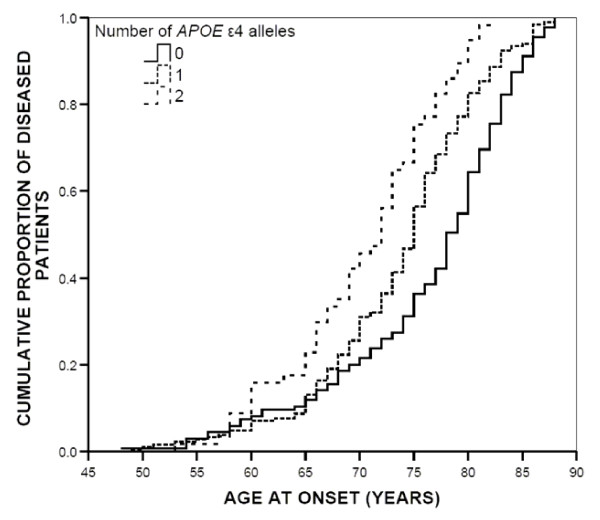
BACKGROUND: The objective of this study was to analyze factors influencing the risk and timing of Alzheimer's disease (AD) in central Norway. The APOE epsilon4 allele is the only consistently identified risk factor for late onset Alzheimer's disease (LOAD). We have described the allele frequencies of the apolipoprotein E gene (APOE) in a large population of patients with AD compared to the frequencies in a cognitively-normal control group, and estimated the effect of the APOE epsilon4 allele on the risk and the age at onset of AD in this population. METHODS: 376 patients diagnosed with AD and 561 cognitively-normal control individuals with no known first degree relatives with dementia were genotyped for the APOE alleles. Allele frequencies and genotypes in patients and control individuals were compared. Odds Ratio for developing AD in different genotypes was calculated. RESULTS: Odds Ratio (OR) for developing AD was significantly increased in carriers of the APOE epsilon4 allele compared to individuals with the APOE epsilon3/epsilon3 genotype. Individuals carrying APOE epsilon4/epsilon4 had OR of 12.9 for developing AD, while carriers of APOE epsilon2/epsilon4 and APOE epsilon3/epsilon4 had OR of 3.2 and 4.2 respectively. The effect of the APOE epsilon4 allele was weaker with increasing age. Carrying the APOE epsilon2 allele showed no significant protective effect against AD and did not influence age at onset of the disease. Onset in LOAD patients was significantly reduced in a dose dependent manner from 78.4 years in patients without the APOE epsilon4 allele, to 75.3 in carriers of one APOE epsilon4 allele and 72.9 in carriers of two APOE epsilon4 alleles. Age at onset in early onset AD (EOAD) was not influenced by APOE epsilon4 alleles. CONCLUSION: APOE epsilon4 is a very strong risk factor for AD in the population of central Norway, and lowers age at onset of LOAD significantly.
Overview
The claims and statistics of this paper haven’t been checked yet.
Run the check — free, no account needed. It reads the open-access text and checks the sources it cites.
Integrity signals
Registry
Cites
Statistics
Figures
Verification
Claims the paper makes
The claims and statistics of this paper haven’t been checked yet.
Run the check — free, no account needed. It reads the open-access text and checks the sources it cites.
Claims other papers make about this one
Each is checked against this paper’s own text: does it say what the citing paper says it does?
The source backs part of the claim, not all of it — or backs it for a different population, condition or comparison.
In the citing paper
“as well as an earlier age of onset for developing the disease (approximately 5 years for each APOE4 allele compared to APOE3 homozygotes).6,9,10”
From AAVrh.10-Mediated APOE2 Central Nervous System Gene Therapy for APOE4-Associated Alzheimer's Disease (2018) · cites this paper as [10]
Experimental — accuracy not yet measuredThe source backs part of the claim, not all of it — or backs it for a different population, condition or comparison.
In the citing paper
“APOE4 homozygotes have a markedly increased risk of developing AD (14.5-fold compared to APOE3 homozygotes)”
From AAVrh.10-Mediated APOE2 Central Nervous System Gene Therapy for APOE4-Associated Alzheimer's Disease (2018) · cites this paper as [10]
Experimental — accuracy not yet measuredThe source backs part of the claim, not all of it — or backs it for a different population, condition or comparison.
In the citing paper
“Each ApoE4 allele reduces the age of Alzheimer’s disease (AD) onset by approximately 3–5 years compared to ApoE3 homozygotes, which comprise ~80% of the human population (Roses, 1994; Sando et al., 2008).”
From NHE6 depletion corrects ApoE4-mediated synaptic impairments and reduces amyloid plaque load (2021) · cites this paper as Sando et al., 2008
Experimental — accuracy not yet measuredIn the citing paper
“Each ApoE4 allele reduces the age of Alzheimer’s disease (AD) onset by approximately 3–5 years compared to ApoE3 homozygotes, which comprise ~80% of the human population (Roses, 1994; Sando et al., 2008).”
From NHE6 depletion corrects ApoE4-mediated synaptic impairments and reduces amyloid plaque load (2021) · cites this paper as Sando et al., 2008
Self-check
Percentages, sums and reported differences re-computed from the paper’s own numbers.
The self-check needs the paper’s full text.
Citations
Cites
Folstein, M. F., Folstein, S. E., & McHugh, P. R. (1975) · Journal of Psychiatric Research · doi:10.1016/0022-3956(75)90026-6 · Cited by 88,282
McKhann, G., Drachman, D., Folstein, M., Katzman, R., Price, D., & Stadlan, E. M. (1984) · Neurology · doi:10.1212/wnl.34.7.939 · Cited by 27,915
Corder, E. H., Saunders, A. M., Strittmatter, W. J., Schmechel, D. E., Gaskell, P. C., Small, G. W., Roses, A. D., Haines, J. L., & Pericak-Vance, M. A. (1993) · Science · doi:10.1126/science.8346443 · Cited by 9,429
Strittmatter, W. J., Saunders, A. M., Schmechel, D., Pericak-Vance, M., Enghild, J., Salvesen, G. S., & Roses, A. D. (1993) · Proceedings of the National Academy of Sciences · doi:10.1073/pnas.90.5.1977 · Cited by 4,268
Apolipoprotein E: Cholesterol Transport Protein with Expanding Role in Cell Biology
Mahley, R. W. (1988) · Science · doi:10.1126/science.3283935 · Cited by 4,028
Association of apolipoprotein E allele ϵ4 with late‐onset familial and sporadic Alzheimer's disease
Saunders, A. M., Strittmatter, W. J., Schmechel, D., St. George-Hyslop, P. H., Pericak-Vance, M. A., Joo, S. H., Rosi, B. L., Gusella, J. F., Crapper-MacLachlan, D. R., Alberts, M. J., et al. (1993) · Neurology · doi:10.1212/wnl.43.8.1467 · Cited by 3,786
Apolipoprotein E polymorphism and Alzheimer's disease
Poirier, J., Bertrand, P., Poirier, J., Kogan, S., Gauthier, S., Poirier, J., Gauthier, S., Davignon, J., Bouthillier, D., & Davignon, J. (1993) · The Lancet · doi:10.1016/0140-6736(93)91705-q · Cited by 1,108
Ott, A., Breteler, M. M. B., van Harskamp, F., Claus, J. J., van der Cammen, T. J. M., Grobbee, D. E., & Hofman, A. (1995) · BMJ · doi:10.1136/bmj.310.6985.970 · Cited by 792
Rates and risk factors for dementia and Alzheimer’s disease: Results from EURODEM pooled analyses
Launer, L. J., Andersen, K., Dewey, M. E., Letenneur, L., Ott, A., Amaducci, L. A., Brayne, C., Copeland, J. R. M., Dartigues, J.-F., Kragh-Sorensen, P., et al. (1999) · Neurology · doi:10.1212/wnl.52.1.78 · Cited by 758
Apolipoprotein E (APOE) allele distribution in the world. Is APOE*4 a ‘thrifty’ allele?
Corbo, R. M., & Scacchi, R. (1999) · Annals of Human Genetics · doi:10.1046/j.1469-1809.1999.6340301.x · Cited by 653
Cited by
Sorted by citations
Items 201–274 of 274
NHE6-Depletion Corrects ApoE4-Mediated Synaptic Impairments and Reduces Amyloid Plaque LoadPreprint
Pohlkamp, T., Xian, X., Wong, C. H. Y., Durakoglugil, M. S., Werthmann, G. C., Saido, T., Evers, B. M., White, C. L., Connor, J., Hammer, R. E., et al. (2021) · bioRxiv (Cold Spring Harbor Laboratory) · doi:10.1101/2021.03.22.436385 · Cited by 4
C‐reactive protein‐mediated dementia
Tang, J., Lu, Q., Lin, H., Li, J., Zhu, X., & Ma, T. (2025) · Psychogeriatrics · doi:10.1111/psyg.70032 · Cited by 3
A possible role of Apolipoprotein E in Idiopathic Generalized Epilepsy
Kabbage, M., Mrabet, S., Mounadi, M., Gharbi, A., Atrous, A., Abdelkefi, I., Gargouri, A., & Gouider, R. (2025) · Epilepsy & Behavior · doi:10.1016/j.yebeh.2025.110554 · Cited by 3
High-fat Western diet induces retinal and metabolic alterations in APOE3 and APOE4 knock-in mice
Abhyankar, S. D., Luo, Q., Hartman, G. D., Mahajan, N. S., Corson, T. W., Oblak, A. L., Lamb, B. T., & Bhatwadekar, A. D. (2026) · Scientific Reports · doi:10.1038/s41598-025-34776-9 · Cited by 3
Exploring the connection between dementia and cardiovascular risk with a focus on ADAM10
Targas, A. B. A., Victoriano, P. H. M., Garcia, M. B. B., Alexandre-Silva, V., & Cominetti, M. R. (2025) · Biochimica et Biophysica Acta (BBA) - Molecular Basis of Disease · doi:10.1016/j.bbadis.2025.167825 · Cited by 3
Ongtanasup, T., & Eawsakul, K. (2025) · Advances in Pharmacological and Pharmaceutical Sciences · doi:10.1155/adpp/5528793 · Cited by 3
Alzheimer Dementia and Microvascular Pathology: Blood-Brain Barrier Permeability Imaging
Moon, W. (2020) · Journal of the Korean Society of Radiology · doi:10.3348/jksr.2020.81.3.488 · Cited by 3
Halla, S. B., Tazzite, A., Gazzaz, B., Moutawakil, B. E., & Dehbi, H. (2022) · Gene Reports · doi:10.1016/j.genrep.2021.101484 · Cited by 3
Zeng, Y., Du, W., Zhang, M., Walker, A. P., Han, Y., & Ding, Y. (2024) · Brain Sciences · doi:10.3390/brainsci14030281 · Cited by 3
Lucero Rengifo, R., Gaviria, D., & Serrano, H. (2012) · Biomédica · doi:10.7705/biomedica.v32i2.427 · Cited by 3
Robert, J., Cheng, W. H., Hayat, A., Ward-Able, T., & Wellington, C. L. (2015) · Clinical Lipidology · doi:10.2217/clp.14.64 · Cited by 3
Identifiability-Guided Assessment of Digital Twins in Alzheimer’s Disease Clinical Research and CarePreprint
Jiang, J., Petrella, J. R., Hao, W., & Initiative, T. A. D. N. (2025) · bioRxiv (Cold Spring Harbor Laboratory) · doi:10.1101/2025.08.17.670697 · Cited by 3
Akgün, B., Gulyayev, A. V., Coker, M. M., Hamilton‐Nelson, K. L., Olalusi, O., Adams, L. D., Akinwande, K., Whitehead, P. G., Diala, S., Ogunronbi, M., et al. (2025) · Alzheimer s & Dementia · doi:10.1002/alz.70583 · Cited by 2
Mostafaei, S., Shemer, D. W., Mak, J. K. L., Karlsson, I., & Hägg, S. (2026) · Alzheimer s Research & Therapy · doi:10.1186/s13195-026-02011-w · Cited by 2
Hayes, C. A., Agwu, C., Dharmapuri, A., Contreras, J. A., & The Health and Aging Brain Study (HABS‐HD) Study Team (2026) · Journal of Alzheimer s Disease · doi:10.1177/13872877261427706 · Cited by 2
Moon, S. S., Anderson, L., Liu, J., Lee, J., & Moon, Y. (2024) · Journal of Alzheimer s Disease Reports · doi:10.3233/adr-230162 · Cited by 2
Tábuas‐Pereira, M., Guerreiro, R. J., Kun‐Rodrigues, C., Almeida, M. R., Brás, J., & Santana, I. J. (2022) · Neurogenetics · doi:10.1007/s10048-022-00699-0 · Cited by 2
CASE REPORT OF A PATIENT WITH RARE P.ARG136CYS (APOE2*) MUTATION IN APOLIPOPROTEIN E GENE
Lisyova (2014) · OnLine Journal of Biological Sciences · doi:10.3844/ojbsci.2014.36.43 · Cited by 2
Stephen, R. (2020) · UEF eRepo (University of Eastern Finland) · Cited by 2
A microglia clonal inflammatory disorder in Alzheimer’s DiseasePreprint
Vicario, R., Fragkogianni, S., Weber, L., Lazarov, T., Hu, Y., Hayashi, S. Y., Craddock, B. P., Socci, N. D., Alberdi, A., Baako, A., et al. (2024) · eLife · doi:10.7554/elife.96519.2 · Cited by 2
Wolf, E. J., Miller, M. W., Zhang, R., Sherva, R., Harrington, K. M., Fonda, J. R., Daskalakis, N. P., Gaziano, J. M., & Logue, M. W. (2024) · Nature Mental Health · doi:10.1038/s44220-024-00225-1 · Cited by 1
Valdez-Gaxiola, C. A., Rosales-Leycegui, F., Gaxiola-Rubio, A., Dumois‐Petersen, S., Gallegos‐Arreola, M. P., Ringman, J. M., & Figuera, L. E. (2025) · International Journal of Molecular Sciences · doi:10.3390/ijms26167929 · Cited by 1
Wu, X., Chen, Y., Liu, H., Sun, Z., Sun, P., Liu, Y., Shuai, P., Yang, H., Yang, L., & Wan, Z. (2026) · The journal of nutrition health & aging · doi:10.1016/j.jnha.2026.100868 · Cited by 1
Long, X., Rong, M., Long, S., Wen, S., Mo, L., Xu, M., Zhang, Z., & Nie, Q. (2026) · Frontiers in Aging Neuroscience · doi:10.3389/fnagi.2026.1868433 · Cited by 1
What Psychiatrists Should Know about Genes and Alzheimer's Disease.
Howe, E. G. (2010) · PubMed Central · Cited by 1
Alzheimer’s Disease and Other Dementias
Neel, I. C. (2022) · Springer eBooks · doi:10.1007/978-3-030-01782-8_84-1 · Cited by 1
Lashkari, F. M., Meybodi, A. M., Mansouri, Z., Kalantari, H., Farahmand, K., & Vaziri, H. (2015) · Egyptian Journal of Medical Human Genetics · doi:10.1016/j.ejmhg.2015.11.003 · Cited by 1
Diagnosis Test Meta-Analysis for Apolipoprotein E in Alzheimer’s Disease
Xiong, X., Xiao, H., Zhang, Y., Yu, D., Chuan, J., Zhong, L., Yin, Q., & Tong, R. (2020) · Disease Markers · doi:10.1155/2020/6486031 · Cited by 1
Wang, Z., Pang, J., Zhou, R., Qi, J., Shi, X., Han, B., Xu, M., Wang, Q., & Sun, J. (2023) · Frontiers in Psychiatry · doi:10.3389/fpsyt.2023.1197987 · Cited by 1
Zuniga, G. (2016) · Texas ScholarWorks (Texas Digital Library) · doi:10.15781/t2jd4pp3c · Cited by 1
A microglia clonal inflammatory disorder in Alzheimer’s DiseasePreprint
Vicario, R., Fragkogianni, S., Weber, L., Lazarov, T., Hu, Y., Hayashi, S. Y., Craddock, B. P., Socci, N. D., Alberdi, A., Baako, A., et al. (2024) · eLife · doi:10.7554/elife.96519.1 · Cited by 1
DFP: Therapie der Alzheimer-Demenz: Status quo und Zukunftsperspektiven
Moser, U., Kaser, S., & Winkler, D. (2017) · Journal für Kardiologie (Krause & Pachernegg GmbH)
Identification of Novel Fluid Biomarkers for Alzheimer's Disease
Craig‐Schapiro, R. (2012) · Open Scholarship Institutional Repository (Washington University in St. Louis) · doi:10.7936/k7pr7t12
Alzheimer's Disease Association with Chlamydia pneumoniae
Short, A. (2011) · Digital Commons - PCOM (Philadelphia College of Osteopathic Medicine)
Ravona‐Springer, R., & Korczyn, A. D. (2011) · Clinical Investigation · doi:10.4155/cli.11.136
van den Kommer, T. N. (2011) · Digital Academic REpository of VU University Amsterdam (Vrije Universiteit Amsterdam)
Wagle, J. (2011) · NORA - Norwegian Open Research Archives
Memory decline and Aβ amyloid as markers of neurodegeneration in preclinical Alzheimer's disease
Lim, Y. Y. (2013) · Minerva Access (University of Melbourne)
Pomary, P. K. (2016) · BIBSYS Brage (BIBSYS (Norway)) · doi:10.13140/rg.2.2.14151.50081
Reiter, K. E. (2017) · e-Publications@Marquette (Marquette University)
AXL receptor tyrosine kinase regulates Apolipoprotein E expression
Zhao, W. (2019) · cIRcle (University of British Columbia) · doi:10.14288/1.0372324
Risk and resilience in cognitive ageing
O'Donoghue, M. C. (2018) · Oxford University Research Archive (ORA) (University of Oxford) · doi:10.5287/ora-zo5bjqmnn
Cerebrospinal fluid biomarkers and cognition in older adults
Rådestig, M. A. (2021)
Szymanski, J. P. (2021) · DIGITAL.CSIC (Spanish National Research Council (CSIC))
Current awareness in geriatric psychiatry
(2008) · International Journal of Geriatric Psychiatry · doi:10.1002/gps.1917
Salamanca, L. H. (2011) · Biomédica · doi:10.7705/biomedica.v31i0.437
(2018) · Elsevier eBooks · doi:10.1016/b978-0-12-811351-6.00026-7
(2023) · Frontiers research topics · doi:10.3389/978-2-8325-3143-3
Glial Cells in Alzheimer’s Disease
Verkerke, M. L. (2023) · Utrecht University Repository (Utrecht University) · doi:10.33540/1838
Human genetics: Establishment of cause-and-effect relationships
Saido, T. C. (2024) · Elsevier eBooks · doi:10.1016/b978-0-443-28979-8.00013-9
Author response: A microglia clonal inflammatory disorder in Alzheimer’s disease
Vicario, R., Fragkogianni, S., Weber, L., Lazarov, T., Hu, Y., Hayashi, S. Y., Craddock, B. P., Socci, N. D., Alberdi, A., Baako, A., et al. (2025) · eLife · doi:10.7554/elife.96519.3.sa3
Clinical investigation cases studies and critical thinking problem approaches
ZEIDAN, H. M., & ZEIDAN, I. H. (2025) · Elsevier eBooks · doi:10.1016/b978-0-443-21632-9.00010-8
Song, Z., Bhandari, K., Hou, T., & Ding, F. (2025) · Biomacromolecules · doi:10.1021/acs.biomac.5c01323
Alcohol use as a potential moderator of risk factors for Alzheimer's disease
Stelmokas, J. (2013) · CommonKnowledge Research Repository (Pacific University Oregon)
James, K. (2013) · Open University of Cape Town (University of Cape Town)
Čepukaitytė, G. (2021) · Oxford University Research Archive (ORA) (University of Oxford) · doi:10.5287/ora-pmrpkmmza
Ontrafelen van de rol van APOE in astrocyten en microglia bij de ziekte van Alzheimer
Preman, P. (2023) · Lirias (KU Leuven)
Ribas Miquel, G. (2021) · Tesis Doctorals en Xarxa (Consorci de Serveis Universitaris de Catalunya)
Garcia, M. G. (2023) · Lund University Publications (Lund University)
LIPID DROPLET TARGETING AND FUNCTION OF APOLIPOPROTEIN E
Windham, I. A. (2026) · Carolina Digital Repository (University of North Carolina at Chapel Hill) · doi:10.17615/yant-mg96
Kumar, R., Jain, A., & Nagar, S. (2025) · International Conference on Image Information Processing (ICIIP) · doi:10.1109/iciip68302.2025.11346268
Carpentier, M., Bertho, P., & Bigot‐Corbel, E. (2026) · Revue Francophone des Laboratoires · doi:10.1016/s1773-035x(26)76570-9
Hippocampal plasticity underlying learning and memory processes in healthy and diseased conditions
Petsophonsakul, P. (2017) · theses.fr (ABES) · doi:10.70675/5fdda64ez871dz42c8za517zf44c3618705e
Role of T-cell immunity in the pathophysiology of Alzheimer’s disease and other Tauopathies
Matta, K. (2024) · theses.fr (ABES) · doi:10.70675/cea4fe5ez67c3z4445z92f7z39af62ba059b
Apolipoprotein E in Alzheimer’s disease: Genetic predisposition and mechanistic implications
Koley, A., Aziz, N., Dash, B., Prakash, K. P., Firdaus, J. U., Atneriya, U. K., Wal, P., Kumar, A., & Ganeshpurkar, A. (2026) · Elsevier eBooks · doi:10.1016/b978-0-443-40563-1.00004-1
The Association Between APOE Genotype, Race, and Dementia
Lakomski, N., Giorgio, K., Stephen, J. J., Mansolf, M. A., Soumaré, A., Gross, A. L., Aiello, A. E., Singh‐Manoux, A., Ikram, M. A., Helmer, C., et al. (2026) · Neurology Genetics · doi:10.1212/nxg.0000000000200417
Factors associated with intracerebral hemorrhage in confirmed cerebral amyloid angiopathy
Chaachou-Charradi, A., Burgueño‐García, I., Camacho, J., Moliné, T., Zagrean, N., y Cajal, S. R., Rábano‐Gutierrez, A., Martínez-Sáez, E. A., & Hernández‐Guillamón, M. (2026) · Alzheimer s & Dementia · doi:10.1002/alz.71786
ORCI.Welch: Approximate Odds Ratio Confidence Intervals with Welch's Adjustments
Clinton, C., & Noguchi, K. (2026) · doi:10.32614/cran.package.orci.welch
Šimončičová, E., Verkerke, M., Ibáñez, F. G., Bourgeois, R., Picard, K., Khakpour, M., Julia, T. C. W., Hol, E. M., & Tremblay, M. (2026) · Neuromethods · doi:10.1007/978-1-0716-5456-9_6
Metadata
- Authors
- Sando, S. B., Melquist, S., Cannon, A., Hutton, M. L., Sletvold, O., Saltvedt, I., White, L. R., Lydersen, S., & Aasly, J. O.
- Affiliations
- Norwegian University of Science and Technology (NO)
- Mayo Clinic (US)
- Corresponding author
- Sando, Sigrid B
- Venue
- BMC Neurology
- Published
- 2008-04-16
- Volume
- 8
- Issue
- 1
- Pages
- 9-9
- ISSN
- 1471-2377 (ISSN-L)
- PMC
- PMC2375917
- OpenAlex
- W1972488785
- Cited by
- 261
- References
- 39
- Citations by year
- 2026: 11 · 2025: 24 · 2024: 21 · 2023: 12 · 2022: 22 · 2021: 20 · 2020: 13 · 2019: 12 · 2018: 17 · 2017: 15 · 2016: 13 · 2015: 16 · 2014: 10 · 2013: 10 · 2012: 11
- FWCI
- 7.94
- Type
- journal article
- Language
- en
- Open access
- gold
- doi.org
- Licence
- Locations
- BMC Neurology (publishedVersion, cc-by)
- PubMed Central (publishedVersion, cc-by)
- PubMed (publishedVersion)
- BIBSYS Brage (BIBSYS (Norway)) (acceptedVersion)
- DOAJ (DOAJ: Directory of Open Access Journals) (submittedVersion)
- NORA - Norwegian Open Research Archives (submittedVersion, cc-by)
- Funders
- Mayo Foundation for Medical Education and Research (AG17216)
- Norges Forskningsråd (153487/V50)
- National Institutes of Health (AG17216)
- National Institute on Aging (P01-AG-17216, F32AG024030, AG 24030, P01AG017216)
- Topics
- Health Sciences › Medicine › Psychiatry and Mental health › Dementia and Cognitive Impairment Research
- Life Sciences › Neuroscience › Cellular and Molecular Neuroscience › Alzheimer's disease research and treatments
- Life Sciences › Biochemistry, Genetics and Molecular Biology › Genetics › Genetic Associations and Epidemiology
- Keywords
- Alzheimer's disease, APOE ε4, apolipoprotein E, late-onset Alzheimer's disease, age of onset, genetic risk factors, APOE ε2 allele, allele frequency, early-onset Alzheimer's disease, dose-dependent effects
- MeSH terms
- Aged, Aged, 80 and over, Alleles, Alzheimer Disease, Female, Gene Frequency, Humans, Male, Norway, Risk Factors, Odds Ratio, Case-Control Studies, Age of Onset, Apolipoprotein E4
About these checks
Registry, retraction, Cites and statistics results are computed, not judged, with one exception: a printed reference that no index lists is read once by a model before it counts as a citation error. Claims are extracted by a model and kept only when their quote appears verbatim in the text; each cited source is then checked, with a model’s help, for whether it says what the claim relies on. Those verdicts can be wrong — read the claim’s quote and the cited source before relying on one.
Statistics and arithmetic are recomputed, not judged.
Confidence bands are shown only for fields calibrated on our annotated test set. None is calibrated yet, so no band is shown.
What counts as a claim ›How we measure confidence ›How we check this ›
Are you an author, or do you see a problem with this page? Request a review
