

Making pragmatic choices: women’s experiences of delivery care in Northern Ethiopia
Open accessThe DOI matches its Crossref record; 32 of the 32 references it cites were found in a registry or an index.
Abstract
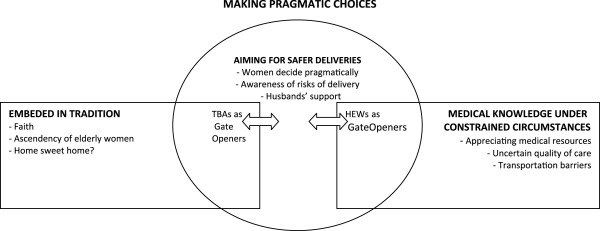
BACKGROUND: In 2003, the Ethiopian Ministry of Health launched the Health Extension Programme (HEP), which was intended to increase access to reproductive health care. Despite enormous effort, utilization of maternal health services remains limited, and the reasons for the low utilization of the services offered through the HEP previously have not been explored in depth.This study explores women's experiences and perceptions regarding delivery care in Tigray, a northern region of Ethiopia, and enables us to make suggestions for better implementation of maternal health care services in this setting. METHODS: We used six focus group discussions with 51 women to explore perceptions and experiences regarding delivery care. The data were analysed by means of grounded theory. RESULTS: One core category emerged, 'making pragmatic choices', which connected the categories 'aiming for safer deliveries', 'embedded in tradition', and 'medical knowledge under constrained circumstances'. In this setting, women - aiming for safer deliveries - made choices pragmatically between the two available models of childbirth. On the one hand, choice of home delivery, represented by the category 'embedded in tradition', was related to their faith, the ascendancy of elderly women, the advantages of staying at home and the custom of traditional birth attendants (TBAs). On the other, institutional delivery, represented by the category 'medical knowledge under constrained circumstances', and linked to how women appreciated medical resources and the support of health extension workers (HEWs) but were uncertain about the quality of care, emphasized the barriers to transportation.In Tigray women made choices pragmatically and seemed to not feel any conflict between the two available models, being supported by traditional birth attendants, HEWs and husbands in their decision-making. Representatives of the two models were not as open to collaboration as the women themselves, however. CONCLUSIONS: Although women did not see any conflict between traditional and institutional maternal care, the gap between the models remained and revealed a need to reconcile differing views among the caregivers. The HEP would benefit from an approach that incorporates all the actors involved in maternal care, at institutional, community and family levels alike. Reconsideration is required of the role of TBAs, and a well-designed, community-inclusive, coordinated and feasible referral system should be maintained.
Overview
The claims and statistics of this paper haven’t been checked yet.
Free: it reads the open-access text and checks the first 5 claims that cite a source we can check. Create a free account to check every claim.
Integrity signals
Registry
Cites
Statistics
Figures
Verification
Claims the paper makes
The claims and statistics of this paper haven’t been checked yet.
Free: it reads the open-access text and checks the first 5 claims that cite a source we can check. Create a free account to check every claim.
Claims other papers make about this one
Each is checked against this paper’s own text: does it say what the citing paper says it does?
The cited source doesn’t support the claim as written.
In the citing paper
“In contrast, a husband may prohibit a facility visit altogether due to financial or cultural constraints.”
From Facilitators and barriers to facility-based delivery in low- and middle-income countries: a qualitative evidence synthesis (2014) · cites this paper as [18]
Checked by a reasoning model — may be wrong.
Experimental — accuracy not yet measuredThe cited source doesn’t support the claim as written.
In the citing paper
“Therefore, there was no rationale for delivering at a facility, and paying to do so was considered illogical and superfluous.”
From Facilitators and barriers to facility-based delivery in low- and middle-income countries: a qualitative evidence synthesis (2014) · cites this paper as [18]
Checked by a reasoning model — may be wrong.
Experimental — accuracy not yet measuredThe source backs part of the claim, not all of it — or backs it for a different population, condition or comparison.
In the citing paper
“Barrier: Facilities deemed unnecessary for the “natural event” of birth”
From Facilitators and barriers to facility-based delivery in low- and middle-income countries: a qualitative evidence synthesis (2014) · cites this paper as [18]
Experimental — accuracy not yet measuredThe source backs part of the claim, not all of it — or backs it for a different population, condition or comparison.
In the citing paper
“Barrier: Making logistical plans for childbirth is rare”
From Facilitators and barriers to facility-based delivery in low- and middle-income countries: a qualitative evidence synthesis (2014) · cites this paper as [18]
Experimental — accuracy not yet measuredThe source backs part of the claim, not all of it — or backs it for a different population, condition or comparison.
In the citing paper
“Barrier: Utilization of TBAs as first-line providers”
From Facilitators and barriers to facility-based delivery in low- and middle-income countries: a qualitative evidence synthesis (2014) · cites this paper as [18]
Experimental — accuracy not yet measured
75 more claims about this paper
Create a free account to see every claim other papers make about this one.
Self-check
Percentages, sums and reported differences re-computed from the paper’s own numbers.
The self-check needs the paper’s full text.
Citations
Cites
Maternal mortality: who, when, where, and why
Ronsmans, C., & Graham, W. J. (2006) · The Lancet · doi:10.1016/s0140-6736(06)69380-x · Cited by 1,801 · cited 1×
“; licensee BioMed Ce Creative Commons Attribution License (http:/ distribution, and reproduction in any medium of them die because they lack access to skilled delivery attendance and emergency care [1-5].”
BackgroundStill too far to walk: Literature review of the determinants of delivery service use
Gabrysch, S., & Campbell, O. M. (2009) · BMC Pregnancy and Childbirth · doi:10.1186/1471-2393-9-34 · Cited by 1,255
Continuum of care for maternal, newborn, and child health: from slogan to service delivery
Kerber, K. J., de Graft-Johnson, J. E., Bhutta, Z. A., Okong, P., Starrs, A., & Lawn, J. E. (2007) · The Lancet · doi:10.1016/s0140-6736(07)61578-5 · Cited by 1,008 · cited 3×
“In order to reduce maternal mortality all these actors should be mobilized to work together [12,13].”
BackgroundQualitative methodology for international public health
Dahlgren, L. G., Emmelin, M., & Winkvist, A. (2007) · Cited by 507
The Millennium Development Goals
(2014) · Maternal and Infant Deaths: Chasing Millennium Development Goals 4 and 5 · doi:10.1017/cbo9781107784758.003 · Cited by 489
Estimates of maternal mortality worldwide between 1990 and 2005: an assessment of available data
Hill, K., Thomas, K., AbouZahr, C., Walker, N., Say, L., Inoue, M., & Suzuki, E. (2007) · The Lancet · doi:10.1016/s0140-6736(07)61572-4 · Cited by 469
Sub-Saharan Africa's Mothers, Newborns, and Children: Where and Why Do They Die?
Kinney, M. V., Kerber, K. J., Black, R. E., Cohen, B., Nkrumah, F., Coovadia, H., Nampala, P. M., Lawn, J. E., & on behalf of the Science in Action: Saving the lives of Africa's mothers, N. (2010) · PLoS Medicine · doi:10.1371/journal.pmed.1000294 · Cited by 435 · cited 1×
“; licensee BioMed Ce Creative Commons Attribution License (http:/ distribution, and reproduction in any medium of them die because they lack access to skilled delivery attendance and emergency care [1-5].”
BackgroundMrisho, M., Obrist, B., Schellenberg, J. A., Haws, R. A., Mushi, A. K., Mshinda, H., Tanner, M., & Schellenberg, D. (2009) · BMC Pregnancy and Childbirth · doi:10.1186/1471-2393-9-10 · Cited by 299 · cited 1×
“Our study also points out the importance of allowing relatives and/or community health care workers into the delivery room, another change that would increase women’s acceptance of institutional delivery and has proven to be cost-effective [32].”
Backgroundvan Eijk, A. M., Bles, H. M., Odhiambo, F., Ayisi, J. G., Blokland, I. E., Rosen, D. H., Adazu, K., Slutsker, L., & Lindblade, K. A. (2006) · Reproductive Health · doi:10.1186/1742-4755-3-2 · Cited by 291 · cited 1×
“If enhancing quality of care regarding availability of drugs or technical skills is expensive and hard to achieve in resource-limited settings, respectful interactions with users do not need high investment but rather an attitudinal change in the institutional culture of the health systems [25,30,31].”
BackgroundKiwanuka, S. N., Ekirapa, E. K., Peterson, S., Okui, O., Rahman, M. H., Peters, D., & Pariyo, G. W. (2008) · Transactions of the Royal Society of Tropical Medicine and Hygiene · doi:10.1016/j.trstmh.2008.04.023 · Cited by 267 · cited 1×
“Results from this study align with previous research from similar settings which also points out that transportation difficulty remains a barrier to accessing institutional delivery [33-36].”
Result
Research works printed but not linked: 9
- Yosuf J Mulatu T Nigatu T Revisiting the exclusion of TBAs from formal health systems in Ethiopia 2010 Kenya-Nairobi: AMREF
- Federal Ministry of Health Health extension programme implementation guidelines 2004 Addis Ababa: Ministry of Health
- Federal Ministry of Health Health extension programme in Ethiopia 2007 Addis Ababa: Ministry of Health
- Federal Ministry of Health Health sector development programme, HSDPIII, 2005/06 – 2010/11, mid-term review, volume I 2008 Addis Ababa: Ministry of Health
- Tsegay Y Determinants of Antenatal Care, Institutional Delivery and Skilled birth Attendant Utilization in Ethiopia MPH thesis 2010 Umea, Sweden: Department of Public Health and Clinical Medicine; Umea University
- Tigray Health Bureau Tigray Health Profile 2007/2008 2008 Mekelle: Tigray Health Bureau
- Tigray Health Bureau Tigray Health Profile 2010 2010 Mekelle: Tigray Health Bureau
- Gidey G Tagu S Hagos S Lecture notes for health science students, Introduction to Public Health: Chapter four, Traditional health care practices EPHTI, USAID, Addis Ababa, Ethiopia 2006
- Lincoln Y Guba E Naturalistic Inquiry 1985 New York: SAGE
Cited by
Bohren, M. A., Hunter, E. C., Munthe-Kaas, H. M., Souza, J. P., Vogel, J. P., & Gülmezoglu, A. M. (2014) · Reproductive Health · doi:10.1186/1742-4755-11-71 · Cited by 823
“Facilitator: Facility delivery valued for obstetric complications [18,19,26,29-38]”
BackgroundInfluentialAccess barriers to obstetric care at health facilities in sub-Saharan Africa—a systematic review
Kyei-Nimakoh, M., Carolan-Olah, M., & McCann, T. V. (2017) · Systematic Reviews · doi:10.1186/s13643-017-0503-x · Cited by 367
“Religious reasons for not using obstetric services were cited in some studies [60, 73, 79, 90, 97, 99, 111, 125, 128].”
on behalf of the Quality of Maternal and Newborn Care Study Group of the Maternal and Child Health Integrated Program, Rosen, H. E., Lynam, P. F., Carr, C., Reis, V., Ricca, J., Bazant, E. S., & Bartlett, L. A. (2015) · BMC Pregnancy and Childbirth · doi:10.1186/s12884-015-0728-4 · Cited by 282
“Women and their families especially mention rude and uncaring provider attitudes, lack of privacy, discrimination against cultural practices, physical abuse, dirty facilities, and delays in receiving care as reasons for dissatisfaction with facility services or for not giving birth at facilities nor seeking facility-b…”
BackgroundTsegay, Y., Gebrehiwot, T., Goicolea, I., Edin, K., Lemma, H., & Sebastian, M. S. (2013) · International Journal for Equity in Health · doi:10.1186/1475-9276-12-30 · Cited by 260
“Similarly, TBAs and elderly relatives at the household level strongly influenced women in giving birth at home [36].”
BackgroundSelf-citationHameed, W., & Avan, B. I. (2018) · PLoS ONE · doi:10.1371/journal.pone.0194601 · Cited by 114
Metadata
- Authors
- Gebrehiwot, T., Goicolea, I., Edin, K., & Sebastian, M. S.
- Affiliations
- Mekelle University (ET)
- Umeå University (SE)
- Corresponding author
- Gebrehiwot, Tesfay
- Venue
- BMC Pregnancy and Childbirth
- Published
- 2012-10-19
- Volume
- 12
- Issue
- 1
- Pages
- 113-113
- ISSN
- 1471-2393 (ISSN-L)
- PMC
- PMC3542090
- OpenAlex
- W2161121814
- Cited by
- 84
- References
- 32
- Citations by year
- 2026: 3 · 2025: 3 · 2024: 4 · 2023: 4 · 2022: 3 · 2021: 6 · 2020: 11 · 2019: 7 · 2018: 12 · 2017: 5 · 2016: 7 · 2015: 11 · 2014: 5 · 2013: 3
- FWCI
- 5.34
- Type
- journal article
- Language
- en
- Open access
- gold
- doi.org
- Licence
- cc-by
- creativecommons.org/licenses/by/2.0 (tdm)
- Locations
- BMC Pregnancy and Childbirth (publishedVersion, cc-by)
- PubMed Central (publishedVersion, cc-by)
- PubMed (publishedVersion)
- DiVA at Umeå University (Umeå University) (submittedVersion, other-oa)
- DOAJ (DOAJ: Directory of Open Access Journals) (submittedVersion)
- Funders
- Forskningsrådet för Arbetsliv och Socialvetenskap (2006-1512)
- Topics
- Health Sciences › Medicine › Pediatrics, Perinatology and Child Health › Global Maternal and Child Health
- Health Sciences › Medicine › Obstetrics and Gynecology › Maternal and Perinatal Health Interventions
- Health Sciences › Medicine › Public Health, Environmental and Occupational Health › Reproductive Health and Contraception
- Keywords
- childbirth care, home birth, institutional delivery, traditional birth attendants, maternal health service utilization, women's decision-making, maternal care, Tigray, referral systems, health extension workers
- MeSH terms
- Adolescent, Adult, Choice Behavior, Decision Making, Ethiopia, Female, Home Childbirth, Humans, Health Knowledge, Attitudes, Practice, Midwifery, Patient Acceptance of Health Care, Patient Participation, Pregnancy, Prenatal Care, Focus Groups, Delivery, Obstetric, Young Adult
About these checks
Registry, retraction, Cites and statistics results are computed, not judged, with one exception: a printed reference that no index lists is read once by a model before it counts as a citation error. Claims are extracted by a model and kept only when their quote appears verbatim in the text; each cited source is then checked, with a model’s help, for whether it says what the claim relies on. Those verdicts can be wrong — read the claim’s quote and the cited source before relying on one.
Statistics and arithmetic are recomputed, not judged.
Confidence bands are shown only for fields calibrated on our annotated test set. None is calibrated yet, so no band is shown.
What counts as a claim ›How we measure confidence ›How we check this ›
Are you an author, or do you see a problem with this page? Request a review
How to cite
Cite CoChat for the checks on this page, and the paper for its own findings.
- This page
- CoChat. (2026). Citation check: Making pragmatic choices: women’s experiences of delivery care in Northern Ethiopia. https://app.cochat.ai/papers/10.1186/1471-2393-12-113
- The paper
- Gebrehiwot, T., Goicolea, I., Edin, K., & Sebastian, M. S. (2012). Making pragmatic choices: women’s experiences of delivery care in Northern Ethiopia. BMC Pregnancy and Childbirth. https://doi.org/10.1186/1471-2393-12-113
Data sources
Bibliographic data: Semantic Scholar, OpenAlex, Crossref.
Contains information from the Semantic Scholar Academic Graph Datasets, made available under the ODC Attribution License (ODC-BY 1.0).
Semantic Scholar’s data is described in: Kinney, R., et al. (2023). The Semantic Scholar Open Data Platform. arXiv:2301.10140.
