

Why do women prefer home births in Ethiopia?
Open accessThe DOI matches its Crossref record; 44 of the 44 references it cites were found in a registry or an index.
Abstract
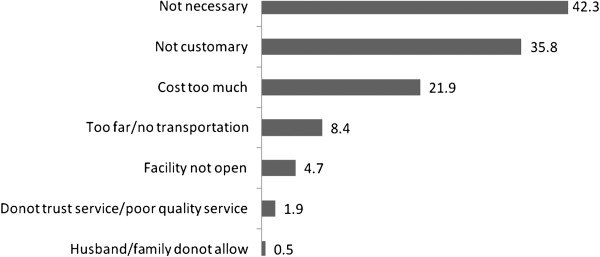
BACKGROUND: Skilled attendants during labor, delivery, and in the early postpartum period, can prevent up to 75% or more of maternal death. However, in many developing countries, very few mothers make at least one antenatal visit and even less receive delivery care from skilled professionals. The present study reports findings from a region where key challenges related to transportation and availability of obstetric services were addressed by an ongoing project, giving a unique opportunity to understand why women might continue to prefer home delivery even when facility based delivery is available at minimal cost. METHODS: The study took place in Ethiopia using a mixed study design employing a cross sectional household survey among 15-49 year old women combined with in-depth interviews and focus group discussions. RESULTS: Seventy one percent of mothers received antenatal care from a health professional (doctor, health officer, nurse, or midwife) for their most recent birth in the one year preceding the survey. Overall only 16% of deliveries were assisted by health professionals, while a significant majority (78%) was attended by traditional birth attendants. The most important reasons for not seeking institutional delivery were the belief that it is not necessary (42%) and not customary (36%), followed by high cost (22%) and distance or lack of transportation (8%). The group discussions and interviews identified several reasons for the preference of traditional birth attendants over health facilities. Traditional birth attendants were seen as culturally acceptable and competent health workers. Women reported poor quality of care and previous negative experiences with health facilities. In addition, women's low awareness on the advantages of skilled attendance at delivery, little role in making decisions (even when they want), and economic constraints during referral contribute to the low level of service utilization. CONCLUSIONS: The study indicated the crucial role of proper health care provider-client communication and providing a more client centered and culturally sensitive care if utilization of existing health facilities is to be maximized. Implications of findings for maternal health programs and further research are discussed.
Overview
The claims and statistics of this paper haven’t been checked yet.
Free: it reads the open-access text and checks the first 5 claims that cite a source we can check. Create a free account to check every claim.
Integrity signals
Registry
Cites
Statistics
Figures
Verification
Claims the paper makes
The claims and statistics of this paper haven’t been checked yet.
Free: it reads the open-access text and checks the first 5 claims that cite a source we can check. Create a free account to check every claim.
Claims other papers make about this one
Each is checked against this paper’s own text: does it say what the citing paper says it does?
The source backs part of the claim, not all of it — or backs it for a different population, condition or comparison.
In the citing paper
“Barrier: Fear of cutting”
From Facilitators and barriers to facility-based delivery in low- and middle-income countries: a qualitative evidence synthesis (2014) · cites this paper as [43]
Experimental — accuracy not yet measuredThe source backs part of the claim, not all of it — or backs it for a different population, condition or comparison.
In the citing paper
“Barrier: Inaccessibility of transportation and facilities during off-hours”
From Facilitators and barriers to facility-based delivery in low- and middle-income countries: a qualitative evidence synthesis (2014) · cites this paper as [43]
Experimental — accuracy not yet measuredThe source backs part of the claim, not all of it — or backs it for a different population, condition or comparison.
In the citing paper
“Across a variety of contexts, elder women, including mothers, mothers-in-law and grandmothers of parturient women, hold the greatest influence and decision-making power regarding delivery location.”
From Facilitators and barriers to facility-based delivery in low- and middle-income countries: a qualitative evidence synthesis (2014) · cites this paper as [43]
Experimental — accuracy not yet measuredThe source backs part of the claim, not all of it — or backs it for a different population, condition or comparison.
In the citing paper
“Some women believed that they should choose the same delivery location that their mothers and grandmothers experienced, in order to maintain their identity and intergenerational continuity.”
From Facilitators and barriers to facility-based delivery in low- and middle-income countries: a qualitative evidence synthesis (2014) · cites this paper as [43]
Experimental — accuracy not yet measuredThe source backs part of the claim, not all of it — or backs it for a different population, condition or comparison.
In the citing paper
“Travel at night or on weekends was considered particularly difficult as there are fewer public transportation options, women may be afraid of thieves and wild animals, and the price is higher.”
From Facilitators and barriers to facility-based delivery in low- and middle-income countries: a qualitative evidence synthesis (2014) · cites this paper as [43]
Experimental — accuracy not yet measured
24 more claims about this paper
Create a free account to see every claim other papers make about this one.
Self-check
Percentages, sums and reported differences re-computed from the paper’s own numbers.
The self-check needs the paper’s full text.
Citations
Cites
WHO analysis of causes of maternal death: a systematic review
Khan, K. S., Wojdyla, D., Say, L., Gülmezoglu, A. M., & Van Look, P. F. (2006) · The Lancet · doi:10.1016/s0140-6736(06)68397-9 · Cited by 3,978
Hogan, M. C., Foreman, K. J., Naghavi, M., Ahn, S. Y., Wang, M., Makela, S. M., Lopez, A. D., Lozano, R., & Murray, C. J. (2010) · The Lancet · doi:10.1016/s0140-6736(10)60518-1 · Cited by 2,194
the GAPPS Review Group, Lawn, J. E., Gravett, M. G., Nunes, T. M., Rubens, C. E., & Stanton, C. (2010) · BMC Pregnancy and Childbirth · doi:10.1186/1471-2393-10-s1-s1 · Cited by 784
Global burden of maternal death and disability
AbouZahr, C. (2003) · British Medical Bulletin · doi:10.1093/bmb/ldg015 · Cited by 567
Hogan, M. C., Foreman, K. J., Naghavi, M., Ahn, S. Y., Wang, M., Makela, S. M., Lopez, A. D., Lozano, R., & Murray, C. J. (2011) · Obstetric Anesthesia Digest · doi:10.1097/01.aoa.0000397097.96320.28 · Cited by 387
Gabrysch, S., Cousens, S., Cox, J., & Campbell, O. M. R. (2011) · PLoS Medicine · doi:10.1371/journal.pmed.1000394 · Cited by 353
Barriers to the utilization of maternal health care in rural Mali
Gage, A. J. (2007) · Social Science & Medicine · doi:10.1016/j.socscimed.2007.06.001 · Cited by 334
Kruk, M. E., Paczkowski, M., Mbaruku, G., de Pinho, H., & Galea, S. (2009) · American Journal of Public Health · doi:10.2105/ajph.2008.146209 · Cited by 290
Organizing delivery care: what works for safe motherhood?
Koblinsky, M. A., Campbell, O. M. R., & Heichelheim, J. (1999) · Europe PMC (PubMed Central) · Cited by 251
Magoma, M., Requejo, J., Campbell, O. M., Cousens, S., & Filippi, V. (2010) · BMC Pregnancy and Childbirth · doi:10.1186/1471-2393-10-13 · Cited by 230
Research works printed but not linked: 6
- Demographic E Survey H Central Statistical Agency 2011 Addis Ababa Ethiopia: MEASURE DHS, ICF International Calverton, Maryland, USA 2012
- Ethiopian Ministry of Health Emergency Obstetric and Neonatal Care survey report 2009 Ethiopia: Ministry of Health
- S. B Appropriate obstetric technologies to deal with maternal complications Stud Health Serv Organisation Policy 2001 17 175 194
- Lerberghe V.D.B.a.W.V Safe motherhood strategies: a review of the evidence Stud Health Serv Organisation Policy 2001 17
- Department of Public Health and Clinical Medicine at Umeå University OpenCode 3.6 B1 © UMDAC and Epidemiology 2009
- Federal Ministry of Health of Ethiopia Federal Democratic Republic of Ethiopia Ministry of Health - Maternal and Child Health Package 2003 Addis Ababa, Ethiopia
Cited by
Items 201–300 of 364
Social norms as possible causes of stillbirths
Noge, S. R., Botma, Y., & Steinberg, W. J. (2020) · Midwifery · doi:10.1016/j.midw.2020.102823 · Cited by 8
Munabi, I. G., Byamugisha, J. K., Luboobi, L. S., Luboga, S. A., & Mirembe, F. M. (2016) · Pan African Medical Journal · doi:10.11604/pamj.2016.24.257.9889 · Cited by 8
Home based postpartum care and determinants in Ethiopia: A multilevel analysis
Birhane, B. M., Bayih, W. A., Agimas, M. C., Yismaw, G. A., Simegn, A., Asnakew, S., Azanaw, M. M., Yeshambel, A., Liyeh, T. M., Demis, A., et al. (2022) · PLoS ONE · doi:10.1371/journal.pone.0272489 · Cited by 8
Dada, A. A. (2019) · ResearchSpace (University of KwaZulu-Natal) · Cited by 8
Kebede, A. A., Taye, B. T., Wondie, K. Y., Tiguh, A. E., Eriku, G. A., & Mihret, M. S. (2021) · Clinical Epidemiology and Global Health · doi:10.1016/j.cegh.2021.100830 · Cited by 7
Evidence review and analysis of provider behavior change opportunities
Zimmerman, E., Caetano, V., Banay, R., & Smith, J. (2020) · doi:10.31899/rh14.1110 · Cited by 7
Chelva, M. P., Chard, S., Eberle, A., Lucchese, A., Kaushal, S., West, N., Marandu, P. D., Smith, G. N., Erwin, E., Tillya, R., et al. (2022) · Journal of Global Health Reports · doi:10.29392/001c.33808 · Cited by 7
Aliyu, A. A., & Dahiru, T. (2020) · IntechOpen eBooks · doi:10.5772/intechopen.92138 · Cited by 7
Rahimi, B. A., Mohamadi, E., Maku, M., Hemat, M. D., Farooqi, K., Mahboobi, B. A., Mudaser, G. M., & Taylor, W. R. J. (2022) · PLoS ONE · doi:10.1371/journal.pone.0277075 · Cited by 7
Amare, N. S., Mekuriyaw, A. M., Tesema, G. W., & Ambaw, Y. L. (2022) · Frontiers in Medicine · doi:10.3389/fmed.2022.917678 · Cited by 7
Respectful Maternal Care − Need for Educational Interventions Among Maternal Health Care Providers
Vivekanandan, K., Sharma, U., Sharma, B., Subbiah, N., & Raina, D. (2022) · ECS Transactions · doi:10.1149/10701.5899ecst · Cited by 7
Folk Practice During Childbirth and Reasons for the Practice in Ethiopia: A Systematic Review
Kitila, S. B., Molla, W., Wedaynewu, T., Yadessa, T., & Gellan, M. (2018) · Gynecology & Obstetrics · doi:10.4172/2161-0932.1000465 · Cited by 7
Pujihartati, S. H., Wijaya, M., & Demartoto, A. (2020) · International Conference on Social Transformation, Community and Sustainable Development (ICSTCSD) · doi:10.2991/icstcsd-19.2020.24 · Cited by 7
Kang, B., Tamene, H., Lakew, Y., Stephens, D., & Rimal, R. N. (2024) · Gates Open Research · doi:10.12688/gatesopenres.16277.1 · Cited by 6
Factors associated with Institutional delivery in Boricha district of Sidama zone, southern Ethiopia
Gudura, T. T., Debiso, A. T., & Gudura, T. T. (2014) · International Journal of Public Health Science (IJPHS) · doi:10.11591/ijphs.v3i4.4696 · Cited by 6
Feyisa, J. W., Merdassa, E., Lema, M., Hailu, W. B., Desalegn, M., Shama, A. T., Jaleta, D. D., Firdisa, G., Berhanu, R. D., Alemu, S. S., et al. (2023) · PLoS ONE · doi:10.1371/journal.pone.0291394 · Cited by 6
Story, W. T., Amare, Y., Vaz, L. M. E., Gardner, H., Tura, H., Snetro, G., Kinney, M. V., Wall, S. N., & Bekele, A. (2021) · BMC Pregnancy and Childbirth · doi:10.1186/s12884-021-03865-8 · Cited by 6
Aychiluhm, S. B., Melaku, M. S., Mare, K. U., Tadesse, A. W., & Mulaw, G. F. (2022) · Emerging Themes in Epidemiology · doi:10.1186/s12982-022-00117-8 · Cited by 8
Isangula, K. G., Mwasha, L., Pallangyo, E., & Ndirangu, E. W. (2023) · Frontiers in Health Services · doi:10.3389/frhs.2023.1058840 · Cited by 5
Kaba, M., Geletu, Z. A., & Bersisa, T. (2015) · Ethiopian Journal of Health Development · Cited by 5
Ganle, J. K. (2013) · Oxford University Research Archive (ORA) (University of Oxford) · doi:10.5287/ora-xkamrzx4x · Cited by 5
Perceived Disrespect and Abuse among Women delivering at a Rural Tertiary Care Center in Nepal
Munikar, S., Chalise, M., Dhungana, R., Shrestha, D. L., Naresh Pratap, K. C., Dhungana, A., Clark, R. B., Visick, M. K., & Thapa, K. (2024) · Civil Medical Journal · doi:10.59338/cmj.27 · Cited by 5
Disparity in Maternal Health Services Among the Different Geopolitical Zones in Nigeria
Umar, A. S., Kennedy, C. M., Tawfik, H., & Okenu, D. M. N. (2017) · Journal of Social Behavioral and Health Sciences · doi:10.5590/jsbhs.2017.11.1.11 · Cited by 5
Mohamed, M., Abdeeq, B. A., Mohamed, A. I., Jama, H. A., Tafese, F., & Garedew, M. G. (2024) · BMC Health Services Research · doi:10.1186/s12913-024-11330-3 · Cited by 5
Sociocultural Factors Affecting Unplanned Deliveries at Home: A Community-Based Case Control Study
Çatak, B., & Öner, C. (2015) · Social Work in Public Health · doi:10.1080/19371918.2015.1063101 · Cited by 5
Seme, A., & Seifu, A. (2017) · Ethiopian Medical Journal · Cited by 5
Intrapartum midwifery care for women's enhanced childbirth: a concept analysis
Toda, A., Okubo, N., Misumi, J., & Hiroyama, N. (2025) · British Journal of Midwifery · doi:10.12968/bjom.2024.0121 · Cited by 4
Infrastructure-driven healthcare advancements: Rural Roads and Maternal Health in Ethiopia
Ahmed, M. H., & Tesfaye, W. M. (2025) · Journal of Behavioral and Experimental Economics · doi:10.1016/j.socec.2025.102427 · Cited by 4
Sarantaki, A., Metallinou, D., Kyritsi, R., Diamanti, A., & Lykeridou, A. (2020) · Materia Socio Medica · doi:10.5455/msm.2020.32.294-298 · Cited by 4
Bergen, N. (2020) · uO Research (University of Ottawa) · doi:10.20381/ruor-24698 · Cited by 4
Improving Maternal and Reproductive Health in Ethiopia
Lailulo, Y. A., Susuman, A. S., & Blignaut, R. J. (2016) · Journal of Asian and African Studies · doi:10.1177/0021909615623810 · Cited by 4
Kurji, J. (2021) · uO Research (University of Ottawa) · doi:10.20381/ruor-26384 · Cited by 5
Tancred, T. (2016) · IHI Repository · doi:10.17037/pubs.02528880 · Cited by 4
Facteurs contextuels dans l'évaluation d'une politique de santé maternelle au Burkina Faso
Belaid, L. (2014) · doi:10.71781/900 · Cited by 5
Land, A.-J. V. D., Medhanyie, A. A., Spigt, M., Beumer, C., Alemayehu, M., Desta, K. G., Sinke, A. H., Lemango, E. T., & Mulugeta, A. (2018) · Ethiopian Journal of Health Development · Cited by 4
Self-citationImpact of respectful maternity care and its outcome in a childbearing woman
Shwetha, K., Yadav, A., & Jeetu (2023) · International Journal of Reproduction Contraception Obstetrics and Gynecology · doi:10.18203/2320-1770.ijrcog20231523 · Cited by 4
Bennett, A. (2014) · UTS ePRESS (University of Technology Sydney) · Cited by 3
Longitudinal Trends in Childbirth Practices in Ethiopia
Weis, J. (2017) · Maternal and Child Health Journal · doi:10.1007/s10995-017-2279-y · Cited by 3
Improving Respectful Maternity Care in Ethiopia
Sheferaw, E. D. (2021) · University of Groningen research database (University of Groningen / Centre for Information Technology) · doi:10.33612/diss.182129166 · Cited by 3
Adeleye, O. J., Adebowale, A. S., Adeyemo, O., Adeoye, I. A., Afolabi, R. F., Fagbamigbe, A. F., & Palamuleni, M. E. (2023) · Journal of African Population Studies · doi:10.59147/tau3uto8 · Cited by 3
Desta, D. Z., Kebede, A., Merid, M. W., Negash, W. D., & Asmamaw, D. B. (2021) · Research Square · doi:10.21203/rs.3.rs-1030571/v1 · Cited by 3
Hackett, K. M. (2016) · TSpace (University of Toronto) · Cited by 3
"Why We Deliver Elsewhere": Women's Preferred Places of Delivery and Their Effects
Kodom, P. N. B., Kodom, M., & Senah, K. (2018) · Sociology and Anthropology · doi:10.13189/sa.2018.060305 · Cited by 3
Azeze, G. A., Negash, B. T., Asgedom, Y. S., Amsalu, A. A., Kena, S. S., Gebrekidan, A. Y., Tsegaye, T. G., Kassie, G. A., & Haile, K. E. (2026) · Sexual & Reproductive Healthcare · doi:10.1016/j.srhc.2026.101202 · Cited by 3
Preference for home births in rural Bangladesh: A qualitative exploratory study
Islam, M. M., Shahjahan, M., & Rahman, M. M. (2021) · Journal of Public Health and Development · Cited by 3
Dargaso, Y. D., Tunta, T. O., & Kabalo, B. Y. (2019) · Research Square · doi:10.21203/rs.2.15580/v1 · Cited by 3
Takele, K. (2015) · American Journal of Theoretical and Applied Statistics · doi:10.11648/j.ajtas.20150403.11 · Cited by 3
Socio-cultural determinants and missed opportunities of maternal healthcare services in Ethiopia
Abdulahi, I. M. (2018) · Unisa Institutional Repository (University of South Africa) · Cited by 3
Ndugga, P. (2019) · ePrints Soton (University of Southampton) · Cited by 3
Aturaka, S. O., Eric, Y., Sanni, F. O., Olatunde, A. O., Peter, A. I., Christiana, A. E., Augusta, O. N., Modupe, A. A., Olubukola, P. T., & Modupe, S. I. (2024) · MGM Journal of Medical Sciences · doi:10.4103/mgmj.mgmj_281_24 · Cited by 3
Individual and community-level factors associated with introducing prelacteal feeding in Ethiopia
Gilano, G., Hailegebreal, S., Kashala, K., & Gilano, K. (2023) · Clinical Nutrition Open Science · doi:10.1016/j.nutos.2023.09.009 · Cited by 3
Munabi, I. G., Luboga, S. A., & Mirembe, F. M. (2015) · Pan African Medical Journal · doi:10.11604/pamj.2015.22.175.7145 · Cited by 3
The nutritional behavior of pregnant women attending antenatal classes and non-attendees
Ługowska, K., & Kolanowski, W. (2020) · British Food Journal · doi:10.1108/bfj-10-2019-0754 · Cited by 3
Ouedraogo, M. (2018) · uO Research (University of Ottawa) · doi:10.20381/ruor-21563 · Cited by 3
Levira, F., Gaydosh, L. M., & Ramaiya, A. (2014) · BMC Pregnancy and Childbirth · doi:10.1186/1471-2393-14-329 · Cited by 2
Women’s childbearing location preferences in South Ethiopia: a qualitative study
Mordal, E., Vatne, S., Gemeda, H., Tsegaye, M., & Ulvund, I. (2018) · Health Care For Women International · doi:10.1080/07399332.2018.1526287 · Cited by 2
Adinew, Y. M., Hall, H. G., Marshall, A., & Kelly, J. (2019) · The JBI Database of Systematic Reviews and Implementation Reports · doi:10.11124/jbisrir-d-19-00116 · Cited by 2
Changing the place of birth from home to health facilities in Kafa Zone, Ethiopia
Jackson, R. (2016) · Journal of Development Effectiveness · doi:10.1080/19439342.2016.1206952 · Cited by 2
What creates good experiences for EmOC clients in public health facilities in Ethiopia?
Helelo, A. Z., Zungu, L. I., & Chiegil, R. J. (2015) · South African Family Practice · doi:10.1080/20786190.2015.1024014 · Cited by 2
Bitew, F. H., Nyarko, S. H., Potter, L. B., & Sparks, C. S. (2020) · Research Square · doi:10.21203/rs.2.13113/v2 · Cited by 2
Acuerdo de parís: instrumento de la Ley Internacional en la Lucha Contra el Calentamiento Global
de Montreal, U., Dubois, A., Seminario-Hurtado, N., & de Milán, U. (2019) · Lumen · doi:10.33539/lumen.2019.n15.1755 · Cited by 2
Tilahun, B. D., Ayele, M., Alamaw, A. W., Lake, E. S., Abate, B. B., Yilak, G., Azmeraw, M., Zemariam, A. B., & Kitaw, T. A. (2024) · BMJ Open · doi:10.1136/bmjopen-2024-087290 · Cited by 2
Association of Health Facility Delivery and Risk of Infant Mortality in Nigeria
Ukwu, S. A. (2019) · ScholarWorks (Walden University) · Cited by 2
Factors That Influence Place of Delivery Choice Among Expectant Mothers in Ghana
Baba, M. I. (2019) · ScholarWorks (Walden University) · Cited by 2
Valentine, N. (2018) · RePub (Erasmus University Rotterdam) · Cited by 2
Damtew, S. A., Fantaye, F. T., & Sene, K. M. (2024) · Research Square · doi:10.21203/rs.3.rs-4138407/v1 · Cited by 2
Scina, Y. (2017) · ResearchSpace (University of KwaZulu-Natal) · Cited by 2
Enyew, A., & Dolamo, B. L. (2017) · Africa Journal of Nursing and Midwifery · doi:10.25159/2520-5293/1510 · Cited by 2
A Review of Sudanese Maternal Deaths
Mohammed, N. M. K., Ahmed, T. U., Ahmed, M. A. I., Abdelrahman, N. A. M., & Hamad, M. N. M. (2022) · SAR Journal of Medicine · doi:10.36346/sarjm.2022.v03i05.001 · Cited by 2
Gurung, M. S., Wangdi, S., Lethro, P., Tshomo, T., Dema, T., & Pelzom, D. (2020) · Asia Pacific Journal of Public Health · doi:10.1177/1010539520969236 · Cited by 1
Strategies to improve utilisation of skilled birth attendance services in North West Ethiopia
Shiferaw, B. B. (2017) · Unisa Institutional Repository (University of South Africa) · Cited by 1
Institutional Delivery Services Utilization and Associated Factors at Hetosa District, Ethiopia
Temesgen, H., Worku, A., Demissie, H. F., Segni, M. T., Adugna, S., Amdemichael, R., & Mekit, S. (2020) · American Journal of Life Sciences · doi:10.11648/j.ajls.20200804.13 · Cited by 1
Bitew, F. H., Nyarko, S. H., Potter, L. B., & Sparks, C. S. (2019) · Research Square · doi:10.21203/rs.2.13113/v1 · Cited by 1
Bitew, F. H., Nyarko, S. H., Potter, L. B., & Sparks, C. S. (2020) · Research Square · doi:10.21203/rs.2.13113/v3 · Cited by 1
Azeze, G. A., Negash, B. T., Asgedom, Y. S., Amsalu, A. A., Kena, S. S., Gebrekidan, A. Y., Tsegaye, T. G., Kassie, G. A., & Haile, K. E. (2026) · Sexual & Reproductive Healthcare · doi:10.1016/j.srhc.2026.101229 · Cited by 1
Manyiwa, J. S. (2018) · Texila international journal of public health · doi:10.21522/tijph.2013.06.03.art001 · Cited by 1
Manyiwa, J. S. (2018) · Texila international journal of public health · doi:10.21522/tijph.2013.06.03.art016 · Cited by 1
Ngotiek, P., Kahiga, T., & Onyambu, M. O. (2021) · Journal of Health Medicine and Nursing · doi:10.47604/jhmn.1400 · Cited by 1
Community factors accountable for home births in a low income rural setting in Ghana
Konlan, K. D., Japiong, M., Suuk, A. N., Doat, A. R., Afaya, A., & Salia, S. M. (2017) · International Journal of Community Medicine and Public Health · doi:10.18203/2394-6040.ijcmph20172141 · Cited by 1
Jama, A. A., Arowojolu, A. O., & Ajay, I. O. (2019) · Research Square · doi:10.21203/rs.2.19610/v1 · Cited by 1
Birthing in Girar Jarso woreda of Ethiopia
Pambour, E. (2015) · HARVEST (University of Saskatchewan) · Cited by 1
Maternal Health in Ethiopia: Global and Local Complexities
(2017) · Arizona State University Library Digital Repository (Arizona State University) · Cited by 1
Factors Affecting the Use of Midwifery Services in Remote Nepal
Ellis, C. (2019) · Summit (Simon Fraser University) · Cited by 1
Olarewaju, O., Jegede, O. S., Oladimije, O., & Alamu, O. (2021) · Journal of Epidemiological Society of Nigeria · doi:10.46912/jeson.50 · Cited by 1
Tegegne, K. (2018) · Ethiopian Renaissance Journal of Social Sciences and Humanities · Cited by 1
Gesese, K. T. (2015) · Figshare · Cited by 1
An interpretive phenomenological study of women's childbirth experiences in Zambia
Kwaleyela, C. N. (2016) · Nottingham ePrints (University of Nottingham) · Cited by 1
Guarnizo Tole, G. M., Vicente‐Rodríguez, G., & OLMEDILLAS FERNÁNDEZ, H. (2019) · LA Referencia (Red Federada de Repositorios Institucionales de Publicaciones Científicas) · Cited by 1
Training health workers to provide person-centred maternal and newborn health care in Burkina Faso
Perkins, J. E., Bargo, A., Capello, C., & Santarelli, C. (2013) · The International Journal of Person Centered Medicine · doi:10.5750/ijpcm.v3i2.405 · Cited by 1
Munabi, I. G., Luboga, S. A., Byamugisha, J. K., Luboobi, L. S., & Mirembe, F. M. (2017) · Anatomy Journal of Africa · doi:10.4314/aja.v6i1.150688 · Cited by 1
Determinants of maternal autonomyin Nigeria
Awe Olubusola, W., Oladokun, Y. O. M., & Adenegan, K. O. (2020) · MOJ Women s Health · doi:10.15406/mojwh.2020.09.00275 · Cited by 1
Medhanyie, A. A., Alemayehu, M., & Mulugeta, A. (2018) · Ethiopian Journal of Health Development · Cited by 1
Tenaw, L. A., & Endalifer, M. L. (2021) · Research Square · doi:10.21203/rs.3.rs-58894/v2 · Cited by 1
Núñez, V., & Sofía, D. (2013) · USFQ Digital Repository (Universidad San Francisco de Quito) · Cited by 1
Guta, Y. R. (2016) · Unisa Institutional Repository (University of South Africa)
A study of perinatal services among maternity users in a southern district in Nepal
Mahato, P. K. (2019) · Bournemouth University Research Online (Bournemouth University)
Kang, B., Rimal, R. N., Lakew, Y., Stephens, D., & Tamene, H. (2026) · BMJ Public Health · doi:10.1136/bmjph-2025-002778
Negash, W. A. (2020) · Unisa Institutional Repository (University of South Africa)
Sendo, E. G. (2019) · Unisa Institutional Repository (University of South Africa)
Metadata
- Authors
- Shiferaw, S., Spigt, M., Godefrooij, M., Melkamu, Y., & Tekie, M.
- Affiliations
- Addis Ababa University (ET)
- Maastricht University (NL)
- International Planned Parenthood Federation (US)
- United Nations Population Fund (US)
- Corresponding author
- Shiferaw, Solomon
- Venue
- BMC Pregnancy and Childbirth
- Published
- 2013-01-16
- Volume
- 13
- Issue
- 1
- Pages
- 5-5
- ISSN
- 1471-2393 (ISSN-L)
- PMC
- PMC3562506
- OpenAlex
- W2131946391
- Cited by
- 290
- References
- 43
- Citations by year
- 2026: 10 · 2025: 5 · 2024: 11 · 2023: 14 · 2022: 23 · 2021: 42 · 2020: 22 · 2019: 27 · 2018: 36 · 2017: 24 · 2016: 26 · 2015: 25 · 2014: 16 · 2013: 8
- FWCI
- 23.27
- Type
- journal article
- Language
- en
- Open access
- gold
- doi.org
- Licence
- cc-by
- creativecommons.org/licenses/by/2.0 (tdm)
- Locations
- BMC Pregnancy and Childbirth (publishedVersion, cc-by)
- Europe PMC (PubMed Central) (publishedVersion, cc-by)
- PubMed Central (publishedVersion, cc-by)
- PubMed (publishedVersion)
- Research Publications (Maastricht University) (submittedVersion, cc-by)
- DOAJ (DOAJ: Directory of Open Access Journals) (submittedVersion, cc-by-sa)
- NORA - Norwegian Open Research Archives (submittedVersion, other-oa)
- Research Publications (Maastricht University) (submittedVersion, other-oa)
- Topics
- Health Sciences › Medicine › Pediatrics, Perinatology and Child Health › Global Maternal and Child Health
- Health Sciences › Medicine › Obstetrics and Gynecology › Maternal and Perinatal Health Interventions
- Health Sciences › Medicine › Public Health, Environmental and Occupational Health › Reproductive Health and Contraception
- Keywords
- home birth, institutional delivery, traditional birth attendants, skilled birth attendance, antenatal care utilization, obstetric care
- MeSH terms
- Adolescent, Adult, Cross-Sectional Studies, Culture, Developing Countries, Ethiopia, Female, Health Services Accessibility, Home Childbirth, Humans, Male, Maternal Mortality, Middle Aged, Midwifery, Pregnancy, Focus Groups, Qualitative Research, Delivery, Obstetric, Patient Preference
About these checks
Registry, retraction, Cites and statistics results are computed, not judged, with one exception: a printed reference that no index lists is read once by a model before it counts as a citation error. Claims are extracted by a model and kept only when their quote appears verbatim in the text; each cited source is then checked, with a model’s help, for whether it says what the claim relies on. Those verdicts can be wrong — read the claim’s quote and the cited source before relying on one.
Statistics and arithmetic are recomputed, not judged.
Confidence bands are shown only for fields calibrated on our annotated test set. None is calibrated yet, so no band is shown.
What counts as a claim ›How we measure confidence ›How we check this ›
Are you an author, or do you see a problem with this page? Request a review
Data sources
Bibliographic data: Semantic Scholar, OpenAlex, Crossref.
Contains information from the Semantic Scholar Academic Graph Datasets, made available under the ODC Attribution License (ODC-BY 1.0).
Semantic Scholar’s data is described in: Kinney, R., et al. (2023). The Semantic Scholar Open Data Platform. arXiv:2301.10140.
