

Why do women prefer home births in Ethiopia?
Open accessThe DOI matches its Crossref record; 44 of the 44 references it cites were found in a registry or an index.
Abstract
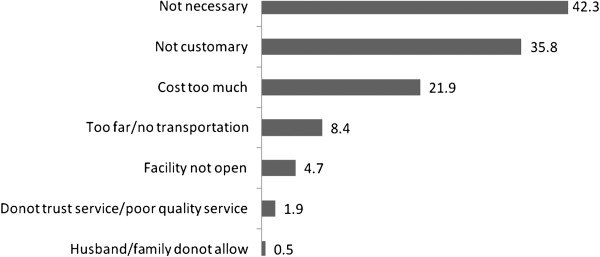
BACKGROUND: Skilled attendants during labor, delivery, and in the early postpartum period, can prevent up to 75% or more of maternal death. However, in many developing countries, very few mothers make at least one antenatal visit and even less receive delivery care from skilled professionals. The present study reports findings from a region where key challenges related to transportation and availability of obstetric services were addressed by an ongoing project, giving a unique opportunity to understand why women might continue to prefer home delivery even when facility based delivery is available at minimal cost. METHODS: The study took place in Ethiopia using a mixed study design employing a cross sectional household survey among 15-49 year old women combined with in-depth interviews and focus group discussions. RESULTS: Seventy one percent of mothers received antenatal care from a health professional (doctor, health officer, nurse, or midwife) for their most recent birth in the one year preceding the survey. Overall only 16% of deliveries were assisted by health professionals, while a significant majority (78%) was attended by traditional birth attendants. The most important reasons for not seeking institutional delivery were the belief that it is not necessary (42%) and not customary (36%), followed by high cost (22%) and distance or lack of transportation (8%). The group discussions and interviews identified several reasons for the preference of traditional birth attendants over health facilities. Traditional birth attendants were seen as culturally acceptable and competent health workers. Women reported poor quality of care and previous negative experiences with health facilities. In addition, women's low awareness on the advantages of skilled attendance at delivery, little role in making decisions (even when they want), and economic constraints during referral contribute to the low level of service utilization. CONCLUSIONS: The study indicated the crucial role of proper health care provider-client communication and providing a more client centered and culturally sensitive care if utilization of existing health facilities is to be maximized. Implications of findings for maternal health programs and further research are discussed.
Overview
The claims and statistics of this paper haven’t been checked yet.
Free: it reads the open-access text and checks the first 5 claims that cite a source we can check. Create a free account to check every claim.
Integrity signals
Registry
Cites
Statistics
Figures
Verification
Claims the paper makes
The claims and statistics of this paper haven’t been checked yet.
Free: it reads the open-access text and checks the first 5 claims that cite a source we can check. Create a free account to check every claim.
Claims other papers make about this one
Each is checked against this paper’s own text: does it say what the citing paper says it does?
The source backs part of the claim, not all of it — or backs it for a different population, condition or comparison.
In the citing paper
“Barrier: Fear of cutting”
From Facilitators and barriers to facility-based delivery in low- and middle-income countries: a qualitative evidence synthesis (2014) · cites this paper as [43]
Experimental — accuracy not yet measuredThe source backs part of the claim, not all of it — or backs it for a different population, condition or comparison.
In the citing paper
“Barrier: Inaccessibility of transportation and facilities during off-hours”
From Facilitators and barriers to facility-based delivery in low- and middle-income countries: a qualitative evidence synthesis (2014) · cites this paper as [43]
Experimental — accuracy not yet measuredThe source backs part of the claim, not all of it — or backs it for a different population, condition or comparison.
In the citing paper
“Across a variety of contexts, elder women, including mothers, mothers-in-law and grandmothers of parturient women, hold the greatest influence and decision-making power regarding delivery location.”
From Facilitators and barriers to facility-based delivery in low- and middle-income countries: a qualitative evidence synthesis (2014) · cites this paper as [43]
Experimental — accuracy not yet measuredThe source backs part of the claim, not all of it — or backs it for a different population, condition or comparison.
In the citing paper
“Some women believed that they should choose the same delivery location that their mothers and grandmothers experienced, in order to maintain their identity and intergenerational continuity.”
From Facilitators and barriers to facility-based delivery in low- and middle-income countries: a qualitative evidence synthesis (2014) · cites this paper as [43]
Experimental — accuracy not yet measuredThe source backs part of the claim, not all of it — or backs it for a different population, condition or comparison.
In the citing paper
“Travel at night or on weekends was considered particularly difficult as there are fewer public transportation options, women may be afraid of thieves and wild animals, and the price is higher.”
From Facilitators and barriers to facility-based delivery in low- and middle-income countries: a qualitative evidence synthesis (2014) · cites this paper as [43]
Experimental — accuracy not yet measured
24 more claims about this paper
Create a free account to see every claim other papers make about this one.
Self-check
Percentages, sums and reported differences re-computed from the paper’s own numbers.
The self-check needs the paper’s full text.
Citations
Cites
WHO analysis of causes of maternal death: a systematic review
Khan, K. S., Wojdyla, D., Say, L., Gülmezoglu, A. M., & Van Look, P. F. (2006) · The Lancet · doi:10.1016/s0140-6736(06)68397-9 · Cited by 3,978
Hogan, M. C., Foreman, K. J., Naghavi, M., Ahn, S. Y., Wang, M., Makela, S. M., Lopez, A. D., Lozano, R., & Murray, C. J. (2010) · The Lancet · doi:10.1016/s0140-6736(10)60518-1 · Cited by 2,194
the GAPPS Review Group, Lawn, J. E., Gravett, M. G., Nunes, T. M., Rubens, C. E., & Stanton, C. (2010) · BMC Pregnancy and Childbirth · doi:10.1186/1471-2393-10-s1-s1 · Cited by 784
Global burden of maternal death and disability
AbouZahr, C. (2003) · British Medical Bulletin · doi:10.1093/bmb/ldg015 · Cited by 567
Hogan, M. C., Foreman, K. J., Naghavi, M., Ahn, S. Y., Wang, M., Makela, S. M., Lopez, A. D., Lozano, R., & Murray, C. J. (2011) · Obstetric Anesthesia Digest · doi:10.1097/01.aoa.0000397097.96320.28 · Cited by 387
Gabrysch, S., Cousens, S., Cox, J., & Campbell, O. M. R. (2011) · PLoS Medicine · doi:10.1371/journal.pmed.1000394 · Cited by 353
Barriers to the utilization of maternal health care in rural Mali
Gage, A. J. (2007) · Social Science & Medicine · doi:10.1016/j.socscimed.2007.06.001 · Cited by 334
Kruk, M. E., Paczkowski, M., Mbaruku, G., de Pinho, H., & Galea, S. (2009) · American Journal of Public Health · doi:10.2105/ajph.2008.146209 · Cited by 290
Organizing delivery care: what works for safe motherhood?
Koblinsky, M. A., Campbell, O. M. R., & Heichelheim, J. (1999) · Europe PMC (PubMed Central) · Cited by 251
Magoma, M., Requejo, J., Campbell, O. M., Cousens, S., & Filippi, V. (2010) · BMC Pregnancy and Childbirth · doi:10.1186/1471-2393-10-13 · Cited by 230
Research works printed but not linked: 6
- Demographic E Survey H Central Statistical Agency 2011 Addis Ababa Ethiopia: MEASURE DHS, ICF International Calverton, Maryland, USA 2012
- Ethiopian Ministry of Health Emergency Obstetric and Neonatal Care survey report 2009 Ethiopia: Ministry of Health
- S. B Appropriate obstetric technologies to deal with maternal complications Stud Health Serv Organisation Policy 2001 17 175 194
- Lerberghe V.D.B.a.W.V Safe motherhood strategies: a review of the evidence Stud Health Serv Organisation Policy 2001 17
- Department of Public Health and Clinical Medicine at Umeå University OpenCode 3.6 B1 © UMDAC and Epidemiology 2009
- Federal Ministry of Health of Ethiopia Federal Democratic Republic of Ethiopia Ministry of Health - Maternal and Child Health Package 2003 Addis Ababa, Ethiopia
Cited by
Items 301–364 of 364
Doyle, K., Kazimbaya, S., Levtov, R., Banerjee, J., Betron, M. L., Sethi, R., Kayirangwa, M. R., Vlahovicova, K., Sayinzoga, F., & Morgan, R. (2021) · Figshare · doi:10.6084/m9.figshare.14100216
Effect of Bundle Care on Deep Venous Thrombosis in Patients Received Renal Biopsy
Zhong, Y., He, Y., Liu, L., Le, W., Liu, F., & Chen, Y. (2021) · International Journal of Clinical Medicine · doi:10.4236/ijcm.2021.125017
Yetwale, A., Melkamu, E., & Seid, H. (2022) · International Journal of Childbirth · doi:10.1891/ijc-2021-0016
From Decision to Delivery: A Qualitative Study of Non-Institutional Birth Pathways in Northern India
Singh, M., Sharma, N., Arsenault, C., Yang, W.-C., Baumann, S. G., Nayak, S. R., Smith, E. R., & Mazumder, S. (2026) · Healthcare · doi:10.3390/healthcare14183126
Childbirth decisions and outcomes in South Sulawesi Province, Indonesia
Ansariadi, A. (2017) · Figshare · doi:10.4225/03/58ae2d977f232
Antarini, A. (2026) · Research Square · doi:10.21203/rs.3.rs-8688842/v1
Kang, B., Rimal, R. N., Lakew, Y., & Temesgen, H. T. (2026) · Health Communication · doi:10.1080/10410236.2026.2692533
Clients' perspectives of quality emergency obstetric care in public health facilities in Ethiopia
Zewdie, A. (2013) · Unisa Institutional Repository (University of South Africa)
Gudayu, T. (2021) · Research Square · doi:10.21203/rs.3.rs-1052151/v1
Barriers and enablers to women's access to services during childbearing in Timor-Leste
King, R. M. (2019) · FedUni ResearchOnline (Federation University Australia)
Hura, D. (2020) · Journal of Midwifery and Nursing
Keno, B. F., Morketo, D. J., & Tashite, G. T. (2026) · Scientific Reviews · doi:10.1038/s44573-026-00024-y
Yadav, S., Sharma, T., Rathore, S., Yadav, K., & Mukherjee, R. (2026) · Research Square · doi:10.21203/rs.3.rs-8537702/v1
Kareem, Y. O., Morhason-Bello, I. O., OlaOlorun, F. M., & Yaya, S. (2021) · Figshare · doi:10.6084/m9.figshare.14196526
Kareem, Y. O., Morhason-Bello, I. O., OlaOlorun, F. M., & Yaya, S. (2021) · Figshare · doi:10.6084/m9.figshare.14196532
Kareem, Y. O., Morhason-Bello, I. O., OlaOlorun, F. M., & Yaya, S. (2021) · Figshare · doi:10.6084/m9.figshare.14196523
Kareem, Y. O., Morhason-Bello, I. O., OlaOlorun, F. M., & Yaya, S. (2021) · Figshare · doi:10.6084/m9.figshare.14196529
Kareem, Y. O., Morhason-Bello, I. O., OlaOlorun, F. M., & Yaya, S. (2021) · Figshare · doi:10.6084/m9.figshare.14196535
Factors Influencing Mortality Under the Age of Five in Ethiopia
Gagabo, S. Y. (2024) · World Journal of Public Health · doi:10.11648/j.wjph.20240901.13
Getaneh, R. H., & Terefa, D. R. (2022) · Science Journal of Public Health · doi:10.11648/j.sjph.20221001.15
Mussa, I., & Makhubela-Nkondo, O. (2026) · Scientific Reports · doi:10.1038/s41598-026-39471-x
Fabian, A. (2026) · Advances in African economic, social and political development · doi:10.1007/978-3-032-29966-6_25
Maternal and foeto-neonatal characteristics of home childbirth
Alemu, W. G. (2024) · Pécsi Egyetemi Archívum (University of Pécs) · doi:10.15170/pte.2024.011
Jembere, B. M., Alemu, H., Kassa, M., Zelalem, M., Abate, M., Bitewulign, B., Mathewos, K., Njoku, K., Prose, N. S., & Magge, H. (2021) · Figshare · doi:10.6084/m9.figshare.15128564
Jembere, B. M., Alemu, H., Kassa, M., Zelalem, M., Abate, M., Bitewulign, B., Mathewos, K., Njoku, K., Prose, N. S., & Magge, H. (2021) · Figshare · doi:10.6084/m9.figshare.15128561
Jembere, B. M., Alemu, H., Kassa, M., Zelalem, M., Abate, M., Bitewulign, B., Mathewos, K., Njoku, K., Prose, N. S., & Magge, H. (2021) · Figshare · doi:10.6084/m9.figshare.15128558
Amboko, B., Mugenya, I., Odipo, E., Kosgei, R. J., Yang, W.-C., Sabwa, S., Wondim, G. M., Mfeka-Nkabinde, N. G., Mthethwa, L., Mzolo, N. C., et al. (2026) · PLOS Global Public Health · doi:10.1371/journal.pgph.0004729
Exploring the decision-making processes during childbirth in rural Sierra Leone
Treacy, L. (2014) · NVA (Nasjonalt vitenarkiv)
Boatemaa, A., & Forkuo, G. O. (2026) · SSRN Electronic Journal · doi:10.21203/rs.3.rs-9017125/v1
Bureau of Statistics, L., Zeeshan, M., Shahzad, I., Bureau of Statistics, L., & Hayat, S. (2023) · Medical Journal Of South Punjab · doi:10.61581/mjsp.vol04/01/05
Binyaruka, P., Foss, A. M., Alibrahim, A., Mziray, N., Cassidy, R., & Josephine, B. (2023) · Figshare · doi:10.6084/m9.figshare.24515863
Bulndi, L. B., Ireson, D., Adama, E., & Bayes, S. J. (2022) · Figshare · doi:10.6084/m9.figshare.20887373
Congolese mothers' beliefs that influence health-seeking behaviors for their infants.
Meiman, S. (2025) · ThinkIR: The University of Louisville's Institutional Repository (University of Louisville)
Socioeconomic inequalities in skilled birth attendance in Zimbabwe: a comparative analysis
Lukwa, A. T. (2020) · Open University of Cape Town (University of Cape Town)
Awol, M., Edosa, D., & Jemal, K. (2021) · Research Square · doi:10.21203/rs.3.rs-960333/v2
An Analysis of Major Issues for Culturally-Minded Professionals in Women's Health Care
Clark, V. (2019) · Digital Commons (Liberty University)
Abraha Derbew, A. (2024) · DiVA at Umeå University (Umeå University)
Silva, P. M. P. C. E. (2023) · Portuguese National Funding Agency for Science, Research and Technology (RCAAP Project by FCT) · doi:10.34626/h428-c795
Ghosh, K., Chakraborty, A. S., Haloi, B., & Patel, S. (2025) · International Journal of Health Sciences · doi:10.53730/ijhs.v9n2.15657
Agaba, P. (2019) · Repository@Hull (Worktribe) (University of Hull)
Gazimbi, M. M. (2018) · Repository@Hull (Worktribe) (University of Hull)
Health, Poverty, and Surgery in the US and Around the World
Shrime, M. G. (2015) · Digital Access to Scholarship at Harvard (DASH) (Harvard University)
Peña-Eraso, I. C., Segura, M. C., der Hammen, M. C. R.-V., Meléndez-Bolaños, A. P., Pinto-Quinayás, L. J., Ortiz-Martínez, R. A., & Montoya-Chica, P. J. (2026) · Revista Facultad Nacional de Salud Pública
Lloyd, R. B., Haussman, M., & James, P. (2019) · Policy Press eBooks · doi:10.51952/9781447337881.bm002
Damtew, S. A., Yihdego, M. G., Fantaye, F. T., Atnafu, N. T., Dejene, T., Sene, K. M., Awoke, T., Gebrekidan, H. G., Seme, A., & Shiferaw, S. (2024) · medRxiv · doi:10.1101/2024.06.05.24308524
Self-citationDamtew, S. A. (2024) · Research Square · doi:10.21203/rs.3.rs-4924973/v1
wanjiku, C. (2026) · Research Square · doi:10.21203/rs.3.rs-9136466/v1
Improving respectful maternity care in Ethiopia: Health system constraints and mitigation approaches
Asefa, A. (2020) · Minerva Access (University of Melbourne)
Aridi, J. K. O. (2020) · SU+ Digital Repository (Strathmore University)
Bernard-Jones, L. (2019) · Creative Matter (Skidmore College) · Cited by 1
Zimmerman, L. A., Desta, S., Karp, C., Yihdego, M., Seme, A., Shiferaw, S., & Ahmed, S. (2021) · doi:10.1371/journal.pgph.0000023.r003
Self-citationEthiopia’s Health Extension Workers and Maternal Healthcare Improvements
Kamal, Z., Ren, X., Sen, P., Sulis, G., White, A., & Zhang, E. (2018) · McGill Journal of Global Health
Rotich, J., & Mang’usho, Y. S. (2017) · American Scientific Research Journal for Engineering, Technology, and Sciences
Noncungu, T. M. (2017) · UWC Research Repository (University of the Western Cape)
Limperg, T. B., Verregghen, M., Ridder, I. D., Allsworth, J. E., & Anderson, T. L. (2021) · The Ethiopian journal of reproductive health. · doi:10.69614/ejrh.v13i01.415
Bekele, D. (2021) · Research Square · doi:10.21203/rs.3.rs-574394/v1
Awol, M., Edosa, D., & Jemal, K. (2021) · Research Square · doi:10.21203/rs.3.rs-960333/v1
The Frequency of Maternal Complications after Home Delivered
Phulpoto, M., Kanwal, A., Nigar, R., Bijarani, S. A., Baloch, I., & Roshan, S. (2023) · Pakistan Journal of Medical and Health Sciences · doi:10.53350/pjmhs2023175542
Levandowski, B. A. (2025) · Gates Open Research · doi:10.21956/gatesopenres.17708.r39457
Achieving Inclusive and Respectful Maternity Care
Kawish, A. B. (2022) · Pakistan Armed Forces Medical Journal
Ermiza, E., Siregar, K. N., Besral, B., Murti, F. A. K., Sutedja, I., & Cici, C. A. (2026) · JBRA · doi:10.5935/1518-0557.20260113
Determinants of Choice for Delivery Place among Mothers in Selected Sub-Counties, Mombasa County
Athman, R. S., Gitahi, M., & Otieno, G. (2026) · Journal of Medicine Nursing & Public Health · doi:10.70619/vol6iss9pp14-24969
Gardiner, E., Lai, J. F., Khanna, D., Meza, G., de Wildt, G., & Taylor, B. (2021) · doi:10.1371/journal.pone.0257135.r004
Metadata
- Authors
- Shiferaw, S., Spigt, M., Godefrooij, M., Melkamu, Y., & Tekie, M.
- Affiliations
- Addis Ababa University (ET)
- Maastricht University (NL)
- International Planned Parenthood Federation (US)
- United Nations Population Fund (US)
- Corresponding author
- Shiferaw, Solomon
- Venue
- BMC Pregnancy and Childbirth
- Published
- 2013-01-16
- Volume
- 13
- Issue
- 1
- Pages
- 5-5
- ISSN
- 1471-2393 (ISSN-L)
- PMC
- PMC3562506
- OpenAlex
- W2131946391
- Cited by
- 290
- References
- 43
- Citations by year
- 2026: 10 · 2025: 5 · 2024: 11 · 2023: 14 · 2022: 23 · 2021: 42 · 2020: 22 · 2019: 27 · 2018: 36 · 2017: 24 · 2016: 26 · 2015: 25 · 2014: 16 · 2013: 8
- FWCI
- 23.27
- Type
- journal article
- Language
- en
- Open access
- gold
- doi.org
- Licence
- cc-by
- creativecommons.org/licenses/by/2.0 (tdm)
- Locations
- BMC Pregnancy and Childbirth (publishedVersion, cc-by)
- Europe PMC (PubMed Central) (publishedVersion, cc-by)
- PubMed Central (publishedVersion, cc-by)
- PubMed (publishedVersion)
- Research Publications (Maastricht University) (submittedVersion, cc-by)
- DOAJ (DOAJ: Directory of Open Access Journals) (submittedVersion, cc-by-sa)
- NORA - Norwegian Open Research Archives (submittedVersion, other-oa)
- Research Publications (Maastricht University) (submittedVersion, other-oa)
- Topics
- Health Sciences › Medicine › Pediatrics, Perinatology and Child Health › Global Maternal and Child Health
- Health Sciences › Medicine › Obstetrics and Gynecology › Maternal and Perinatal Health Interventions
- Health Sciences › Medicine › Public Health, Environmental and Occupational Health › Reproductive Health and Contraception
- Keywords
- home birth, institutional delivery, traditional birth attendants, skilled birth attendance, antenatal care utilization, obstetric care
- MeSH terms
- Adolescent, Adult, Cross-Sectional Studies, Culture, Developing Countries, Ethiopia, Female, Health Services Accessibility, Home Childbirth, Humans, Male, Maternal Mortality, Middle Aged, Midwifery, Pregnancy, Focus Groups, Qualitative Research, Delivery, Obstetric, Patient Preference
About these checks
Registry, retraction, Cites and statistics results are computed, not judged, with one exception: a printed reference that no index lists is read once by a model before it counts as a citation error. Claims are extracted by a model and kept only when their quote appears verbatim in the text; each cited source is then checked, with a model’s help, for whether it says what the claim relies on. Those verdicts can be wrong — read the claim’s quote and the cited source before relying on one.
Statistics and arithmetic are recomputed, not judged.
Confidence bands are shown only for fields calibrated on our annotated test set. None is calibrated yet, so no band is shown.
What counts as a claim ›How we measure confidence ›How we check this ›
Are you an author, or do you see a problem with this page? Request a review
Data sources
Bibliographic data: Semantic Scholar, OpenAlex, Crossref.
Contains information from the Semantic Scholar Academic Graph Datasets, made available under the ODC Attribution License (ODC-BY 1.0).
Semantic Scholar’s data is described in: Kinney, R., et al. (2023). The Semantic Scholar Open Data Platform. arXiv:2301.10140.
