

The DOI matches its Crossref record; 58 of the 58 references it cites were found in a registry or an index.
Counting every stillbirth and neonatal death through mortality audit to improve quality of care for every pregnant woman and her baby
Open accessAbstract
BACKGROUND: While there is widespread acknowledgment of the need for improved quality and quantity of information on births and deaths, there has been less movement towards systematically capturing and reviewing the causes and avoidable factors linked to deaths, in order to affect change. This is particularly true for stillbirths and neonatal deaths which can fall between different health care providers and departments. Maternal and perinatal mortality audit applies to two of the five objectives in the Every Newborn Action Plan but data on successful approaches to overcome bottlenecks to scaling up audit are lacking. METHODS: We reviewed the current evidence for facility-based perinatal mortality audit with a focus on low- and middle-income countries and assessed the status of mortality audit policy and implementation. Based on challenges identified in the literature, key challenges to completing the audit cycle and affecting change were identified across the WHO health system building blocks, along with solutions, in order to inform the process of scaling up this strategy with attention to quality. RESULTS: Maternal death surveillance and review is moving rapidly with many countries enacting and implementing policies and with accountability beyond the single facility conducting the audits. While 51 priority countries report having a policy on maternal death notification in 2014, only 17 countries have a policy for reporting and reviewing stillbirths and neonatal deaths. The existing evidence demonstrates the potential for audit to improve birth outcomes, only if the audit cycle is completed. The primary challenges within the health system building blocks are in the area of leadership and health information. Examples of successful implementation exist from high income countries and select low- and middle-income countries provide valuable learning, especially on the need for leadership for effective audit systems and on the development and the use of clear guidelines and protocols in order to ensure that the audit cycle is completed. CONCLUSIONS: Health workers have the power to change health care routines in daily practice, but this must be accompanied by concrete inputs at every level of the health system. The system requires data systems including consistent cause of death classification and use of best practice guidelines to monitor performance, as well as leaders to champion the process, especially to ensure a no-blame environment, and to access change agents at other levels to address larger, systemic challenges.
Overview
The claims and statistics of this paper haven’t been checked yet.
Run the check — free, no account needed. It reads the open-access text and checks the sources it cites.
Integrity signals
Registry
Cites
Statistics
Figures
Verification
Claims the paper makes
The claims and statistics of this paper haven’t been checked yet.
Run the check — free, no account needed. It reads the open-access text and checks the sources it cites.
Claims other papers make about this one
Each is checked against this paper’s own text: does it say what the citing paper says it does?
The source backs part of the claim, not all of it — or backs it for a different population, condition or comparison.
In the citing paper
“A culture of trust is nurtured by strong leadership and continuous re-assurance of a “blame-free culture” [24].”
From Implementation of maternal and perinatal death surveillance and response (MPDSR) in humanitarian settings: insights and experiences of humanitarian health practitioners and global technical expert meeting attendees (2022) · cites this paper as [24]
Experimental — accuracy not yet measuredThe cited source says what the claim attributes to it.
In the citing paper
“In low resource settings where the numbers of maternal and perinatal deaths are the highest, significant challenges have been identified in the MPDSR process, including the quality of mortality reviews and linkage to concrete actions [23, 24].”
Self-check
Percentages, sums and reported differences re-computed from the paper’s own numbers.
The self-check needs the paper’s full text.
Citations
Cites
Audit and feedback: effects on professional practice and healthcare outcomes
Ivers, N., Jamtvedt, G., Flottorp, S., Young, J. M., Odgaard-Jensen, J., French, S. D., O'Brien, M. A., Johansen, M., Grimshaw, J., & Oxman, A. D. (2012) · Cochrane Database of Systematic Reviews · doi:10.1002/14651858.cd000259.pub3 · Cited by 5,485
4 million neonatal deaths: When? Where? Why?
Lawn, J. E., Cousens, S., & Zupan, J. (2005) · The Lancet · doi:10.1016/s0140-6736(05)71048-5 · Cited by 3,670
Self-citationThe burden of oral disease: challenges to improving oral health in the 21st century.
Petersen, P. E. (2005) · Europe PMC (PubMed Central) · Cited by 3,575
Too far to walk: Maternal mortality in context
Thaddeus, S., & Maine, D. (1994) · Social Science & Medicine · doi:10.1016/0277-9536(94)90226-7 · Cited by 3,240 · cited 1×
“Without adequate facilitation and guidance, blame may be transferred to the first delay (decision to seek care) [51], and community-related factors rather than to avoidable factors within the realm of the health provider [48].”
BackgroundEvery Newborn: progress, priorities, and potential beyond survival
Lawn, J. E., Blencowe, H., Oza, S., You, D., Lee, A. C., Waiswa, P., Lalli, M., Bhutta, Z., Barros, A. J., Christian, P., et al. (2014) · The Lancet · doi:10.1016/s0140-6736(14)60496-7 · Cited by 1,929 · cited 1×
“Each year, half of the world’s babies do not receive a birth certificate; most neonatal deaths and almost all stillbirths have no death certificate, let alone information on the causes and avoidable factors surrounding these deaths [4].”
BackgroundSelf-citationStillbirths: Where? When? Why? How to make the data count?
Lawn, J. E., Blencowe, H., Pattinson, R., Cousens, S., Kumar, R., Ibiebele, I., Gardosi, J., Day, L. T., & Stanton, C. (2011) · The Lancet · doi:10.1016/s0140-6736(10)62187-3 · Cited by 785 · cited 1×
“Disparate classification systems between CRVS, routine systems, and audit forms may result in duplication and inefficient documentation [45].”
BackgroundSelf-citationBeyond the Numbers: reviewing maternal deaths and complications to make pregnancy safer
Lewis, G. (2003) · British Medical Bulletin · doi:10.1093/bmb/ldg009 · Cited by 552
Self-citationImproving Patient Care: The Implementation of Change in Health Care
(2013) · doi:10.1002/9781118525975 · Cited by 506
Stillbirths: the way forward in high-income countries.
Flenady, V., Middleton, P., Smith, G. C. S., Duke, W., Erwich, J., Khong, T., Neilson, J., Ezzati, M., Koopmans, L., Ellwood, D., et al. (2011) · The Lancet · doi:10.1016/s0140-6736(11)60064-0 · Cited by 470
Self-citation‡ (2008) · The Lancet · doi:10.1016/s0140-6736(08)60559-0 · Cited by 347 · cited 1×
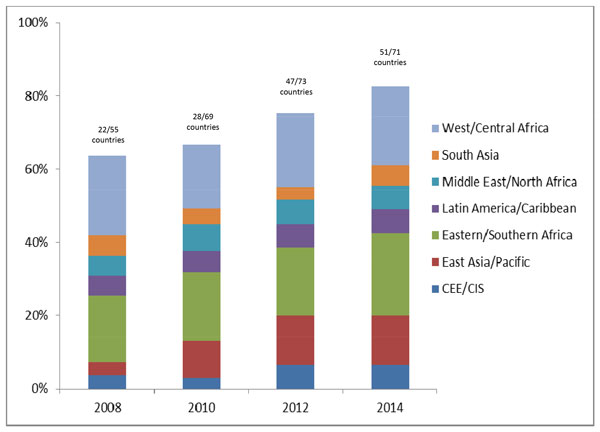
“Maternal deaths were notifiable by national policy in 51 of 71 (72%) high burden countries in 2014 [13], up from 22 of 55 countries (40%) in 2008 [14] (Figure 3) with more countries moving towards implementation in addition to policy (See Table S1, additional file 1).”
Background
Research works printed but not linked: 7
- UNICEF, WHO: Fulfilling the health agenda for women and children: Countdown to 2015 for Maternal, Newborn and Child Survival. 2014, Geneva: WHO
- WHO: Everybody's business -- strengthening health systems to improve health outcomes : WHO's framework for action. 2007, Geneva: World Health Organization
- Flenady V, King J, Charles A, Gardener G, Ellwood D, Day K, McCowan L, Kent A, Tudehope D, Richardson R, et al: PSANZ Clinical Practice Guideline for Perinatal Mortality. Version 2.2. 2009, Queensland: Perinatal Society of Australia and New Zealand
- PMNCH: A Global Review of the Key Interventions Related to Reproductive, Maternal, Newborn and Child Health (RMNCH). 2011, Geneva, Switzerland: The Partnership for Maternal, Newborn & Child Health
- Jagau A: ACT for Birth: Improving the Quality of Care in Uganda. 2012
- Woods DL: Saving Mothers and Babies: Assessing and reducing mortality rates in your hospital. 2011, Cape Town: Perinatal Education Programme
- Commission on Information and Accountability: Keeping promises, measuring results: Commission on Information and Accountability for Women's and Children's Health. 2011, Geneva: World Health Organization
Cited by
Sorted by citations
Stillbirths: rates, risk factors, and acceleration towards 2030
Lawn, J. E., Blencowe, H., Waiswa, P., Amouzou, A., Mathers, C., Hogan, D., Flenady, V., Frøen, J. F., Qureshi, Z. U., Calderwood, C., et al. (2016) · The Lancet · doi:10.1016/s0140-6736(15)00837-5 · Cited by 1,778
Self-citationNarayan, A. J., Rivera, L. M., Bernstein, R. E., Harris, W. W., & Lieberman, A. F. (2017) · Child Abuse & Neglect · doi:10.1016/j.chiabu.2017.09.022 · Cited by 622
Stillbirths: ending preventable deaths by 2030
de Bernis, L., Kinney, M. V., Stones, W. R., ten Hoope‐Bender, P., Vivio, D., Leisher, S. H., Bhutta, Z. A., Gülmezoglu, M., Mathai, M., Belizán, J. M., et al. (2016) · The Lancet · doi:10.1016/s0140-6736(15)00954-x · Cited by 479
Self-citationCount every newborn; a measurement improvement roadmap for coverage data
Moxon, S. G., Ruysen, H., Kerber, K. J., Amouzou, A., Fournier, S., Grove, J. T., Moran, A. C., Vaz, L. M. E., Blencowe, H. K., Conroy, N., et al. (2015) · BMC Pregnancy and Childbirth · doi:10.1186/1471-2393-15-s2-s8 · Cited by 357
Self-citationFlannery, C., McHugh, S., Anaba, A. E., Clifford, E., O’Riordan, M., Kenny, L. C., McAuliffe, F. M., Kearney, P. M., & Byrne, M. (2018) · BMC Pregnancy and Childbirth · doi:10.1186/s12884-018-1816-z · Cited by 218
Metadata
- Authors
- Kerber, K. J., Mathai, M., Lewis, G., Flenady, V., Erwich, J. J. H., Segun, T., Aliganyira, P., Abdelmegeid, A., Allanson, E., Roos, N., Rhoda, N., Lawn, J. E., & Pattinson, R.
- Affiliations
- Save the Children (US)
- World Health Organization (CH)
- University College London (GB)
- The University of Queensland (AU)
- University Medical Center Groningen (NL)
- Jhpiego (US)
- The University of Western Australia (AU)
- University of Cape Town (ZA)
- South African Medical Research Council (ZA)
- Corresponding author
- Kerber, Kate J
- ORCID
- Venue
- BMC Pregnancy and Childbirth
- Published
- 2015-09-11
- Volume
- 15
- Issue
- S2
- Pages
- S9-S9
- ISSN
- 1471-2393 (ISSN-L)
- PMC
- PMC4577789
- OpenAlex
- W1924529051
- Cited by
- 231
- References
- 58
- Citations by year
- 2026: 6 · 2025: 11 · 2024: 21 · 2023: 8 · 2022: 16 · 2021: 46 · 2020: 26 · 2019: 33 · 2018: 24 · 2017: 17 · 2016: 15 · 2015: 8
- FWCI
- 3.22
- Type
- journal article
- Language
- en
- Open access
- gold
- doi.org
- Licence
- Locations
- BMC Pregnancy and Childbirth (publishedVersion, cc-by)
- PubMed Central (publishedVersion, cc-by)
- PubMed (publishedVersion)
- LSHTM Research Online (London School of Hygiene and Tropical Medicine) (acceptedVersion)
- UWA Profiles and Research Repository (UWA) (submittedVersion, other-oa)
- Open University of Cape Town (University of Cape Town) (submittedVersion, cc-by)
- University of Groningen research database (University of Groningen / Centre for Information Technology) (submittedVersion, cc-by)
- Funders
- World Health Organization
- Topics
- Health Sciences › Medicine › Pediatrics, Perinatology and Child Health › Global Maternal and Child Health
- Health Sciences › Medicine › Pediatrics, Perinatology and Child Health › Maternal and Neonatal Healthcare
- Health Sciences › Medicine › Pediatrics, Perinatology and Child Health › Maternal and fetal healthcare
- Keywords
- stillbirth, neonatal death, Every Newborn Action Plan, cause of death classification, health information systems, health system leadership, avoidable causes of death, quality of care, low- and middle-income countries, health policy implementation
- MeSH terms
- Africa, Asia, Developing Countries, Female, Health Policy, Humans, Infant, Newborn, Leadership, Medical Audit, Postnatal Care, Pregnancy, Prenatal Care, Practice Guidelines as Topic, Stillbirth, Perinatal Mortality, Quality Improvement, Healthcare Financing, Health Information Systems, Maternal Death, Perinatal Death
About these checks
Registry, retraction, Cites and statistics results are computed, not judged, with one exception: a printed reference that no index lists is read once by a model before it counts as a citation error. Claims are extracted by a model and kept only when their quote appears verbatim in the text; each cited source is then checked, with a model’s help, for whether it says what the claim relies on. Those verdicts can be wrong — read the claim’s quote and the cited source before relying on one.
Statistics and arithmetic are recomputed, not judged.
Confidence bands are shown only for fields calibrated on our annotated test set. None is calibrated yet, so no band is shown.
What counts as a claim ›How we measure confidence ›How we check this ›
Are you an author, or do you see a problem with this page? Request a review
