

Bacterial and viral etiology of childhood diarrhea in Ouagadougou, Burkina Faso
Open accessThe DOI matches its Crossref record; 29 of the 29 references it cites were found in a registry or an index.
Abstract
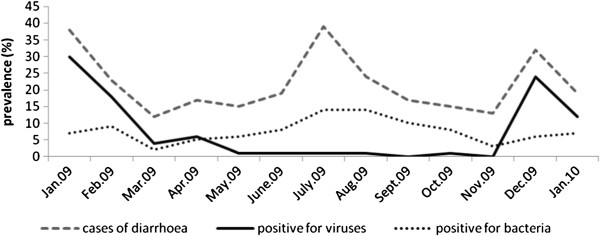
BACKGROUND: Diarrhea is the most frequent health problem among children in developing countries. This study investigated the bacterial and viral etiology and related clinical and epidemiological factors in children with acute diarrhea in Ouagadougou, Burkina Faso. METHODS: Stool specimens were collected from 283 children under 5 years of age visiting hospital due to acute diarrhea and from 60 healthy controls of similar age. Pathogens were investigated by using conventional culture techniques, PCR and immunochromatographic testing. Salmonella and Shigella strains were serotyped and their susceptibility to 23 antimicrobial agents was determined by the agar dilution method. RESULTS: At least one pathogen was detected in 64% of the 283 patients and in 8% of the 60 controls (p < 0.001). Rotavirus was found in 30% of the patients, followed by diarrheagenic Escherichia coli (24%), Salmonella enterica ssp. enterica (9%), Shigella spp. (6%), adenovirus (5%) and Campylobacter spp. (2%). Multiple pathogens were found in 11% of the patients and in 2% of the controls (p = 0.028). Viruses were found mainly in children of ≤ 2 years of age, whereas bacteria were equally prevalent among all the age groups. Viral infections occurred mostly during the cool dry season and the bacterial infections during the rainy season. Fever (64%) and vomiting (61%) were the most common symptoms associated with diarrhea. Only one Salmonella strain was resistant to nalidixic acid and ciprofloxacin. Of the Shigella strains, one was resistant to nalidixic acid but 81% to trimethoprim- sulfamethoxazole, 63% to streptomycin and 50% to ampicillin. Most of all the other Salmonella and Shigella strains were sensitive to all antimicrobials tested. CONCLUSION: Rotaviruses and diarrheal E. coli were the most predominant pathogens associated with acute diarrhea in Burkinabe children. Constant antimicrobial surveillance is warranted to observe for the emergence of enteric bacteria resistant to antimicrobials that are important in treatment also of severe infections.
Overview
The claims and statistics of this paper haven’t been checked yet.
Free: it reads the open-access text and checks the first 5 claims that cite a source we can check. Create a free account to check every claim.
Integrity signals
Registry
Cites
Statistics
Figures
Verification
Claims the paper makes
The claims and statistics of this paper haven’t been checked yet.
Free: it reads the open-access text and checks the first 5 claims that cite a source we can check. Create a free account to check every claim.
Claims other papers make about this one
Each is checked against this paper’s own text: does it say what the citing paper says it does?
The source backs part of the claim, not all of it — or backs it for a different population, condition or comparison.
In the citing paper
“Eight of these 16 serotypes were also reported in humans in this country (Bredeney, Derby, Enteritidis, Kentucky, Muenster, Poona, Tilene, and Tennessee) [34–36].”
From Contamination of street food with multidrug-resistant Salmonella, in Ouagadougou, Burkina Faso (2021) · cites this paper as [35]
Experimental — accuracy not yet measured
Self-check
Percentages, sums and reported differences re-computed from the paper’s own numbers.
The self-check needs the paper’s full text.
Citations
Cites
WHO estimates of the causes of death in children
Bryce, J., Boschi-Pinto, C., Shibuya, K., & Black, R. E. (2005) · The Lancet · doi:10.1016/s0140-6736(05)71877-8 · Cited by 2,096
Wayne, P. A. (2011) · Cited by 705
Typical and Atypical Enteropathogenic Escherichia coli
Trabulsi, L. R., Keller, R., & Gomes, T. A. T. (2002) · Emerging Infectious Diseases · doi:10.3201/eid0805.010385 · Cited by 692
Updated norovirus outbreak management and disease prevention guidelines.
Gregoricus, N., Hall, A. J., Lopman, B. A., et al. (2011) · PubMed · Cited by 542
A millennium update on pediatric diarrheal illness in the developing world.
O’Ryan, M., Prado, V., & Pickering, L. K. (2005) · Seminars in Pediatric Infectious Diseases · doi:10.1053/j.spid.2005.12.008 · Cited by 283 · cited 2×
“Moreover, parasites and other viral enteropathogens, such as norovirus and sapovirus, which were not included in our study, can cause enteric infections [14,26] and may be responsible for illness in some of the 36% of cases with no etiologic diagnosis.”
BackgroundUpdated norovirus outbreak management and disease prevention guidelines.
(2011) · PubMed · Cited by 199
Acute Infantile Gastroenteritis Associated with Human Enteric Viruses in Tunisia
Sdiri-Loulizi, K., Gharbi-Khélifi, H., de Rougemont, A., Chouchane, S., Sakly, N., Ambert-Balay, K., Hassine, M., Guédiche, M. N., Aouni, M., & Pothier, P. (2008) · Journal of Clinical Microbiology · doi:10.1128/jcm.02438-07 · Cited by 178 · cited 2×
“Sdiri-Loulizi K, Gharbi-Khélifi H, De Rougemont A, Chouchane S, Sakly N, Ambert-Balay K, Hassine M, Guédiche MN, Aouni M, Pothier P: Acute infantile gastroenteritis associated with human enteric viruses in Tunisia.”
BackgroundOkeke, I. N., Lamikanra, A., Steinrück, H., & Kaper, J. B. (2000) · Journal of Clinical Microbiology · doi:10.1128/jcm.38.1.7-12.2000 · Cited by 176 · cited 2×
“coli pathogroups can be considered as major bacterial causes of infantile diarrhea in developing countries [19,21,22].”
BackgroundResultEtiology of Diarrhea in Young Children in Denmark: a Case-Control Study
Olesen, B., Neimann, J., Böttiger, B., Ethelberg, S., Schiellerup, P., Jensen, C., Helms, M., Scheutz, F., Olsen, K. E. P., Krogfelt, K., et al. (2005) · Journal of Clinical Microbiology · doi:10.1128/jcm.43.8.3636-3641.2005 · Cited by 170 · cited 2×
“Similar results have also been reported from other countries [10,11], showing the importance of bacterial and viral infections as a cause of childhood diarrhea.”
ResultMANDOMANDO, I. M., MACETE, E. V., RUIZ, J., SANZ, S., ABACASSAMO, F., VALLÈS, X., SACARLAL, J., NAVIA, M. M., VILA, J., ALONSO, P. L., et al. (2007) · The American Journal of Tropical Medicine and Hygiene · doi:10.4269/ajtmh.2007.76.522 · Cited by 152 · cited 1×
“in Mozambique and Tanzania in which the prevalence was approximately 3% [23,24].”
Background
Research works printed but not linked: 1
- 7. WHO: Handbook-Integrated Management of Childhood Illness. Geneva: World Health Organization; 2000:18-22.
Cited by
Items 101–166 of 166
Somda, N. S., Bonkoungou, I. J. O., Yves, T., & Savadogo, A. (2017) · International Journal of Sciences · doi:10.18483/ijsci.1305 · Cited by 7
Self-citationCliffer, I. R., Naumova, E. N., Masters, W. A., Perumal, N., Garanet, F., & Rogers, B. L. (2023) · American Journal of Clinical Nutrition · doi:10.1016/j.ajcnut.2023.09.021 · Cited by 6
Ali, M. B. (2024) · NEWPORT INTERNATIONAL JOURNAL OF RESEARCH IN MEDICAL SCIENCES · doi:10.59298/nijrms/2024/105.11557.1400 · Cited by 6
Berendes, D. M., O’Reilly, C. E., Kim, S., Omore, R., Ochieng, J. B., Ayers, T., Fagerli, K., Farag, T. H., Nasrin, D., Panchalingam, S., et al. (2018) · Epidemiology and Infection · doi:10.1017/s0950268818002972 · Cited by 7
Detection of Campylobacter sp. from Poultry Feces in Ouagadougou, Burkina Faso
Kagambèga, A., Thibodeau, A., Soro, D. K., Barro, N., & Fravalo, P. (2021) · Food and Nutrition Sciences · doi:10.4236/fns.2021.122009 · Cited by 6
Self-citationKagambèga, A., Bouda, S., Bako, E. S., Cissé, H., Barro, N., & Haukka, K. (2017) · African Journal of Microbiology Research · doi:10.5897/ajmr2017.8698 · Cited by 6
“The strains were isolated using standard bacteriological methods and serotyped according to Kauffman White scheme (Kagambega et al., 2013; Bonkoungou et al., 2013; Traoré et al., 2015).”
MethodSelf-citationJoseph, A., Odimayo, M. S., Oluwayemi, I. O., Fadeyi, A., & Dada, S. A. (2017) · Medical Journal of Zambia · doi:10.55320/mjz.44.4.298 · Cited by 7
Tafti, Z. S. M., Rahbar, M., Eslami, P., Hashemi, S. H. R., Hajia, M., Dori, M. G., & Abdinia, B. (2016) · International Journal of Enteric Pathogens · doi:10.17795/ijep32713 · Cited by 5
Salfo, S., Diarra, B., Bisseyé, C., Compaore, T. R., Djigma, F. W., Ouermi, D., OUATTARA, A. S., & Simporè, J. (2017) · Sudan Journal of Medical Sciences · doi:10.18502/sjms.v12i3.931 · Cited by 5
“Shigella flexneri was the most frequently isolated (3 of 5 cases), which is consistent with previous studies which have shown that it is the most common species in developing countries [16, 17, 21, 22].”
BackgroundResultOuédraogo, G. A., Cissé, H., Ouédraogo, H. S., Kaboré, B., Traoré, R., Traoré, Y., Bassolé, I. H. N., François, T., & Savadogo, A. (2023) · Infection and Drug Resistance · doi:10.2147/idr.s408315 · Cited by 4
“Notwithstanding that E. coli is part of the commensal flora in humans, but it occupies the first place in enteric and urinary infections in Burkina.34,35 In addition to E. coli (25.00”
BackgroundInfluentialTraoré, K. A., Akapovi, M. M., Ouédraogo, N., Ouoba, J. B., Roques, P., & Barro, N. (2024) · BMC Infectious Diseases · doi:10.1186/s12879-024-09668-4 · Cited by 7
Self-citationMukherjee, P., Mondal, V., Bhaumik, U., Sinha, R., Sarkar, S., Mitra, S. R., Howlader, D. R., Maiti, S., Mukhopadhyay, A. K., Dutta, S., et al. (2019) · Microbes and Infection · doi:10.1016/j.micinf.2019.02.007 · Cited by 4
Burden of acute gastrointestinal infections in Ouagadougou, Burkina Faso
Huovinen, R. D. E. (2016) · Journal of Microbiology and Infectious Diseases · doi:10.5799/jmid.328799 · Cited by 5
Dembelé, R., Wendpoulomdé, A. D. K., Soulama, I., Ali, K., Kagambèga, A., Traoré, O., Alfred, S. T., Awa, A.-K., Gassama‐Sow, A., & Barro, N. (2020) · AFRICAN JOURNAL OF BIOTECHNOLOGY · doi:10.5897/ajb2019.16986 · Cited by 6
Self-citationKlebsiella pneumoniae Infections in Intensive Care Unit and Risk Factors for Carbapenem Resistance
Yeşilbağ, Z., Şeker, Y. T., Şenoğlu, S., & Hergünsel, G. O. (2021) · Klimik Dergisi/Klimik Journal · doi:10.36519/kd.2021.05 · Cited by 5
Traoré, K. A., Sanou, M., Ouoba, J. B., Ouoba, L. B., Roques, P., & Barro, N. (2024) · Food and Nutrition Sciences · doi:10.4236/fns.2024.157041 · Cited by 3
Self-citationDakouo, D., Ouattara, A. K., Ouermi, D., Traoré, M. A. E., Zohoncon, T. M., Sawadogo, M., Zigani, N. L., Tao, N. I., Traore, L., Ouedraogo, T. C., et al. (2024) · American Journal of Molecular Biology · doi:10.4236/ajmb.2024.144016 · Cited by 3
Deji-Agboola, A. M., Bamigbola, F. A., & Osinupebi, O. A. (2020) · African Journal of Science and Nature · doi:10.46881/ajsn.v10i0.190 · Cited by 3
“The aetiological agents for acute diarrhea include a wide range of viruses, bacteria and parasites (Bonkoungou et al., 2013; WHO, 2013).”
BackgroundCissé, H., Kagambèga, A., BOUDA, S. C., Sawadogo, A., & Barro, N. (2023) · Advances in Microbiology · doi:10.4236/aim.2023.137022 · Cited by 3
Self-citationEVALUASI PENGGUNAAN ANTIBIOTIK PADA PASIEN PEDIATRIK DENGAN DIARE AKUT DI RUANG RAWAT INAP ANAK
Anshory, M. B. (2021) · Media Informasi · doi:10.37160/bmi.v16i1.407 · Cited by 3
Nurseha, I., Miarsyah, M., & Ristanto, . H. (2021) · Indonesian Journal of Biology Education · doi:10.31002/ijobe.v4i1.3919 · Cited by 4
“The pie chart shows the percentage of diarrhea-causing microorganisms such as rotavirus, E. Coli, adenovirus, Salmonella sp. (Bonkoungou et al., 2013).”
BackgroundMabika, R. M., Oyegue-Liabagui, S. L., Mounioko, F., Dibakou, S. E., Delis, A. M., MOUSSAVOU, M. G., Lékana-Douki, J. B., Souza, A., & Yala, J. F. (2020) · Research Square · doi:10.21203/rs.3.rs-131619/v1 · Cited by 3
Dabiré, A. M., Bénao, S. L. C. S., Ouédraogo, N., Tiemtoré, R. Y. W., Badini, R. O., Bambara, L. E. B., & Simporè, J. (2024) · Journal of Biosciences and Medicines · doi:10.4236/jbm.2024.1211019 · Cited by 2
Anggreli, C. A., Anggraini, D., & Savira, M. (2014) · Jurnal Online Mahasiswa Fakultas Kedokteran Universitas Riau · Cited by 2
Emami, A., Pirbonyeh, N., Javanmardi, F., Bazargani, A., Moattari, A., Keshavarzi, A., & Akbari, A. (2021) · Future Microbiology · doi:10.2217/fmb-2020-0151 · Cited by 2
Tawfiq, S. M. (2019) · Tikrit Journal of Pure Science · doi:10.25130/j.v24i1.774 · Cited by 2
“Elderly, pregnant, infants, children, and people between (15-20) years at danger for severe complications as a result of Salmonella food poisoning [29, 30].”
BackgroundACUTE GASTROENTERITIS IN RWANDAN CHILDREN UNDER FIVE YEARS OF AGE INVESTIGATED BY REAL-TIME PCR
Kabayiza, J.-C. (2014) · Gothenburg University Publications Electronic Archive (Gothenburg University) · Cited by 5
Precipitation Associated with Increased Diarrheal Disease in Mozambique; A Time Series Analysis
Horn, L. (2017) · ResearchWorks at the University of Washington (University of Washington) · Cited by 2
wudie, B., Melese, A., & Mekonnen, D. S. (2021) · Research Square · doi:10.21203/rs.3.rs-882502/v1 · Cited by 2
BenyamZenebe, B. Z., TesfayeSisay, T. S., Belay, G., WorkeabebaAbebe, W., Zenebe, B., & Zenebd, B. Z. B. (2022) · Research Square · doi:10.21203/rs.3.rs-2370163/v1 · Cited by 2
Biswas, S., Khuntia, H. K., Bal, M., Pati, S., Dixit, S., Pattanaik, S. S. S., Manna, P., Routray, S., Beuria, J., & Ranjit, M. (2024) · One Health Bulletin · doi:10.4103/ohbl.ohbl_42_23 · Cited by 1
Asakura, S., Borin, K., Seng, S., Pok, S., Chhay, T., Phiny, C., Srey, T., Blacksell, S. D., Gilbert, J. R., Grace, D., et al. (2023) · Frontiers in Sustainable Food Systems · doi:10.3389/fsufs.2023.1127445 · Cited by 3
“In addition, from the perspective of the season, while bacterial diarrheal diseases often occur during rainy season, the sampling was performed in dry season in the current study, which may be behind the low overall diarrhea incidence observed (Bonkoungou et al., 2013; Kraay et al., 2020).”
BackgroundOccurrence of Salmonella serovars implicated in Salmonellosis in North-western part of Nigeria
Abdullahi, B., Abdulkadi̇r, B., & Olayinka, B. O. (2017) · UMYU Journal of Microbiology Research (UJMR) · doi:10.47430/ujmr.1722.022 · Cited by 1
“countries, they are also the most frequently isolated from diarrheal diseases (Bonkoungou et al., 2013), which is confirmed by this study.”
ResultSyndromic testing for increasing diagnostic accuracy in gastrointestinal infection
Dharmawan, A., & Pusparini, P. (2023) · The Journal of Infection in Developing Countries · doi:10.3855/jidc.17038 · Cited by 4
“Similar results were found in a study in Burkina Faso where the most numerous pathogens were rotavirus and pathogenic E. coli [32].”
ResultZhao, X., Liu, Z. C., Wang, Y., Wang, Y., Zhang, W., Wang, X., Song, D., Zhao, Z., & Liu, X. (2026) · Infection · doi:10.1007/s15010-026-02863-2 · Cited by 1
Prevalence of Gastroenteritis Among Children Under Five Years of Age at a District Hospital
Elamin, M. O., Rahmutalah, H., Natto, H. A., Elamin, F. O., & Alfahmi, M. H. (2021) · Journal of Health and Medical Sciences · doi:10.31014/aior.1994.04.03.183 · Cited by 1
Anugraheni, A., & Rini, C. S. (2023) · Pharmaciana · doi:10.12928/pharmaciana.v13i2.24711 · Cited by 1
“(Bonkoungou et al., 2013) found that children under five years of age, were discovered the pathogenic bacterium E.”
BackgroundMafo, L. D., Founou, R. C., Noubom, M., Dimani, B. D., Zemtsa, J. R., Koudoum, P. L., Mbossi, A. D., Tchouangueu, T. F., Noukeu, D., Founou, L. L., et al. (2023) · Journal of Bacteriology and Mycology · doi:10.26420/jbacteriolmycol.2023.1206 · Cited by 1
Abdul-Ganiu, Z., Shamsu-Deen, Z., & Yakubu, A. (2025) · BMC Public Health · doi:10.1186/s12889-025-25301-8 · Cited by 1
Bioactivity of Xanthium indicum koen. (Compositae) leaf
Biswas, A. S., Siraj, M. A., Saifuzzaman, Rahman, M., Khatun, A., Anwar, H., Khalid, A. A., Das, K. K., & Farjana, Y. (2014) · Cited by 1
Setianingsih, I., Andiarsa, D., & Hariyati, E. (2019) · Biomedika · doi:10.31001/biomedika.v12i2.597 · Cited by 1
Asmat, T. M. (2019) · Pak-Euro Journal of Medical and Life Sciences · doi:10.31580/pjmls.v2i2.992 · Cited by 1
“coli usually reside in the intestines of healthy humans and animals (3).”
BackgroundAntimicrobial Resistance of Shigella spp., Typhoid Salmonella, and Non-typhoid Salmonella
DuPont, H. L., & Whichard, J. M. (2017) · Springer eBooks · doi:10.1007/978-3-319-47266-9_12 · Cited by 4
Gasurira, S. (2017) · Cited by 2
Arianto, R., Putra, D. S., & Fauzia Adrini, D. (2015) · Jurnal Online Mahasiswa Fakultas Kedokteran Universitas Riau
Association between morbidity and physical activity among 18-month-old Malawian toddlers
Ollila, S. (2016) · Tampere University Institutional Repository (Tampere University)
Zongo, A., Ouattara, A. K., Yonli, A. T., Sorgho, P. A., Soubeïga, S. T., Djigma, F. W., Millogo, H., & Simporè, J. (2019) · Trends in Medicine · doi:10.15761/tim.1000172
“*Correspondence to: Abdoul Karim Ouattara, Ph.D. in Molecular Biology and Genetics; CERBA/LABIOGENE, UFR/SVT, University Ouaga 1 Prof. Joseph KiZerbo, 01 BP 364, Ouagadougou 01, Burkina Faso, Tel: 226 25361232; E-mail: ak.ouattara02@gmail.com Key words: intestinal parasites, diarrhoea, children, Burkina Faso Received:…”
BackgroundInfluentialSurvival Analisis Suhu Tubuh pada Pasien Diare yang Diberikan Vitamin D
Sutrimo Usali, R., Darmawan, E., & Kurniawan, N. U. (2020) · Jurnal Surya Medika · doi:10.33084/jsm.v5i2.1321 · Cited by 2
Netshikweta, R. (2019) · UpSpace Institutional Repository (University of Pretoria) · Cited by 4
Real-space correlations in dissipative quantum systems
Gärtner, E. (2014) · Kölner Universitäts PublikationsServer (Universität zu Köln)
Nov, V., Nguyen, L. P., Osei, K. M., Lee, H., Yong, D., & Lee, K. (2021) · Annals of Clinical Microbiology · doi:10.5145/acm.2021.24.4.2
Bacterial Diarrhea and Sepsis in Developing Countries
(2021) · Journal of Chemical Biological and Physical Sciences · doi:10.24214/jcbps.b.11.2.42127
John-Isa, J. F., Adebolu, T. T., & Oyetayo, V. O. (2022) · Bangladesh Journal of Medical Science · doi:10.3329/bjms.v21i3.59568
Suciati, W., & Basuki, S. W. (2022) · Qanun Medika - Medical Journal Faculty of Medicine Muhammadiyah Surabaya · doi:10.30651/jqm.v6i2.4168
Enyuma, C. O. A., Ikpeme, O. E., Olorunfemi, G., & Enyuma, S. I. G. (2022) · Calabar Journal of Health Sciences · doi:10.25259/cjhs_46_2021
Ezzat, M., Youssef, F., Eid, A., & Hashem, M. A. (2024) · Advances in Animal and Veterinary Sciences · doi:10.17582/journal.aavs/2024/12.s1.310.319
Karambiri, Y. R., Robert, É., & Nikiema, D. E. (2025) · Cybergeo · doi:10.4000/14hxe · Cited by 1
Meilani, N., Dianasari, D., & Ningsih, I. Y. (2025) · Journal of Agromedicine and Medical Sciences · doi:10.19184/ams.v11i2.53717
In vivo Human Safety Profile of Sudanese Herbal Antidiarrheal Agent
Osman, M. E., Mohammed, S.-A. H., Ahmed, A. A. E., Shamou, J., Elagib, S. M., Elnaem, I. S., Alameen, A. A. S., Alreshidi, H. F. H., & Elagib, H. M. (2025) · Asian Journal of Pharmaceutical Research and Health Care · doi:10.4103/ajprhc.ajprhc_102_25
Bailey, J. L. B., Menyere, A., Dawood, H., Mapila, O., Ngunguni, S., Pinchbeck, G. L., Williams, N. J., Cunliffe, N. A., & Cornick, J. (2026) · medRxiv · doi:10.64898/2026.02.09.26345948
Yala, J. F., Mabika, R. M., Mounioko, F., Minko, O. Z., Massima, R. B., Moyen, R., & Souza, A. (2026) · The Open Microbiology Journal · doi:10.2174/0118742858401660250922115627
Héma, A., Tondé, I., Kaboré, R., Sangaré, M., Tamboura, M., Bako, É., Bagré, T. S., Nikiema, M. E. M., Ouattara, A., Hossain, M. J., et al. (2026) · BMC Infectious Diseases · doi:10.1186/s12879-026-13722-8
Héma, A., Tondé, I., Zongo, J., Nikiema, M. E. M., Evariste, B., Badjo, A. O. R., Tamboura, M., Ky-Ba, A., Sangare, M. B., Ouédraogo, A., et al. (2026) · Microbiology Spectrum · doi:10.1128/spectrum.01243-26
Gampene, M. T., Somda, N. S., Soubeiga, P. A., Karfo, P., Zoma, B. S., Bako, É., Soma, D., Diarra, F. B. J., Sagnon, A., Sougué, S., et al. (2026) · BMC Infectious Diseases · doi:10.1186/s12879-026-14002-1
Self-citationViral diarrhea in Ghana: a scoping review of disease burden, epidemiology, and control strategies
-, A. A. K., Arthur, S. E., Yeboah-Manu, M., Jones, M. B., & Kyei, G. B. (2026) · Frontiers in Public Health · doi:10.3389/fpubh.2026.1840821
Metadata
- Authors
- Bonkoungou, I. J. O., Haukka, K., Österblad, M., Hakanen, A. J., Traoré, A. S., Barro, N., & Siitonen, A.
- Affiliations
- Finnish Institute for Health and Welfare (FI)
- University of Helsinki (FI)
- Université Joseph Ki-Zerbo (BF)
- Corresponding author
- Bonkoungou, Isidore Juste O
- Venue
- BMC Pediatrics
- Published
- 2013-03-19
- Volume
- 13
- Issue
- 1
- Pages
- 36-36
- ISSN
- 1471-2431 (ISSN-L)
- PMC
- PMC3616825
- OpenAlex
- W1988226877
- Semantic Scholar
- f641c4da47604028138e62242bfdbfec100099f8
- Cited by
- 166
- References
- 28
- Citations by year
- 2026: 7 · 2025: 5 · 2024: 13 · 2023: 16 · 2022: 11 · 2021: 18 · 2020: 13 · 2019: 13 · 2018: 10 · 2017: 20 · 2016: 9 · 2015: 17 · 2014: 10 · 2013: 3
- FWCI
- 9.44
- Type
- journal article
- Language
- en
- Open access
- gold
- doi.org
- Licence
- cc-by
- creativecommons.org/licenses/by/2.0 (tdm)
- Locations
- BMC Pediatrics (publishedVersion, cc-by)
- Europe PMC (PubMed Central) (publishedVersion, cc-by)
- PubMed Central (publishedVersion, cc-by)
- PubMed (publishedVersion)
- Työväentutkimus Vuosikirja (submittedVersion)
- STM:n Hallinnonalan avoin julkaisuarkisto (Julkari) (submittedVersion)
- Funders
- Academy of Finland (122600)
- Terveyden ja hyvinvoinnin laitos
- Topics
- Health Sciences › Medicine › Infectious Diseases › Viral gastroenteritis research and epidemiology
- Life Sciences › Agricultural and Biological Sciences › Food Science › Salmonella and Campylobacter epidemiology
- Health Sciences › Medicine › Surgery › Gastrointestinal disorders and treatments
- Keywords
- childhood diarrhea, acute diarrhea, enteric pathogens, rotavirus, diarrheagenic Escherichia coli, Salmonella, Shigella, antimicrobial resistance, seasonal variation, Ouagadougou
- MeSH terms
- Acute Disease, Adenoviridae Infections, Burkina Faso, Child, Preschool, Diarrhea, Feces, Female, Follow-Up Studies, Humans, Infant, Infant, Newborn, Male, Rotavirus Infections, Salmonella, Seasons, Serotyping, Shigella, Case-Control Studies, Gram-Negative Bacterial Infections, Drug Resistance, Bacterial
About these checks
Registry, retraction, Cites and statistics results are computed, not judged, with one exception: a printed reference that no index lists is read once by a model before it counts as a citation error. Claims are extracted by a model and kept only when their quote appears verbatim in the text; each cited source is then checked, with a model’s help, for whether it says what the claim relies on. Those verdicts can be wrong — read the claim’s quote and the cited source before relying on one.
Statistics and arithmetic are recomputed, not judged.
Confidence bands are shown only for fields calibrated on our annotated test set. None is calibrated yet, so no band is shown.
What counts as a claim ›How we measure confidence ›How we check this ›
Are you an author, or do you see a problem with this page? Request a review
Data sources
Bibliographic data: Semantic Scholar, OpenAlex, Crossref.
Contains information from the Semantic Scholar Academic Graph Datasets, made available under the ODC Attribution License (ODC-BY 1.0).
Semantic Scholar’s data is described in: Kinney, R., et al. (2023). The Semantic Scholar Open Data Platform. arXiv:2301.10140.
