

The DOI matches its Crossref record; 31 of the 31 references it cites were found in a registry or an index.
A patient perspective of the impact of medication side effects on adherence: results of a cross-sectional nationwide survey of patients with schizophrenia
Open accessAbstract
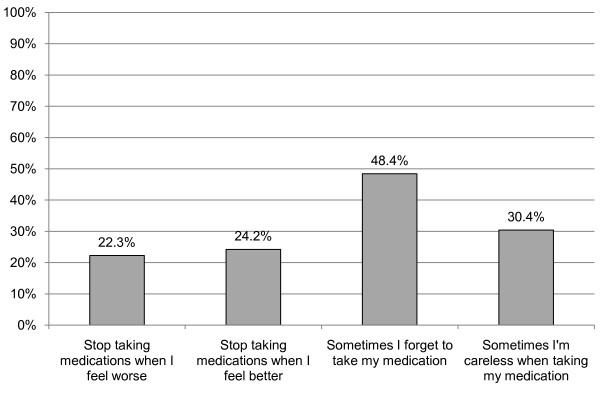
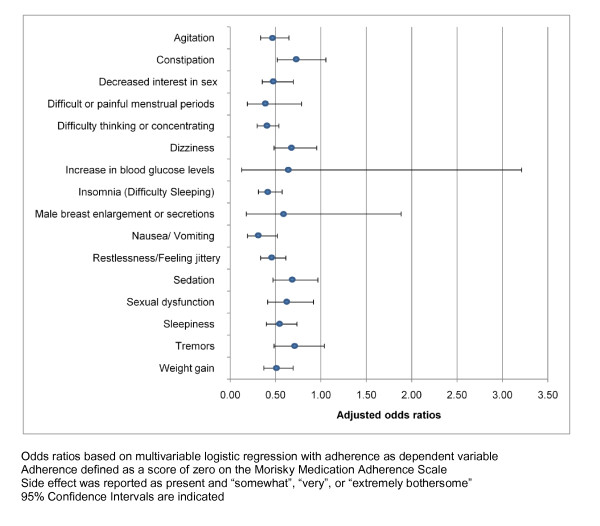
BACKGROUND: Antipsychotic medications often have a variety of side effects, however, it is not well understood how the presence of specific side effects correlate with adherence in a real-world setting. The aim of the current study was to examine the relationship between these variables among community-dwelling patients with schizophrenia. METHODS: Data were analyzed from a 2007-2008 nationwide survey of adults who self-reported a diagnosis of schizophrenia and were currently using an antipsychotic medication (N = 876). The presence of side effects was defined as those in which the patient reported they were at least "somewhat bothered". Adherence was defined as a score of zero on the Morisky Medication Adherence Scale. To assess the relationship between side effects and adherence, individual logistic regression models were fitted for each side effect controlling for patient characteristics. A single logistic regression model assessed the relationship between side effect clusters and adherence. The relationships between adherence and health resource use were also examined. RESULTS: A majority of patients reported experiencing at least one side effect due to their medication (86.19%). Only 42.5% reported complete adherence. Most side effects were associated with a significantly reduced likelihood of adherence. When grouped as side effect clusters in a single model, extra pyramidal symptoms (EPS)/agitation (odds ratio (OR) = 0.57, p = 0.0007), sedation/cognition (OR = 0.70, p = 0.033), prolactin/endocrine (OR = 0.69, p = 0.0342), and metabolic side effects (OR = 0.64, p = 0.0079) were all significantly related with lower rates of adherence. Those who reported complete adherence to their medication were significantly less likely to report a hospitalization for a mental health reason (OR = 0.51, p = 0.0006), a hospitalization for a non-mental health reason (OR = 0.43, p = 0.0002), and an emergency room (ER) visit for a mental health reason (OR = 0.60, p = 0.008). CONCLUSIONS: Among patients with schizophrenia, medication side effects are highly prevalent and significantly associated with medication nonadherence. Nonadherence is significantly associated with increased healthcare resource use. Prevention, identification, and effective management of medication-induced side effects are important to maximize adherence and reduce health resource use in schizophrenia.
Overview
The claims and statistics of this paper haven’t been checked yet.
Run the check — free, no account needed. It reads the open-access text and checks the sources it cites.
Integrity signals
Registry
Cites
Statistics
Figures
Verification
Claims the paper makes
The claims and statistics of this paper haven’t been checked yet.
Run the check — free, no account needed. It reads the open-access text and checks the sources it cites.
Claims other papers make about this one
Each is checked against this paper’s own text: does it say what the citing paper says it does?
The cited source says what the claim attributes to it.
In the citing paper
“Likewise, in five studies, weight gain was another medication-related side-effect that associated with medication non-adherence and patients’ perception toward their medication [25, 33, 36, 44, 55].”
From Psychotropic medication non-adherence and its associated factors among patients with major psychiatric disorders: A systematic review and meta-analysis (2020) · cites this paper as [33]
In the citing paper
“In seven studies, patients feeling dizziness, fatigue, tiredness, sedation, lethargy, and sleepiness were the most frequently reported side-effects that contributed to medication non-adherence [11, 33, 36, 37, 50, 52, 65].”
From Psychotropic medication non-adherence and its associated factors among patients with major psychiatric disorders: A systematic review and meta-analysis (2020) · cites this paper as [33]
In the citing paper
“In two studies, side-effects such as decreased sexual interest and having a symptom of sexual dysfunction were associated with patients’ medication adherence [33, 36].”
From Psychotropic medication non-adherence and its associated factors among patients with major psychiatric disorders: A systematic review and meta-analysis (2020) · cites this paper as [33]
Self-check
Percentages, sums and reported differences re-computed from the paper’s own numbers.
The self-check needs the paper’s full text.
Citations
Cites
Effectiveness of Antipsychotic Drugs in Patients with Chronic Schizophrenia
Lieberman, J. A., Stroup, T. S., McEvoy, J. P., Swartz, M. S., Rosenheck, R. A., Perkins, D. O., Keefe, R. S. E., Davis, S. M., Davis, C. E., Lebowitz, B. D., et al. (2005) · New England Journal of Medicine · doi:10.1056/nejmoa051688 · Cited by 5,892
Concurrent and Predictive Validity of a Self-reported Measure of Medication Adherence
Morisky, D. E., Green, L. W., & Levine, D. M. (1986) · Medical Care · doi:10.1097/00005650-198601000-00007 · Cited by 5,399
Lacro, J. P., Dunn, L. B., Dolder, C. R., Leckband, S. G., & Jeste, D. V. (2002) · The Journal of Clinical Psychiatry · doi:10.4088/jcp.v63n1007 · Cited by 1,383 · cited 2×
“Prior evidence has suggested that longer illness duration is associated with greater adherence [30]; therefore, age may be serving as a proxy for years diagnosed.”
BackgroundDeterminants of Medication Compliance in Schizophrenia: Empirical and Clinical Findings
Fenton, W. S., Blyler, C. R., & HEINSSEN, R. K. (1997) · Schizophrenia Bulletin · doi:10.1093/schbul/23.4.637 · Cited by 948
Atypical antipsychotic-induced metabolic side effects: insights from receptor-binding profiles
Nasrallah, H. A. (2007) · Molecular Psychiatry · doi:10.1038/sj.mp.4002066 · Cited by 718
Kendler, K. S. (1996) · Archives of General Psychiatry · doi:10.1001/archpsyc.1996.01830110060007 · Cited by 676
The Economic Burden of Schizophrenia in the United States in 2002
Wu, E. Q., Birnbaum, H. G., Shi, L., BALL, D. E., Kessler, R. C., Moulis, M., & Aggarwal, J. (2005) · The Journal of Clinical Psychiatry · doi:10.4088/jcp.v66n0906 · Cited by 614
Operational criteria and factors related to recovery from schizophrenia
Liberman, R. P., Kopelowicz, A. J., Ventura, J., & Gutkind, D. (2002) · International Review of Psychiatry · doi:10.1080/0954026021000016905 · Cited by 519
Obesity as a risk factor for antipsychotic noncompliance
Weiden, P. J., Mackell, J. A., & McDonnell, D. D. (2003) · Schizophrenia Research · doi:10.1016/s0920-9964(02)00498-x · Cited by 432
Self-reports of health care utilization compared to provider records
Ritter, P. L., Stewart, A. L., Kaymaz, H., Sobel, D. S., Block, D. A., & Lorig, K. R. (2001) · Journal of Clinical Epidemiology · doi:10.1016/s0895-4356(00)00261-4 · Cited by 401
Cited by
Sorted by citations
Semahegn, A., Torpey, K., Manu, A., Assefa, N., Tesfaye, G., & Ankomah, A. (2020) · Systematic Reviews · doi:10.1186/s13643-020-1274-3 · Cited by 555
“USA [43] MA was 51.9%.”
BackgroundInfluentialKane, J. M., Kishimoto, T., & Correll, C. U. (2013) · World Psychiatry · doi:10.1002/wps.20060 · Cited by 520
“Schizophrenia, USA (16) 876 Naturalistic Self-report 48.”
InfluentialVelligan, D. I., Sajatovic, M., Hatch, A., Kramata, P., & Docherty, J. (2017) · Patient Preference and Adherence · doi:10.2147/ppa.s124658 · Cited by 333
Kaplan, G., Casoy, J., & Zummo, J. (2013) · Patient Preference and Adherence · doi:10.2147/ppa.s53795 · Cited by 201
“A cross-sectional survey of patients with schizophrenia found that side effects to antipsychotic drugs were highly prevalent, and medication nonadherence was significantly associated with the occurrence of these side effects.(72) In addition, medication nonadherence was significantly associated with increased health c…”
The nocebo effect: patient expectations and medication side effects
Faasse, K., & Petrie, K. J. (2013) · Postgraduate Medical Journal · doi:10.1136/postgradmedj-2012-131730 · Cited by 201
Metadata
- Authors
- DiBonaventura, M., Gabriel, S., Dupclay, L., Gupta, S., & Kim, E.
- Affiliations
- Kantar Health (United States) (US)
- Novartis (United States) (US)
- Corresponding author
- DiBonaventura, Marco
- Venue
- BMC Psychiatry
- Published
- 2012-03-20
- Volume
- 12
- Issue
- 1
- Pages
- 20-20
- ISSN
- 1471-244X (ISSN-L)
- PMC
- PMC3342101
- OpenAlex
- W2157910519
- Cited by
- 333
- References
- 31
- Citations by year
- 2026: 16 · 2025: 30 · 2024: 32 · 2023: 27 · 2022: 22 · 2021: 34 · 2020: 22 · 2019: 27 · 2018: 22 · 2017: 20 · 2016: 24 · 2015: 22 · 2014: 13 · 2013: 19 · 2012: 2
- FWCI
- 15.48
- Type
- journal article
- Language
- en
- Open access
- gold
- doi.org
- Licence
- Locations
- BMC Psychiatry (publishedVersion, cc-by)
- PubMed Central (publishedVersion, cc-by)
- PubMed (publishedVersion)
- DOAJ (DOAJ: Directory of Open Access Journals) (submittedVersion, cc-by-sa)
- Topics
- Health Sciences › Medicine › Family Practice › Medication Adherence and Compliance
- Health Sciences › Medicine › Psychiatry and Mental health › Schizophrenia research and treatment
- Health Sciences › Medicine › Psychiatry and Mental health › Bipolar Disorder and Treatment
- Keywords
- schizophrenia, antipsychotic adverse effects, medication adherence, medication non-adherence, sedation, prolactin, metabolic side effects, health care utilization, hospitalization, emergency department visits, patient perspectives, community-dwelling patients, Morisky Medication Adherence Scale, health care costs, quality of life
- MeSH terms
- Adult, Attitude to Health, Cross-Sectional Studies, Female, Health Surveys, Humans, Male, Middle Aged, Schizophrenia, Schizophrenic Psychology, Antipsychotic Agents, Medication Adherence
About these checks
Registry, retraction, Cites and statistics results are computed, not judged, with one exception: a printed reference that no index lists is read once by a model before it counts as a citation error. Claims are extracted by a model and kept only when their quote appears verbatim in the text; each cited source is then checked, with a model’s help, for whether it says what the claim relies on. Those verdicts can be wrong — read the claim’s quote and the cited source before relying on one.
Statistics and arithmetic are recomputed, not judged.
Confidence bands are shown only for fields calibrated on our annotated test set. None is calibrated yet, so no band is shown.
What counts as a claim ›How we measure confidence ›How we check this ›
Are you an author, or do you see a problem with this page? Request a review
