

Predictors and impact of non-adherence in adults with attention-deficit/hyperactivity disorder receiving OROS methylphenidate: results from a randomized, placebo-controlled trial
Open accessThe DOI matches its Crossref record; 21 of the 21 references it cites were found in a registry or an index.
Abstract
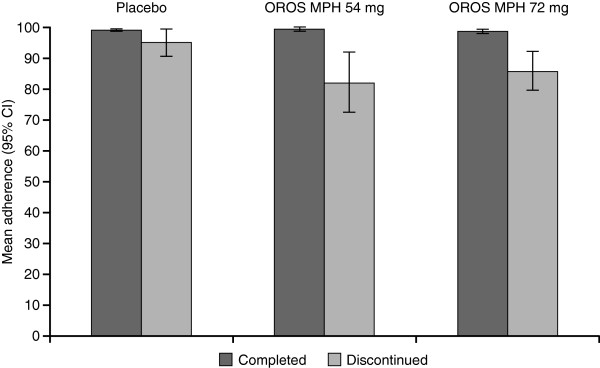
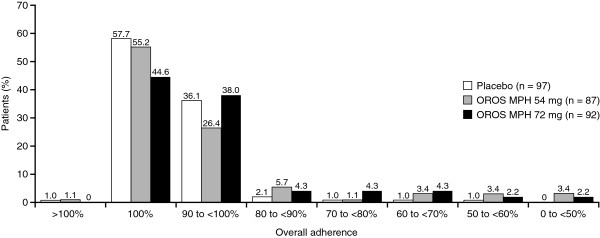
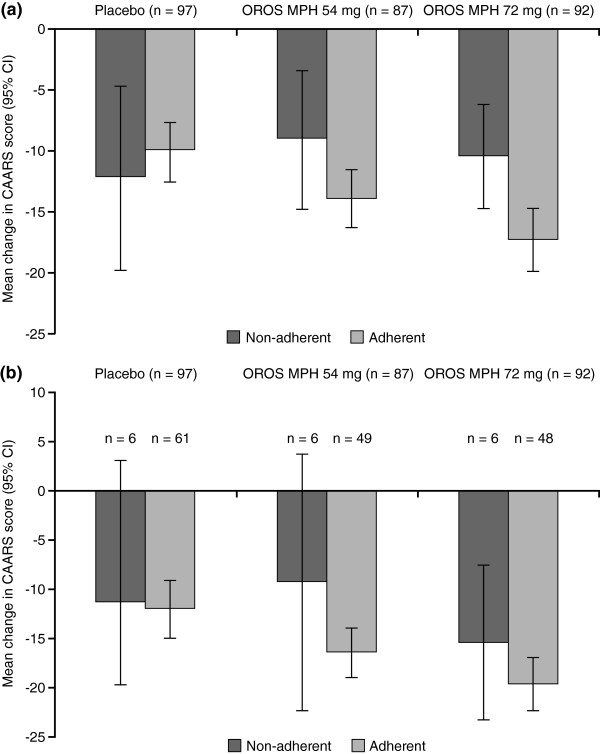
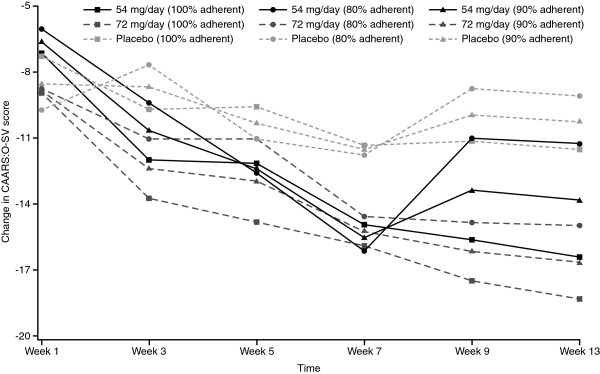
BACKGROUND: Medication non-adherence has an important impact on treatment efficacy and healthcare burden across a range of conditions and therapeutic areas. The aim of this analysis was to determine predictors of non-adherence and impact of non-adherence on treatment response in adults with attention-deficit/hyperactivity disorder (ADHD). METHODS: Post-hoc analysis of a 13-week randomized, double-blind placebo-controlled study of OROS methylphenidate (MPH) 54 and 72 mg/day. Primary efficacy variable was the Conners' Adult ADHD Rating Scale - Screening Version (CAARS:O-SV). Daily adherence was calculated as average daily adherence (100 × capsules taken/2), with overall adherence calculated as the average daily adherence. Predictors of adherence were assessed using mixed-effects logistic regression. Descriptive statistics were generated for change in CAARS:O-SV score for adherent (> 95% adherence) and non-adherent subjects. Predictors of change were analyzed using a mixed model. RESULTS: Subjects were allocated to OROS MPH (54 mg, n = 87; 72 mg, n = 92) or placebo (n = 97). Mean adherence was 92.6% and 93.3% (OROS MPH 54 and 72 mg/day, respectively), versus 97.5% (placebo). Adherence was higher and less variable in completers. Factors significantly associated with non-adherence included female sex, shorter time since ADHD diagnosis, higher education level (completion of university) and score on the Drug Use Screening Inventory psychiatric disorders subscale. Improvements from baseline in CAARS:O-SV score were numerically greater in subjects defined as adherent than in those who were non-adherent. Significant predictors of CAARS:O-SV change in patients who completed the study included percentage adherence up to the point of assessment (p < 0.0001), baseline score (p < 0.0001) and family history of ADHD (p = 0.0003). CONCLUSION: The results of this analysis suggest that newly diagnosed patients, those with a high score on the DUSI-R psychiatric disorder scale, women, and subjects with high educational degrees may be at increased risk of non-adherence. Clinicians and policymakers should therefore pay special attention to these individuals, as non-adherence is a significant predictor of reduced response to treatment. TRIAL REGISTRATION: EudraCT #: 2007-002111-82.
Overview
The claims and statistics of this paper haven’t been checked yet.
Free: it reads the open-access text and checks the first 5 claims that cite a source we can check. Create a free account to check every claim.
Integrity signals
Registry
Cites
Statistics
Figures
Verification
Claims the paper makes
The claims and statistics of this paper haven’t been checked yet.
Free: it reads the open-access text and checks the first 5 claims that cite a source we can check. Create a free account to check every claim.
Claims other papers make about this one
Each is checked against this paper’s own text: does it say what the citing paper says it does?
The source backs part of the claim, not all of it — or backs it for a different population, condition or comparison.
In the citing paper
“the effectiveness of any intervention is closely related to keeping regular appointments and adherence to treatment recommendations [25,26].”
From A Digital Mental Health Support Program for Depression and Anxiety in Populations With Attention-Deficit/Hyperactivity Disorder: Feasibility and Usability Study (2023) · cites this paper as [26]
Experimental — accuracy not yet measured
Self-check
Percentages, sums and reported differences re-computed from the paper’s own numbers.
The self-check needs the paper’s full text.
Citations
Cites
(2006) · Technometrics · doi:10.1198/tech.2006.s417 · Cited by 4,950
Interventions for enhancing medication adherence
Nieuwlaat, R., Wilczynski, N., Navarro, T., Hobson, N., Jeffery, R., Keepanasseril, A., Agoritsas, T., Mistry, N., Iorio, A., Jack, S., et al. (2014) · Cochrane Database of Systematic Reviews · doi:10.1002/14651858.cd000011.pub4 · Cited by 2,945 · cited 1×
“Indeed, improving adherence may have a greater impact on health than switching to a more potent or effective agent [2].”
BackgroundCourgeau, D., & Goldstein, H. (1997) · Population (French Edition) · doi:10.2307/1534624 · Cited by 2,562
A systematic review of the associations between dose regimens and medication compliance
Claxton, A. J., Cramer, J., & Pierce, C. (2001) · Clinical Therapeutics · doi:10.1016/s0149-2918(01)80109-0 · Cited by 2,388 · cited 1×
“For example, adherence can be improved by simplifying medication regimens, particularly in terms of reduced frequency of dosing [1,4,5].”
BackgroundInterventions for enhancing medication adherence
Haynes, R. B., Ackloo, E., Sahota, N., McDonald, H. P., & Yao, X. (2008) · Cochrane Database of Systematic Reviews · doi:10.1002/14651858.cd000011.pub3 · Cited by 1,244
Kooij, S. J., Bejerot, S., Blackwell, A., Caci, H., Casas-Brugué, M., Carpentier, P. J., Edvinsson, D., Fayyad, J., Foeken, K., Fitzgerald, M., et al. (2010) · BMC Psychiatry · doi:10.1186/1471-244x-10-67 · Cited by 928 · cited 1×
“According to several published guidelines, MPH is the treatment of choice for adults with ADHD [9-13].”
BackgroundSelf-citation(2009) · PubMed · Cited by 359
Medication Adherence: A Review of the Literature and Implications for Clinical Practice
Julius, R. J., Novitsky, M. A., & Dubin, W. R. (2009) · Journal of Psychiatric Practice · doi:10.1097/01.pra.0000344917.43780.77 · Cited by 301 · cited 1×
“One method of improving adherence is by identifying patient and medication factors that may prevent patients from taking their medication in an optimal manner [3].”
MethodReview of Medication Adherence in Children and Adults with ADHD
Adler, L. D., & Nierenberg, A. A. (2010) · Postgraduate Medicine · doi:10.3810/pgm.2010.01.2112 · Cited by 295 · cited 1×
“In a recent systematic review of 11 adherence studies in adults and children with ADHD, a very wide range was obtained for the prevalence of medication discontinuation or non-adherence (13–64%) [6].”
BackgroundRelationships Among Subjective and Objective Measures of Adherence to Oral Antipsychotic Medications
Velligan, D. I., Wang, M., Diamond, P., Glahn, D. C., Castillo, D., Bendle, S., Lam, Y. W. F., Ereshefsky, L., & Miller, A. L. (2007) · Psychiatric Services · doi:10.1176/appi.ps.58.9.1187 · Cited by 249 · cited 1×
“In the present study, it is possible that measurements of adherence were affected by patients deliberately returning fewer capsules to give the impression that their adherence was higher [24].”
Background
Research works printed but not linked: 6
- CADDRA Canadian ADHD Practice Guidelines 2008 Toronto: Canadian Attention Deficit Hyperactivity Disorder Resource Alliance
- National Collaborating Centre for Mental Health Attention Deficit Hyperactivity Disorder: Diagnosis and Management of ADHD in Children, Young People and Adults 2009 London: National Institute for Health and Clinical Excellence
- National Steering Committee on Multidisciplinary Guideline Development Multidisciplinary Guideline on ADHD [in Dutch] 2005 Utrecht: Trimbos Institute
- Sosial- og helsedirektoratet Diagnosis and Treatment of Hyperkinetic Disorder/Attention Deficit Hyperactivity Disorder (ADHD) in Children, Adolescents and Adults [in Norwegian] 2010 Oslo: Sosial- og helsedirektoratet
- Janssen–Cilag Ltd Concerta XL 18 mg–36 mg Prolonged Release Tablets 2010 High Wycombe: Janssen–Cilag Ltd
- Conners C Erhardt D Sparrow E Conners’ Adult ADHD Rating Scales (CAARS): Technical Manual 1999 North Tonawanda: Multi-Health Systems
Cited by
Adult ADHD and comorbid disorders: clinical implications of a dimensional approach
Katzman, M. A., Bilkey, T. S., Chokka, P. R., Fallu, A., & Klassen, L. J. (2017) · BMC Psychiatry · doi:10.1186/s12888-017-1463-3 · Cited by 732
“Studies have found that ADHD in individuals with SUD is associated with earlier onset of substance use, increased likelihood of suicide attempts, more hospitalizations, higher rates of poly-substance abuse, less likelihood of achieving abstinence, and lower rates of treatment adherence [43, 98, 99].”
BackgroundGender differences in adults with attention-deficit/hyperactivity disorder: A narrative review
Williamson, D., & Johnston, C. (2015) · Clinical Psychology Review · doi:10.1016/j.cpr.2015.05.005 · Cited by 226
ADHD and Bipolar Disorder in Adulthood: Clinical and Treatment Implications
Salvi, V., Ribuoli, E., Servasi, M., Orsolini, L., & Volpe, U. (2021) · Medicina · doi:10.3390/medicina57050466 · Cited by 95
“Moreover, the presence of ADHD may significantly influence the course of SUDs, being associated with an early onset of substance use, higher rates of polyabuse, lower likelihood of achieving abstinence and hampering of treatment adherence [40,41].”
BackgroundKanarik, M., Grimm, O., Mota, N. R., Reif, A., & Harro, J. (2022) · Neuroscience & Biobehavioral Reviews · doi:10.1016/j.neubiorev.2022.104757 · Cited by 59
Adesão do portador de transtorno mental à terapêutica medicamentosa no tratamento em saúde mental
Borba, L. D. O., Maftum, M. A., Vayego, S. A., Mantovani, M. D. F., Félix, J. V. C., & Kalinke, L. P. (2018) · Revista da Escola de Enfermagem da USP · doi:10.1590/s1980-220x2017006603341 · Cited by 55
“Studies have shown that men have a lower risk of discontinuing drug use and that the female gender is more associated with non-adherence(5,19).”
Background
Metadata
- Authors
- Kooij, J. J. S., Rösler, M., Philipsen, A., Wächter, S., Dejonckheere, J., van der Kolk, A., van Agthoven, M., & Schäuble, B.
- Affiliations
- PsyQ (NL)
- Universitätsklinikum des Saarlandes (DE)
- University of Freiburg (DE)
- Janssen (Germany) (DE)
- UCB Pharma (Belgium) (BE)
- Corresponding author
- Kooij, J J Sandra
- Venue
- BMC Psychiatry
- Published
- 2013-01-24
- Volume
- 13
- Issue
- 1
- Pages
- 36-36
- ISSN
- 1471-244X (ISSN-L)
- PMC
- PMC3577504
- OpenAlex
- W2031304370
- Cited by
- 44
- References
- 21
- Citations by year
- 2026: 4 · 2025: 5 · 2023: 3 · 2022: 3 · 2021: 3 · 2020: 6 · 2019: 2 · 2018: 2 · 2017: 3 · 2016: 5 · 2015: 2 · 2014: 4 · 2013: 2
- FWCI
- 3.07
- Type
- journal article
- Language
- en
- Open access
- gold
- doi.org
- Licence
- Locations
- BMC Psychiatry (publishedVersion, cc-by)
- Europe PMC (PubMed Central) (publishedVersion, cc-by)
- PubMed Central (publishedVersion, cc-by)
- PubMed (publishedVersion)
- DOAJ (DOAJ: Directory of Open Access Journals) (submittedVersion, cc-by-sa)
- Radboud Repository (Radboud University) (submittedVersion)
- Radboud Repository (Radboud University) (submittedVersion, other-oa)
- Funders
- Cilag
- Topics
- Health Sciences › Medicine › Psychiatry and Mental health › Attention Deficit Hyperactivity Disorder
- Health Sciences › Medicine › Family Practice › Medication Adherence and Compliance
- Health Sciences › Medicine › Pediatrics, Perinatology and Child Health › Pharmaceutical studies and practices
- Keywords
- medication non-adherence, attention deficit hyperactivity disorder, adults, OROS methylphenidate, predictors of non-adherence, treatment response, psychiatric comorbidity, newly diagnosed patients, sex differences, educational attainment, family history of ADHD, real-world evidence, healthcare burden
- MeSH terms
- Adult, Central Nervous System Stimulants, Attention Deficit Disorder with Hyperactivity, Delayed-Action Preparations, Double-Blind Method, Female, Humans, Male, Methylphenidate, Psychiatric Status Rating Scales, Treatment Outcome, Medication Adherence
About these checks
Registry, retraction, Cites and statistics results are computed, not judged, with one exception: a printed reference that no index lists is read once by a model before it counts as a citation error. Claims are extracted by a model and kept only when their quote appears verbatim in the text; each cited source is then checked, with a model’s help, for whether it says what the claim relies on. Those verdicts can be wrong — read the claim’s quote and the cited source before relying on one.
Statistics and arithmetic are recomputed, not judged.
Confidence bands are shown only for fields calibrated on our annotated test set. None is calibrated yet, so no band is shown.
What counts as a claim ›How we measure confidence ›How we check this ›
Are you an author, or do you see a problem with this page? Request a review
How to cite
Cite CoChat for the checks on this page, and the paper for its own findings.
- This page
- CoChat. (2026). Citation check: Predictors and impact of non-adherence in adults with attention-deficit/hyperactivity disorder receiving OROS methylphenidate: results from a randomized, placebo-controlled trial. https://app.cochat.ai/papers/10.1186/1471-244x-13-36
- The paper
- Kooij, J. J. S., Rösler, M., Philipsen, A., Wächter, S., Dejonckheere, J., van der Kolk, A., van Agthoven, M., & Schäuble, B. (2013). Predictors and impact of non-adherence in adults with attention-deficit/hyperactivity disorder receiving OROS methylphenidate: results from a randomized, placebo-controlled trial. BMC Psychiatry. https://doi.org/10.1186/1471-244x-13-36
Data sources
Bibliographic data: Semantic Scholar, OpenAlex, Crossref.
Contains information from the Semantic Scholar Academic Graph Datasets, made available under the ODC Attribution License (ODC-BY 1.0).
Semantic Scholar’s data is described in: Kinney, R., et al. (2023). The Semantic Scholar Open Data Platform. arXiv:2301.10140.
