

The DOI matches its Crossref record; 38 of the 38 references it cites were found in a registry or an index.
Quetiapine augmentation of SRIs in treatment refractory obsessive-compulsive disorder: a double-blind, randomised, placebo-controlled study [ISRCTN83050762]
Open accessAbstract
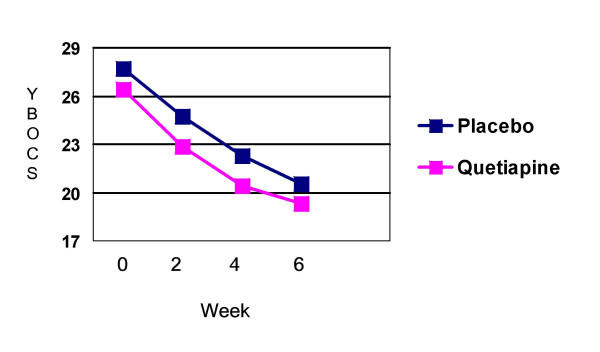
Background: Although serotonin reuptake inhibitors are effective in the treatment of OCD, many patients fail to respond to these agents. Growing evidence from open-label and placebo-controlled trials suggests a role for augmentation of SRIs with atypical antipsychotics in OCD. Quetiapine is generally well tolerated and previous open-label data has produced mixed results in OCD and additional controlled data is needed. Methods: We undertook a double-blind, randomised, parallel-group, flexible-dose, placebo-controlled study of quetiapine augmentation in subjects who had responded inadequately to open-label treatment with an SRI for 12 weeks. Following informed consent and screening, forty-two subjects were randomised to either placebo or quetiapine for six weeks. Results: There was significant improvement from baseline to endpoint on the Yale-Brown Obsessive-Compulsive Scale in both the quetiapine and placebo groups (quetiapine, n = 20, p < 0.0001; placebo, n = 21, p = 0.001) with 40% (n = 8) of quetiapine and 47.6% (n = 10) of placebo treated subjects being classified as responders. Quetiapine did not demonstrate a significant benefit over placebo at the end of the six-week treatment period (p = .636). Similarly quetiapine failed to separate from placebo in the subgroup of subjects (n = 10) with co-morbid tics. Quetiapine was generally well tolerated. Conclusions: In this study, quetiapine augmentation was no more effective than placebo augmentation of SRIs. A number of limitations in study design make comparisons with previous studies in this area difficult and probably contributed to our negative findings. Future work in this important clinical area should address these limitations.
Overview
The claims and statistics of this paper haven’t been checked yet.
Run the check — free, no account needed. It reads the open-access text and checks the sources it cites.
Integrity signals
Registry
Cites
Statistics
Figures
Verification
Claims the paper makes
The claims and statistics of this paper haven’t been checked yet.
Run the check — free, no account needed. It reads the open-access text and checks the sources it cites.
Claims other papers make about this one
Each is checked against this paper’s own text: does it say what the citing paper says it does?
In the citing paper
“Recently, second-generation antipsychotic agents have shown benefit, either alone or as adjunctive therapy. Specifically, high-dose olanzapine [522], quetiapine [523], and risperidone [524] have all shown at least minimal clinical benefit relative to placebo treatment [525].”
From Reward circuitry dysfunction in psychiatric and neurodevelopmental disorders and genetic syndromes: animal models and clinical findings (2012) · cites this paper as [523]
Self-check
Percentages, sums and reported differences re-computed from the paper’s own numbers.
The self-check needs the paper’s full text.
Citations
Cites
(1998) · The Journal of Clinical Psychiatry · Cited by 19,139
A new depression scale designed to be sensitive to change
Montgomery, S. A., & Åsberg, M. (1979) · British Journal of Psychiatry · doi:10.1192/bjp.134.4.382 · Cited by 13,962
(1998) · PubMed · Cited by 10,216
The Yale-Brown Obsessive Compulsive Scale: I. Development, Use, and Reliability
Goodman, W. K. (1989) · Archives of General Psychiatry · doi:10.1001/archpsyc.1989.01810110048007 · Cited by 7,712
(1996) · Cited by 6,884
The mini international neuropsychiatric interview
Lecrubier, Y., Sheehan, D. V., Hergueta, T., & Weiller, E. (1998) · European Psychiatry · doi:10.1016/s0924-9338(99)80239-9 · Cited by 5,899
The Yale-Brown Obsessive Compulsive Scale: II. Validity
Goodman, W. K. (1989) · Archives of General Psychiatry · doi:10.1001/archpsyc.1989.01810110054008 · Cited by 2,799
The Yale-Brown Obsessive-Compulsive Scale: measures of internal consistency.
Kim, S.-W., Dysken, M., Pheley, A., & Hoover, K. M. (1994) · Psychiatry Research · doi:10.1016/0165-1781(94)90039-6 · Cited by 2,333
The yale global tic severity scale: initial testing of a clinician-rated scale of tic severity
LECKMAN, J. F., RIDDLE, M. A., HARDIN, M. T., ORT, S. I., SWARTZ, K. L., STEVENSON, J., & COHEN, D. J. (1989) · Journal of the American Academy of Child & Adolescent Psychiatry · doi:10.1097/00004583-198907000-00015 · Cited by 2,146
Sheehan, D. V. (1984) · Medical Entomology and Zoology · Cited by 883
Research works printed but not linked: 2
- Diagnostic and Statistical Manual for Mental Disorders Fourth Edition TR: . 2002, Washington, D.C., American Psychiatric Association
- Guy W: ECDU Assessment Manual for Psychopharmacology. 1976, National Institute of Mental Health, Research Branch, 313-331.
Cited by
Sorted by citations
Items 101–133 of 133
Pharmako- und/oder Psychotherapie bei posttraumatischer Belastungsstörung
Kunzke, D., Thoma, M. V., & Joksimović, L. (2019) · Psychotherapeut · doi:10.1007/s00278-019-0339-z · Cited by 2
Shafti, S. S., & Kaviani, H. (2019) · Current Psychopharmacologye · doi:10.2174/2211556008666190314113446 · Cited by 1
Shahtou, A., Omara, H. R., Qari, S. A., Alqahtani, R. S., Alnasyan, Z. S., Alotaibi, A. E., Ali, A. A., Alabdulrahim, J. M., Naser, S. A., Asad, N., et al. (2026) · Cureus · doi:10.7759/cureus.108358 · Cited by 1
Augmentation of serotonin reuptake inhibitors in the treatment of obsessive-compulsive disorder
Goddard, A. W., & Shin, Y. (2011) · Cambridge University Press eBooks · doi:10.1017/cbo9780511973796.005 · Cited by 1
Kombinationen mit Psychopharmaka in der Behandlung von Angst- und Zwangsstörungen
Volz, H. (2009) · Springer eBooks · doi:10.1007/978-3-211-79826-3_8 · Cited by 1
Sayyah, M., & Rahim, F. (2016) · Asian Journal of Pharmaceutical and Clinical Research · doi:10.22159/ajpcr.2017.v10i1.14528 · Cited by 2
Methodological Issues for Clinical Treatment Trials in Obsessive‐Compulsive Disorder
Reghunandanan, S., & Fineberg, N. A. (2012) · Wiley eBooks · doi:10.1002/9781119941125.ch8 · Cited by 1
Simpson, H. B., & Harrison-Read, P. (2008) · Cambridge University Press eBooks · doi:10.1017/cbo9780511544392.037 · Cited by 1
Stewart, S. E., Dougherty, D. D., Wilhelm, S., Keuthen, N. J., & Jenike, M. A. (2008) · Elsevier eBooks · doi:10.1016/b978-0-323-04743-2.50035-4 · Cited by 1
Biological Models and Treatments for OCD in Adults
Stewart, S. E., & Loh, A. S. (2017) · Wiley eBooks · doi:10.1002/9781118890233.ch14 · Cited by 1
Korkmaz, N. D., Elibol, B., Durmus, Z. B., Ozdemir, A., Akbaş, F., Gülöksüz, S., & Şahbaz, Ç. (2025) · SSRN Electronic Journal · doi:10.2139/ssrn.5135082 · Cited by 1
The Art of Prescribing Pharmacotherapy of Obsessive?Compulsive Disorder: An Evidence-Based Approach
Antai-Otong, D. (2007) · Perspectives In Psychiatric Care · doi:10.1111/j.1744-6163.2007.00137.x
Il trattamento del disturbo ossessivo-compulsivo resistente
Aguglia, A., Albert, U., Cori, D. D., Maina, G., & Bogetto, F. (2011) · Quaderni Italiani di Psichiatria · doi:10.1016/j.quip.2010.12.003
Revisión de los antipsicóticos atípicos en la ansiedad
Vulink, N. C. C., Figee, M., & Denys, D. A. J. P. (2012) · Psiquiatría Biológica · doi:10.1016/j.psiq.2012.10.002
Carey, P. D. (2008) · SUNScholar (Stellenbosch University)
Self-citationDucasse, D. (2013) · Journal of Depression & Anxiety · doi:10.4172/2167-1044.s10-001
Ferrão, Y. A., Diniz, J. B., Lopes, A. C., Shavitt, R. G., Greenberg, B. D., & Miguel, E. C. (2007)
[Therapeutic strategies for obsessive-compulsive disorder refractory to treatment].
Mussa, A. (2008) · PubMed
The Use of Antipsychotics in the Treatment of Obsessive-Compulsive Disorder
Walsh, K. H., Scott, E. L., & McDougle, C. J. (2008) · Psychopharm Review · doi:10.1097/01.idt.0000314887.61319.fa
Ferrão, Y. A., Diniz, J. B., Lopes, A. C., Shavitt, R. G., Greenberg, B. M., & Miguel, E. C. (2007) · DOAJ (DOAJ: Directory of Open Access Journals)
Managing a Child With OCD Who Is Treatment Refractory
Bloch, M. H. (2018) · Elsevier eBooks · doi:10.1016/b978-0-12-811427-8.00017-4
Pae, C., & Patkar, A. A. (2009) · Elsevier eBooks · doi:10.1016/b978-1-4160-3291-5.50056-1
Kombinationen mit Psychopharmaka in der Behandlung von Angst- und Zwangsstörungen
Volz, H. (2015) · Springer eBooks · doi:10.1007/978-3-7091-1849-8_8
(2007) · Elsevier eBooks · doi:10.1016/b978-2-294-70195-5.50010-4
Meuffels, Y., & Bervoets, C. (2022) · Tijdschrift voor Geneeskunde · doi:10.47671/tvg.78.22.071
Buckley, P. F., & Foster, A. E. (2024) · American Psychiatric Association Publishing eBooks · doi:10.1176/appi.books.9781615375523.as28
Chapter 52. Treatment of Obsessive-Compulsive Disorder
Kayser, R. R., & Simpson, H. B. (2024) · American Psychiatric Association Publishing eBooks · doi:10.1176/appi.books.9781615375523.as52 · Cited by 1
Voderholzer, U., Rubart, A., Kathmann, N., Staniloiu, A., Kordon, A., & Zurowski, B. (2024) · Springer eBooks · doi:10.1007/978-3-662-67878-7_6
Treatment of anxiety: current status and controversial issues
Simpson, H. B., Neria, Y., Lewis‐Fernández, R., & Schneier, F. (2010) · Cambridge University Press eBooks · doi:10.1017/cbo9780511777578.024
Adegbola, A., Dhir, N., & Ogunjobi, O. (2026) · Cureus · doi:10.7759/cureus.102813
Grigaitytė, J., & Strumila, R. (2026) · Pharmaceuticals · doi:10.3390/ph19040551
Hudak, R., Eken, H. N., & Donahue, C. (2026) · Elsevier eBooks · doi:10.1016/b978-0-443-27446-6.00006-6
Metadata
- Authors
- Carey, P. D., Vythilingum, B., Seedat, S., Muller, J. E., van Ameringen, M., & Stein, D. J.
- Affiliations
- Stellenbosch University (ZA)
- Corresponding author
- Carey, Paul D
- Venue
- BMC Psychiatry
- Published
- 2005-01-24
- Volume
- 5
- Issue
- 1
- Pages
- 5-5
- ISSN
- 1471-244X (ISSN-L)
- PMC
- PMC547907
- OpenAlex
- W2128853507
- Cited by
- 133
- References
- 37
- Citations by year
- 2026: 4 · 2025: 2 · 2024: 5 · 2023: 2 · 2022: 1 · 2020: 4 · 2019: 7 · 2018: 6 · 2017: 3 · 2016: 7 · 2015: 7 · 2014: 9 · 2013: 4 · 2012: 8
- FWCI
- 15.04
- Type
- journal article
- Language
- en
- Update notices
- erratum (2005-11-30)
- Open access
- gold
- doi.org
- Locations
- BMC Psychiatry (publishedVersion, cc-by)
- PubMed Central (publishedVersion, cc-by)
- PubMed (publishedVersion)
- DOAJ (DOAJ: Directory of Open Access Journals) (submittedVersion, cc-by-sa)
- SUNScholar (Stellenbosch University) (submittedVersion)
- Topics
- Social Sciences › Psychology › Clinical Psychology › Obsessive-Compulsive Spectrum Disorders
- Social Sciences › Psychology › Experimental and Cognitive Psychology › Anxiety, Depression, Psychometrics, Treatment, Cognitive Processes
- Health Sciences › Medicine › Psychiatry and Mental health › Schizophrenia research and treatment
- Keywords
- quetiapine, obsessive-compulsive disorder, treatment-refractory OCD, serotonin reuptake inhibitors, drug augmentation, atypical antipsychotics, Yale-Brown Obsessive Compulsive Scale, drug tolerability
- MeSH terms
- Quetiapine Fumarate, Adolescent, Adult, Dibenzothiazepines, Double-Blind Method, Drug Administration Schedule, Drug Resistance, Drug Therapy, Combination, Female, Humans, Male, Middle Aged, Obsessive-Compulsive Disorder, Placebos, Psychiatric Status Rating Scales, Antipsychotic Agents, Treatment Outcome, Treatment Failure, Selective Serotonin Reuptake Inhibitors
About these checks
Registry, retraction, Cites and statistics results are computed, not judged, with one exception: a printed reference that no index lists is read once by a model before it counts as a citation error. Claims are extracted by a model and kept only when their quote appears verbatim in the text; each cited source is then checked, with a model’s help, for whether it says what the claim relies on. Those verdicts can be wrong — read the claim’s quote and the cited source before relying on one.
Statistics and arithmetic are recomputed, not judged.
Confidence bands are shown only for fields calibrated on our annotated test set. None is calibrated yet, so no band is shown.
What counts as a claim ›How we measure confidence ›How we check this ›
Are you an author, or do you see a problem with this page? Request a review
