

The Worksite Health Promotion Capacity Instrument (WHPCI): development, validation and approaches for determining companies' levels of health promotion capacity
Open accessThe DOI matches its Crossref record; 45 of the 45 references it cites were found in a registry or an index.
Abstract
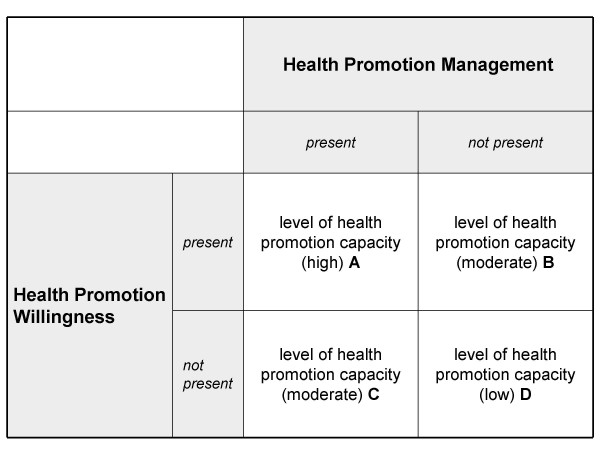
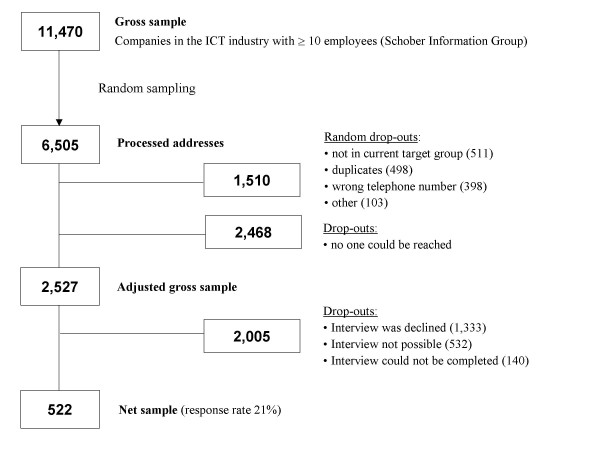
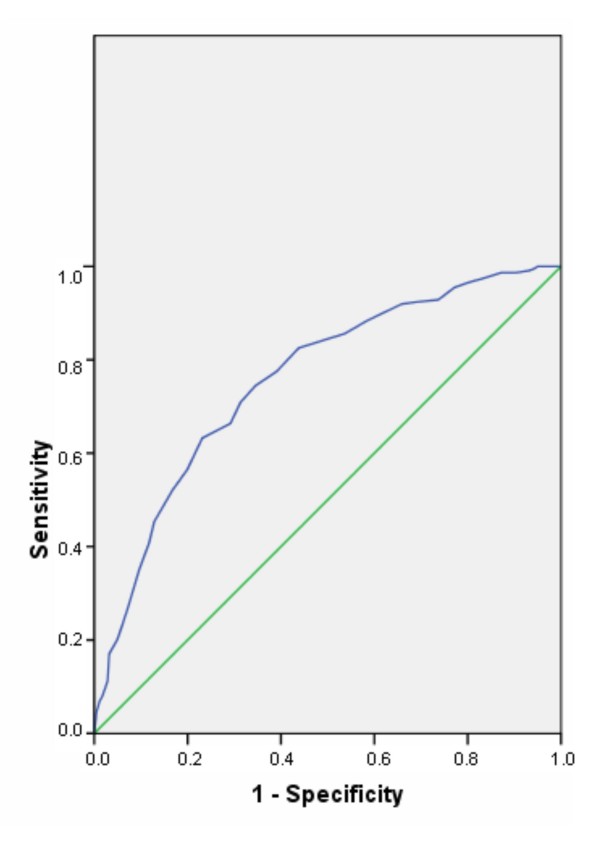
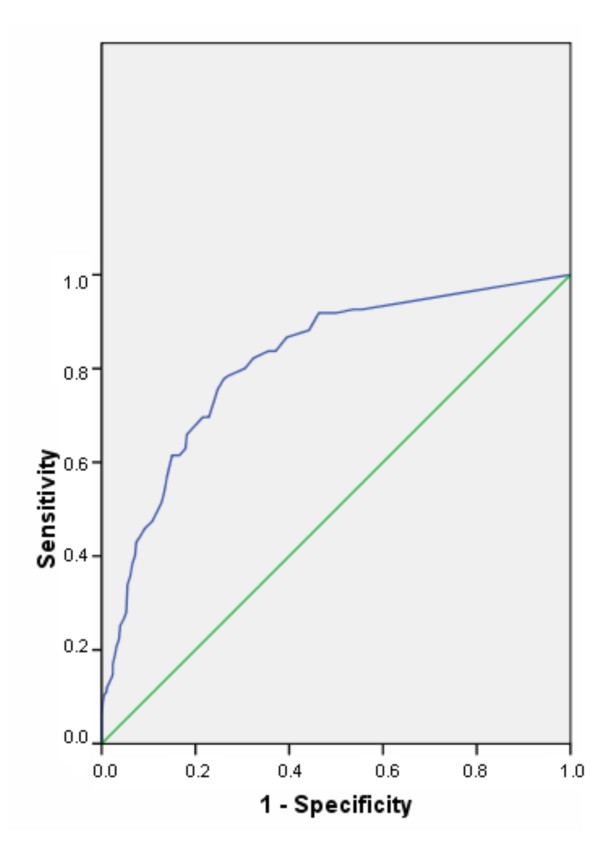
BACKGROUND: The Worksite Health Promotion Capacity Instrument (WHPCI) was developed to assess two key factors for effective worksite health promotion: collective willingness and the systematic implementation of health promotion activities in companies. This study evaluates the diagnostic qualities of the WHPCI based on its subscales Health Promotion Willingness and Health Promotion Management, which can be used to place companies into four different categories based on their level of health promotion capacity. METHODS: Psychometric evaluation was conducted using exploratory factor and reliability analyses with data taken from a random sample of managers from n = 522 German information and communication technology (ICT) companies. Receiver operating characteristic (ROC) analyses were conducted to determine further diagnostic qualities of the instrument and to establish the cut-off scores used to determine each company's level of health promotion capacity. RESULTS: The instrument's subscales, Health Promotion Willingness and Health Promotion Management, are based on one-dimensional constructs, each with very good reliability (Cronbach's alpha = 0.83/0.91). ROC analyses demonstrated satisfactory diagnostic accuracy with an area under the curve (AUC) of 0.76 (SE = 0.021; 95% CI 0.72-0.80) for the Health Promotion Willingness scale and 0.81 (SE = 0.021; 95% CI 0.77-0.86) for the Health Promotion Management scale. A cut-off score with good sensitivity (71%/76%) and specificity (69%/75%) was determined for each scale. Both scales were found to have good predictive power and exhibited good efficiency. CONCLUSIONS: Our findings indicate preliminary evidence for the validity and reliability of both subscales of the WHPCI. The goodness of each cut-off score suggests that the scales are appropriate for determining companies' levels of health promotion capacity. Support in implementing (systematic) worksite health promotion can then be tailored to each company's needs based on their current capacity level.
Overview
The claims and statistics of this paper haven’t been checked yet.
Free: it reads the open-access text and checks the first 5 claims that cite a source we can check. Create a free account to check every claim.
Integrity signals
Registry
Cites
Statistics
Figures
Verification
Claims the paper makes
The claims and statistics of this paper haven’t been checked yet.
Free: it reads the open-access text and checks the first 5 claims that cite a source we can check. Create a free account to check every claim.
Claims other papers make about this one
Each is checked against this paper’s own text: does it say what the citing paper says it does?
The cited source says what the claim attributes to it.
In the citing paper
“However, several measures were utilized to evaluate implementation of health-related innovations in educational (e.g., implementation of a preventive intervention in elementary schools [66]), mental health (technology transfer in substance abuse treatment centers [45]), workplace (e.g., willingness to implement worksite health promotion programs [67]), or other settings.”
Self-check
Percentages, sums and reported differences re-computed from the paper’s own numbers.
The self-check needs the paper’s full text.
Citations
Cites
Self-efficacy: Toward a unifying theory of behavioral change
Bandura, A. (1977) · Psychological Review · doi:10.1037/0033-295x.84.2.191 · Cited by 43,925 · cited 1×
“Both components outcome expectation and efficacy - show similarities to Bandura’s social learning theory, whereby an intent to change individual behavior is then probable when the person has a high level of self-efficacy and a positive outcome expectation regarding the change in behavior [29].”
BackgroundHerne, H., Cooley, W. W., & Lohnes, P. R. (1973) · Journal of the Royal Statistical Society. Series A (General) · doi:10.2307/2344428 · Cited by 35,697
The fifth discipline, the art and practice of the learning organization
Senge, P. M. (1991) · Performance + Instruction · doi:10.1002/pfi.4170300510 · Cited by 20,060
Missing data: our view of the state of the art
Schafer, J. L., & Graham, J. W. (2002) · Psychological Methods · doi:10.1037/1082-989x.7.2.147 · Cited by 11,638 · cited 2×
“Maximum plausible values were then imputed, while taking random variability into account [39].”
BackgroundMethodSelf-efficacy: Toward a unifying theory of behavioral change
Bandura, A. (1978) · Advances in Behaviour Research and Therapy · doi:10.1016/0146-6402(78)90002-4 · Cited by 10,586
Multivariate Data Analysis, 6th ed
Tatham, R. L., Anderson, R. E., Babin, B. J., Black, W. C., & Hair, J. F. (2006) · Cited by 9,807
(2008) · Environmental Chemometrics · doi:10.1201/9781420067972-10 · Cited by 8,170
Senge, P. M. (1990) · Cited by 6,332
Clinical Epidemiology: A Basic Science for Clinical Medicine.
(1991) · Annals of Internal Medicine · doi:10.7326/0003-4819-114-9-825_9 · Cited by 3,476
Estimation of the Youden Index and its Associated Cutoff Point
Fluss, R., Faraggi, D., & Reiser, B. (2005) · Biometrical Journal · doi:10.1002/bimj.200410135 · Cited by 2,608 · cited 2×
“The receiver operating characteristic (ROC) analysis is an accepted procedure used to identify a cut-off for differentiating between two groups with the help of an external criterion [41,42].”
Method
Research works printed but not linked: 9
- European Network for Workplace Health Promotion (ENWHP) Luxembourg Declaration on Workplace Health Promotion in the European Union 2007 http://www.enwhp.org/fileadmin/downloads/press/Luxembourg_Declaration_June2005_final.pdf
- Bradshaw LM Fishwick D Curran AD Eskin F Provision and perception of occupational health in small and medium-sized enterprises in Sheffield, UK Occup Med (Lond) 2001 51 39 44 10.1093/occmed/51.1.39 11235826 · DOI
- Della LJ DeJoy DM Goetzel RZ Ozminkowski RJ Wilson MG Assessing Managment Support for Worksite Health Promotion: Psychometric Analysis of the Leading by Example (LBE) Instrument Am J Health Promot 2008 22 359 367 10.4278/ajhp.22.5.359 18517097 PMC2743959 · DOI
- European Network for Workplace Health Promotion (ENWHP) Healthy Employees in Healthy Organisations. Good Practice in Workplace Health Promotion in Europe. Quality Criteria of Workplace Health Promotion. ENWHP 1999 Essen, Federal Association of Company Health Insurance Funds (BKK Bundesverband) Ref Type: Report
- World Health Organization (WHO) Regional guidelines for the development of healthy workplaces. Geneva 1999
- Pfaff H Slesina W Effektive betriebliche Gesundheitsförderung. Konzepte und methodische Ansätze zur Evaluation und Qualitätssicherung 2001 Weinheim und München: Juventa
- Swets JA Pickett RM Evaluation of Diagnostic Systems. Methods from Detection Theory 1982 Academic Press. Series in Cognition and Perception edn. New York
- Greiner M Serodiagnostische Tests. Evaluierung und Interpretation in der Veterinärmedizin und anderen Fachgebieten 2003 Berlin, Heidelberg, New York, Hongkong, London, Mailand, Paris, Tokyo: Springer Verlag
- Sackett DL Haynes RB Guyatt GH Tugwell P Clinical Epidemiology. A Basic Science for Clinical Medicine 1991 2 Boston, Toronto, London: Little, Brown and Company
Cited by
Chaudoir, S. R., Dugan, A. G., & Barr, C. H. (2013) · Implementation Science · doi:10.1186/1748-5908-8-22 · Cited by 800
“, willingness to implement worksite health promotion programs [67]), or other settings.”
BackgroundClinton-McHarg, T., Yoong, S. L., Tzelepis, F., Regan, T., Fielding, A., Skelton, E., Kingsland, M., Ooi, J. Y., & Wolfenden, L. (2016) · Implementation Science · doi:10.1186/s13012-016-0512-5 · Cited by 116
“Worksite Health Promotion Capacity Instrument (WHPCI) [84] Germany Information and communication technology companies in Germany (n = 522) Willingness and capacity to implement worksite health promotion activities n = 522 21 % Managing director/board of directors Division head/senior department head Department head Hu…”
BackgroundInfluentialHannon, P. A., Garson, G., Harris, J. R., Hammerback, K., Sopher, C. J., & Clegg-Thorp, C. (2012) · Journal of Occupational and Environmental Medicine · doi:10.1097/jom.0b013e3182717cf2 · Cited by 113
“Other WHP readiness scales have been developed in other countries; 42,43 the health and healthcare context is different enough in countries with national health care systems that these instruments may not generalize to U.S. workplaces.”
Zeike, S. J., Ansmann, L., Lindert, L., Samel, C., Kowalski, C., & Pfaff, H. (2018) · BMJ Open · doi:10.1136/bmjopen-2017-021366 · Cited by 44
“The predictive power of the determined cut-off scores coincides with the results of other studies.(47) However, it is noteworthy that there are only a few comparable studies that have determined (risk-based) cut-off scores in the field of occupational health and health promotion.”
ResultSelf-citationJacobs, C., Pfaff, H., Lehner, B. S., Driller, E., Nitzsche, A., Stieler-Lorenz, B., Wasem, J., & Jung, J. (2013) · Journal of Occupational and Environmental Medicine · doi:10.1097/jom.0b013e3182972ee5 · Cited by 53
Self-citationJung, J., Ernstmann, N., Nitzsche, A., Driller, E., Kowalski, C., Lehner, B. S., Stieler-Lorenz, B., Friepörtner, K., Schmidt, A. G., & Pfaff, H. (2011) · Journal of Occupational and Environmental Medicine · doi:10.1097/jom.0b013e318237a1b6 · Cited by 40
Self-citationKien, C., Schultes, M.-T., Szeląg, M., Schoberberger, R., & Gartlehner, G. (2018) · Implementation Science · doi:10.1186/s13012-018-0837-3 · Cited by 40
Organizational factors and the attitude toward health promotion in German ICT-companies
Jung, J., Nitzsche, A., Ansmann, L., Ernstmann, N., Ommen, O., Stieler-Lorenz, B., Wasem, J., & Pfaff, H. (2011) · Health Promotion International · doi:10.1093/heapro/dar049 · Cited by 17
Self-citationJung, J., Nitzsche, A., Ernstmann, N., Driller, E., Wasem, J., Stieler-Lorenz, B., & Pfaff, H. (2011) · Journal of Occupational and Environmental Medicine · doi:10.1097/jom.0b013e31820d103f · Cited by 11
Self-citationImplementing workplace health promotion initiatives: who should we target?
George, A. S., King, L. A., Newson, R. S., Wells, V., & Campbell, M. (2012) · Health Promotion Journal of Australia · doi:10.1071/he12134 · Cited by 14
Workplace health promotion and employee health in Swedish municipal social care organizations
Larsson, R., Ljungblad, C., Sandmark, H., & Åkerlind, I. (2014) · Journal of Public Health · doi:10.1007/s10389-014-0616-9 · Cited by 13
“For example, Jung et al. (2010) developed an instrument tomeasure the WHP capacities of companies that emphasizes tailored support based on the current capacity of the organization.”
BackgroundIT-Support in Workplace Health Promotion: Mobile Apps on the Rise
Dehkordi, F. N., Breitschwerdt, R., & Michael Fellmann, M. A. (2017) · Lecture notes in business information processing · doi:10.1007/978-3-319-56925-3_4 · Cited by 8
Bleier, H., Lützerath, J., & Schaller, A. (2022) · International Journal of Environmental Research and Public Health · doi:10.3390/ijerph19063693 · Cited by 10
“At the same time, there are signs of a lack in nurses in Germany [2].”
BackgroundMethodResultInfluentialPräventionsreife in kleinen und mittleren Unternehmen
Biallas, B., Schäfer, D., Dejonghe, L. A. L., Franz, L., Petrowski, K., Froböse, I., & Wilke, C. (2019) · Prävention und Gesundheitsförderung · doi:10.1007/s11553-018-0694-6 · Cited by 7
The Potentials of Digital Workplace Health Promotion
Nöhammer, E., & Drexel, M. (2024) · International Journal of Environmental Research and Public Health · doi:10.3390/ijerph21070902 · Cited by 6
“This is often achieved via initiatives of WHP. Implementing these successfully depends on management processes being in place [55], but also on value congruence with health promotion such as internal capacity criteria and evidence for the WHP program elements [56].”
BackgroundGoldsmith, R., & Harris, S. (2013) · Population Health Management · doi:10.1089/pop.2012.0103 · Cited by 5
“Subsequently, the Work Health Promotion Capacity Instrument was developed, which evaluates worksite capacity for programs by measuring the organization’s willingness and ability to systematically implement health promotion activities.(4) The goal of this paper is to advance Hawe’s concept of 3-dimensional health promo…”
Gernert, M., Fohr, G., & Schaller, A. (2024) · BMC Public Health · doi:10.1186/s12889-024-19025-4 · Cited by 5
“In the context of WHP, health promotion capacity has been proposed as a key success factor, implying “health promotion willingness” and “health promotion management” [59].”
BackgroundInfluentialKuchenbaur, M., & Peter, R. (2021) · Frontiers in Public Health · doi:10.3389/fpubh.2021.797838 · Cited by 5
“(14)* Not specified Participants from various branches Health promotion capacity Health promotion willingness (+) Level of analysis: Organizations”
BackgroundHower, K. I., Pförtner, T., Pfaff, H., Lee, S.-Y. D., & Ansmann, L. (2019) · Human Services Organizations Management Leadership & Governance · doi:10.1080/23303131.2019.1661929 · Cited by 3
“For example, it measures the belief that the healthy development of children of parents with SUD can be supported and is endorsed at the management level (Jung et al., 2010).”
BackgroundResultInfluentialSelf-citationLegault, M.-È. B., & Chênevert, D. (2024) · International Journal of Environmental Research and Public Health · doi:10.3390/ijerph21081008 · Cited by 2
“These indicators were adapted from the Worksite Health Promotion Capacity Instrument, a validated scale developed to assess the effectiveness of worksite health promotion by Jung et al. [28] ( α = 0.92).”
MethodInfluentialStieler-Lorenz, B., Pfaff, H., & Jung, J. (2011) · Springer eBooks · doi:10.1007/978-3-642-21655-8_16 · Cited by 2
Self-citationÖkonomische Aspekte der Evaluation in der Organisationsbezogenen Versorgungsforschung
Wirtz, M. A. (2024) · Springer Reference Pflege, Therapie, Gesundheit · doi:10.1007/978-3-662-66798-9_47-1 · Cited by 2
Self-citationVelez, M. C. (2011) · Cardinal Scholar (Ball State University) · Cited by 1
Das 7-Schritte-Modell des BGM-Controllings
Pfaff, H., & Zeike, S. J. (2019) · Springer eBooks · doi:10.1007/978-3-658-16525-3_4 · Cited by 1
Self-citationTanner, G., & Stein, M. (2023) · Fehlzeiten-Report · doi:10.1007/978-3-662-67514-4_24 · Cited by 1
Factors Motivating Employee Participation in Employer-Sponsored Health Awareness Programs
Henry, M. (2015) · ScholarWorks (Walden University) · Cited by 1
Results of the Kentucky Worksite Assessment: Utilization of the CDC's Health ScoreCard
Watkins, C. M., Lartey, G. K., Macy, G. B., Golla, V., & Lovely, T. (2014) · TopSCHOLAR (Western Kentucky University) · Cited by 2
MEASURING HEALTH AND WELLNESS OF INTERNATIONAL STUDENTS
Cosby, J. (2017) · Murray State's Digital Commons (Murray State University)
Kuchenbaur, M. (2024) · OPUS (Augsburg University) · doi:10.18725/oparu-52968
Bleier, H., Lützerath, J., Kayser, I., Gernert, M., & Schaller, A. (2026) · Journal of Public Health · doi:10.1007/s10389-026-02805-0
Metadata
- Authors
- Jung, J., Nitzsche, A., Neumann, M., Wirtz, M., Kowalski, C., Wasem, J., Stieler-Lorenz, B., & Pfaff, H.
- Affiliations
- University of Cologne (DE)
- Witten/Herdecke University (DE)
- University of Education Freiburg (DE)
- University of Duisburg-Essen (DE)
- Corresponding author
- Jung, Julia
- Venue
- BMC Public Health
- Published
- 2010-09-13
- Volume
- 10
- Issue
- 1
- Pages
- 550-550
- ISSN
- 1471-2458 (ISSN-L)
- PMC
- PMC2949769
- OpenAlex
- W2052909361
- Cited by
- 29
- References
- 45
- Citations by year
- 2026: 1 · 2024: 4 · 2023: 1 · 2022: 1 · 2021: 1 · 2019: 3 · 2018: 2 · 2017: 2 · 2016: 1 · 2015: 1 · 2014: 2 · 2013: 3 · 2012: 2
- FWCI
- 5.69
- Type
- journal article
- Language
- en
- Open access
- gold
- doi.org
- Licence
- cc-by
- creativecommons.org/licenses/by/2.0 (tdm)
- Locations
- BMC Public Health (publishedVersion, cc-by)
- PubMed Central (publishedVersion, cc-by)
- PubMed (publishedVersion)
- Kölner Universitäts PublikationsServer (Universität zu Köln) (publishedVersion)
- DOAJ (DOAJ: Directory of Open Access Journals) (submittedVersion)
- Funders
- European Commission
- Bundesministerium für Bildung und Forschung (01FM07007)
- Universität zu Köln
- Universität Duisburg-Essen
- Universitätsklinikum Köln
- European Social Fund
- Topics
- Health Sciences › Medicine › Public Health, Environmental and Occupational Health › Workplace Health and Well-being
- Health Sciences › Medicine › Public Health, Environmental and Occupational Health › Occupational Health and Safety in Workplaces
- Health Sciences › Medicine › Public Health, Environmental and Occupational Health › School Health and Nursing Education
- Keywords
- workplace health promotion, psychometric validation, cut-off values, ICT companies, diagnostic accuracy
- MeSH terms
- Administrative Personnel, Germany, Health Promotion, Humans, Interviews as Topic, Psychometrics, Surveys and Questionnaires, ROC Curve, Occupational Health, Program Development
About these checks
Registry, retraction, Cites and statistics results are computed, not judged, with one exception: a printed reference that no index lists is read once by a model before it counts as a citation error. Claims are extracted by a model and kept only when their quote appears verbatim in the text; each cited source is then checked, with a model’s help, for whether it says what the claim relies on. Those verdicts can be wrong — read the claim’s quote and the cited source before relying on one.
Statistics and arithmetic are recomputed, not judged.
Confidence bands are shown only for fields calibrated on our annotated test set. None is calibrated yet, so no band is shown.
What counts as a claim ›How we measure confidence ›How we check this ›
Are you an author, or do you see a problem with this page? Request a review
Data sources
Bibliographic data: Semantic Scholar, OpenAlex, Crossref.
Contains information from the Semantic Scholar Academic Graph Datasets, made available under the ODC Attribution License (ODC-BY 1.0).
Semantic Scholar’s data is described in: Kinney, R., et al. (2023). The Semantic Scholar Open Data Platform. arXiv:2301.10140.
