

Suicide and unintentional poisoning mortality trends in the United States, 1987-2006: two unrelated phenomena?
Open accessThe DOI matches its Crossref record; 55 of the 55 references it cites were found in a registry or an index.
Abstract
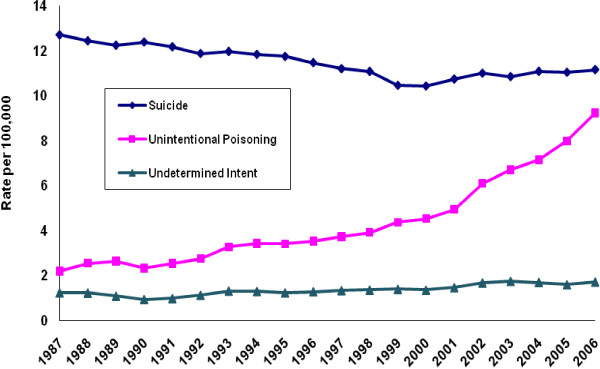
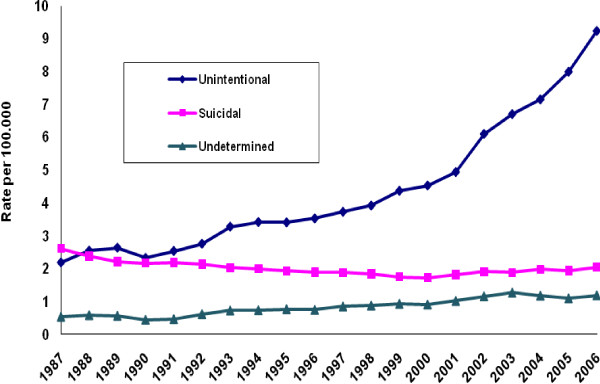
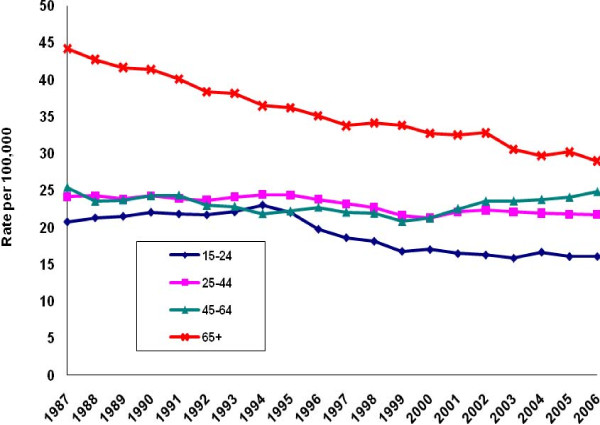
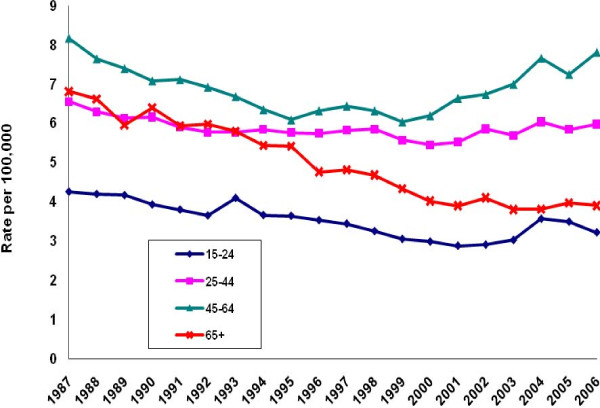
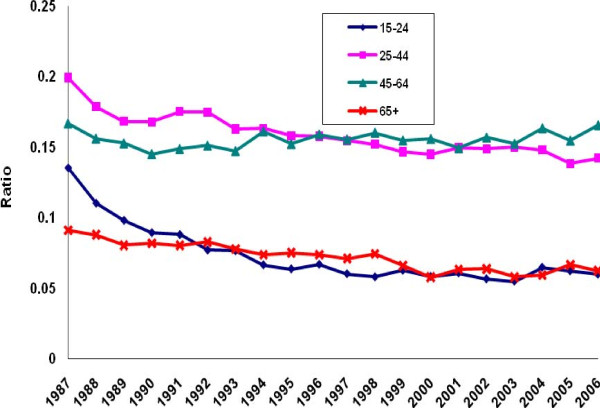
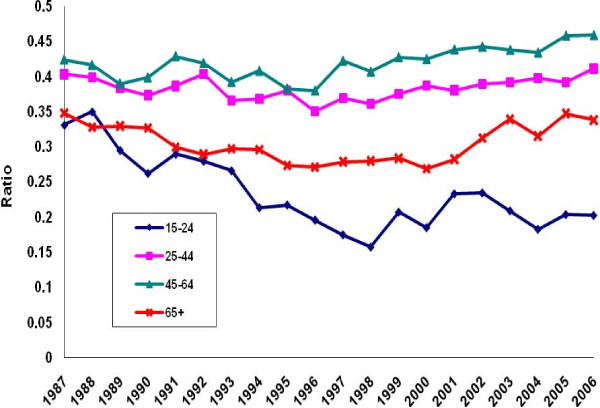
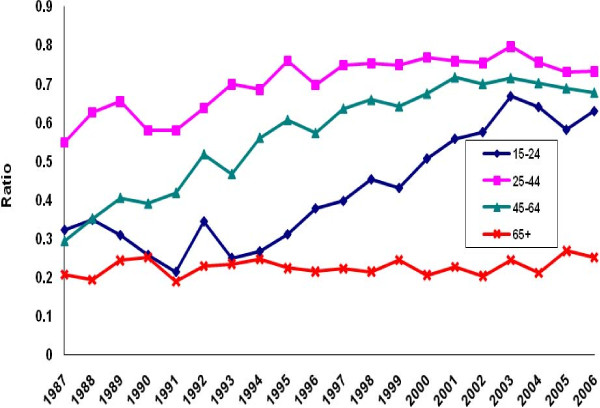
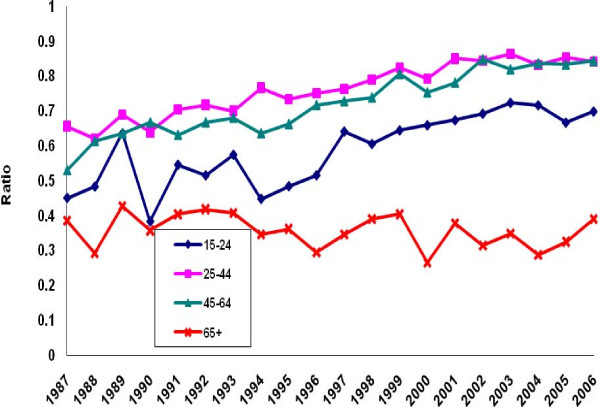
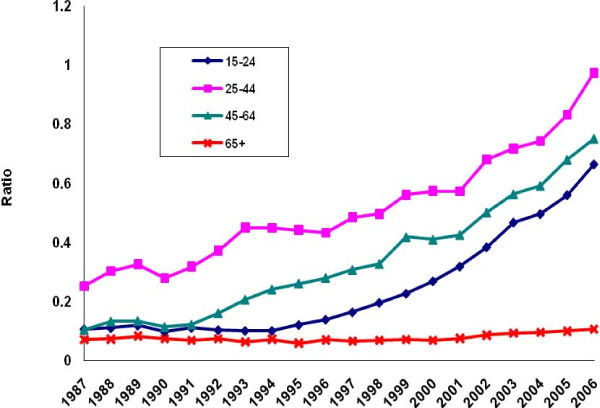
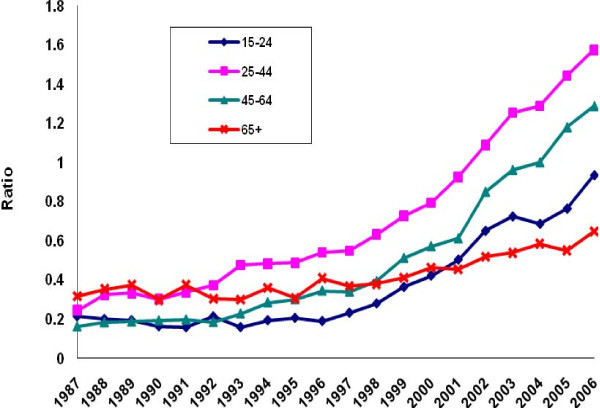
BACKGROUND: Two counter trends in injury mortality have been separately reported in the US in recent times - a declining suicide rate and a rapidly rising unintentional poisoning mortality rate. Poisoning suicides are especially difficult to detect, and injury of undetermined intent is the underlying cause-of-death category most likely to reflect this difficulty. We compare suicide and poisoning mortality trends over two decades in a preliminary assessment of their independence and implications for suicide misclassification. METHODS: Description of overall and gender- and age-specific trends using national mortality data from WISQARS, the Web-based Injury Statistics Query and Reporting System, maintained by the Centers for Disease Control and Prevention (CDC). Subjects were the 936,633 residents dying in the 50 states and the District of Columbia between 1987 and 2006 whose underlying cause of death was classified as suicide, unintentional poisoning, or injury mortality of undetermined intent. RESULTS: The official US suicide rate declined 18% between 1987 and 2000, from 12.71 to 10.43 deaths per 100,000 population. It then increased to 11.15 deaths per 100,000 by 2006, a 7% rise. By contrast to these much smaller rate changes for suicide, the unintentional poisoning mortality rate rose more than fourfold between 1987 and 2006, from 2.19 to 9.22 deaths per 100,000. Only the population aged 65 years and older showed a sustained decline in the suicide rate over the entire observation period. Consistently highest in gender-age comparisons, the elderly male rate declined by 35%. The elderly female rate declined by 43%. Unlike rate trends for the non-elderly, both declines appeared independent of corresponding mortality trends for unintentional poisoning and poisoning of undetermined intent. The elderly also deviated from younger counterparts by having a smaller proportion of their injury deaths of undetermined intent classified as poisoning. Poisoning manifested as a less common method of suicide for this group than other decedents, except for those aged 15-24 years. Although remaining low, the undetermined poisoning mortality rate increased over the observation period. CONCLUSIONS: The official decline in the suicide rate between 1987 and 2000 may have been a partial artifact of misclassification of non-elderly suicides within unintentional poisoning mortality. We recommend in-depth national, regional, and local population-based research investigations of the poisoning-suicide nexus, and endorse calls for widening the scope of the definition of suicide and evaluation of its risk factors.
Overview
The claims and statistics of this paper haven’t been checked yet.
Free: it reads the open-access text and checks the first 5 claims that cite a source we can check. Create a free account to check every claim.
Integrity signals
Registry
Cites
Statistics
Figures
Verification
Claims the paper makes
The claims and statistics of this paper haven’t been checked yet.
Free: it reads the open-access text and checks the first 5 claims that cite a source we can check. Create a free account to check every claim.
Claims other papers make about this one
Each is checked against this paper’s own text: does it say what the citing paper says it does?
In the citing paper
“This age range was selected because ascertaining the intent to selfharm among children younger than 10 years is difficult, 16 and suicide rates were higher in 2017 than in 1999 among individuals between 10 and 74 years of age but not among those 75 years or older. 2”
From Trends in the Incidence and Lethality of Suicidal Acts in the United States, 2006 to 2015 (2020) · cites this paper as [16]
Self-check
Percentages, sums and reported differences re-computed from the paper’s own numbers.
The self-check needs the paper’s full text.
Citations
Cites
Suicide as an outcome for mental disorders: A meta-analysis
Harris, E. C., & Barraclough, B. (1997) · British Journal of Psychiatry · doi:10.1192/bjp.170.3.205 · Cited by 2,589 · cited 2×
“While substance use disorders are strong determinants of suicide [20-22], they also diminish the likelihood of a suicide ruling or diagnosis [23-25].”
Reducing Suicide--A National Imperative
(2002) · PsycEXTRA Dataset · doi:10.1037/e719942007-001 · Cited by 902
Patterns of abuse among unintentional pharmaceutical overdose fatalities
Hall, A. J. (2008) · JAMA · doi:10.1001/jama.2008.802 · Cited by 815 · cited 1×
“On the other hand, a stronger and more persistent increasing trend in the unintentional poisoning mortality rate has focused attention on the epidemic of fatal prescription and recreational drug overdoses [4-6].”
Wilcox, H. C., Conner, K. R., & Caine, E. D. (2004) · Drug and Alcohol Dependence · doi:10.1016/j.drugalcdep.2004.08.003 · Cited by 720 · cited 2×
“While substance use disorders are strong determinants of suicide [20-22], they also diminish the likelihood of a suicide ruling or diagnosis [23-25].”
Increasing deaths from opioid analgesics in the United States
Paulozzi, L. J., Budnitz, D. S., & Xi, Y. (2006) · Pharmacoepidemiology and Drug Safety · doi:10.1002/pds.1276 · Cited by 696 · cited 2×
“Media reporting might also be implicated in the epidemic of opioid mortality [39], and prescription drug diversion is becoming a core issue [38,40].”
Stone, M., Laughren, T., Jones, M. L., Levenson, M., Holland, P. C., Hughes, A., Hammad, T. A., Temple, R., & Rochester, G. (2009) · BMJ · doi:10.1136/bmj.b2880 · Cited by 609 · cited 1×
“With controversial benefit for youth and the youngest adults, prescribed use of SSRIs alone, for example, seems neutral on suicidal behavior and protects against suicidal ideation in adults ages 25-64 [42].”
National Trends in Psychotropic Medication Polypharmacy in Office-Based Psychiatry
Mojtabai, R., & Olfson, M. (2010) · Archives of General Psychiatry · doi:10.1001/archgenpsychiatry.2009.175 · Cited by 479 · cited 1×
“Complicating evaluation of decedent intent, and etiologic understanding of suicide, are the competing beneficial and harmful exposures which characterize the rapid rise of psychotropic medication [41].”
National Strategy for Suicide Prevention: Goals and Objectives for Action: (415652005-001)
US Department of Health and Human Services; Substance Abuse and Mental Health Services Administration (2001) · PsycEXTRA Dataset · doi:10.1037/e415652005-001 · Cited by 459
National Strategy for Suicide Prevention: Goals and Objectives for Action
Satcher, D. S. (2003) · Cited by 392
Gunnell, D., Saperia, J., & Ashby, D. (2005) · BMJ · doi:10.1136/bmj.330.7488.385 · Cited by 387
Warner, M., Chen, L. H., & Makuc, D. M. (2009) · PsycEXTRA Dataset · doi:10.1037/e665272010-001 · Cited by 344
Open verdict v. suicide – importance to research
Linsley, K. R., Schapira, K., & Kelly, T. P. (2001) · British Journal of Psychiatry · doi:10.1192/bjp.178.5.465 · Cited by 279 · cited 1×
“Indicative of a potentially strong poisoning-suicide nexus, poisoning deaths represent a large component of injury mortality of undetermined intent [14], the category most prone to contain misclassified suicides [15-17].”
Barbui, C., Esposito, E., & Cipriani, A. (2009) · Canadian Medical Association Journal · doi:10.1503/cmaj.081514 · Cited by 275 · cited 1×
“Consideration of our results, in conjunction with those from systematic reviews of antidepressants and suicide risk [43,44], leads us to recommend a gender- and age-specific evaluation of the association between psychopharmacology and the decline in elderly suicide rates in particular.”
Substance Use Disorders and Risk for Completed Suicide
Schneider, B. (2009) · Archives of Suicide Research · doi:10.1080/13811110903263191 · Cited by 248 · cited 2×
“While substance use disorders are strong determinants of suicide [20-22], they also diminish the likelihood of a suicide ruling or diagnosis [23-25].”
A Consideration of the Validity and Reliability of Suicide Mortality Data
O'Carroll, P. W. (1989) · Suicide and Life-Threatening Behavior · doi:10.1111/j.1943-278x.1989.tb00362.x · Cited by 218
Antidepressants and Suicide Risk in the United States, 1985–1999
Grunebaum, M. F., Ellis, S. P., Li, S., Oquendo, M. A., & Mann, J. J. (2004) · The Journal of Clinical Psychiatry · doi:10.4088/jcp.v65n1103 · Cited by 186 · cited 1×
“The steady decline in the suicide rate between the late 1980 s and 2000 engendered both optimistic discussion and caution concerning attribution to prescriptive use of selective serotonin reuptake inhibitors (SSRIs) and other antidepressants [1-3].”
Unintentional overdose and suicide among substance users: A review of overlap and risk factors
Bohnert, A. S. B., Roeder, K., & Ilgen, M. A. (2010) · Drug and Alcohol Dependence · doi:10.1016/j.drugalcdep.2010.03.010 · Cited by 176 · cited 1×
“The clear trend in overall poisoning mortality lends weight to a new argument that suicide prevention must address the gamut of risky behaviors inducing self-destruction beyond those clearly implicating deliberate intent [26,46], and another that the definition of suicide needs broadening [47].”
Hinkley, S. W. (1981) · Archives of General Psychiatry · doi:10.1001/archpsyc.1981.01780270119020 · Cited by 173
Hospitalizations for Poisoning by Prescription Opioids, Sedatives, and Tranquilizers
Coben, J. H., Davis, S. M., Furbee, P. M., Sikora, R. D., Tillotson, R. D., & Bossarte, R. M. (2010) · American Journal of Preventive Medicine · doi:10.1016/j.amepre.2010.01.022 · Cited by 173 · cited 1×
“On the other hand, a stronger and more persistent increasing trend in the unintentional poisoning mortality rate has focused attention on the epidemic of fatal prescription and recreational drug overdoses [4-6].”
The Effect of Access to Lethal Methods of Injury on Suicide Rates
Marzuk, P. M. (1992) · Archives of General Psychiatry · doi:10.1001/archpsyc.1992.01820060031005 · Cited by 171 · cited 1×
“Access to lethal methods, including prescription drugs, affects suicide rates [36].”
Race/ethnicity and potential suicide misclassification: window on a minority suicide paradox?
Rockett, I. R., Wang, S., Stack, S., De Leo, D., Frost, J. L., Ducatman, A. M., Walker, R. L., & Kapusta, N. D. (2010) · BMC Psychiatry · doi:10.1186/1471-244x-10-35 · Cited by 149 · cited 2×
“However, indirect evidence indicates that medicolegal authorities exercise more caution in ruling or diagnosing suicide among younger than older decedents [18].”
Self-citationAdequacy of Official Suicide Statistics for Scientific Research and Public Policy
Phillips, D. P., & Ruth, T. E. (1993) · Suicide and Life-Threatening Behavior · doi:10.1111/j.1943-278x.1993.tb00201.x · Cited by 147 · cited 1×
“Moreover, a diagnosis or legal ruling of death by suicide is not a default option for medicolegal authorities [9,10], and suicide is highly susceptible to undercounting at local [11,12], state [13], and hence national levels.”
Balancing on the edge of death: suicide attempts and life‐threatening overdoses among drug addicts
Rossow, I., & Lauritzen, G. (1999) · Addiction · doi:10.1046/j.1360-0443.1999.9422095.x · Cited by 145 · cited 1×
“Interviews with survivors of near fatal “unintentional” overdoses documented an ambivalent attitude towards potential death at time of overdose [48,49].”
Variability of undetermined manner of death classification in the US
Breiding, M. J., & Wiersema, B. (2006) · Injury Prevention · doi:10.1136/ip.2006.012591 · Cited by 128 · cited 3×
“The clear trend in overall poisoning mortality lends weight to a new argument that suicide prevention must address the gamut of risky behaviors inducing self-destruction beyond those clearly implicating deliberate intent [26,46], and another that the definition of suicide needs broadening [47].”
Suicide Determination and the Professional Authority of Medical Examiners
Timmermans, S. (2005) · American Sociological Review · doi:10.1177/000312240507000206 · Cited by 127 · cited 1×
“Moreover, a diagnosis or legal ruling of death by suicide is not a default option for medicolegal authorities [9,10], and suicide is highly susceptible to undercounting at local [11,12], state [13], and hence national levels.”
US Suicide Rates by Age Group, 1970–2002: An Examination of Recent Trends
McKeown, R. E., Cuffe, S. P., & Schulz, R. M. (2006) · American Journal of Public Health · doi:10.2105/ajph.2005.066951 · Cited by 119 · cited 1×
“The steady decline in the suicide rate between the late 1980 s and 2000 engendered both optimistic discussion and caution concerning attribution to prescriptive use of selective serotonin reuptake inhibitors (SSRIs) and other antidepressants [ 1-3 ].”
HEMON, D., BERGER, C., & LAZAR, P. (1979) · International Journal of Epidemiology · doi:10.1093/ije/8.3.292 · Cited by 115
Assessing substance abuse treatment need: A statewide hospital emergency department study
Rockett, I. R. H., Putnam, S. L., Jia, H., & Smith, G. S. (2003) · Annals of Emergency Medicine · doi:10.1067/mem.2003.189 · Cited by 113 · cited 1×
“A statewide hospital emergency department study estimated that 27% of patients aged 18 years and older needed substance abuse treatment, where need was assessed by means of self-report and validatory toxicological testing [32].”
Self-citationEmergency Department Visitors and Visits: Who Used the Emergency Room in 2007?
Garcia, T. C., Bernstein, A. B., & Bush, M. A. (2010) · PsycEXTRA Dataset · doi:10.1037/e665452010-001 · Cited by 108
Reducing Suicide: A National Imperative
Maltsberger, J. T. (2003) · The Journal of Nervous and Mental Disease · doi:10.1097/01.nmd.0000087330.14485.41 · Cited by 92
Suicidal intent in non‐fatal illicit drug overdose
Neale, J. (2000) · Addiction · doi:10.1046/j.1360-0443.2000.951859.x · Cited by 92 · cited 1×
“Interviews with survivors of near fatal “unintentional” overdoses documented an ambivalent attitude towards potential death at time of overdose [48,49].”
Problems in suicide statistics for whites and blacks.
Warshauer, M. E., & Monk, M. (1978) · American Journal of Public Health · doi:10.2105/ajph.68.4.383 · Cited by 90 · cited 1×
“Moreover, a diagnosis or legal ruling of death by suicide is not a default option for medicolegal authorities [9,10], and suicide is highly susceptible to undercounting at local [11,12], state [13], and hence national levels.”
BackgroundClassifying undetermined poisoning deaths
Donaldson, A. E., Larsen, G. Y., Fullerton-Gleason, L., & Olson, L. M. (2006) · Injury Prevention · doi:10.1136/ip.2005.011171 · Cited by 90 · cited 1×
“A study of death certificate and medical examiner data for Utah estimated that the unintentional poisoning mortality rate and overall suicide rate were underreported by 61 percent and 10 percent, respectively [27].”
Dasgupta, N., Mandl, K. D., & Brownstein, J. S. (2009) · PLoS ONE · doi:10.1371/journal.pone.0007758 · Cited by 75 · cited 1×
“Media reporting might also be implicated in the epidemic of opioid mortality [39], and prescription drug diversion is becoming a core issue [38,40].”
The Coroner's System and Under-Reporting of Suicide
Cooper, P. N., & Milroy, C. M. (1995) · Medicine, Science and the Law · doi:10.1177/002580249503500409 · Cited by 75
The increased use of antidepressants has contributed to the worldwide reduction in suicide rates
Isacsson, G., Rich, C. L., Jureidini, J., & Raven, M. (2010) · British Journal of Psychiatry · doi:10.1192/bjp.bp.109.076166 · Cited by 74 · cited 1×
“It would be prudent for such a study to factor in autopsy rates [45], since they vary with age [34].”
Wanted: a public health approach to prescription opioid abuse and diversion
Joranson, D. E., & Gilson, A. M. (2006) · Pharmacoepidemiology and Drug Safety · doi:10.1002/pds.1293 · Cited by 71 · cited 1×
“Media reporting might also be implicated in the epidemic of opioid mortality [39], and prescription drug diversion is becoming a core issue [38,40].”
Suicide classification—clues and their use
Lindqvist, P., & Gustafsson, L. (2002) · Forensic Science International · doi:10.1016/s0379-0738(02)00188-3 · Cited by 69 · cited 1×
“Without compelling corroborative evidence, poisoning suicides are particularly difficult to detect [7,8].”
Accident or Suicide? Predictors of Coroners' Decisions in Suicide and Accident Verdicts
Stanistreet, D., Taylor, S., Jeffrey, V., & Gabbay, M. (2001) · Medicine Science and the Law · doi:10.1177/002580240104100205 · Cited by 64 · cited 2×
“While substance use disorders are strong determinants of suicide [20-22], they also diminish the likelihood of a suicide ruling or diagnosis [23-25].”
Trends in Unintentional Injury Deaths, U.S., 1999–2005
Hu, G., & Baker, S. P. (2009) · American Journal of Preventive Medicine · doi:10.1016/j.amepre.2009.04.023 · Cited by 59
From the Revue d'Epidémiologie et de Santé Publique
(1977) · International Journal of Epidemiology · doi:10.1093/ije/6.1.94 · Cited by 59
Forging a Poison Prevention and Control System
Institute of Medicine (2004) · National Academies Press eBooks · doi:10.17226/10971 · Cited by 56
[Quality of suicide mortality data].
Jougla, É., PÉQUIGNOT, F., Chappert, J., Rossollin, F., Toullec, A. L., & Pavillon, G. (2002) · PubMed · Cited by 49
Increasing Poisoning Mortality Rates in the United States, 1999–2006
Bohnert, A. S. B., Fudalej, S., & Ilgen, M. A. (2010) · Public Health Reports® · doi:10.1177/003335491012500409 · Cited by 49
Modeling of the Temporal Patterns of Fluoxetine Prescriptions and Suicide Rates in the United States
Milane, M. S., Suchard, M. A., Wong, M.-L., & Licinio, J. (2006) · PLoS Medicine · doi:10.1371/journal.pmed.0030190 · Cited by 49 · cited 1×
“The steady decline in the suicide rate between the late 1980 s and 2000 engendered both optimistic discussion and caution concerning attribution to prescriptive use of selective serotonin reuptake inhibitors (SSRIs) and other antidepressants [1-3].”
The Psychological Autopsy: Solving the Mysteries of Death
Scott, C. L., Swartz, E., & Warburton, K. D. (2006) · Psychiatric Clinics of North America · doi:10.1016/j.psc.2006.04.003 · Cited by 44 · cited 1×
“Without compelling corroborative evidence, poisoning suicides are particularly difficult to detect [7,8].”
BackgroundForging a poison prevention and control system
(2005) · Choice Reviews Online · doi:10.5860/choice.42-4674 · Cited by 36
Manner of death and circumstances in fatal poisonings: evidence from New Jersey
Hempstead, K. (2006) · Injury Prevention · doi:10.1136/ip.2006.012583 · Cited by 32
Where Did the Bodies Go? The Social Construction of Suicide Data, New York City, 1976–1992*
Whitt, H. P. (2006) · Sociological Inquiry · doi:10.1111/j.1475-682x.2006.00150.x · Cited by 24
Medical Examiners and Manner of Death
Jarvis, G. K., Boldt, M., & Butt, J. (1991) · Suicide and Life-Threatening Behavior · doi:10.1111/j.1943-278x.1991.tb00460.x · Cited by 23 · cited 2×
“While substance use disorders are strong determinants of suicide [20-22], they also diminish the likelihood of a suicide ruling or diagnosis [23-25].”
Hoyert, D. L., Kung, H.-C., & Xu, J. (2007) · PubMed · Cited by 21
Predictors of Coroner's Verdict: A Logistic Regression Model
Salib, E. (1996) · Medicine Science and the Law · doi:10.1177/002580249603600310 · Cited by 13 · cited 2×
“While substance use disorders are strong determinants of suicide [20-22], they also diminish the likelihood of a suicide ruling or diagnosis [23-25].”
Recognizing the Suicidal Overdose
Pallis, D., & Pierce, D. W. (1979) · Journal of the Royal Society of Medicine · doi:10.1177/014107687907200805 · Cited by 13 · cited 5×
“A 2002 Institute of Medicine report inferred that suicide etiology and prevention in the United States are complicated by undercounting [31].”
InfluentialHoyert, D. L., Kung, H.-C., & Xu, J. (2007) · Cited by 13
A Proposal for a Nomenclature for Suicide
Lester, D. (2009) · Psychological Reports · doi:10.2466/pr0.105.3.685-686 · Cited by 9 · cited 1×
“The clear trend in overall poisoning mortality lends weight to a new argument that suicide prevention must address the gamut of risky behaviors inducing self-destruction beyond those clearly implicating deliberate intent [26,46], and another that the definition of suicide needs broadening [47].”
Research works printed but not linked: 1
- World Health Organization International Statistical Classification of Diseases and Related Health Problems, Ninth Revision (ICD-9) 1979 Geneva: WHO
Cited by
Suicide rates in China from 2002 to 2011: an update
Wang, C.-W., Chan, C. L. W., & Yip, P. S. F. (2014) · Social Psychiatry and Psychiatric Epidemiology · doi:10.1007/s00127-013-0789-5 · Cited by 279
Leading Causes of Unintentional and Intentional Injury Mortality: United States, 2000–2009
Rockett, I. R. H., Regier, M. D., Kapusta, N. D., Coben, J. H., Miller, T. R., Hanzlick, R. L., Todd, K. H., Sattin, R. W., Kennedy, L. W., Kleinig, J., et al. (2012) · American Journal of Public Health · doi:10.2105/ajph.2012.300960 · Cited by 229
Self-citationPain and suicidality: Insights from reward and addiction neuroscience
Elman, I., Borsook, D., & Volkow, N. D. (2013) · Progress in Neurobiology · doi:10.1016/j.pneurobio.2013.06.003 · Cited by 219
Declining Autopsy Rates and Suicide Misclassification: A Cross-national Analysis of 35 Countries
Kapusta, N. D. (2011) · Archives of General Psychiatry · doi:10.1001/archgenpsychiatry.2011.66 · Cited by 169
Self-citationRockett, I. R. H., Caine, E. D., Connery, H. S., D’Onofrio, G., Gunnell, D. J., Miller, T. R., Nolte, K. B., Kaplan, M. S., Kapusta, N. D., Lilly, C. L., et al. (2018) · PLOS ONE · doi:10.1371/journal.pone.0190200 · Cited by 164
“Although large, this rise may be a serious underestimate due to increasing misclassification of intoxication suicides [2], a trend detected in other countries [3,4].”
ResultSelf-citation
Metadata
- Authors
- Rockett, I. R., Hobbs, G., De Leo, D., Stack, S., Frost, J. L., Ducatman, A. M., Kapusta, N. D., & Walker, R. L.
- Affiliations
- West Virginia University (US)
- Wayne State University (US)
- Medical University of Vienna (AT)
- University of Georgia (US)
- Corresponding author
- Rockett, Ian RH
- Venue
- BMC Public Health
- Published
- 2010-11-17
- Volume
- 10
- Issue
- 1
- Pages
- 705-705
- ISSN
- 1471-2458 (ISSN-L)
- PMC
- PMC3091585
- OpenAlex
- W2150771581
- Cited by
- 88
- References
- 55
- Citations by year
- 2026: 1 · 2025: 6 · 2024: 2 · 2023: 4 · 2022: 6 · 2021: 13 · 2020: 4 · 2019: 10 · 2018: 2 · 2017: 6 · 2016: 4 · 2015: 8 · 2014: 7 · 2013: 4 · 2012: 8
- FWCI
- 5.25
- Type
- journal article
- Language
- en
- Open access
- gold
- doi.org
- Licence
- cc-by
- creativecommons.org/licenses/by/2.0 (tdm)
- Locations
- BMC Public Health (publishedVersion, cc-by)
- PubMed Central (publishedVersion, cc-by)
- PubMed (publishedVersion)
- Human Biology (submittedVersion)
- The Research Repository @ WVU (West Virginia University) (submittedVersion, cc-by)
- DOAJ (DOAJ: Directory of Open Access Journals) (submittedVersion)
- Griffith Research Online (submittedVersion, cc-by)
- Funders
- Centers for Disease Control and Prevention (5 R49 CE001170)
- Topics
- Social Sciences › Psychology › Clinical Psychology › Suicide and Self-Harm Studies
- Social Sciences › Sociology and Political Science › Homicide, Infanticide, and Child Abuse
- Health Sciences › Medicine › Emergency Medicine › Poisoning and overdose treatments
- Keywords
- suicide mortality, mortality trends, young adults, older women, older men
- MeSH terms
- Adolescent, Adult, Female, Humans, Male, Middle Aged, Mortality, Poisoning, Suicide, United States, Databases, Factual, Young Adult
About these checks
Registry, retraction, Cites and statistics results are computed, not judged, with one exception: a printed reference that no index lists is read once by a model before it counts as a citation error. Claims are extracted by a model and kept only when their quote appears verbatim in the text; each cited source is then checked, with a model’s help, for whether it says what the claim relies on. Those verdicts can be wrong — read the claim’s quote and the cited source before relying on one.
Statistics and arithmetic are recomputed, not judged.
Confidence bands are shown only for fields calibrated on our annotated test set. None is calibrated yet, so no band is shown.
What counts as a claim ›How we measure confidence ›How we check this ›
Are you an author, or do you see a problem with this page? Request a review
Data sources
Bibliographic data: Semantic Scholar, OpenAlex, Crossref.
Contains information from the Semantic Scholar Academic Graph Datasets, made available under the ODC Attribution License (ODC-BY 1.0).
Semantic Scholar’s data is described in: Kinney, R., et al. (2023). The Semantic Scholar Open Data Platform. arXiv:2301.10140.
