

Traumatic brain injury among people who are homeless: a systematic review
Open accessThe DOI matches its Crossref record; 32 of the 33 references it cites were found in a registry or an index.
Abstract
BACKGROUND: Homelessness and poverty are important social problems, and reducing the prevalence of homelessness and the incidence of injury and illness among people who are homeless would have significant financial, societal, and individual implications. Recent research has identified high rates of traumatic brain injury (TBI) among this population, but to date there has not been a review of the literature on this topic. The objective of this systematic review was to review the current state of the literature on TBI and homelessness in order to identify knowledge gaps and direct future research. METHODS: A systematic literature search was conducted in PsycINFO (1887-2012), Embase (1947-2012), and MEDLINE/Pubmed (1966-2012) to identify all published research studies on TBI and homelessness. Data on setting, sampling, outcome measures, and rate of TBI were extracted from these studies. RESULTS: Eight research studies were identified. The rate of TBI among samples of persons who were homeless varied across studies, ranging from 8%-53%. Across the studies there was generally little information to adequately describe the research setting, sample sizes were small and consisted mainly of adult males, demographic information was not well described, and validated screening tools were rarely used. The methodological quality of the studies included was generally moderate and there was little information to illustrate that the studies were adequately powered or that study samples were representative of the source population. There was also an absence of qualitative studies in the literature. CONCLUSIONS: The rate of TBI is higher among persons who are homeless as compared to the general population. Both descriptive and interventional studies of individuals who are homeless should include a psychometrically sound measure of history of TBI and related disability. Education of caregivers of persons who are at risk of becoming, or are homeless, should involve training on TBI. Dissemination of knowledge to key stakeholders such as people who are homeless, their families, and public policy makers is also advocated.
Overview
The claims and statistics of this paper haven’t been checked yet.
Free: it reads the open-access text and checks the first 5 claims that cite a source we can check. Create a free account to check every claim.
Integrity signals
Registry
Cites
Statistics
Figures
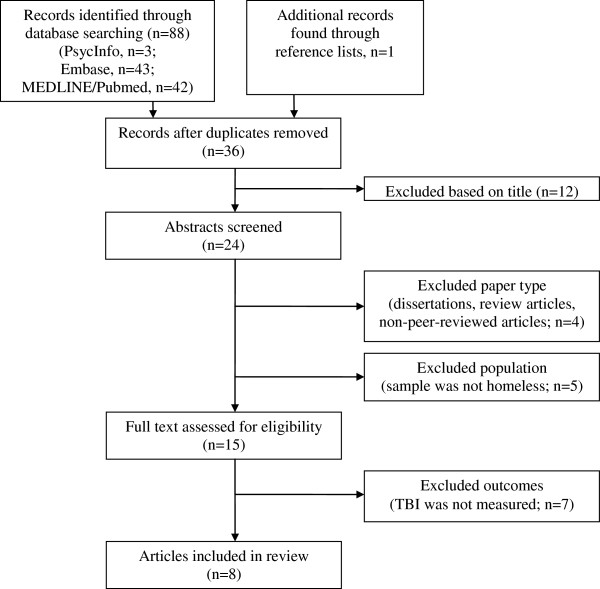
Verification
Claims the paper makes
The claims and statistics of this paper haven’t been checked yet.
Free: it reads the open-access text and checks the first 5 claims that cite a source we can check. Create a free account to check every claim.
Claims other papers make about this one
Each is checked against this paper’s own text: does it say what the citing paper says it does?
The source backs part of the claim, not all of it — or backs it for a different population, condition or comparison.
In the citing paper
“Other risk factors are secondary to the conditions of homelessness itself, such as poor nutrition,54,55 exposure to communicable diseases,56 harsh living environments,57,58 high rates of victimisation59 and unintentional injuries,57,60 and increased rates of tobacco use.61,62”
From The health of homeless people in high-income countries: descriptive epidemiology, health consequences, and clinical and policy recommendations (2014) · cites this paper as [56]
Experimental — accuracy not yet measuredThe source backs part of the claim, not all of it — or backs it for a different population, condition or comparison.
In the citing paper
“The most com monly identified methodological limitations inclu ded heterogeneity among studies that assess TBI in this population.”
From Traumatic brain injury in homeless and marginally housed individuals: a systematic review and meta-analysis (2020) · cites this paper as [15]
Experimental — accuracy not yet measuredThe cited source says what the claim attributes to it.
In the citing paper
“Since a 2012 systematic review,56 two new studies69,70 of tuberculosis that reported a prevalence of between 4% and 8%, and one study71 of HIV (from New York City) reporting rates of HIV of 1·8% have been published (appendix).”
From The health of homeless people in high-income countries: descriptive epidemiology, health consequences, and clinical and policy recommendations (2014) · cites this paper as [56]
The cited source says what the claim attributes to it.
In the citing paper
“Only three studies identified by the previous review evaluated severity of TBI, precluding systematic evaluation of the effects of more clinically significant brain injuries.”
From Traumatic brain injury in homeless and marginally housed individuals: a systematic review and meta-analysis (2020) · cites this paper as [15]
The check wasn’t confident either way, so it gives no verdict — never disputed.
In the citing paper
“Heterogeneity between individual tuberculosis studies is partly explained by different diagnostic methods (higher rates when chest radiography was used vs sputum analysis) and differences in the underlying rate in the general population.56”
From The health of homeless people in high-income countries: descriptive epidemiology, health consequences, and clinical and policy recommendations (2014) · cites this paper as [56]
Experimental — accuracy not yet measured
4 more claims about this paper
Create a free account to see every claim other papers make about this one.
Self-check
Percentages, sums and reported differences re-computed from the paper’s own numbers.
The self-check needs the paper’s full text.
Citations
Cites
Preferred Reporting Items for Systematic Reviews and Meta-Analyses: the PRISMA statement
Moher, D., Liberati, A., Tetzlaff, J., Altman, D. G., & for the PRISMA Group (2009) · BMJ · doi:10.1136/bmj.b2535 · Cited by 83,823
Preferred reporting items for systematic reviews and meta-analyses: the PRISMA Statement.
(2009) · PubMed Central · Cited by 44,859
Preferred Reporting Items for Systematic Reviews and Meta-Analyses: The PRISMA Statement
Moher, D., Liberati, A., Tetzlaff, J., & Altman, D. G. (2009) · Journal of Clinical Epidemiology · doi:10.1016/j.jclinepi.2009.06.005 · Cited by 19,575
Downs, S. H., & Black, N. (1998) · Journal of Epidemiology and Community Health · doi:10.1136/jech.52.6.377 · Cited by 8,252
Centers for Disease Control and Prevention
(2007) · Encyclopedia of Measurement and Statistics · doi:10.4135/9781412952644.n74 · Cited by 6,444
National Center for Injury Prevention and Control (U.S.). Division of Injury Response., Faul, M., Wald, M. M., Wu, L., & Coronado, V. G. (2010) · doi:10.15620/cdc.5571 · Cited by 3,494
(1999) · doi:10.1097/00001199-199912000-00009 · Cited by 1,387 · cited 1×
“general population [40].”
The epidemiology of traumatic brain injury: a review
Bruns, J., & Hauser, W. A. (2003) · Epilepsia · doi:10.1046/j.1528-1157.44.s10.3.x · Cited by 1,271 · cited 1×
“These findings align with the increased rates of TBI amongst males in the general population [29].”
ResultThe Psychiatric Sequelae of Traumatic Injury
Bryant, R. A., O'Donnell, M. L., Creamer, M., McFarlane, A. C., Clark, C. R., & Silove, D. (2010) · American Journal of Psychiatry · doi:10.1176/appi.ajp.2009.09050617 · Cited by 843
Mortality among men using homeless shelters in Toronto, Ontario
Hwang, S. W. (2000) · JAMA · doi:10.1001/jama.283.16.2152 · Cited by 398 · cited 1×
“In addition to the societal and financial burdens of homelessness, individuals who are homeless often suffer from serious health conditions and are at increased risk of death [3-5].”
BackgroundSelf-citation
Research works printed but not linked: 5
- 1. The Salvation Army: Poverty shouldn't be a life sentence: A report on the perceptions of homelessness and poverty in Canada. Toronto: The Salvation Army; 2010.
- 2. Brown P: 2010 Per diem rates for the purchase of service shelter system and results of the review of the Per diem funding model, Toronto (ON): shelter, support and housing administration. Toronto, City of Toronto: 2009.
- 6. Highley JL: Traumatic brain injury among homeless persons. In Etiology, prevalence, and severity. Edited by Proffitt BJ. Nashville: Health Care for the Homeless Clinicians' Network, National Health Care for the Homeless Council, Inc; 2008.
- 22. Cotman A, Sandman C: Cognitive deficits and their remediation in the homeless. Journal of Cognitive Rehabilitation 1997, 15:16-23.
- 27. Kim DK, Jwa CS, Kim GH, Kang JK: An experience of management of homeless neurosurgical patients. J Korean Neurosurg Soc 2007, 42:191-194.
Cited by
Items 101–147 of 147
The educational needs of Canadian homeless shelter workers related to traumatic brain injury
Formosa, A., Dobronyi, I., & Topolovec‐Vranic, J. (2021) · Work · doi:10.3233/wor-205111 · Cited by 2
Self-citationFlatau, P., Seivwright, A. N., Callis, Z., Thielking, M., Mackelprang, J. L., Taylor, K. M., & La Sala, L. (2018) · Zenodo (CERN European Organization for Nuclear Research) · doi:10.4225/50/5b39771548dcf · Cited by 2
O’Connor, T. A. (2016) · Summit (Simon Fraser University) · Cited by 2
Jego-Sablier, M. (2019) · theses.fr (ABES) · doi:10.70675/b16d4d82z1cd5z4b93z99a5z95468ee4eebd · Cited by 1
Reinventing Healthy Communities: Implications for Individual and Societal Well-Being
Marx, J. (2016) · MDPI eBooks · doi:10.3390/books978-3-03842-263-1 · Cited by 1
Collaboration for Success in Young Adults with Traumatic Brain Injury
Cechanowicz, B. (2015) · UNM’s Digital Repository (University of New Mexico) · Cited by 1
Experiences of Homelessness and Brain Injury
Grant, S., Atherton, A., Brooks, J., Colbeck, M., Fortescue, D., & Vanderhoven, D. (2016) · SHURA (Sheffield Hallam University Research Archive) (Sheffield Hallam University) · Cited by 1
Homelessness and head injury: Outcomes from a pilot neuro case management service
Worthington, A. D., Edwards, L., Joiner, L., & Devenney, E. (2020) · The Neuropsychologist · doi:10.53841/bpsneur.2020.1.10.12 · Cited by 1
Whittaker, E. (2017) · UNSWorks (University of New South Wales, Sydney, Australia) · doi:10.26190/unsworks/19559 · Cited by 1
Mollayeva, T. (2020) · Wiley eBooks · doi:10.1002/9780470015902.a0027190 · Cited by 1
Jubinville, W., Bottari, C. L., Ducharme, R., Thibault, G., Wagner, V., & Roy, L. (2026) · International Journal on Homelessness · doi:10.5206/ijoh.2026.2.24247 · Cited by 1
An odyssey: families' experiences living with acquired brain injury
Karpa, J. V. (2019) · Mspace (University of Manitoba) · Cited by 1
Severe and Multiple Disadvantage: A critical policy analysis
Lemkes, A. (2024) · White Rose eTheses Online (University of Leeds, The University of Sheffield, University of York) · Cited by 1
Durand, E. (2016) · theses.fr (ABES) · doi:10.70675/fb5bc494z5b76z4058zb70cz1f0677f33c48 · Cited by 1
Durocher, V. (2017) · Archipel (Université du Québec à Montréal) · Cited by 1
Is bipolar disorder associated with tramautic brain injury in the homeless?
Bacciardi, S., Maremmani, A. G. I., Nikoo, N., Cambioli, L., Schütz, C., Jang, K., & Krausz, M. (2017) · Rivista di Psichiatria · doi:10.1708/2631.27053
Banimahdi, R., Mohammadzadeh, M., Egan, M. Y., Sylvestre, J. C., & Sauvé-Schenk, K. (2026) · Disability and Rehabilitation · doi:10.1080/09638288.2026.2616148
Clinical Management of the Homeless Patient with Traumatic Brain Injury and Cognitive Impairment
Subbarao, B. S., & Eapen, B. C. (2021) · Springer eBooks · doi:10.1007/978-3-030-70135-2_7
Incident traumatic brain injury in precariously housed persons
O’Connor, T. A. (2020) · Summit (Simon Fraser University)
Duffy, B., Bista, S., & Michaels, N. L. (2024) · Journal of Interpersonal Violence · doi:10.1177/08862605241303955
O’Connor, T. A. (2016) · Summit (Simon Fraser University)
Fornaro, M., Dragioti, E., De Prisco, M., Billeci, M., Mondin, A. M., Calati, R., Smith, L., Hatcher, S., Kaluzienski, M., Fiedorowicz, J. G., et al. (2022) · Figshare · doi:10.6084/m9.figshare.20291151
Guala, T., Harries, T., de Andrade, D., Langbein, A., Hill, H., Miller, P. G., & Curtis, A. (2026) · Disability and Rehabilitation · doi:10.1080/09638288.2026.2731076
Gabler, K. (2016) · uO Research (University of Ottawa) · doi:10.20381/ruor-5321
Novedades en la regulación de los sistemas de previsión social
Arrién, F. A. (2014) · Forum fiscal: la revista tributaria de Álava, Bizkaia y Gipuzkoa
Gimarc, K., Moore, M., Hinson, H. E., & Gardner, R. C. (2024) · Springer eBooks · doi:10.1007/978-3-031-62727-9_18
Goodwin, E., Abouezzeddine, T., Chin, E. G., & Gorgens, K. A. (2025) · Journal of Social Distress and the Homeless · doi:10.1080/10530789.2025.2580032
Park, E., Saunders, J. C., Pico, A., Beckerle, J., Unger, R., Kenner, H. A., Barragan, C., Anderson, C., Azizi, E., Comin, W., et al. (2026) · Neurotrauma Reports · doi:10.1177/2689288x261446848
Rapaport, P., Kidd, G., Jeraldo, R. E., Mason, A., Knapp, M. R. J., Manthorpe, J., Shulman, C., & Livingston, G. (2023) · Figshare · doi:10.6084/m9.figshare.24130271
Rapaport, P., Kidd, G., Jeraldo, R. E., Mason, A., Knapp, M. R. J., Manthorpe, J., Shulman, C., & Livingston, G. (2023) · Figshare · doi:10.6084/m9.figshare.24130268
Cognition and Social Cognition in People Experiencing Homelessness
Reene, H., & Jones‐Chesters, M. H. (2025) · International Journal on Homelessness · doi:10.5206/ijoh.2023.3.21839
Li-Chay-Chung, A. (2024) · YorkSpace (York University)
McNamara, A. (2024) · ePrints Soton (University of Southampton)
Hiebert, N. (2024) · eScholarship (California Digital Library)
Holding, S. (2022) · Lancaster EPrints (Lancaster University) · doi:10.17635/lancaster/thesis/1818 · Cited by 1
Incident traumatic brain injury in precariously housed persons
O’Connor, T. A. (2020) · Summit (Simon Fraser University)
The links between head injury and homelessness : a qualitative study
Findlay, G. (2016) · Enlighten: Theses (The University of Glasgow)
Boumediene, S. M. (2019) · eScholarship (California Digital Library)
The Constructions and Experiences of Males with an Acquired Brain Injury (ABI)
Dhillon, J. (2016) · University of Hertfordshire Research Archive (University of Hertfordshire) · doi:10.18745/th.17318
Robinson, E. (2021) · Repository@Hull (Worktribe) (University of Hull)
Ashwell, G. (2020) · CRC Press eBooks · doi:10.1201/9781351013918-31
Mollayeva, T., Mollayeva, S., Pacheco, N., & Colantonio, A. (2021) · doi:10.3389/fneur.2021.678971.s001
Self-citationPoints clefs du parcours de réadaptation du patient traumatisé sévère
Paquereau, J., Castro, J., Facione, J., & Genêt, F. (2026) · Anesthésie & Réanimation · doi:10.1016/j.anrea.2026.07.009
Metadata
- Authors
- Topolovec-Vranic, J., Ennis, N., Colantonio, A., Cusimano, M. D., Hwang, S. W., Kontos, P., Ouchterlony, D., & Stergiopoulos, V.
- Affiliations
- St. Michael's Hospital (CA)
- University of Toronto (CA)
- University Health Network (CA)
- ORCID
- Venue
- BMC Public Health
- Published
- 2012-12
- Volume
- 12
- Issue
- 1
- Pages
- 1059-1059
- ISSN
- 1471-2458 (ISSN-L)
- PMC
- PMC3538158
- OpenAlex
- W2060063220
- Semantic Scholar
- 084fbef989d9d0c4b37ed15151e64f23f291eecb
- Cited by
- 115
- References
- 33
- Citations by year
- 2026: 6 · 2025: 4 · 2024: 8 · 2023: 10 · 2022: 12 · 2021: 14 · 2020: 10 · 2019: 11 · 2018: 4 · 2017: 6 · 2016: 12 · 2015: 6 · 2014: 8 · 2013: 4
- FWCI
- 0.86
- Type
- journal article
- Language
- en
- Open access
- gold
- doi.org
- Licence
- cc-by
- creativecommons.org/licenses/by/2.0 (tdm)
- Locations
- BMC Public Health (publishedVersion, cc-by)
- PubMed Central (publishedVersion, cc-by)
- PubMed (publishedVersion)
- TSpace (University of Toronto) (submittedVersion)
- DOAJ (DOAJ: Directory of Open Access Journals) (submittedVersion, cc-by-sa)
- Funders
- Canadian Institutes of Health Research (117769_1)
- Topics
- Social Sciences › Sociology and Political Science › Homelessness and Social Issues
- Health Sciences › Medicine › Clinical Neurology › Traumatic Brain Injury Research
- Health Sciences › Medicine › Clinical Neurology › Traumatic Brain Injury and Neurovascular Disturbances
- Keywords
- traumatic brain injury, homelessness, homeless people, poverty, caregiver education, methodological quality
- MeSH terms
- Adult, Brain Injuries, Female, Ill-Housed Persons, Humans, Male, Middle Aged, Prevalence, Young Adult
About these checks
Registry, retraction, Cites and statistics results are computed, not judged, with one exception: a printed reference that no index lists is read once by a model before it counts as a citation error. Claims are extracted by a model and kept only when their quote appears verbatim in the text; each cited source is then checked, with a model’s help, for whether it says what the claim relies on. Those verdicts can be wrong — read the claim’s quote and the cited source before relying on one.
Statistics and arithmetic are recomputed, not judged.
Confidence bands are shown only for fields calibrated on our annotated test set. None is calibrated yet, so no band is shown.
What counts as a claim ›How we measure confidence ›How we check this ›
Are you an author, or do you see a problem with this page? Request a review
Data sources
Bibliographic data: Semantic Scholar, OpenAlex, Crossref.
Contains information from the Semantic Scholar Academic Graph Datasets, made available under the ODC Attribution License (ODC-BY 1.0).
Semantic Scholar’s data is described in: Kinney, R., et al. (2023). The Semantic Scholar Open Data Platform. arXiv:2301.10140.
