

The DOI matches its Crossref record; 38 of the 40 references it cites were found in a registry or an index; none of the 22 sources its claims cite is checked for support yet.
Air sampling procedures to evaluate microbial contamination: a comparison between active and passive methods in operating theatres
Open accessAbstract
BACKGROUND: Since air can play a central role as a reservoir for microorganisms, in controlled environments such as operating theatres regular microbial monitoring is useful to measure air quality and identify critical situations. The aim of this study is to assess microbial contamination levels in operating theatres using both an active and a passive sampling method and then to assess if there is a correlation between the results of the two different sampling methods. METHODS: The study was performed in 32 turbulent air flow operating theatres of a University Hospital in Southern Italy. Active sampling was carried out using the Surface Air System and passive sampling with settle plates, in accordance with ISO 14698. The Total Viable Count (TVC) was evaluated at rest (in the morning before the beginning of surgical activity) and in operational (during surgery). RESULTS: The mean TVC at rest was 12.4 CFU/m3 and 722.5 CFU/m2/h for active and passive samplings respectively. The mean in operational TVC was 93.8 CFU/m3 (SD = 52.69; range = 22-256) and 10496.5 CFU/m2/h (SD = 7460.5; range = 1415.5-25479.7) for active and passive samplings respectively. Statistical analysis confirmed that the two methods correlate in a comparable way with the quality of air. CONCLUSION: It is possible to conclude that both methods can be used for general monitoring of air contamination, such as routine surveillance programs. However, the choice must be made between one or the other to obtain specific information.
Overview
CoChat Summary
TL;DR
This study compared active air sampling (SAS) and passive settle plates (IMA) in 32 operating theatres and found the two methods tracked air contamination closely at both rest and during surgery. The authors conclude both are useful for routine monitoring, but each gives different kinds of information.
Key findings
- In 32 turbulent air flow operating theatres, mean TVC at rest was 12.4 CFU/m³ for active sampling and 722.5 CFU/m²/h for passive sampling.
- During surgery, mean TVC rose to 93.8 CFU/m³ (SD 52.69, range 22–256) for active sampling and 10496.5 CFU/m²/h (SD 7460.5, range 1415.5–25479.7) for passive sampling.
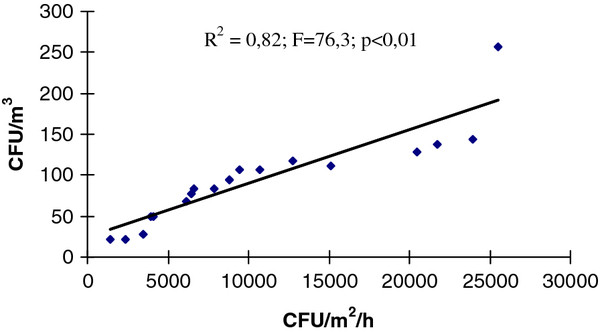
- The two methods showed very strong correlation: Spearman rs = 0.96 at rest and 0.99 in operational sampling; regression also showed correlation (R² = 0.84, F = 154.1, p < 0.01 at rest; R² = 0.82, F = 76.3, p < 0.01 in operational).
- Microbial load increased with the number of people present during surgery: IMA R² = 0.610, F = 26.3, p < 0.01 and SAS R² = 0.608, F = 26.6, p < 0.01; mean personnel count in the operating theatre was 7.4 (SD 3.1, range 3–13).
Methods
- Observational comparison study in 32 turbulent air flow operating theatres in a University Hospital in Southern Italy, sampled between September–October 2010; all rooms had HEPA filters and mean room volume was 136.9 m³.
- Both methods were applied at rest and during surgery: active sampling with the Surface Air System (SAS) and passive sampling with settle plates / Index of Microbial Air Contamination (IMA), following ISO 14698; active sampling used 500 L total air in operational settings and passive plates were exposed for 1 hour.
- Main analysis used Spearman’s rank correlation and linear regression to compare methods and to test association with number of people in the room.
Limitations
- The study itself states that air sampling protocols are not standardized, and that differing samplers, sites, and parameters have caused inconsistent results across previous studies.
- The study was done in one hospital and in 32 operating theatres only; this is evident from the text, so generalizability to other settings is limited.
- Only one sampling point was used, about 1 m from the surgical table; the authors note that sampling nearer the wound might have produced higher counts, suggesting location may affect results.
Model-written summary. Check it against the paper before relying on it.
Integrity signals
Registry
Cites
Statistics
Figures

Verification
Claims the paper makes
0 Valid · 0 Not valid · 18 Not checked · 19 Own results and interpretations
A result the paper reports from its own data — it cites no other source for it, so there is none to check. The quote shows it is in the paper.
In the paper
“The mean number of people present in the operating theatre during the 19 in operational samplings was high at 7.4 (SD = 3.1; range = 3-13).”
§ Air sampling procedures to evaluate microbial contamination: a comparison between active and passive methods in operating theatres > Results and Discussion
plainn = 19- Asserted: passes — The authors put it forward as true.
- Checkable: passes — It can be checked against evidence.
- Load-bearing: unclear — It is unclear whether the paper’s conclusions depend on it.
- Based: passes — The paper gives a reason why it holds.
A result the paper reports from its own data — it cites no other source for it, so there is none to check. The quote shows it is in the paper.
In the paper
“Linear regression, in fact, revealed a significant association between the number of people and the TVC with both methods: IMA (R2 = 0.610; F = 26.3; p < 0.01) and SAS (R2 = 0.608; F = 26.6; p < 0.01).”
§ Air sampling procedures to evaluate microbial contamination: a comparison between active and passive methods in operating theatres > Results and Discussion
plainstates an associationn = 19- Asserted: passes — The authors put it forward as true.
- Checkable: passes — It can be checked against evidence.
- Load-bearing: passes — The paper’s conclusions depend on it.
- Based: passes — The paper gives a reason why it holds.
A result the paper reports from its own data — it cites no other source for it, so there is none to check. The quote shows it is in the paper.
In the paper
“At rest, 1 (3.1%) and 7 (21.9%) samples exceeded the limit value of the active (35 CFU/m3) and of the passive method (786.4 CFU/m2/h) respectively.”
§ Air sampling procedures to evaluate microbial contamination: a comparison between active and passive methods in operating theatres > Results and Discussion
plain- Asserted: passes — The authors put it forward as true.
- Checkable: passes — It can be checked against evidence.
- Load-bearing: unclear — It is unclear whether the paper’s conclusions depend on it.
- Based: passes — The paper gives a reason why it holds.
A result the paper reports from its own data — it cites no other source for it, so there is none to check. The quote shows it is in the paper.
In the paper
“The mean TVC at rest was 12.4 CFU/m3 (SD = 12.1; range = 0-56) and 722.5 CFU/m2/h (SD = 1035.5; range = 0-4718.5) for active and passive samplings respectively.”
§ Air sampling procedures to evaluate microbial contamination: a comparison between active and passive methods in operating theatres > Results and Discussion
plain- Asserted: passes — The authors put it forward as true.
- Checkable: passes — It can be checked against evidence.
- Load-bearing: unclear — It is unclear whether the paper’s conclusions depend on it.
- Based: passes — The paper gives a reason why it holds.
A result the paper reports from its own data — it cites no other source for it, so there is none to check. The quote shows it is in the paper.
In the paper
“The mean in operational TVC was 93.8 CFU/m3 (SD = 52.69; range = 22-256) and 10496.5 CFU/m2/h (SD = 7460.5; range = 1415.5-25479.7) for active and passive samplings respectively.”
§ Air sampling procedures to evaluate microbial contamination: a comparison between active and passive methods in operating theatres > Abstract > Results
plain- Asserted: passes — The authors put it forward as true.
- Checkable: passes — It can be checked against evidence.
- Load-bearing: unclear — It is unclear whether the paper’s conclusions depend on it.
- Based: passes — The paper gives a reason why it holds.
15 more claims
Create a free account to see all 37 claims and to verify the 8 references still open.
- It may state two separate claims as one. 7
- Probably not a substantial claim. 13
Citations
Cites
Sehulster, L. M., & Chinn, R. Y. W. (2003) · PubMed · Cited by 1,708
de Hoog, S., Guarro, J., Gené, J., & Figueras, M. J. (2000) · UvA-DARE (University of Amsterdam) · Cited by 1,427
Guidelines for Environmental Infection Control in Health-Care Facilities: (545922006-001)
(2003) · PsycEXTRA Dataset · doi:10.1037/e545922006-001 · Cited by 687
CHARNLEY, J. (1972) · Clinical Orthopaedics and Related Research · doi:10.1097/00003086-197209000-00020 · Cited by 432 · cited 1×
“In fact, surgeons were the first to deal with environmental hygiene conditions during high risk surgery in order to reduce post-operative infections [11,12].”
BackgroundThe index of microbial air contamination
Pasquarella, C., Pitzurra, O., & Savino, A. (2000) · Journal of Hospital Infection · doi:10.1053/jhin.2000.0820 · Cited by 380 · cited 3×
“of Microbial Air Contamination (IMA) [22].”
BackgroundInfluentialWOUND HEALING AND WOUND INFECTION
Hunt, T. K., & Hopf, H. W. (1997) · Surgical Clinics of North America · doi:10.1016/s0039-6109(05)70570-3 · Cited by 308
Environmental controls in operating theatres
Dharan, S., & Pittet, D. (2002) · Journal of Hospital Infection · doi:10.1053/jhin.2002.1217 · Cited by 282 · cited 1×
“Since then, many authors have underlined the importance of microbial surveillance of environmental matrices [1,2,5,13-15].”
BackgroundOren, I., Haddad, N., Finkelstein, R., & Rowe, J. M. (2001) · American Journal of Hematology · doi:10.1002/ajh.1054 · Cited by 235 · cited 2×
“HEPA system completely eliminated invasive pulmonary aspergillosis in immune-compromised patients [17].”
BackgroundAlberti, C., Bouakline, A., Ribaud, P., Lacroix, C., Rousselot, P., Leblanc, T., & Derouin, F. (2001) · Journal of Hospital Infection · doi:10.1053/jhin.2001.0998 · Cited by 221 · cited 1×
“Other authors have reported that fungal air contamination was never detected in rooms equipped with HEPA filters [38,39] and that simple protective measures, such as air filtration, are known to be effective against mould complications in hospitalized patients [17].”
BackgroundRisk factors for particulate and microbial contamination of air in operating theatres
Scaltriti, S., Cencetti, S., Rovesti, S., Marchesi, I., Bargellini, A., & Borella, P. (2007) · Journal of Hospital Infection · doi:10.1016/j.jhin.2007.05.019 · Cited by 188 · cited 1×
“Since then, many authors have underlined the importance of microbial surveillance of environmental matrices [1,2,5,13-15].”
Background
Cited by
Senanayake, I. (2020) · Mycosphere · doi:10.5943/mycosphere/11/1/20 · Cited by 592
“A Petri-dish containing suitable agar medium is exposed to the atmosphere wherein the medium collects fungi that are settled by gravity (Napoli et al. 2012).”
BackgroundInfluentialA scoping review on bio-aerosols in healthcare and the dental environment
Zemouri, C., de Soet, H., Crielaard, W., & Laheij, A. (2017) · PLOS ONE · doi:10.1371/journal.pone.0178007 · Cited by 335
“Furthermore, in many studies variables in the experimental setup were not described, like sampling time, distance and sampling location.”
Biological contaminants in the indoor air environment and their impacts on human health
Kumar, P., Kausar, M. A., Singh, A. B., & Singh, R. (2021) · Air Quality, Atmosphere & Health · doi:10.1007/s11869-021-00978-z · Cited by 182
Indoor hospital air and the impact of ventilation on bioaerosols: a systematic review
Stockwell, R. E., Ballard, E. L., O'Rourke, P., Knibbs, L. D., Morawska, L., & Bell, S. C. (2019) · Journal of Hospital Infection · doi:10.1016/j.jhin.2019.06.016 · Cited by 179
“Emergency department ~ Unknown Unknown [61] Bacteria and fungi Operating theatre & Enhanced mechanical ventilation [62] Bacteria and fungi Operating theatre & Enhanced mechanical ventilation [63] Bacteria Operating theatre &”
BackgroundMora, M., Mahnert, A., Koskinen, K., Pausan, M. R., Oberauner-Wappis, L., Krause, R., Perras, A. K., Gorkiewicz, G., Berg, G., & Moissl-Eichinger, C. (2016) · Frontiers in Microbiology · doi:10.3389/fmicb.2016.01573 · Cited by 162
“…strategies from air and surfaces in various cleanroom settings, most studies that tried to expand applied methods beyond routine microbial monitoring were conducted in spacecraft assembly cleanroom settings due to planetary protection requirements (Nicholson et al., 2009; Kminek and Rummel, 2015).”
Background
Metadata
- Authors
- Napoli, C., Marcotrigiano, V., & Montagna, M. T.
- Affiliations
- University of Bari Aldo Moro (IT)
- Corresponding author
- Napoli, Christian
- Venue
- BMC Public Health
- Published
- 2012-08-02
- Volume
- 12
- Issue
- 1
- Pages
- 594-594
- ISSN
- 1471-2458 (ISSN-L)
- PMC
- PMC3444341
- OpenAlex
- W2065216672
- Semantic Scholar
- 3b9952f5ec30aed453787f72a581139997aba2b2
- Cited by
- 244
- References
- 40
- Citations by year
- 2026: 14 · 2025: 12 · 2024: 20 · 2023: 25 · 2022: 29 · 2021: 27 · 2020: 27 · 2019: 21 · 2018: 15 · 2017: 17 · 2016: 14 · 2015: 10 · 2014: 10 · 2013: 2 · 2012: 1
- FWCI
- 5.10
- Type
- journal article
- Language
- en
- Open access
- gold
- doi.org
- Licence
- Locations
- BMC Public Health (publishedVersion, cc-by)
- PubMed Central (publishedVersion, cc-by)
- PubMed (publishedVersion)
- DOAJ (DOAJ: Directory of Open Access Journals) (submittedVersion, cc-by-sa)
- IRIS Research product catalog (Sapienza University of Rome) (submittedVersion)
- CINECA IRIS Institutional Research Information System (University of Bari Aldo Moro) (submittedVersion)
- Topics
- Physical Sciences › Environmental Science › Health, Toxicology and Mutagenesis › Indoor Air Quality and Microbial Exposure
- Health Sciences › Medicine › Pulmonary and Respiratory Medicine › Infection Control and Ventilation
- Health Sciences › Medicine › Infectious Diseases › Infection Control in Healthcare
- Keywords
- airborne microbial contamination, active air sampling, passive air sampling, settle plates, total viable count, surgical asepsis, airborne infection control, method comparison
- MeSH terms
- Air Microbiology, Environmental Monitoring, Hospitals, University, Italy, Operating Rooms
About these checks
Registry, retraction, Cites and statistics results are computed, not judged, with one exception: a printed reference that no index lists is read once by a model before it counts as a citation error. Claims are extracted by a model and kept only when their quote appears verbatim in the text; each cited source is then checked, with a model’s help, for whether it says what the claim relies on. Those verdicts can be wrong — read the claim’s quote and the cited source before relying on one.
A language model drew the claims from the paper on 2026-10-10, under version 3 of the claim definition (model deepseek-v4.1-flash, prompt extract-v3).
A second model labelled each claim on 2026-10-10 (model jev-1.13-20260917, definition revision gold-guideline-v0.2).
Statistics and arithmetic are recomputed, not judged.
Confidence bands are shown only for fields calibrated on our annotated test set. None is calibrated yet, so no band is shown.
What counts as a claim ›How we measure confidence ›How we check this ›
Are you an author, or do you see a problem with this page? Request a review
How to cite
Cite CoChat for the checks on this page, and the paper for its own findings.
- This page
- CoChat. (2026). Citation check: Air sampling procedures to evaluate microbial contamination: a comparison between active and passive methods in operating theatres. https://app.cochat.ai/papers/10.1186/1471-2458-12-594
- The paper
- Napoli, C., Marcotrigiano, V., & Montagna, M. T. (2012). Air sampling procedures to evaluate microbial contamination: a comparison between active and passive methods in operating theatres. BMC Public Health. https://doi.org/10.1186/1471-2458-12-594
Data sources
Bibliographic data: Semantic Scholar, OpenAlex, Crossref.
Contains information from the Semantic Scholar Academic Graph Datasets, made available under the ODC Attribution License (ODC-BY 1.0).
Semantic Scholar’s data is described in: Kinney, R., et al. (2023). The Semantic Scholar Open Data Platform. arXiv:2301.10140.
