

Air sampling procedures to evaluate microbial contamination: a comparison between active and passive methods in operating theatres
Open accessThe DOI matches its Crossref record; 38 of the 40 references it cites were found in a registry or an index; none of the 22 sources its claims cite is checked for support yet.
Abstract
BACKGROUND: Since air can play a central role as a reservoir for microorganisms, in controlled environments such as operating theatres regular microbial monitoring is useful to measure air quality and identify critical situations. The aim of this study is to assess microbial contamination levels in operating theatres using both an active and a passive sampling method and then to assess if there is a correlation between the results of the two different sampling methods. METHODS: The study was performed in 32 turbulent air flow operating theatres of a University Hospital in Southern Italy. Active sampling was carried out using the Surface Air System and passive sampling with settle plates, in accordance with ISO 14698. The Total Viable Count (TVC) was evaluated at rest (in the morning before the beginning of surgical activity) and in operational (during surgery). RESULTS: The mean TVC at rest was 12.4 CFU/m3 and 722.5 CFU/m2/h for active and passive samplings respectively. The mean in operational TVC was 93.8 CFU/m3 (SD = 52.69; range = 22-256) and 10496.5 CFU/m2/h (SD = 7460.5; range = 1415.5-25479.7) for active and passive samplings respectively. Statistical analysis confirmed that the two methods correlate in a comparable way with the quality of air. CONCLUSION: It is possible to conclude that both methods can be used for general monitoring of air contamination, such as routine surveillance programs. However, the choice must be made between one or the other to obtain specific information.
Overview
CoChat Summary
TL;DR
This study compared active air sampling (SAS) and passive settle plates (IMA) in 32 operating theatres and found the two methods tracked air contamination closely at both rest and during surgery. The authors conclude both are useful for routine monitoring, but each gives different kinds of information.
Key findings
- In 32 turbulent air flow operating theatres, mean TVC at rest was 12.4 CFU/m³ for active sampling and 722.5 CFU/m²/h for passive sampling.
- During surgery, mean TVC rose to 93.8 CFU/m³ (SD 52.69, range 22–256) for active sampling and 10496.5 CFU/m²/h (SD 7460.5, range 1415.5–25479.7) for passive sampling.
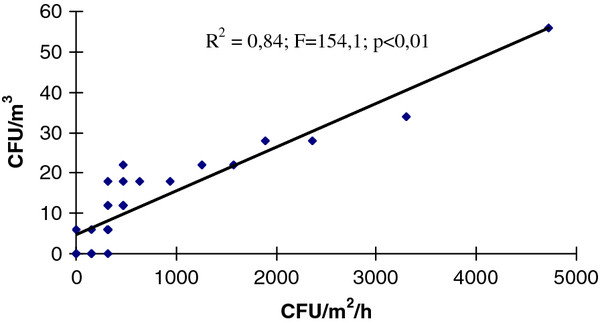
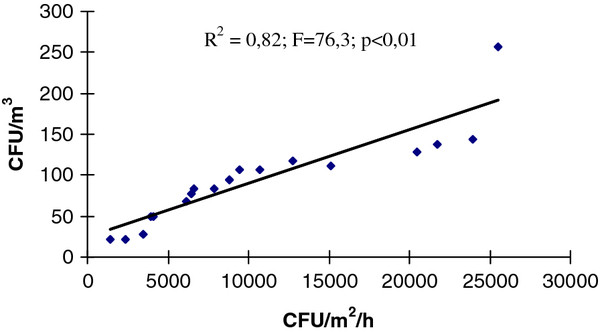
- The two methods showed very strong correlation: Spearman rs = 0.96 at rest and 0.99 in operational sampling; regression also showed correlation (R² = 0.84, F = 154.1, p < 0.01 at rest; R² = 0.82, F = 76.3, p < 0.01 in operational).
- Microbial load increased with the number of people present during surgery: IMA R² = 0.610, F = 26.3, p < 0.01 and SAS R² = 0.608, F = 26.6, p < 0.01; mean personnel count in the operating theatre was 7.4 (SD 3.1, range 3–13).
Methods
- Observational comparison study in 32 turbulent air flow operating theatres in a University Hospital in Southern Italy, sampled between September–October 2010; all rooms had HEPA filters and mean room volume was 136.9 m³.
- Both methods were applied at rest and during surgery: active sampling with the Surface Air System (SAS) and passive sampling with settle plates / Index of Microbial Air Contamination (IMA), following ISO 14698; active sampling used 500 L total air in operational settings and passive plates were exposed for 1 hour.
- Main analysis used Spearman’s rank correlation and linear regression to compare methods and to test association with number of people in the room.
Limitations
- The study itself states that air sampling protocols are not standardized, and that differing samplers, sites, and parameters have caused inconsistent results across previous studies.
- The study was done in one hospital and in 32 operating theatres only; this is evident from the text, so generalizability to other settings is limited.
- Only one sampling point was used, about 1 m from the surgical table; the authors note that sampling nearer the wound might have produced higher counts, suggesting location may affect results.
Model-written summary. Check it against the paper before relying on it.
Integrity signals
Registry
Cites
Statistics
Figures
Verification
Claims the paper makes
0 Valid · 0 Not valid · 18 Not checked · 19 Own results and interpretations
A result the paper reports from its own data — it cites no other source for it, so there is none to check. The quote shows it is in the paper.
In the paper
“The mean number of people present in the operating theatre during the 19 in operational samplings was high at 7.4 (SD = 3.1; range = 3-13).”
§ Air sampling procedures to evaluate microbial contamination: a comparison between active and passive methods in operating theatres > Results and Discussion
plainn = 19- Asserted: passes — The authors put it forward as true.
- Checkable: passes — It can be checked against evidence.
- Load-bearing: unclear — It is unclear whether the paper’s conclusions depend on it.
- Based: passes — The paper gives a reason why it holds.
A result the paper reports from its own data — it cites no other source for it, so there is none to check. The quote shows it is in the paper.
In the paper
“Linear regression, in fact, revealed a significant association between the number of people and the TVC with both methods: IMA (R2 = 0.610; F = 26.3; p < 0.01) and SAS (R2 = 0.608; F = 26.6; p < 0.01).”
§ Air sampling procedures to evaluate microbial contamination: a comparison between active and passive methods in operating theatres > Results and Discussion
plainstates an associationn = 19- Asserted: passes — The authors put it forward as true.
- Checkable: passes — It can be checked against evidence.
- Load-bearing: passes — The paper’s conclusions depend on it.
- Based: passes — The paper gives a reason why it holds.
A result the paper reports from its own data — it cites no other source for it, so there is none to check. The quote shows it is in the paper.
In the paper
“At rest, 1 (3.1%) and 7 (21.9%) samples exceeded the limit value of the active (35 CFU/m3) and of the passive method (786.4 CFU/m2/h) respectively.”
§ Air sampling procedures to evaluate microbial contamination: a comparison between active and passive methods in operating theatres > Results and Discussion
plain- Asserted: passes — The authors put it forward as true.
- Checkable: passes — It can be checked against evidence.
- Load-bearing: unclear — It is unclear whether the paper’s conclusions depend on it.
- Based: passes — The paper gives a reason why it holds.
A result the paper reports from its own data — it cites no other source for it, so there is none to check. The quote shows it is in the paper.
In the paper
“The mean TVC at rest was 12.4 CFU/m3 (SD = 12.1; range = 0-56) and 722.5 CFU/m2/h (SD = 1035.5; range = 0-4718.5) for active and passive samplings respectively.”
§ Air sampling procedures to evaluate microbial contamination: a comparison between active and passive methods in operating theatres > Results and Discussion
plain- Asserted: passes — The authors put it forward as true.
- Checkable: passes — It can be checked against evidence.
- Load-bearing: unclear — It is unclear whether the paper’s conclusions depend on it.
- Based: passes — The paper gives a reason why it holds.
A result the paper reports from its own data — it cites no other source for it, so there is none to check. The quote shows it is in the paper.
In the paper
“The mean in operational TVC was 93.8 CFU/m3 (SD = 52.69; range = 22-256) and 10496.5 CFU/m2/h (SD = 7460.5; range = 1415.5-25479.7) for active and passive samplings respectively.”
§ Air sampling procedures to evaluate microbial contamination: a comparison between active and passive methods in operating theatres > Abstract > Results
plain- Asserted: passes — The authors put it forward as true.
- Checkable: passes — It can be checked against evidence.
- Load-bearing: unclear — It is unclear whether the paper’s conclusions depend on it.
- Based: passes — The paper gives a reason why it holds.
15 more claims
Create a free account to see all 37 claims and to verify the 9 references still open.
- It may state two separate claims as one. 7
- Probably not a substantial claim. 13
Citations
Cites
Sehulster, L. M., & Chinn, R. Y. W. (2003) · PubMed · Cited by 1,710
de Hoog, S., Guarro, J., Gené, J., & Figueras, M. J. (2000) · UvA-DARE (University of Amsterdam) · Cited by 1,427
Guidelines for Environmental Infection Control in Health-Care Facilities: (545922006-001)
(2003) · PsycEXTRA Dataset · doi:10.1037/e545922006-001 · Cited by 687
CHARNLEY, J. (1972) · Clinical Orthopaedics and Related Research · doi:10.1097/00003086-197209000-00020 · Cited by 432 · cited 1×
“In fact, surgeons were the first to deal with environmental hygiene conditions during high risk surgery in order to reduce post-operative infections [11,12].”
BackgroundThe index of microbial air contamination
Pasquarella, C., Pitzurra, O., & Savino, A. (2000) · Journal of Hospital Infection · doi:10.1053/jhin.2000.0820 · Cited by 380 · cited 3×
“of Microbial Air Contamination (IMA) [22].”
BackgroundInfluentialWOUND HEALING AND WOUND INFECTION
Hunt, T. K., & Hopf, H. W. (1997) · Surgical Clinics of North America · doi:10.1016/s0039-6109(05)70570-3 · Cited by 308
Environmental controls in operating theatres
Dharan, S., & Pittet, D. (2002) · Journal of Hospital Infection · doi:10.1053/jhin.2002.1217 · Cited by 282 · cited 1×
“Since then, many authors have underlined the importance of microbial surveillance of environmental matrices [1,2,5,13-15].”
BackgroundOren, I., Haddad, N., Finkelstein, R., & Rowe, J. M. (2001) · American Journal of Hematology · doi:10.1002/ajh.1054 · Cited by 235 · cited 2×
“HEPA system completely eliminated invasive pulmonary aspergillosis in immune-compromised patients [17].”
BackgroundAlberti, C., Bouakline, A., Ribaud, P., Lacroix, C., Rousselot, P., Leblanc, T., & Derouin, F. (2001) · Journal of Hospital Infection · doi:10.1053/jhin.2001.0998 · Cited by 221 · cited 1×
“Other authors have reported that fungal air contamination was never detected in rooms equipped with HEPA filters [38,39] and that simple protective measures, such as air filtration, are known to be effective against mould complications in hospitalized patients [17].”
BackgroundRisk factors for particulate and microbial contamination of air in operating theatres
Scaltriti, S., Cencetti, S., Rovesti, S., Marchesi, I., Bargellini, A., & Borella, P. (2007) · Journal of Hospital Infection · doi:10.1016/j.jhin.2007.05.019 · Cited by 188 · cited 1×
“Since then, many authors have underlined the importance of microbial surveillance of environmental matrices [1,2,5,13-15].”
Background
Cited by
Senanayake, I. (2020) · Mycosphere · doi:10.5943/mycosphere/11/1/20 · Cited by 592
“A Petri-dish containing suitable agar medium is exposed to the atmosphere wherein the medium collects fungi that are settled by gravity (Napoli et al. 2012).”
BackgroundInfluentialA scoping review on bio-aerosols in healthcare and the dental environment
Zemouri, C., de Soet, H., Crielaard, W., & Laheij, A. (2017) · PLOS ONE · doi:10.1371/journal.pone.0178007 · Cited by 335
“Furthermore, in many studies variables in the experimental setup were not described, like sampling time, distance and sampling location.”
Biological contaminants in the indoor air environment and their impacts on human health
Kumar, P., Kausar, M. A., Singh, A. B., & Singh, R. (2021) · Air Quality, Atmosphere & Health · doi:10.1007/s11869-021-00978-z · Cited by 182
Indoor hospital air and the impact of ventilation on bioaerosols: a systematic review
Stockwell, R. E., Ballard, E. L., O'Rourke, P., Knibbs, L. D., Morawska, L., & Bell, S. C. (2019) · Journal of Hospital Infection · doi:10.1016/j.jhin.2019.06.016 · Cited by 179
“Emergency department ~ Unknown Unknown [61] Bacteria and fungi Operating theatre & Enhanced mechanical ventilation [62] Bacteria and fungi Operating theatre & Enhanced mechanical ventilation [63] Bacteria Operating theatre &”
BackgroundMora, M., Mahnert, A., Koskinen, K., Pausan, M. R., Oberauner-Wappis, L., Krause, R., Perras, A. K., Gorkiewicz, G., Berg, G., & Moissl-Eichinger, C. (2016) · Frontiers in Microbiology · doi:10.3389/fmicb.2016.01573 · Cited by 162
“…strategies from air and surfaces in various cleanroom settings, most studies that tried to expand applied methods beyond routine microbial monitoring were conducted in spacecraft assembly cleanroom settings due to planetary protection requirements (Nicholson et al., 2009; Kminek and Rummel, 2015).”
BackgroundAkanyange, S. N., Lyu, X., Zhao, X., Li, X., Zhang, Y., Crittenden, J. C., Anning, C., Chen, T., Jiang, T., & Zhao, H. (2021) · Science of The Total Environment · doi:10.1016/j.scitotenv.2021.146020 · Cited by 132
Bankier, C., Cheong, Y., Mahalingam, S., Edirisinghe, M., Ren, G., Cloutman-Green, E., & Ciric, L. (2018) · PLOS ONE · doi:10.1371/journal.pone.0192093 · Cited by 100
“Currently, one of the most common methods used within hospitals and industry to measure antimicrobial activity is the plate count method for microbial enumeration [4,5].”
MethodChawla, H., Anand, P., Garg, K., Bhagat, N., Varmani, S. G., Bansal, T., McBain, A. J., & Marwah, R. G. (2023) · Frontiers in Public Health · doi:10.3389/fpubh.2023.1285393 · Cited by 166
The microbiome of the built environment and mental health
Hoisington, A. J., Brenner, L. A., Kinney, K. A., Postolache, T. T., & Lowry, C. A. (2015) · Microbiome · doi:10.1186/s40168-015-0127-0 · Cited by 91
“The results of that work are not yet published, but other articles have identified methods to control microbial spread in a hospital environment including ventilation strategies [88, 89], cleaning techniques [90–92], and use of UV lamps [93–96].”
BackgroundSARS-CoV-2: A systematic review of indoor air sampling for virus detection
Borges, J. T., Nakada, L. Y. K., Maniero, M. G., & Guimarães, J. R. (2021) · Environmental Science and Pollution Research · doi:10.1007/s11356-021-13001-w · Cited by 85
An Overview on Novel Microbial Determination Methods in Pharmaceutical and Food Quality Control
Nemati, M., Hamidi, A., Dizaj, S. M., Javaherzadeh, V., & Lotfipour, F. (2016) · Advanced Pharmaceutical Bulletin · doi:10.15171/apb.2016.042 · Cited by 89
Faridi, S., Hassanvand, M. S., Naddafi, K., Yunesian, M., Nabizadeh, R., Sowlat, M. H., Kashani, H., Gholampour, A., Niazi, S., Zare, A., et al. (2014) · Environmental Science and Pollution Research · doi:10.1007/s11356-014-3944-y · Cited by 85
On the airborne transmission of SARS-CoV-2 and relationship with indoor conditions at a hospital
Baboli, Z., Neisi, N., Babaei, A. A., Ahmadi, M., Sorooshian, A., Birgani, Y. T., & Goudarzi, G. (2021) · Atmospheric Environment · doi:10.1016/j.atmosenv.2021.118563 · Cited by 70
Carducci, A., Donzelli, G., Cioni, L., & Verani, M. (2016) · International Journal of Environmental Research and Public Health · doi:10.3390/ijerph13070733 · Cited by 74
“When risk comes from environmental contamination, such as exposure to bioaerosols, microbiological monitoring can help define levels of risk and the sources and spread of biological agents [5].”
BackgroundSadrizadeh, S., & Holmberg, S. (2014) · Particuology · doi:10.1016/j.partic.2014.06.002 · Cited by 60
Mold contamination in a controlled hospital environment: a 3-year surveillance in southern Italy
Caggiano, G., Napoli, C., Coretti, C., Lovero, G., Scarafile, G., Giglio, O. D., & Montagna, M. T. (2014) · BMC Infectious Diseases · doi:10.1186/s12879-014-0595-z · Cited by 64
Self-citationBenami, M., Busgang, A., Gillor, O., & Gross, A. (2016) · The Science of The Total Environment · doi:10.1016/j.scitotenv.2016.03.200 · Cited by 65
Yang, C., Liao, C.-J., Liu, J., Den, W., Chou, Y., & Tsai, J.-J. (2014) · Journal of Medical Systems · doi:10.1007/s10916-014-0015-3 · Cited by 59
“While there appears to be varying degrees of correlation between the microbial counts detected by active (airborne) and passive (surface-bound) sampling methods for total viable counts [23, 24] and targeted microorganisms [26], one must follow a specific sampling protocol when the microbial enumeration values are used…”
BackgroundArgyropoulos, C. D., Skoulou, V. K., Efthimiou, G., & Michopoulos, A. K. (2022) · Air Quality Atmosphere & Health · doi:10.1007/s11869-022-01286-w · Cited by 66
“Such microbial monitoring is done routinely at healthcare-related areas for assessing environmental quality and deciding if corrective intervention is necessary or not (Napoli et al. 2012; Razzini et al. 2020).”
BackgroundTan, H., Wong, K. Y., Nyakuma, B. B., Kamar, H. M., Chong, W. T., Wong, S. L., & Kang, H. S. (2021) · Environmental Science and Pollution Research · doi:10.1007/s11356-021-16171-9 · Cited by 56
Montagna, M. T., Cristina, M. L., Giglio, O. D., Spagnolo, A. M., Napoli, C., Cannova, L., Deriu, M. G., Delia, S. A., Giuliano, A., Guida, M., et al. (2015) · Environmental Research · doi:10.1016/j.envres.2015.12.015 · Cited by 52
“in air samples, as well as differing air sampling methods, have been reported widely in the scientific literature (Chang and Chou, 2011; Napoli et al., 2012; Pasquarella et al., 2008, 2012).”
Self-citationCanha, N., Almeida, S. M., Freitas, M. C., & Wolterbeek, H. T. (2015) · Archives of Environmental Protection · doi:10.1515/aep-2015-0034 · Cited by 46
“Napoli et al. (2012) studied these correlations in operating rooms of hospitals and also registered high correlations between methods (R > 0.9).”
BackgroundInfluentialMontagna, M. T., Giglio, O. D., Cristina, M. L., Napoli, C., Pacifico, C., Agodi, A., Baldovin, T., Casini, B., Coniglio, M. A., D’Errico, M. M., et al. (2017) · International Journal of Environmental Research and Public Health · doi:10.3390/ijerph14070670 · Cited by 52
“Previous studies have confirmed a correlation between the two sampling methods for microbial air contamination, but not specifically for Legionella [13,14,25].”
Self-citationHouses Based on Wood as an Ecological and Sustainable Housing Alternative—Case Study
Švajlenka, J., & Kozlovská, M. (2018) · Sustainability · doi:10.3390/su10051502 · Cited by 58
Bolookat, F., Hassanvand, M. S., Faridi, S., Hadei, M., Rahmatinia, M., & Alimohammadi, M. (2018) · MethodsX · doi:10.1016/j.mex.2018.11.021 · Cited by 46
“Most studies support our results and indicate the prevalence and persistence of some fungal species in the different hospital environments [2,6,25,33,36,48].”
BackgroundMethodResultSivagnanasundaram, P., Amarasekara, R. W. K., Madegedara, D., Ekanayake, A., & Magana-Arachchi, D. (2019) · BioMed Research International · doi:10.1155/2019/7393926 · Cited by 43
On-Site Bioaerosol Sampling and Airborne Microorganism Detection Technologies
Rastmanesh, A., Boruah, J. S., Lee, M.-S., & Park, S. (2024) · Biosensors · doi:10.3390/bios14030122 · Cited by 57
“Furthermore, particle size selection and hygroscopic growth can also be accomplished in active samplers by pre-conditioning their air streams [35].”
BackgroundDai, R., Liu, S., Li, Q., Wu, H., Wu, L., & Ji, C. (2021) · PLoS ONE · doi:10.1371/journal.pone.0259996 · Cited by 54
The Influence of Traffic, Area Location, and Other Factors on Operating Room Microbial Load
Taaffe, K., Lee, B. W., Ferrand, Y., Fredendall, L. D., San, D., Salgado, C. D., Shvorin, D., Khoshkenar, A., & Reeves, S. T. (2018) · Infection Control and Hospital Epidemiology · doi:10.1017/ice.2017.323 · Cited by 43
“This finding supports prior research that the measurements of microbial load near the wound are the most important.(27,28) It also suggests that intraoperative asepsis methods that would keep traffic away from the surgical field would contribute to reducing microbial load near the wound and consequently to fewer SSI.”
ResultOutbreaks of Fungal Infections in Hospitals: Epidemiology, Detection, and Management
Douglas, A. P., Stewart, A. G., Halliday, C. L., & Chen, S. C. ‐. (2023) · Journal of Fungi · doi:10.3390/jof9111059 · Cited by 59
“Active air sampling involves the use of a specialized device which draws in a predetermined volume of air over a defined period of time [326].”
BackgroundSensors and Analytical Technologies for Air Quality: Particulate Matters and Bioaerosols
Su, X., Sutarlie, L., & Loh, X. J. (2020) · Chemistry - An Asian Journal · doi:10.1002/asia.202001051 · Cited by 39
Exposure and Health Effects of Bacteria in Healthcare Units: An Overview
Monteiro, A., Cardoso, J., Guerra, N., Ribeiro, E., Viegas, C. S. B., Verde, S. C., & Uva, A. D. S. (2022) · Applied Sciences · doi:10.3390/app12041958 · Cited by 43
Microbial Contamination of Food: Probiotics and Postbiotics as Potential Biopreservatives
Zavišić, G., Ristić, S., Petricevic, S. M., Janković, D. L., & Petković, B. B. (2024) · Foods · doi:10.3390/foods13162487 · Cited by 57
“In addition, the presence of airborne contaminants [19] or contaminated surfaces that come into contact with food [20] can affect the microbiological quality of bakery products.”
BackgroundIdentification of airborne microbiota in selected areas in a health-care setting in South Africa
Lenetha, G. G., Malebo, N. J., Shale, K., & Lues, R. J. F. (2014) · BMC Microbiology · doi:10.1186/1471-2180-14-100 · Cited by 35
Slezáková, K., Morais, S., & Pereira, M. D. C. (2013) · Environmental Science and Pollution Research · doi:10.1007/s11356-013-2316-3 · Cited by 36
“Studies have shown that hospital patients can acquire microbial contaminants (bacteria, fungi, and viruses) from personnel and from indoor environment (Napoli et al. 2012).”
BackgroundMontagna, M. T., Rutigliano, S., Trerotoli, P., Napoli, C., Apollonio, F., D’Amico, A., Giglio, O. D., Diella, G., Lopuzzo, M., Marzella, A., et al. (2019) · International Journal of Environmental Research and Public Health · doi:10.3390/ijerph16193581 · Cited by 32
Self-citationCompendium of analytical methods for sampling, characterization and quantification of bioaerosols
Whitby, C. B., Ferguson, R., Colbeck, I., Dumbrell, A. J., Nasir, Z. A., Marczylo, E. L., Kinnersley, R., Douglas, P., Drew, G. H., Bhui, K. S., et al. (2022) · Advances in ecological research/Advances in Ecological Research · doi:10.1016/bs.aecr.2022.09.004 · Cited by 46
Paleologos, K. E., Selim, M. Y. E., & Mohamed, A. O. (2020) · Elsevier eBooks · doi:10.1016/b978-0-12-809582-9.00008-6 · Cited by 44
Matinyi, S., Muwanguzi, E., Akia, D., Byaruhanga, V., Masereka, E., Ekeu, I., & Atuheire, C. (2018) · BMC Infectious Diseases · doi:10.1186/s12879-018-3374-4 · Cited by 34
“If the operating theatres are not sufficiently sterilized, surgical site infections are most likely to increase leading to poorer prognostic outcomes of patients post-surgery [10, 11] .”
BackgroundGismondi, A., Marco, G. D., Redi, E. L., Ferrucci, L., Cantonetti, M., & Canini, A. (2021) · Journal of Herbal Medicine · doi:10.1016/j.hermed.2021.100426 · Cited by 37
Viegas, C. S. B., Almeida, B., Gomes, A. Q., Carolino, E., & Caetano, L. A. (2019) · Environmental Research · doi:10.1016/j.envres.2019.05.015 · Cited by 29
Detection of pathogenic bioaerosols and occupational risk in a Philippine landfill site
Pagalilauan, H. A. M., Paraoan, C. E. M., & Vital, P. G. (2017) · Archives of Environmental & Occupational Health · doi:10.1080/19338244.2017.1299087 · Cited by 27
“In addition, the computation for CFU/m(3) using passive sampling included a lot of assumptions while the computation using active sampling is direct since the volume is already known.(10,13,14) The bioaerosol concentration was found to be higher in the indoor sampling sites as compared to the 3 outdoor locations (p < .”
Ling, S., & Liu, H. (2019) · BMC Infectious Diseases · doi:10.1186/s12879-019-4249-z · Cited by 28
Cataract surgery in mobile eye surgical unit: Safe and viable alternative
Sangameswaran, R., Verma, G., Raghavan, N., et al. (2016) · Indian Journal of Ophthalmology · doi:10.4103/0301-4738.195599 · Cited by 24
“For safe surgical environment, washing and disinfecting of OT was done for 3 consecutive days along with culture by settle plate method and air sampling.[11,12] Surgeries were started only after obtaining negative culture for 3 consecutive days.”
MethodAnnaqeeb, M. K., Zhang, Y., Dziedzic, J. W., Xue, K., Pedersen, C., Stenstad, L. I., Novaković, V., & Cao, G. (2021) · Journal of Hospital Infection · doi:10.1016/j.jhin.2021.08.009 · Cited by 27
Scarano, C., Giacometti, F., Manfreda, G., et al. (2014) · Applied and Environmental Microbiology · doi:10.1128/aem.02491-14 · Cited by 24
“(29), using plates of the Arcobacter medium (28); (iii) a pooled ricotta cheese sample, obtained mixing aliquots of about 50 g taken by sterile spoons from 20 ricotta cheese sampling units before packing.”
MethodHai, V. D., Hoang, S. M. T., Hung, N. T. Q., Nguyen, M., Gwi-Nam, B., Park, K., Chang, S. W., Bach, Q., Nhu-Trang, T., & Nguyen, D. D. (2019) · International Biodeterioration & Biodegradation · doi:10.1016/j.ibiod.2019.104819 · Cited by 26
Abbasi, F., Samaei, M. R., Manoochehri, Z., et al. (2020) · Journal of Building Engineering · doi:10.1016/j.jobe.2020.101294 · Cited by 24
Fungal Airborne Contamination as a Serious Threat for Respiratory Infection in the Hematology Ward.
Ghajari, A., Lotfali, E., Azari, M. R., Fateh, R., & Kalantary, S. (2015) · PubMed Central · Cited by 28
Yasir, M., Subahi, A. M., Shukri, H. A., Bibi, F., Sohrab, S. S., Alawi, M., Sindi, A., Jiman-Fatani, A. A., & Azhar, E. I. (2022) · Pharmaceuticals · doi:10.3390/ph15050611 · Cited by 28
“Air samples were collected using sheep blood agar plates that were left open on a table inside each room or at the nurse stations for 1 h (Figure 6) [54].”
MethodQuintana, Á. R., Perea, J., García‐Béjar, B., Jiménez, L., Sigler, A. I. G., & Sánchez, R. A. (2020) · Animals · doi:10.3390/ani10050906 · Cited by 25
“The air sampler was placed at a distance of at least 1 m above the floor and 1 m away from walls or obstacles [22], and in the case of the milking parlour, the sampler was also placed near the clusters.”
BackgroundBiomonitoring the indoor environment of agricultural buildings
Švajlenka, J., Kozlovská, M., & Pošiváková, T. (2018) · Annals of Agricultural and Environmental Medicine · doi:10.26444/aaem/81314 · Cited by 21
Viegas, C. S. B., Almeida, B., Monteiro, A., Paciência, I., Rufo, J. C., Aguiar, L., Lage, B., Gonçalves, L., Caetano, L. A., Carolino, E., et al. (2019) · Environmental Research · doi:10.1016/j.envres.2019.108947 · Cited by 21
Bahador, M., Alfirdous, R. A., Alquria, T., Griffin, I. L., Tordik, P. A., & Martinho, F. C. (2021) · Journal of Endodontics · doi:10.1016/j.joen.2021.01.009 · Cited by 26
The Exposome in the Era of the Quantified Self
Zhang, X., Gao, P., & Snyder, M. P. (2021) · Annual Review of Biomedical Data Science · doi:10.1146/annurev-biodatasci-012721-122807 · Cited by 25
Onat, B., Şahin, Ü. A., & Sivri, N. (2016) · Indoor and Built Environment · doi:10.1177/1420326x16643373 · Cited by 19
“In active monitoring, a microbiological air sampler physically draws a known volume of air through or over a particle collection device, which can comprise a liquid or solid culture media or a nitrocellulose membrane, and the quantity of microorganisms present is measured in CFU/m(3) of air.(32) In this study, the pri…”
BackgroundRapid MPN-Qpcr Screening for Pathogens in Air, Soil, Water, and Agricultural Produce
Orlofsky, E., Benami, M., Gross, A., Dutt, M., & Gillor, O. (2015) · Water Air & Soil Pollution · doi:10.1007/s11270-015-2560-x · Cited by 19
Chou, K., Liu, J., Lu, X., et al. (2023) · Food Microbiology · doi:10.1016/j.fm.2023.104443 · Cited by 18
Schreiber, P. W., Köhler, N., Cervera, R., Hasse, B. K., Sax, H., & Keller, P. M. (2017) · Journal of Hospital Infection · doi:10.1016/j.jhin.2017.11.007 · Cited by 19
“Studying microbial detection limits in air volumes is notoriously challenging [33, 34] and was beyond the scope of the current protocol.”
BackgroundSannat, C., Nair, A., Sahu, S. B., et al. (2015) · Veterinary World · doi:10.14202/vetworld.2015.631-635 · Cited by 18
“Laboratory environment including carpets and ceiling generating high humidity inside the closed room are the wide sources of the bacterial population, which adversely affects the quality of materials being exposed [21-23].”
BackgroundRock, C., Harris, A. D., Johnson, J. K., et al. (2015) · Infection Control and Hospital Epidemiology · doi:10.1017/ice.2015.68 · Cited by 17
Assessment and biomonitoring indoor environment of buildings
Švajlenka, J., Kozlovská, M., & Pošiváková, T. (2017) · International Journal of Environmental Health Research · doi:10.1080/09603123.2017.1373276 · Cited by 21
Kayta, G., Manilal, A., Tadesse, D., & Siraj, M. (2022) · PLoS ONE · doi:10.1371/journal.pone.0271022 · Cited by 27
“However, these are much higher than that reported from southern Thailand (an average load of 418.79 CFU/m3) [27], and Nigeria (3.0 CFU/m3 to 76.0CFU/m3) [28].”
BackgroundResultInfluentialHaas, D., Galler, H., Fritz, C., Hasler, C., Habib, J., & Reinthaler, F. F. (2017) · PLoS ONE · doi:10.1371/journal.pone.0187039 · Cited by 24
“found that the two methods correlate in a similar manner with the air quality [10].”
ResultCarroll, G. T., Kirschman, D. L., & Mammana, A. (2022) · Patient Safety in Surgery · doi:10.1186/s13037-022-00343-8 · Cited by 21
Najotra, D., Malhotra, A. S., Slathia, P., Raina, S., & Dhar, A. (2017) · International Journal of Applied and Basic Medical Research · doi:10.4103/ijabmr.ijabmr_281_16 · Cited by 25
“[3,9] Whereas there are other studies which have reported a very high counts from air sampling.[20,21] The highly variable results in different studies can be ascribed to various factors like method of surveillance (active air sampling or passive air sampling), time of sampling, i.”
BackgroundKumari, H., Chakraborti, T., Singh, M., Chakrawarti, M. K., & Mukhopadhyay, K. (2020) · BMC Microbiology · doi:10.1186/s12866-020-01875-8 · Cited by 18
Microbiological challenges to the pharmaceuticals and healthcare
Sandle, T. (2015) · Elsevier eBooks · doi:10.1016/b978-0-08-100022-9.00022-0 · Cited by 17
Casini, B., Tuvo, B., Totaro, M., Aquino, F., Baggiani, A., & Privitera, G. P. (2018) · Pathogens · doi:10.3390/pathogens7030071 · Cited by 17
“ambulatory activity is carried out to monitor the risk of microbial wound contamination, a passive measurement is better than volumetric sampling for predicting the likely contamination rate, as it allows for a direct measurement of the number of microorganisms settling on surfaces [36].”
BackgroundMicrobiological Contamination Assessment in Higher Education Institutes
Viegas, C. S. B., Pimenta, R., Dias, M., Gomes, B., Brito, M., Caetano, L. A., Carolino, E., & Gomes, A. Q. (2021) · Atmosphere · doi:10.3390/atmos12081079 · Cited by 22
Dziurzyński, M., Ciuchciński, K., Dyda, M., Szych, A., Drabik, P., Laudy, A., & Dziewit, Ł. (2020) · Applied Sciences · doi:10.3390/app10207128 · Cited by 16
“, active (oftentimes involving the usage of various air samplers and impactors) [3] and passive sampling [4,5].”
BackgroundFakunle, A. G., Olusola, B. A., Jafta, N., Faneye, A. O., Heederik, D. J. J., Smit, L. A. M., & Naidoo, R. N. (2020) · International Journal of Environmental Research and Public Health · doi:10.3390/ijerph17061857 · Cited by 16
A Personal Respirator Specification for Health-care Workers Treating COVID-19 (PeRSo)Preprint
Elkington, P. T., Dickinson, A., Mavrogordato, M., Spencer, D., Gillams, R. J., Grazia, A. D., Rosini, S., Garay‐Baquero, D. J., Diment, L. E., Mahobia, N., et al. (2020) · Engineering Archive (engrXiv) · doi:10.31224/osf.io/rvcs3 · Cited by 16
Glevitzky, M., Aleya, L., Vică, M. L., Dumitrel, G., Avram, M., Ţiţ, D. M., Popa, M., Popa, V., Behl, T., & BUNGAU, S. G. (2020) · Environmental Science and Pollution Research · doi:10.1007/s11356-020-11170-8 · Cited by 14
“In our case, both passive and active methods can be used for general monitoring of air contamination, such as routine surveillance programs (Napoli et al. 2012).).”
BackgroundBacterial indoor air contaminations in hospitals in MENA region: a systematic review
Abu-Rub, L. I., Johar, A.-R. A., Mana, H. A., Abdelrahman, H. A., Thani, A. A. A., Qotba, H. A., Yassine, H. M., & Eltai, N. O. (2022) · International Journal of Environmental Health Research · doi:10.1080/09603123.2022.2083087 · Cited by 16
“Active sampling is the most effective method of quantifying airborne microbes when the concentration is not very high, like in operating rooms and other controlled environments of hospitals (Napoli et al. 2012; Fu Shaw et al. 2018).”
MethodSapkota, B., Gupta, G., Shrestha, S., Pradhan, A., Karki, P., & Thapa, A. (2016) · Australasian Medical Journal · doi:10.4066/amj.2015.2558 · Cited by 13
“Air quality in the operating room and other areas of the healthcare institution should be carefully monitored and controlled to prevent or at least minimise nosocomial infections.(2) Risk of contamination can be minimised by providing consistent, sufficient, quality airflow to the operating room.”
BackgroundIntensive Care Units and Operating Rooms Bacterial Load and Antibiotic Susceptibility Pattern
Hailemariam, M., Worku, M., & Azerefegne, E. (2016) · Journal of Surgery · doi:10.11648/j.js.20160402.21 · Cited by 17
“This finding goes in line with the study conducted in Gaza [12] which revealed that, the total bacterial count within indoor air in two ICUs ranged from (1170 to 1470) cfu/m 3 (standard is less than 50 cfu/m 3 ) our finding was also similar with Venezuelans finding [13]which reported, bacteria in surgical settings wer…”
BackgroundResultInfluentialInterventional Effect of Nanosilver Paint on Fungal Load of Indoor Air in a Hospital Ward
Rostami, N., Alidadi, H., Zarrinfar, H., Ketabi, D., & Tabesh, H. (2021) · Canadian Journal of Infectious Diseases and Medical Microbiology · doi:10.1155/2021/8658600 · Cited by 13
Surface Microbial Contamination and Air Quality before and after Regular Cleaning Procedures
Mohammed, M. O. A. (2023) · Atmosphere · doi:10.3390/atmos14020352 · Cited by 17
Dietz, L. G., Constant, D. A., Fretz, M., Horve, P. F., Olsen-Martinez, A., Stenson, J., Wilkes, A., Martindale, R. G., Messer, W. B., & Wymelenberg, K. G. V. D. (2021) · medRxiv · doi:10.1101/2021.03.26.21254416 · Cited by 14
Quintana, Á. R., Perea, J., Palop, M. L., Sigler, A. I. G., & Sánchez, R. A. (2020) · Animals · doi:10.3390/ani10112180 · Cited by 11
“The sampler was placed at a minimum distance of 1 m above the floor and from the walls or any existing obstacle in the room [23].”
BackgroundHailemariam, M., Misganaw, B., & Azerefege, E. (2016) · Journal of Microbiology and Antimicrobials · doi:10.5897/jma2015.0349 · Cited by 14
“…hospital, especially in an operating theatre and other specialized units had continued to increase prevalence of nosocomial infections with resultant effect of high morbidity and mortality rate among patient admitted for post-operative surgery, patients (Napoli et al., 2012; Jyotshna et al., 2011).”
BackgroundEnvironmental microbiology: Perspectives for legal and occupational medicine
Giampaoli, S., Alessandrini, F., Frajese, G. V., Guglielmi, G., Tagliabracci, A., & Berti, A. (2018) · Legal Medicine · doi:10.1016/j.legalmed.2018.09.014 · Cited by 13
Stålfelt, F., Malchau, K. S., Björn, C., Mohaddes, M., & Andersson, A. E. (2023) · American Journal of Infection Control · doi:10.1016/j.ajic.2023.05.004 · Cited by 16
Wong, S. C., Chen, J. H., Kwok, M. O.-T., Siu, C. Y., Yuen, L. L., AuYeung, C. H.-Y., Li, C. K., Li, B. H., Chan, B. W.-K., So, S. Y.-C., et al. (2024) · Journal of Hospital Infection · doi:10.1016/j.jhin.2024.04.011 · Cited by 12
Tseng, C., Hsiao, P.-K., Chang, K.-C., Cheng, C.-C., Yiin, .-M., & Hsieh, C. (2014) · Indoor Air · doi:10.1111/ina.12165 · Cited by 12
Moubasher, H., El‐Kholy, A., Sherif, M. M., Zahran, M., & Elnagdy, S. M. (2022) · Molecules · doi:10.3390/molecules27082541 · Cited by 12
“The plates were incubated at 26 ◦C for 5 days [25].”
MethodChou, K., Yan, C.-T., & Hsiao, H. (2022) · Food Control · doi:10.1016/j.foodcont.2022.109495 · Cited by 17
UV-based evaluation of ergosterol for monitoring the fungal exposure in Italian buffalo farms
Vella, F. M., & Laratta, B. (2017) · FEMS Microbiology Letters · doi:10.1093/femsle/fnx224 · Cited by 11
Analysis of the indoor environment of agricultural constructions in the context of sustainability
Švajlenka, J., Kozlovská, M., & Pošiváková, T. (2019) · Environmental Monitoring and Assessment · doi:10.1007/s10661-019-7608-8 · Cited by 13
Impact of microbial air quality in preschools on paediatric respiratory health
Madamarandawala, P., Weerasinghe, Y., Pathiraja, D., Ekanayake, A., Madegedara, D., & Magana-Arachchi, D. (2019) · SN Applied Sciences · doi:10.1007/s42452-019-1306-6 · Cited by 12
Gushit, J. S., Mohammed, S. U., & Moda, H. M. (2022) · Toxics · doi:10.3390/toxics10080419 · Cited by 11
“These activities create steam, heat, mist, and dust [22,24], which informs the highest PM concentrations and temperature recorded.”
BackgroundMethodAirborne Fungi in Neonatal Intensive Care Unit of a Public Hospital in Brazil
Souza, A. K. P., do Nascimento, J. P. M., Araújo, M. A. D. S., et al. (2019) · International Journal of Current Microbiology and Applied Sciences · doi:10.20546/ijcmas.2019.812.149 · Cited by 11
Belay, M. M., Ambelu, A., Mekonen, S., Karbana, G., & Yemane, B. (2024) · Environmental Health Insights · doi:10.1177/11786302241266052 · Cited by 18
Operating theaters as a source of nosocomial infection: A systematic review
Gebremariam, T. T., & Declaro, M. F. (2014) · Saudi Journal for Health Sciences · doi:10.4103/2278-0521.130196 · Cited by 11
Gill, S. P., Learman, D. R., Annis, M. L., & Woolnough, D. (2022) · Journal of Applied Microbiology · doi:10.1111/jam.15801 · Cited by 9
“…air controls (n = 3) were also obtained during preliminary and end gut dissections to account for any bacteria within the air that may contaminate the samples (Napoli et al., 2012) by opening a tube to the air during dissections and running analyses on the tube as if it contained a sample.”
BackgroundLiu, Z., Zhang, P., Liu, H., et al. (2023) · International Journal of Hygiene and Environmental Health · doi:10.1016/j.ijheh.2023.114120 · Cited by 10
A Personal Respirator to Improve Protection for Healthcare Workers Treating COVID-19 (PeRSo)
Elkington, P. T., Dickinson, A., Mavrogordato, M., Spencer, D. C., Gillams, R. J., Grazia, A. D., Rosini, S., Garay‐Baquero, D. J., Diment, L. E., Mahobia, N., et al. (2021) · Frontiers in Medical Technology · doi:10.3389/fmedt.2021.664259 · Cited by 11
“0013), to an equivalent standard expected from an operation theater environment (29).”
BackgroundEfthymiopoulos, S., Aktaş, Y. D., & Altamirano, H. (2023) · UCL Open Environment · doi:10.14324/111.444/ucloe.000055 · Cited by 10
“[30] Fieldwork/impaction and total viable counts (TVC enumeration) Reported an increase of the mean TVC by approximately 7.”
BackgroundHampton‐Marcell, J., Ghosh, A., Gukeh, M. J., & Megaridis, C. M. (2023) · Microbiome · doi:10.1186/s40168-023-01555-5 · Cited by 12
“Current methods of capturing airborne microbes utilize either passive (settling plates) or active filtration (electrostatic, air impingers), which may damage organisms during collection, which is done in a non-wet state [4].”
Method
Metadata
- Authors
- Napoli, C., Marcotrigiano, V., & Montagna, M. T.
- Affiliations
- University of Bari Aldo Moro (IT)
- Corresponding author
- Napoli, Christian
- Venue
- BMC Public Health
- Published
- 2012-08-02
- Volume
- 12
- Issue
- 1
- Pages
- 594-594
- ISSN
- 1471-2458 (ISSN-L)
- PMC
- PMC3444341
- OpenAlex
- W2065216672
- Semantic Scholar
- 3b9952f5ec30aed453787f72a581139997aba2b2
- Cited by
- 244
- References
- 40
- Citations by year
- 2026: 14 · 2025: 12 · 2024: 20 · 2023: 25 · 2022: 29 · 2021: 27 · 2020: 27 · 2019: 21 · 2018: 15 · 2017: 17 · 2016: 14 · 2015: 10 · 2014: 10 · 2013: 2 · 2012: 1
- FWCI
- 5.10
- Type
- journal article
- Language
- en
- Open access
- gold
- doi.org
- Licence
- Locations
- BMC Public Health (publishedVersion, cc-by)
- PubMed Central (publishedVersion, cc-by)
- PubMed (publishedVersion)
- DOAJ (DOAJ: Directory of Open Access Journals) (submittedVersion, cc-by-sa)
- IRIS Research product catalog (Sapienza University of Rome) (submittedVersion)
- CINECA IRIS Institutional Research Information System (University of Bari Aldo Moro) (submittedVersion)
- Topics
- Physical Sciences › Environmental Science › Health, Toxicology and Mutagenesis › Indoor Air Quality and Microbial Exposure
- Health Sciences › Medicine › Pulmonary and Respiratory Medicine › Infection Control and Ventilation
- Health Sciences › Medicine › Infectious Diseases › Infection Control in Healthcare
- Keywords
- airborne microbial contamination, active air sampling, passive air sampling, settle plates, total viable count, surgical asepsis, airborne infection control, method comparison
- MeSH terms
- Air Microbiology, Environmental Monitoring, Hospitals, University, Italy, Operating Rooms
About these checks
Registry, retraction, Cites and statistics results are computed, not judged, with one exception: a printed reference that no index lists is read once by a model before it counts as a citation error. Claims are extracted by a model and kept only when their quote appears verbatim in the text; each cited source is then checked, with a model’s help, for whether it says what the claim relies on. Those verdicts can be wrong — read the claim’s quote and the cited source before relying on one.
A language model drew the claims from the paper on 2026-10-10, under version 3 of the claim definition (model deepseek-v4.1-flash, prompt extract-v3).
A second model labelled each claim on 2026-10-10 (model jev-1.13-20260917, definition revision gold-guideline-v0.2).
Statistics and arithmetic are recomputed, not judged.
Confidence bands are shown only for fields calibrated on our annotated test set. None is calibrated yet, so no band is shown.
What counts as a claim ›How we measure confidence ›How we check this ›
Are you an author, or do you see a problem with this page? Request a review
Data sources
Bibliographic data: Semantic Scholar, OpenAlex, Crossref.
Contains information from the Semantic Scholar Academic Graph Datasets, made available under the ODC Attribution License (ODC-BY 1.0).
Semantic Scholar’s data is described in: Kinney, R., et al. (2023). The Semantic Scholar Open Data Platform. arXiv:2301.10140.
