

Air sampling procedures to evaluate microbial contamination: a comparison between active and passive methods in operating theatres
Open accessThe DOI matches its Crossref record; 38 of the 40 references it cites were found in a registry or an index; none of the 22 sources its claims cite is checked for support yet.
Abstract
BACKGROUND: Since air can play a central role as a reservoir for microorganisms, in controlled environments such as operating theatres regular microbial monitoring is useful to measure air quality and identify critical situations. The aim of this study is to assess microbial contamination levels in operating theatres using both an active and a passive sampling method and then to assess if there is a correlation between the results of the two different sampling methods. METHODS: The study was performed in 32 turbulent air flow operating theatres of a University Hospital in Southern Italy. Active sampling was carried out using the Surface Air System and passive sampling with settle plates, in accordance with ISO 14698. The Total Viable Count (TVC) was evaluated at rest (in the morning before the beginning of surgical activity) and in operational (during surgery). RESULTS: The mean TVC at rest was 12.4 CFU/m3 and 722.5 CFU/m2/h for active and passive samplings respectively. The mean in operational TVC was 93.8 CFU/m3 (SD = 52.69; range = 22-256) and 10496.5 CFU/m2/h (SD = 7460.5; range = 1415.5-25479.7) for active and passive samplings respectively. Statistical analysis confirmed that the two methods correlate in a comparable way with the quality of air. CONCLUSION: It is possible to conclude that both methods can be used for general monitoring of air contamination, such as routine surveillance programs. However, the choice must be made between one or the other to obtain specific information.
Overview
CoChat Summary
TL;DR
This study compared active air sampling (SAS) and passive settle plates (IMA) in 32 operating theatres and found the two methods tracked air contamination closely at both rest and during surgery. The authors conclude both are useful for routine monitoring, but each gives different kinds of information.
Key findings
- In 32 turbulent air flow operating theatres, mean TVC at rest was 12.4 CFU/m³ for active sampling and 722.5 CFU/m²/h for passive sampling.
- During surgery, mean TVC rose to 93.8 CFU/m³ (SD 52.69, range 22–256) for active sampling and 10496.5 CFU/m²/h (SD 7460.5, range 1415.5–25479.7) for passive sampling.
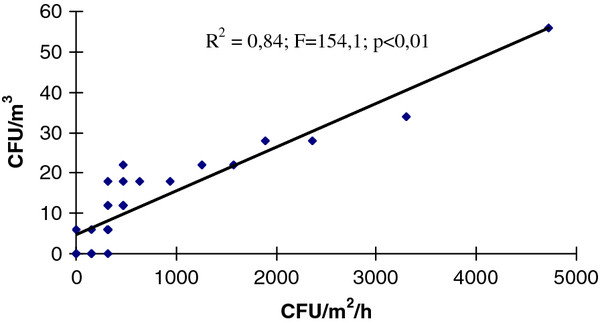
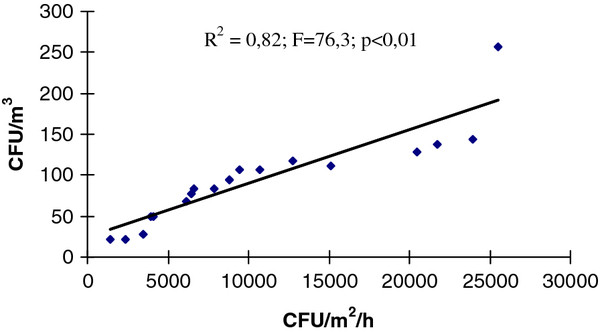
- The two methods showed very strong correlation: Spearman rs = 0.96 at rest and 0.99 in operational sampling; regression also showed correlation (R² = 0.84, F = 154.1, p < 0.01 at rest; R² = 0.82, F = 76.3, p < 0.01 in operational).
- Microbial load increased with the number of people present during surgery: IMA R² = 0.610, F = 26.3, p < 0.01 and SAS R² = 0.608, F = 26.6, p < 0.01; mean personnel count in the operating theatre was 7.4 (SD 3.1, range 3–13).
Methods
- Observational comparison study in 32 turbulent air flow operating theatres in a University Hospital in Southern Italy, sampled between September–October 2010; all rooms had HEPA filters and mean room volume was 136.9 m³.
- Both methods were applied at rest and during surgery: active sampling with the Surface Air System (SAS) and passive sampling with settle plates / Index of Microbial Air Contamination (IMA), following ISO 14698; active sampling used 500 L total air in operational settings and passive plates were exposed for 1 hour.
- Main analysis used Spearman’s rank correlation and linear regression to compare methods and to test association with number of people in the room.
Limitations
- The study itself states that air sampling protocols are not standardized, and that differing samplers, sites, and parameters have caused inconsistent results across previous studies.
- The study was done in one hospital and in 32 operating theatres only; this is evident from the text, so generalizability to other settings is limited.
- Only one sampling point was used, about 1 m from the surgical table; the authors note that sampling nearer the wound might have produced higher counts, suggesting location may affect results.
Model-written summary. Check it against the paper before relying on it.
Integrity signals
Registry
Cites
Statistics
Figures
Verification
Claims the paper makes
0 Valid · 0 Not valid · 18 Not checked · 19 Own results and interpretations
A result the paper reports from its own data — it cites no other source for it, so there is none to check. The quote shows it is in the paper.
In the paper
“The mean number of people present in the operating theatre during the 19 in operational samplings was high at 7.4 (SD = 3.1; range = 3-13).”
§ Air sampling procedures to evaluate microbial contamination: a comparison between active and passive methods in operating theatres > Results and Discussion
plainn = 19- Asserted: passes — The authors put it forward as true.
- Checkable: passes — It can be checked against evidence.
- Load-bearing: unclear — It is unclear whether the paper’s conclusions depend on it.
- Based: passes — The paper gives a reason why it holds.
A result the paper reports from its own data — it cites no other source for it, so there is none to check. The quote shows it is in the paper.
In the paper
“Linear regression, in fact, revealed a significant association between the number of people and the TVC with both methods: IMA (R2 = 0.610; F = 26.3; p < 0.01) and SAS (R2 = 0.608; F = 26.6; p < 0.01).”
§ Air sampling procedures to evaluate microbial contamination: a comparison between active and passive methods in operating theatres > Results and Discussion
plainstates an associationn = 19- Asserted: passes — The authors put it forward as true.
- Checkable: passes — It can be checked against evidence.
- Load-bearing: passes — The paper’s conclusions depend on it.
- Based: passes — The paper gives a reason why it holds.
A result the paper reports from its own data — it cites no other source for it, so there is none to check. The quote shows it is in the paper.
In the paper
“At rest, 1 (3.1%) and 7 (21.9%) samples exceeded the limit value of the active (35 CFU/m3) and of the passive method (786.4 CFU/m2/h) respectively.”
§ Air sampling procedures to evaluate microbial contamination: a comparison between active and passive methods in operating theatres > Results and Discussion
plain- Asserted: passes — The authors put it forward as true.
- Checkable: passes — It can be checked against evidence.
- Load-bearing: unclear — It is unclear whether the paper’s conclusions depend on it.
- Based: passes — The paper gives a reason why it holds.
A result the paper reports from its own data — it cites no other source for it, so there is none to check. The quote shows it is in the paper.
In the paper
“The mean TVC at rest was 12.4 CFU/m3 (SD = 12.1; range = 0-56) and 722.5 CFU/m2/h (SD = 1035.5; range = 0-4718.5) for active and passive samplings respectively.”
§ Air sampling procedures to evaluate microbial contamination: a comparison between active and passive methods in operating theatres > Results and Discussion
plain- Asserted: passes — The authors put it forward as true.
- Checkable: passes — It can be checked against evidence.
- Load-bearing: unclear — It is unclear whether the paper’s conclusions depend on it.
- Based: passes — The paper gives a reason why it holds.
A result the paper reports from its own data — it cites no other source for it, so there is none to check. The quote shows it is in the paper.
In the paper
“The mean in operational TVC was 93.8 CFU/m3 (SD = 52.69; range = 22-256) and 10496.5 CFU/m2/h (SD = 7460.5; range = 1415.5-25479.7) for active and passive samplings respectively.”
§ Air sampling procedures to evaluate microbial contamination: a comparison between active and passive methods in operating theatres > Abstract > Results
plain- Asserted: passes — The authors put it forward as true.
- Checkable: passes — It can be checked against evidence.
- Load-bearing: unclear — It is unclear whether the paper’s conclusions depend on it.
- Based: passes — The paper gives a reason why it holds.
15 more claims
Create a free account to see all 37 claims and to verify the 9 references still open.
- It may state two separate claims as one. 7
- Probably not a substantial claim. 13
Citations
Cites
Sehulster, L. M., & Chinn, R. Y. W. (2003) · PubMed · Cited by 1,710
de Hoog, S., Guarro, J., Gené, J., & Figueras, M. J. (2000) · UvA-DARE (University of Amsterdam) · Cited by 1,427
Guidelines for Environmental Infection Control in Health-Care Facilities: (545922006-001)
(2003) · PsycEXTRA Dataset · doi:10.1037/e545922006-001 · Cited by 687
CHARNLEY, J. (1972) · Clinical Orthopaedics and Related Research · doi:10.1097/00003086-197209000-00020 · Cited by 432 · cited 1×
“In fact, surgeons were the first to deal with environmental hygiene conditions during high risk surgery in order to reduce post-operative infections [11,12].”
BackgroundThe index of microbial air contamination
Pasquarella, C., Pitzurra, O., & Savino, A. (2000) · Journal of Hospital Infection · doi:10.1053/jhin.2000.0820 · Cited by 380 · cited 3×
“of Microbial Air Contamination (IMA) [22].”
BackgroundInfluentialWOUND HEALING AND WOUND INFECTION
Hunt, T. K., & Hopf, H. W. (1997) · Surgical Clinics of North America · doi:10.1016/s0039-6109(05)70570-3 · Cited by 308
Environmental controls in operating theatres
Dharan, S., & Pittet, D. (2002) · Journal of Hospital Infection · doi:10.1053/jhin.2002.1217 · Cited by 282 · cited 1×
“Since then, many authors have underlined the importance of microbial surveillance of environmental matrices [1,2,5,13-15].”
BackgroundOren, I., Haddad, N., Finkelstein, R., & Rowe, J. M. (2001) · American Journal of Hematology · doi:10.1002/ajh.1054 · Cited by 235 · cited 2×
“HEPA system completely eliminated invasive pulmonary aspergillosis in immune-compromised patients [17].”
BackgroundAlberti, C., Bouakline, A., Ribaud, P., Lacroix, C., Rousselot, P., Leblanc, T., & Derouin, F. (2001) · Journal of Hospital Infection · doi:10.1053/jhin.2001.0998 · Cited by 221 · cited 1×
“Other authors have reported that fungal air contamination was never detected in rooms equipped with HEPA filters [38,39] and that simple protective measures, such as air filtration, are known to be effective against mould complications in hospitalized patients [17].”
BackgroundRisk factors for particulate and microbial contamination of air in operating theatres
Scaltriti, S., Cencetti, S., Rovesti, S., Marchesi, I., Bargellini, A., & Borella, P. (2007) · Journal of Hospital Infection · doi:10.1016/j.jhin.2007.05.019 · Cited by 188 · cited 1×
“Since then, many authors have underlined the importance of microbial surveillance of environmental matrices [1,2,5,13-15].”
Background
Cited by
Items 101–200 of 239
An Overview of Recent Analytical Techniques for Air Quality Monitoring and Assessment
Mohammed, S. E., Badamasi, H., Unimke, A. A., Iya, N. I. D., Aderibigbe, D. O., Okoro, C. K., Okezie, O., & Olaleye, A. A. (2024) · Current Analytical Chemistry · doi:10.2174/0115734110302106240404105903 · Cited by 10
Karigoudar, R. M., Wavare, S. M., Kakhandki, L., Bagali, S., & Kumar, I. H. (2020) · Journal of Pure and Applied Microbiology · doi:10.22207/jpam.14.4.47 · Cited by 12
Legionella Indoor Air Contamination in Healthcare Environments
GISIO-SItI Working Group, Montagna, M. T., AIA Working Group, SIMPIOS Working Group, Giglio, O. D., Cristina, M. L., Albertini, R., & Pasquarella, C. I. M. (2017) · SpringerBriefs in public health · doi:10.1007/978-3-319-49160-8_6 · Cited by 11
Self-citationTan, K. S., Chew, R. J. J., Allen, P., et al. (2021) · Journal of Hospital Infection · doi:10.1016/j.jhin.2021.09.004 · Cited by 9
Establishment of an environmental microbiological monitoring program in a mice barrier facility
Schlapp, G., Fernández-Graña, G., Arévalo, A. P., & Crispo, M. (2018) · Anais da Academia Brasileira de Ciências · doi:10.1590/0001-3765201820180043 · Cited by 11
Investigations of the UVC 222 NM air cleaning system in an air-conditioned room
Leow, C. H., Saw, L. H., & Low, F. S. (2024) · Building and Environment · doi:10.1016/j.buildenv.2024.111990 · Cited by 8
Zeleke, B., Muleta, D., Dinka, H., Tsegaye, D., & Ali, J. H. (2025) · PLoS ONE · doi:10.1371/journal.pone.0312922 · Cited by 9
Szabłowska‐Gadomska, I., Humięcka, M., Brzezicka, J., Chróścicka, A., Płaczkowska, J., Ołdak, T., & Lewandowska-Szumieł, M. (2023) · Cells · doi:10.3390/cells12050680 · Cited by 11
Investigation of bio-air contamination in some hospitals of Kermanshah, Iran
Farahani, A. S., Mohajeri, P., Soltani, S., Getso, M. I., Khatib, M., & Dastranj, M. (2019) · Advances in Human Biology · doi:10.4103/aihb.aihb_49_18 · Cited by 8
“On the other hand, if the sampling is performed to obtain information on the concentration of all inhalable viable particles, the active method should be done.[15]”
BackgroundResultEslami, A., Karimi, F., Karimi, Z., & Rajabi, Z. (2016) · Electronic physician · doi:10.19082/2281 · Cited by 8
“Based on this standard, the number of colonies must be ≤ 25 cfu/plate/h in active operating rooms (5, 15).”
BackgroundInfluentialHARP, J. H. (2018) · JBJS Open Access · doi:10.2106/jbjs.oa.18.00001 · Cited by 9
Simulating the effects of operating room staff movement and door opening policies on microbial load
Taaffe, K., Allen, R. W., Fredendall, L. D., Shehan, M., Stachnik, M. G., Smith, T., Carbonell, A. M., Glover, E., & Fiore, A. (2020) · Infection Control and Hospital Epidemiology · doi:10.1017/ice.2020.1359 · Cited by 11
Gupta, N., El-Gawaad, N. S. A., & Mallasiy, L. O. (2024) · Heliyon · doi:10.1016/j.heliyon.2024.e38874 · Cited by 11
“This method is preferred in controlled environments such as operating theatres where airborne pathogens concentration is supposed to be low [125].”
MethodCritical insights on fungal contamination in schools: a comprehensive review of assessment methods
Cervantes, R., Pena, P., Riesenberger, B., Rodriguez, M., Henderson, D., Gonçalves, S., Newire, E., Pogner, C., Salonen, H., Almeida-Silva, M., et al. (2025) · Frontiers in Public Health · doi:10.3389/fpubh.2025.1557506 · Cited by 10
Mérai, L., Deák, Á., Harech, M. A., et al. (2022) · Applied Clay Science · doi:10.1016/j.clay.2022.106703 · Cited by 7
Chidambaram, S., Vasudevan, M. C., Nair, M. N., Joyce, C., & Germanwala, A. V. (2017) · World Neurosurgery · doi:10.1016/j.wneu.2017.10.142 · Cited by 8
“These studies have shown that both active and passive methods can be used to evaluate microbial air contamination in ORs, and that the evidence does not clearly favor any one method.(23,24) Although there is no universally accepted standardized method of testing the dynamic air quality of ORs, various options for prot…”
BackgroundY, V., & S, U. (2019) · Journal of Pure and Applied Microbiology · doi:10.22207/jpam.13.1.25 · Cited by 6
Mycological Methods for Routine Air Sampling and Interpretation of Results in Operating Theaters
Tomazin, R., & Matos, T. (2024) · Diagnostics · doi:10.3390/diagnostics14030288 · Cited by 7
Lee, P. E., Kozak, R. A., Alavi, N., Mbareche, H., Kung, R., Murphy, K. E., Perruzza, D. L., Jarvi, S., Salvant, E., Ladhani, N. N. N., et al. (2022) · CMAJ Open · doi:10.9778/cmajo.20210321 · Cited by 6
“35 39”
Napoli, C. (2013) · Epidemiology Open Access · doi:10.4172/2161-1165.1000e106 · Cited by 6
Self-citationJang, J., Hendriksen, N. B., Jakobsen, H. H., & Gosewinkel, U. (2018) · Journal of Microbiological Methods · doi:10.1016/j.mimet.2018.10.012 · Cited by 6
Assessment of microbiological indoor air quality in a public hospital in the city of Agadir, Morocco
Oulkheir, S. (2021) · Periodicum Biologorum · doi:10.18054/pb.v123i1-2.6461 · Cited by 6
Real-time contamination modeling for robotic health care support
Kraft, K., Chu, T., Hansen, P., et al. (2016) · IEEE/RSJ International Conference on Intelligent Robots and Systems (IROS) · doi:10.1109/iros.2016.7759352 · Cited by 6
“These systems cannot identify diseases in real-time and are only capable of detecting airborne diseases [11].”
BackgroundOsunmakinde, C. O., Selvarajan, R., Ogola, H. J. O., Sibanda, T., & Msagati, T. A. M. (2020) · Springer eBooks · doi:10.1007/978-3-030-35296-7_5 · Cited by 6
Hallak, M. A., Verdier, T., Bertron, A., Mercade, M., Lepercq, P., Roques, C. G., & Bailly, J. (2025) · Pathogens · doi:10.3390/pathogens14040345 · Cited by 5
“It is therefore of interest to note that Aspergillus was also one of the most abundant genera found in the air samples.”
Understanding the atmospheric cycle of microplastics: from emission to deposition
Shan, J., Yu, B., Guo, J., Chen, W., Su, Y., Wang, X., & Wang, X. (2026) · Environmental Science Atmospheres · doi:10.1039/d5ea00162e · Cited by 12
Monitoring of indoor bioaerosol for the detection of SARS-CoV-2 in different hospital settings
Tedeschini, E., Pasqualini, S., Emiliani, C., Marini, E., Valecchi, A., Laoreti, C., Ministrini, S., Camilloni, B., Castronari, R., Patoia, L., et al. (2023) · Frontiers in Public Health · doi:10.3389/fpubh.2023.1169073 · Cited by 6
“Previous attempts to detect the presence of the virus in healthcare institutions yielded conflicting results (13), although it has been previously demonstrated that it is possible to detect microbial contamination in high-risk environments, by using an appropriate sampling protocol and a correct detectionmethod (14).”
BackgroundSivalingam, S., Priya, P. G., Lakshmi, D. S., et al. (2024) · Environmental Science Atmospheres · doi:10.1039/d4ea00100a · Cited by 5
Indoor fungal contamination of traditional public baths (Hammams)
Benammar, L., Menasria, T., Amel, C., Benfiala, S., & Ayachi, A. (2016) · International Biodeterioration & Biodegradation · doi:10.1016/j.ibiod.2016.12.004 · Cited by 7
Air quality and employee hygiene-related behavior in a post anesthesia care unit in Thailand
Kampan, S. (2019) · Asian/Pacific Island Nursing Journal · doi:10.31372/20190401.1005 · Cited by 5
Gebremeskel, A. F., Ngoda, P. N., Kamau‐Mbuthia, E. W., et al. (2021) · Food and Nutrition Sciences · doi:10.4236/fns.2021.1212096 · Cited by 5
“The indoor and outdoor air sample was collected during/after production using a passive sampling method 1 m above the floor and 1m away from the wall in an agar media containing petri dish (140 mm diameter) left open for 1 hour according to the procedure of ISO 14698 air sampling described by [38].”
MethodZhao, W., Wang, H., Xiao, X., Stefano, L. D., Katz, J. M., Lin, J. S., Barron, A. E., Schaer, T. P., Wang, H., & Libera, M. (2022) · Advanced Materials Interfaces · doi:10.1002/admi.202201662 · Cited by 4
Patil, R., Hindlekar, A., Jadhav, G. R., Mittal, P., Humnabad, V. K., Blasio, M. D., Cicciù, M., & Minervini, G. (2023) · BMC Oral Health · doi:10.1186/s12903-023-03585-9 · Cited by 8
“A settle plate technique was used i.e . petri dish containing agar media was placed for a given period of time in order to allow the growth of aerobes and facultative anaerobes that are commonly observed in carious teeth [65].”
MethodBACTERIAL BIOAEROSOLS IN THE OPERATING ROOMS: A CASE STUDY IN TEHRAN SHARIATI HOSPITAL
Azimi, F., Nabizadeh, R., Alimohammadi, M., et al. (2016) · DOAJ (DOAJ: Directory of Open Access Journals) · Cited by 5
Correlation between Particulate Matter and Microbial Counts in Hospital Operating Rooms
(2018) · Advances in Environmental Biology · doi:10.22587/aeb.2018.12.10.1 · Cited by 5
Tseng, C., Yu, P.-Y., Liou, J.-W., & Chang, K. (2018) · Indoor Air · doi:10.1111/ina.12487 · Cited by 5
Kumar, M., Meena, V. K., & Singh, S. B. (2025) · Materials Research Express · doi:10.1088/2053-1591/adaac4 · Cited by 4
Gebrehiwot, M. (2020) · International Journal of Environmental Health Research · doi:10.1080/09603123.2020.1781065 · Cited by 4
“Bacterial samples were collected from the cafeteria’s indoor environment following the passive air sampling technique (the settle plate method) using 9 cm diameter petri dishes (Napoli et al. 2012).”
MethodInfluentialMohammad, Z. H., Beck, S. H., King, M. D., Griffin, D. B., & Castillo, A. (2020) · Journal of Food Protection · doi:10.4315/jfp-19-616 · Cited by 4
Chirumbolo, S., Gibellini, D., Berto, L., Cirrito, C., Vella, A., Bjørklund, G., Sbarbati, A., Bernardi, P., & Tirelli, U. (2023) · Scientific Reports · doi:10.1038/s41598-023-31464-4 · Cited by 5
Bacterial Bioburden in Hospital Environment
Monteiro, A., & Verde, S. C. (2017) · Springer eBooks · doi:10.1007/978-3-319-61688-9_15 · Cited by 4
GENERAL HOSPITALS INDOOR AIR QUALITY IN LORESTAN, IRAN
Sepahvand, A., Azimi, F., Hashemi, S. Y., et al. (2017) · DOAJ (DOAJ: Directory of Open Access Journals) · Cited by 4
Ibacache‐Quiroga, C., Romo, N., Dı́az, R., & Dinamarca, M. A. (2018) · InTech eBooks · doi:10.5772/intechopen.72390 · Cited by 4
“There are two main strategies to obtain air samples: (1) to use air samples and (2) harvest particulate matter from air conditioning equipment [44].”
MethodMycotoxins in foodstuffs: Italian regulations in the European framework.
Montagna, M. T., Giglio, O. D., & Napoli, C. (2012) · PubMed · Cited by 4
Self-citationKosel, J., & Ropret, P. (2021) · Journal of Microbiological Methods · doi:10.1016/j.mimet.2021.106325 · Cited by 3
Chmiel, M. J., & Lenart-Boroń, A. M. (2021) · Aerobiologia · doi:10.1007/s10453-020-09687-z · Cited by 3
“The susceptibility of an exposed individual to a given biological agent is its individual feature, which makes it difficult to clearly determine the effects on the population understood as a unified group of people (Dutkiewicz and Górny 2002; Bonetta et al. 2010; Górny et al. 2011; Napoli et al. 2012; Frąk et al. 2014…”
BackgroundOyebanji, F. F., Ana, G. R. E. E., Tope-Ajayi, O. O., et al. (2021) · Applied Environmental Research · doi:10.35762/aer.2021.43.2.7 · Cited by 3
Yimer, R. M., & Kebede, M. (2022) · Infection and Drug Resistance · doi:10.2147/idr.s380774 · Cited by 8
Ahmed, F., Roni, M. H., Rahman, M. A., & Salam, S. M. A. (2023) · Al-Bahir Journal for Engineering and Pure Sciences · doi:10.55810/2312-5721.1045 · Cited by 5
Fouladvand, S., Nozari, M., Naddafi, K., Alimohammadi, M., Khalui, M., Hassanvand, M. S., & Pourmand, M. R. (2024) · Environmental Health Engineering and Management · doi:10.34172/ehem.2024.30 · Cited by 5
Air Contamination in the Hospital Environment
Shimose, L. A., Masuda, E., Caban, A. B., & Munoz-Price, L. S. (2017) · Springer eBooks · doi:10.1007/978-3-319-60980-5_17 · Cited by 3
An evaluation of the infection control potential of a UV clinical podiatry unit
Humphreys, P. N., Davies, C. S., & Rout, S. P. (2014) · Journal of Foot and Ankle Research · doi:10.1186/1757-1146-7-17 · Cited by 4
Оценка численности микроорганизмов в воздухе общественного транспорта Москвы в зимний период
Тихонов, В. В., Николаева, О. В., & Пильгун, П. А. (2020) · Городские исследования и практики · doi:10.17323/usp33201836-47 · Cited by 4
Marks, T., Begum, T. F., McDermott, K., & Khwaja, H. A. (2023) · International Journal of Environmental Research · doi:10.1007/s41742-023-00545-7 · Cited by 3
“We conducted passive air sampling for larger particles using two types of agar settling plates at all three locations (Napoli et al. 2012).”
MethodAlsing-Johansson, T., Bergström, K., Lewerin, S. S., Bergh, A., Östlund, E., & Penell, J. (2024) · Acta veterinaria Scandinavica · doi:10.1186/s13028-024-00768-4 · Cited by 6
“Results from passive and active air sampling have been shown to correlate in ORs with a turbulent mixed airflow, both in empty ORs and during surgery [26].”
BackgroundAjis, A. H., Tan, Y. S., & Chai, L. C. (2024) · Fungal Biology · doi:10.1016/j.funbio.2024.09.005 · Cited by 2
Iizuka, K., Ochiai, H., Harazono, T., 飯塚, 芳., Tsuchida, S., Umemura, H., Somei, J., Tanimichi, Y., Yamamoto, H., Minoshima, J., et al. (2025) · Scientific Reports · doi:10.1038/s41598-024-82229-6 · Cited by 3
Zeleke, B., Muleta, D., Dinka, H., Tsegaye, D., & Ali, J. H. (2025) · Heliyon · doi:10.1016/j.heliyon.2025.e44470 · Cited by 2
Comparison of Efficiency of Active and Passive Methods of Bioaerosols’ Estimation
Balyan, P., Ghosh, C., Das, S., & Banerjee, B. (2020) · Lecture notes in civil engineering · doi:10.1007/978-981-15-1334-3_10 · Cited by 3
Alhadlaq, M. A., Green, J. D., & Kudhair, B. K. (2021) · Microbial Physiology · doi:10.1159/000512751 · Cited by 2
“DOI: 10.1159/000512751 this way [Napoli et al., 2012].”
InfluentialFungal contamination assessment in healthcare environments—A bibliographic review
Pimenta, R., Gomes, B., Dias, M., et al. (2022) · Elsevier eBooks · doi:10.1016/b978-0-323-85206-7.00005-8 · Cited by 2
Microbiological indoor air quality in faculty's rooms: Risks on students' health
Stefanović, O. D., Radosavljević, J., & Kosanić, M. (2021) · Kragujevac Journal of Science · doi:10.5937/kgjsci2143063s · Cited by 2
“Passive sampling of airborne microorganisms by the settle plate method provides a valid health risk assessment as it detects larger bioaerosols which under the effect of gravity falls onto a critical surface, such as a working area in breathing zone (NAPOLI et al., 2012).”
MethodAn in vitro model of microbial contamination in the operating room
Zhao, W., Libera, M., Prysak, M. H., Katz, J. M., & Stefano, L. D. (2022) · Journal of Biomedical Materials Research Part B Applied Biomaterials · doi:10.1002/jbm.b.35104 · Cited by 2
Carroll, G. T., & Kirschman, D. L. (2023) · Indoor and Built Environment · doi:10.1177/1420326x231197187 · Cited by 3
Metataxonomics study of dental bioaerosols affected by waterline disinfection
Poolkerd, W., Swatasuk, B., Saengpitak, M., et al. (2024) · BMC Oral Health · doi:10.1186/s12903-024-05304-4 · Cited by 2
Koshlak, H., Лобанов, Л. М., Басок, Б. І., Hrabova, T., & Goncharov, P. V. (2025) · Materials · doi:10.3390/ma18081870 · Cited by 4
INDOOR MICROBIAL CONTAMINATION THROUGH WATER MIST AEROSOL AT PUBLIC RESTAURANTS
Maryam, Z., Azira, M. R. R., Noor Faizul Hadry, N., Abdull, N., & Mohd Shukri, M. A. (2015) · Jurnal Teknologi · doi:10.11113/jt.v77.6706 · Cited by 2
“This trend was in line with the previous study where active method (SAS IAQ) was more preferable than gravitational method to be used in obtaining viable particles [14].”
MethodMacroparticles monitoring for biocontamination prevention
Tovena, I., Thibaudon, M., Clertant, J., & Godefroy, P. (2017) · Particulate Science And Technology · doi:10.1080/02726351.2017.1346021 · Cited by 2
Evaluation of bacterial aerosol contamination during dental procedures
Madhuri, K. R., & Girish Babu, R. J. (2019) · IP International Journal of Medical Microbiology and Tropical Diseases · doi:10.18231/2581-4761.2019.0006 · Cited by 2
Infection Prevention and Control
Moore, L. S. P., & Hatcher, J. (2019) · Cambridge University Press eBooks · doi:10.1017/9781316659373.006 · Cited by 2
Hmar, V., Vanlalruati, R., Khiangte, L., Vanlalchhanhimi, L. V., Chongthu, J. L., Hmar, L., & Sailo, L. (2022) · IP International Journal of Medical Microbiology and Tropical Diseases · doi:10.18231/j.ijmmtd.2022.005 · Cited by 5
Zeneli, A., Petrini, M., Foca, F., Bernabini, M., Ronconi, S., Montalti, S., Pancisi, E., Soldati, V., Golinucci, M., Frassineti, G. L., et al. (2019) · Journal of Hospital Infection · doi:10.1016/j.jhin.2019.11.016 · Cited by 3
Correlation of the air–surface nexus of bacterial burden during routine patient care
Bischoff, W. E., & Russell, G. B. (2020) · Infection Control and Hospital Epidemiology · doi:10.1017/ice.2020.436 · Cited by 2
Microbiological Surveillance of Hospital Environment in Chevella, India
LAXMI, R. V., Ramya, A., Vanaja, S., & Vijayalakshmi, P. (2021) · Journal of Pure and Applied Microbiology · doi:10.22207/jpam.15.3.38 · Cited by 4
Biological and chemical hazards in water-mix metalworking fluids and mists
Brookes, J. (2017) · Sheffield Hallam University · doi:10.7190/shu-thesis-00073 · Cited by 2
Fungal Exposure in Agricultural Environments – A Review
Sousa, P., & Viegas, C. S. B. (2020) · Elsevier eBooks · doi:10.1016/b978-0-12-809633-8.21579-3 · Cited by 3
Efthymiopoulos, S., Aktaş, Y. D., & Altamirano, H. (2022) · doi:10.14324/111.444/000141.v2 · Cited by 2
Pantoja, L. D. M., do Nascimento, R. F., & Nunes, A. B. D. A. (2015) · Revista Brasileira de Ciências Ambientais · doi:10.5327/z2176-94782015001 · Cited by 1
Ly, Y.-T., Kohl, A., Schmeling, D., et al. (2025) · Indoor Air · doi:10.1155/ina/8825442 · Cited by 1
“It is a common technique used in numerous studies [21, 36] and has been known for a long time [37].”
Dumais, C., Veillette, M., Efthymiopoulos, S., Bissonnette, É., Daignault, L., Dubé, M., Hunt, S., Ouazia, B., Ioannou, I., Yang, W., et al. (2025) · Building and Environment · doi:10.1016/j.buildenv.2025.114111 · Cited by 2
Xhetani, M., Parllaku, B., Bakiri, F., Lugaj, A., Hamzaraj, E., Lika, M., Metaliaj, A., Beca, V., & Bennewitz, B. (2026) · Aerobiology · doi:10.3390/aerobiology4010004 · Cited by 1
“…asymptomatically colonizing the nostrils of an estimated 20–40% of the population, but it is also a highly capable pathogen responsible for a spectrum of diseases, including skin and soft tissue infections, wound infections, bloodstream infections, osteomyelitis, and septic arthritis [3–5].”
Environmental Microbial Contamination during Cystic Fibrosis Group-Based Psychotherapy
Rossitto, M., Tabarini, P., Assanti, V. T. G., Montemitro, E., Pompilio, A., & Fiscarelli, E. V. (2021) · International Journal of Environmental Research and Public Health · doi:10.3390/ijerph18031142 · Cited by 1
“Air contamination was evaluated through passive sampling [18] by quantifying the microbial fall-out onto five petri dishes containing Trypticase Soy Agar (TSA; Thermo Fisher Diagnostic, Rodano, Italy) according to the 1/1/1 scheme with some modifications.”
MethodPowered air-purifying respirators do not compromise air quality in the operating theatre
Brady, D., Boran, N., O'Malley, D. A., et al. (2021) · Infection Prevention in Practice · doi:10.1016/j.infpip.2021.100140 · Cited by 1
“Statistical analysis has previously confirmed that passive and active monitoring correlate in a comparable way with the quality of air in operating theatres [4].”
Evaluation of Dominant Microbial Air Pollutants in Hospital Environments and Nearby Areas in Albania
Troja, E., Ceci, R., Markaj, A., et al. (2021) · Journal of Ecological Engineering · doi:10.12911/22998993/135866 · Cited by 1
“Many authors have conducted comparative studies on two selected methods or used some of them, providing their respective evaluations [Napoli et al. 2012, Pallabi et al. 2018].”
BackgroundMethodTroja, E., Pinguli, L., Troja, R., et al. (2021) · Innovations-Sustainability-Modernity-Openness Conference (ISMO) · doi:10.3390/environsciproc2021009013 · Cited by 1
Tuntun, M. (2022) · Jurnal Analis Kesehatan · doi:10.26630/jak.v11i1.3201 · Cited by 2
Microbial preservation for biotechnological development
Ingsriswang, S., Eurwilaichitr, L., Chunhametha, S., Harnpicharnchai, P., Likhitrattanapisal, S., & Kitikhun, S. (2022) · Elsevier eBooks · doi:10.1016/b978-0-12-818272-7.00008-0 · Cited by 3
Givvisis, P., Sergiadis, G. D., Vyzantiadis, T., et al. (2022) · International Journal of Applied Electromagnetics and Mechanics · doi:10.3233/jae-220153 · Cited by 1
“…with its corresponding, after the application the mechanical air sterilization system Viter, at standard time points of use with two different air sampling technics, with passive air sampling (4-hour precipitation/dish) [11] and active air sampling using a precise compliant air sampler MAS-100 (Fig.”
Sampling methods for airborne microorganisms
Mohammed, S. S. D., & Balogu, T. V. (2023) · Elsevier eBooks · doi:10.1016/b978-0-323-96122-6.00001-3 · Cited by 5
Hajhosseini, M., Sharifi, I., Bamorovat, M., Karamoozian, A., Amanizadeh, A., & Afshari, S. A. K. (2023) · Environmental Monitoring and Assessment · doi:10.1007/s10661-023-11791-9 · Cited by 1
Nair, C., Kozak, R. A., Alavi, N., Mbareche, H., Kung, R., Murphy, K. E., Perruzza, D. L., Jarvi, S., Salvant, E., Ladhani, N. N. N., et al. (2023) · Journal of Obstetrics and Gynaecology Canada · doi:10.1016/j.jogc.2023.102276 · Cited by 2
The Role of Air and Aerosols in Contaminating Food Products During Food Processing
Mohammad, Z. H., Ahmad, F., & Juneja, V. K. (2024) · Springer eBooks · doi:10.1007/978-3-031-51417-3_19 · Cited by 3
Risk of infection due to airborne virus in classroom environments lacking mechanical ventilation
Goldblatt, A., Loccisano, M. J., Mahe, M. I., Dennehy, J. J., & Spagnolo, F. (2024) · PLoS ONE · doi:10.1371/journal.pone.0314002 · Cited by 2
Basic Concept and Application of Sampling Procedures
Raval, N., Tambe, V., Kuche, K., Maheshwari, R., & Tekade, R. K. (2018) · Elsevier eBooks · doi:10.1016/b978-0-12-814421-3.00009-9 · Cited by 5
The microbiological condition of public air in the city during autumn and winter
Adamus-Białek, W., Filipiak, A., Wawszczak-Kasza, M., Woźniak, A., & Głuszek, S. (2019) · Medical Studies · doi:10.5114/ms.2019.88418 · Cited by 1
“For this reason, public places should have environmental control procedures that can help to reduce the spread of microorganisms, especially pathogens [30].”
BackgroundApplication of Atmospheric Pressure Argon Plasma Jet (APAPJ) in Biomedical Science and Engineering
Gurung, J. P., Subedi, D. P., Shrestha, R., et al. (2020) · Journal of Tropical Life Science · doi:10.11594/jtls.10.02.07 · Cited by 1
“During the settle plate method [8], open workspace and PTB treatment chamber were exposed with agar plates for 30 and 60 min to observe if PTB is sterilized enough to experiment.”
MethodBelay, G., Gelaw, B., Tigabu, A., et al. (2020) · Indoor and Built Environment · doi:10.1177/1420326x20963377 · Cited by 1
“After incubation, the number of CFU was counted on a Petri dish with a diameter of 9 cm placed according to the 1/1/1 scheme (for 1 h, 1m above the floor, about 1m away from walls or any major obstacles), and bacterial counts in each of the plates were enumerated as CFUs (CFU/m(2)/h).(37) Qualitative tests were also c…”
MethodSingam, C. A. K. (2019) · arXiv (Cornell University) · doi:10.48550/arxiv.1908.06768 · Cited by 1
“This particularly affects biological payloads, where standard experimental equipment such as the biological air samplers recommended by International Organization for Standardization standards (ISO 14698) [21] can cost upwards of $1500 – more than the operational cost of some HAB launches.”
BackgroundJose, S., Phadke, K. S., Venkatraman, J. V., et al. (2020) · medRxiv · doi:10.1101/2020.08.02.20166801 · Cited by 1
“Air Sample collection : A Handheld air sampler (SAS Super 100) was used, which could sample 100lts of air per minute (8).”
MethodEfthymiopoulos, S., Yasemin, A., & Hector, A. (2022) · doi:10.14324/111.444/000141.v3 · Cited by 1
Metadata
- Authors
- Napoli, C., Marcotrigiano, V., & Montagna, M. T.
- Affiliations
- University of Bari Aldo Moro (IT)
- Corresponding author
- Napoli, Christian
- Venue
- BMC Public Health
- Published
- 2012-08-02
- Volume
- 12
- Issue
- 1
- Pages
- 594-594
- ISSN
- 1471-2458 (ISSN-L)
- PMC
- PMC3444341
- OpenAlex
- W2065216672
- Semantic Scholar
- 3b9952f5ec30aed453787f72a581139997aba2b2
- Cited by
- 244
- References
- 40
- Citations by year
- 2026: 14 · 2025: 12 · 2024: 20 · 2023: 25 · 2022: 29 · 2021: 27 · 2020: 27 · 2019: 21 · 2018: 15 · 2017: 17 · 2016: 14 · 2015: 10 · 2014: 10 · 2013: 2 · 2012: 1
- FWCI
- 5.10
- Type
- journal article
- Language
- en
- Open access
- gold
- doi.org
- Licence
- Locations
- BMC Public Health (publishedVersion, cc-by)
- PubMed Central (publishedVersion, cc-by)
- PubMed (publishedVersion)
- DOAJ (DOAJ: Directory of Open Access Journals) (submittedVersion, cc-by-sa)
- IRIS Research product catalog (Sapienza University of Rome) (submittedVersion)
- CINECA IRIS Institutional Research Information System (University of Bari Aldo Moro) (submittedVersion)
- Topics
- Physical Sciences › Environmental Science › Health, Toxicology and Mutagenesis › Indoor Air Quality and Microbial Exposure
- Health Sciences › Medicine › Pulmonary and Respiratory Medicine › Infection Control and Ventilation
- Health Sciences › Medicine › Infectious Diseases › Infection Control in Healthcare
- Keywords
- airborne microbial contamination, active air sampling, passive air sampling, settle plates, total viable count, surgical asepsis, airborne infection control, method comparison
- MeSH terms
- Air Microbiology, Environmental Monitoring, Hospitals, University, Italy, Operating Rooms
About these checks
Registry, retraction, Cites and statistics results are computed, not judged, with one exception: a printed reference that no index lists is read once by a model before it counts as a citation error. Claims are extracted by a model and kept only when their quote appears verbatim in the text; each cited source is then checked, with a model’s help, for whether it says what the claim relies on. Those verdicts can be wrong — read the claim’s quote and the cited source before relying on one.
A language model drew the claims from the paper on 2026-10-10, under version 3 of the claim definition (model deepseek-v4.1-flash, prompt extract-v3).
A second model labelled each claim on 2026-10-10 (model jev-1.13-20260917, definition revision gold-guideline-v0.2).
Statistics and arithmetic are recomputed, not judged.
Confidence bands are shown only for fields calibrated on our annotated test set. None is calibrated yet, so no band is shown.
What counts as a claim ›How we measure confidence ›How we check this ›
Are you an author, or do you see a problem with this page? Request a review
Data sources
Bibliographic data: Semantic Scholar, OpenAlex, Crossref.
Contains information from the Semantic Scholar Academic Graph Datasets, made available under the ODC Attribution License (ODC-BY 1.0).
Semantic Scholar’s data is described in: Kinney, R., et al. (2023). The Semantic Scholar Open Data Platform. arXiv:2301.10140.
