

Gender differences in exposure to SRH information and risky sexual debut among poor Myanmar youths.
Open accessThe DOI matches its Crossref record; 40 of the 41 references it cites were found in a registry or an index.
Abstract
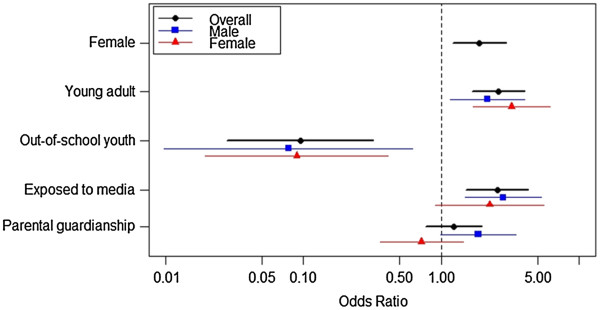
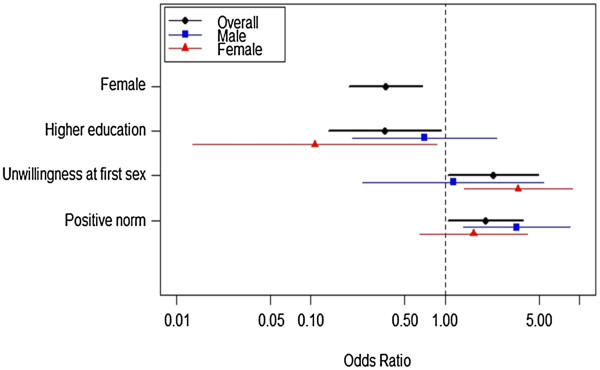
BACKGROUND: Globally, the proportion of youths has been steadily increasing, especially in Asia. This vulnerable population has limited exposure to sexual and reproductive health (SRH) information leading to various reproductive health (RH) problems including risky sexual debut, unwanted pregnancy, unsafe abortion as well as STI/HIV infections. Among known social variations which influence youth's RH, gender differences are critical for planning necessary gender appropriate interventions. This study aimed to identify gender differences in exposure to SRH information and risky sexual debut as well as associated factors among Myanmar youths in poor suburban communities of Mandalay City. METHODS: A total of 444 randomly selected youths (aged 15-24 years) from all poor, suburban communities in Mandalay City took part in our survey. Gender differences in exposure to SRH information and risky sexual debut were assessed by bivariate analysis. Multivariate logistic regression was used to confirm gender differences and identify independent factors associated with main outcomes separately for males and females as well as for both. RESULTS: Of 444 youths interviewed, 215 were males and 229 were females. Gender differences were seen in both exposures to SRH information (p = 0.013) and risky sexual debut (p = 0.003). These gender differences were confirmed by multivariate analysis even after adjusting for other risk factors. For exposure to SRH information, only age group and schooling status were significant factors for females. As well as those two factors, media exposure and parental guardianship were significant factors among males. Only positive norm of premarital sex increased the likelihood of risky sexual debut among males. In contrast, unwillingness at sexual debut was a risk factor and a higher education level was a protective factor for risky sexual debut among females. CONCLUSIONS: Limited exposure to SRH information and high risky sexual debut among poor youths were found. There were different influential factors for RH behaviors between males and females. Policy makers as well as local RH care providers should be aware of these differences. Dissemination of reliable SRH information among youths through possible mass media, especially among males, is an urgent issue.
Overview
The claims and statistics of this paper haven’t been checked yet.
Free: it reads the open-access text and checks the first 5 claims that cite a source we can check. Create a free account to check every claim.
Integrity signals
Registry
Cites
Statistics
Figures
Verification
Claims the paper makes
The claims and statistics of this paper haven’t been checked yet.
Free: it reads the open-access text and checks the first 5 claims that cite a source we can check. Create a free account to check every claim.
Claims other papers make about this one
Each is checked against this paper’s own text: does it say what the citing paper says it does?
The check wasn’t confident either way, so it gives no verdict — never disputed.
In the citing paper
“The proxy for education in this analysis—the ability to read—reduced repeat pregnancy by about half and supports several other studies showing relationships between education and number of offspring 37– 39.”
From Trends and birth outcomes in adolescent refugees and migrants on the Thailand-Myanmar border, 1986-2016: an observational study (2018) · cites this paper as [39]
Experimental — accuracy not yet measured
Self-check
Percentages, sums and reported differences re-computed from the paper’s own numbers.
The self-check needs the paper’s full text.
Citations
Cites
Dunkle, K. L., Jewkes, R. K., Brown, H. C., Gray, G. E., McIntryre, J. A., & Harlow, S. D. (2004) · The Lancet · doi:10.1016/s0140-6736(04)16098-4 · Cited by 1,323 · cited 1×
“The postulation was that abusive men were more likely to have HIV and impose risky sexual practices on their partners [37].”
BackgroundHow Sources of Sexual Information Relate to Adolescents' Beliefs About Sex
Bleakley, A. (2009) · American Journal of Health Behavior · doi:10.5993/ajhb.33.1.4 · Cited by 269 · cited 1×
“In contrast, mass media was significantly associated with beliefs that increased the likelihood of sexual exposure among adolescents in the US [30], a finding which highlights the importance of mass media among male youths and its ambiguous effects on their RH behaviors.”
BackgroundHindin, M. J., & Fatusi, A. O. (2009) · PubMed · doi:10.1363/ipsrh.35.058.09 · Cited by 208 · cited 5×
“Evidence has shown that males take more sexual risks than females [5,9,10].”
BackgroundInfluentialVan, D., McLaws, M.-L., Crimmins, J., MacIntyre, C. R., & Seale, H. (2010) · BMC Public Health · doi:10.1186/1471-2458-10-130 · Cited by 186
Hindin, M. J., & O. Fatusi, A. (2009) · International Perspectives on Sexual and Reproductive Health · doi:10.1363/3505809 · Cited by 179
Swenson, R. R., Rizzo, C. J., Brown, L. K., Vanable, P. A., Carey, M. P., Valois, R. F., DiClemente, R. J., & Römer, D. (2010) · Journal of the National Medical Association · doi:10.1016/s0027-9684(15)30772-0 · Cited by 141 · cited 11×
“However, females had a higher knowledge of STI/HIV resulting in a higher overall exposure to SRH information (p-value = 0.013).”
ResultInfluentialWong, L. P. (2012) · BMC Public Health · doi:10.1186/1471-2458-12-865 · Cited by 121 · cited 1×
“However, various socio-economic factors deter youths from receiving basic SRH information as well as achieving a safe and responsible sexual debut [3,5,8,9].”
BackgroundKaljee, L., Green, M., Riel, R., Lerdboon, P., Tho, L. H., Thoa, L. T. K., & Minh, T. T. (2007) · Journal of the Association of Nurses in AIDS Care · doi:10.1016/j.jana.2007.01.003 · Cited by 119
Cuffee, J. J., Hallfors, D. D., & Waller, M. W. (2007) · Journal of Adolescent Health · doi:10.1016/j.jadohealth.2007.02.012 · Cited by 114 · cited 6×
“Evidence has shown that males take more sexual risks than females [5,9,10].”
BackgroundInfluentialBarriers to Sexual Health Services for Young People in Nepal
Regmi, P. R., Van Teijlingen, E., Simkhada, P., & Acharya, D. R. (2010) · Journal of Health, Population and Nutrition · doi:10.3329/jhpn.v28i6.6611 · Cited by 108 · cited 1×
“Adolescents had lower exposure to SRH information compared to older youths probably because of their own embarrassment to access the available information or the cultural barrier which deters them to do so [27-29].”
Background
Research works printed but not linked: 2
- United Nations Asia’s Changing Youth Population 2001 http://www.eastwestcenter.org/fileadmin/stored/misc/FuturePop06Youth.pdf
- Zubairu I Isa SA Hadiza SG Babam-Maryam A Muktar HA Premarital sexual experience and preferred sources of reproductive health information among young men in Kumbotso, northern Nigeria Niger J Med 2012 21 343 349 23304934
Cited by
Ahinkorah, B. O., Kang, M., Perry, L., Brooks, F., & Hayen, A. (2021) · PLOS ONE · doi:10.1371/journal.pone.0246308 · Cited by 166
“Adolescent girls who are exposed to media may have greater access to SRH information [69, 70].”
BackgroundSserwanja, Q., Sepenu, A. S., Mwamba, D., & Mukunya, D. (2022) · BMJ Open · doi:10.1136/bmjopen-2021-052684 · Cited by 42
Romero‐Estudillo, E., González‐Jiménez, E., Mesa‐Franco, M. C., & García, I. G. (2014) · BMC Public Health · doi:10.1186/1471-2458-14-745 · Cited by 41
“The steadily increasing prevalence of STIs in people of younger ages underlines the need to examine the aspects involved in the adoption of high-risk sexual practices, based on gender [22].”
BackgroundMelese, M., Esubalew, D., Siyoum, T. M., Worku, Y. B., Azanaw, J., & Mengistie, B. A. (2024) · Frontiers in Public Health · doi:10.3389/fpubh.2024.1342027 · Cited by 35
Fentie, E. A., Kidie, A. A., Fetene, S. M., & Shewarega, E. S. (2023) · BMC Public Health · doi:10.1186/s12889-023-16124-6 · Cited by 29
Factors Associated with Risky Sexual Behavior among Unmarried Most-at-Risk Young People in Cambodia
Yi, S., Tuot, S., Yung, K., Kim, S., Chhea, C., & Saphonn, V. (2014) · American journal of public health research · doi:10.12691/ajphr-2-5-5 · Cited by 28
“Previous studies in China and Myanmar also found that out-of-school youths had limited opportunity to receive sexual reproductive health information [5,32].”
BackgroundResultInfluentialSserwanja, Q., Mwamba, D., Poon, P. K.-M., & Kim, J. H. (2022) · Archives of Sexual Behavior · doi:10.1007/s10508-022-02385-6 · Cited by 30
Parker, A. L., Parker, D. M., Zan, B. N., Min, A. M., Gilder, M. E., Ringringulu, M., Win, E., Wiladphaingern, J., Charunwatthana, P., Nosten, F., et al. (2018) · Wellcome Open Research · doi:10.12688/wellcomeopenres.14613.1 · Cited by 17
Htet, K. K. K., Phyu, A. N., Thwin, T., & Chongsuvivatwong, V. (2022) · JMIR Formative Research · doi:10.2196/37779 · Cited by 16
Maurya, C., Muhammad, T., & Thakkar, S. (2023) · Scientific Reports · doi:10.1038/s41598-023-34975-2 · Cited by 15
Sheehy, G., Aung, Y., Sietstra, C., & Foster, A. M. (2016) · Global Journal of Health Science · doi:10.5539/gjhs.v8n11p194 · Cited by 14
Tekletsadik, E., Debebe, S., & Daka, D. (2014) · Journal of Public Health and Epidemiology · doi:10.5897/jphe2014.0640 · Cited by 13
Ali, A. I., Azam, I., Tikmani, S. S., & Saleem, S. (2025) · BMJ Open · doi:10.1136/bmjopen-2024-096404 · Cited by 11
Nguyen, T. H. H., Linh, V. M., Thi, A. N., Thuy, H. M. T., Bui, L. K., Phuong, A. H., Thi, T. P., Duc, T. Q., & Nguyen, H. T. T. (2024) · International Journal of Adolescence and Youth · doi:10.1080/02673843.2024.2353207 · Cited by 13
“This result was comparable with a study among poor Myanmar youths (Thin Zaw et al., 2013), which means more positive perceptions among girls than boys.”
Mataraarachchi, D., Vithana, P. V. S. C., Lokubalasooriya, A., Jayasundara, C. J., Suranutha, A. S., Pathirana, T. E. A., & Silva, C. D. (2023) · Contraception and Reproductive Medicine · doi:10.1186/s40834-023-00216-0 · Cited by 9
“A study done among Myanmar youth in 2013 showed that females were more likely to have a negative perception of premarital sex and more likely to be under the guardianship of their parents [25], which might prevent them from accessing”
BackgroundChanging Trends in Sexual Debut Age in the Korean Internet Sexuality Survey
Park, J., Park, S. H., Lee, S. J., Song, W. H., Choi, W. S., Cho, M. C., & Son, H. (2021) · The World Journal of Men s Health · doi:10.5534/wjmh.210012 · Cited by 9
“Because the existing studies are often cross-sectional studies that employ questionnaires conducted at specific times [1-10], it is difficult to identify trends related to changes in the age of people’s first sexual intercourse.”
BackgroundAung, M. S., Soe, P. P., & Moh, M. M. (2019) · International Journal of Community Medicine and Public Health · doi:10.18203/2394-6040.ijcmph20194477 · Cited by 7
“A significant linkage of risky sexual debut with exposure to sexual and reproductive health information and media was also found among poor Myanmar youths (Thin Zaw et al. 2013).”
BackgroundInternet Usage and Risky Sexual Behavior among High School Students in a Suburban Area of Indonesia
Ibrahim, K., Juliana, A. A., Setyorini, D., & Pramukti, I. (2021) · Open Access Macedonian Journal of Medical Sciences · doi:10.3889/oamjms.2021.6379 · Cited by 10
“In Asia, similar finding also found among poor Myanmar youth [23].”
BackgroundBoku, G., Abeya, S. G., Ayers, N., & Abera, M. (2024) · Journal of Healthcare Leadership · doi:10.2147/jhl.s441951 · Cited by 8
Bauer, S. (2015) · Uppsala University Publications (Uppsala University) · Cited by 6
APLIKASI THEORY OF PLANNED BEHAVIOR: DETERMINAN PERILAKU SEKS PRA NIKAH PADA REMAJA
Qomariah, N. L., Widiyato, A., Atmojo, J. T., & Fajriah, A. S. (2021) · Avicenna Journal of Health Research · doi:10.36419/avicenna.v4i1.457 · Cited by 4
“Norma norma sosial memperngaruhi perilaku seksual remaja (Thin Zaw et al., 2013).”
BackgroundMasters Program in Public Health, U. S. M., Qomariah, N. L., Pamungkasari, E. P., & Budihastuti, U. R. (2020) · Journal of Health Promotion and Behavior · doi:10.26911/thejhpb.2020.05.04.05 · Cited by 3
Tamang, L. (2015) · The Sydney eScholarship Repository (The University of Sydney) · Cited by 7
Mofokeng, P. P. (2021) · ResearchSpace (University of KwaZulu-Natal) · Cited by 4
Tafess, T., & Negera, T. (2024) · Psychology and Behavioral Sciences · doi:10.11648/j.pbs.20241306.13 · Cited by 1
Psychosocial Factors Underlying Sexual Deviance Among Adolescents in ASEAN: a Systematic ReviewPreprint
Kamaluddin, M. R., Chendirasagaram, K., Mey, L. S., Ibrahim, F. B., Rathakrishnan, B., Singh, S. S. B., Nasir, N. C. M., Muda, A. T., Hinduan, Z. R., Mokhtar, D. M. M., et al. (2021) · Research Square · doi:10.21203/rs.3.rs-1099052/v1 · Cited by 2
Banwat, M., Lar, L., Odunze, P. A., & Ogbonna, C. (2017) · Journal of Epidemiological Society of Nigeria · doi:10.46912/jeson.9
Hlaing, Y. S. Y., Siewchaisakul, P., & Chautrakarn, S. (2025) · Frontiers in Reproductive Health · doi:10.3389/frph.2025.1626266
Adolescent Oral, Mental and Sexual Wellness
Folayan, M. O., Fatusi, A., & Oladeji, B. D. (2025) · Frontiers research topics · doi:10.3389/978-2-8325-7245-0
Ramiro, M. T. (2014) · Institutional Repository of the University of Granada (University of Granada) · Cited by 2
Hlaing, Y. S. Y., Siewchaisakul, P., & Chautrakarn, S. (2026) · Frontiers in Reproductive Health · doi:10.3389/frph.2026.1751178
Kawuki, J., Sserwanja, Q., & Kim, J. H. (2026) · Archives of Sexual Behavior · doi:10.1007/s10508-026-03458-6
Oo, T., Than, K. K., Kennedy, E., Azzopardi, P. S., Rittirong, J., & Phuengsamran, D. (2026) · Journal of Population and Social Studies · doi:10.25133/jpssv352027.031
Metadata
- Authors
- Thin Zaw, P. P., Liabsuetrakul, T., McNeil, E., & Htay, T. T.
- Affiliations
- Prince of Songkla University (TH)
- Ministry of Health (MM)
- Venue
- BMC Public Health
- Published
- 2013-12
- Volume
- 13
- Issue
- 1
- Pages
- 1122-1122
- ISSN
- 1471-2458 (ISSN-L)
- PMC
- PMC4235033
- OpenAlex
- W1971494166
- Cited by
- 30
- References
- 41
- Citations by year
- 2026: 2 · 2025: 2 · 2024: 4 · 2023: 3 · 2022: 3 · 2021: 6 · 2020: 1 · 2019: 1 · 2018: 1 · 2017: 1 · 2016: 1 · 2015: 2 · 2014: 3
- FWCI
- 3.62
- Type
- journal article
- Language
- en
- Open access
- gold
- doi.org
- Licence
- Locations
- BMC Public Health (publishedVersion, cc-by)
- Europe PMC (PubMed Central) (publishedVersion, cc-by)
- PubMed Central (publishedVersion, cc-by)
- PubMed (publishedVersion)
- Funders
- Prince of Songkla University
- Faculty of Medicine, Prince of Songkla University
- Topics
- Health Sciences › Medicine › Public Health, Environmental and Occupational Health › Adolescent Sexual and Reproductive Health
- Health Sciences › Medicine › Public Health, Environmental and Occupational Health › Adolescent Health and Behaviors
- Social Sciences › Psychology › Social Psychology › LGBTQ Health, Identity, and Policy
- Keywords
- sexual and reproductive health information, gender differences, youth sexual behavior, Myanmar, media exposure, educational attainment, risk factors
- MeSH terms
- Adolescent, Myanmar, Cities, Female, Humans, Male, Poverty, Pregnancy, Risk Factors, Risk-Taking, Sexual Behavior, Sex Education, Sex Factors, Multivariate Analysis, Consumer Health Information, Young Adult, Reproductive Health
About these checks
Registry, retraction, Cites and statistics results are computed, not judged, with one exception: a printed reference that no index lists is read once by a model before it counts as a citation error. Claims are extracted by a model and kept only when their quote appears verbatim in the text; each cited source is then checked, with a model’s help, for whether it says what the claim relies on. Those verdicts can be wrong — read the claim’s quote and the cited source before relying on one.
Statistics and arithmetic are recomputed, not judged.
Confidence bands are shown only for fields calibrated on our annotated test set. None is calibrated yet, so no band is shown.
What counts as a claim ›How we measure confidence ›How we check this ›
Are you an author, or do you see a problem with this page? Request a review
Data sources
Bibliographic data: Semantic Scholar, OpenAlex, Crossref.
Contains information from the Semantic Scholar Academic Graph Datasets, made available under the ODC Attribution License (ODC-BY 1.0).
Semantic Scholar’s data is described in: Kinney, R., et al. (2023). The Semantic Scholar Open Data Platform. arXiv:2301.10140.
