

Gender differences in exposure to SRH information and risky sexual debut among poor Myanmar youths.
Open accessThe DOI matches its Crossref record; 40 of the 41 references it cites were found in a registry or an index.
Abstract
BACKGROUND: Globally, the proportion of youths has been steadily increasing, especially in Asia. This vulnerable population has limited exposure to sexual and reproductive health (SRH) information leading to various reproductive health (RH) problems including risky sexual debut, unwanted pregnancy, unsafe abortion as well as STI/HIV infections. Among known social variations which influence youth's RH, gender differences are critical for planning necessary gender appropriate interventions. This study aimed to identify gender differences in exposure to SRH information and risky sexual debut as well as associated factors among Myanmar youths in poor suburban communities of Mandalay City. METHODS: A total of 444 randomly selected youths (aged 15-24 years) from all poor, suburban communities in Mandalay City took part in our survey. Gender differences in exposure to SRH information and risky sexual debut were assessed by bivariate analysis. Multivariate logistic regression was used to confirm gender differences and identify independent factors associated with main outcomes separately for males and females as well as for both. RESULTS: Of 444 youths interviewed, 215 were males and 229 were females. Gender differences were seen in both exposures to SRH information (p = 0.013) and risky sexual debut (p = 0.003). These gender differences were confirmed by multivariate analysis even after adjusting for other risk factors. For exposure to SRH information, only age group and schooling status were significant factors for females. As well as those two factors, media exposure and parental guardianship were significant factors among males. Only positive norm of premarital sex increased the likelihood of risky sexual debut among males. In contrast, unwillingness at sexual debut was a risk factor and a higher education level was a protective factor for risky sexual debut among females. CONCLUSIONS: Limited exposure to SRH information and high risky sexual debut among poor youths were found. There were different influential factors for RH behaviors between males and females. Policy makers as well as local RH care providers should be aware of these differences. Dissemination of reliable SRH information among youths through possible mass media, especially among males, is an urgent issue.
Overview
The claims and statistics of this paper haven’t been checked yet.
Free: it reads the open-access text and checks the first 5 claims that cite a source we can check. Create a free account to check every claim.
Integrity signals
Registry
Cites
Statistics
Figures
Verification
Claims the paper makes
The claims and statistics of this paper haven’t been checked yet.
Free: it reads the open-access text and checks the first 5 claims that cite a source we can check. Create a free account to check every claim.
Claims other papers make about this one
Each is checked against this paper’s own text: does it say what the citing paper says it does?
The check wasn’t confident either way, so it gives no verdict — never disputed.
In the citing paper
“The proxy for education in this analysis—the ability to read—reduced repeat pregnancy by about half and supports several other studies showing relationships between education and number of offspring 37– 39.”
From Trends and birth outcomes in adolescent refugees and migrants on the Thailand-Myanmar border, 1986-2016: an observational study (2018) · cites this paper as [39]
Experimental — accuracy not yet measured
Self-check
Percentages, sums and reported differences re-computed from the paper’s own numbers.
The self-check needs the paper’s full text.
Citations
Cites
Dunkle, K. L., Jewkes, R. K., Brown, H. C., Gray, G. E., McIntryre, J. A., & Harlow, S. D. (2004) · The Lancet · doi:10.1016/s0140-6736(04)16098-4 · Cited by 1,323 · cited 1×
“The postulation was that abusive men were more likely to have HIV and impose risky sexual practices on their partners [37].”
BackgroundHow Sources of Sexual Information Relate to Adolescents' Beliefs About Sex
Bleakley, A. (2009) · American Journal of Health Behavior · doi:10.5993/ajhb.33.1.4 · Cited by 269 · cited 1×
“In contrast, mass media was significantly associated with beliefs that increased the likelihood of sexual exposure among adolescents in the US [30], a finding which highlights the importance of mass media among male youths and its ambiguous effects on their RH behaviors.”
BackgroundHindin, M. J., & Fatusi, A. O. (2009) · PubMed · doi:10.1363/ipsrh.35.058.09 · Cited by 208 · cited 5×
“Evidence has shown that males take more sexual risks than females [5,9,10].”
BackgroundInfluentialVan, D., McLaws, M.-L., Crimmins, J., MacIntyre, C. R., & Seale, H. (2010) · BMC Public Health · doi:10.1186/1471-2458-10-130 · Cited by 186
Hindin, M. J., & O. Fatusi, A. (2009) · International Perspectives on Sexual and Reproductive Health · doi:10.1363/3505809 · Cited by 179
Swenson, R. R., Rizzo, C. J., Brown, L. K., Vanable, P. A., Carey, M. P., Valois, R. F., DiClemente, R. J., & Römer, D. (2010) · Journal of the National Medical Association · doi:10.1016/s0027-9684(15)30772-0 · Cited by 141 · cited 11×
“However, females had a higher knowledge of STI/HIV resulting in a higher overall exposure to SRH information (p-value = 0.013).”
ResultInfluentialWong, L. P. (2012) · BMC Public Health · doi:10.1186/1471-2458-12-865 · Cited by 121 · cited 1×
“However, various socio-economic factors deter youths from receiving basic SRH information as well as achieving a safe and responsible sexual debut [3,5,8,9].”
BackgroundKaljee, L., Green, M., Riel, R., Lerdboon, P., Tho, L. H., Thoa, L. T. K., & Minh, T. T. (2007) · Journal of the Association of Nurses in AIDS Care · doi:10.1016/j.jana.2007.01.003 · Cited by 119
Cuffee, J. J., Hallfors, D. D., & Waller, M. W. (2007) · Journal of Adolescent Health · doi:10.1016/j.jadohealth.2007.02.012 · Cited by 114 · cited 6×
“Evidence has shown that males take more sexual risks than females [5,9,10].”
BackgroundInfluentialBarriers to Sexual Health Services for Young People in Nepal
Regmi, P. R., Van Teijlingen, E., Simkhada, P., & Acharya, D. R. (2010) · Journal of Health, Population and Nutrition · doi:10.3329/jhpn.v28i6.6611 · Cited by 108 · cited 1×
“Adolescents had lower exposure to SRH information compared to older youths probably because of their own embarrassment to access the available information or the cultural barrier which deters them to do so [27-29].”
BackgroundMolla, M., Berhane, Y., & Lindtjørn, B. (2008) · BMC Public Health · doi:10.1186/1471-2458-8-9 · Cited by 98
Wang, B., Li, X., STANTON, B. F., Kamali, V., Naar‐King, S., Shah, I., & Thomas, R. (2007) · BMC Public Health · doi:10.1186/1471-2458-7-189 · Cited by 96 · cited 8×
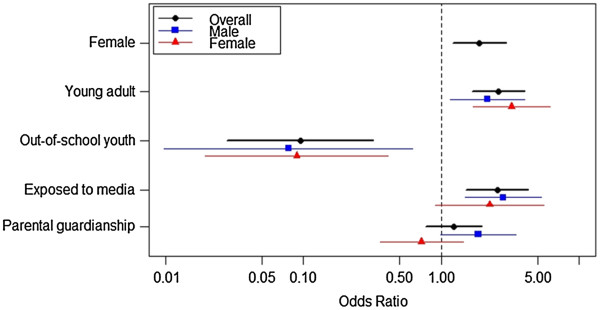
“Figure 1 Overall and sex stratified factors associated with exposure t forced into sex was extremely high among females in our study compared to a study conducted among out-ofschool youths in China [24].”
BackgroundResultInfluentialEverybody’s doin’ it (right?): Neighborhood norms and sexual activity in adolescence
Warner, T. D., Giordano, P. C., Manning, W. D., & Longmore, M. A. (2011) · Social Science Research · doi:10.1016/j.ssresearch.2011.06.009 · Cited by 84
Forced Sex and HIV Risk in Violent Relationships
Campbell, J. C., Lucea, M. B., Stockman, J. K., & Draughon, J. E. (2013) · American Journal of Reproductive Immunology · doi:10.1111/aji.12026 · Cited by 79 · cited 1×
“The finding that females who had sex unwillingly or were forced into sex at their sexual debut were more likely to be exposed to risky sexual behaviors was also supported by a systematic review conducted in the US [36].”
Pre-marital sexual debut and its associated factors among in-school adolescents in eastern Ethiopia
Oljira, L., Berhane, Y., & Worku, A. (2012) · BMC Public Health · doi:10.1186/1471-2458-12-375 · Cited by 72 · cited 4×
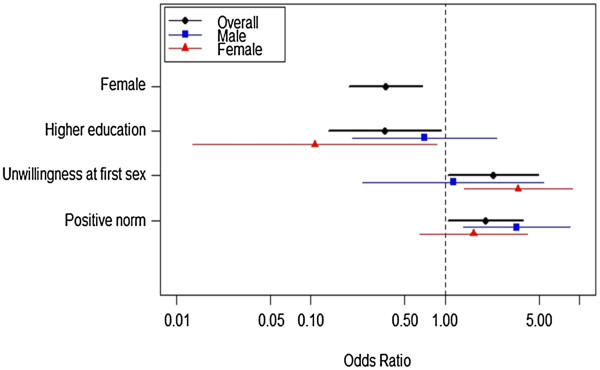
“Figure 2 Overall and sex stratified factors associated with risky sexua Asian and African studies [5,9-11].”
BackgroundResultInfluentialMeasurement of Motivations For and Against Sexual Behavior
Patrick, M. E., Maggs, J. L., Cooper, M. L., & Lee, C. M. (2010) · Assessment · doi:10.1177/1073191110372298 · Cited by 67 · cited 1×
“This might probably be because males have a higher interest in sexual pleasure, freedom of motivations to have sex, and lesser feelings of guilt and shame after sex compared to females [9,32].”
BackgroundThe Timing of Sexual Debut Among Chinese Youth
Guo, W., Wu, Z. L., Qiu, Y., Chen, G., & Zheng, X. (2012) · International Perspectives on Sexual and Reproductive Health · doi:10.1363/3819612 · Cited by 64 · cited 5×
“On the other hand, the level of early sexual debut among both males and females was alarmingly high in our study compared to a Chinese study in which sexual debut before age 18 among youths was rare [10].”
BackgroundResultInfluentialEthnic differences in childhood and adolescent sexual abuse and teenage pregnancy
Kenney, J. W., Reinholtz, C., & Angelini, P. J. (1997) · Journal of Adolescent Health · doi:10.1016/s1054-139x(97)00035-9 · Cited by 55 · cited 1×
“Females are socioeconomically more vulnerable, especially in poor communities and are more likely to be coerced into sexual debut and early marriage than males [12,13].”
BackgroundMbizvo, M. T., & Zaidi, S. (2010) · International Journal of Gynecology & Obstetrics · doi:10.1016/j.ijgo.2010.04.001 · Cited by 55 · cited 1×
“Failure to provide adequate sexual and reproductive health (SRH) information to youths combined with their lack of exposure to this information during this transitional period may lead to major public health implications such as STI/HIV infections, unwanted pregnancies and unsafe abortions as well as risky sexual debu…”
BackgroundDenison, J. A., Tsui, S., Bratt, J., Torpey, K., Weaver, M. A., & Kabaso, M. (2012) · Health Education Research · doi:10.1093/her/cyr093 · Cited by 49 · cited 1×
“Adequate exposure to proper SRH information has been shown to have a protective effect on risky sexual behaviors and reduce negative RH outcomes [6,7].”
BackgroundChar, A., Saavala, M., & Kulmala, T. (2011) · BMC Public Health · doi:10.1186/1471-2458-11-476 · Cited by 43 · cited 2×
“A study conducted among young-unmarried men in India showed that these men also received SRH information mainly from the mass media [26].”
BackgroundResultZaw, P. P. T., Liabsuetrakul, T., Htay, T. T., & McNeil, E. B. (2012) · BMC Health Services Research · doi:10.1186/1472-6963-12-458 · Cited by 41 · cited 1×
“In the larger study, youths as well as RH care providers (governmental, non-governmental and local drug-shop owners) and community leaders were included (participant triangulation) by using both quantitative and qualitative methods (method triangulation) [19].”
MethodSelf-citationRusakaniko, S., Mbizvo, M. T., Kasule, J., Gupta, V., Kinoti, S. N., Mpanju-Shumbushu, W., Sebina-Zziwa, J., Mwateba, R., & Padayachy, J. (1997) · PubMed · Cited by 36
Decraen, E. V., Michielsen, K., Herbots, S., Rossem, R. V., & Temmerman, M. (2012) · African Journal of Reproductive Health · Cited by 30
Risk behaviours and associated factors among medical students and community youths in Myanmar.
San, S. H., Myo, O., Yoshida, Y., Md., H.-O.-R., & SAKAMOTO, J. (2010) · PubMed · doi:10.18999/nagjms.72.1-2.71 · Cited by 27 · cited 1×
“Early, premarital and risky sexual debut is not uncommon [16-18]; however issues on youth’s sexual behaviors have so far been poorly understood and scarcely addressed in the country due to cultural reasons.”
BackgroundRossem, R. V., Berten, H., & Tuyckom, C. V. (2010) · BMC Public Health · doi:10.1186/1471-2458-10-30 · Cited by 26 · cited 1×
“A higher education level was a protective factor of risky sexual debut among females, a finding which was supported by many other studies [33-35].”
ResultMbonile, L., & Kayombo, E. J. (2008) · East African Journal of Public Health · doi:10.4314/eajph.v5i1.38973 · Cited by 26 · cited 1×
“Adolescents had lower exposure to SRH information compared to older youths probably because of their own embarrassment to access the available information or the cultural barrier which deters them to do so [27-29].”
BackgroundFactors associated with early sexual debut in Slovenia: results of a general population survey
Klavs, I., Rodrigues, L. C., Weiss, H. A., & Hayes, R. (2006) · Sexually Transmitted Infections · doi:10.1136/sti.2006.019984 · Cited by 26 · cited 1×
“Sexual debut is important because the earlier age at sexual debut, the more risky sexual behaviors become later in life [4].”
BackgroundHargreaves, J., Slaymaker, E., Fearon, E., & Howe, L. D. (2012) · Journal of the International AIDS Society · doi:10.7448/ias.15.3.17363 · Cited by 24 · cited 1×
“A higher education level was a protective factor of risky sexual debut among females, a finding which was supported by many other studies [33-35].”
ResultChanges in HIV knowledge, and socio-cultural and sexual attitudes in South India from 2003-2009
Bradley, J., Rajaram, S., Moses, S., Bhattacharjee, P., Lobo, A. M., Ramesh, B., Washington, R., & Alary, M. (2011) · BMC Public Health · doi:10.1186/1471-2458-11-s6-s12 · Cited by 18 · cited 1×
“The level of exposure to SRH information (mainly on sexuality and STI/HIV) among males and females in our study was lower compared to that of Indian and African studies conducted among youths [20-22].”
ResultKakoko, D., Ketting, E., Kamazima, S. R., & Ruben, R. (2012) · African Journal of Reproductive Health · Cited by 18
Opportunities and Challenges of Sexual Health Services Among Young People: A Study in Nepal
Regmi, K. (2008) · The Journal of Sexual Medicine · doi:10.1111/j.1743-6109.2008.00798.x · Cited by 15 · cited 2×
“Failure to provide adequate sexual and reproductive health (SRH) information to youths combined with their lack of exposure to this information during this transitional period may lead to major public health implications such as STI/HIV infections, unwanted pregnancies and unsafe abortions as well as risky sexual debu…”
BackgroundUnadike, B., Ekrikpo, U. E., & Bassey, E. (2012) · PubMed · Cited by 9
Cui, N., Tian, A.-P., Li, M., & Shah, I. (2012) · PubMed · Cited by 8
Young adults and aids epidemics: their perception awareness information sources and sexual practices
Oyeyemi, A. Y., & Oyeyemi, B. O. (2012) · East African Journal of Public Health · doi:10.4314/eajph.v9i1.110015 · Cited by 6 · cited 1×
“The level of exposure to SRH information (mainly on sexuality and STI/HIV) among males and females in our study was lower compared to that of Indian and African studies conducted among youths [20-22].”
ResultSexual and reproductive health needs of vulnerable youth in Myanmar.
Hla-Soe-Tint, Phyo-Maung-Thaw, Yin-Thet-Nu-Oo, Ko-Ko-Zaw, Than-Tun-Sein, & Thein-Tun (2008) · PubMed · Cited by 6
Iliyasu, Z., Zubairu, I. H., Abubakar, I. S., Isa, S. A., Galadanci, H. S., Hadiza, S., Maryam, A., Babam-Maryam, A., Aliyu, M. H., & Muktar, H. (2012) · PubMed · Cited by 5
A look at Asia's changing youth population.
Xenos, P. S., Kabamalan, M., & Westley, S. B. (1999) · PubMed · Cited by 4
Behavioural interventions required in South East Asia to minimize infections with HIV
Dwyer, J. M. (1996) · International Journal of STD & AIDS · doi:10.1258/0956462961917681 · Cited by 3 · cited 1×
“In addition, SRH for youths is a culturally sensitive issue in most Asian countries [14].”
BackgroundRisk behaviors for HIV/AIDS among youth in rural area of Myanmar.
Pacheun, O., Shwe, E. E., & Powwattana, A. (2008) · PubMed · Cited by 1
Research works printed but not linked: 2
- United Nations Asia’s Changing Youth Population 2001 http://www.eastwestcenter.org/fileadmin/stored/misc/FuturePop06Youth.pdf
- Zubairu I Isa SA Hadiza SG Babam-Maryam A Muktar HA Premarital sexual experience and preferred sources of reproductive health information among young men in Kumbotso, northern Nigeria Niger J Med 2012 21 343 349 23304934
Cited by
Ahinkorah, B. O., Kang, M., Perry, L., Brooks, F., & Hayen, A. (2021) · PLOS ONE · doi:10.1371/journal.pone.0246308 · Cited by 166
“Adolescent girls who are exposed to media may have greater access to SRH information [69, 70].”
BackgroundSserwanja, Q., Sepenu, A. S., Mwamba, D., & Mukunya, D. (2022) · BMJ Open · doi:10.1136/bmjopen-2021-052684 · Cited by 42
Romero‐Estudillo, E., González‐Jiménez, E., Mesa‐Franco, M. C., & García, I. G. (2014) · BMC Public Health · doi:10.1186/1471-2458-14-745 · Cited by 41
“The steadily increasing prevalence of STIs in people of younger ages underlines the need to examine the aspects involved in the adoption of high-risk sexual practices, based on gender [22].”
BackgroundMelese, M., Esubalew, D., Siyoum, T. M., Worku, Y. B., Azanaw, J., & Mengistie, B. A. (2024) · Frontiers in Public Health · doi:10.3389/fpubh.2024.1342027 · Cited by 35
Fentie, E. A., Kidie, A. A., Fetene, S. M., & Shewarega, E. S. (2023) · BMC Public Health · doi:10.1186/s12889-023-16124-6 · Cited by 29
Metadata
- Authors
- Thin Zaw, P. P., Liabsuetrakul, T., McNeil, E., & Htay, T. T.
- Affiliations
- Prince of Songkla University (TH)
- Ministry of Health (MM)
- Venue
- BMC Public Health
- Published
- 2013-12
- Volume
- 13
- Issue
- 1
- Pages
- 1122-1122
- ISSN
- 1471-2458 (ISSN-L)
- PMC
- PMC4235033
- OpenAlex
- W1971494166
- Cited by
- 30
- References
- 41
- Citations by year
- 2026: 2 · 2025: 2 · 2024: 4 · 2023: 3 · 2022: 3 · 2021: 6 · 2020: 1 · 2019: 1 · 2018: 1 · 2017: 1 · 2016: 1 · 2015: 2 · 2014: 3
- FWCI
- 3.62
- Type
- journal article
- Language
- en
- Open access
- gold
- doi.org
- Licence
- Locations
- BMC Public Health (publishedVersion, cc-by)
- Europe PMC (PubMed Central) (publishedVersion, cc-by)
- PubMed Central (publishedVersion, cc-by)
- PubMed (publishedVersion)
- Funders
- Prince of Songkla University
- Faculty of Medicine, Prince of Songkla University
- Topics
- Health Sciences › Medicine › Public Health, Environmental and Occupational Health › Adolescent Sexual and Reproductive Health
- Health Sciences › Medicine › Public Health, Environmental and Occupational Health › Adolescent Health and Behaviors
- Social Sciences › Psychology › Social Psychology › LGBTQ Health, Identity, and Policy
- Keywords
- sexual and reproductive health information, gender differences, youth sexual behavior, Myanmar, media exposure, educational attainment, risk factors
- MeSH terms
- Adolescent, Myanmar, Cities, Female, Humans, Male, Poverty, Pregnancy, Risk Factors, Risk-Taking, Sexual Behavior, Sex Education, Sex Factors, Multivariate Analysis, Consumer Health Information, Young Adult, Reproductive Health
About these checks
Registry, retraction, Cites and statistics results are computed, not judged, with one exception: a printed reference that no index lists is read once by a model before it counts as a citation error. Claims are extracted by a model and kept only when their quote appears verbatim in the text; each cited source is then checked, with a model’s help, for whether it says what the claim relies on. Those verdicts can be wrong — read the claim’s quote and the cited source before relying on one.
Statistics and arithmetic are recomputed, not judged.
Confidence bands are shown only for fields calibrated on our annotated test set. None is calibrated yet, so no band is shown.
What counts as a claim ›How we measure confidence ›How we check this ›
Are you an author, or do you see a problem with this page? Request a review
Data sources
Bibliographic data: Semantic Scholar, OpenAlex, Crossref.
Contains information from the Semantic Scholar Academic Graph Datasets, made available under the ODC Attribution License (ODC-BY 1.0).
Semantic Scholar’s data is described in: Kinney, R., et al. (2023). The Semantic Scholar Open Data Platform. arXiv:2301.10140.
