

Burden of self-reported acute gastrointestinal illness in China: a population-based survey
Open accessThe DOI matches its Crossref record; 43 of the 43 references it cites were found in a registry or an index.
Abstract
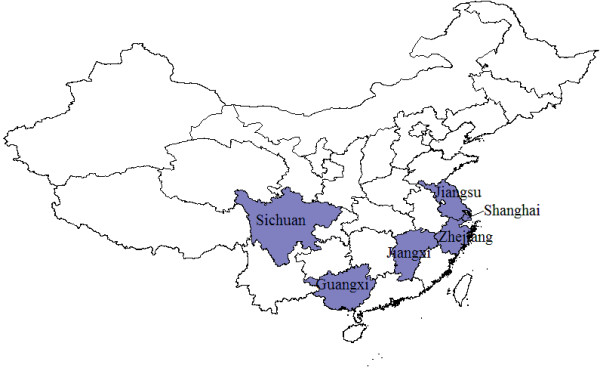
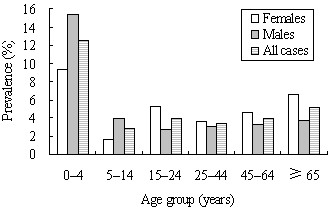
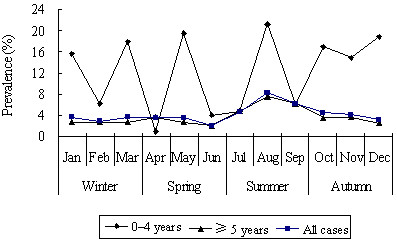
Background: Acute gastrointestinal illness (AGI) is an important public-health problem worldwide. Previous national studies of the incidence of AGI in China were performed decades ago, and detailed information was not available. This study therefore sought to determine the magnitude, distribution, and burden of self-reported AGI in China. Methods: Twelve-month, retrospective face-to-face surveys were conducted in 20 sentinel sites from six provinces between July 2010 and July 2011. Results: In total, 39686 interviews were completed. The overall adjusted monthly prevalence of AGI was 4.2% (95% confidence interval, 4.0–4.4), corresponding to 0.56 episodes of AGI per person-year. Rates of AGI were highest in children aged < 5 years. Healthcare was sought by 56.1% of those reporting illness. Of the cases who visited a doctor, 32.7% submitted a stool sample. The use of antibiotics was reported by 49.7% of the cases who sought medical care and 54.0% took antidiarrhoeals. In the multivariable model, gender, age, education, household type, residence, season, province and travel were significant risk factors of being a case of AGI. Conclusions: This first population-based study in China indicated that AGI represents a substantial burden of health. Further research into the specific pathogens is needed to better estimate the burden of AGI and foodborne disease in China.
Overview
The claims and statistics of this paper haven’t been checked yet.
Free: it reads the open-access text and checks the first 5 claims that cite a source we can check. Create a free account to check every claim.
Integrity signals
Registry
Cites
Statistics
Figures
Verification
Claims the paper makes
The claims and statistics of this paper haven’t been checked yet.
Free: it reads the open-access text and checks the first 5 claims that cite a source we can check. Create a free account to check every claim.
Claims other papers make about this one
Each is checked against this paper’s own text: does it say what the citing paper says it does?
The cited source says what the claim attributes to it.
In the citing paper
“However, they suggest acute gastro-intestinal disease is common (around one in two people a year) and around one third of cases (12%–55%) are self-attributed to food [41,42,43,44].”
From Food Safety in Low and Middle Income Countries (2015) · cites this paper as [43]
Self-check
Percentages, sums and reported differences re-computed from the paper’s own numbers.
The self-check needs the paper’s full text.
Citations
Cites
中華人民共和国国家統計局 (1988) · Medical Entomology and Zoology · Cited by 12,443
Foodborne illness acquired in the United States—Major pathogens
Scallan, E., Hoekstra, R. M., Angulo, F. J., Tauxe, R. V., Widdowson, M.-A., Roy, S. L., Jones, J. L., & Griffin, P. M. (2011) · Emerging Infectious Diseases · doi:10.3201/eid1701.p11101 · Cited by 7,657 · cited 1×
“56 AGI episodes per person-year, by extrapolating the average of the proportion of AGI that is foodborne published from the USA (25%), England and Wales (26%) and Australia (32%) [15-18], it is estimated that there are 209 million cases of foodborne disease in China in one year.”
Modern Epidemiology 3rd edition
Rothman, K. J., Lash, T. L., & Greenland, S. (1986) · Cited by 3,103
Modern Epidemiology / Kenneth J. Rothman, Sander Greenland and Timothy L. Lash
Rothman, K. J., Greenland, S., & Lash, T. L. (2008) · Cited by 2,158
Stowman, K. (1949) · The Milbank Memorial Fund Quarterly · doi:10.2307/3348165 · Cited by 2,096
(2012) · Choice Reviews Online · doi:10.5860/choice.49-6620 · Cited by 1,273
Foodborne Illness Acquired in the United States—Unspecified Agents
Scallan, E., Griffin, P. M., Angulo, F. J., Tauxe, R. V., & Hoekstra, R. M. (2011) · Emerging Infectious Diseases · doi:10.3201/eid1701.p21101 · Cited by 1,050 · cited 1×
“56 AGI episodes per person-year, by extrapolating the average of the proportion of AGI that is foodborne published from the USA (25%), England and Wales (26%) and Australia (32%) [15-18], it is estimated that there are 209 million cases of foodborne disease in China in one year.”
de Wit, M. A. S., Koopmans, M. P. G., Kortbeek, L. M., Wannet, W. J. B., Vinjé, J., van Leusden, F., Bartelds, A. I. M., & van Duynhoven, Y. T. H. P. (2001) · American Journal of Epidemiology · doi:10.1093/aje/154.7.666 · Cited by 583 · cited 2×
“Prospective cohort studies tend to give lower rates with a rate of 0.28 episodes per person-year in The Netherlands [24] and a rate of 0.27 in the United Kingdom [25].”
InfluentialTam, C. C., Rodrigues, L. C., Viviani, L., Dodds, J. P., Evans, M. R., Hunter, P. R., Gray, J. J., Letley, L. H., Rait, G., Tompkins, D. S., et al. (2012) · Gut · doi:10.1136/gut.2011.238386 · Cited by 564 · cited 1×
“27 in the United Kingdom [25].”
Trends in indigenous foodborne disease and deaths, England and Wales: 1992 to 2000
Adak, G. K., Long, S. M., & O’Brien, S. J. (2002) · Gut · doi:10.1136/gut.51.6.832 · Cited by 480 · cited 1×
“56 AGI episodes per person-year, by extrapolating the average of the proportion of AGI that is foodborne published from the USA (25%), England and Wales (26%) and Australia (32%) [15-18], it is estimated that there are 209 million cases of foodborne disease in China in one year.”
Research works printed but not linked: 2
- Wei CY The disease control and prevention strategy of infectious diarrhoea in China Haixia Yu Fang Yi Xue Za Zhi 2006 12 3 1 4 Article in Chinese
- Rothman K Greenland S Lash T Modern epidemiology 2008 3 Philadelphia, Pennsylvania: Lippincott-Raven
Cited by
Global Economic Burden of Norovirus Gastroenteritis
Bartsch, S. M., Lopman, B. A., Ozawa, S., Hall, A. J., & Lee, B. Y. (2016) · PLOS ONE · doi:10.1371/journal.pone.0151219 · Cited by 567
Food Safety in Low and Middle Income Countries
Grace, D. (2015) · International Journal of Environmental Research and Public Health · doi:10.3390/ijerph120910490 · Cited by 544
“However, they suggest acute gastro-intestinal disease is common (around one in two people a year) and around one third of cases (12%–55%) are self-attributed to food [41–44].”
BackgroundSurveillance of foodborne disease outbreaks in China, 2003–2017
Li, W., Pires, S. M., Liu, Z., Ma, X., Liang, J., Jiang, Y., Chen, J., Liang, J., Wang, S., Wang, L., et al. (2020) · Food Control · doi:10.1016/j.foodcont.2020.107359 · Cited by 228
Self-citationSurveillance for foodborne disease outbreaks in China, 2003 to 2008
Wu, Y., Liu, X., Chen, Q., Liu, H., Dai, Y., Zhou, Y., Wen, J., Tang, Z., & Chen, Y. (2017) · Food Control · doi:10.1016/j.foodcont.2017.08.010 · Cited by 148
“A study of acute gastrointestinal illness (AGI) in China estimated 209 million episodes of foodborne disease occurred in 2010e2011, and the relative incidence in China appears to be within the range of incidence reported in the abovementioned countries (Chen et al., 2013) .”
Self-citationEpidemiology of foodborne disease outbreaks caused by Vibrio parahaemolyticus, China, 2003–2008
Wu, Y., Wen, J., Ma, Y., Ma, X., & Chen, Y. (2014) · Food Control · doi:10.1016/j.foodcont.2014.05.023 · Cited by 125
Self-citationFood safety monitoring and surveillance in China: Past, present and future
Wu, Y., & Chen, J. (2018) · Food Control · doi:10.1016/j.foodcont.2018.03.009 · Cited by 73
Self-citationSurveillance for foodborne disease outbreaks in Zhejiang Province, China, 2015–2020
Chen, L., Sun, L., Zhang, R., Liao, N., Qi, X., & Chen, J. (2022) · BMC Public Health · doi:10.1186/s12889-022-12568-4 · Cited by 61
Self-citationConsumer knowledge, risk perception and food-handling behaviors – A national survey in China
Wang, M., Huang, L., Xia, L., & Bai, L. (2020) · Food Control · doi:10.1016/j.foodcont.2020.107789 · Cited by 63
Li, W., Cui, Q., Bai, L., Fu, P., Han, H., Liu, J., & Guo, Y. (2021) · Foodborne Pathogens and Disease · doi:10.1089/fpd.2020.2908 · Cited by 48
“In China, based on the estimates of 0.56 acute gastrointestinal illness episodes per person-year, about 748 million cases occur each year (Chen et al. , 2013).”
InfluentialNational molecular tracing network for foodborne disease surveillance in China
Li, W., Wu, S., Fu, P., Liu, J., Han, H., Bai, L., Pei, X., Li, N., Liu, X., & Guo, Y. (2017) · Food Control · doi:10.1016/j.foodcont.2017.12.032 · Cited by 37
Xian, X., Wang, L., Wu, X., Tang, X., Zhai, X., Yu, R., Qu, L., & Ye, M. (2023) · BMC Infectious Diseases · doi:10.1186/s12879-023-08799-4 · Cited by 43
“…1,082 cases of bacterial FBD, if relying solely on these numbers alone would seriously underestimate the number of FBD in China, and a national acute gastroenteritis survey estimates that 748 million cases of acute gastroenteritis and 420 million medical consultations occur in China every year [7].”
BackgroundClark, S. N., Berrang‐Ford, L., Lwasa, S., Namanya, D. B., Edge, V. L., & Harper, S. L. (2014) · Epidemiology and Infection · doi:10.1017/s0950268814003124 · Cited by 40
“Batwa AGI estimated incidence using an internationally comparable case definition [29] was higher than incidences reported in studies using the same case definition but using a 28- or 30-day recall period in Denmark [12], Italy [11], Ontario [16], United States [10], Chile [20], The Netherlands [8], Australia [10, 13]…”
BackgroundResultInfluentialGu, P., Feng, Y. X., Zhu, L., Kong, L., Zhang, X., Zhang, S., Li, S., & Jia, G. (2020) · Molecules · doi:10.3390/molecules25081797 · Cited by 30
Food Safety Knowledge, Attitudes and Behavior among Dairy Plant Workers in Beijing, Northern China
Chen, Y., Ji, H., Chen, L., Jiang, R., & Wu, Y. (2018) · International Journal of Environmental Research and Public Health · doi:10.3390/ijerph15010063 · Cited by 28
“It is estimated that approximately 200 million cases of foodborne disease occurred in China annually [5].”
BackgroundSelf-citationZhu, Y., Liu, W., Liu, S., Li, M., Zhao, L., Xu, L., Wang, N., Zhao, G., & Yu, Q. (2022) · Food Research International · doi:10.1016/j.foodres.2022.111426 · Cited by 22
Bian, W., Hou, H., Chen, J., Zhou, B., Xia, J. C., Xie, S., & Liu, T. C. (2022) · Remote Sensing · doi:10.3390/rs14153613 · Cited by 22
Self-citationZhao, J., Cheng, H., Wang, Z., Fu, P. P., Guo, Y., & Yang, S. (2022) · Foodborne Pathogens and Disease · doi:10.1089/fpd.2022.0028 · Cited by 25
“Based on the incidence of 0.56 episodes of acute gastro-intestinal illness (AGI) per person per year, it is estimated that there are 209 million cases of foodborne illness in China each year (Chen et al. , 2013).”
InfluentialSelf-citationLi, Y.-J., Yang, Y.-F., Zhou, Y., Zhang, R., Liu, C., Liu, H. D., Li, X., Chen, W., Chen, Y., & Wu, Y. (2022) · PLoS ONE · doi:10.1371/journal.pone.0277203 · Cited by 25
“heavy burden of disease to society [1-6] .”
BackgroundSelf-citationChen, Y., Liu, H., Chen, M., Sun, H., & Wu, Y. (2020) · PLoS ONE · doi:10.1371/journal.pone.0242156 · Cited by 21
“To estimate the incidence of AGI in the general population, a twelve-month, face-to-face survey from July 2010 through June 2011 of randomly selected respondents were conducted in Shanghai of east China [7].”
BackgroundSelf-citationSang, X.-L., Liang, X.-C., Chen, Y., Li, J.-D., Li, J.-G., Bai, L., & Sun, J.-Y. (2014) · BMC Public Health · doi:10.1186/1471-2458-14-787 · Cited by 19
“Data were collected using a questionnaire developed through the modification of a pre-existing population-based burden-of-disease questionnaire [8].”
BackgroundMethodResultInfluentialSelf-citationBai, L., Cai, Z., Lv, Y., Wu, T., Sharma, M., Shi, Z., Hou, X., & Zhao, Y. (2018) · International Journal of Environmental Research and Public Health · doi:10.3390/ijerph15092059 · Cited by 22
Zoch-Lesniak, B., Karch, A., Dreesman, J. M., Monazahian, M., Baillot, A., & Mikolajczyk, R. (2015) · BMC Infectious Diseases · doi:10.1186/s12879-015-1189-0 · Cited by 17
“If a sample collection was only conducted during hospital visits or consultation of a physician, more than half of the respiratory infections and one quarter of the gastrointestinal infections in childhood would be missed [9] [10] [11] [12] [13] .”
BackgroundChen, Y., Ford, L., HALL, G., Dobbins, T., & Kirk, M. (2015) · Epidemiology and Infection · doi:10.1017/s0950268815001375 · Cited by 21
Self-citationKim, Y. S., Lee, S. H., Kim, S. H., Joo, Y., & Bahk, G. J. (2014) · Food Control · doi:10.1016/j.foodcont.2014.07.015 · Cited by 23
Yan, W., Dai, Y.-S., Zhou, Y., LIU, H., Duan, S., Han, H., & CHEN, Y. (2014) · Epidemiology and Infection · doi:10.1017/s0950268814001599 · Cited by 15
“In this study, 1·4% of controls took antibiotics which is consistent with previous data on antibiotic use in the Chinese population (1·5%) [26].”
Self-citationMoving Forward to the Future: A Review of Microbial Food Safety Education in China
Chen, H., & Feng, Y. (2021) · Foodborne Pathogens and Disease · doi:10.1089/fpd.2020.2889 · Cited by 17
“In China, a previous study found that an estimated 200 million foodborne illness cases occur annually (Chen et al. , 2013).”
Lucero, Y., Lagomarcino, A. J., Espinoza, M., Kawakami, N., Nora Mamani, M., Huerta, N., Canto, F. D., Farfán, M. J., Sawaguchi, Y., George, S., et al. (2020) · International Journal of Infectious Diseases · doi:10.1016/j.ijid.2020.10.013 · Cited by 17
Liu, J., Luo, B., Zhou, Y., Ma, X., Liang, J., Sang, X., Lv, L., Chen, W., Fu, P., Liu, H., et al. (2023) · BMC Public Health · doi:10.1186/s12889-023-15337-z · Cited by 14
Self-citationChen, Y., Wen, Y., Song, J., Chen, B., Ding, S., Ding, L., & Dai, J. (2018) · BMC Public Health · doi:10.1186/s12889-018-6223-x · Cited by 11
Self-citationWang, A., Huang, Q., Lin, Q., Zhong, X., Li, H., Chen, R., Wan, Z., Lin, H. D., Liang, J., Li, J., et al. (2018) · Epidemiology and Infection · doi:10.1017/s0950268818002212 · Cited by 11
Self-citationXiao, C., Lyu, H., Zhang, J., Bai, L., & Wang, J. (2021) · Foodborne Pathogens and Disease · doi:10.1089/fpd.2021.0022 · Cited by 10
Towards One Health: Reflections and practices on the different fields of One Health in China
Li, Q., Guo, C., Hu, H., & Lu, J. (2021) · Biosafety and Health · doi:10.1016/j.bsheal.2021.12.004 · Cited by 12
Al-Mohaithef, M. (2021) · Environmental Health Insights · doi:10.1177/11786302211050761 · Cited by 8
Ren, H., Liu, T. C., Hou, H., Qi, X., Fang, L., Yang, Y., & Ma, R. (2024) · Foods · doi:10.3390/foods13132116 · Cited by 7
“In terms of occupational distribution, the detection rate of V. parahaemolyticus was highest among cadres and staff, followed by houseworkers and the unemployed and migrant workers.”
BackgroundMa, R., Liu, T. C., Fang, L., Chen, J., Yao, S., Lei, H., & Song, Y. (2025) · Foods · doi:10.3390/foods14101800 · Cited by 8
“Key meteorological factors—air temperature, relative humidity, precipitation, sunshine duration, and wind speed—were identified as significant predictors, with lags of 3, 7, 8, 3, and 0 weeks, respectively.”
Self-citationAin, Q. U., & Asif, S. (2024) · Computational Biology and Chemistry · doi:10.1016/j.compbiolchem.2024.108238 · Cited by 11
Li, J., Zhang, T., Cai, K., Jiang, Y., Guan, X., Zhan, J., Zou, W., Yang, Z., Xing, X., Wu, Y. F., et al. (2018) · Virus Research · doi:10.1016/j.virusres.2018.03.016 · Cited by 6
Self-citationIncidence of acute diarrheal illness in Chinese communities: a meta-analysis
Cui, P., Li, J., Liu, N., & Duan, Z.-J. (2018) · BMC Gastroenterology · doi:10.1186/s12876-018-0839-2 · Cited by 11
Self-citationChen, Y., Wen, Y., Song, J., Chen, B., Wang, L., Ding, S., Ding, L., & Dai, J. (2019) · Journal of Food Protection · doi:10.4315/0362-028x.jfp-18-163 · Cited by 6
Self-citationHuo, Y., Gao, F., Wang, J., Liu, Z., Zhou, L., Gu, B., Zhang, X., & Ma, Y. (2022) · Frontiers in Public Health · doi:10.3389/fpubh.2022.905458 · Cited by 6
Self-citationShi, Y. Y., Sun, R., An, D., Lü, W., Zhang, C., Wang, L., Liu, Y., & Wang, Q. (2016) · Food Control · doi:10.1016/j.foodcont.2016.11.025 · Cited by 5
“parahaemolyticus may be much higher than reported, as outbreaks may be overlooked and incidents may occur sporadically in multiple locations (Chen et al., 2013; Kubota et al., 2011; Scallan et al., 2011).”
BackgroundYu, J., Zhu, W., Ye, C., Xue, C., Lai, S., ZHANG, H.-L., Zhang, Z., Geng, Q., Yang, W., Sun, Q., et al. (2017) · Epidemiology and Infection · doi:10.1017/s0950268817001844 · Cited by 5
“years of age, a target sample of 3000 was required based on an assumed monthly prevalence of 4% [5], with a 1% precision level, a 95% confidence level and a design effect of two.”
BackgroundResultInfluentialAlkeem, F. A., Loney, T., Aziz, F., Blair, I., Sonnevend, Á., & Sheek‐Hussein, M. (2019) · International Journal of Infectious Diseases · doi:10.1016/j.ijid.2019.06.004 · Cited by 4
Swimming pool-associated viral outbreaks in China: causes and solutions
Huang, Z. (2024) · Frontiers in Public Health · doi:10.3389/fpubh.2024.1480680 · Cited by 3
Yang, L., Yuan, Y., Long, J., Yang, J., Li, Z., & Li, Q. (2025) · Tropical Medicine and Health · doi:10.1186/s41182-025-00812-7 · Cited by 4
“…the incidence rate of diarrhea frequency in Chongqing to be 0.69 times per person year, higher than the 0.54 times per person year in the municipality city of Shanghai Pudong area and that in the national survey in 2010 [5, 25], indicating a larger disease burden of diarrhea in Chongqing.”
InfluentialBurden of acute gastrointestinal infections in Ouagadougou, Burkina Faso
Huovinen, R. D. E. (2016) · Journal of Microbiology and Infectious Diseases · doi:10.5799/jmid.328799 · Cited by 5
“This proportion of stool samples taken is lower than in developed countries [6,8,25,26].”
Wang, J., He, Y., Chen, L., Zhang, H., Qi, X., Sun, L., Zhang, S.-F., Chen, J., & Zhang, R. (2022) · PLoS ONE · doi:10.1371/journal.pone.0268717 · Cited by 3
“In summary, we concluded that acute gastrointestinal illness (AGI) causes a substantial health burden in Zhejiang Province in southeast China.”
BackgroundInfluentialSelf-citationUsing Convolutional Neural Networks to Extract Keywords and Keyphrases About Foodborne Illnesses
Wang, J. (2019) · The Atrium (University of Guelph) · Cited by 3
Food‐borne Diseases and Surveillance
Guo, Y., Wu, S., & Zhu, J. (2017) · doi:10.1002/9781119238102.ch5 · Cited by 2
Evaluating Chinese migrant workers’ housing conditions by diarrhea disease prevalence
Lyu, J., Feng, B., Kim, H., & Marwah, G. (2025) · Journal of Public Health Policy · doi:10.1057/s41271-025-00567-9 · Cited by 1
“Self-reported diarrhea is widely used in developing countries to reflect foodborne diseases in social epidemiological research [18].”
Prevalence of foodborne diseases in the Western Pacific region
Toyofuku, H. (2022) · Elsevier eBooks · doi:10.1016/b978-0-12-822521-9.00019-8
https://apps.crossref.org/webDeposit/
Leary, J. K. O. (2022) · doi:10.34719/qolt9975
Chen, L., Sun, L., Zhang, R., Liao, N., Qi, X., & Chen, J. (2022) · Figshare · doi:10.6084/m9.figshare.18739381
Self-citationChen, L., Sun, L., Zhang, R., Liao, N., Qi, X., & Chen, J. (2022) · Figshare · doi:10.6084/m9.figshare.18739384
Self-citationSang, X., Fan, Y., Liang, X., Li, J. J., & Chen, Y. (2026) · BMC Public Health · doi:10.1186/s12889-026-27563-2
“In China, submitted stool specimens primarily undergo routine analysis for indicators such as red and white blood cells, occult blood, and parasite eggs, with limited specific testing for foodborne pathogens [31].”
Self-citation
Metadata
- Authors
- Chen, Y., Yan, W.-X., Zhou, Y.-J., Zhen, S.-Q., Zhang, R.-H., Chen, J., Liu, Z.-H., Cheng, H.-Y., Liu, H., Duan, S.-G., Lan, Z., Sun, J.-C., You, X.-Y., Li, J.-G., & Wu, Y.-N.
- Affiliations
- China National Center for Food Safety Risk Assessment (CN)
- Zhejiang Center for Disease Control and Prevention (CN)
- Guangxi Center for Disease Prevention and Control (CN)
- Shanghai Municipal Center For Disease Control Prevention (CN)
- Sichuan Center for Disease Control and Prevention (CN)
- Nanchang Center for Disease Control and Prevention (CN)
- Venue
- BMC Public Health
- Published
- 2013-05-08
- Volume
- 13
- Issue
- 1
- Pages
- 456-456
- ISSN
- 1471-2458 (ISSN-L)
- PMC
- PMC3655923
- OpenAlex
- W2145479375
- Semantic Scholar
- 508aed973f17f44834855d23bdd88fab48160576
- Cited by
- 55
- References
- 43
- Citations by year
- 2026: 1 · 2025: 3 · 2024: 3 · 2023: 2 · 2022: 11 · 2021: 5 · 2020: 5 · 2019: 3 · 2018: 7 · 2017: 4 · 2016: 3 · 2015: 3 · 2014: 5
- FWCI
- 2.66
- Type
- journal article
- Language
- en
- Open access
- gold
- doi.org
- Licence
- Locations
- BMC Public Health (publishedVersion, cc-by)
- Europe PMC (PubMed Central) (publishedVersion, cc-by)
- PubMed Central (publishedVersion, cc-by)
- PubMed (publishedVersion)
- Funders
- Ministry of Education of the People's Republic of China (973 program)
- National Health and Family Planning Commission of the People's Republic of China (201302005)
- National Key Research and Development Program of China (201302005, 2012CB720804)
- Topics
- Health Sciences › Medicine › Infectious Diseases › Viral gastroenteritis research and epidemiology
- Life Sciences › Agricultural and Biological Sciences › Food Science › Salmonella and Campylobacter epidemiology
- Health Sciences › Medicine › Public Health, Environmental and Occupational Health › Global Health and Epidemiology
- Keywords
- acute gastrointestinal illness, disease burden, prevalence, diarrhea, children, risk factors, healthcare seeking, stool sampling, antibiotic use, food poisoning, China
- MeSH terms
- Acute Disease, Adolescent, Adult, Child, Child, Preschool, China, Cross-Sectional Studies, Female, Gastrointestinal Diseases, Humans, Infant, Infant, Newborn, Interviews as Topic, Male, Middle Aged, Risk Factors, Socioeconomic Factors, Prevalence, Young Adult, Self Report
About these checks
Registry, retraction, Cites and statistics results are computed, not judged, with one exception: a printed reference that no index lists is read once by a model before it counts as a citation error. Claims are extracted by a model and kept only when their quote appears verbatim in the text; each cited source is then checked, with a model’s help, for whether it says what the claim relies on. Those verdicts can be wrong — read the claim’s quote and the cited source before relying on one.
Statistics and arithmetic are recomputed, not judged.
Confidence bands are shown only for fields calibrated on our annotated test set. None is calibrated yet, so no band is shown.
What counts as a claim ›How we measure confidence ›How we check this ›
Are you an author, or do you see a problem with this page? Request a review
Data sources
Bibliographic data: Semantic Scholar, OpenAlex, Crossref.
Contains information from the Semantic Scholar Academic Graph Datasets, made available under the ODC Attribution License (ODC-BY 1.0).
Semantic Scholar’s data is described in: Kinney, R., et al. (2023). The Semantic Scholar Open Data Platform. arXiv:2301.10140.
