

Screening and brief interventions for hazardous and harmful alcohol use among patients with active tuberculosis attending primary public care clinics in South Africa: results from a cluster randomized controlled trial
Open accessThe DOI matches its Crossref record; 48 of the 48 references it cites were found in a registry or an index.
Abstract
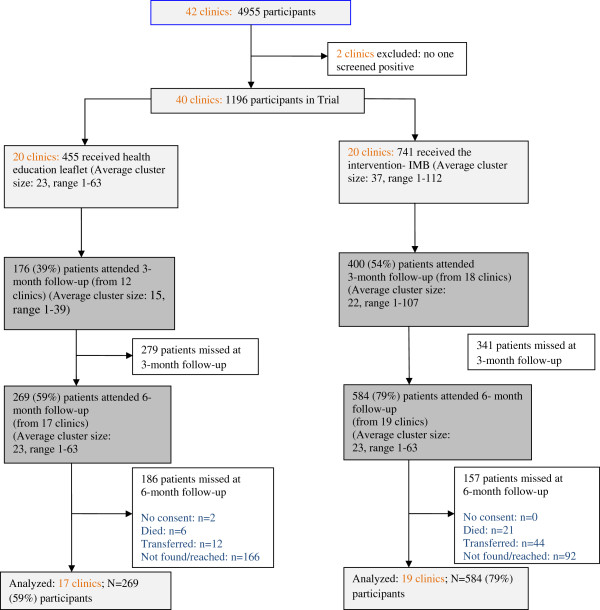
BACKGROUND: In 2008 the World Health Organization (WHO) reported that South Africa had the highest tuberculosis (TB) incidence in the world. This high incidence rate is linked to a number of factors, including HIV co-infection and alcohol use disorders. The diagnosis and treatment package for TB and HIV co-infection is relatively well established in South Africa. However, because alcohol use disorders may present more insidiously, making it difficult to diagnose, those patients with active TB and misusing alcohol are not easily cured from TB. With this in mind, the primary purpose of this cluster randomized controlled trial was to provide screening for alcohol misuse and to test the effectiveness of brief interventions in reducing alcohol intake in those patients with active TB found to be misusing alcohol in primary public health care clinics in three districts in South Africa. METHODS: Within each of the three provinces targeted, one district with the highest TB burden was selected. Furthermore, 14 primary health care facilities with the highest TB caseload in each district were selected. In each district, 7 of the 14 (50%) clinics were randomly assigned to a control arm and another 7 of the 14 (50%) clinics assigned to intervention arm. At the clinic level systematic sampling was used to recruit newly diagnosed and retreatment TB patients. Those consenting were screened for alcohol misuse using the Alcohol Use Disorder Identification Test (AUDIT). Patients who screened positive for alcohol misuse over a 6-month period were given either a brief intervention based on the Information-Motivation-Behavioural Skills (IMB) Model or an alcohol use health education leaflet. RESULTS: Of the 4882 tuberculosis patients screened for alcohol and agreed to participate in the trial, 1196 (24.6%) tested positive for the AUDIT. Among the 853 (71%) patients who also attended the 6-month follow-up session, the frequency of positive screening results at baseline/follow-up were 100/21.2% for the AUDIT (P < 0.001) for the control group and 100/16.8% (P < 0.001) for the intervention group. The intervention effect on the AUDIT score was statistically not significant. The intervention effect was also not significant for hazardous or harmful drinkers and alcohol dependent drinkers ( AUDIT: 7-40), alcohol dependent drinkers and heavy episodic drinking, while the control group effect was significant for hazardous drinkers ( AUDIT: 7-19) (P = 0.035). CONCLUSION: The results suggest that alcohol screening and the provision of a health education leaflet on sensible drinking performed at the beginning of anti-tuberculosis treatment in public primary care settings may be effective in reducing alcohol consumption. TRIAL REGISTRATIONS: PACTR201105000297151.
Overview
The claims and statistics of this paper haven’t been checked yet.
Free: it reads the open-access text and checks the first 5 claims that cite a source we can check. Create a free account to check every claim.
Integrity signals
Registry
Cites
Statistics
Figures
Verification
Claims the paper makes
The claims and statistics of this paper haven’t been checked yet.
Free: it reads the open-access text and checks the first 5 claims that cite a source we can check. Create a free account to check every claim.
Claims other papers make about this one
Each is checked against this paper’s own text: does it say what the citing paper says it does?
The cited source doesn’t support the claim as written.
In the citing paper
“Blinding of outcome assessment (detection bias) All outcomes High risk”
From Psychosocial and pharmacologic interventions to reduce harmful alcohol use in low- and middle-income countries (2023) · cites this paper as Peltzer 2013
Checked by a reasoning model — may be wrong.
Experimental — accuracy not yet measuredThe cited source says what the claim attributes to it.
In the citing paper
“Similarly, those evaluating a brief intervention in tuberculosis patients in the inpatient or outpatient setting showed limited results [22,79].”
From Patient-level interventions to reduce alcohol-related harms in low- and middle-income countries: A systematic review and meta-summary (2022) · cites this paper as [79]
The cited source says what the claim attributes to it.
In the citing paper
“However, there were some studies that found a similar reduction in alcohol-related outcomes between both the intervention and control groups, thus a null effect [22,28,30,79,80,82,88].”
From Patient-level interventions to reduce alcohol-related harms in low- and middle-income countries: A systematic review and meta-summary (2022) · cites this paper as [79]
The cited source says what the claim attributes to it.
In the citing paper
“In our systematic review, 6 studies evaluated brief interventions in South Africa [67,79–81,93,94].”
From Patient-level interventions to reduce alcohol-related harms in low- and middle-income countries: A systematic review and meta-summary (2022) · cites this paper as [79]
The cited source says what the claim attributes to it.
In the citing paper
“The intervention effect on the AUDIT score was statistically not significant.”
From A scoping review of substance use brief interventions in Africa (2024) · cites this paper as [89]
6 more claims about this paper
Create a free account to see every claim other papers make about this one.
Self-check
Percentages, sums and reported differences re-computed from the paper’s own numbers.
The self-check needs the paper’s full text.
Citations
Cites
(2001) · Cited by 5,455
Effectiveness of brief alcohol interventions in primary care populations
Kaner, E. F., Beyer, F. R., Muirhead, C., Campbell, F., Pienaar, E. D., Bertholet, N., Daeppen, J. B., Saunders, J. B., & Burnand, B. (2018) · Cochrane Database of Systematic Reviews · doi:10.1002/14651858.cd004148.pub4 · Cited by 1,665
Moyer, A., Finney, J. W., Swearingen, C. E., & Vergun, P. (2002) · Addiction · doi:10.1046/j.1360-0443.2002.00018.x · Cited by 1,092 · cited 1×
“A previous review [39] found a clinically important difference in negative status on AUDIT between brief intervention and controls of 13% (5% reduction in controls and 18% in brief intervention recipients).”
MethodMissing Data in Clinical Studies
Molenberghs, G., & Kenward, M. G. (2007) · Wiley eBooks · doi:10.1002/9780470510445 · Cited by 962
Effectiveness of brief alcohol interventions in primary care populations
Kaner, E. F. S., Dickinson, H. O., Beyer, F. R., Campbell, F., Schlesinger, C., Heather, N., Saunders, J. B., Burnand, B., & Pienaar, E. D. (2007) · Cochrane Database of Systematic Reviews · doi:10.1002/14651858.cd004148.pub3 · Cited by 746 · cited 1×
“Whilst there have been studies conducted on screening for alcohol misuse and brief interventions producing favourable results [19,20], there is a dearth of scientific literature on evidence-based best practice methods to screen for alcohol misuse and brief interventions amongst individuals with active TB [21].”
Fisher, W. A., Fisher, J. D., & Harman, J. (2003) · Social Psychological Foundations of Health and Illness · doi:10.1002/9780470753552.ch4 · Cited by 644 · cited 1×
“The IMB model [30-32] proposes that information about alcohol misuse and methods of reducing and preventing harmful and/or hazardous drinking is a necessary precursor to risk reduction.”
MethodAlcohol use as a risk factor for tuberculosis – a systematic review
Lönnroth, K., Williams, B. G., Stadlin, S., Jaramillo, E., & Dye, C. (2008) · BMC Public Health · doi:10.1186/1471-2458-8-289 · Cited by 548 · cited 2×
“There are numerous studies cited in the literature that support the strong association between alcohol use, alcohol use disorders and TB [3-8].”
BackgroundBrief intervention for hazardous and harmful drinking: a manual for use in primary care.
Babor, T. F., & Higgins-Biddle, J. C. (2001) · Cited by 484
Rehm, J., Samokhvalov, A. V., Neuman, M. G., Room, R., Parry, C., Lönnroth, K., Patra, J., Poznyak, V., & Popova, S. (2009) · BMC Public Health · doi:10.1186/1471-2458-9-450 · Cited by 458
Myer, L., Smit, J., Roux, L. L., Parker, S., Stein, D. J., & Seedat, S. (2008) · AIDS Patient Care and STDs · doi:10.1089/apc.2007.0102 · Cited by 450 · cited 1×
“tivity and specificity in detecting MINI-defined dependence/abuse (sensitivity, 100% and correctly classified 79% of individuals who did not have alcohol abuse or dependence) [27] and among TB and HIV patients in primary care in Zambia demonstrating good discriminatory ability in detecting MINI-defined current AUDs (A…”
MethodThe effectiveness of brief alcohol interventions in primary care settings: A systematic review
KANER, E. F. S., DICKINSON, H. O., BEYER, F., PIENAAR, E., SCHLESINGER, C., CAMPBELL, F., SAUNDERS, J. B., BURNAND, B., & HEATHER, N. (2009) · Drug and Alcohol Review · doi:10.1111/j.1465-3362.2009.00071.x · Cited by 434 · cited 1×
“Whilst there have been studies conducted on screening for alcohol misuse and brief interventions producing favourable results [19,20], there is a dearth of scientific literature on evidence-based best practice methods to screen for alcohol misuse and brief interventions amongst individuals with active TB [21].”
BackgroundSocial Psychological Foundations of Health and Illness
(2003) · Wiley eBooks · doi:10.1002/9780470753552 · Cited by 426
Hazardous and Harmful Alcohol Consumption in Primary Care
Reid, M. C., Fiellin, D. A., & O'Connor, P. G. (1999) · Archives of Internal Medicine · doi:10.1001/archinte.159.15.1681 · Cited by 368
Review of the effectiveness of treatment for alcohol problems.
Raistrick, D., Heather, N., & Godfrey, C. (2006) · Cited by 352
Lane, C., Huws-Thomas, M., Hood, K., Rollnick, S., Edwards, K., & Robling, M. (2005) · Patient Education and Counseling · doi:10.1016/j.pec.2004.01.003 · Cited by 250 · cited 1×
“The brief intervention counsellor was assessed for adherence to the brief counselling protocol in addition to their behaviour and skills using a Behaviour Change Counselling Index [36].”
MethodDaeppen, J.-B., Yersin, B., Landry, U., P??coud, A., & Decrey, H. (2000) · Alcoholism: Clinical and Experimental Research · doi:10.1097/00000374-200005000-00010 · Cited by 246 · cited 1×
“To increase the reliability of the AUDIT, researchers have suggested locating alcohol consumption within the context of other health-related behaviours [25].”
BackgroundMcCambridge, J., & Kypri, K. (2011) · PLoS ONE · doi:10.1371/journal.pone.0023748 · Cited by 242 · cited 1×
“McCambridge and Kypri [41] reviewed that simply answering questions on drinking in brief intervention trials appears to alter subsequent self-reported behaviour.”
BackgroundAlcohol use and problem drinking in South Africa: Findings from a national population-based survey.
Peltzer, K., Davids, A., & Njuho, P. (2011) · African Journal of Psychiatry · doi:10.4314/ajpsy.v14i1.65466 · Cited by 226
Self-citationAlcohol, Immunosuppression, and the Lung
Happel, K. I., & Nelson, S. (2005) · Proceedings of the American Thoracic Society · doi:10.1513/pats.200507-065js · Cited by 207 · cited 1×
“Numerous studies show the pathogenic impact of alcohol on the immune system causing susceptibility to TB among drinkers [4,7,9].”
BackgroundChishinga, N., Kinyanda, E., Weiss, H. A., Patel, V., Ayles, H., & Seedat, S. (2011) · BMC Psychiatry · doi:10.1186/1471-244x-11-75 · Cited by 146 · cited 1×
“75 for men) [28].”
Social psychological foundations of health and illness
(2004) · Choice Reviews Online · doi:10.5860/choice.41-2847 · Cited by 143
Framework for effective tuberculosis control
Gräf, P. (1994) · Tubercle and Lung Disease · doi:10.1016/0962-8479(94)90785-4 · Cited by 126
Newbury-Birch, D., Bland, M., Cassidy, P., Coulton, S., Deluca, P., Drummond, C., Gilvarry, E., Godfrey, C., Heather, N., Kaner, E., et al. (2009) · BMC Public Health · doi:10.1186/1471-2458-9-418 · Cited by 90
Alcohol and infectious diseases: an overlooked causal linkage?
PARRY, C., REHM, J., POZNYAK, V., & ROOM, R. (2009) · Addiction · doi:10.1111/j.1360-0443.2008.02500.x · Cited by 83
Alcohol Exacerbates Murine Pulmonary Tuberculosis
Mason, C. M., Dobard, E., Zhang, P., & Nelson, S. (2004) · Infection and Immunity · doi:10.1128/iai.72.5.2556-2563.2004 · Cited by 76 · cited 2×
“Numerous studies show the pathogenic impact of alcohol on the immune system causing susceptibility to TB among drinkers [4,7,9].”
BackgroundFreeborn, D. K., Polen, M. R., Hollis, J. F., & Senft, R. A. (2000) · The Journal of Behavioral Health Services & Research · doi:10.1007/bf02287826 · Cited by 68
Noknoy, S., Rangsin, R., Saengcharnchai, P., Tantibhaedhyangkul, U., & McCambridge, J. (2010) · Alcohol and Alcoholism · doi:10.1093/alcalc/agq013 · Cited by 64 · cited 1×
“The consensus in the research community that self-reported alcohol consumption was valid derives mainly from conclusions drawn from studies undertaken in treatment contexts [45].”
Kaner, E., Bland, M., Cassidy, P., Coulton, S., Deluca, P., Drummond, C., Gilvarry, E., Godfrey, C., Heather, N., Myles, J., et al. (2009) · BMC Public Health · doi:10.1186/1471-2458-9-287 · Cited by 62 · cited 1×
“This information supported clinical supervision and training until the brief intervention counsellor reached a required standard of practice agreed by the assessors [37].”
MethodPeltzer, K., Friend-du Preez, N., Ramlagan, S., Fomundam, H., Anderson, J., & Chanetsa, L. (2011) · African Journal of Traditional, Complementary and Alternative Medicines · doi:10.4314/ajtcam.v8i4.1 · Cited by 61 · cited 1×
“, [42] seem to have shown a reduction of alcohol use with the initiation of ART, which could be similar with the initiation to TB treatment.”
ResultSelf-citationBrief Intervention in Alcohol-Dependent Versus Nondependent Individuals
Guth, S., Lindberg, S. A., Badger, G. J., Thomas, C. S., Rose, G. L., & Helzer, J. E. (2008) · Journal of Studies on Alcohol and Drugs · doi:10.15288/jsad.2008.69.243 · Cited by 51 · cited 1×
“A few studies have reported that brief interventions are effective even among excessive drinkers [22-24].”
BackgroundPeltzer, K., Matseke, G., Azwihangwisi, M., & Babor, T. (2008) · Croatian medical journal · doi:10.3325/cmj.2008.3.392 · Cited by 51
Self-citationPeltzer, K., Tabane, C. E. M., Matseke, G., & Simbayi, L. C. (2010) · Evaluation and Program Planning · doi:10.1016/j.evalprogplan.2010.03.002 · Cited by 46 · cited 1×
“Lay counsellor delivered brief alcohol interventions with TB patients seems to be feasible to implement with fidelity in the South African primary care setting, as found in the context of HIV risk reduction counselling in South Africa [44].”
BackgroundSelf-citationPeltzer, K., Louw, J., Mchunu, G., Naidoo, P., Matseke, G., & Tutshana, B. (2012) · International Journal of Environmental Research and Public Health · doi:10.3390/ijerph9093245 · Cited by 44 · cited 1×
“2%-36%) [11,12].”
Self-citationBreaking new ground in the study and practice of alcohol brief interventions
HEATHER, N. (2010) · Drug and Alcohol Review · doi:10.1111/j.1465-3362.2010.00204.x · Cited by 43
Tsai, Y., Tsai, M., Lin, Y., & Chen, C. (2009) · Alcoholism: Clinical and Experimental Research · doi:10.1111/j.1530-0277.2008.00815.x · Cited by 42 · cited 1×
“A few studies have reported that brief interventions are effective even among excessive drinkers [22-24].”
BackgroundDo brief interventions which target alcohol consumption also reduce cigarette smoking?
McCambridge, J., & Jenkins, R. J. (2008) · Drug and Alcohol Dependence · doi:10.1016/j.drugalcdep.2008.03.011 · Cited by 38 · cited 1×
“In addition, the study did not find a significant reduction of tobacco use in the intervention compared to the control group, which is in line with a recent review [43] that found brief alcohol interventions do not also reduce cigarette smoking, and it appears unlikely that there exist other important secondary effect…”
ResultJackson, J. K., & Holmes, T. H. (1957) · Human Organization · doi:10.17730/humo.16.4.l67575006414u38x · Cited by 32
Mathew, T. A., Yanov, S. A., Mazitov, R., Mishustin, S. P., Strelis, A. K., Yanova, G. V., Vt, G., Taran, D., Golubkov, A., Shields, A. L., et al. (2008) · European Journal of Public Health · doi:10.1093/eurpub/ckn093 · Cited by 30 · cited 2×
“The goals for brief counselling were as follows: 1) To identify any alcohol- related problems mentioned in the interview, 2) To introduce the sensible drinking leaflet, emphasis the idea of sensible drinking limits, and make sure that patients realize that they are in the risk drinking category, 3) To provide feedback…”
BackgroundMethodGreenfield, S. F., Shields, A., Connery, H. S., Livchits, V., Yanov, S. A., Lastimoso, C. S., Strelis, A. K., Mishustin, S. P., Fitzmaurice, G., Mathew, T. A., et al. (2010) · Alcoholism: Clinical and Experimental Research · doi:10.1111/j.1530-0277.2009.01094.x · Cited by 29
Training primary care nurses to conduct alcohol screening and brief interventions in South Africa
Peltzer, K., Seoka, P., Babor, T., & Obot, I. (2006) · Curationis · doi:10.4102/curationis.v29i2.1067 · Cited by 28 · cited 3×
“Counsellor training and intervention quality assurance The intervention counsellors consisted of lay HIV counsellors from the study clinics who spoke the predominant languages, namely English, Afrikaans, i-Zulu, i-Xhosa and Tswana, in the respective areas.”
MethodSelf-citationPREVALENCE OF ALCOHOL USE BY RURAL PRIMARY CARE OUTPATIENTS IN SOUTH AFRICA
Peltzer, K. (2006) · Psychological Reports · doi:10.2466/pr0.99.1.176-178 · Cited by 28 · cited 1×
“Screening instruments such as the AUDIT, CAGE (Cut Down, Annoyed, Guilty and Eye Opener), and Screening and Brief Interventions (SBIs) have been found to be useful in detecting and treating alcohol use disorders in a number of settings [13,16,17].”
MethodSelf-citationRole of Tl and T2 Cytokines in the Response to Mycobacterium tuberculosis
Flynn, J. L., & Bloom, B. R. (1996) · Annals of the New York Academy of Sciences · doi:10.1111/j.1749-6632.1996.tb52662.x · Cited by 26
Prevalence and Correlates of Substance Use Among South African Primary Care Clinic Patients
Ward, C. L., Mertens, J. R., Flisher, A. J., Bresick, G. F., Sterling, S. A., Little, F., & Weisner, C. M. (2008) · Substance Use & Misuse · doi:10.1080/10826080801922744 · Cited by 25 · cited 1×
“2% [14] and in a national population-based survey in South Africa 9% [15].”
BackgroundPeltzer, K. K., Naidoo, P. P., Matseke, G. G., & Zuma, K. K. (2011) · BMC Public Health · doi:10.1186/1471-2458-11-394 · Cited by 18 · cited 1×
“The IMB model also shows that information or motivation alone can have direct effects on some preventive behaviour, such as when information about risky alcohol drinking prompts drinking at moderate levels or to stop drinking more detail, [33].”
BackgroundSelf-citationAssessment of alcohol-screening instruments in tuberculosis patients
Schoeman, J. H., Parry, C. D. H., Lombard, C. J., & Klopper, H. J. (1994) · Tubercle and Lung Disease · doi:10.1016/0962-8479(94)90084-1 · Cited by 15 · cited 1×
“Increasing emphasis has been placed on the detection and treatment of hazardous and harmful drinking disorders, particularly among patients who are seen in primary health care settings [11].”
BackgroundAlcohol and susceptibility to tuberculosis
Szabó, G. (1997) · Alcohol Research & Health · Cited by 13
PREVALENCE OF ALCOHOL USE BY RURAL PRIMARY CARE OUTPATIENTS IN SOUTH AFRICA
Peltzer, K. (2006) · Psychological Reports · doi:10.2466/pr0.99.5.176-178 · Cited by 13
Self-citationRaistrick, D., & Tober, G. (2004) · Psychiatry · doi:10.1383/psyt.3.1.36.30294 · Cited by 8
Research works printed but not linked: 2
- World Health Organization Global tuberculosis report 2012. Report No. WHO/HTM/TB/2012.6 2012 Geneva, Switzerland: WHO
- Department of Health National tuberculosis management guidelines 2009 Pretoria: Department of Health
Cited by
Harmful use of alcohol: a shadow over Sub-Saharan Africa in need of workable solutions
Ferreira-Borges, C., Parry, C., & Babor, T. (2017) · International Journal of Environmental Research and Public Health · doi:10.3390/ijerph14040346 · Cited by 189
“The potential value of introducing alcohol-related preventive measures in primary health care and specialised HIV clinics, aimed at reducing alcohol consumption among people with HIV/AIDS or TB has already been noted [80,82,83].”
Backgroundvan Ginneken, N., Chin, W. Y., Lim, Y. C., Ussif, A., Singh, R., Shahmalak, U., Purgato, M., Rojas-García, A., Uphoff, E., McMullen, S., et al. (2021) · Cochrane Database of Systematic Reviews · doi:10.1002/14651858.cd009149.pub3 · Cited by 188
Hahn, J. A., Emenyonu, N. I., Fatch, R., Muyindike, W. R., Kekiibina, A., Carrico, A. W., Woolf‐King, S., & Shiboski, S. (2016) · Addiction · doi:10.1111/add.13173 · Cited by 97
The impact of alcohol consumption on African people in 2012: an analysis of burden of disease
Ferreira‐Borges, C., Rehm, J., Dias, S., Babor, T., & Parry, C. D. H. (2016) · Tropical Medicine & International Health · doi:10.1111/tmi.12618 · Cited by 90
“The potential value of introducing alcoholrelated preventive measures in primary public care or in HIV clinics, aimed at reducing alcohol consumption among people with HIV/AIDS or TB, has already been noted [35].”
BackgroundSorsdahl, K., Stein, D. J., Corrigall, J., Cuijpers, P., Smits, N., Naledi, T., & Myers, B. (2015) · Substance Abuse Treatment, Prevention, and Policy · doi:10.1186/s13011-015-0042-1 · Cited by 84
“Substance use disorders represent a major public health problem, both globally and in South Africa [1].”
Influential
Metadata
- Authors
- Peltzer, K., Naidoo, P., Louw, J., Matseke, G., Zuma, K., Mchunu, G., Tutshana, B., & Mabaso, M.
- Affiliations
- Human Sciences Research Council (ZA)
- Corresponding author
- Peltzer, Karl
- ORCID
- Venue
- BMC Public Health
- Published
- 2013-07-31
- Volume
- 13
- Issue
- 1
- Pages
- 699-699
- ISSN
- 1471-2458 (ISSN-L)
- PMC
- PMC3733870
- OpenAlex
- W1995966683
- Cited by
- 82
- References
- 46
- Citations by year
- 2026: 2 · 2025: 4 · 2024: 10 · 2023: 6 · 2022: 6 · 2021: 8 · 2020: 14 · 2019: 5 · 2018: 2 · 2017: 6 · 2016: 8 · 2015: 6 · 2014: 3 · 2013: 2
- FWCI
- 4.61
- Type
- journal article
- Language
- en
- Open access
- gold
- doi.org
- Licence
- Locations
- BMC Public Health (publishedVersion, cc-by)
- Europe PMC (PubMed Central) (publishedVersion, cc-by)
- PubMed Central (publishedVersion, cc-by)
- PubMed (publishedVersion)
- Funders
- National Department of Health (21/2010-2011)
- Topics
- Health Sciences › Medicine › Epidemiology › Substance Abuse Treatment and Outcomes
- Health Sciences › Medicine › Infectious Diseases › Tuberculosis Research and Epidemiology
- Health Sciences › Medicine › Pathology and Forensic Medicine › Alcohol Consumption and Health Effects
- Keywords
- tuberculosis, alcohol abuse, screening, brief intervention, Alcohol Use Disorders Identification Test, information-motivation-behavioural skills model, alcoholism, HIV coinfection, primary care, alcohol consumption reduction, South Africa, binge drinking, health education leaflets, tuberculosis incidence
- MeSH terms
- Adult, Alcoholism, Female, Health Promotion, Humans, Male, Mass Screening, Patient Education as Topic, Primary Health Care, Psychotherapy, Brief, Socioeconomic Factors, South Africa, Tuberculosis, Comorbidity, Cluster Analysis, Treatment Outcome, Risk Reduction Behavior
About these checks
Registry, retraction, Cites and statistics results are computed, not judged, with one exception: a printed reference that no index lists is read once by a model before it counts as a citation error. Claims are extracted by a model and kept only when their quote appears verbatim in the text; each cited source is then checked, with a model’s help, for whether it says what the claim relies on. Those verdicts can be wrong — read the claim’s quote and the cited source before relying on one.
Statistics and arithmetic are recomputed, not judged.
Confidence bands are shown only for fields calibrated on our annotated test set. None is calibrated yet, so no band is shown.
What counts as a claim ›How we measure confidence ›How we check this ›
Are you an author, or do you see a problem with this page? Request a review
Data sources
Bibliographic data: Semantic Scholar, OpenAlex, Crossref.
Contains information from the Semantic Scholar Academic Graph Datasets, made available under the ODC Attribution License (ODC-BY 1.0).
Semantic Scholar’s data is described in: Kinney, R., et al. (2023). The Semantic Scholar Open Data Platform. arXiv:2301.10140.
