

Effectiveness and reach of a directed-population approach to improving dental health and reducing inequalities: a cross sectional study
Open accessThe DOI matches its Crossref record; 20 of the 20 references it cites were found in a registry or an index.
Abstract
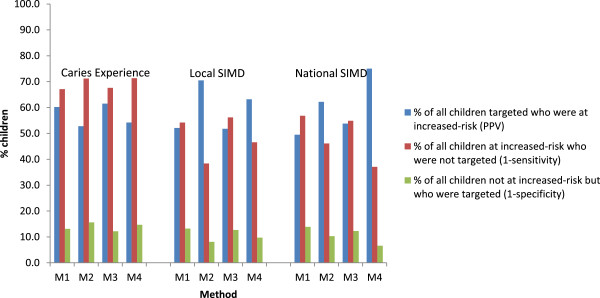
Background: Childsmile School adopts a directed-population approach to target fluoride varnish applications to 20% of the primary one (P1) population in priority schools selected on the basis of the proportion of enrolled children considered to be at increased-risk of developing dental caries. The study sought to compare the effectiveness of four different methods for identifying individuals most in need when a directed-population approach is taken. Methods: The 2008 Basic National Dental Inspection Programme (BNDIP) cross-sectional P1 Scottish epidemiological survey dataset was used to model four methods and test three definitions of increased-risk. Effectiveness was determined by the positive predictive value (PPV) and explored in relation to 1-sensitivity and 1-specificity. Results: Complete data was available on 43470 children (87% of the survey). At the Scotland level, at least half (50%) of the children targeted were at increased-risk irrespective of the method used to target or the definition of increased-risk. There was no one method across all definitions of increased-risk that maximised PPV. Instead, PPV was highest when the targeting method complimented the definition of increased-risk. There was a higher percentage of children at increased-risk who were not targeted (1-sensitivity) when caries experience (rather than deprivation) was used to define increased-risk, irrespective of the method used for targeting. Over all three definitions of increased-risk, there was no one method that minimised (1-sensitivity) although this was lowest when the method and definition of increased-risk were complimentary. The false positive rate (1-specificity) for all methods and all definitions of increased-risk was consistently low (<20%), again being lowest when the method and definition of increased-risk were complimentary. Conclusion: Developing a method to reach all (or even the vast majority) of individuals at increased-risk defined by either caries experience or deprivation is difficult using a directed-population approach at a group level. There is a need for a wider debate between politicians and public health experts to decide how best to reach those most at need of intervention to improve health and reduce inequalities.
Overview
The claims and statistics of this paper haven’t been checked yet.
Free: it reads the open-access text and checks the first 5 claims that cite a source we can check. Create a free account to check every claim.
Integrity signals
Registry
Cites
Statistics
Figures
Verification
Claims the paper makes
The claims and statistics of this paper haven’t been checked yet.
Free: it reads the open-access text and checks the first 5 claims that cite a source we can check. Create a free account to check every claim.
Claims other papers make about this one
Each is checked against this paper’s own text: does it say what the citing paper says it does?
The source backs part of the claim, not all of it — or backs it for a different population, condition or comparison.
In the citing paper
“In the majority of interventions included in the review, authors stated aiming at reducing health inequality, target access or geographical inequalities but not flattening directly the social gradient (Table 2) (37,38,47–53).”
From Theoretical and practical challenges of proportionate universalism: a review (2020) · cites this paper as [53]
Experimental — accuracy not yet measuredThe cited source says what the claim attributes to it.
In the citing paper
“They found out that almost 50% of the children targeted with their postal code (selection of most deprived areas) were indeed not at-risk according to other measurements (clinical antecedents, other indexes of deprivation) (53).”
From Theoretical and practical challenges of proportionate universalism: a review (2020) · cites this paper as [53]
Self-check
Percentages, sums and reported differences re-computed from the paper’s own numbers.
The self-check needs the paper’s full text.
Citations
Cites
Sick individuals and sick populations
Rose, G. (2001) · International Journal of Epidemiology · doi:10.1093/ije/30.3.427 · Cited by 3,736 · cited 1×
“Health improvement strategies can involve whole population approaches, targeted programmes directed at individuals (high-risk approach) or at populations at greater risk (directed-population approach), or a mixture of approaches [1-6].”
BackgroundKirkwood, B. R., & Sterne, J. A. C. (2014) · Bristol Research (University of Bristol) · Cited by 2,820
Sick individuals and sick populations
ROSE, G. (1985) · International Journal of Epidemiology · doi:10.1093/ije/14.1.32 · Cited by 2,701
Marmot, M. G., Allen, J., Goldblatt, P., Boyce, T., McNeish, D., Grady, M., & Geddes, I. (2010) · Europe PMC (PubMed Central) · Cited by 1,404
(2010) · Nursing Standard · doi:10.7748/ns2010.10.25.6.30.p4603 · Cited by 1,043
Frohlich, K. L., & Potvin, L. (2008) · American Journal of Public Health · doi:10.2105/ajph.2007.114777 · Cited by 989
Strategies and approaches in oral disease prevention and health promotion.
Watt, R. G. (2005) · Europe PMC (PubMed Central) · Cited by 630
Rose's population strategy of prevention need not increase social inequalities in health
McLaren, L., McIntyre, L., & Kirkpatrick, S. (2010) · International Journal of Epidemiology · doi:10.1093/ije/dyp315 · Cited by 295
Emberson, J. (2004) · European Heart Journal · doi:10.1016/j.ehj.2003.11.012 · Cited by 239
Concepts of risk in dental public health
Burt, B. A. (2005) · Community Dentistry and Oral Epidemiology · doi:10.1111/j.1600-0528.2005.00231.x · Cited by 142
Research works printed but not linked: 2
- 14. Macpherson LMD, Ball G, Conway DI, Edwards M, Goold S, O'Hagan P, McMahon AD, O'Keefe E, Pitts NB: Report of the 2012 Detailed National Dental Inspection Programme of Primary 1 Children and the Basic Inspection of Primary 1 and Primary 7 Children. Edinburgh: ISD Scotland on behalf of the Scottish Dental Epidemiological Coordinating Committee; 2012.
- 17. Government S: Scottish Index of Multiple Deprivation 2012. Edinburgh: A National Statistics Publication; 2012.
Cited by
Theoretical and practical challenges of proportionate universalism: a review
Francis-Oliviero, F., Cambon, L., Wittwer, J., Marmot, M., & Alla, F. (2020) · Revista Panamericana de Salud Pública · doi:10.26633/rpsp.2020.110 · Cited by 136
Splieth, C. H., Christiansen, J., & Page, L. A. F. (2016) · Caries Research · doi:10.1159/000442713 · Cited by 57
School-based oral health education increases caries inequalities
Qadri, G., Alkilzy, M., Franze, M., Hoffmann, W., & Splieth, C. (2018) · Community Dental Health · doi:10.1922/cdh_4145qadri07 · Cited by 34
Moore, D., Allen, T., Birch, S., Tickle, M., Walsh, T., & Pretty, I. (2021) · BDJ Open · doi:10.1038/s41405-021-00062-9 · Cited by 24
Tan, S. H. X., Teo, Y.-Y., Tan, M. H. X., & Gao, X. (2021) · International Dental Journal · doi:10.1016/j.identj.2021.01.008 · Cited by 24
Metadata
- Authors
- Brewster, L., Sherriff, A., & Macpherson, L.
- Affiliations
- University of Glasgow (GB)
- Corresponding author
- Macpherson, Lorna
- ORCID
- Sherriff, Andrea
- Venue
- BMC Public Health
- Published
- 2013-08-27
- Volume
- 13
- Issue
- 1
- Pages
- 778-778
- ISSN
- 1471-2458 (ISSN-L)
- PMC
- PMC3765943
- OpenAlex
- W2100131134
- Cited by
- 7
- References
- 20
- Citations by year
- 2021: 3 · 2020: 2 · 2018: 1 · 2016: 1
- FWCI
- 0.40
- Type
- journal article
- Language
- en
- Open access
- gold
- doi.org
- Licence
- Locations
- BMC Public Health (publishedVersion, cc-by)
- Europe PMC (PubMed Central) (publishedVersion, cc-by)
- PubMed Central (publishedVersion, cc-by)
- PubMed (publishedVersion)
- ENLIGHTEN (Jurnal Bimbingan dan Konseling Islam) (acceptedVersion)
- Topics
- Health Sciences › Dentistry › General Dentistry › Dental Health and Care Utilization
- Health Sciences › Medicine › Public Health, Environmental and Occupational Health › School Health and Nursing Education
- Health Sciences › Medicine › Public Health, Environmental and Occupational Health › Health Promotion and Cardiovascular Prevention
- Keywords
- fluoride varnish, dental caries, elementary school students, caries experience, socioeconomic deprivation, positive predictive value, sensitivity and specificity, health disparities
- MeSH terms
- Child, Child, Preschool, Cross-Sectional Studies, Dental Caries, Dental Health Services, DMF Index, Female, Humans, Infant, Male, Poverty Areas, Predictive Value of Tests, Surveys and Questionnaires, Risk Factors, Scotland, Socioeconomic Factors, Program Evaluation, Healthcare Disparities
About these checks
Registry, retraction, Cites and statistics results are computed, not judged, with one exception: a printed reference that no index lists is read once by a model before it counts as a citation error. Claims are extracted by a model and kept only when their quote appears verbatim in the text; each cited source is then checked, with a model’s help, for whether it says what the claim relies on. Those verdicts can be wrong — read the claim’s quote and the cited source before relying on one.
Statistics and arithmetic are recomputed, not judged.
Confidence bands are shown only for fields calibrated on our annotated test set. None is calibrated yet, so no band is shown.
What counts as a claim ›How we measure confidence ›How we check this ›
Are you an author, or do you see a problem with this page? Request a review
How to cite
Cite CoChat for the checks on this page, and the paper for its own findings.
- This page
- CoChat. (2026). Citation check: Effectiveness and reach of a directed-population approach to improving dental health and reducing inequalities: a cross sectional study. https://app.cochat.ai/papers/10.1186/1471-2458-13-778
- The paper
- Brewster, L., Sherriff, A., & Macpherson, L. (2013). Effectiveness and reach of a directed-population approach to improving dental health and reducing inequalities: a cross sectional study. BMC Public Health. https://doi.org/10.1186/1471-2458-13-778
Data sources
Bibliographic data: Semantic Scholar, OpenAlex, Crossref.
Contains information from the Semantic Scholar Academic Graph Datasets, made available under the ODC Attribution License (ODC-BY 1.0).
Semantic Scholar’s data is described in: Kinney, R., et al. (2023). The Semantic Scholar Open Data Platform. arXiv:2301.10140.
