

The DOI matches its Crossref record; 87 of the 88 references it cites were found in a registry or an index.
A systematic review of the effectiveness of mental health promotion interventions for young people in low and middle income countries
Open accessAbstract
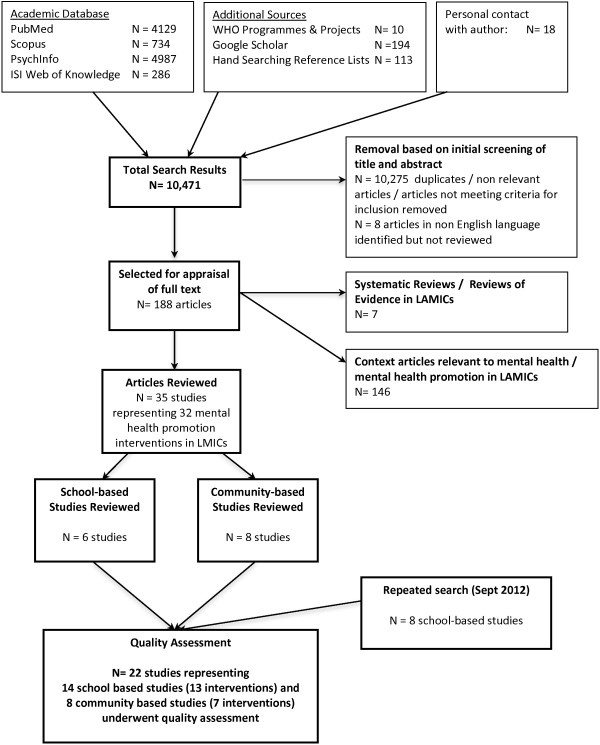
BACKGROUND: This systematic review provides a narrative synthesis of the evidence on the effectiveness of mental health promotion interventions for young people in low and middle-income countries (LMICs). Commissioned by the WHO, a review of the evidence for mental health promotion interventions across the lifespan from early years to adulthood was conducted. This paper reports on the findings for interventions promoting the positive mental health of young people (aged 6-18 years) in school and community-based settings. METHODS: Searching a range of electronic databases, 22 studies employing RCTs (N = 11) and quasi-experimental designs conducted in LMICs since 2000 were identified. Fourteen studies of school-based interventions implemented in eight LMICs were reviewed; seven of which included interventions for children living in areas of armed conflict and six interventions of multicomponent lifeskills and resilience training. Eight studies evaluating out-of-school community interventions for adolescents were identified in five countries. Using the Effective Public Health Practice Project (EPHPP) criteria, two reviewers independently assessed the quality of the evidence. RESULTS: The findings from the majority of the school-based interventions are strong. Structured universal interventions for children living in conflict areas indicate generally significant positive effects on students' emotional and behavioural wellbeing, including improved self-esteem and coping skills. However, mixed results were also reported, including differential effects for gender and age groups, and two studies reported nonsignficant findings. The majority of the school-based lifeskills and resilience programmes received a moderate quality rating, with findings indicating positive effects on students' self-esteem, motivation and self-efficacy. The quality of evidence from the community-based interventions for adolescents was moderate to strong with promising findings concerning the potential of multicomponent interventions to impact on youth mental health and social wellbeing. CONCLUSIONS: The review findings indicate that interventions promoting the mental health of young people can be implemented effectively in LMIC school and community settings with moderate to strong evidence of their impact on both positive and negative mental health outcomes. There is a paucity of evidence relating to interventions for younger children in LMIC primary schools. Evidence for the scaling up and sustainability of mental health promotion interventions in LMICs needs to be strengthened.
Overview
The claims and statistics of this paper haven’t been checked yet.
Run the check — free, no account needed. It reads the open-access text and checks the sources it cites.
Integrity signals
Registry
Cites
Statistics
Figures
Verification
Claims the paper makes
The claims and statistics of this paper haven’t been checked yet.
Run the check — free, no account needed. It reads the open-access text and checks the sources it cites.
Claims other papers make about this one
Each is checked against this paper’s own text: does it say what the citing paper says it does?
In the citing paper
“Evidence also suggests that ECD and parenting interventions can be implemented effectively in LMICs' schools and community settings; however, evidence for scaling-up and sustainability of mental health promotion interventions in LMICs needs to be strengthened [68].”
From Interventions for Adolescent Mental Health: An Overview of Systematic Reviews (2016) · cites this paper as [68]
Self-check
Percentages, sums and reported differences re-computed from the paper’s own numbers.
The self-check needs the paper’s full text.
Citations
Cites
Child and adolescent mental health worldwide: evidence for action
Kieling, C., Baker-Henningham, H., Belfer, M., Conti, G., Ertem, I., Omigbodun, O., Rohde, L. A., Srinath, S., Ulkuer, N., & Rahman, A. (2011) · The Lancet · doi:10.1016/s0140-6736(11)60827-1 · Cited by 2,449
Reducing Risks for Mental Disorders: Frontiers for Preventive Intervention Research
(1994) · doi:10.17226/2139 · Cited by 2,073
Prentice, T. (2013) · Res Medica · doi:10.2218/resmedica.v21i1.510 · Cited by 1,710
Mental Health: New Understanding, New Hope
Brundtland, G. H. (2001) · JAMA · doi:10.1001/jama.286.19.2391 · Cited by 1,606
Building academic success on social and emotional learning: what does the research say?
(2005) · Choice Reviews Online · doi:10.5860/choice.42-5390 · Cited by 1,382
Poverty and common mental disorders in low and middle income countries: A systematic review
Lund, C., Breen, A., Flisher, A. J., Kakuma, R., Corrigall, J., Joska, J. A., Swartz, L., & Patel, V. (2010) · Social Science & Medicine · doi:10.1016/j.socscimed.2010.04.027 · Cited by 1,375
Self-citationMental health promotion and problem prevention in schools: what does the evidence say?
Weare, K., & Nind, M. (2011) · Health Promotion International · doi:10.1093/heapro/dar075 · Cited by 1,043
Primary prevention mental health programs for children and adolescents: A meta-analytic review
Durlak, J. A., & Wells, A. M. (1997) · American Journal of Community Psychology · doi:10.1023/a:1024654026646 · Cited by 963
Pronyk, P., Hargreaves, J., Kim, J. C., Morison, L. A., Godfrey Phetla, B., Watts, C., Busza, J. R., & Porter, J. D. (2006) · The Lancet · doi:10.1016/s0140-6736(06)69744-4 · Cited by 913
The prevention of mental disorders in school-aged children: Current state of the field.
Greenberg, M. T., Domitrovich, C. E., & Bumbarger, B. K. (2001) · Prevention & Treatment · doi:10.1037/1522-3736.4.1.41a · Cited by 873
Research works printed but not linked: 8
- Hosman C, Jané-Llopis E: The Evidence of Health Promotion Effectiveness: Shaping Public Health in a new Europe, A Report for the European Commission. Political challenge 2: mental health. 1999, Paris: International Union for Health Promotion and Education
- Payton J, Weissberg RP, Durlak JA, Dymnicki AB, Taylor RD, Schellinger KB, Pachan M: The positive impact of social and emotional learning for kindergarten to eight-grade students: Findings from three scientific reviews. 2008, Chicago, IL: Collaborative for Academic, Social, and Emotional Learning
- World Health Organization: WHO’s Global School Health Initiative: Health Promoting Schools. 1998, Geneva: World Health Organization
- World Health Organization: Seventh Global Conference on Health Promotion: Promoting Health and Development: closing the Implementation Gap. 26th-30th October 2009, Nairobi, Kenya: , Accessible at: http://www.who.int/healthpromotion/conferences/7gchp/en/index.html
- Khamis V, Macy R, Coignez V: The Impact of the Classroom/Community/Camp-Based Intervention (CBI) Program on Palestinian Children. 2004, USA: Save the Children
- Smith P, Dyregrov A, Yule W: Children and war: Teaching recovery techniques. 2000, Bergen, Norway: Foundation for Children and War
- Adi Y: Systematic review of the effectiveness of interventions to promote mental wellbeing in primary schools Report 1: Universal approaches which do not focus on violence or bullying. 2007, London: National Institute of Clinical Excellence
- Stewart-Brown S: What is the evidence on school health promotion in improving health or preventing disease and, specifically, what is the effectiveness of the health promoting schools approach. 2006, Copenhagen: WHO Regional Office for Europe
Cited by
Sorted by citations
Items 201–300 of 577
Wuermli, A. J., Yoshikawa, H., & Hastings, P. D. (2021) · Development and Psychopathology · doi:10.1017/s095457942000156x · Cited by 18
Banati, P., & Idele, P. (2021) · Frontiers in Psychiatry · doi:10.3389/fpsyt.2021.589827 · Cited by 16
Kiweewa, J. M., Knettel, B. A., & Luke, M. M. (2017) · International Journal for the Advancement of Counselling · doi:10.1007/s10447-017-9316-9 · Cited by 14
Bleile, A. C. E., Koppenol‐Gonzalez, G. V., Orech, B., Verreault, K., & Jordans, M. J. D. (2024) · Journal of Clinical Child & Adolescent Psychology · doi:10.1080/15374416.2024.2330073 · Cited by 14
Benoni, R., Malesani, C., Sartorello, A., Cardoso, H., Chaguruca, I., Alamo, C., Putoto, G., Brigadoi, G., Zin, A., Donà, D., et al. (2024) · Journal of Global Health · doi:10.7189/jogh.14.04182 · Cited by 13
Connolly, P., Miller, S. J., Hanratty, J., Roberts, J., & Sloan, S. (2018) · Campbell Systematic Reviews · doi:10.1002/cl2.210 · Cited by 17
Bottaccioli, A. G., Mariani, U., Schiralli, R., Mari, M. G., Pontani, M., Bologna, M., Muzi, P., Giannoni, S. D., Ciummo, V., Necozione, S., et al. (2023) · Comprehensive Psychoneuroendocrinology · doi:10.1016/j.cpnec.2023.100183 · Cited by 13
Hameed, N., & Mehrotra, S. (2017) · International Journal of Community Medicine and Public Health · doi:10.18203/2394-6040.ijcmph20174209 · Cited by 13
LEARNING AND WELL-BEING ECOSYSTEMS: FACTORS THAT INFLUENCE SCHOOL SUCCESS
Gaspar, T., Tomé, G., Ramiro, L., Almeida, A. P., & de Matos, M. G. (2020) · Psicologia Saúde & Doenças · doi:10.15309/20psd210221 · Cited by 13
Eustache, E., Gerbasi, M. E., Severe, J., Fils-Aimé, J. R., Fawzi, M. C. S., Raviola, G. J., Darghouth, S. L., Boyd, K., Thérosmé, T., Legha, R. K., et al. (2017) · International Journal of Social Psychiatry · doi:10.1177/0020764017700173 · Cited by 13
Cheung, A. T., Ho, L. L. K., Li, W. H. C., Chan, G. C. F., Choi, K. C., Chung, J. O. K., & Chan, C. Y. W. H. (2024) · Nursing Open · doi:10.1002/nop2.2134 · Cited by 12
Mental Health Care Models in Low- and Middle-Income Countries
Nadkarni, A., Hanlon, C., & Patel, V. (2024) · Springer eBooks · doi:10.1007/978-3-030-51366-5_156 · Cited by 13
Self-citationEffectiveness of School-Based Interventions for Preventing Obesity in Children: A Narrative Review
Alhelal, A., AlSalem, M. S., Alasmari, F. M. A., Alqarni, S. A., Alamri, R., Alshahrani, R. A. A., Alrashdi Afnan Hassan, M., Almalki, A. E., Alenezi, W. A. A., Abdulrahim, N., et al. (2024) · Cureus · doi:10.7759/cureus.75104 · Cited by 15
Mental health promotion in school context – Validation of the ES’COOL scale for teachers
Tomé, G., de Matos, M. G., Camacho, I., Gomes, P., Reis, M., & Branquinho, C. (2018) · Journal of Psychiatry and Behavioral Sciences · doi:10.33582/2637-8027/1009 · Cited by 12
Raj, V., Raykar, V., Robinson, A. M., & Islam, M. R. (2021) · Community Mental Health Journal · doi:10.1007/s10597-021-00805-w · Cited by 12
Sorsdahl, K. R., Davies, T., Jensel, C., Oberholzer, D., Gelberg, L., & van der Westhuizen, C. (2021) · Journal of Adolescent Research · doi:10.1177/07435584211052983 · Cited by 12
Woodrow, N., Fairbrother, H., Breheny, K., d’Apice, K., Albers, P. N., Mills, C., Curtis, M., Hopkins, L., Tebbett, S., Campbell, R. M., et al. (2022) · BMC Public Health · doi:10.1186/s12889-022-12748-2 · Cited by 12
Lai, S., Zhou, J., Xu, X., Li, S., Ji, Y., Yang, S., Tang, W., Zhang, J., Jiang, J., & Liu, Q. (2022) · BMC Psychiatry · doi:10.1186/s12888-022-03833-2 · Cited by 12
Manjula, M., & Srivastava, A. (2022) · Springer eBooks · doi:10.1007/978-981-16-8263-6_26 · Cited by 16
Maruyama, J. M., Valente, J., Tovo-Rodrigues, L., Santos, I., Barros, A., Munhoz, T. N., Barros, F., Murray, J., & Matijasevich, A. (2022) · European Child and Adolescent Psychiatry · doi:10.1007/s00787-022-02022-6 · Cited by 9
How Effective Altruism Can Help Psychologists Maximize Their Impact
Gainsburg, I., Pauer, S., Abboub, N., Aloyo, E., Mourrat, J.-C., & Cristià, A. (2022) · Perspectives on Psychological Science · doi:10.1177/17456916221079596 · Cited by 14
Leventhal, K. S., Cooper, P. L., DeMaria, L., Priyam, P., Shanker, H., Andrew, G., & Leventhal, S. (2022) · Frontiers in Psychiatry · doi:10.3389/fpsyt.2022.1021892 · Cited by 12
Improving Mental Health of Adolescent Girls in Low- and Middle-Income Countries
Shah, M., Baird, S., Seager, J. E., Avuwadah, B., Hicks, J. H., Sabarwal, S., & Vyas, A. N. (2023) · The Journal of Human Resources · doi:10.3368/jhr.1222-12707r2 · Cited by 12
Κουρκούτας, Η., Stavrou, P., & Plexousakis, S. (2018) · Journal of Psychology and Behavioral Science · doi:10.15640/jpbs.v6n2a3 · Cited by 12
Spanemberg, L., Salum, G. A., & Bado, P. (2020) · Current Opinion in Psychiatry · doi:10.1097/yco.0000000000000591 · Cited by 12
Mental fitness in higher education: Intervention Mapping programme design
O’Brien, N., Lawlor, M., Chambers, F. C., & O’Brien, W. (2020) · Health Education · doi:10.1108/he-09-2019-0042 · Cited by 12
Machado, D. B., de Araújo, J. A. P., Alves, F. J. O., Castro-de-Araujo, L. F. S., Rodrigues, E. D. S., Xavier, É. F. M., Rodrigues, R. L., Rasella, D., Naslund, J. A., Patel, V., et al. (2022) · PLoS ONE · doi:10.1371/journal.pone.0272481 · Cited by 12
Self-citationLi, J., Ma, C., Qi, L., & Hesketh, T. M. (2022) · Healthcare · doi:10.3390/healthcare10112332 · Cited by 11
Gerstl, B., Ahinkorah, B. O., Nguyen, T. P., John, J. R., Hawker, P. J., Winata, T., Brice, F., Bowden, M. R., & Eapen, V. (2024) · Frontiers in Psychiatry · doi:10.3389/fpsyt.2024.1324220 · Cited by 13
Long, J., Zhang, S., Chu, L., Balkian, J., Giovannucci, I., Mui, C., Luan, Y., Chang, O., Chanthavilay, P., Goundar, K., et al. (2025) · The Lancet Regional Health - Western Pacific · doi:10.1016/j.lanwpc.2025.101674 · Cited by 11
Family violence as a determinant of suicidality and depression among adolescents in India
Bhan, N., Jose, R., Silverman, J. G., & Raj, A. (2019) · Journal of Global Health Reports · doi:10.29392/joghr.3.e2019072 · Cited by 11
McMullen, J. D., & Eaton, P. (2020) · Pastoral Care in Education · doi:10.1080/02643944.2020.1751687 · Cited by 11
Carlson, C., Namy, S., Nakuti, J., Mufson, L. H., Ikenberg, C., Musoni, O., Hopson, L. M., Anton-Erxleben, K., Naker, D., & Wainberg, M. L. (2021) · Implementation Research and Practice · doi:10.1177/26334895211051290 · Cited by 11
Resilience-Based Intervention to Promote Mental and Behavioral Health in Children
Jiang, Y., Harrison, S. E., & Li, X. (2022) · Pediatric Clinics of North America · doi:10.1016/j.pcl.2022.04.009 · Cited by 11
Implementing Mental Health Promoting Schools
Clarke, A. M., & Barry, M. M. (2014) · Springer eBooks · doi:10.1007/978-94-017-9171-7_15 · Cited by 11
Self-citationUniversal Mental Health Promotion and Prevention Programs for Students
Conley, C. S., & Durlak, J. A. (2017) · Springer eBooks · doi:10.1007/978-3-319-59123-0_12 · Cited by 11
A picture of Indian adolescent mental health: an analysis from three urban secondary schools
Long, K. N. G., Gren, L. H., Long, P. M., Jaggi, R., Banik, S., & Mihalopoulos, N. L. (2017) · International Journal of Adolescent Medicine and Health · doi:10.1515/ijamh-2017-0035 · Cited by 11
Mindfulness-Based Programs in School Settings: Current State of the Research
Rawana, J. S., Diplock, B. D., & Chan, S. (2018) · Plenum series on human exceptionality · doi:10.1007/978-3-319-89842-1_18 · Cited by 12
Castro-Camacho, L., Moreno-Villamizar, J. D., & Naismith, I. (2018) · Cognitive and Behavioral Practice · doi:10.1016/j.cbpra.2018.09.002 · Cited by 12
Bullying and ART Nonadherence Among South African ALHIV: Effects, Risks, and Protective Factors
Casale, M. A. J., Cluver, L. D., Boyes, M. E., Toska, E., Gulaid, L., Armstrong, A., Shenderovich, Y., Rudgard, W. E., Zhou, S., & Langwenya, N. (2020) · JAIDS Journal of Acquired Immune Deficiency Syndromes · doi:10.1097/qai.0000000000002574 · Cited by 11
Higgins, E., & Booker, R. (2023) · International Journal of Wellbeing · doi:10.5502/ijw.v13i2.2833 · Cited by 10
Li, J., & Hesketh, T. M. (2024) · Child and Adolescent Psychiatry and Mental Health · doi:10.1186/s13034-024-00758-4 · Cited by 10
Supporting the mental health of forcibly displaced children
Pluess, M., Brown, F. L., & Panter‐Brick, C. (2025) · Nature Reviews Psychology · doi:10.1038/s44159-025-00447-9 · Cited by 11
Population and Community Platform Interventions
Petersen, I., Evans-Lacko, S. E., Semrau, M., Barry, M. M., Chisholm, D., Gronholm, P. C., Egbe, C. O., & Thornicroft, G. (2016) · World Bank, Washington, DC eBooks · doi:10.1596/978-1-4648-0426-7_ch10 · Cited by 10
Self-citationBarton, G. M., Baguley, M. M., Kerby, M., & MacDonald, A. (2019) · Springer eBooks · doi:10.1007/978-3-030-18925-9_9 · Cited by 10
Bartels, S. M., Cárdenas, P., Uribe-Restrepo, J. M., Cubillos, L., Torrey, W. C., Castro, S., Williams, M. J., Oviedo-Manrique, D. G., Gómez–Restrepo, C., & Marsch, L. A. (2021) · Revista Colombiana de Psiquiatría (English ed ) · doi:10.1016/j.rcpeng.2021.01.001 · Cited by 10
Impact of Social Work Services on the Resilience of Migrant Children
Huang, D., Lin, W., Luo, Y., & Liu, Y. (2021) · Research on Social Work Practice · doi:10.1177/10497315211051624 · Cited by 10
Sharma, M., Perera, C., Ipince, A., Bakrania, S., Shokraneh, F., Idele, P., Anthony, D. S., & Banati, P. (2022) · Campbell Systematic Reviews · doi:10.1002/cl2.1221 · Cited by 11
Onono, M. A., Frongillo, E. A., Sheira, L. A., Odhiambo, G., Wekesa, P., Conroy, A. A., Cohen, C. R., Bukusi, E. A., & Weiser, S. D. (2023) · Journal of Nutrition · doi:10.1016/j.tjnut.2023.10.008 · Cited by 10
Jordans, M. J. D., & Tol, W. A. (2015) · BJPsych International · doi:10.1192/s2056474000000490 · Cited by 11
Frank, H. E., Saldana, L., Kendall, P. C., Schaper, H., & Norris, L. A. (2021) · Child & Youth Services · doi:10.1080/0145935x.2021.1894920 · Cited by 12
Mutiso, V., Musyimi, C. W., Musau, A., Nandoya, E., McKenzie, K. J., & Ndetei, D. M. (2018) · Early Intervention in Psychiatry · doi:10.1111/eip.12543 · Cited by 10
Reframing the Challenge of Promoting Population Mental Health
Barry, M. M. (2019) · Springer eBooks · doi:10.1007/978-3-030-23455-3_2 · Cited by 10
Self-citationToit, S. D., Tomlinson, M., Laurenzi, C. A., Gordon, S. L., Hartmann, L., Abrahams, N., Bradshaw, M., Brand, A., Meléndez‐Torres, G. J., Servili, C., et al. (2024) · Journal of Adolescent Health · doi:10.1016/j.jadohealth.2024.09.030 · Cited by 10
Steel, J., Twagira, F., Seekles, M. L., & Obasi, A. I. N. (2022) · PLoS ONE · doi:10.1371/journal.pone.0279424 · Cited by 9
“It was Very Liberating”. Dialogic Literary Gatherings Supporting Mental Health Literacy
Zubiri-Esnaola, H., Racionero-Plaza, S., Fernández-Villardón, A., & Carbonell, S. (2022) · Community Mental Health Journal · doi:10.1007/s10597-022-01071-0 · Cited by 11
Unlocking the power of physical activity in easing psychological distress
Liu, X., & Wang, X. (2024) · World Journal of Psychiatry · doi:10.5498/wjp.v14.i1.1 · Cited by 9
Lee, M. H. M. H., & Yap, K. H. (2024) · Current Psychology · doi:10.1007/s12144-024-06357-y · Cited by 9
Baltag, V., & Saewyc, E. (2016) · Springer eBooks · doi:10.1007/978-3-319-40743-2_24 · Cited by 9
Campion, J. (2018) · Springer eBooks · doi:10.1007/978-3-319-70554-5_31 · Cited by 9
Evaluating a school-based body image lesson in Indonesia: A randomised controlled trial
Craddock, N., Budhraja, M., Garbett, K. M., Nasution, K., Gentili, C., Rizkiah, C., Haime, Z., Saraswati, L. A., Medise, B. E., White, P., et al. (2023) · Body Image · doi:10.1016/j.bodyim.2023.101654 · Cited by 9
MALLA, A. K., Margoob, M. A., Iyer, S. N., Majid, A., Lal, S., Joober, R., & Mansouri, B. I. (2019) · The Canadian Journal of Psychiatry · doi:10.1177/0706743719839314 · Cited by 9
Evaluation of students’ mental and social health promotion educational programs: A systematic review
Baghian, N., Sari, A. A., Shati, M., Fallahzadeh, H., & Ahmadi, B. (2019) · Journal of Education and Health Promotion · doi:10.4103/jehp.jehp_416_19 · Cited by 9
Foster, C. E., Hamilton, A., & Richards, J. A. (2016) · Bristol Research (University of Bristol) · Cited by 9
Zavala‐Villalón, G., Ganga‐León, C., Andrade, R. M. R., Torres-Cortés, B., & Leiva, L. (2020) · Gestión y Política Pública · doi:10.29265/gypp.v29i2.780 · Cited by 14
Poli, S., Salerno, L., Delvecchio, E., Muscolino, A., Tona, A. L., Ghizzoni, G., Nembrini, G., Brugnera, A., & Donisi, V. (2025) · Current Addiction Reports · doi:10.1007/s40429-025-00694-z · Cited by 11
Youth-led co-production of mental health promotion in Pakistan: intergenerational influences
Vostanis, P., Hassan, S., Fatima, S. Z., & O’Reilly, M. J. (2024) · Health Promotion International · doi:10.1093/heapro/daae010 · Cited by 8
Campos, S., Núñez, D. E., Pérez, J. C., & Robinson, J. (2024) · JMIR Formative Research · doi:10.2196/57038 · Cited by 8
Promoting Mental Health in Italian Middle and High School: A Pilot Study
Veltro, F., Ialenti, V., García, M. A. M., Bonanni, E., Iannone, C., D'Innocenzo, M., & Gigantesco, A. (2017) · BioMed Research International · doi:10.1155/2017/2546862 · Cited by 8
Promoting Children’s and Young People’s Mental Health in Schools
Clarke, A. M. (2019) · Springer eBooks · doi:10.1007/978-3-030-23455-3_10 · Cited by 9
Self-citationCresswell‐Smith, J., Macintyre, A. K., & Wahlbeck, K. (2020) · Voluntary Sector Review · doi:10.1332/204080520x15874661935482 · Cited by 9
Hamdani, S. U., Huma, Z., Malik, A., Nizami, A. T., Baneen, U. U., Suleman, N., Javed, H., Wang, D., van Ommeren, M., Mazhar, S., et al. (2022) · BMJ Open · doi:10.1136/bmjopen-2022-063607 · Cited by 8
The position of Ghana on the progressive map of positive mental health: A critical perspective
Fadiji, A. W., & Somhlaba, N. Z. (2016) · Global Public Health · doi:10.1080/17441692.2016.1161816 · Cited by 8
Deforche, B. I., Mommen, J., Hublet, A., Roover, W. D., Huys, N., Clays, E., Maes, L., Bourdeaudhuij, I. D., & Cauwenberg, J. V. (2018) · International Journal of Environmental Research and Public Health · doi:10.3390/ijerph15102107 · Cited by 8
Mental Health in the Asia-Pacific Region: An Overview
Samy, A. L., Khalaf, Z. F., & Low, W. Y. (2015) · The Journal of Behavioral Science · doi:10.14456/ijbs.2015.39 · Cited by 8
Menon, V., Coppard, M., McEwen, S., Romero, L., Kennedy, E. C., & Azzopardi, P. S. (2025) · Asia Pacific Journal of Public Health · doi:10.1177/10105395241313154 · Cited by 7
Bajaria, S., Yusufu, I., Mboya, I. B., Eyeberu, A., Dessie, Y., Assefa, N., Shinde, S., Patil, R., Tang, K., Oduola, A. M. J., et al. (2025) · PLOS mental health. · doi:10.1371/journal.pmen.0000479 · Cited by 7
Chiumento, A., Hosny, W., Gaber, E., Emadeldin, M., Barabry, W. E., Hamoda, H. M., & Alonge, O. (2022) · SSM - Mental Health · doi:10.1016/j.ssmmh.2022.100075 · Cited by 7
Barriers to and ways of facilitating the implementation of Aragon’s Health-Promoting School network
Rodrigo-Sanjoaquín, J., Pardo, B. M., Corral-Abós, A., Lorente-Echeverría, S., & Casterad, J. Z. (2023) · Health Education Journal · doi:10.1177/00178969221150904 · Cited by 7
Cherewick, M., Bertomen, S., Njau, P., Leiferman, J., & Dahl, R. E. (2023) · Health Psychology and Behavioral Medicine · doi:10.1080/21642850.2023.2288883 · Cited by 6
Mhango, W., Michelson, D., & Gaysina, D. (2024) · Cambridge Prisms Global Mental Health · doi:10.1017/gmh.2024.76 · Cited by 7
de Wit, E. E., Adithy, A., Bunders, J., & Regeer, B. J. (2016) · Journal of Educational and Developmental Psychology · doi:10.5539/jedp.v6n2p53 · Cited by 7
Adolescent Mental Health: The Public Health Response
Singh, S. P., & Winsper, C. (2016) · Springer eBooks · doi:10.1007/978-3-319-40743-2_6 · Cited by 7
Siyothula, E. B. (2018) · South African Journal of Psychology · doi:10.1177/0081246318815337 · Cited by 8
Mental health of transitional aged youth in Nicaragua: Perceptions and experiences of educators
Gajaria, A., Ravindran, A. V., Castrillo, M., Rodríguez, A. H., & Zaheer, J. (2019) · Global Public Health · doi:10.1080/17441692.2019.1648535 · Cited by 7
Kretchy, I. A., Blewuada, E. K., & Debrah, A. B. (2021) · Scientific African · doi:10.1016/j.sciaf.2021.e00969 · Cited by 7
Ivanova, M. Y., Hall, A., Weinberger, S., Buckingham, S. L., Copeland, W., Crockett, P., Dainer‐Best, J., D’Alberto, C., Dewey, L. M., Foret, D., et al. (2022) · Child Psychiatry & Human Development · doi:10.1007/s10578-022-01329-4 · Cited by 7
Impact on Students of the Act–Belong–Commit Mentally Healthy Schools Framework
Donovan, R. J., Drane, C. F., & Anwar‐McHenry, J. (2023) · Children · doi:10.3390/children10030548 · Cited by 7
Factors influencing the mental health in college nursing students
Park, S.-H., & Byun, E. K. (2015) · Journal of the Korea Academia-Industrial cooperation Society · doi:10.5762/kais.2015.16.12.8284 · Cited by 7
Amod, Z. (2018) · Journal of Educational and Psychological Consultation · doi:10.1080/10474412.2018.1531764 · Cited by 7
Alexander, P. M., & Rossouw, J. (2015) · DigitalCommons - Kennesaw State University (Kennesaw State University) · Cited by 7
Mihiret, G. T., Meselu, B. T., Wondmu, K. S., Getaneh, T., & Moges, N. A. (2025) · Frontiers in Global Women s Health · doi:10.3389/fgwh.2024.1468725 · Cited by 6
Kassa, G. M., Yu, Z., Yitayew, F. M., & Gross, D. A. (2025) · Journal of Global Health · doi:10.7189/jogh.15.04018 · Cited by 6
Factors Shaping a Proactive Plan of Care for Student Mental Health
Nygaard, M. A., Renshaw, T. L., Ormiston, H. E., & Matthews, A. (2024) · School Mental Health · doi:10.1007/s12310-024-09634-0 · Cited by 6
Resilience and Stress at Professional Work: Analysis of the Research Landscape and Public Interest
Borissov, D. (2024) · Business Ethics and Leadership · doi:10.61093/bel.8(2).128-151.2024 · Cited by 6
Tsimtsiou, Z., Drosos, E., Drontsos, A., Haidich, A., Dantsi, F., Sekeri, Z., Dardavesis, T. I., Nanos, P., & Arvanitidou, M. (2017) · International Journal of Adolescent Medicine and Health · doi:10.1515/ijamh-2017-0072 · Cited by 6
Dsouza, S. M., Saran, A., & Krishnan, J. B. (2021) · Campbell Systematic Reviews · doi:10.1002/cl2.1182 · Cited by 6
Veltro, F., Ialenti, V., García, M. A. M., Iannone, C., Bonanni, E., & Gigantesco, A. (2015) · Rivista di psichiatria · doi:10.1708/1872.20452 · Cited by 6
Development of a Trans-disciplinary Intervention Module for Adolescent Girls on Self-awareness
John, J. M. (2017) · JOURNAL OF CLINICAL AND DIAGNOSTIC RESEARCH · doi:10.7860/jcdr/2017/25765.10462 · Cited by 6
Mental health literacy in low- and middle-income countries
Raghavan, R., Brown, B. J., & Svirydzenka, N. (2022) · Oxford University Press eBooks · doi:10.1093/med/9780198861478.003.0073 · Cited by 6
Metadata
- Authors
- Barry, M. M., Clarke, A. M., Jenkins, R., & Patel, V.
- Affiliations
- Ollscoil na Gaillimhe – University of Galway (IE)
- King's College London (GB)
- London School of Hygiene & Tropical Medicine (GB)
- Corresponding author
- Barry, Margaret M
- Venue
- BMC Public Health
- Published
- 2013-09-11
- Volume
- 13
- Issue
- 1
- Pages
- 835-835
- ISSN
- 1471-2458 (ISSN-L)
- PMC
- PMC3848687
- OpenAlex
- W2105332173
- Cited by
- 569
- References
- 88
- Citations by year
- 2026: 53 · 2025: 45 · 2024: 59 · 2023: 69 · 2022: 66 · 2021: 56 · 2020: 32 · 2019: 45 · 2018: 41 · 2017: 30 · 2016: 30 · 2015: 23 · 2014: 18 · 2013: 1
- FWCI
- 4.29
- Type
- journal article
- Language
- en
- Open access
- gold
- doi.org
- Licence
- Locations
- BMC Public Health (publishedVersion, cc-by)
- Europe PMC (PubMed Central) (publishedVersion, cc-by)
- PubMed Central (publishedVersion, cc-by)
- PubMed (publishedVersion)
- Arrow@dit (Dublin Institute of Technology) (acceptedVersion)
- ARAN (University of Galway Research Repository) (Ollscoil na Gaillimhe – University of Galway) (acceptedVersion, cc-by-nc-nd)
- LSHTM Research Online (London School of Hygiene and Tropical Medicine) (acceptedVersion)
- Arrow@dit (Dublin Institute of Technology) (submittedVersion)
- ARAN (University of Galway Research Repository) (Ollscoil na Gaillimhe – University of Galway) (submittedVersion, cc-by-nc-nd)
- Lenus, The Irish Health Repository (Dr Steevens Hospital Library) (submittedVersion)
- Funders
- John D. and Catherine T. MacArthur Foundation
- Wellcome Trust (100714, 091834)
- Topics
- Health Sciences › Medicine › Public Health, Environmental and Occupational Health › School Health and Nursing Education
- Social Sciences › Psychology › Clinical Psychology › Child and Adolescent Psychosocial and Emotional Development
- Health Sciences › Medicine › Psychiatry and Mental health › Mental Health Treatment and Access
- Keywords
- mental health promotion, youth, school-based intervention, community-based intervention, low- and middle-income countries, children in armed conflict, resilience training, self-esteem, adolescents, multicomponent intervention, scaling up interventions
- MeSH terms
- Adolescent, Mental Disorders, Child, Child Welfare, Female, Health Promotion, Humans, Income, Male, Poverty, Psychological Tests, School Health Services, Severity of Illness Index, Socioeconomic Factors, Program Evaluation, Randomized Controlled Trials as Topic, Early Intervention, Educational, Risk Assessment
About these checks
Registry, retraction, Cites and statistics results are computed, not judged, with one exception: a printed reference that no index lists is read once by a model before it counts as a citation error. Claims are extracted by a model and kept only when their quote appears verbatim in the text; each cited source is then checked, with a model’s help, for whether it says what the claim relies on. Those verdicts can be wrong — read the claim’s quote and the cited source before relying on one.
Statistics and arithmetic are recomputed, not judged.
Confidence bands are shown only for fields calibrated on our annotated test set. None is calibrated yet, so no band is shown.
What counts as a claim ›How we measure confidence ›How we check this ›
Are you an author, or do you see a problem with this page? Request a review
