

Evaluation of drinking patterns and their impact on alcohol-related aggression: a national survey of adolescent behaviours
Open accessThe DOI matches its Crossref record; 36 of the 37 references it cites were found in a registry or an index.
Abstract
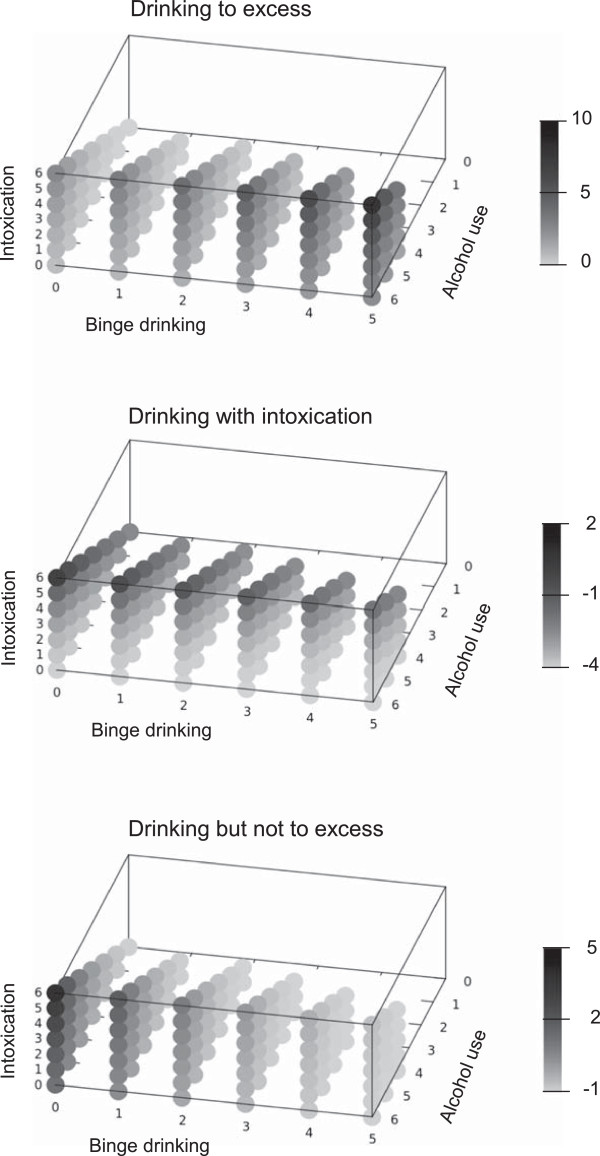
Background: Although there have been a wide range of epidemiological studies examining the impact of patterns of alcohol consumption among adolescents, there remains considerable variability in both defining these patterns and the ability to comprehensively evaluate their relationship to behavioural patterns. This study explores a new procedure for defining and evaluating drinking patterns and integrating well-established indicators. The composite measure is then used to estimate the impact of these patterns on alcohol-related aggressive behaviour among Italian adolescents. Methods: Data were collected as part of the 2011 European School Survey Project on Alcohol and other Drugs (ESPAD). A national sample of 14,199 students aged 15–19 years was collected using an anonymous, self-administered questionnaire completed in a classroom setting. Drinking patterns were established using principal component analysis. Alcohol-related aggression was analysed as to its relationship to patterns of drinking, behaviour of friends towards alcohol use, substance use/abuse, school performance, family relationships and leisure activities. Results: Several specific drinking patterns were identified: “Drinking to Excess” (DE), “Drinking with Intoxication” (DI) and “Drinking but Not to Excess” (DNE). A higher percentage of males were involved in alcohol-related aggression compared with females. In males, the DE and DI patterns significantly increased the likelihood of alcohol-related aggression, whereas the DNE pattern was negatively associated. Similar results were found in females, although the DI pattern was not significantly associated with alcohol-related aggression. Overall, cigarette smoking, illegal drug use, truancy, limited parental monitoring, frequent evenings spent outside of the home and peer influence associated strongly with alcohol-related aggression. Conclusions: Our findings suggest that drinking patterns, as uniquely monitored with an integrated metric, can: 1) explain drinking habits better than commonly used indicators of alcohol use and 2) provide a better understanding of behavioural risks such as alcohol-related aggression. Environmental background also appears to strongly associate with this type of aggressive behaviour.
Overview
The claims and statistics of this paper haven’t been checked yet.
Free: it reads the open-access text and checks the first 5 claims that cite a source we can check. Create a free account to check every claim.
Integrity signals
Registry
Cites
Statistics
Figures
Verification
Claims the paper makes
The claims and statistics of this paper haven’t been checked yet.
Free: it reads the open-access text and checks the first 5 claims that cite a source we can check. Create a free account to check every claim.
Claims other papers make about this one
Each is checked against this paper’s own text: does it say what the citing paper says it does?
The source backs part of the claim, not all of it — or backs it for a different population, condition or comparison.
In the citing paper
“A study in Italian adolescents, for example, found that heavy chronic alcohol use is associated with a heightened risk for alcohol-involved aggressive incidents, while moderate use is not (Siciliano et al. 2013).”
From Decoding the bidirectional links between alcohol misuse and aggression: toward a unified translational framework (2026) · cites this paper as Siciliano et al. 2013
Experimental — accuracy not yet measuredThe source backs part of the claim, not all of it — or backs it for a different population, condition or comparison.
In the citing paper
“Several studies have consistently reported that heavy, chronic alcohol use, but not moderate drinking, is associated with heightened aggression (Beseler et al. 2012; Siciliano et al. 2013).”
From Decoding the bidirectional links between alcohol misuse and aggression: toward a unified translational framework (2026) · cites this paper as Siciliano et al. 2013
Experimental — accuracy not yet measured
Self-check
Percentages, sums and reported differences re-computed from the paper’s own numbers.
The self-check needs the paper’s full text.
Citations
Cites
Jolliffe, I. (2005) · Encyclopedia of Statistics in Behavioral Science · doi:10.1002/0470013192.bsa501 · Cited by 14,310
Jolliffe, I. T. (1986) · Springer Series in Statistics · doi:10.1007/978-1-4757-1904-8 · Cited by 8,273
Risk behavior in adolescence: A psychosocial framework for understanding and action
JESSOR, R. (1991) · Journal of Adolescent Health · doi:10.1016/1054-139x(91)90007-k · Cited by 1,508 · cited 1×
“This comprehensive approach, incorporating concepts derived from problembehaviour theory [24], offers a theoretical framework for better understanding underage alcohol use.”
BackgroundRisk Behavior in Adolescence: A Psychosocial Framework for Understanding and Action
Jessor, R. (2021) · Adolescents at Risk · doi:10.4324/9780429046582-4 · Cited by 1,215
Rehm, J., Room, R., Graham, K., Monteiro, M., Gmel, G., & Sempos, C. T. (2003) · Addiction · doi:10.1046/j.1360-0443.2003.00467.x · Cited by 995
Chassin, L., Pitts, S. C., & Prost, J. (2002) · Journal of Consulting and Clinical Psychology · doi:10.1037//0022-006x.70.1.67 · Cited by 765 · cited 1×
“Similarly, it has been demonstrated that adolescents who misuse alcohol have higher rates of violent behaviours [6-8].”
BackgroundThe 2011 ESPAD report: substance use among students in 36 European countries.
Hibell, B., Guttormsson, U., Ahlström, S., Balakireva, O. M., Bjarnason, Þ., Kokkevi, A., & Kraus, L. (2012) · UWE Research Repository (UWE Bristol) · Cited by 686
Characteristics of binge drinkers in Europe
Kuntsche, E., Rehm, J., & Gmel, G. (2004) · Social Science & Medicine · doi:10.1016/j.socscimed.2003.10.009 · Cited by 576 · cited 1×
“Besides frequency of use, a basic parameter indicating the regularity of drinking, one of the most studied characteristics is binge drinking (typically defined as consuming five or more drinks on a single occasion), which exhibits high prevalence among youth [1,17].”
BackgroundData Mining Methods and Models
Larose, D. T. (2005) · Wiley eBooks · doi:10.1002/0471756482 · Cited by 512
Epidemiology of Juvenile Violence
Farrington, D. P., & Loeber, R. (2000) · Child and Adolescent Psychiatric Clinics of North America · doi:10.1016/s1056-4993(18)30089-0 · Cited by 312 · cited 1×
“It has been shown that adolescents who display violent behaviour are more likely to exhibit problematic alcohol consumption than other adolescents [3,4], excessive alcohol use or drunkenness [5].”
BackgroundProfiles of violent youth: substance use and other concurrent problems.
Ellickson, P., Saner, H., & McGuigan, K. A. (1997) · American Journal of Public Health · doi:10.2105/ajph.87.6.985 · Cited by 274 · cited 1×
“As already shown [32], the use of illegal drugs resulted as always positively associated with alcoholrelated aggression, indicating a tendency to concurrent problem behaviours.”
BackgroundIntoxication and bad behaviour: understanding cultural differences in the link
Room, R. (2001) · Social Science & Medicine · doi:10.1016/s0277-9536(00)00330-0 · Cited by 216 · cited 1×
“Other studies, focused on alcohol’s negative effects, report that the extent of drunkenness (or perceived intoxication) rather than total volume of alcohol consumed relates to acute consequences such as various types of aggression and violence [4,18-20].”
BackgroundData mining methods and models
(2007) · Choice Reviews Online · doi:10.5860/choice.44-5686 · Cited by 210
Alcohol misuse and juvenile offending in adolescence
FERGUSSON, D. M., LYNSKEY, M. T., & HORWOOD, L. J. (1996) · Addiction · doi:10.1046/j.1360-0443.1996.9144834.x · Cited by 162 · cited 1×
“Similarly, it has been demonstrated that adolescents who misuse alcohol have higher rates of violent behaviours [6-8].”
BackgroundAlcohol-related aggression during the college years: theories, risk factors and policy implications.
Giancola, P. R. (2002) · Journal of Studies on Alcohol, Supplement · doi:10.15288/jsas.2002.s14.129 · Cited by 132 · cited 3×
“Giancola PR: Alcohol-related aggression during college years: theories, risk factors and policy implications.”
BackgroundWells, S., Graham, K., Speechley, M., & J. Koval, J. (2005) · Addiction · doi:10.1111/j.1360-0443.2005.001121.x · Cited by 131
Relations between alcohol, violence and victimization in adolescence
Shepherd, J. P., Sutherland, I., & Newcombe, R. G. (2006) · Journal of Adolescence · doi:10.1016/j.adolescence.2006.06.005 · Cited by 106 · cited 1×
“Other studies, focused on alcohol’s negative effects, report that the extent of drunkenness (or perceived intoxication) rather than total volume of alcohol consumed relates to acute consequences such as various types of aggression and violence [4,18-20].”
BackgroundInteractions Among Drugs, Alcohol, and Violence
Fagan, J. (1993) · Health Affairs · doi:10.1377/hlthaff.12.4.65 · Cited by 106 · cited 2×
“Fagan J: Interactions among drugs, alcohol, and violence.”
BackgroundThe Nexus between Alcohol and Violent Crime
Zhang, L., Wieczorek, W. F., & Welte, J. W. (1997) · Alcoholism: Clinical and Experimental Research · doi:10.1111/j.1530-0277.1997.tb04447.x · Cited by 103 · cited 1×
“According to Fagan [9], alcohol consumption provides a “provocative context” for violence, rather than a direct cause, whereas another study proposes alcohol consumption as a moderating variable with a conditioning and reinforcing role in explaining aggressive behaviour [10].”
BackgroundDanielsson, A., Wennberg, P., Hibell, B., & Romelsjö, A. (2012) · Addiction · doi:10.1111/j.1360-0443.2011.03537.x · Cited by 101
Kraus, L., Baumeister, S., Pabst, A., & Orth, B. (2009) · Alcohol and Alcoholism · doi:10.1093/alcalc/agn110 · Cited by 91 · cited 3×
“Background Alcohol consumption among adolescents is a common concern that is growing in most countries and, notably, hazardous and harmful drinking patterns seem to be on the rise [1,2].”
BackgroundThe Nexus between Alcohol and Violent Crime
Zhang, L., Wieczorek, W. F., & Welte, J. W. (1997) · Alcoholism: Clinical & Experimental Research · doi:10.1097/00000374-199710000-00016 · Cited by 84
Bye, E. K., & Rossow, I. M. (2010) · Drug and Alcohol Review · doi:10.1111/j.1465-3362.2009.00117.x · Cited by 81 · cited 3×
“Other studies, focused on alcohol’s negative effects, report that the extent of drunkenness (or perceived intoxication) rather than total volume of alcohol consumed relates to acute consequences such as various types of aggression and violence [4,18-20].”
BackgroundKUNTSCHE, E., KNIBBE, R., GMEL, G., & ENGELS, R. (2006) · Alcohol and Alcoholism · doi:10.1093/alcalc/agl046 · Cited by 80 · cited 1×
“Moreover, since it has been demonstrated [21,22] that preferences for alcoholic beverage may reflect different attitudes towards alcohol consumption, such preferences were also taken into account.”
BackgroundYoung, wet & wild? Associations between alcohol intoxication and violent behaviour in adolescence
Rossow, I., Pape, H., & Wichstrom, L. (1999) · Addiction · doi:10.1046/j.1360-0443.1999.94710177.x · Cited by 72
A longitudinal study of alcohol use and antisocial behaviour in young people
Young, R., Sweeting, H., & West, P. (2008) · Alcohol and Alcoholism · doi:10.1093/alcalc/agm147 · Cited by 63 · cited 1×
“Results from a longitudinal study [11], focusing on the relationships between alcohol misuse, antisocial behaviour and alcohol-related problems at particular ages, strongly support the reciprocal hypothesis.”
BackgroundSwahn, M. H., & Donovan, J. E. (2006) · Addictive Behaviors · doi:10.1016/j.addbeh.2006.02.001 · Cited by 59 · cited 3×
“In investigating the relationship between aggressive behaviours and alcohol use, some studies have considered single parameters to assess drinking [23,28], whereas other studies have evaluated the interaction of several parameters to characterize different classes of drinkers [29] or have utilized a single drinking pa…”
BackgroundWine preference and related health determinants in a U.S. national sample of young adults
Paschall, M. J., & Lipton, R. I. (2005) · Drug and Alcohol Dependence · doi:10.1016/j.drugalcdep.2004.12.004 · Cited by 52 · cited 1×
“Moreover, since it has been demonstrated [21,22] that preferences for alcoholic beverage may reflect different attitudes towards alcohol consumption, such preferences were also taken into account.”
BackgroundViolent behaviour among adolescents in Iceland: a national survey
Gudlaugsdottir, G. R. (2004) · International Journal of Epidemiology · doi:10.1093/ije/dyh190 · Cited by 43 · cited 1×
“Similarly, it has been demonstrated that adolescents who misuse alcohol have higher rates of violent behaviours [6-8].”
BackgroundAggregating dimensions of alcohol consumption to predict medical and social consequences
Rehm, J. T., & Gmel, G. E. (2000) · Journal of Substance Abuse · doi:10.1016/s0899-3289(00)00045-6 · Cited by 43 · cited 1×
“Although the “average amount of alcohol consumed” is consistent with a range of physical and social consequences, a growing number of behavioural studies provide evidence that not only quantity but also patterns of drinking are measures that relate to drinking outcomes [1,15,16] and, notably, to alcoholviolence associ…”
BackgroundAstudillo, M., Kuntsche, S., Graham, K., & Gmel, G. E. (2010) · European Addiction Research · doi:10.1159/000303379 · Cited by 33 · cited 1×
“In investigating the relationship between aggressive behaviours and alcohol use, some studies have considered single parameters to assess drinking [23,28], whereas other studies have evaluated the interaction of several parameters to characterize different classes of drinkers [29] or have utilized a single drinking pa…”
BackgroundEklund, J. M., & af Klinteberg, B. (2005) · Journal of Individual Differences · doi:10.1027/1614-0001.26.2.63 · Cited by 30
Rolfe, A., Dalton, S. I., Krishnan, M., Orford, J., Mehdikhani, M., Cawley, J., & Ferrins‐Brown, M. (2006) · Journal of Substance Use · doi:10.1080/14659890600677487 · Cited by 28 · cited 1×
“Similarly, results from a study on alcohol and violence [12] suggest that alcohol has a “magnifying” effect, amplifying underlying aggressive tendencies.”
ResultThompson, K., Stockwell, T. R., & MacDonald, S. W. S. (2011) · Drug and Alcohol Review · doi:10.1111/j.1465-3362.2011.00378.x · Cited by 17 · cited 1×
“Actually, little is known about young people consuming alcohol at “lowrisk” levels: only recently, research has addressed this issue in an attempt to establish drinking guidelines for youth [31].”
BackgroundStafström, M. (2007) · Substance Abuse Treatment Prevention and Policy · doi:10.1186/1747-597x-2-18 · Cited by 14
Multiple Regression and Model Building
Larose, D. T. (2005) · doi:10.1002/0471756482.ch3 · Cited by 3
Research works printed but not linked: 1
- 2. Beccaria F: Alcohol and generations. Changes in style and changing styles in Italy and Finland. Carocci Editore: Rome; 2010.
Cited by
Rehm, J. T., & Hasan, O. S. M. (2019) · Alcohol · doi:10.1016/j.alcohol.2019.06.005 · Cited by 53
Principales daños sanitarios y sociales relacionados con el consumo de alcohol
Sarasa‐Renedo, A., Sordo, L., Molist, G., Hoyos, J., Guitart, A. M., & Barrio, G. (2014) · Revista Española de Salud Pública · doi:10.4321/s1135-57272014000400004 · Cited by 76
Rezaei, N., Ahmadi, N., Shams-Beyranvand, M., Hasan, M., Gohari, K., Yoosefi, M., Djalalinia, S., Moghaddam, S. S., Modirian, M., Pazhuheian, F., et al. (2022) · PLOS Global Public Health · doi:10.1371/journal.pgph.0000107 · Cited by 20
“Alcohol consumption is a risk factor among young people, causing disability or even death [9, 10].”
BackgroundAlcohol Consumption Among Adolescents — Implications for Public Health
Carvajal, F., & Lerma-Cabrera, J. M. (2015) · InTech eBooks · doi:10.5772/58930 · Cited by 28
Youth Problem Drinking: The Role of Parental and Familial Relationships
Balázs, M. Á., Piko, B. F., & Fitzpatrick, K. M. (2017) · Substance Use & Misuse · doi:10.1080/10826084.2017.1281311 · Cited by 20
“These results suggest that problem drinking may be part of youth problem behavior syndrome stemming from the adolescencerelated problems (Siciliano et al., 2013).”
Background
Metadata
- Authors
- Siciliano, V., Mezzasalma, L., Lorenzoni, V., Pieroni, S., & Molinaro, S.
- Affiliations
- Istituto di Fisiologia Clinica (IT)
- Corresponding author
- Molinaro, Sabrina
- Venue
- BMC Public Health
- Published
- 2013-10-10
- Volume
- 13
- Issue
- 1
- Pages
- 950-950
- ISSN
- 1471-2458 (ISSN-L)
- PMC
- PMC3852436
- OpenAlex
- W2031260938
- Semantic Scholar
- 68766d13abe8cf3bd354d4188cc7e95990b10199
- Cited by
- 23
- References
- 37
- Citations by year
- 2026: 1 · 2025: 2 · 2024: 1 · 2023: 1 · 2022: 3 · 2021: 2 · 2020: 1 · 2019: 2 · 2017: 3 · 2016: 2 · 2015: 4 · 2014: 1
- FWCI
- 1.70
- Type
- journal article
- Language
- en
- Open access
- gold
- doi.org
- Licence
- Locations
- BMC Public Health (publishedVersion, cc-by)
- Europe PMC (PubMed Central) (publishedVersion, cc-by)
- PubMed Central (publishedVersion, cc-by)
- PubMed (publishedVersion)
- CINECA IRIS Institutional Research Information System (Sant'Anna School of Advanced Studies) (submittedVersion, other-oa)
- Topics
- Health Sciences › Medicine › Epidemiology › Substance Abuse Treatment and Outcomes
- Social Sciences › Psychology › Social Psychology › Bullying, Victimization, and Aggression
- Social Sciences › Sociology and Political Science › Crime Patterns and Interventions
- Keywords
- adolescent alcohol use, drinking patterns, alcohol-related aggression, peer influence, parental supervision, truancy, cigarette smoking, illicit drug use, academic performance, gender differences, Italian adolescents
- MeSH terms
- Adolescent, Adolescent Behavior, Aggression, Alcohol Drinking, Female, Humans, Italy, Male, Surveys and Questionnaires, Schools, Students, Adolescent Health Services, Substance-Related Disorders, Young Adult
About these checks
Registry, retraction, Cites and statistics results are computed, not judged, with one exception: a printed reference that no index lists is read once by a model before it counts as a citation error. Claims are extracted by a model and kept only when their quote appears verbatim in the text; each cited source is then checked, with a model’s help, for whether it says what the claim relies on. Those verdicts can be wrong — read the claim’s quote and the cited source before relying on one.
Statistics and arithmetic are recomputed, not judged.
Confidence bands are shown only for fields calibrated on our annotated test set. None is calibrated yet, so no band is shown.
What counts as a claim ›How we measure confidence ›How we check this ›
Are you an author, or do you see a problem with this page? Request a review
Data sources
Bibliographic data: Semantic Scholar, OpenAlex, Crossref.
Contains information from the Semantic Scholar Academic Graph Datasets, made available under the ODC Attribution License (ODC-BY 1.0).
Semantic Scholar’s data is described in: Kinney, R., et al. (2023). The Semantic Scholar Open Data Platform. arXiv:2301.10140.
