

The DOI matches its Crossref record; 18 of the 21 references it cites were found in a registry or an index.
Menstrual hygiene management and school absenteeism among female adolescent students in Northeast Ethiopia
Open accessAbstract
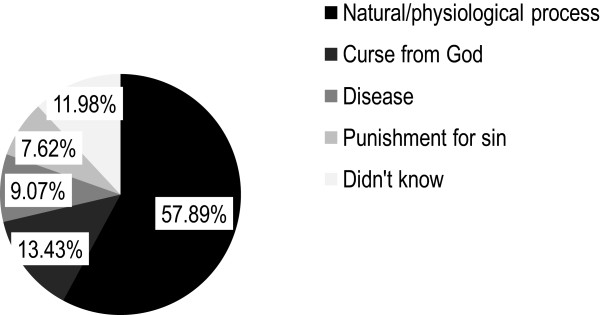
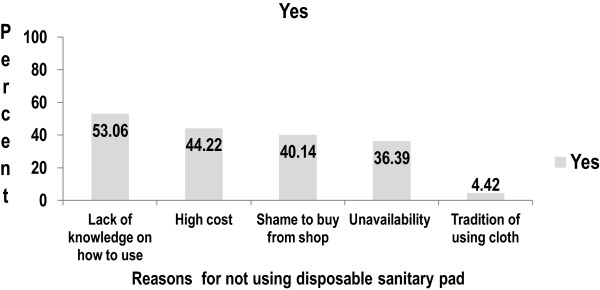
BACKGROUND: Adolescence in girls has been recognized as a special period marked with the onset of menarche. Even though menstruation is a natural process, it is associated with misconceptions, malpractices and challenges among girls in developing countries. However, much is not documented; school-absenteeism and dropout are a common problem among girls in rural Ethiopia. Focusing among school girls, this study has examined knowledge about menstruation, determinants of menstrual management and its influence on school-attendance in Northeast Ethiopia. METHODS: We conducted a mixed-method research combining quantitative and qualitative methods in Northeast Ethiopia. The quantitative study was conducted among 595 randomly selected adolescent school girls. Nine in-depth interviews; five school-dropout girls and four female teachers, and four focus group discussions among school girls were conducted in 2013. RESULTS: The mean age at menarche was 13.98 (±1.17) years. About 51% of girls had knowledge about menstruation and its management. Only a third of the girls used sanitary napkins as menstrual absorbent during their last menstruation. Girls from urban areas, had mothers of secondary and above education and, families of higher monthly expenditure had more chance of using sanitary napkins than their counterparts. More than half of the girls reported to have been absent from school during their menstruation period. Those who did not use sanitary napkins were more likely to be absent from school [AOR-95% C.I: 5.37 (3.02 - 9.55)]. Fifty eight percent of girls reported that their school-performance had declined after they had menarche. In addition, the qualitative study indicated that school-dropout was common among girls who experienced teasing and humiliation by classmates when their clothes were stained with blood as they do not use sanitary napkins. CONCLUSION: Though there is an effort to increase girls' school enrollment, lack of basic needs, like sanitary napkins that facilitate routine activates of girls at early adolescence are observed to deter girls' school-attendance in rural Ethiopia. Special support for girl students, especially when they have their first menstruation and separate functioning sanitary facilities are necessities that should be in school at all times if gender equality and girls empowerment is to be achieved.
Overview
The claims and statistics of this paper haven’t been checked yet.
Run the check — free, no account needed. It reads the open-access text and checks the sources it cites.
Integrity signals
Registry
Cites
Statistics
Figures
Verification
Claims the paper makes
The claims and statistics of this paper haven’t been checked yet.
Run the check — free, no account needed. It reads the open-access text and checks the sources it cites.
Claims other papers make about this one
Each is checked against this paper’s own text: does it say what the citing paper says it does?
The cited source doesn’t support the claim as written.
In the citing paper
“In contrast to some past studies (e.g., [3, 16, 23]), we found that most girls were aware of menstruation prior to menarche.”
From A qualitative understanding of the effects of reusable sanitary pads and puberty education: Implications for future research and practice (2017) · cites this paper as [16]
Checked by a reasoning model — may be wrong.
Experimental — accuracy not yet measuredThe cited source doesn’t support the claim as written.
In the citing paper
“Most quantitative studies have not found an association between menstruation and school attendance [12, 13, 20, 21]”
From Menstrual health and school absenteeism among adolescent girls in Uganda (MENISCUS): a feasibility study (2018) · cites this paper as [21]
Checked by a reasoning model — may be wrong.
Experimental — accuracy not yet measuredThe cited source doesn’t support the claim as written.
In the citing paper
“In an Ethiopian study, about 90% of girls stated that their academic performance or class rank declined after menarche.7”
From Menstrual hygiene management among Bangladeshi adolescent schoolgirls and risk factors affecting school absence: results from a cross-sectional survey (2017) · cites this paper as [7]
Checked by a reasoning model — may be wrong.
Experimental — accuracy not yet measuredThe source backs part of the claim, not all of it — or backs it for a different population, condition or comparison.
In the citing paper
“In our study, school absence during menstruation was independently associated with negative attitudes and perceptions about menstruation, not having a gender-separated unlocked toilet for girls at schools and being forbidden from activities during menstruation, factors that are similar to other studies.7 9 10 21 24–27”
From Menstrual hygiene management among Bangladeshi adolescent schoolgirls and risk factors affecting school absence: results from a cross-sectional survey (2017) · cites this paper as [7]
Experimental — accuracy not yet measuredThe source backs part of the claim, not all of it — or backs it for a different population, condition or comparison.
In the citing paper
“This finding is consistent with those from qualitative studies in LMIC settings which demonstrate that taboos and negative attitudes, including shame and secrecy, contribute to unhygienic practices and school absenteeism [4,33]”
From Menstrual hygiene management and school absenteeism among adolescent students in Indonesia: evidence from a cross-sectional school-based survey (2018) · cites this paper as [4]
Experimental — accuracy not yet measured
The cited source says what the claim attributes to it.
In the citing paper
“The 41% absence rate during menstruation in our study was higher than that reported in a smaller-scale study in Maharashtra, India, where data were collected using a pre-tested, self-administered structured questionnaire among girls aged 10–19 years (561 girls, 14% absent),11 but similar to those reported in Habru, Ethiopia (595 girls, 55% absent),7 and West Bengal, India (190 girls, 39% absent),”
From Menstrual hygiene management among Bangladeshi adolescent schoolgirls and risk factors affecting school absence: results from a cross-sectional survey (2017) · cites this paper as [7]
The cited source says what the claim attributes to it.
In the citing paper
“However, a number of small-scale, mostly qualitative studies have found that many school-age girls do not attend school during menstruation2 6–8 due to shame, fear of having visible stains on their clothing, absence of a private place to manage menstruation in school2 7 9 10 or dysmenorrhoea.11 12”
From Menstrual hygiene management among Bangladeshi adolescent schoolgirls and risk factors affecting school absence: results from a cross-sectional survey (2017) · cites this paper as [7]
The cited source says what the claim attributes to it.
In the citing paper
“This finding contrasts with a similar study conducted in Ethiopia, where students ‘who did not use disposable sanitary napkins were 5.4 times more likely to be absent from school than their counterparts’7 but supports a recent systematic review.47”
From Menstrual hygiene management among Bangladeshi adolescent schoolgirls and risk factors affecting school absence: results from a cross-sectional survey (2017) · cites this paper as [7]
The cited source says what the claim attributes to it.
In the citing paper
“This is lower than has been reported in studies from African contexts but is still substantial [4,33,34].”
From Menstrual hygiene management and school absenteeism among adolescent students in Indonesia: evidence from a cross-sectional school-based survey (2018) · cites this paper as [4]
In the citing paper
“Girls expressed a strong desire for more practical information, including managing menses or pain relief”
From Women’s and girls’ experiences of menstruation in low- and middle-income countries: A systematic review and qualitative metasynthesis (2019) · cites this paper as [93]
In the citing paper
“Quantitative evidence for links between MHM and attendance have been mixed, although studies have almost exclusively looked at absorbent type, rather than all MHM practices discussed below.9–12”
From Measuring the prevalence and impact of poor menstrual hygiene management: A quantitative survey of schoolgirls in rural Uganda (2016) · cites this paper as [9]
In the citing paper
“A higher proportion of girls (who did not use AFRIpads) reported using cloth compared with studies of girls in rural India (pooled prevalence: 63%12), and single-study estimates from East Africa (24% in rural Kenya;18 56% in Ethiopia9).”
From Measuring the prevalence and impact of poor menstrual hygiene management: A quantitative survey of schoolgirls in rural Uganda (2016) · cites this paper as [9]
In the citing paper
“others suggest that one in ten school-aged girls in low and middle income countries fail to attend school during menstruation or drop out of school at puberty due to the absence of menstrual hygiene management (MHM) facilities [4–7].”
From Menstrual hygiene management in rural schools of Zambia: a descriptive study of knowledge, experiences and challenges faced by schoolgirls (2019) · cites this paper as [7]
In the citing paper
“girls’ school performance has been noted to decline after they attain menarche in Africa [7].”
From Menstrual hygiene management in rural schools of Zambia: a descriptive study of knowledge, experiences and challenges faced by schoolgirls (2019) · cites this paper as [7]
In the citing paper
“Girls’ participation and psychological well-being while in class is affected when they do not have access to sanitary pads or adequate alternatives because they fear staining their clothes and subsequently being teased and humiliated by their classmates [4, 7].”
From Menstrual hygiene management in rural schools of Zambia: a descriptive study of knowledge, experiences and challenges faced by schoolgirls (2019) · cites this paper as [7]
In the citing paper
“With respect to menstrual material, schoolgirls rely heavily on cloth due to household poverty, which is similar to that found in Northeast Ethiopia where girls used pieces of cloth and rags because of lack of money [7].”
From Menstrual hygiene management in rural schools of Zambia: a descriptive study of knowledge, experiences and challenges faced by schoolgirls (2019) · cites this paper as [7]
Self-check
Percentages, sums and reported differences re-computed from the paper’s own numbers.
The self-check needs the paper’s full text.
Citations
Cites
Graneheim, U. H., & Lundman, B. (2004) · Nurse Education Today · doi:10.1016/j.nedt.2003.10.001 · Cited by 20,772
Menstrual hygiene: How hygienic is the adolescent girl?
Dasgupta, A., & Sarkar, M. (2008) · Indian Journal of Community Medicine · doi:10.4103/0970-0218.40872 · Cited by 592
McMahon, S. A., Winch, P. J., Caruso, B. A., Obure, A. F., Ogutu, E. A., Ochari, I. A., & Rheingans, R. D. (2011) · BMC International Health and Human Rights · doi:10.1186/1472-698x-11-7 · Cited by 316
Menstrual Hygiene: Knowledge and Practice among Adolescent School Girls of Saoner, Nagpur District
Thakre, S. B., Thakre, S. S., Reddy, M. B., Rathi, N., Pathak, K., & Ughade, S. N. (2011) · Cited by 274
Menstruation, Sanitary Products, and School Attendance: Evidence from a Randomized Evaluation
Oster, E., & Thornton, R. (2011) · American Economic Journal: Applied Economics · doi:10.1257/app.3.1.91 · Cited by 231
Age at menarche and the menstrual pattern of secondary school adolescents in northwest Ethiopia
Zegeye, D. T., Zeleke, B. M., & Mulu, A. (2009) · BMC Women s Health · doi:10.1186/1472-6874-9-29 · Cited by 188
Menstruation and menstrual hygiene amongst adolescent school girls in Kano, Northwestern Nigeria.
Lawan, U. M., Yusuf, N. W., & Musa, A. B. (2010) · PubMed · Cited by 160
(2008) · African Journal of Reproductive Health · Cited by 154
Mudey, A. B., Kesharwani, N., Mudey, G. A., & Goyal, R. C. (2010) · Global Journal of Health Science · doi:10.5539/gjhs.v2n2p225 · Cited by 143
Ds, D., & Ch, G. (2005) · Indian Journal of Community Medicine · Cited by 138
Research works printed but not linked: 10
- Keerti J, Pravin Y: A community based study on menstrual hygiene among adolescent girls. Indian J Matern Child Health. 2011, 13 (3): 1-6.
- Abeer E, Houaida H, Wafaa E: Menstrual attitude and knowledge among Egyptian female adolescents. J Am Sci. 2012, 8 (6): 555-565.
- Sanitation: The Challenge. 2005, United Nations Children’s Fund
- Neamat A, Maher S, Nadia H, Eman R: Assessment of dysmenorrhea and menstrual hygiene practices among adolescent girls in some nursing schools at EL-Minia governorate, Egypt. J Am Sci. 2011, 7 (9): 216-223.
- Mohamed M: Epidemiology of dysmenorrhea among adolescent students in Assiut City, Egypt. Life Sci J. 2012, 9 (1): 348-353.
- Fehr A: Stress, Menstruation and School Attendance: Effects of Water Security on Adolescent Girls in South Gondar. 2011, Ethiopia. MPH thesis: Emory University, School of Public Health
- Nekatibeb T: Low Participation of Female Students in Primary Education. 2002, Addis Ababa, Ethiopia: A case study of dropouts from the Amhara and Oromia regions in Ethiopia
- OpenCode: Umea University. 1997, Sweden: Department of Public Health and Clinical Medicine
- Menstrual Hygiene Management and School Absenteeism among Female Adolescent Students in Northeast Ethiopia: Ethical Clearance Form: Ref. No SPH/266/05 and Project number 0020. 2013, Addis Ababa, Ethiopia: Addis Ababa University, College of Health Sciences, School of Public Health
- Carmela E, Rosa D, Maricela Q, Gumercinda F, Shirley A, Teresa K: Menarche and its implications for Educational Policy in Peru. 2001, Ayacucho, Peru: Girls’ and Women’s Education Policy Research Activity
Cited by
Sorted by citations
Items 201–300 of 340
Modern concept about the vaginal biocenosis of adolescent girls and its changes
Akhmetova, M. Y., Флоренсов, В. В., Leshchenko, O. Y., Евгеньевна, Б. О., & Kolesnikova, L. I. (2025) · Бюллетень Восточно-Сибирского научного центра Сибирского отделения Российской академии медицинских наук · doi:10.29413/abs.2025-10.1.2 · Cited by 2
Brooks, A., Maybin, J. A., & Harper, J. C. (2026) · BMC Public Health · doi:10.1186/s12889-025-24681-1 · Cited by 2
Kuponiyi, S. F., & Amubode, A. A. (2026) · International Health · doi:10.1093/inthealth/ihag029 · Cited by 4
Chang, S. (2016) · ASEE Annual Conference & Exposition · doi:10.18260/p.25526 · Cited by 2
Sharma, N., & Shekhawat, R. (2019) · International Journal of Community Medicine and Public Health · doi:10.18203/2394-6040.ijcmph20192591 · Cited by 2
The Effect of Mothers' Group Counseling on the Health-Promoting Behaviors of Adolescent Girls
Pourshamsian, M., Mafi, M., & Azh, N. (2019) · Asian Journal of Social Health and Behavior · doi:10.4103/shb.shb_49_18 · Cited by 2
Hassan, M. E., Doumat, G., Daher, D., Tannir, A. H. A., Hassan, B., Chidiac, C., Hariri, H., Hatab, T., Daher, A. A., Ezzedin, O., et al. (2022) · Frontiers in Reproductive Health · doi:10.3389/frph.2022.920461 · Cited by 3
Knowledge and Practices of Omani Adolescent Girls Related to Menstruation
Anwar, S. S., Jahwari, J. A. S. A., Kharous, M. I. N. R. A., Adawi, A. H. A. A., Samad, R. A., & Al-Zubaidi, N. (2018) · British Journal of Medical and Health Research · doi:10.46624/bjmhr.2018.v5.i10.005 · Cited by 2
Wasan, Y., Baxter, J. B., Rizvi, A., Shaheen, F., Junejo, Q., Hussain, A., Ahmed, I., Soofi, S. B., & Bhutta, Z. A. (2020) · Research Square · doi:10.21203/rs.3.rs-92846/v1 · Cited by 2
Zeru, A. B., & Muluneh, M. A. (2020) · Research Square · doi:10.21203/rs.3.rs-73097/v1 · Cited by 2
Do Sanitary Pads Alleviate Period Poverty and Improve Girls' Educational Outcomes?Preprint
Agarwal, S. D., Chia, L. E., & Ghosh, P. (2022) · SSRN Electronic Journal · doi:10.2139/ssrn.4189740 · Cited by 2
Menstrual hygiene management in two districts of MalawiPreprint
Hinton, R. G. K., Tremblay-Lévesque, L.-C., Kanjaye, M. B., Macleod, C. J. A., Troldborg, M., & Kalin, R. M. (2024) · medRxiv · doi:10.1101/2024.04.12.24305724 · Cited by 2
Epidemiology of menstrual-related absenteeism in 44 low and middle-income countriesPreprint
Starr, M., Harding, R., Ataíde, R., VonDinklage, N., Sinharoy, S. S., Jayasinghe, Y., Manda‐Taylor, L., Fisher, J., Braat, S., & Pasricha, S. (2024) · medRxiv · doi:10.1101/2024.05.07.24307016 · Cited by 2
Obiano, E. C., Umahi, E. N., Isikekpei, B., Sodeinde, K. J., Atinge, S., Okondu, O. E., Okoye, H. C., & Okorie, P. C. (2023) · Journal of Health and Environmental Research · doi:10.11648/j.jher.20230903.11 · Cited by 1
Tsebee, K. A., & Ternenge, K. (2024) · Asian Journal of Advanced Research and Reports · doi:10.9734/ajarr/2024/v18i8712 · Cited by 1
Gesese, M. M., Gebeyehu, N. A., Gelaw, K. A., Asnake, A. A., & Geda, Y. F. (2025) · BMJ Open · doi:10.1136/bmjopen-2023-083329 · Cited by 1
Healthy menstruation: Myth or reality? Insights into urban slums of Vishakhapatnam city, India
Pandey, G., Darbhamulla, T., Athe, R., & Dwivedi, R. (2025) · Journal of Water Sanitation and Hygiene for Development · doi:10.2166/washdev.2025.247 · Cited by 1
Girl-friendly Environment in Schools across 11 Districts of India: A Cross-sectional Study
Dixit, S., Chakravarty, R. T., Bhardwaj, A., Choudhary, S. K., & Mehra, S. (2025) · Journal of Public Health and Primary Care · doi:10.4103/jphpc.jphpc_5_25 · Cited by 1
Kyei‐Gyamfi, S., Kyei‐Arthur, F., Hayford, P., Martey‐Otchere, J., Kwatsenu, J., & Gyasi‐Mensah, A. (2025) · Infant and Child Development · doi:10.1002/icd.70025 · Cited by 2
Water, sanitation and hygiene in selected counties in western Kenya: status and challenges
Owino, K. O., Ong'or, B. T. I., Kanda, E. K., Ochanda, D. A., Kariaga, P. A., Mukolwe, M. M., Lusweti, E., & Lutta, V. O. (2025) · Water Policy · doi:10.2166/wp.2025.080 · Cited by 1
Niwemukiza, T., Mochama, M., & Andegiorgish, A. K. (2025) · BMC Research Notes · doi:10.1186/s13104-025-07429-3 · Cited by 3
Menstrual Hygiene of School-going Adolescent Girls in Kolkata, West Bengal: A Cross-sectional Study
Arif, W., Mitra, S., Majumdar, K. K., Dasgupta, S., & Joardar, G. K. (2025) · Indian Journal of Public Health · doi:10.4103/ijph.ijph_112_24 · Cited by 1
Seifu, B. A., Dagae, W. B., Nane, D., & Gebrekidan, A. Y. (2025) · Medicine · doi:10.1097/md.0000000000046094 · Cited by 1
Uzunlu, Ş., Sayar, S. E., Çalım, G. A., & Çapık, C. (2026) · BMC Public Health · doi:10.1186/s12889-026-26331-6 · Cited by 6
Baleke, C., Mugenyi, L., Nelson, K. A., Thomas, K. A., Ndekezi, D., Enomut, J. R., Alezuyo, C., Jerrim, J., & Weiss, H. A. (2026) · PLoS ONE · doi:10.1371/journal.pone.0326549 · Cited by 1
Zaman, M. N. U., Sai, A., & Yamauchi, T. (2026) · Scientific Reports · doi:10.1038/s41598-026-41531-1 · Cited by 2
Shaping hygiene: the role of mass media in menstrual health among young Indian women
Trivedy, A., & Khatun, M. (2026) · SN Social Sciences · doi:10.1007/s43545-026-01487-5 · Cited by 1
Nkansah, G. B., Vega, C., & Amofa-Adade, E. (2026) · Frontiers in Reproductive Health · doi:10.3389/frph.2026.1869076 · Cited by 1
Kangwana, B. P., Muthengi, E. N., & Austrian, K. (2020) · BMC Public Health · doi:10.1186/s12889-020-09097-3 · Cited by 1
Effect of Educational Program on Menstrual Health: An Intervention Study among School Girls in Sudan
Ahmed, W. A. M., Mohammed, A. A. R., & Ahmed, R. G. (2021) · Egyptian Journal of Health Care · doi:10.21608/ejhc.2021.205170 · Cited by 1
Preventing School Absenteeism during Menstruation
Boro, P. (2022) · Indian Journal of Youth and Adolescent Health · doi:10.24321/2349.2880.202210 · Cited by 1
Büyüksoy, G. D. B., & AHİ, S. (2023) · Ordu Üniversitesi Hemşirelik Çalışmaları Dergisi · doi:10.38108/ouhcd.1218288 · Cited by 2
Hirai, M., Kushner, C., Shirihuru, N., Chagwiza, G., Mavi, T., Munyaka, M., Mwenda, J., Midzi, N., & Nyamandi, V. (2024) · Journal of Water Sanitation and Hygiene for Development · doi:10.2166/washdev.2024.218 · Cited by 1
Private Sanitation and Psychosocial Health in Adolescent Girls
Miller, R., Mudenda, L. D., Sedai, A. K., & Vilims, L. (2024) · The World Bank Economic Review · doi:10.1093/wber/lhae049 · Cited by 2
Bhedi, S. K., & Khanal, S. P. (2024) · Nepalese Journal of Statistics · doi:10.3126/njs.v8i1.73160 · Cited by 1
Practices of Menstrual Sanitary Care among Post Primary School Girls in Nigeria
Diorgu, F. C., & Diorgu, A. O. (2019) · Research in Health Science · doi:10.22158/rhs.v4n2p78 · Cited by 1
Dewi, T. K., Hapsari, E. D., & Purwanto, P. (2019) · JURNAL WACANA KESEHATAN · doi:10.52822/jwk.v4i1.88 · Cited by 1
杉田, 映. (2019) · 国際開発研究 · doi:10.32204/jids.28.2_1 · Cited by 1
Krishnamurthy, L., Parmar, J., & Suryawanshi, D. M. (2021) · International Journal of Community Medicine and Public Health · doi:10.18203/2394-6040.ijcmph20212007 · Cited by 2
Menstrual hygiene management practice among adolescent girls: a cross sectional study in Nepal
Gautam, K. R., Dahal, H. R., Karki, K., Acharya, S., Subedi, S., Abinash, U., & Shah, S. K. (2021) · International Journal of Community Medicine and Public Health · doi:10.18203/2394-6040.ijcmph20212582 · Cited by 1
Gelo, A., Damena, M., Geleto, A. B., & Kenay, A. (2021) · Research Square · doi:10.21203/rs.3.rs-415160/v1 · Cited by 1
Kumbeni, M. T., Ziba, F. A., Apenkwa, J., & Otupiri, E. (2021) · Research Square · doi:10.21203/rs.3.rs-146221/v1 · Cited by 1
Khalil, S. N., Alsaleem, S. A., Siddiqui, A. F., Alshaikh, A. A., & Althabet, M. M. A. (2020) · doi:10.21203/rs.3.rs-24247/v1 · Cited by 1
Anbesu, E. W., & Aychiluhm, S. B. (2021) · Research Square · doi:10.21203/rs.3.rs-640932/v4 · Cited by 1
Mensural Hygiene Management in Schools of Oromia Region, EthiopiaPreprint
Kaba, M., & Geletu, Z. A. (2020) · Research Square · doi:10.21203/rs.3.rs-55327/v1 · Cited by 1
Anbesu, E. W., & Aychiluhm, S. B. (2021) · Research Square · doi:10.21203/rs.3.rs-640932/v3 · Cited by 1
Khanal, G., Shrestha, N., Adhikari, K., & Ghimire, U. (2022) · medRxiv · doi:10.1101/2022.12.05.22283126 · Cited by 1
Akoth, C., Wambiya, E. O. A., Kibe, P. M., Mbuthia, G. W., Ng’ang’a, L., Otieno, P. O., & Oguta, J. O. (2023) · Research Square · doi:10.21203/rs.3.rs-3280589/v1 · Cited by 1
Gelo, A., Geleto, A. B., Demena, M., & Tura, A. K. (2023) · Research Square · doi:10.21203/rs.3.rs-3700784/v1 · Cited by 2
Ayehu, A., Kassaw, T., & Hailu, G. (2016)
Menstrual hygiene practices among female adolescents seen in general outpatient clinic
Aliyu, I., Grema, B., & Michael, G. C. (2018) · Tropical Journal of Obstetrics and Gynaecology · doi:10.4103/tjog.tjog_31_18
Menstrual health among school adolescent girls
Mishra, L. (2019) · International Journal of Advance Research in Nursing · doi:10.33545/nursing.2019.v2.i1.c.1
Vidyasagar, V., & Jilani, K. (2020) · International Journal of Community Medicine and Public Health · doi:10.18203/2394-6040.ijcmph20201988
B., S. R. B., Ks, V., Aishwarya, D., Shefali, & Iyengar, K. (2019) · Research Journal of Medical and Allied Health Sciences · doi:10.46319/rjmahs.2019.v02i02.004
Kumar, P. (2020) · National Journal of Community Medicine · doi:10.5455/njcm.20200204084244
Ibrahim, M. J., Sani, Z. M., Olorukooba, A. A., Usman, N. O., Ahmad, A. I., & Mohammed-Idris, Z. K. (2021) · Journal of Community Medicine and Primary Health Care · doi:10.4314/jcmphc.v33i1.1
Anbesu, E. W., & Aychiluhm, S. B. (2021) · Research Square · doi:10.21203/rs.3.rs-640932/v1
ADJEI-AMOAFO, K. (2021) · Research Square · doi:10.21203/rs.3.rs-813356/v1
Perception and Practice about Menstrual Health/Hygiene Among Adolescent Girls in Barisal District
Shelley, F. E. (2022) · Ibrahim Cardiac Medical Journal · doi:10.3329/icmj.v11i1.58710
Anbesu, E. W., & Aychiluhm, S. B. (2021) · Research Square · doi:10.21203/rs.3.rs-640932/v2
PANDEY, P., & KUMAR, S. (2022) · GFNPSS GLOBAL NURSING JOURNAL OF INDIA · doi:10.46376/gnji/4.iii.2021.358-361
Challenges and Gaps in Sanitary Towels Provision in Kenya During COVID-19 Pandemic
Gichuhi, L. (2022) · International Journal of Learning and Development · doi:10.5296/ijld.v12i3.20060
Relationship between Menstruation and Fertility: Perception and Knowledge of Nigerian Women
Abidoye, G., Olalere, O., Haleemah, F. D., Oshodi, O. O., Abisowo, Y., Olumodeji, O., Moses, A., Kuye, K., & Kuye-Kuku, T. O. (2022) · Gynecology & Reproductive Health · doi:10.33425/2639-9342.1177
Impact of Menstrual Distress During Menstruation to Promote Coping Strategies
Karmakar, M., Panduragan, S. L., Said, F. M., & Poddar, S. (2023) · Advances in medical diagnosis, treatment, and care (AMDTC) book series · doi:10.4018/978-1-6684-5088-8.ch012
Assessment of knowledge and practice of menstrual hygiene among high school
Mishra, L. (2019) · International Journal of Midwifery and Nursing Practice · doi:10.33545/26630427.2019.v2.i1a.24
Adolescents’ Feelings About Menarche in Mosul Schools
Omar, Z. A. (2023) · International Journal of Research in Medical Sciences & Technology · doi:10.37648/ijrmst.v16i01.010
Shah, V., Schmidt, W., Sonko, B. J., Sinjanka, E., Mendy, F., Hennegan, J. M., Phillips‐Howard, P. A., & Torondel, B. (2023) · SSRN Electronic Journal · doi:10.2139/ssrn.4628186
Christine, C., & Agustiany, D. (2023) · Poltekita Jurnal Pengabdian Masyarakat · doi:10.33860/pjpm.v4i3.2132 · Cited by 2
Awareness about Menstrual Hygiene Management among Visually Impaired Adolescent Girls
Singh, S., & Agarwal, S. (2023) · Journal of Ecophysiology and Occupational Health · doi:10.18311/jeoh/2023/34656 · Cited by 2
Bhatt, A., & Devkota, E. (2023) · Journal of Public Health and Development · doi:10.55131/jphd/2024/220104
Menstrual Management in U.S. Public Schools: A Qualitative Case Study
Powley, C. (2023) · Women s Reproductive Health · doi:10.1080/23293691.2023.2287527
Acesso e práticas de higiene menstrual na América Latina: revisão de escopo
de Oliveira, V. C., Pena, É. D., de Andrade, G. N., & Felisbino-Mendes, M. S. (2023) · Revista Latino-Americana de Enfermagem · doi:10.1590/1518-8345.6736.4030
Phiri, R., & Ilubala-Ziwa, J. L. (2023) · International Journal of Education and Teaching · doi:10.51483/ijedt.3.2.2023.62-71 · Cited by 2
Barini, G. O., Amima, S., Mulwa, D. F., & Mogeni, P. (2024) · medRxiv · doi:10.1101/2024.04.04.24305345
Neupane, P., Sushhama, N., Amgain, K., Lama, N., & Panta, P. P. (2023) · Journal of Chitwan Medical College · doi:10.54530/jcmc.1456
Kassa, W., Mihiret, M., & Yeshita, H. Y. (2024) · Research Square · doi:10.21203/rs.3.rs-4268128/v1
Bhandari, K., Dahal, R., & Paudel, Y. R. (2024) · International Journal of Health Sciences and Research · doi:10.52403/ijhsr.20240516
Kusbaryanto, & Chapsoh (2024) · International Journal of Human and Health Sciences (IJHHS) · doi:10.31344/ijhhs.v8i2.637
Asaasira, R., Twinamatsiko, M., & Komurere, A. (2024) · Student s Journal of Health Research Africa · doi:10.51168/sjhrafrica.v5i9.1345
Nassozi, P., Kebirungi, H., Opit, E., Charles, M., Kaahwa, Y. T., Lawrence, S., Kaweesi, M., Mugenyi, D. K., Mutebi, A., Isabirye, C., et al. (2024) · Sexuality Gender & Policy · doi:10.1002/sgp2.12109
Menstrual Health in the Global South
Letsie, P. R. (2024) · doi:10.5871/bacad/9780197267578.003.0002
Sukriti, Padda, P., & Mahajan, S. (2024) · International Journal of Community Medicine and Public Health · doi:10.18203/2394-6040.ijcmph20243636
Hailu, M., Abie, A., Mehari, M. G., Dagnaw, T. E., Worku, N. K., Esubalew, D., Limenh, L. W., Delie, A. M., Melese, M., & Fenta, E. T. (2025) · International Journal of Scientific Reports · doi:10.18203/issn.2454-2156.intjscirep20250387
Hyttel, M., Thomsen, C. F., Luff, B., Storrusten, H. S. H., Nyakato, V. N., & Tellier, M. (2024) · Waterlines · doi:10.3362/1756-3488.24-00003
Evidence-based nursing practice: Barriers and enablers in clinical settings
Traoré, A. (2025) · International Journal of Midwifery and Nursing Practice · doi:10.33545/26630427.2025.v8.i1a.185
Baleke, C., Mugenyi, L., Nelson, K. A., Thomas, K. A., Ndekezi, D., Enomut, J. R., Alezuyo, C., Jerrim, J., & Weiss, H. A. (2025) · medRxiv · doi:10.1101/2025.06.03.25328933
Rajput, K. B., Mangla, V., Bhargava, A., Tawar, S., & Singh, P. (2025) · International Journal of Community Medicine and Public Health · doi:10.18203/2394-6040.ijcmph20252109 · Cited by 1
Semela, T., & Cochrane, L. (2025) · Journal of Research in Childhood Education · doi:10.1080/02568543.2025.2528698
Why Inter-sectoral Coordination is Imperative for Improved Menstrual Hygiene Management in India
Sherin Raj, T. P., & Kathuria, B. (2025) · Journal of Health Management · doi:10.1177/09720634251370523
Nigatu, D. T., Desta, R., & Feleke, A. (2025) · Journal of Family Medicine and Health Care · doi:10.11648/j.jfmhc.20251104.11
Kiza, A. N., Itigaino, S. B., Labat, A., Tshilumba, C. K., Alliance Tagoto Tepungipame, Likwela, J. L., Bosunga, G. K., & Kitronza, J. P. L. (2025) · Journal of Water Sanitation and Hygiene for Development · doi:10.2166/washdev.2025.035
Tanton, C., Nakuya, K., Kansiime, C., Hytti, L., Torondel, B., Francis, S. C., Namirembe, P., Nakalema, S., Nalugya, R., Musoke, S. N., et al. (2021) · Figshare · doi:10.6084/m9.figshare.17162909
Shah, V., Phillips‐Howard, P. A., Hennegan, J. M., Cavill, S., Sonko, B. J., Sinjanka, E., Trawally, N. C., Kanteh, A., Mendy, F., Bah, A. B., et al. (2022) · Figshare · doi:10.6084/m9.figshare.20329873
Gu, Y., Zhou, W., Zheng, T., & Huang, F. (2024) · Figshare · doi:10.6084/m9.figshare.26638782
Additional file 1 of Menstrual health among adolescents and young adults in rural Haiti
Rupe, E. R., Rodean, J., Hurley, E. A., Miller, M. K., Boncoeur, M. D., & Masonbrink, A. R. (2024) · Figshare · doi:10.6084/m9.figshare.26556086
Anbesu, E. W., & Asgedom, D. K. (2024) · Figshare · doi:10.6084/m9.figshare.26559410
Tanton, C., Nakuya, K., Kansiime, C., Hytti, L., Torondel, B., Francis, S. C., Namirembe, P., Nakalema, S., Nalugya, R., Musoke, S. N., et al. (2021) · Figshare · doi:10.6084/m9.figshare.17162906
Shah, V., Phillips‐Howard, P. A., Hennegan, J. M., Cavill, S., Sonko, B. J., Sinjanka, E., Trawally, N. C., Kanteh, A., Mendy, F., Bah, A. B., et al. (2022) · Figshare · doi:10.6084/m9.figshare.20329867
Shah, V., Phillips‐Howard, P. A., Hennegan, J. M., Cavill, S., Sonko, B. J., Sinjanka, E., Trawally, N. C., Kanteh, A., Mendy, F., Bah, A. B., et al. (2022) · Figshare · doi:10.6084/m9.figshare.20329858
Metadata
- Authors
- Tegegne, T. K., & Sisay, M. M.
- Affiliations
- Debre Markos University (ET)
- Addis Ababa University (ET)
- Corresponding author
- Sisay, Mitike Molla
- Venue
- BMC Public Health
- Published
- 2014-10-29
- Volume
- 14
- Issue
- 1
- Pages
- 1118-1118
- ISSN
- 1471-2458 (ISSN-L)
- PMC
- PMC4232635
- OpenAlex
- W2092680858
- Cited by
- 342
- References
- 21
- Citations by year
- 2026: 29 · 2025: 37 · 2024: 45 · 2023: 37 · 2022: 49 · 2021: 43 · 2020: 35 · 2019: 23 · 2018: 17 · 2017: 16 · 2016: 6 · 2015: 3 · 2014: 2
- FWCI
- 8.92
- Type
- journal article
- Language
- en
- Open access
- gold
- doi.org
- Licence
- Locations
- BMC Public Health (publishedVersion, cc-by)
- Europe PMC (PubMed Central) (publishedVersion, cc-by)
- PubMed Central (publishedVersion, cc-by)
- PubMed (publishedVersion)
- Deakin Research Online (Deakin University) (submittedVersion)
- Figshare (submittedVersion)
- Funders
- Addis Ababa University
- Topics
- Health Sciences › Medicine › Public Health, Environmental and Occupational Health › Menstrual Health and Disorders
- Health Sciences › Medicine › Public Health, Environmental and Occupational Health › Adolescent Sexual and Reproductive Health
- Health Sciences › Medicine › Reproductive Medicine › Hypothalamic control of reproductive hormones
- Keywords
- menstrual hygiene management, school absenteeism, adolescent girls, menarche, sanitary napkins, school dropout, menstrual knowledge, academic performance, peer teasing, rural Ethiopia, girls' empowerment
- MeSH terms
- Absenteeism, Adolescent, Adolescent Behavior, Ethiopia, Female, Humans, Hygiene, Menarche, Surveys and Questionnaires, School Health Services, Schools, Students, Health Behavior, Young Adult
About these checks
Registry, retraction, Cites and statistics results are computed, not judged, with one exception: a printed reference that no index lists is read once by a model before it counts as a citation error. Claims are extracted by a model and kept only when their quote appears verbatim in the text; each cited source is then checked, with a model’s help, for whether it says what the claim relies on. Those verdicts can be wrong — read the claim’s quote and the cited source before relying on one.
Statistics and arithmetic are recomputed, not judged.
Confidence bands are shown only for fields calibrated on our annotated test set. None is calibrated yet, so no band is shown.
What counts as a claim ›How we measure confidence ›How we check this ›
Are you an author, or do you see a problem with this page? Request a review
