

A review of life expectancy and infant mortality estimations for Australian Aboriginal people
Open accessThe DOI matches its Crossref record; 34 of the 34 references it cites were found in a registry or an index.
Abstract
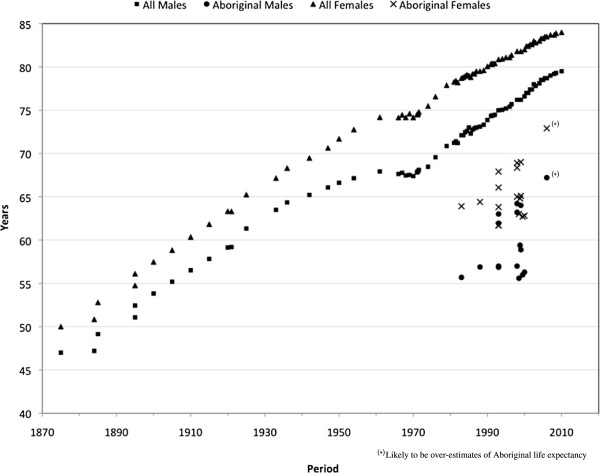
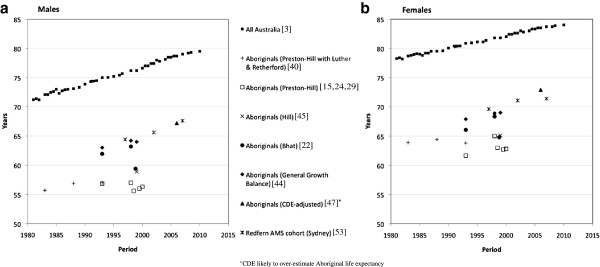
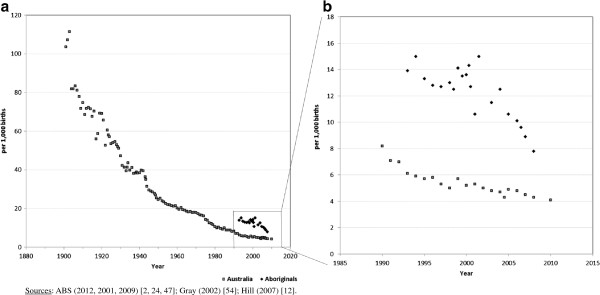
Background: Significant variation exists in published Aboriginal mortality and life expectancy (LE) estimates due to differing and evolving methodologies required to correct for inadequate recording of Aboriginality in death data, under-counting of Aboriginal people in population censuses, and unexplained growth in the Aboriginal population attributed to changes in the propensity of individuals to identify as Aboriginal at population censuses. The objective of this paper is to analyse variation in reported Australian Aboriginal mortality in terms of LE and infant mortality rates (IMR), compared with all Australians. Methods: Published data for Aboriginal LE and IMR were obtained and analysed for data quality and method of estimation. Trends in reported LE and IMR estimates were assessed and compared with those in the entire Australian population. Results: LE estimates derived from different methodologies vary by as much as 7.2 years for the same comparison period. Indirect methods for estimating Aboriginal LE have produced LE estimates sensitive to small changes in underlying assumptions, some of which are subject to circular reasoning. Most indirect methods appear to under-estimate Aboriginal LE. Estimated LE gaps between Aboriginal people and the overall Australian population have varied between 11 and 20 years. Latest mortality estimates, based on linking census and death data, are likely to over-estimate Aboriginal LE. Temporal LE changes by each methodology indicate that Aboriginal LE has improved at rates similar to the Australian population overall. Consequently the gap in LE between Aboriginal people and the total Australian population appears to be unchanged since the early 1980s, and at the end of the first decade of the 21st century remains at least 11–12 years. In contrast, focussing on the 1990–2010 period Aboriginal IMR declined steeply over 2001–08, from more than 12 to around 8 deaths per 1,000 live births, the same level as Australia overall in 1993–95. The IMR gap between Aboriginal people and the total Australian population, while still unacceptable, has declined considerably, from over 8 before 2000 to around 4 per 1,000 live births by 2008. Conclusions: Regardless of estimation method used, mortality and LE gaps between Aboriginal and non-Aboriginal people are substantial, but remain difficult to estimate accurately.
Overview
The claims and statistics of this paper haven’t been checked yet.
Free: it reads the open-access text and checks the first 5 claims that cite a source we can check. Create a free account to check every claim.
Integrity signals
Registry
Cites
Statistics
Figures
Verification
Claims the paper makes
The claims and statistics of this paper haven’t been checked yet.
Free: it reads the open-access text and checks the first 5 claims that cite a source we can check. Create a free account to check every claim.
Claims other papers make about this one
Each is checked against this paper’s own text: does it say what the citing paper says it does?
The check wasn’t confident either way, so it gives no verdict — never disputed.
In the citing paper
“Given the greater burden of childhood trauma and social adversity experienced by Indigenous77 78 and refugee children,79 this is a major gap in the literature.”
From What factors are associated with resilient outcomes in children exposed to social adversity? A systematic review (2019) · cites this paper as [78]
Experimental — accuracy not yet measured
Self-check
Percentages, sums and reported differences re-computed from the paper’s own numbers.
The self-check needs the paper’s full text.
Citations
Cites
The health and welfare of Australia?s Aboriginal and Torres Strait Islander peoples 1999
Cunningham, J. (1999) · New South Wales Public Health Bulletin · doi:10.1071/nb99075 · Cited by 801
Vos, T., Barker, B., Begg, S., Stanley, L., & Lopez, A. D. (2009) · International Journal of Epidemiology · doi:10.1093/ije/dyn240 · Cited by 593
Methods for estimating fertility and mortality from limited and defective data.
Brass, W. (1975) · Cited by 319
The burden of disease and injury in Aboriginal and Torres Strait Islander peoples 2003
Vos, T., López, A. D., Stanley, L., & Barker, B. M. (2007) · Cited by 194
The health status of indigenous peoples and others
Ring, I., & Brown, N. (2003) · BMJ · doi:10.1136/bmj.327.7412.404 · Cited by 163 · cited 1×
“6 and 21 years, depending on sex, time periods chosen, the jurisdiction investigated and, most of all, the method of calculation [3,9-19].”
MethodEstimating census and death registration completeness.
Hill, K. (1987) · PubMed · Cited by 123
Hill, K., Barker, B., & Vos, T. (2007) · International Journal of Epidemiology · doi:10.1093/ije/dym011 · Cited by 107 · cited 21×
“Wilson T, Condon J, Barnes T: Northern Territory Indigenous life expectancy improvements, 1967–2004.”
BackgroundMethodInfluentialZhao, Y., & Dempsey, K. (2006) · Medical Journal of Australia · doi:10.5694/j.1326-5377.2006.tb00340.x · Cited by 94 · cited 2×
“6 and 21 years, depending on sex, time periods chosen, the jurisdiction investigated and, most of all, the method of calculation [3,9-19].”
BackgroundMethodAboriginal and Torres Strait Islander Health Performance Framework 2008 report: detailed analyses
Gourley, M., Stace-Winkles, N., & Al-Yaman, F. M. (2009) · Cited by 94
Estimating the completeness of death registration
Preston, S., & Hill, K. (1980) · Population Studies · doi:10.1080/00324728.1980.10410395 · Cited by 57 · cited 4×
“However, the method also assumes a closed population with no net migration, no age misreporting, and no differences in age-specific coverage of Aboriginality in death versus population data [33,37].”
MethodInfluentialThe contemporary demography of indigenous Australians
Taylor, J. (1997) · Journal of the Australian Population Association · doi:10.1007/bf03029488 · Cited by 56 · cited 1×
“Since the 1971 census, Aboriginal people have self-identified on census forms whilst death registers usually acquire Aboriginality from a family member, medical doctor or funeral director, if it is reported [26,27].”
BackgroundLife Table and Mortality Analysis.
Billewicz, W. Z., & Chiang, C. L. (1979) · Biometrics · doi:10.2307/2529958 · Cited by 56
Life table and mortality analysis.
Chiang, C. L. (1978) · Cited by 52
Health Expenditure, Income and Health Status Among Indigenous and Other Australians
Gray, M., Hunter, B. H., & Taylor, J. (2004) · ANU Press eBooks · doi:10.22459/caepr21.08.2004 · Cited by 49
Standards for Statistics on Cultural and Language Diversity
Queensland (2006) · Cited by 43
Northern Territory Indigenous life expectancy improvements, 1967–2004
Wilson, T., Condon, J. R., & Barnes, T. (2007) · Australian and New Zealand Journal of Public Health · doi:10.1111/j.1753-6405.2007.00039.x · Cited by 42 · cited 2×
“6 and 21 years, depending on sex, time periods chosen, the jurisdiction investigated and, most of all, the method of calculation [3,9-19].”
BackgroundMethodThe Australian mortality decline: cause-specific mortality 1907-1990
Taylor, R., Lewis, M., & Powles, J. (1998) · Australian and New Zealand Journal of Public Health · doi:10.1111/j.1467-842x.1998.tb01142.x · Cited by 40 · cited 1×
“Life expectancy Since the late 19th century reported LE estimates for Australia overall have increased steadily in an almost linear fashion, from 47 years in males and 50 years in females in the 1870s [36], to 79.”
BackgroundSelf-citationIndigenous mortality: Placing Australian aboriginal mortality within a broader context
Hogg, R. S. (1992) · Social Science & Medicine · doi:10.1016/0277-9536(92)90030-t · Cited by 39 · cited 1×
“6 and 21 years, depending on sex, time periods chosen, the jurisdiction investigated and, most of all, the method of calculation [3,9-19].”
MethodGeneral growth balance method: A reformulation for populations open to migration
BHAT, P. N. M. (2002) · Population Studies · doi:10.1080/00324720213798 · Cited by 37 · cited 18×
“Excepting a 2.3 year rise in female Aboriginal LE between 1991–1996 and 1996–2001 reported by the ABS using the Bhat method, and the slight decreases in LE mentioned above, Aboriginal LE estimates generally have increased by between 1.0 and 1.3 years over 2 or 3 inter-censal periods (10–15 years) using any one particu…”
MethodInfluentialAdjusting the general growth balance method for migration
Hill, K., & Queiroz, B. (2010) · Revista Brasileira de Estudos de População · doi:10.1590/s0102-30982010000100002 · Cited by 30 · cited 1×
“However, where the Bhat method regards changes in the propensity to identify as Aboriginal as a ‘migration’ effect, with an age distribution proportional to the Aboriginal estimated resident population, the GGB method attributes these changes to changes in census coverage explicitly with an age distribution proportion…”
MethodEstimates of cancer incidence, mortality and survival in aboriginal people from NSW, Australia
Morrell, S. L., You, H., & Baker, D. F. (2012) · BMC Cancer · doi:10.1186/1471-2407-12-168 · Cited by 30 · cited 1×
“For example, Aboriginal status in cancerspecific mortality in NSW has been around 97% complete since the late 1990s [8], and since 1998 numbers of death registrations of Aboriginal people have shown greater year-by-year consistency in NSW and Queensland [4].”
BackgroundSelf-citationEstimating the components of indigenous population change, 1996–2001
Kinfu, Y., & Taylor, J. (2002) · ANU Open Research (Australian National University) · Cited by 28
Assessing the validity of intercensal comparisons of indigenous Australians, 1986–96
Hunter, B. H. (1998) · Journal of the Australian Population Association · doi:10.1007/bf03029391 · Cited by 27 · cited 1×
“Between the 1991 and 1996 census, the Aboriginal population increased by 33%, with less than half (14%) the increase attributable to natural growth, and the remainder thought to be due mainly to the change in propensity to identify as Aboriginal [31,32].”
BackgroundHealth Expenditure, Income and Health Status Among Indigenous and Other Australians
Taylor, J., Hunter, B. H., & Gray, M. C. (2004) · ANU Press eBooks · doi:10.26530/oapen_459260 · Cited by 24 · cited 2×
“Sources: ABS (2012, 2001, 2009) [2, 24, 47]; Gray (2002) [54]; Hill (2007) [12].”
BackgroundAboriginal population prospects
Gray, A., & Tesfaghiorgbis, H. (1993) · Journal of the Australian Population Association · doi:10.1007/bf03029416 · Cited by 22 · cited 1×
“In 1993 Gray and Tesfaghiorghis estimated Aboriginal LE using the Preston-Hill method supplemented by Luther and Retherford’s balancing procedure [39,40].”
MethodRecent patterns in chronic disease mortality in remote living Indigenous Australians
Andreasyan, K., & Hoy, W. E. (2010) · BMC Public Health · doi:10.1186/1471-2458-10-483 · Cited by 20 · cited 1×
“6 and 21 years, depending on sex, time periods chosen, the jurisdiction investigated and, most of all, the method of calculation [3,9-19].”
MethodThe explosion of aboriginality: Components of Indigenous population growth 1991-1996
Gray, A. (2018) · ANU Open Research (Australian National University) · Cited by 18
Estimating Indigenous life expectancy: pitfalls with consequences
Madden, R., Tickle, L., Pulver, L. J., & Ring, I. T. (2012) · Journal of Population Research · doi:10.1007/s12546-012-9085-6 · Cited by 16
Occasional paper: mortality of Aboriginal and Torres Strait Islander Australians
Cunningham, J., & Paradies, Y. (2000) · Deakin Research Online (Deakin University) · Cited by 14
Identification of Aboriginal and Torres Strait Islander women using an urban obstetric hospital
Pulver, L. R. J., Bush, A., & Ward, J. (2003) · Australian Health Review · doi:10.1071/ah030019 · Cited by 14 · cited 1×
“It should be noted that while increasing the scope of data linkage to include more databases with Aboriginal identification is theoretically beneficial to outcome improvement, some authors have found Aboriginality to remain largely under-identified in such datasets [59].”
BackgroundCan human rights discourse improve the health of Indigenous Australians?
Gray, N. J., & Bailie, R. S. (2006) · Australian and New Zealand Journal of Public Health · doi:10.1111/j.1467-842x.2006.tb00462.x · Cited by 13 · cited 2×
“6 and 21 years, depending on sex, time periods chosen, the jurisdiction investigated and, most of all, the method of calculation [3,9-19].”
BackgroundMethodConsistent correction of census and vital registration data
Luther, N. Y., & Retherford, R. D. (1988) · Mathematical Population Studies · doi:10.1080/08898488809525258 · Cited by 9
A comparative analysis of indirect methodologies for estimating Indigenous life expectancy
Barnes, T., Smith, L., Zhao, Y., & Guthridge, S. L. (2008) · Cited by 9
Mortality in an Aboriginal Medical Service (Redfern) cohort
Morrell, S. L., Phillips, B., Taylor, R. J., Daniels, J. S. M., Burgess, K., & Mayers, N. R. (2013) · Population Health Metrics · doi:10.1186/1478-7954-11-2 · Cited by 5 · cited 5×
“study [44] are comparable with those from the AMS study [53].”
BackgroundMethodResultInfluentialSelf-citation
Research works printed but not linked: 27
- 1. NSW Department of Health Communicating positively: A Guide to Appropriate Aboriginal Terminology 2004 Sydney: NSW Health
- 3. Australian Bureau of Statistics Deaths, Australia, 2010 2010 Canberra: ABS Cat. No. 3302.0
- 4. Australian Bureau of Statistics Discussion Paper: Assessment of Methods for Developing Life Tables for Aboriginal and Torres Strait Islander Australians. Australia 2006 2008 Canberra: ABS ABS Catalogue No. 3302.0.55.002
- 5. Australian Bureau of Statistics Population Characteristics, Aboriginal and Torres Strait Islander Australians 2010 Canberra: Australian Bureau of Statistics 4713.0
- 6. Council of Australian Governments (COAG) National Partnership Agreement on Closing the Gap in Indigenous Health Outcomes 2008 Canberra: COAG
- 7. Council of Australian Governments (COAG) National Indigenous Reform Agreement (Closing the Gap) 2008 Canberra: COAG
- 9. Anderson P Bhatia K Cunningham J Mortality of Indigenous Australians 1996 Canberra: (AUST): Australian Bureau of Statistics; Occasional Paper, Cat No. 3315.0
- 15. Australian Bureau of Statistics Deaths, Australia, 1999 2000 Canberra: ABS Cat. No. 3302.0
- 16. Australian Bureau of Statistics Experimental Life Tables for Aboriginal and Torres Strait Islander Australians, 2005–2007 2009 Canberra: Australian Bureau of Statistics ABS cat. no. 3302.0.55.003
- 17. Australian Institute of Health and Welfare The Health and Welfare of Australia’s Aboriginal and Torres Strait Islander people, An Overview 2011 2011 Canberra: AIHW
- 20. Australian Bureau of Statistics Deaths, Australia, 2006 2007 Canberra: ABS Cat. No. 3302.0
- 21. Australian Bureau of Statistics Demography Working Paper 2001/4 - Issues in Estimating the Indigenous Population, 2001 2001 Canberra: ABS 3126.0
- 22. Australian Bureau of Statistics Demography Working Paper 2004/3 - Calculating Experimental Life Tables for Use in Population Estimates and Projections of Aboriginal and Torres Strait Islander Australians, 1991 to 2001 2004 Canberra: (AUST): ABS Cat. No. 3106.0.55.003
- 23. Australian Bureau of Statistics Information paper: Census data enhancement - Indigenous mortality quality study 2008 Canberra: ABS Cat. No. 4723.0
- 24. Australian Bureau of Statistics Deaths, Australia, 2001 2002 Canberra: ABS Cat. No. 3302.0
- 29. Australian Bureau of Statistics Deaths, Australia, 1993 1994 Canberra: ABS Cat. No. 3302.0
- 32. Ross K Occasional Paper: Population Issues, Indigenous Australians, 1996 1999 Canberra: Australian Government Publishing Service, Commonwealth of Australia
- 34. Australian Bureau of Statistics Experimental Estimates and Projections, Aboriginal and Torres Strait Islander Australians, 1991–2021 2009 Canberra: ABS Cat. No. 3238.0
- 43. Jain S Shahidullah M Indigenous mortality estimation: an application of Bhat’s recent reformulation of Brass Growth Balance Equation Population and Society: Issues, Research, Policy 2004 Canberra: Australian Population Association, 12th biennial conference
- 47. Australian Bureau of Statistics Deaths, Australia, 2009 2010 Canberra: ABS Cat. No. 3302.0
- 48. Australian Bureau of Statistics Deaths, Australia, 1998 1998 Canberra: ABS Cat. No. 3302.0
- 49. Australian Bureau of Statistics Deaths, Australia, 2003 2004 Canberra: ABS Cat. No. 3302.0
- 50. Australian Bureau of Statistics Deaths, Australia, 2008 2009 Canberra: ABS Cat. No. 3302.0
- 51. Australian Bureau of Statistics Demography 1971 1974 Canberra: ABS Bulletin No. 87
- 52. Australian Institute of Health and Welfare Mortality over the Twentieth Century in Australia – Trends and Patterns in Major Causes of Death 2006 Canberra: AIHW AIHW cat. no. PHE 73
- 56. Australian Institute of Health and Welfare Comparing Life Expectancy of Indigenous People in Australia, New Zealand, Canada and the United States: Conceptual, Methodological and Data Issues 2011 Canberra: AIHW
- 58. Australian Institute of Health and Welfare An Enhanced Mortality Database for Estimating Indigenous Life Expectancy: A Feasibility Study 2012 Canberra: AIHW Cat. No. IHW 75
Cited by
Saqlain, M., Munir, M. M., Rehman, S. U., Gulzar, A., Naz, S., Ahmed, Z., Tahir, A. H., & Mashhood, M. (2020) · Journal of Hospital Infection · doi:10.1016/j.jhin.2020.05.007 · Cited by 703
The mental health of civilians displaced by armed conflict: an ecological model of refugee distress
Miller, K. E., & Rasmussen, A. (2017) · Epidemiology and Psychiatric Sciences · doi:10.1017/s2045796016000172 · Cited by 653
Neurodiversity at work: a biopsychosocial model and the impact on working adults
Doyle, N. (2020) · British Medical Bulletin · doi:10.1093/bmb/ldaa021 · Cited by 527
Munt, A. E., Partridge, S. R., & Allman‐Farinelli, M. (2017) · Obesity Reviews · doi:10.1111/obr.12472 · Cited by 388
A Systematic Review of the Public’s Knowledge and Understanding of Alzheimer’s Disease and Dementia
Cahill, S., Pierce, M., Werner, P., Darley, A., & Bobersky, A. (2015) · Alzheimer Disease & Associated Disorders · doi:10.1097/wad.0000000000000102 · Cited by 265
Metadata
- Authors
- Phillips, B., Morrell, S., Taylor, R., & Daniels, J.
- Affiliations
- UNSW Sydney (AU)
- University of Wollongong (AU)
- Corresponding author
- Taylor, Richard
- Venue
- BMC Public Health
- Published
- 2014-01-02
- Volume
- 14
- Issue
- 1
- Pages
- 1-1
- ISSN
- 1471-2458 (ISSN-L)
- PMC
- PMC3893414
- OpenAlex
- W2155883884
- Cited by
- 578
- References
- 34
- Citations by year
- 2026: 20 · 2025: 67 · 2024: 51 · 2023: 42 · 2022: 59 · 2021: 85 · 2020: 44 · 2019: 37 · 2018: 34 · 2017: 69 · 2016: 51 · 2015: 16 · 2014: 3
- FWCI
- 59.18
- Type
- journal article
- Language
- en
- Open access
- gold
- doi.org
- Licence
- Locations
- BMC Public Health (publishedVersion, cc-by)
- Europe PMC (PubMed Central) (publishedVersion, cc-by)
- PubMed Central (publishedVersion, cc-by)
- PubMed (publishedVersion)
- Research Online (University of Wollongong) (submittedVersion)
- Figshare (submittedVersion)
- Funders
- Medical Research Council
- National Health and Medical Research Council (402485)
- Topics
- Social Sciences › Health › Indigenous Health, Education, and Rights
- Social Sciences › Demography › Insurance, Mortality, Demography, Risk Management
- Health Sciences › Medicine › Public Health, Environmental and Occupational Health › Indigenous Health and Education
- Keywords
- Aboriginal Australians, life expectancy, infant mortality, mortality estimation, life expectancy gap, mortality gap, data linkage
- MeSH terms
- Australia, Death, Female, Humans, Infant, Infant Mortality, Life Expectancy, Male, Research Design, Censuses, Native Hawaiian or Other Pacific Islander, Health Status Disparities
About these checks
Registry, retraction, Cites and statistics results are computed, not judged, with one exception: a printed reference that no index lists is read once by a model before it counts as a citation error. Claims are extracted by a model and kept only when their quote appears verbatim in the text; each cited source is then checked, with a model’s help, for whether it says what the claim relies on. Those verdicts can be wrong — read the claim’s quote and the cited source before relying on one.
Statistics and arithmetic are recomputed, not judged.
Confidence bands are shown only for fields calibrated on our annotated test set. None is calibrated yet, so no band is shown.
What counts as a claim ›How we measure confidence ›How we check this ›
Are you an author, or do you see a problem with this page? Request a review
Data sources
Bibliographic data: Semantic Scholar, OpenAlex, Crossref.
Contains information from the Semantic Scholar Academic Graph Datasets, made available under the ODC Attribution License (ODC-BY 1.0).
Semantic Scholar’s data is described in: Kinney, R., et al. (2023). The Semantic Scholar Open Data Platform. arXiv:2301.10140.
