

Epidemiologic studies of modifiable factors associated with cognition and dementia: systematic review and meta-analysis
Open accessThe DOI matches its Crossref record; 311 of the 314 references it cites were found in a registry or an index; 7 of the 209 sources its claims cite were checked for support.
Abstract
BACKGROUND: Cognitive impairment, including dementia, is a major health concern with the increasing aging population. Preventive measures to delay cognitive decline are of utmost importance. Alzheimer's disease (AD) is the most frequent cause of dementia, increasing in prevalence from <1% below the age of 60 years to >40% above 85 years of age. METHODS: We systematically reviewed selected modifiable factors such as education, smoking, alcohol, physical activity, caffeine, antioxidants, homocysteine (Hcy), n-3 fatty acids that were studied in relation to various cognitive health outcomes, including incident AD. We searched MEDLINE for published literature (January 1990 through October 2012), including cross-sectional and cohort studies (sample sizes > 300). Analyses compared study finding consistency across factors, study designs and study-level characteristics. Selecting studies of incident AD, our meta-analysis estimated pooled risk ratios (RR), population attributable risk percent (PAR%) and assessed publication bias. RESULTS: In total, 247 studies were retrieved for systematic review. Consistency analysis for each risk factor suggested positive findings ranging from ~38.9% for caffeine to ~89% for physical activity. Education also had a significantly higher propensity for "a positive finding" compared to caffeine, smoking and antioxidant-related studies. Meta-analysis of 31 studies with incident AD yielded pooled RR for low education (RR = 1.99; 95% CI: 1.30-3.04), high Hcy (RR = 1.93; 95% CI: 1.50-2.49), and current/ever smoking status (RR = 1.37; 95% CI: 1.23-1.52) while indicating protective effects of higher physical activity and n-3 fatty acids. Estimated PAR% were particularly high for physical activity (PAR% = 31.9; 95% CI: 22.7-41.2) and smoking (PAR% = 31.09%; 95% CI: 17.9-44.3). Overall, no significant publication bias was found. CONCLUSIONS: Higher Hcy levels, lower educational attainment, and decreased physical activity were particularly strong predictors of incident AD. Further studies are needed to support other potential modifiable protective factors, such as caffeine.
Overview
CoChat Summary
TL;DR
This systematic review and meta-analysis examined modifiable factors in relation to cognition and dementia, finding the strongest evidence for elevated homocysteine, low education, and low physical activity as predictors of incident Alzheimer’s disease. Across 247 studies, positive findings ranged from about 38.9% for caffeine to about 89% for physical activity, and meta-analysis of 31 incident AD studies produced pooled risk estimates for several factors.
Key findings
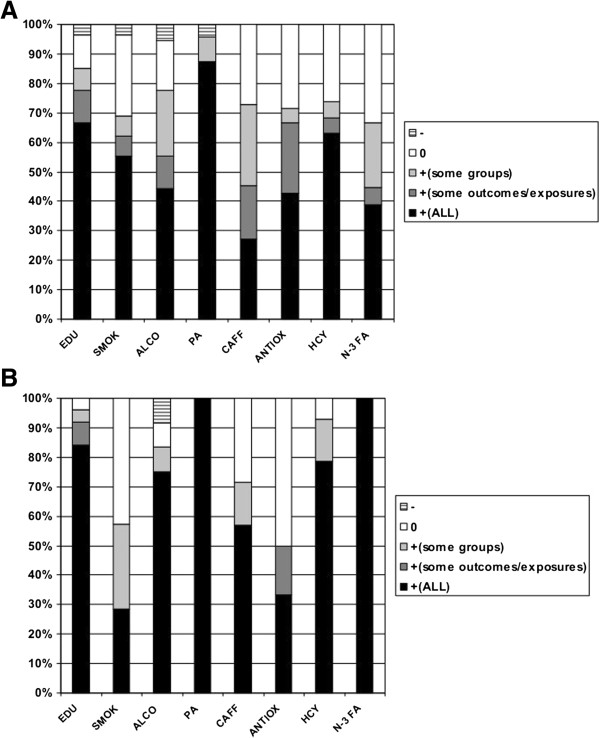
- Of 247 included studies (167 cohort, 80 cross-sectional), consistency of positive findings ranged from ~38.9% for caffeine to ~89% for physical activity; education had a significantly higher propensity for a positive finding compared with caffeine, smoking, and antioxidant-related studies.
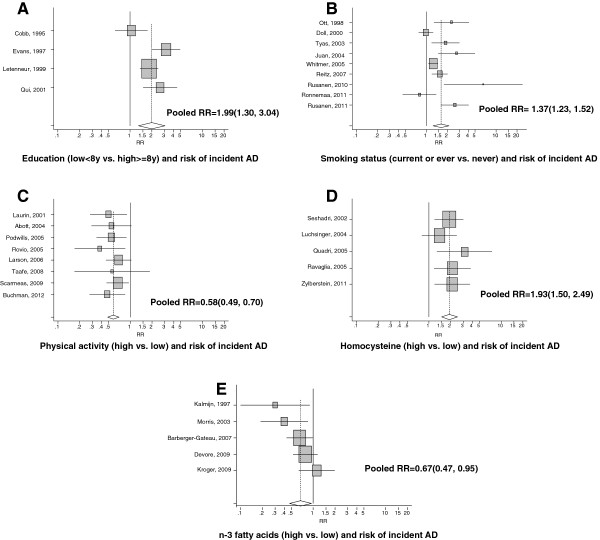
- Meta-analysis of 31 studies with incident AD yielded pooled RRs of 1.99 (95% CI 1.30–3.04) for low education, 1.93 (95% CI 1.50–2.49) for high homocysteine, 1.37 (95% CI 1.23–1.52) for current/ever smoking, 0.58 (95% CI 0.49–0.70) for higher physical activity, and 0.67 (95% CI 0.47–0.96) for higher n-3 fatty acid intake.
- Estimated PAR% was 31.9% (95% CI 22.7–41.2) for physical activity, 31.09% (95% CI 17.9–44.3) for smoking, 24.0% (95% CI 8.4–39.6) for low education, 21.7% (95% CI 12.8–30.6) for high homocysteine, and 21.9% (95% CI 4.7–39.1) for lower fish consumption. No significant publication bias was found.
- The authors concluded that higher homocysteine, lower educational attainment, and decreased physical activity were particularly strong predictors of incident AD, while further studies are needed for other potential factors such as caffeine.
Methods
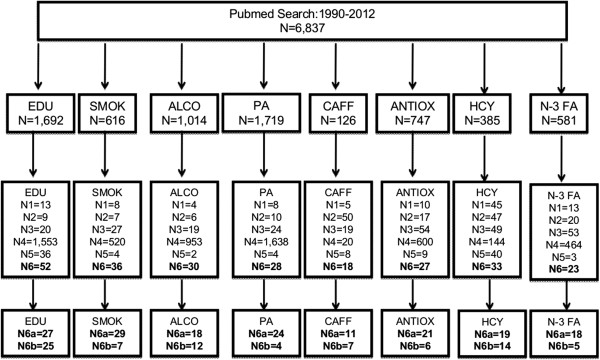
- MEDLINE was searched for literature published January 1990 through October 2012; inclusion required sample size >300, cross-sectional or cohort design, general healthy population, and outcomes including dementia, AD, cognitive function, cognitive decline, or cognitive impairment. In total, 247 studies were included.
- A qualitative consistency analysis coded each study finding as positive, null, or against the hypothesis, and logistic regression modeled positive/partially positive findings against study-level characteristics.
- Meta-analysis was restricted to 31 data points/studies with incident AD and comparable exposure measurements; pooled RRs used random- or fixed-effects models based on Q-test heterogeneity, PAR% was computed using exposure prevalence from the largest study, and publication bias was assessed with funnel plots, Begg-adjusted rank correlation, and Egger’s regression asymmetry test.
Limitations
- Stated: the literature search was limited to published English articles available in Medline; quantitative meta-analysis was not possible for all outcomes because cognitive measures were diverse; the qualitative finding classification cannot distinguish null findings due to low power or poor quality from true null findings; exposure measurements for incident AD were not fully comparable; and no common quality measure could be created across studies.
- Evident from the text: included studies were observational (cross-sectional or cohort), so causal inference is limited; diagnostic criteria for dementia, AD, and MCI changed over time, particularly between the 1990s and more recent years; and exposure definitions varied across studies, requiring assumptions that they operationalized the same concepts.
Model-written summary. Check it against the paper before relying on it.
Integrity signals
Registry
Cites
Statistics
Figures
Verification
Claims the paper makes
6 Valid · 0 Not valid · 68 Not checked · 76 Own results and interpretations
The sources with a verdict support this claim; the rest weren’t checked yet, have no full text we could read, or their verdicts aren’t rated yet.
In the paper
“The remaining four cohort studies did not find an association in the hypothesized direction [26,60,68,71].”
§ Epidemiologic studies of modifiable factors associated with cognition and dementia: systematic review and meta-analysis > Results and discussion > Socio-economic Status (SES) as indicated by education
What the sources say
- Not checked yetcites [26] 26. Paykel ES Brayne C Huppert FA Gill C Barkley C Gehlhaar E Beardsall L Girling DM Pollitt P O'Connor D Incidence of dementia in a population older than 75 years in the United Kingdom Arch Gen Psychiatry 1994 51 325 332 8161293 10.1001/archpsyc.1994.03950040069009 source
- Not checked yetcites [60] 60. Christensen H Batterham PJ Mackinnon AJ Anstey KJ Wen W Sachdev PS Education, atrophy, and cognitive change in an epidemiological sample in early old age Am J Geriatr Psychiatry 2009 17 218 226 19454848 10.1097/JGP.0b013e3181961a84 source
- Supportedcites [68] 68. Castro-Costa E Dewey ME Uchoa E Firmo JO Lima-Costa MF Stewart R Trajectories of cognitive decline over 10 years in a Brazilian elderly population: the Bambui cohort study of aging Cad Saude Publica 2011 27 Suppl 3 S345 350 21952855 10.1590/s0102-311x2011001500004 source
The Results section reports that in model 2 'the significant interaction along with the interaction term coefficients indicate a faster decline associated with higher education', i.e. Bambuí found no protective (hypothesized-direction) effect of education on cognitive decline. The Discussion states explicitly that 'our education findings (highly educated groups decline faster) are not consistent with previous studies; those in which education has a protective effect 16,17,18,19,20,21,22 and those studies where education was not related to cognitive decline 9,10', and the Conclusion confirms education was associated with long-term rates of decline in this low-education Brazilian cohort. Thus the cited cohort study did not show an association in the hypothesized (protective) direction, which is exactly what the citing sentence attributes to it. (LLM, conf=0.85)
plain- Asserted: passes — The authors put it forward as true.
- Checkable: passes — It can be checked against evidence.
- Load-bearing: unclear — It is unclear whether the paper’s conclusions depend on it.
- Based: passes — The paper gives a reason why it holds.
The sources with a verdict support this claim; the rest weren’t checked yet, have no full text we could read, or their verdicts aren’t rated yet.
In the paper
“Similarly, of the 6 cross-sectional studies that were selected, 2 (33.3%) found an association in the hypothesized direction for the entire study population and for most outcomes of interest [190,195]”
§ Epidemiologic studies of modifiable factors associated with cognition and dementia: systematic review and meta-analysis > Results and discussion > Nutritional factors
What the sources say
- Not checked yetcites [190] 190. Cherubini A Martin A Andres-Lacueva C Di Iorio A Lamponi M Mecocci P Bartali B Corsi A Senin U Ferrucci L Vitamin E levels, cognitive impairment and dementia in older persons: the InCHIANTI study Neurobiol Aging 2005 26 987 994 15748776 10.1016/j.neurobiolaging.2004.09.002 source
- Supportedcites [195] 195. Akbaraly NT Faure H Gourlet V Favier A Berr C Plasma carotenoid levels and cognitive performance in an elderly population: results of the EVA study J Gerontol A Biol Sci Med Sci 2007 62 308 316 17389729 10.1093/gerona/62.3.308 source
Our copy identifies this as a cross-sectional analysis of the whole EVA study population (Abstract: 'We examined, in a cross sectional analysis, the relationship between cognitive performances ... in a healthy elderly population: the EVA study (n=589)'), with no subgroup restriction. The Results ('Association between cognition and carotenoids') report associations in the hypothesized direction — low carotenoid levels with low cognitive performance — for zeaxanthin across all tests except MMSE in crude analysis and for TMTA, DSS, FTT and WFT after adjustment, plus lycopene for DSS and TMTB, i.e. most of the cognitive outcomes tested. The Discussion confirms the direction and scope ('low levels of specific plasma carotenoids - lycopene and zeaxanthin- were associated to poor cognitive functioning in a highly educated free-living elderly community'). The count itself ('6 studies, 2 of them') is the citing review's synthesis and not attributable here; what is attributable — that this is a cross-sectional study with a positive finding in the whole population for most outcomes — is stated in our copy. Note that the null results for the other carotenoids (total carotenoids, alpha- and beta-carotene, lutein, beta-cryptoxanthin) do not contradict this, since the outcomes of interest are the cognitive tests. (LLM, conf=0.82)
plainstates an association- Asserted: passes — The authors put it forward as true.
- Checkable: passes — It can be checked against evidence.
- Load-bearing: unclear — It is unclear whether the paper’s conclusions depend on it.
- Based: passes — The paper gives a reason why it holds.
The cited sources support only part of this claim — read each source’s verdict below.
In the paper
“In addition, all of the 5 (100%) cross-sectional studies that were selected found an association in the hypothesized direction for the entire study population and for most outcomes of interest [240,244,249,254,255]”
§ Epidemiologic studies of modifiable factors associated with cognition and dementia: systematic review and meta-analysis > Results and discussion > Nutritional factors
What the sources say
- Not checked yetcites [240] 240. Kalmijn S van Boxtel MP Ocke M Verschuren WM Kromhout D Launer LJ Dietary intake of fatty acids and fish in relation to cognitive performance at middle age Neurology 2004 62 275 280 14745067 10.1212/01.wnl.0000103860.75218.a5 source
- Not checked yetcites [244] 244. Cherubini A Andres-Lacueva C Martin A Lauretani F Iorio AD Bartali B Corsi A Bandinelli S Mattson MP Ferrucci L Low plasma N-3 fatty acids and dementia in older persons: the InCHIANTI study J Gerontol A Biol Sci Med Sci 2007 62 1120 1126 17921425 10.1093/gerona/62.10.1120 PMC2646093 source
- Partly supportedcites [249] 249. Albanese E Dangour AD Uauy R Acosta D Guerra M Guerra SS Huang Y Jacob KS de Rodriguez JL Noriega LH Salas A Sosa AL Sousa RM Williams J Ferri CP Prince MJ Dietary fish and meat intake and dementia in Latin America, China, and India: a 10/66 dementia research group population-based study Am J Clin Nutr 2009 90 392 400 19553298 10.3945/ajcn.2009.27580 PMC3008672 sourceExperimental — accuracy not yet measured
The Results (Association between prevalent dementia and dietary fish; page not provided) report a cross-sectional inverse association between fish intake and dementia across the combined sample. However, the study measured fish intake rather than n-3 fatty-acid intake; the association was absent in India, and fish intake was not significantly associated with dementia severity in any country. This paper also cannot establish the citing sentence’s count or findings for all five selected studies. (LLM, conf=0.87)
- Not checked yetcites [254] 254. Gonzalez S Huerta JM Fernandez S Patterson AM Lasheras C The relationship between dietary lipids and cognitive performance in an elderly population Int J Food Sci Nutr 2010 61 217 225 20001761 10.3109/09637480903348098 source
- Not checked yetcites [255] 255. Muldoon MF Ryan CM Sheu L Yao JK Conklin SM Manuck SB Serum phospholipid docosahexaenonic acid is associated with cognitive functioning during middle adulthood J Nutr 2010 140 848 853 20181791 10.3945/jn.109.119578 PMC2838625 source
plainstates an association- Asserted: passes — The authors put it forward as true.
- Checkable: passes — It can be checked against evidence.
- Load-bearing: unclear — It is unclear whether the paper’s conclusions depend on it.
- Based: passes — The paper gives a reason why it holds.
The cited sources support only part of this claim — read each source’s verdict below.
In the paper
“Similarly, of the 14 cross-sectional studies that were selected, 11(78%) found an association in the hypothesized direction for the entire study population and for most outcomes of interest [204,205,207,208,216,218,220,221,225,227,232]”
§ Epidemiologic studies of modifiable factors associated with cognition and dementia: systematic review and meta-analysis > Results and discussion > Nutritional factors
What the sources say
- Not checked yetcites [204] 204. Duthie SJ Whalley LJ Collins AR Leaper S Berger K Deary IJ Homocysteine, B vitamin status, and cognitive function in the elderly Am J Clin Nutr 2002 75 908 913 11976166 10.1093/ajcn/75.5.908 source
- Not checked yetcites [205] 205. Prins ND Den Heijer T Hofman A Koudstaal PJ Jolles J Clarke R Breteler MM Homocysteine and cognitive function in the elderly: the Rotterdam scan study Neurology 2002 59 1375 1380 12427887 10.1212/01.wnl.0000032494.05619.93 source
- Not checked yetcites [207] 207. Miller JW Green R Ramos MI Allen LH Mungas DM Jagust WJ Haan MN Homocysteine and cognitive function in the Sacramento area Latino study on aging Am J Clin Nutr 2003 78 441 447 12936927 10.1093/ajcn/78.3.441 source
- Not checked yetcites [208] 208. Ravaglia G Forti P Maioli F Muscari A Sacchetti L Arnone G Nativio V Talerico T Mariani E Homocysteine and cognitive function in healthy elderly community dwellers in Italy Am J Clin Nutr 2003 77 668 673 12600859 10.1093/ajcn/77.3.668 source
- Not checked yetcites [216] 216. Ramos MI Allen LH Mungas DM Jagust WJ Haan MN Green R Miller JW Low folate status is associated with impaired cognitive function and dementia in the Sacramento area Latino study on aging Am J Clin Nutr 2005 82 1346 1352 16332669 10.1093/ajcn/82.6.1346 source
- Not checked yetcites [218] 218. Schafer JH Glass TA Bolla KI Mintz M Jedlicka AE Schwartz BS Homocysteine and cognitive function in a population-based study of older adults J Am Geriatr Soc 2005 53 381 388 15743278 10.1111/j.1532-5415.2005.53153.x source
- Not checked yetcites [220] 220. Elias MF Robbins MA Budge MM Elias PK Brennan SL Johnston C Nagy Z Bates CJ Homocysteine, folate, and vitamins B6 and B12 blood levels in relation to cognitive performance: the Maine-Syracuse study Psychosom Med 2006 68 547 554 16868263 10.1097/01.psy.0000221380.92521.51 source
- Not checked yetcites [221] 221. Feng L Ng TP Chuah L Niti M Kua EH Homocysteine, folate, and vitamin B-12 and cognitive performance in older Chinese adults: findings from the Singapore longitudinal ageing study Am J Clin Nutr 2006 84 1506 1512 17158436 10.1093/ajcn/84.6.1506 source
- Not checked yetcites [225] 225. Kim J Park MH Kim E Han C Jo SA Jo I Plasma homocysteine is associated with the risk of mild cognitive impairment in an elderly Korean population J Nutr 2007 137 2093 2097 17709448 10.1093/jn/137.9.2093 source
- Partly supportedcites [227] 227. Kim JM Kim SW Shin IS Yang SJ Park WY Kim SJ Shin HY Yoon JS Folate, vitamin b(12), and homocysteine as risk factors for cognitive decline in the elderly Psychiatry Investig 2008 5 36 40 10.4306/pi.2008.5.1.36 PMC2796089 20046406 sourceExperimental — accuracy not yet measured
The Introduction and Discussion report that higher homocysteine was associated with cognitive impairment in the authors’ earlier cross-sectional analysis and in previous studies. This paper does not report a selection of 14 cross-sectional studies or establish that 11 (78%) found associations for entire populations and most outcomes; it describes its own study as prospective. No page numbers are available in our copy. (LLM, conf=0.85)
plainstates an association- Asserted: passes — The authors put it forward as true.
- Checkable: passes — It can be checked against evidence.
- Load-bearing: unclear — It is unclear whether the paper’s conclusions depend on it.
- Based: passes — The paper gives a reason why it holds.
The cited sources support only part of this claim — read each source’s verdict below.
In the paper
“In sum, 7 out of the 18 (39%) selected cohort studies linking n-3 fatty acids to the various cognitive outcomes found the relationship in the hypothesized direction in the entire population that was studied and for most outcomes of interest [237,239,247,248,250,253,257]”
§ Epidemiologic studies of modifiable factors associated with cognition and dementia: systematic review and meta-analysis > Results and discussion > Nutritional factors
What the sources say
- Not checked yetcites [237] 237. Kalmijn S Launer LJ Ott A Witteman JC Hofman A Breteler MM Dietary fat intake and the risk of incident dementia in the Rotterdam study Ann Neurol 1997 42 776 782 9392577 10.1002/ana.410420514 source
- Not checked yetcites [239] 239. Morris MC Evans DA Bienias JL Tangney CC Bennett DA Wilson RS Aggarwal N Schneider J Consumption of fish and n-3 fatty acids and risk of incident Alzheimer disease Arch Neurol 2003 60 940 946 12873849 10.1001/archneur.60.7.940 source
- Not checked yetcites [247] 247. Eskelinen MH Ngandu T Helkala EL Tuomilehto J Nissinen A Soininen H Kivipelto M Fat intake at midlife and cognitive impairment later in life: a population-based CAIDE study Int J Geriatr Psychiatry 2008 23 741 747 18188871 10.1002/gps.1969 source
- Not checked yetcites [248] 248. Samieri C Feart C Letenneur L Dartigues JF Peres K Auriacombe S Peuchant E Delcourt C Barberger-Gateau P Low plasma eicosapentaenoic acid and depressive symptomatology are independent predictors of dementia risk Am J Clin Nutr 2008 88 714 721 18779288 10.1093/ajcn/88.3.714 source
- Not checked yetcites [250] 250. Devore EE Grodstein F van Rooij FJ Hofman A Rosner B Stampfer MJ Witteman JC Breteler MM Dietary intake of fish and omega-3 fatty acids in relation to long-term dementia risk Am J Clin Nutr 2009 90 170 176 19474131 10.3945/ajcn.2008.27037 PMC2696999 source
- Supportedcites [253] 253. Vercambre MN Boutron-Ruault MC Ritchie K Clavel-Chapelon F Berr C Long-term association of food and nutrient intakes with cognitive and functional decline: a 13-year follow-up study of elderly French women Br J Nutr 2009 102 419 427 19203415 10.1017/S0007114508201959 PMC2891709 source
This citation identifies one of the cohort studies counted in the citing sentence, rather than serving as evidence for the 7-of-18 tally by itself. The Dietary intakes and age-related decline section (p. 4) reports that, in the studied women, the odds of recent cognitive decline increased as n-3 fatty acid intake decreased. That supports classifying this study as finding a relationship in the hypothesized direction for its cognitive outcome. (LLM, conf=0.87)
- Partly supportedcites [257] 257. Kesse-Guyot E Peneau S Ferry M Jeandel C Hercberg S Galan P Thirteen-year prospective study between fish consumption, long-chain n-3 fatty acids intakes and cognitive function J Nutr Health Aging 2011 15 115 120 21365164 10.1007/s12603-011-0023-7 sourceExperimental — accuracy not yet measured
The Abstract Results report a prospective association in the hypothesized direction between higher long-chain n-3 fatty acid intake and fewer self-reported cognitive difficulties. However, the Discussion says there was no significant association with the clinical cognitive tests, so this study does not support the claim that the relationship held for most outcomes of interest. This paper also does not establish the citing review’s count of 7 out of 18 studies. (LLM, conf=0.88)
plainstates an association- Asserted: passes — The authors put it forward as true.
- Checkable: passes — It can be checked against evidence.
- Load-bearing: unclear — It is unclear whether the paper’s conclusions depend on it.
- Based: passes — The paper gives a reason why it holds.
92 more claims
Create a free account to see all 150 claims and to verify the 202 references still open.
- It may state two separate claims as one. 20
- Probably not a substantial claim. 34
- The quote only partly states this claim. 1
Claims other papers make about this one
Each is checked against this paper’s own text: does it say what the citing paper says it does?
The source backs part of the claim, not all of it — or backs it for a different population, condition or comparison.
In the citing paper
“In addition, AHA’s Life’s Simple 7 has been linked to successful cognitive health25,94,95,112”
From Defining Optimal Brain Health in Adults: A Presidential Advisory From the American Heart Association/American Stroke Association (2017) · cites this paper as [94]
Experimental — accuracy not yet measuredThe source backs part of the claim, not all of it — or backs it for a different population, condition or comparison.
In the citing paper
“Owing to these limitations, two systematic reviews [32, 47] refrained from conducting meta-analyses because of the lack of exposure or outcome comparability across studies or both.”
From Alcohol use and dementia: a systematic scoping review (2019) · cites this paper as [32]
Experimental — accuracy not yet measuredThe cited source says what the claim attributes to it.
In the citing paper
“Prospective observational studies have generally found a positive association between physical activity and cognitive health outcomes.”
From Defining Optimal Brain Health in Adults: A Presidential Advisory From the American Heart Association/American Stroke Association (2017) · cites this paper as [94]
The cited source says what the claim attributes to it.
In the citing paper
“Many studies lacked a quality assessment for various outcomes, with many different operationalizations for cognitive functioning [32], and lacked standardization for the diagnoses of different types of dementia [27, 37].”
From Alcohol use and dementia: a systematic scoping review (2019) · cites this paper as [32]
2 more claims about this paper
Create a free account to see every claim other papers make about this one.
Self-check
Percentages, sums and reported differences re-computed from the paper’s own numbers.
Each contradiction between two passages listed here was confirmed by an independent check.
Rated minor: it would not touch a result — a value no result rests on, a p-value that stays on the same side of the significance level, or a conflict that is clerical, resolved elsewhere in the paper, or outside its own findings.
In the paper
“| 1 | 179 | (72.5) | 34 | (65.4) | 26 | (86.7) |”
§ Epidemiologic studies of modifiable factors associated with cognition and dementia: systematic review and meta-analysis > Results and discussion > Description of study-level characteristics and comparison by risk factor
Reported 86.7 · recomputed 72.222222
Rated minor: it would not touch a result — a value no result rests on, a p-value that stays on the same side of the significance level, or a conflict that is clerical, resolved elsewhere in the paper, or outside its own findings.
In the paper
§ Epidemiologic studies of modifiable factors associated with cognition and dementia: systematic review and meta-analysis > Methods > Literature search
“| [255] | 35-54/B | 2010 | US | Cross-sectional | N = 280 | Cognitive function | + |”
§ Epidemiologic studies of modifiable factors associated with cognition and dementia: systematic review and meta-analysis > Methods > Literature search
“Final inclusion criteria were: (1) Study sample size > 300.”
Rated minor: it would not touch a result — a value no result rests on, a p-value that stays on the same side of the significance level, or a conflict that is clerical, resolved elsewhere in the paper, or outside its own findings.
In the paper
“| 4 | 2 | (1.2) |”
§ Epidemiologic studies of modifiable factors associated with cognition and dementia: systematic review and meta-analysis > Results and discussion > Description of study-level characteristics and comparison by risk factor
Reported 1.2 · recomputed 0.809717
Rated minor: it would not touch a result — a value no result rests on, a p-value that stays on the same side of the significance level, or a conflict that is clerical, resolved elsewhere in the paper, or outside its own findings.
In the paper
§ Epidemiologic studies of modifiable factors associated with cognition and dementia: systematic review and meta-analysis > Results and discussion > Nutritional factors
“[237,239,247,248,250,253,257], while 1 found this relationship for some outcomes but not others [245], 4 detected it for a sub-group of the total population [242,243,246,258], and 6 found no association [236,238,241,250-252]”
§ Epidemiologic studies of modifiable factors associated with cognition and dementia: systematic review and meta-analysis > Methods > Literature search
“| [250] | 55+/B | 2009 | Netherlands | Cohort | N = 5,395 | Incident dementia and AD | 0 |”
Rated minor: it would not touch a result — a value no result rests on, a p-value that stays on the same side of the significance level, or a conflict that is clerical, resolved elsewhere in the paper, or outside its own findings.
In the paper
§ Epidemiologic studies of modifiable factors associated with cognition and dementia: systematic review and meta-analysis > Results and discussion > Nutritional factors
“These findings of a protective effect of supplemental antioxidant use against cognitive impairment and decline was replicated in a large cohort study [185].”
§ Epidemiologic studies of modifiable factors associated with cognition and dementia: systematic review and meta-analysis > Methods > Literature search
“| [185] | 65+/B | 2003 | US | Cohort | N = 2,969 | Incident dementia Incident AD | 0 |”
4 more findings
Create a free account to see every finding of this check.
Citations
Cites
Bias in meta-analysis detected by a simple, graphical test
Egger, M., Smith, G. D., Schneider, M., & Minder, C. (1997) · BMJ · doi:10.1136/bmj.315.7109.629 · Cited by 56,722 · cited 1×
“This type of bias was also formally tested using the Begg-adjusted rank correlation tests [264] and the Egger’s regression asymmetry test [265].”
MethodMcKhann, G., Drachman, D., Folstein, M., Katzman, R., Price, D., & Stadlan, E. M. (1984) · Neurology · doi:10.1212/wnl.34.7.939 · Cited by 27,915
McKhann, G. M., Knopman, D. S., Chertkow, H., Hyman, B. T., Jack, C. R., Kawas, C. H., Klunk, W. E., Koroshetz, W. J., Manly, J. J., Mayeux, R., et al. (2011) · Alzheimer's & Dementia · doi:10.1016/j.jalz.2011.03.005 · Cited by 18,657 · cited 7×
“Vascular Dementia (VaD) (Modified Hachinski Ischemia Score: ≥4) Source [14]: Two-point items Abrupt onset History of stroke Focal neurologic symptoms One-point items Stepwise deterioration Somatic complaints History of hypertension Emotional incontinence Other diagnostic criteria: ICD-10; DSM-IV”
BackgroundInfluentialOperating characteristics of a rank correlation test for publication bias
Begg, C. B., & Mazumdar, M. (1994) · Biometrics · doi:10.2307/2533446 · Cited by 16,955 · cited 1×
“This type of bias was also formally tested using the Begg-adjusted rank correlation tests [264] and the Egger’s regression asymmetry test [265].”
MethodRomán, G. C., Tatemichi, T. K., Erkinjuntti, T., Cummings, J. L., Masdeu, J. C., Garcia, J. H., Amaducci, L., Orgogozo, J.-M., Brun, A., Hofman, A., et al. (1993) · Neurology · doi:10.1212/wnl.43.2.250 · Cited by 4,921
McKeith, I. G., Galasko, D., Kosaka, K., Perry, E. K., Dickson, D. W., Hansen, L. A., Salmon, D. P., Lowe, J., Mirra, S. S., Byrne, E. J., et al. (1996) · Neurology · doi:10.1212/wnl.47.5.1113 · Cited by 3,960 · cited 1×
“Dementia with Lewy Bodies (DLB) (Consensus Guidelines for the Clinical Diagnosis for Dementia with Lewy Bodies) Source [16]: Fluctuating in cognitive performance: Marked variation in cognition or function, or episodic confusion/decreased responsiveness.”
BackgroundGorelick, P. B., Scuteri, A., Black, S. E., DeCarli, C., Greenberg, S. M., Iadecola, C., Launer, L. J., Laurent, S., Lopez, O. L., Nyenhuis, D., et al. (2011) · Stroke · doi:10.1161/str.0b013e3182299496 · Cited by 3,811
Plasma Homocysteine as a Risk Factor for Dementia and Alzheimer's Disease
Seshadri, S., Beiser, A., Selhub, J., Jacques, P. F., Rosenberg, I. H., D'Agostino, R. B., Wilson, P. W. F., & Wolf, P. A. (2002) · New England Journal of Medicine · doi:10.1056/nejmoa011613 · Cited by 3,237 · cited 5×
“Accordingly, a potential influence of hyperhomocysteinemia on cognitive functioning among older adults was postulated and several studies were able to associate high levels of Hcy with increased risk of incident AD or all-cause dementia [206,217,224,228,233,234].”
BackgroundInfluential. Cerebral blood flow in dementia.
Hachinski, V. C., Iliff, L. D., Zilhka, E., Du Boulay, G. H., McAllister, V. L., Marshall, J., Russell, R. W. R., & Symon, L. (1975) · Archives of Neurology · doi:10.1001/archneur.1975.00490510088009 · Cited by 3,186
The projected effect of risk factor reduction on Alzheimer's disease prevalence
Barnes, D. E., & Yaffe, K. (2011) · The Lancet Neurology · doi:10.1016/s1474-4422(11)70072-2 · Cited by 2,666
Research works printed but not linked: 5
- 259. Thomson TM Endnote X3 2010 Philadelphia, PA: Thomson Reuters
- 265. Egger M Davey Smith G Schneider M Minder C Davey Smith G Schneider M Minder C Bias in meta-analysis detected by a simple, graphical test BMJ 1997 315 629 634 9310563 10.1136/bmj.315.7109.629 PMC2127453 · DOI · Paper page
- 266. STATA Editor ed Statistics/Data Analysis: Release 11.0 Book Statistics/Data Analysis: Release 11.0 2009 City: Stata Corporation
- 271. Kellar KJ, Wonnacott S Nicotinic cholinergic receptors in Alzheimer's disease, in nicotine psychopharmacology: molecular, cellular, and behavioral aspects 1990 Oxford: Oxford University Press
- 280. James JE Caffeine & health 1991 London, England: Academic
Cited by
2016 Alzheimer's disease facts and figures
Alzheimer's Association (2016) · Alzheimer's & Dementia · doi:10.1016/j.jalz.2016.03.001 · Cited by 5,069
2019 Alzheimer’s disease facts and figures.
Alzheimer's Association (2019) · Alzheimer's & Dementia · doi:10.1016/j.jalz.2019.01.010 · Cited by 2,461
2020 Alzheimer's disease facts and figures
(2020) · Alzheimer's & Dementia · doi:10.1002/alz.12068 · Cited by 2,353
2022 Alzheimer's disease facts and figures
(2022) · Alzheimer's & Dementia · doi:10.1002/alz.12638 · Cited by 2,341
2021 Alzheimer's disease facts and figures
(2021) · Alzheimer's & Dementia · doi:10.1002/alz.12328 · Cited by 2,201
Metadata
- Authors
- Beydoun, M. A., Beydoun, H. A., Gamaldo, A. A., Teel, A., Zonderman, A. B., & Wang, Y.
- Affiliations
- National Institutes of Health (US)
- Eastern Virginia Medical School (US)
- Johns Hopkins University (US)
- Corresponding author
- Beydoun, May A
- Venue
- BMC Public Health
- Published
- 2014-06-24
- Volume
- 14
- Issue
- 1
- Pages
- 643-643
- ISSN
- 1471-2458 (ISSN-L)
- PMC
- PMC4099157
- OpenAlex
- W2052792956
- Cited by
- 671
- References
- 314
- Citations by year
- 2026: 16 · 2025: 36 · 2024: 52 · 2023: 56 · 2022: 67 · 2021: 85 · 2020: 61 · 2019: 72 · 2018: 49 · 2017: 67 · 2016: 66 · 2015: 38 · 2014: 5
- FWCI
- 8.12
- Type
- journal article
- Language
- en
- Open access
- gold
- doi.org
- Licence
- Locations
- BMC Public Health (publishedVersion, cc-by)
- PubMed Central (publishedVersion, cc-by)
- PubMed (publishedVersion)
- Funders
- National Institutes of Health
- National Institute on Aging
- Topics
- Health Sciences › Medicine › Psychiatry and Mental health › Dementia and Cognitive Impairment Research
- Life Sciences › Neuroscience › Cellular and Molecular Neuroscience › Alzheimer's disease research and treatments
- Health Sciences › Medicine › Public Health, Environmental and Occupational Health › Nutritional Studies and Diet
- Keywords
- Alzheimer's disease, dementia, cognitive decline, modifiable risk factors, smoking, physical activity, caffeine, antioxidants, homocysteine, omega-3 fatty acids, population attributable risk, cognitive health
- MeSH terms
- Alcohol Drinking, Alzheimer Disease, Antioxidants, Caffeine, Cognition, Cognition Disorders, Dementia, Diet, Educational Status, Female, Homocysteine, Humans, Male, Smoking, Exercise, Fatty Acids, Omega-3
About these checks
Registry, retraction, Cites and statistics results are computed, not judged, with one exception: a printed reference that no index lists is read once by a model before it counts as a citation error. Claims are extracted by a model and kept only when their quote appears verbatim in the text; each cited source is then checked, with a model’s help, for whether it says what the claim relies on. Those verdicts can be wrong — read the claim’s quote and the cited source before relying on one.
The claim verdicts this report counts are experimental: their accuracy is not yet measured.
A language model drew the claims from the paper on 2026-10-04, under version 3 of the claim definition (model deepseek-v4.1-flash, prompt extract-v3).
A second model labelled each claim on 2026-10-04 (model jev-1.13-20260917, definition revision gold-guideline-v0.2).
Cited sources are checked with a language model’s help (qwen3.8-omni-flash and gpt-6-sol).
Statistics and arithmetic are recomputed, not judged.
Confidence bands are shown only for fields calibrated on our annotated test set. None is calibrated yet, so no band is shown.
What counts as a claim ›How we measure confidence ›How we check this ›
Are you an author, or do you see a problem with this page? Request a review
Data sources
Bibliographic data: Semantic Scholar, OpenAlex, Crossref.
Contains information from the Semantic Scholar Academic Graph Datasets, made available under the ODC Attribution License (ODC-BY 1.0).
Semantic Scholar’s data is described in: Kinney, R., et al. (2023). The Semantic Scholar Open Data Platform. arXiv:2301.10140.
