

Please understand when I cry out in pain: women’s accounts of maternity services during labour and delivery in Ghana
Open accessThe DOI matches its Crossref record; 48 of the 49 references it cites were found in a registry or an index.
Abstract
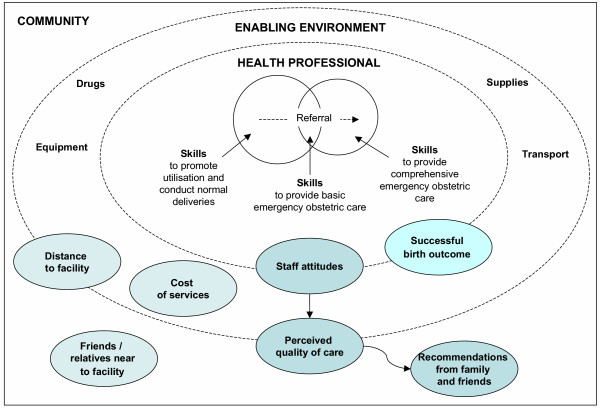
BACKGROUND: This study was undertaken to investigate women's accounts of interactions with health care providers during labour and delivery and to assess the implications for acceptability and utilisation of maternity services in Ghana. METHODS: Twenty-one individual in-depth interviews and two focus group discussions were conducted with women of reproductive age who had delivered in the past five years in the Greater Accra Region. The study investigated women's perceptions and experiences of care in terms of factors that influenced place of delivery, satisfaction with services, expectations of care and whether they would recommend services. RESULTS: One component of care which appeared to be of great importance to women was staff attitudes. This factor had considerable influence on acceptability and utilisation of services. Otherwise, a successful labour outcome and non-medical factors such as cost, perceived quality of care and proximity of services were important. Our findings indicate that women expect humane, professional and courteous treatment from health professionals and a reasonable standard of physical environment. Women will consciously change their place of delivery and recommendations to others if they experience degrading and unacceptable behaviour. CONCLUSION: The findings suggest that inter-personal aspects of care are key to women's expectations, which in turn govern satisfaction. Service improvements which address this aspect of care are likely to have an impact on health seeking behaviour and utilisation. Our findings suggest that user-views are important and warrant further investigation. The views of providers should also be investigated to identify channels by which service improvements, taking into account women's views, could be operationalised. We also recommend that interventions to improve delivery care should not only be directed to the health professional, but also to general health system improvements.
Overview
The claims and statistics of this paper haven’t been checked yet.
Free: it reads the open-access text and checks the first 5 claims that cite a source we can check. Create a free account to check every claim.
Integrity signals
Registry
Cites
Statistics
Figures
Verification
Claims the paper makes
The claims and statistics of this paper haven’t been checked yet.
Free: it reads the open-access text and checks the first 5 claims that cite a source we can check. Create a free account to check every claim.
Claims other papers make about this one
Each is checked against this paper’s own text: does it say what the citing paper says it does?
The source backs part of the claim, not all of it — or backs it for a different population, condition or comparison.
In the citing paper
“A recent qualitative evidence synthesis [4] and several recent studies [6–11] and reports [12,13] clearly indicate that many women globally experience poor treatment during childbirth, including abusive, neglectful, or disrespectful care.”
From The Mistreatment of Women during Childbirth in Health Facilities Globally: A Mixed-Methods Systematic Review (2015) · cites this paper as [7]
Experimental — accuracy not yet measuredThe source backs part of the claim, not all of it — or backs it for a different population, condition or comparison.
In the citing paper
“Across high-, middle-, and low-income countries, verbal abuse of women by health providers during childbirth was a commonly reported event, particularly the use of harsh or rude language.”
From The Mistreatment of Women during Childbirth in Health Facilities Globally: A Mixed-Methods Systematic Review (2015) · cites this paper as [7]
Experimental — accuracy not yet measuredThe source backs part of the claim, not all of it — or backs it for a different population, condition or comparison.
In the citing paper
“Women frequently referred to long delays in receiving care and inattentive health workers who neglected women during labor and delivery.”
From The Mistreatment of Women during Childbirth in Health Facilities Globally: A Mixed-Methods Systematic Review (2015) · cites this paper as [7]
Experimental — accuracy not yet measuredThe source backs part of the claim, not all of it — or backs it for a different population, condition or comparison.
In the citing paper
“In South Africa and Ghana, women were angry at health workers for making unreasonable demands of them during their stay at health facilities.”
From The Mistreatment of Women during Childbirth in Health Facilities Globally: A Mixed-Methods Systematic Review (2015) · cites this paper as [7]
Experimental — accuracy not yet measuredThe source backs part of the claim, not all of it — or backs it for a different population, condition or comparison.
In the citing paper
“Verbal abuse of women by health providers during childbirth was commonly reported across all regions and country income levels [6,7,9,10,13,48,51–55,58,59,61,63,64,67,68,70,73,75,77,80,81,83,85,87,88,90,91,93].”
From The Mistreatment of Women during Childbirth in Health Facilities Globally: A Mixed-Methods Systematic Review (2015) · cites this paper as [7]
Experimental — accuracy not yet measured
5 more claims about this paper
Create a free account to see every claim other papers make about this one.
Self-check
Percentages, sums and reported differences re-computed from the paper’s own numbers.
The self-check needs the paper’s full text.
Citations
Cites
Too far to walk: Maternal mortality in context
Thaddeus, S., & Maine, D. (1994) · Social Science & Medicine · doi:10.1016/0277-9536(94)90226-7 · Cited by 3,240 · cited 1×
“Maternal deaths could be prevented if women were able to access and utilise good quality services, especially when complications arise [17].”
BackgroundPatient satisfaction: A review of issues and concepts
Sitzia, J., & Wood, N. (1997) · Social Science & Medicine · doi:10.1016/s0277-9536(97)00128-7 · Cited by 1,690 · cited 9×
“the more a service meets with the expectations of a user, the more that user will be satisfied with that service [25].”
BackgroundResultInfluentialGhana Demographic and Health Survey 2008
Macro, I. (2009) · Cited by 1,593
Crow, R., Gage, H., Hampson, S., Hart, J., Kimber, A., Storey, L., & Thomas, H. (2002) · Health Technology Assessment · doi:10.3310/hta6320 · Cited by 1,270 · cited 2×
“By contrast, older patients have been seen to be more satisfied and compliant with care than their younger counterparts [41-44].”
BackgroundResultThe World Health Report 2005 - make every mother and child count
Lerberghe, W. V., Manuel, A., Matthews, Z., & Wolfheim, C. (2005) · ePrints Soton (University of Southampton) · Cited by 1,015
Hall, J. A., & Dornan, M. C. (1990) · Social Science & Medicine · doi:10.1016/0277-9536(90)90205-7 · Cited by 945 · cited 2×
“Other factors such as wealth and education can also be influential on perceptions [ 41- 44 ].”
BackgroundResultOvercoming barriers to health service access: influencing the demand side
Ensor, T. (2004) · Health Policy and Planning · doi:10.1093/heapol/czh009 · Cited by 898 · cited 1×
“This study adds weight to the increasing recognition that taking into account women's perceptions is crucial to improve the delivery care experiences of women [46-48].”
BackgroundFundamental Elements of the Quality of Care: A Simple Framework
Bruce, J. (1990) · Studies in Family Planning · doi:10.2307/1966669 · Cited by 849 · cited 4×
“In studies from disparate nations such as South Africa, the United States and Brazil, reasons for such prominent negativity from staff towards patients have been suggested to be used to exert control and obedience, command and respect [14,16,23,42].”
BackgroundResultInfluentialMaternal mortality in 2000: estimates developed by WHO, UNICEF and UNFPA.
AbouZahr, C., & Wardlaw, T. (2004) · Cited by 733
Beyond the Numbers: reviewing maternal deaths and complications to make pregnancy safer
Lewis, G. (2003) · British Medical Bulletin · doi:10.1093/bmb/ldg009 · Cited by 554
Research works printed but not linked: 8
- UNFPA State of the World's Population 2003: Making 1 billion count – investing in adolescents health and rights New York 2003
- World Health Organization Making pregnancy safer: Why is this issue important? Fact sheet N°276 Geneva 2004
- WHO, UNICEF, and UNFPA Maternal Mortality in 1995: Estimates developed by WHO, UNICEF and UNFPA Geneva 2001
- WHO and UNICEF Revised 1990 estimates of maternal mortality: a new approach by WHO and UNICEF, 1996 WHO/FRH/MSM/9611 and UNICEF/PLN/961 Geneva 1996
- World Health Organization Making pregnancy safer: the critical role of the skilled attendant A joint statement by WHO, ICM and FIGO Geneva 2004
- Pawson R Tilley N Realistic evaluation 1997 London, SAGE Publications Ltd
- Inter-Agency Group for Safe Motherhood Skilled care during childbirth: A review of the evidence New York 2003
- The White Ribbon Alliance for Safe Motherhood Best Practices Sub-committee Saving mothers' lives: What works New York 2002
Cited by
Bohren, M. A., Vogel, J. P., Hunter, E. C., Lutsiv, O., Makh, S. K., Souza, J. P., Aguiar, C., Saraiva Coneglian, F., Diniz, A. L. A., Tunçalp, Ö., et al. (2015) · PLOS Medicine · doi:10.1371/journal.pmed.1001847 · Cited by 1,656
Still too far to walk: Literature review of the determinants of delivery service use
Gabrysch, S., & Campbell, O. M. (2009) · BMC Pregnancy and Childbirth · doi:10.1186/1471-2393-9-34 · Cited by 1,255
“Many women report dissatisfaction with rude, arrogant and neglectful behaviour at health facilities and prefer the care of a TBA or relative [26,27,54,56-58].”
What matters to women during childbirth: A systematic qualitative review
Downe, S., Finlayson, K., Oladapo, O., Bonet, M., & Gülmezoglu, A. M. (2018) · PLOS ONE · doi:10.1371/journal.pone.0194906 · Cited by 550
Srivastava, A., Avan, B. I., Rajbangshi, P., & Bhattacharyya, S. (2015) · BMC Pregnancy and Childbirth · doi:10.1186/s12884-015-0525-0 · Cited by 430
Mannava, P., Durrant, K., Fisher, J., Chersich, M., & Luchters, S. (2015) · Globalization and Health · doi:10.1186/s12992-015-0117-9 · Cited by 485
Access barriers to obstetric care at health facilities in sub-Saharan Africa—a systematic review
Kyei-Nimakoh, M., Carolan-Olah, M., & McCann, T. V. (2017) · Systematic Reviews · doi:10.1186/s13643-017-0503-x · Cited by 367
“Poor staff attitudes, whether perceived or experienced, is known to hinder use of obstetric services [9, 193], as these directly influence perceptions of quality of care.”
Kruk, M. E., Kujawski, S., Mbaruku, G., Ramsey, K., Moyo, W., & Freedman, L. P. (2018) · Health Policy and Planning · doi:10.1093/heapol/czu079 · Cited by 367
Exploring the Prevalence of Disrespect and Abuse during Childbirth in Kenya
Abuya, T., Warren, C. E., Miller, N., Njuki, R., Ndwiga, C., Maranga, A., Mbehero, F., Njeru, A., & Bellows, B. (2015) · PLOS ONE · doi:10.1371/journal.pone.0123606 · Cited by 360
Factors affecting home delivery in rural Tanzania
Mrisho, M., Schellenberg, J. A., Mushi, A. K., Obrist, B., Mshinda, H., Tanner, M., & Schellenberg, D. (2007) · Tropical Medicine & International Health · doi:10.1111/j.1365-3156.2007.01855.x · Cited by 338
International Journal of Collaborative Research on Internal Medicine & Public Health
Valdivia, J. R. M. (2021) · Journal of Womens Health Issues and Care · Cited by 300
Disrespect and abuse during facility-based childbirth in a low-income country
Okafor, I. I., Ugwu, E. O., & Obi, S. N. (2015) · International Journal of Gynecology & Obstetrics · doi:10.1016/j.ijgo.2014.08.015 · Cited by 297
“A similar pattern of disrespect and abuse has been reported in South Africa [4], Ghana [5], and the Dominican Republic [19].”
BackgroundMcMahon, S. A., George, A. S., Chebet, J. J., Mosha, I. H., Mpembeni, R. N., & Winch, P. J. (2014) · BMC Pregnancy and Childbirth · doi:10.1186/1471-2393-14-268 · Cited by 244
“Moyer CA, Adongo PB, Aborigo RA, Hodgson A, Engmann CM: ‘They treat you like you are not a human being’: maltreatment during labour and delivery in rural northern Ghana.”
BackgroundDisrespect and abuse of women during childbirth in Nigeria: A systematic review
Ishola, F., Owolabi, O., & Filippi, V. (2017) · PLOS ONE · doi:10.1371/journal.pone.0174084 · Cited by 209
De Allegri, M., Ridde, V., Louis, V. R., Sarker, M., Tiendrebéogo, J., Yé, M., Müller, O., & Jahn, A. (2011) · Health Policy · doi:10.1016/j.healthpol.2010.10.010 · Cited by 215
Moyer, C. A., Adongo, P. B., Aborigo, R. A., Hodgson, A., & Engmann, C. M. (2014) · Midwifery · doi:10.1016/j.midw.2013.05.006 · Cited by 210
Browser, D., & Hill, K. E. (2015) · Cited by 203
Bradley, S., McCourt, C., Rayment, J., & Parmar, D. (2016) · Social Science & Medicine · doi:10.1016/j.socscimed.2016.09.039 · Cited by 191
Kujawski, S., Mbaruku, G., Freedman, L. P., Ramsey, K., Moyo, W., & Kruk, M. E. (2015) · Maternal and Child Health Journal · doi:10.1007/s10995-015-1743-9 · Cited by 170
“Disrespectful and abusive treatment during childbirth, such as physical abuse, abandonment, threatening and negative language, shouting and scolding, physical privacy violations, and non-consented care, has been observed in several resource-constrained contexts, including Tanzania [28–33].”
BackgroundAnastasi, E., Borchert, M., Campbell, O. M. R., Sondorp, E., Kaducu, F. O., Hill, O., Okeng, D., Odong, V. N., & Lange, I. L. (2015) · BMC Pregnancy and Childbirth · doi:10.1186/s12884-015-0695-9 · Cited by 183
Savage, V., & Castro, A. (2017) · Reproductive Health · doi:10.1186/s12978-017-0403-5 · Cited by 201
Bohren, M. A., Vogel, J. P., Tunçalp, Ö., Fawole, B., Titiloye, M. A., Olutayọ, A. Ọ., Oyeniran, A. A., Ogunlade, M., Metiboba, L., Osunsan, O. R., et al. (2016) · SSM - Population Health · doi:10.1016/j.ssmph.2016.07.003 · Cited by 181
Kumbani, L. C., Bjune, G. A., Chirwa, E. M., Malata, A. M., & Odland, J. Ø. (2013) · Reproductive Health · doi:10.1186/1742-4755-10-9 · Cited by 195
Madula, P., Kalembo, F. W., Yu, H. H., & Kaminga, A. C. (2018) · Reproductive Health · doi:10.1186/s12978-018-0580-x · Cited by 173
Rural/Urban and Socioeconomic Differentials in Quality of Antenatal Care in Ghana
Afulani, P. A. (2015) · PLOS ONE · doi:10.1371/journal.pone.0117996 · Cited by 126
Dogba, M., & Fournier, P. (2009) · Human Resources for Health · doi:10.1186/1478-4491-7-7 · Cited by 122
“Meanwhile, if nothing is done, patient dissatisfaction could result in even lower attendance at health facilities, thereby reducing EmOC coverage and the rate of hospital-based deliveries, and generally slowing any progress in maternal health [7,57,58,63].”
InfluentialKaso, M., & Addise, M. (2014) · Reproductive Health · doi:10.1186/1742-4755-11-55 · Cited by 128
Narratives of distress about birth in South African public maternity settings: a qualitative study
Chadwick, R. J., Cooper, D., & Harries, J. (2014) · Midwifery · doi:10.1016/j.midw.2013.12.014 · Cited by 126
Ferrer, M. B. C., Jordana, M. C., Meseguer, C. B., García, C. C., & Roche, M. E. M. (2016) · BMJ Open · doi:10.1136/bmjopen-2016-011362 · Cited by 145
on behalf of the ADVANCE study team, Perera, D., Lund, R., Swahnberg, K., Schei, B., & Infanti, J. J. (2018) · BMC Pregnancy and Childbirth · doi:10.1186/s12884-018-1869-z · Cited by 125
Gungor, I., & Beji, N. K. (2012) · Midwifery · doi:10.1016/j.midw.2011.03.009 · Cited by 114
Kumbani, L. C., Chirwa, E., Malata, A., Odland, J. Ø., & Bjune, G. (2012) · Reproductive Health · doi:10.1186/1742-4755-9-30 · Cited by 112
Moyer, C. A., Adongo, P. B., Aborigo, R. A., Hodgson, A., Engmann, C. M., & DeVries, R. (2014) · Maternal and Child Health Journal · doi:10.1007/s10995-013-1240-y · Cited by 111
the CLIP working group, Mocumbi, S., Högberg, U., Lampa, E., Sacoor, C. N., Valá, A., Bergström, A., von Dadelszen, P., Munguambe, K., Hanson, C., et al. (2019) · BMC Pregnancy and Childbirth · doi:10.1186/s12884-019-2449-6 · Cited by 119
Berlan, D. G., & Shiffman, J. (2011) · Health Policy and Planning · doi:10.1093/heapol/czr036 · Cited by 134
“Studies in Ghana and South Africa found that female nurses abused patients from lower socio-economic classes (Jewkes et al. 1998; Abrahams et al. 2001; D’Ambruoso et al. 2005).”
BackgroundMaya, E. T., Adu‐Bonsaffoh, K., Dako‐Gyeke, P., Badzi, C. D., Vogel, J. P., Bohren, M. A., & Adanu, R. (2018) · Reproductive Health Matters · doi:10.1080/09688080.2018.1502020 · Cited by 120
Determinants of skilled birth attendants for delivery in Nepal
Baral, Y. R., Lyons, K., Skinner, J., & van Teijlingen, E. (2012) · Kathmandu University Medical Journal · doi:10.3126/kumj.v8i3.6223 · Cited by 127
Moyer, C. A., Dako‐Gyeke, P., & Adanu, R. (2013) · PubMed · Cited by 129
Women’s perception of quality of maternity services: a longitudinal survey in Nepal
Karkee, R., Lee, A. H., & Pokharel, P. K. (2014) · BMC Pregnancy and Childbirth · doi:10.1186/1471-2393-14-45 · Cited by 120
“Therefore, client-perceived quality is an important issue in delivery service utilisation [26-28].”
BackgroundCerón, A., Ruano, A. L., Sánchez, S., Chew, A., Díaz, D., Hernández, A., & Flores, W. (2016) · International Journal for Equity in Health · doi:10.1186/s12939-016-0367-z · Cited by 111
(2016) · PubMed Central
Hameed, W., & Avan, B. I. (2018) · PLoS ONE · doi:10.1371/journal.pone.0194601 · Cited by 114
Yakong, V. N., Rush, K. L., Bassett‐Smith, J., Bottorff, J. L., & Robinson, C. (2010) · Journal of Advanced Nursing · doi:10.1111/j.1365-2648.2010.05404.x · Cited by 92
Sychareun, V., Hansana, V., Somphet, V., Xayavong, S., Phengsavanh, A., & Popenoe, R. (2012) · BMC Pregnancy and Childbirth · doi:10.1186/1471-2393-12-86 · Cited by 114
Exploring solutions to improve antenatal care in resource-limited settings: an expert consultation
Gamberini, C., Angeli, F., & Ambrosino, E. (2022) · BMC Pregnancy and Childbirth · doi:10.1186/s12884-022-04778-w · Cited by 107
Nkrumah, J., & Abekah‐Nkrumah, G. (2019) · BMC Health Services Research · doi:10.1186/s12913-019-4748-z · Cited by 90
Determinants of Maternal Near-Miss in Morocco: Too Late, Too Far, Too Sloppy?
Assarag, B., Dujardin, B., Délamou, A., Meskı, F. Z., & Brouwere, V. D. (2015) · PLoS ONE · doi:10.1371/journal.pone.0116675 · Cited by 100
Speizer, I. S., Story, W. T., & Singh, K. (2014) · BMC Pregnancy and Childbirth · doi:10.1186/s12884-014-0398-7 · Cited by 80
“Organizational barriers are focused on the role of the providers in terms of attitudes, availability, and services offered [17,21]; these have been found to be particularly important from qualitative studies in Ghana [14,21].”
BackgroundPrytherch, H., Kagoné, M., Aninanya, G. A., Williams, J. E., Kakoko, D. C., Leshabari, M. T., Yé, M., Marx, M., & Sauerborn, R. (2013) · BMC Health Services Research · doi:10.1186/1472-6963-13-149 · Cited by 83
Treacy, L., Bolkan, H. A., & Sagbakken, M. (2018) · PLOS ONE · doi:10.1371/journal.pone.0188280 · Cited by 82
Kizito, J., Kayendeke, M., Nabirye, C., Staedke, S. G., & Chandler, C. (2012) · Malaria Journal · doi:10.1186/1475-2875-11-55 · Cited by 81
“cited [62,107,109,111,113,116-118].”
Bhattacharyya, S., Issac, A., Rajbangshi, P. R., Srivastava, A., & Avan, B. I. (2015) · BMC Health Services Research · doi:10.1186/s12913-015-1077-8 · Cited by 88
Mothers’ experience of disrespect and abuse during maternity care in northern Ethiopia
Gebremichael, M. W., Worku, A., Medhanyie, A. A., & Berhane, Y. (2018) · Global Health Action · doi:10.1080/16549716.2018.1465215 · Cited by 88
Tunçalp, Ö., Hindin, M. J., Adu-Bonsaffoh, K., & Adanu, R. (2012) · PLoS ONE · doi:10.1371/journal.pone.0044536 · Cited by 72
Social costs of skilled attendance at birth in rural Ghana
Bazzano, A. N., Kirkwood, B., Tawiah‐Agyemang, C., Owusu‐Agyei, S., & Adongo, P. (2008) · International Journal of Gynecology & Obstetrics · doi:10.1016/j.ijgo.2008.02.004 · Cited by 72
Oluoch-Aridi, J., Smith‐Oka, V., Milan, E., & Dowd, R. A. (2018) · Reproductive Health · doi:10.1186/s12978-018-0643-z · Cited by 82
Gashaye, K. T., Tsegaye, A. T., Shiferaw, G., Worku, A. G., & Abebe, S. M. (2019) · PLoS ONE · doi:10.1371/journal.pone.0210693 · Cited by 73
(2013) · PubMed · Cited by 71
Warren, C., Ndwiga, C., Sripad, P., Medich, M., Njeru, A., Maranga, A., Odhiambo, G. A., & Abuya, T. (2017) · BMC Women s Health · doi:10.1186/s12905-017-0425-8 · Cited by 78
van der Pijl, M. S. G., Verhoeven, C. J. M., Verweij, R., van der Linden, T., Kingma, E., Hollander, M., & de Jonge, A. (2022) · Reproductive Health · doi:10.1186/s12978-022-01460-4 · Cited by 83
Belaid, L., & Ridde, V. (2015) · Health Policy and Planning · doi:10.1093/heapol/czu012 · Cited by 67
“According to the literature, perceived quality of care is identified as a major determinant of access to skilled birth attendance (Kyomuhendo 2003; D’Ambruoso et al. 2005; Mrisho et al. 2007; Wild et al. 2010; Some et al. 2011).”
BackgroundWomen's perspective of maternity care in Cambodia
Ith, P., Dawson, A. J., & Homer, C. (2012) · Women and Birth · doi:10.1016/j.wombi.2012.05.002 · Cited by 76
Maternity care and Human Rights: what do women think?
Miltenburg, A. S., Lambermon, F. J., Hamelink, C. J., & Meguid, T. (2016) · BMC International Health and Human Rights · doi:10.1186/s12914-016-0091-1 · Cited by 72
Hospital based maternity care in Ghana - findings of a confidential enquiry into maternal deaths
Ansong‐Tornui, J., Armar‐Klemesu, M., Arhinful, D. K., Penfold, S. C., & Hussein, J. (2010) · Ghana Medical Journal · doi:10.4314/gmj.v41i3.55280 · Cited by 59
Self-citationOLUSANYA, B. O., ALAKIJA, O. P., & INEM, V. A. (2010) · Journal of Biosocial Science · doi:10.1017/s0021932009990526 · Cited by 53
Bhattacharyya, S., Srivastava, A., & Avan, B. I. (2013) · Global Health Action · doi:10.3402/gha.v6i0.22635 · Cited by 67
Lambert, J., Etsane, E., Bergh, A., Pattinson, R., & van den Broek, N. R. (2018) · Midwifery · doi:10.1016/j.midw.2018.04.007 · Cited by 66
Millennium development Goal 5: progress and challenges in reducing maternal deaths in Ghana
Kyei-Nimakoh, M., Carolan, M. C., & McCann, T. V. (2016) · BMC Pregnancy and Childbirth · doi:10.1186/s12884-016-0840-0 · Cited by 72
Dalinjong, P. A., Wang, A. Y., & Homer, C. (2018) · BMC Health Services Research · doi:10.1186/s12913-018-3787-1 · Cited by 54
Bhattacharyya, S., Srivastava, A., Saxena, M., Gogoi, M., Dwivedi, P., & Giessler, K. (2018) · Global Health Action · doi:10.1080/16549716.2018.1527971 · Cited by 58
Obstetric violence in South Africa
Chadwick, R. J. (2016) · South African Medical Journal · doi:10.7196/samj.2016.v106i5.10708 · Cited by 58
The use of antenatal care in two rural districts of Upper West Region, Ghana
Sumankuuro, J., Crockett, J., & Wang, S. (2017) · PLoS ONE · doi:10.1371/journal.pone.0185537 · Cited by 59
Issac, A., Chatterjee, S., Srivastava, A., & Bhattacharyya, S. (2016) · Reproductive Health · doi:10.1186/s12978-016-0221-1 · Cited by 54
Afulani, P. A., & Moyer, C. (2016) · PLOS ONE · doi:10.1371/journal.pone.0154110 · Cited by 49
ALEXANDER, A., MUSTAFA, A., EMIL, S. A. V., AMEKAH, E., ENGMANN, C., ADANU, R., & MOYER, C. A. (2014) · Journal of Biosocial Science · doi:10.1017/s0021932013000412 · Cited by 48
Access to Reproductive Health Care Services for Women in the Southern Region of Saudi Arabia
Dhaher, E. A. (2017) · Women s Reproductive Health · doi:10.1080/23293691.2017.1326255 · Cited by 49
Peca, E., & Sandberg, J. (2018) · Reproductive Health · doi:10.1186/s12978-017-0448-5 · Cited by 53
Humanisation in pregnancy and childbirth: A concept analysis
Curtin, M. E., Savage, E., & Leahy‐Warren, P. (2020) · Journal of Clinical Nursing · doi:10.1111/jocn.15152 · Cited by 53
Health care utilization among rural women of child-bearing age: a nigerian experience
Odetola, T. D. (2015) · Pan African Medical Journal · doi:10.11604/pamj.2015.20.151.5845 · Cited by 45
Using mixed methods to evaluate perceived quality of care in southern Tanzania
Tancred, T., Schellenberg, J., & Marchant, T. (2016) · International Journal for Quality in Health Care · doi:10.1093/intqhc/mzw002 · Cited by 49
O’Connell, T. S., Bedford, K. J. A., Thiede, M., & McIntyre, D. (2015) · International Journal for Equity in Health · doi:10.1186/s12939-015-0181-z · Cited by 51
“Evidence from Ghana indicates that women were prepared to travel longer distances to deliver at health facilities in closer proximity to relations who could offer post-delivery assistance [59].”
Orpin, J., Puthussery, S., & Burden, B. (2019) · International Journal of Public Health · doi:10.1007/s00038-019-01306-0 · Cited by 52
Yalley, A. A., Jarašiūnaitė–Fedosejeva, G., Akik, B. K., & Abreu, L. (2024) · Frontiers in Public Health · doi:10.3389/fpubh.2024.1388858 · Cited by 52
Factors Associated with Home Delivery in West Pokot County of Kenya
Ogolla, J. O. (2015) · Advances in Public Health · doi:10.1155/2015/493184 · Cited by 46
Badu, E., Opoku, M. P., & Appiah, S. C. Y. (2016) · African Journal of Disability · doi:10.4102/ajod.v5i1.181 · Cited by 51
Fagbamigbe, A. F., Hurricane-Ike, E., Yusuf, O. B., & Idemudia, E. S. (2017) · International Journal of Women s Health · doi:10.2147/ijwh.s137848 · Cited by 46
“8–10 This is despite the fact that SBA use has been reported to contribute more to maternal death reduction than ANC visits.”
Majaj, L., Nassar, M., & Allegri, M. D. (2013) · BMC Women s Health · doi:10.1186/1472-6874-13-26 · Cited by 48
O'Donnell, E. A., Utz, B., Khonje, D., & van den Broek, N. R. (2014) · BMC Pregnancy and Childbirth · doi:10.1186/1471-2393-14-248 · Cited by 41
Foster, J. W., Burgos, L. R., Tejada, L. C., Cáceres, L. R., Altamonte, A. T., Perez, L. J., Noboa, F. R. M., Urbaez, M. F., Annemarie Heath CNM, M., Hilliard, R. C., et al. (2010) · Midwifery · doi:10.1016/j.midw.2010.06.001 · Cited by 49
Lakew, S., Ankala, A., & Jemal, F. (2018) · BMC Pregnancy and Childbirth · doi:10.1186/s12884-018-2121-6 · Cited by 40
Tappis, H., Koblinsky, M., Doocy, S., Warren, N., & Peters, D. H. (2016) · Journal of Midwifery & Women's Health · doi:10.1111/jmwh.12359 · Cited by 36
Conceptualizing pathways linking women’s empowerment and prematurity in developing countries
Afulani, P. A., Altman, M. R., Musana, J. W., & Sudhinaraset, M. (2017) · BMC Pregnancy and Childbirth · doi:10.1186/s12884-017-1502-6 · Cited by 38
Perceptions of prenatal and obstetric care in Sub‐Saharan Africa
Brighton, A., D’Arcy, R., Kirtley, S., & Kennedy, S. (2012) · International Journal of Gynecology & Obstetrics · doi:10.1016/j.ijgo.2012.09.017 · Cited by 42
Dynes, M. M., Twentyman, E., Kelly, L., Maro, G., Msuya, A., Dominico, S. A., Chaote, P., Rusibamayila, R., & Serbanescu, F. (2018) · Reproductive Health · doi:10.1186/s12978-018-0486-7 · Cited by 41
Gwacham-Anisiobi, U., & Banke-Thomas, A. O. (2022) · Maternal and Child Health Journal · doi:10.1007/s10995-022-03383-9 · Cited by 35
Lange, I. L., Kanhonou, L., Goufodji, S. B., Ronsmans, C., & Filippi, V. (2016) · Social Science & Medicine · doi:10.1016/j.socscimed.2016.09.008 · Cited by 42
Exploration of perceptions and decision-making processes related to childbirth in rural Sierra Leone
Treacy, L., & Sagbakken, M. (2015) · BMC Pregnancy and Childbirth · doi:10.1186/s12884-015-0500-9 · Cited by 44
Rujumba, J., Tumwine, J. K., Tylleskär, T., Neema, S., & Heggenhougen, H. K. (2012) · BMC Health Services Research · doi:10.1186/1472-6963-12-3 · Cited by 36
Atención humanizada del parto. Diferencial según condición clínica y social de la materna
Cáceres-Manrique, F. D. M., & Nieves-Cuervo, G. M. (2017) · Revista Colombiana de Obstetricia y Ginecología · doi:10.18597/rcog.3022 · Cited by 34
Boah, M., Adampah, T., Jin, B., Wan, S., Mahama, A. B., Hyzam, D., & Akiti, C. (2020) · PLOS ONE · doi:10.1371/journal.pone.0230341 · Cited by 33
Gullo, S., Kuhlmann, A. S., Galavotti, C., Msiska, T., Marti, C. N., & Hastings, P. (2018) · BMC Health Services Research · doi:10.1186/s12913-018-3651-3 · Cited by 33
Metadata
- Authors
- D'Ambruoso, L., Abbey, M., & Hussein, J.
- Affiliations
- Ghana Health Service (GH)
- University of Aberdeen (GB)
- ORCID
- Abbey, Mercy
- Venue
- BMC Public Health
- Published
- 2005-12
- Volume
- 5
- Issue
- 1
- Pages
- 140-140
- ISSN
- 1471-2458 (ISSN-L)
- PMC
- PMC1343547
- OpenAlex
- W2130222056
- Cited by
- 274
- References
- 49
- Citations by year
- 2026: 4 · 2025: 4 · 2024: 5 · 2023: 13 · 2022: 24 · 2021: 11 · 2020: 12 · 2019: 19 · 2018: 29 · 2017: 18 · 2016: 26 · 2015: 28 · 2014: 23 · 2013: 14 · 2012: 17
- FWCI
- 2.89
- Type
- journal article
- Language
- en
- Open access
- gold
- doi.org
- Licence
- Locations
- BMC Public Health (publishedVersion, cc-by)
- PubMed Central (publishedVersion, cc-by)
- PubMed (publishedVersion)
- Aberdeen University Research Archive (Aberdeen University) (submittedVersion)
- DOAJ (DOAJ: Directory of Open Access Journals) (submittedVersion, cc-by-sa)
- Greater South Information System
- Funders
- European Commission
- Department for International Development
- Topics
- Health Sciences › Medicine › Pediatrics, Perinatology and Child Health › Global Maternal and Child Health
- Health Sciences › Medicine › Obstetrics and Gynecology › Maternal and Perinatal Health Interventions
- Health Sciences › Medicine › Public Health, Environmental and Occupational Health › Reproductive Health and Contraception
- Keywords
- obstetric care, labor and delivery care, women's experiences of care, health service acceptability, service utilization, employee attitudes, interpersonal care, patient satisfaction, health-seeking behavior, place of delivery, cost of care
- MeSH terms
- Adult, Attitude of Health Personnel, Female, Ghana, Humans, Interviews as Topic, Maternal Health Services, Pregnancy, Professional-Patient Relations, Surveys and Questionnaires, Patient Satisfaction, Outcome Assessment, Health Care, Focus Groups, Delivery, Obstetric, Labor Pain
About these checks
Registry, retraction, Cites and statistics results are computed, not judged, with one exception: a printed reference that no index lists is read once by a model before it counts as a citation error. Claims are extracted by a model and kept only when their quote appears verbatim in the text; each cited source is then checked, with a model’s help, for whether it says what the claim relies on. Those verdicts can be wrong — read the claim’s quote and the cited source before relying on one.
Statistics and arithmetic are recomputed, not judged.
Confidence bands are shown only for fields calibrated on our annotated test set. None is calibrated yet, so no band is shown.
What counts as a claim ›How we measure confidence ›How we check this ›
Are you an author, or do you see a problem with this page? Request a review
Data sources
Bibliographic data: Semantic Scholar, OpenAlex, Crossref.
Contains information from the Semantic Scholar Academic Graph Datasets, made available under the ODC Attribution License (ODC-BY 1.0).
Semantic Scholar’s data is described in: Kinney, R., et al. (2023). The Semantic Scholar Open Data Platform. arXiv:2301.10140.
