

The DOI matches its Crossref record; 82 of the 83 references it cites were found in a registry or an index.
Timing of noninvasive ventilation failure: causes, risk factors, and potential remedies
Open accessAbstract
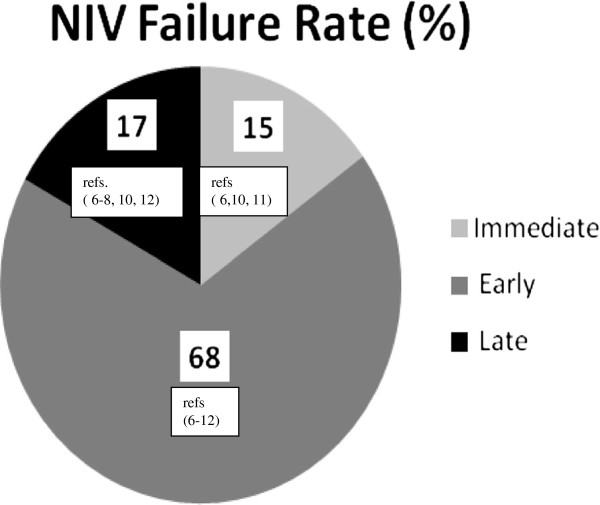
BACKGROUND: Identifying the predictors of noninvasive ventilation (NIV) failure has attracted significant interest because of the strong link between failure and poor outcomes. However, very little attention has been paid to the timing of the failure. This narrative review focuses on the causes of NIV failure and risk factors and potential remedies for NIV failure, based on the timing factor. RESULTS: The possible causes of immediate failure (within minutes to <1 h) are a weak cough reflex, excessive secretions, hypercapnic encephalopathy, intolerance, agitation, and patient-ventilator asynchrony. The major potential interventions include chest physiotherapeutic techniques, early fiberoptic bronchoscopy, changing ventilator settings, and judicious sedation. The risk factors for early failure (within 1 to 48 h) may differ for hypercapnic and hypoxemic respiratory failure. However, most cases of early failure are due to poor arterial blood gas (ABGs) and an inability to promptly correct them, increased severity of illness, and the persistence of a high respiratory rate. Despite a satisfactory initial response, late failure (48 h after NIV) can occur and may be related to sleep disturbance. CONCLUSIONS: Every clinician dealing with NIV should be aware of these risk factors and the predicted parameters of NIV failure that may change during the application of NIV. Close monitoring is required to detect early and late signs of deterioration, thereby preventing unavoidable delays in intubation.
Overview
The claims and statistics of this paper haven’t been checked yet.
Run the check — free, no account needed. It reads the open-access text and checks the sources it cites.
Integrity signals
Registry
Cites
Statistics
Figures
Verification
Claims the paper makes
The claims and statistics of this paper haven’t been checked yet.
Run the check — free, no account needed. It reads the open-access text and checks the sources it cites.
Claims other papers make about this one
Each is checked against this paper’s own text: does it say what the citing paper says it does?
The source backs part of the claim, not all of it — or backs it for a different population, condition or comparison.
In the citing paper
“Previous studies suggested that the misuse or rejection of medication or NIV can be influenced by some psychological factors such as anxiety, depression, health beliefs, and cognitive impairment (27–29); the unacknowledged recognition of the illness; and the use of different devices and medications due to comorbidities (30–32).”
From Promoting Acceptance and Adherence to Noninvasive Ventilation in Chronic Obstructive Pulmonary Disease: A Randomized Controlled Trial. (2022) · cites this paper as [31]
Experimental — accuracy not yet measuredThe check wasn’t confident either way, so it gives no verdict — never disputed.
In the citing paper
“No study has identified the individual psychological factors that increase the risk of rejection or improper use of NIV.”
From A psychological intervention to promote acceptance and adherence to non-invasive ventilation in people with chronic obstructive pulmonary disease: study protocol of a randomised controlled trial. (2017) · cites this paper as [31]
Experimental — accuracy not yet measured
Self-check
Percentages, sums and reported differences re-computed from the paper’s own numbers.
The self-check needs the paper’s full text.
Citations
Cites
Surviving Sepsis Campaign: International Guidelines for Management of Severe Sepsis and Septic Shock
Dellinger, R. P., Levy, M. M., Rhodes, A., Annane, D., Gerlach, H., Opal, S. M., Sevransky, J. E., Sprung, C. L., Douglas, I. S., Jaeschke, R., et al. (2013) · Critical Care Medicine · doi:10.1097/ccm.0b013e31827e83af · Cited by 9,694
Dellinger, R. P., Levy, M. M., Rhodes, A., Annane, D., Gerlach, H., Opal, S. M., Sevransky, J., Sprung, C. L., Douglas, I. S., Jaeschke, R., et al. (2013) · Intensive Care Medicine · doi:10.1007/s00134-012-2769-8 · Cited by 7,371
Noninvasive Ventilation for Acute Exacerbations of Chronic Obstructive Pulmonary Disease
Brochard, L. J., Mancebo, J., Wysocki, M., Lofaso, F., Conti, G., Rauss, A., Simonneau, G., Benito, S., GASPARETTO, A., Lemaire, F., et al. (1995) · New England Journal of Medicine · doi:10.1056/nejm199509283331301 · Cited by 2,043
Plant, P., Owen, J., & Elliott, M. W. (2000) · The Lancet · doi:10.1016/s0140-6736(00)02323-0 · Cited by 1,245
Non-invasive ventilation in acute respiratory failure
Nava, S., & Hill, N. S. (2009) · The Lancet · doi:10.1016/s0140-6736(09)60496-7 · Cited by 1,009
Self-citation(2001) · American Journal of Respiratory and Critical Care Medicine · doi:10.1164/ajrccm.163.1.ats1000 · Cited by 784
Antonelli, M. M., Conti, G., Moro, M. L., Esquinas, A. M., Díaz, G. G., Confalonieri, M., Pelaia, P., Principi, T., Gregoretti, C., Beltrame, F., et al. (2001) · Intensive Care Medicine · doi:10.1007/s00134-001-1114-4 · Cited by 753
Non-invasive ventilation in acute respiratory failure
Mehta, S., & Hill, N. S. (2002) · Thorax · doi:10.1136/thorax.57.3.192 · Cited by 645
Confalonieri, M., Potena, A., Carbone, G., Porta, R., Tolley, E. A., & Meduri, G. U. (1999) · American Journal of Respiratory and Critical Care Medicine · doi:10.1164/ajrccm.160.5.9903015 · Cited by 625
Noninvasive Ventilation in Severe Hypoxemic Respiratory Failure
Ferrer, M., Esquinas, A. M., Leon, M. E., González, G., Alarcón, A., & Torres, A. (2003) · American Journal of Respiratory and Critical Care Medicine · doi:10.1164/rccm.200301-072oc · Cited by 618
Cited by
Sorted by citations
Failure of high-flow nasal cannula therapy may delay intubation and increase mortality
Kang, B. J., Koh, Y., Lim, C., Huh, J. W., Baek, S., Han, M., Seo, H.-S., Suh, H. J., Seo, G. J., Kim, E. Y., et al. (2015) · Intensive Care Medicine · doi:10.1007/s00134-015-3693-5 · Cited by 657
Nishimura, M. (2016) · Respiratory Care · doi:10.4187/respcare.04577 · Cited by 501
High-flow nasal cannula oxygen therapy in adults
Nishimura, M. (2015) · Journal of Intensive Care · doi:10.1186/s40560-015-0084-5 · Cited by 337
Demoule, A., Chevret, S., Carlucci, A., Kouatchet, A., Jaber, S., Meziani, F., Schmidt, M., Schnell, D., Clergue, C., Aboab, J., et al. (2016) · Intensive Care Medicine · doi:10.1007/s00134-015-4087-4 · Cited by 194
A Systematic Review of the High-flow Nasal Cannula for Adult Patients
Helviz, Y., & Einav, S. (2018) · Critical Care · doi:10.1186/s13054-018-1990-4 · Cited by 158
Metadata
- Authors
- Ozyilmaz, E., Ugurlu, A. O., & Nava, S.
- Affiliations
- IRCCS Azienda Ospedliero-Universitaria di Bologna Policlinico di Sant'Orsola (IT)
- Corresponding author
- Nava, Stefano
- Venue
- BMC Pulmonary Medicine
- Published
- 2014-02-13
- Volume
- 14
- Issue
- 1
- Pages
- 19-19
- ISSN
- 1471-2466 (ISSN-L)
- PMC
- PMC3925956
- OpenAlex
- W2041987026
- Cited by
- 260
- References
- 82
- Citations by year
- 2026: 11 · 2025: 17 · 2024: 18 · 2023: 34 · 2022: 33 · 2021: 23 · 2020: 27 · 2019: 27 · 2018: 18 · 2017: 13 · 2016: 18 · 2015: 16 · 2014: 4
- FWCI
- 2.91
- Type
- journal article
- Language
- en
- Open access
- gold
- doi.org
- Licence
- Locations
- BMC Pulmonary Medicine (publishedVersion, cc-by)
- Europe PMC (PubMed Central) (publishedVersion, cc-by)
- PubMed Central (publishedVersion, cc-by)
- PubMed (publishedVersion)
- Archivio istituzionale della ricerca (Alma Mater Studiorum Università di Bologna) (submittedVersion, cc-by)
- Topics
- Health Sciences › Medicine › Pulmonary and Respiratory Medicine › Respiratory Support and Mechanisms
- Health Sciences › Medicine › Physiology (medical) › Obstructive Sleep Apnea Research
- Health Sciences › Medicine › Anesthesiology and Pain Medicine › Airway Management and Intubation Techniques
- Keywords
- noninvasive ventilation failure, risk factors, patient-ventilator asynchrony, hypoxemic respiratory failure, sedation, bronchoscopy, chest physiotherapy, arterial blood gas monitoring, sleep disorders, respiratory failure
- MeSH terms
- Humans, Risk Factors, Time Factors, Treatment Failure, Pulmonary Disease, Chronic Obstructive, Noninvasive Ventilation
About these checks
Registry, retraction, Cites and statistics results are computed, not judged, with one exception: a printed reference that no index lists is read once by a model before it counts as a citation error. Claims are extracted by a model and kept only when their quote appears verbatim in the text; each cited source is then checked, with a model’s help, for whether it says what the claim relies on. Those verdicts can be wrong — read the claim’s quote and the cited source before relying on one.
Statistics and arithmetic are recomputed, not judged.
Confidence bands are shown only for fields calibrated on our annotated test set. None is calibrated yet, so no band is shown.
What counts as a claim ›How we measure confidence ›How we check this ›
Are you an author, or do you see a problem with this page? Request a review
