

Fatigue in fibromyalgia: a conceptual model informed by patient interviews
Open accessThe DOI matches its Crossref record; 42 of the 42 references it cites were found in a registry or an index.
Abstract
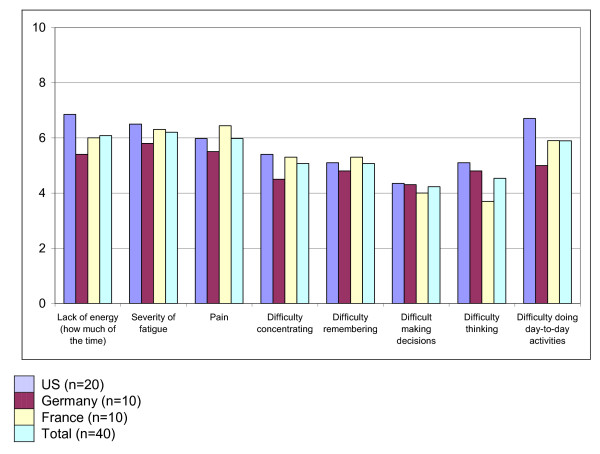
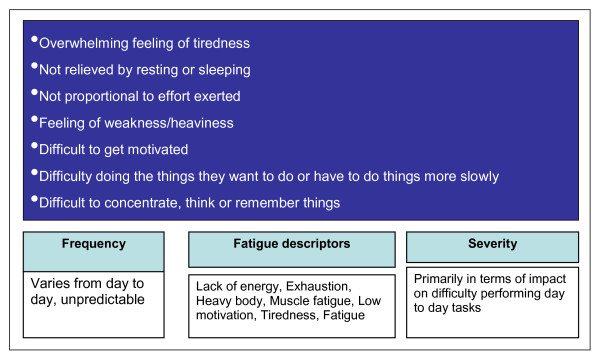
BACKGROUND: Fatigue is increasingly recognized as an important symptom in fibromyalgia (FM). Unknown however is how fatigue is experienced by individuals in the context of FM. We conducted qualitative research in order to better understand aspects of fatigue that might be unique to FM as well as the impact it has on patients' lives. The data obtained informed the development of a conceptual model of fatigue in FM. METHODS: Open-ended interviews were conducted with 40 individuals with FM (US [n = 20], Germany [n = 10] and France [n = 10]). Transcripts were analyzed using qualitative methods based upon grounded theory to identify key themes and concepts. RESULTS: Participants were mostly female (70%) with a mean age of 48.7 years (range: 25-79). Thirty-one individuals (i.e., 77.5%) spontaneously described experiencing tiredness/lack of energy/fatigue due to FM. Participants discussed FM fatigue as being more severe, constant/persistent and unpredictable than normal tiredness. The conceptual model depicts the key elements of fatigue in FM from a patient perspective. This includes: an overwhelming feeling of tiredness (n = 17, 42.5%), not relieved by resting/sleeping (n = 15, 37.5%), not proportional to effort exerted (n = 25, 62.5%), associated with a feeling of weakness/heaviness (n = 20, 50%), interferes with motivation (n = 22, 55%), interferes with desired activities (n = 27, 67.5%), prolongs tasks (n = 15, 37.5%), and makes it difficult to concentrate (n = 21, 52.5%), think clearly (n = 12, 30%) or remember things (n = 9, 22.5%). CONCLUSION: The majority of individuals with FM who participated in this study experience fatigue and describe it as more severe than normal tiredness.
Overview
The claims and statistics of this paper haven’t been checked yet.
Free: it reads the open-access text and checks the first 5 claims that cite a source we can check. Create a free account to check every claim.
Integrity signals
Registry
Cites
Statistics
Figures
Verification
Claims the paper makes
The claims and statistics of this paper haven’t been checked yet.
Free: it reads the open-access text and checks the first 5 claims that cite a source we can check. Create a free account to check every claim.
Claims other papers make about this one
Each is checked against this paper’s own text: does it say what the citing paper says it does?
The cited source says what the claim attributes to it.
In the citing paper
“this symptom has been shown to be highly prevalent, persistent and disabling in patients with fibromyalgia [25,26,27].”
Self-check
Percentages, sums and reported differences re-computed from the paper’s own numbers.
The self-check needs the paper’s full text.
Citations
Cites
(1998) · Sage eBooks · Cited by 38,631
The Discovery of Grounded Theory: Strategies for Qualitative Research
Glaser, B. G., & Strauss, A. L. (2017) · Aldine (Routledge reprint) · doi:10.4324/9780203793206 · Cited by 25,789
How Many Interviews Are Enough?: An Experiment with Data Saturation and Variability
Guest, G., Bunce, A., & Johnson, L. (2006) · Field Methods · doi:10.1177/1525822x05279903 · Cited by 20,808
The american college of rheumatology 1990 criteria for the classification of fibromyalgia
Wolfe, F., Smythe, H. A., Yunus, M. B., Bennett, R. M., Bombardier, C., Goldenberg, D. L., Tugwell, P., Campbell, S. M., Abeles, M., Clark, P., et al. (1990) · Arthritis & Rheumatism · doi:10.1002/art.1780330203 · Cited by 9,563
The Discovery of Grounded Theory
Glaser, B. G., & Strauss, A. L. (2017) · The Discovery of Grounded Theory · doi:10.4324/9780203793206-1 · Cited by 8,344
The Constant Comparative Method of Qualitative Analysis
Glaser, B. G. (1965) · Social Problems · doi:10.2307/798843 · Cited by 4,588
U.S. Department of Health and Human Services FDA Center for Drug Evaluation and Research, U.S. Department of Health and Human Services FDA Center for Biologics Evaluation and Research, & U.S. Department of Health and Human Services FDA Center for Devices and Radiological Health (2006) · Health and Quality of Life Outcomes · doi:10.1186/1477-7525-4-79 · Cited by 2,856
Wolfe, F., Ross, K., Anderson, J., Russell, I. J., & Hebert, L. (1995) · Arthritis & Rheumatism · doi:10.1002/art.1780380104 · Cited by 2,416 · cited 2×
“5-10% worldwide [3-9] with a predominance among females [10].”
Pope, C., & Mays, N. (1995) · BMJ · doi:10.1136/bmj.311.6996.42 · Cited by 2,336
Gosby, J. R. (2000) · Journal of Advanced Nursing · doi:10.1046/j.1365-2648.2000.t01-7-01210.x · Cited by 1,991
Grounded Theory and Sensitizing Concepts
Bowen, G. A. (2006) · International Journal of Qualitative Methods · doi:10.1177/160940690600500304 · Cited by 1,894 · cited 1×
“This analysis approach is based on a Grounded Theory approach [30-33] and Atlas Ti software (Atlas.”
Patient-Reported Outcomes to Support Medical Product Labeling Claims: FDA Perspective
Patrick, D. L., Burke, L. B., Powers, J. H., Scott, J. A., Rock, E. P., Dawisha, S., O'Neill, R., & Kennedy, D. L. (2007) · Value in Health · doi:10.1111/j.1524-4733.2007.00275.x · Cited by 726 · cited 1×
“The primary objective of this research was to better understand the patient experience of FM fatigue through open-ended, qualitative research, as advocated by regulators and experts in PRO development [19,36, 37 ].”
Prevalence of Fibromyalgia: A Survey in Five European Countries
Branco, J. C., Bannwarth, B., Failde, I., Abello Carbonell, J., Blotman, F., Spaeth, M., Saraiva, F., Nacci, F., Thomas, E., Caubère, J.-P., et al. (2010) · Seminars in Arthritis and Rheumatism · doi:10.1016/j.semarthrit.2008.12.003 · Cited by 685 · cited 3×
“Quantitative studies looking at these differences in reporting fatigue are required to provide an understanding of whether the gender and country differences reported here are replicated in larger samples, or if they are an artefact of this small, qualitative sample [5,38,39].”
Crofford, L. J., Rowbotham, M. C., Mease, P. J., Russell, I. J., Dworkin, R. H., Corbin, A. E., Young, J. P., LaMoreaux, L. K., Martin, S. A., Sharma, U., et al. (2005) · Arthritis & Rheumatism · doi:10.1002/art.20983 · Cited by 654 · cited 1×
“Existing fatigue measures such as the Multidimensional Fatigue Inventory (MFI) [21] and the Multidimensional Assessment of Fatigue (MAF) have been used extensively in FM clinical trials [22-27].”
Self-citationThe prevalence and meaning of fatigue in rheumatic disease.
Wolfe, F., Hawley, D. J., & Wilson, K. (1996) · PubMed · Cited by 641
Carmona, L., Ballina, J., Gabriel, R., & Laffon, A. (2001) · Annals of the Rheumatic Diseases · doi:10.1136/ard.60.11.1040 · Cited by 636 · cited 1×
“5-10% worldwide [3-9] with a predominance among females [10].”
Photo Elicitation Interview (PEI): Using Photos to Elicit Children's Perspectives
Epstein, I., Stevens, B., McKeever, P., & Baruchel, S. (2006) · International Journal of Qualitative Methods · doi:10.1177/160940690600500301 · Cited by 559
Patient perspectives on the impact of fibromyalgia
Arnold, L. M., Crofford, L. J., Mease, P. J., Burgess, S. M., Palmer, S. C., Abetz, L., & Martin, S. A. (2008) · Patient Education and Counseling · doi:10.1016/j.pec.2008.06.005 · Cited by 490 · cited 4×
“A conceptual model of FM fatigue was developed based on the qualitative findings and on the previous qualitative research that was reviewed [11,12,14,15] (Figure 2).”
InfluentialSelf-citationSalaffi, F., Angelis, R. D., & Grassi, W. (2005) · PubMed · Cited by 416
Mease, P. J., Russell, I. J., Arnold, L. M., Florian, H., Young, J. P., Martin, S. A., & Sharma, U. (2008) · PubMed · Cited by 291
Self-citationArnold, L. M., Russell, I. J., Diri, E. W., Duan, W. R., Young, J. P., Sharma, U., Martin, S. A., Barrett, J. A., & Haig, G. (2008) · The Journal of Pain · doi:10.1016/j.jpain.2008.03.013 · Cited by 277
MEASE, P. J., CLAUW, D. J., GENDREAU, R. M., RAO, S. G., KRANZLER, J., CHEN, W., & PALMER, R. H. (2009) · The Journal of Rheumatology · doi:10.3899/jrheum.080734 · Cited by 248
Self-citationClassification, epidemiology, and natural history of fibromyalgia
White, K. P., & Harth, M. (2001) · Current Pain and Headache Reports · doi:10.1007/s11916-001-0021-2 · Cited by 246 · cited 1×
“5-10% worldwide [3-9] with a predominance among females [10].”
Crofford, L. J., Mease, P. J., Simpson, S. L., Young, J. P., Martin, S. A., Haig, G. M., & Sharma, U. (2008) · Pain · doi:10.1016/j.pain.2008.02.027 · Cited by 236 · cited 1×
“Existing fatigue measures such as the Multidimensional Fatigue Inventory (MFI) [21] and the Multidimensional Assessment of Fatigue (MAF) have been used extensively in FM clinical trials [22-27].”
Self-citationMease, P. J., Arnold, L. M., Crofford, L. J., Williams, D. A., Russell, I. J., Humphrey, L., Abetz, L., & Martin, S. A. (2008) · Arthritis Care & Research · doi:10.1002/art.23826 · Cited by 232 · cited 2×
“A Delphi study by 23 FM expert clinicians identified fatigue as being the second most important domain to measure (after pain), and it was subsequently rated as third most important (after pain and overall FM) by a Delphi study involving patients [12].”
Self-citationWalker, E. A., Keegan, D., Gardner, G., Sullivan, M., Katon, W. J., & Bernstein, D. (1997) · Psychosomatic Medicine · doi:10.1097/00006842-199711000-00002 · Cited by 207 · cited 1×
“rheumatoid arthritis), given that both groups of patients report this symptom [40].”
Leidy, N. K., & Vernon, M. (2008) · PharmacoEconomics · doi:10.2165/00019053-200826050-00002 · Cited by 204
(2000) · CrossRef Listing of Deleted DOIs · doi:10.1016/s1084-3612(03)00049-2 · Cited by 123 · cited 1×
“Although depression and fatigue is strongly linked [35], our analysis revealed that there were no sub-concepts of fatigue or FM impact that were mentioned by only depressed patients.”
Cöster, L., Kendall, S., Gerdle, B., Henriksson, C., Henriksson, K. G., & Bengtsson, A. (2008) · European Journal of Pain · doi:10.1016/j.ejpain.2007.10.001 · Cited by 119 · cited 1×
“5-10% worldwide [3-9] with a predominance among females [10].”
HISTOLOGICAL ABNORMALITIES IN MUSCLE FROM PATIENTS WITH CERTAIN TYPES OF FIBROSITIS
Bartels, E. M., & Danneskiold‐Samsøe, B. (1986) · The Lancet · doi:10.1016/s0140-6736(86)91779-4 · Cited by 115
Gender differences in fibromyalgia and other related syndromes.
Yunus, M. B. (2002) · PubMed · Cited by 112
Individuals’ Descriptions of Living With Fibromyalgia
Cunningham, M. M., & Jillings, C. (2006) · Clinical Nursing Research · doi:10.1177/1054773806291853 · Cited by 107 · cited 3×
“This is further supported by other publications of qualitative FM patient research [14-18].”
Arnold, L. M., Crofford, L. J., Martin, S. A., Young, J. P., & Sharma, U. (2007) · Pain Medicine · doi:10.1111/j.1526-4637.2007.00332.x · Cited by 96
(2007) · PubMed · Cited by 88
Self-citationThe Experience of Living With Fibromyalgia: Confronting an Invisible Disability
Sturge-Jacobs, M. (2002) · Research and Theory for Nursing Practice · doi:10.1891/rtnp.16.1.19.52994 · Cited by 71 · cited 2×
“This is further supported by other publications of qualitative FM patient research [14-18].”
Ten Rural Women Living with Fibromyalgia Tell It Like It Is
Cudney, S. A., Butler, M. R., Weinert, C., & Sullivan, T. (2002) · Holistic Nursing Practice · doi:10.1097/00004650-200204000-00009 · Cited by 65 · cited 2×
“This is further supported by other publications of qualitative FM patient research [14-18].”
A phenomenological study of fibromyalgia. Patient perspectives
Olle, H., Jennifer, B., Gunnar, K., Per, L., & Bengt, M. (1999) · Scandinavian Journal of Primary Health Care · doi:10.1080/028134399750002827 · Cited by 59
The Lived Experience of Fibromyalgia in African American Women
Schaefer, K. M. (2005) · Holistic Nursing Practice · doi:10.1097/00004650-200501000-00007 · Cited by 35 · cited 2×
“This is further supported by other publications of qualitative FM patient research [14-18].”
(2009) · The Journal of Rheumatology · doi:10.3899/jrheum.080734c1 · Cited by 21
Raspe, H. H. (1992) · Sozial- und Präventivmedizin · doi:10.1007/bf01624572 · Cited by 15
Jäckel, W. H., & Genth, E. (2007) · Zeitschrift für Rheumatologie · doi:10.1007/s00393-007-0229-6 · Cited by 9
Lawrence (1998) · doi:10.1002/1529-0131(199805)41:5<778::aid-art4>3.0.co;2-v · cited 1×
“Quantitative studies looking at these differences in reporting fatigue are required to provide an understanding of whether the gender and country differences reported here are replicated in larger samples, or if they are an artefact of this small, qualitative sample [5,38,39].”
Research works printed but not linked: 3
- Committee for Medicinal Products for Human Use (CHMP) Reflection paper on the regulatory guidance for the use of health-related quality of life (HRQL) measures in the evaluation of medicinal products. EMEA/CHMP/EWP/139391/2004 2005
- Field PA Morse JA Nursing Research: The Application of Qualitative Research 1985 London: Croom Held
- Glaser BG Strauss AL The Discovery of Grounded Theory 1967 New York: Aldine
Cited by
Fibromyalgia: A Critical and Comprehensive Review
Borchers, A. T., & Gershwin, M. E. (2015) · Clinical Reviews in Allergy & Immunology · doi:10.1007/s12016-015-8509-4 · Cited by 275
“However, in the context of OMERACT, there has been an attempt to develop a conceptual model of fatigue in FMS by conducting some detailed patient interviews [174].”
BackgroundMethodPhenotypic features of central sensitization
Williams, D. A. (2018) · Journal of Applied Biobehavioral Research · doi:10.1111/jabr.12135 · Cited by 174
“This generalized sensory hypersensitivity has been documented in other COPCs such as migraine (Friedman & De ver Dye, 2009; Goadsby et al., 2017; Main, Dowson, & Gross, 1997), IBS (Berman et al., 2002; Blomhoff, Jacobsen, Spetalen, Dahm, & Malt, 2000), and TMD (Hollins et al., 2009).”
BackgroundInfluentialSelf-citationBeyond pain in fibromyalgia: Insights into the symptom of fatigue
Vincent, A., Benzo, R. P., Whipple, M. O., McAllister, S. J., Erwin, P. J., & Saligan, L. N. (2013) · Arthritis Research & Therapy · doi:10.1186/ar4395 · Cited by 133
“Although fatigue is reported by both men and women with fibromyalgia, one study demonstrated that men had less fatigue compared to women and a second study reported that men tend to focus more on pain and women on fatigue [8,20].”
BackgroundResultEricsson, A., Palstam, A., Larsson, A., Löfgren, M., Bileviciute-Ljungar, I., Bjersing, J., Gerdle, B., Kosek, E., & Mannerkorpi, K. (2016) · Arthritis Research & Therapy · doi:10.1186/s13075-016-1073-3 · Cited by 87
“Although the improvement in physical fatigue was small in effect size, it is valuable for patients describing themselves as physically weak and becoming fatigued after doing very little [56], which causes deterioration in their quality of life and ability to manage daily activities.”
BackgroundArnold, L. M., Wang, F., Ahl, J., Gaynor, P. J., & Wohlreich, M. M. (2011) · Arthritis Research & Therapy · doi:10.1186/ar3359 · Cited by 44
“Individuals with fibromyalgia report that their fatigue typically is not alleviated by sleep or rest [5] but is a physical tiredness, and these people have low energy and require increased effort to overcome inactivity and perform physical tasks [4,6].”
Background
Metadata
- Authors
- Humphrey, L., Arbuckle, R., Mease, P., Williams, D. A., Samsoe, B. D., & Gilbert, C.
- Affiliations
- Adelphi Group (United Kingdom) (GB)
- University of Michigan (US)
- Pfizer (United Kingdom) (GB)
- Corresponding author
- Humphrey, Louise
- Venue
- BMC Musculoskeletal Disorders
- Published
- 2010-09-20
- Volume
- 11
- Issue
- 1
- Pages
- 216-216
- ISSN
- 1471-2474 (ISSN-L)
- PMC
- PMC2946273
- OpenAlex
- W2011373308
- Cited by
- 68
- References
- 42
- Citations by year
- 2026: 1 · 2025: 8 · 2024: 3 · 2023: 2 · 2022: 6 · 2021: 5 · 2020: 7 · 2019: 4 · 2018: 4 · 2017: 4 · 2016: 3 · 2015: 5 · 2014: 5 · 2013: 8 · 2012: 1
- FWCI
- 2.40
- Type
- journal article
- Language
- en
- Open access
- gold
- doi.org
- Licence
- cc-by
- creativecommons.org/licenses/by/2.0 (tdm)
- Locations
- BMC Musculoskeletal Disorders (publishedVersion, cc-by)
- PubMed Central (publishedVersion, cc-by)
- PubMed (publishedVersion)
- Research at the University of Copenhagen (University of Copenhagen) (publishedVersion)
- Deep Blue (University of Michigan) (submittedVersion)
- DOAJ (DOAJ: Directory of Open Access Journals) (submittedVersion)
- Funders
- National Institutes of Health
- National Institute of Arthritis and Musculoskeletal and Skin Diseases (U01AR55069, U01AR055069)
- Topics
- Health Sciences › Medicine › Psychiatry and Mental health › Fibromyalgia and Chronic Fatigue Syndrome Research
- Health Sciences › Medicine › Psychiatry and Mental health › Psychosomatic Disorders and Their Treatments
- Health Sciences › Health Professions › Physical Therapy, Sports Therapy and Rehabilitation › Musculoskeletal pain and rehabilitation
- Keywords
- fibromyalgia, fatigue, patient experience, lack of energy, cognitive impairment
- MeSH terms
- Adult, Aged, Female, Humans, Interview, Psychological, Male, Middle Aged, Models, Psychological, Fatigue Syndrome, Chronic, Comorbidity
About these checks
Registry, retraction, Cites and statistics results are computed, not judged, with one exception: a printed reference that no index lists is read once by a model before it counts as a citation error. Claims are extracted by a model and kept only when their quote appears verbatim in the text; each cited source is then checked, with a model’s help, for whether it says what the claim relies on. Those verdicts can be wrong — read the claim’s quote and the cited source before relying on one.
Statistics and arithmetic are recomputed, not judged.
Confidence bands are shown only for fields calibrated on our annotated test set. None is calibrated yet, so no band is shown.
What counts as a claim ›How we measure confidence ›How we check this ›
Are you an author, or do you see a problem with this page? Request a review
Data sources
Bibliographic data: Semantic Scholar, OpenAlex, Crossref.
Contains information from the Semantic Scholar Academic Graph Datasets, made available under the ODC Attribution License (ODC-BY 1.0).
Semantic Scholar’s data is described in: Kinney, R., et al. (2023). The Semantic Scholar Open Data Platform. arXiv:2301.10140.
