

Accuracy of physical examination for chronic lumbar radiculopathy
Open accessThe DOI matches its Crossref record; 52 of the 53 references it cites were found in a registry or an index.
Abstract
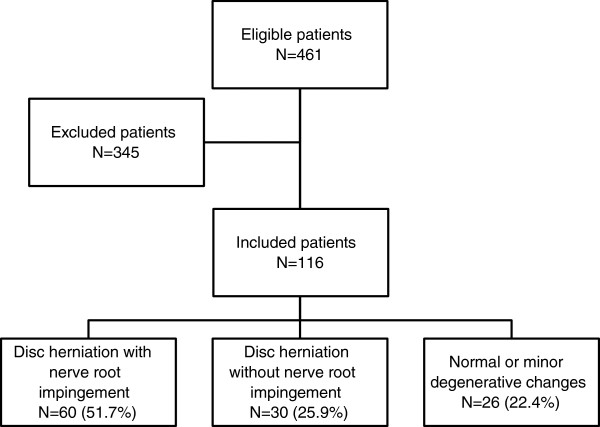
BACKGROUND: Clinical examination of patients with chronic lumbar radiculopathy aims to clarify whether there is nerve root impingement. The aims of this study were to investigate the association between findings at clinical examination and nerve root impingement, to evaluate the accuracy of clinical index tests in a specialised care setting, and to see whether imaging clarifies the cause of chronic radicular pain. METHODS: A total of 116 patients referred with symptoms of lumbar radiculopathy lasting more than 12 weeks and at least one positive index test were included. The tests were the straight leg raising test, and tests for motor muscle strength, dermatome sensory loss, and reflex impairment. Magnetic resonance imaging (n = 109) or computer tomography (n = 7) were imaging reference standards. Images were analysed at the level of single nerve root(s), and nerve root impingement was classified as present or absent. Sensitivities, specificities, and positive and negative likelihood ratios (LR) for detection of nerve root impingement were calculated for each individual index test. An overall clinical evaluation, concluding on the level and side of the radiculopathy, was performed. RESULTS: The prevalence of disc herniation was 77.8%. The diagnostic accuracy of individual index tests was low with no tests reaching positive LR >4.0 or negative LR <0.4. The overall clinical evaluation was slightly more accurate, with a positive LR of 6.28 (95% CI 1.06-37.21) for L4, 1.74 (95% CI 1.04-2.93) for L5, and 1.29 (95% CI 0.97-1.72) for S1 nerve root impingement. An overall clinical evaluation, concluding on the level and side of the radiculopathy was also performed, and receiver operating characteristic (ROC) analysis with area under the curve (AUC) calculation for diagnostic accuracy of this evaluation was performed. CONCLUSIONS: The accuracy of individual clinical index tests used to predict imaging findings of nerve root impingement in patients with chronic lumbar radiculopathy is low when applied in specialised care, but clinicians' overall evaluation improves diagnostic accuracy slightly. The tests are not very helpful in clarifying the cause of radicular pain, and are therefore inaccurate for guidance in the diagnostic workup of the patients. The study population was highly selected and therefore the results from this study should not be generalised to unselected patient populations in primary care nor to even more selected surgical populations.
Overview
The claims and statistics of this paper haven’t been checked yet.
Free: it reads the open-access text and checks the first 5 claims that cite a source we can check. Create a free account to check every claim.
Integrity signals
Registry
Cites
Statistics
Figures
Verification
Claims the paper makes
The claims and statistics of this paper haven’t been checked yet.
Free: it reads the open-access text and checks the first 5 claims that cite a source we can check. Create a free account to check every claim.
Claims other papers make about this one
Each is checked against this paper’s own text: does it say what the citing paper says it does?
The source backs part of the claim, not all of it — or backs it for a different population, condition or comparison.
In the citing paper
“Specifically, L3-L4 lesions affect PTR [19,20], whereas S1 lesions influence ATR [21].”
From The usefulness of deep tendon reflexes in the diagnosis of lumbar spine diseases: a narrative review (2024) · cites this paper as [21]
Experimental — accuracy not yet measured
Self-check
Percentages, sums and reported differences re-computed from the paper’s own numbers.
The self-check needs the paper’s full text.
Citations
Cites
Boden, S. D., McCowin, P. R., Davis, D. O., Dina, T. S., Mark, A. S., & Wiesel, S. (1990) · The Journal of Bone & Joint Surgery · doi:10.2106/00004623-199072080-00008 · Cited by 2,708 · cited 2×
“This confirms that radiculopathy may have other causes, such as neuropathic and inflammatory conditions, or be mimicked by myofascial pain [6,38-40].”
BackgroundInternational Standards For Neurological Classification Of Spinal Cord Injury
Marino, R. J., Barros, T., Biering-Sorensen, F., Burns, S. P., Donovan, W. H., Graves, D. E., Haak, M., Hudson, L. M., & Priebe, M. (2003) · The Journal of Spinal Cord Medicine · doi:10.1080/10790268.2003.11754575 · Cited by 1,141 · cited 1×
“The physical examination was performed according to the recommendations given by the American Spinal Injury Association [20-22].”
MethodJaeschke, R. (1994) · JAMA · doi:10.1001/jama.1994.03510290071040 · Cited by 1,049 · cited 1×
“2) [31].”
Overtreating chronic back pain: time to back off?
Deyo, R. A., Mirza, S. K., Turner, J. A., & Martin, B. I. (2009) · The Journal of the American Board of Family Medicine · doi:10.3122/jabfm.2009.01.080102 · Cited by 796 · cited 1×
“An inaccurate clinical diagnosis may lead to unnecessary imaging and healthcare expenditure, and additional concerns for patients [7-12].”
BackgroundAtlas, S. J., Keller, R. B., Wu, Y. A., Deyo, R. A., & Singer, D. E. (2005) · Spine · doi:10.1097/01.brs.0000158954.68522.2a · Cited by 507 · cited 1×
“An inaccurate clinical diagnosis may lead to unnecessary imaging and healthcare expenditure, and additional concerns for patients [7-12].”
BackgroundAkobeng, A. K. (2007) · Acta Paediatrica · doi:10.1111/j.1651-2227.2006.00179.x · Cited by 440 · cited 1×
“An inaccurate clinical diagnosis may lead to unnecessary imaging and healthcare expenditure, and additional concerns for patients [7-12].”
BackgroundBorenstein, D. G., O'Mara, J. W., Boden, S. D., Lauerman, W. C., Jacobson, A., Platenberg, C., Schellinger, D., & Wiesel, S. W. (2001) · The Journal of Bone and Joint Surgery-American Volume · doi:10.2106/00004623-200109000-00002 · Cited by 434 · cited 2×
“This is not surprising, since the prevalence of disc herniation revealed by MRI in the general population is known to be as high as 30% [3,18,41-44].”
BackgroundMartin, B. I., Turner, J. A., Mirza, S. K., Lee, M. J., Comstock, B. A., & Deyo, R. A. (2009) · Spine · doi:10.1097/brs.0b013e3181b1fad1 · Cited by 419
Physical examination for lumbar radiculopathy due to disc herniation in patients with low-back pain
van der Windt, D. A., Simons, E., Riphagen, I. I., Ammendolia, C., Verhagen, A. P., Laslett, M., Devillé, W., Deyo, R. A., Bouter, L. M., de Vet, H. C., et al. (2010) · Cochrane Database of Systematic Reviews · doi:10.1002/14651858.cd007431.pub2 · Cited by 334 · cited 4×
“Most previous studies have, however, aimed for a generalised understanding of test properties from such selected materials [13].”
BackgroundResultInfluential
Research works printed but not linked: 1
- Stanley H Orthopaedic Neurology. A Diagnostic Guide to Neurological Levels 1997 Philadelphia: Lippincott-Raven
Cited by
Shanthanna, H., Chan, P., McChesney, J., Paul, J., & Thabane, L. (2014) · Journal of Pain Research · doi:10.2147/jpr.s55749 · Cited by 80
“for inclusion because all of these tests, including the wellknown straight leg raising test, have low diagnostic value.(10) Exclusion criteria included patient refusal to participate, any contraindication to neuraxial injections, a history of predominant back pain over leg pain, significant anatomic deformity (either…”
BackgroundFleischmann, M., & Vaughan, B. (2018) · International journal of osteopathic medicine · doi:10.1016/j.ijosm.2018.03.003 · Cited by 74
Zheng, B., Shuai, X., Guo, C. Y., Jin, L., Liu, C., & Liu, H. (2022) · Frontiers in Surgery · doi:10.3389/fsurg.2022.911914 · Cited by 66
“Therefore, increasing attention is being focused on the search for appropriate treatment (3, 4).”
BackgroundMethodInfluentialMonteros, F. J. G. E. D. L., González-Medina, G., Garrido-Ardila, E. M., Mansilla, J. R., Expósito, J., & Ruiz, P. O. (2020) · International Journal of Environmental Research and Public Health · doi:10.3390/ijerph17197046 · Cited by 55
“Regarding the lack of external validity of this test, we coincide with other studies that are available in the literature [41,42,46,47].”
ResultEkedahl, H., Jönsson, B., Annertz, M., & Frobell, R. B. (2017) · Archives of Physical Medicine and Rehabilitation · doi:10.1016/j.apmr.2017.11.006 · Cited by 56
Stynes, S. M., Konstantinou, K., Ogollah, R. O., Hay, E. M., & Dunn, K. M. (2018) · PLoS ONE · doi:10.1371/journal.pone.0191852 · Cited by 50
Outcome prediction in chronic unilateral lumbar radiculopathy: prospective cohort study
Iversen, T., Solberg, T. K., Wilsgaard, T., Waterloo, K. K., Brox, J. I., & Ingebrigtsen, T. (2015) · BMC Musculoskeletal Disorders · doi:10.1186/s12891-015-0474-9 · Cited by 42
“The results of each clinical test were dichotomized as normal or abnormal as described previously [32].”
MethodSelf-citationAAPT Diagnostic Criteria for Chronic Low Back Pain
Markman, J. D., Czerniecka-Foxx, K., Khalsa, P. S., Hayek, S. M., Asher, A. L., Loeser, J. D., & Chou, R. (2020) · Journal of Pain · doi:10.1016/j.jpain.2020.01.008 · Cited by 38
Diagnostic Tests for Low Back Disorders
Hegmann, K. T., Travis, R. L., Belcourt, R. M., Donelson, R. G., Eskay-Auerbach, M., Galper, J. S., Haldeman, S., Hooper, P. D., Lessenger, J. E., Mayer, T. G., et al. (2019) · Journal of Occupational and Environmental Medicine · doi:10.1097/jom.0000000000001551 · Cited by 32
Steenis, M., Odekerken, V. J. J., Ketels, M. M. A., & Dijcks, R. (2023) · Bohn Stafleu van Loghum eBooks · doi:10.1007/978-90-368-2931-1_31 · Cited by 21
Chazen, J. L., Cornman‐Homonoff, J., Zhao, Y., Sein, M., & Feuer, N. (2018) · American Journal of Neuroradiology · doi:10.3174/ajnr.a5797 · Cited by 26
“Lumbar radiculopathy is notoriously difficult to diagnose with history or physical examination findings alone.(13,14) MRN appears to provide useful diagnostic information, and the statistical correlation with EMG further reinforces its accuracy.”
BackgroundShultz, S., Averell, K., Eickelman, A., Sanker, H., & Donaldson, M. B. (2014) · Manual Therapy · doi:10.1016/j.math.2014.08.002 · Cited by 20
Tabesh, H., Tabesh, A., Fakharian, E., Fazel, M. R., & Abrishamkar, S. (2015) · PubMed Central · Cited by 18
de Bruijn, T. M., de Groot, I. B., Miedema, H. S., Haumann, J., & Ostelo, R. (2021) · Clinical Journal of Pain · doi:10.1097/ajp.0000000000000943 · Cited by 21
Clinical and surgical outcomes of upper lumbar disc herniations: a retrospective study
Karaaslan, B., Aslan, A., Börcek, A. Ö., & Kaymaz, M. (2017) · TURKISH JOURNAL OF MEDICAL SCIENCES · doi:10.3906/sag-1604-113 · Cited by 17
Spinal Manipulation for Subacute and Chronic Lumbar Radiculopathy: A Randomized Controlled Trial
Ghasabmahaleh, S. H., Rezasoltani, Z., Dadarkhah, A., Hamidipanah, S., Mofrad, R. K., & Najafi, S. (2020) · The American Journal of Medicine · doi:10.1016/j.amjmed.2020.08.005 · Cited by 15
Vigneri, S., Sindaco, G., Gallo, G., Zanella, M., Paci, V., Grua, M. L., Ravaioli, L., & Pari, G. (2014) · PubMed · Cited by 15
Pennetti, A. (2018) · Physiotherapy Theory and Practice · doi:10.1080/09593985.2017.1422207 · Cited by 17
“Cervical and lumbar radiculopathy were ruled out as possible differential diagnoses since signs and symptoms did not satisfy the criteria required (Iversen et al., 2013; Wainner et al., 2003).”
BackgroundČolaković, H., & Avdić, D. (2013) · Journal of Health Sciences · doi:10.17532/jhsci.2013.73 · Cited by 19
“Th e most common clinical diagnostic tests are the Straight leg raise test (SLR), and tests for tendon refl exes, motor weakness, and sensory defi cits (4).”
BackgroundReliability among clinicians diagnosing low back-related leg pain
Stynes, S. M., Konstantinou, K., Dunn, K. M., Lewis, M., & Hay, E. M. (2015) · European Spine Journal · doi:10.1007/s00586-015-4359-2 · Cited by 13
“Positive MRI findings can be found in asymptomatic people [7], patients with nerve root symptoms can have normal MRIs [8] and MRI findings fail to distinguish sciatica patients in terms of the symptom severity [9].”
BackgroundElectrical impedance myography for assessing paraspinal muscles of patients with low back pain
Wang, Y., Freedman, L., Buck, M., Bohorquez, J. L., Rutkove, S. B., & Keel, J. (2019) · Journal of Electrical Bioimpedance · doi:10.2478/joeb-2019-0015 · Cited by 12
“However, this value is in keeping with standard clinical measures for radiculopathy alone [21,22].”
ResultHasvik, E., Haugen, A. J., & Grøvle, L. (2020) · Clinical Orthopaedics and Related Research · doi:10.1097/corr.0000000000001605 · Cited by 13
“Most research on patients with back pain has investigated sensory function by assessing either light touch or pinprick, which probably reflects common practice [24, 49].”
BackgroundVertical traction for lumbar radiculopathy: a systematic review
Vanti, C., Turone, L., Panizzolo, A., Guccione, A. A., Bertozzi, L., & Pillastrini, P. (2021) · Archives of Physiotherapy · doi:10.1186/s40945-021-00102-5 · Cited by 13
“LR is a common reason for physician consultations and imaging referrals [4]; typical symptoms are radiating pain, often with numbness, paresthesia, and/or muscle weakness [4].”
BackgroundBilly, G. G., Lin, J., Gao, M., & Chow, M. X. (2017) · Clinical Spine Surgery A Spine Publication · doi:10.1097/bsd.0000000000000454 · Cited by 12
The Essence of Clinical Practice Guidelines for Lumbar Disc Herniation, 2021: 3. Diagnosis
Kaito, T., & Yamato, Y. (2022) · Spine Surgery and Related Research · doi:10.22603/ssrr.2022-0044 · Cited by 12
Wexler, R. S., Fox, D. J., Edmond, H., Lemau, J., ZuZero, D., Bollen, M., Montenegro, D., Parikshak, A., Thompson, A. R., Carlson, N. L., et al. (2022) · Contemporary Clinical Trials Communications · doi:10.1016/j.conctc.2022.100962 · Cited by 7
Wei, F., Gao, H., Yan, X., Yuan, Y., Shu, Q., Gao, Q.-Y., Guo, S., Xue, W., Qian, J., & Zhou, C.-P. (2020) · Scientific Reports · doi:10.1038/s41598-020-73357-w · Cited by 7
“(1) Pain in the lower back with radiating pain and/or painful numbness in the unilateral or bilateral lower limbs; (2) physical signs and symptoms consistent with those on physical examination and are located in the same responsible segment; (3) X-ray computed tomography (CT), magnetic resonance imaging (MRI) and othe…”
BackgroundKhan, R. R., Riaz, S., Rashid, S., & Sulman, M. (2021) · Pakistan Journal of Medical Sciences · doi:10.12669/pjms.37.5.4200 · Cited by 11
Pathophysiology of knee jerk reflex abnormalities in L5 root injury
Ginanneschi, F. (2015) · Functional Neurology · doi:10.11138/fneur/2015.30.3.187 · Cited by 6
“A recent paper evaluating the accuracy of physical examination for detecting chronic lumbar radiculopathy reported altered knee jerk reflex expression in radiculopathies other than L3 and L4 (Iversen et al., 2013).”
BackgroundThe Use of Passive Straight Leg Raising Test: A Survey of Clinicians
Pande, K. C. (2015) · Malaysian Orthopaedic Journal · doi:10.5704/moj.1511.012 · Cited by 10
Zhang, H., Lian, Z., & Gao, S. (2023) · Current Medical Imaging Formerly Current Medical Imaging Reviews · doi:10.2174/1573405619666230206113414 · Cited by 5
Kitya, D., Punchak, M. A., & Bajunirwe, F. (2017) · World Neurosurgery · doi:10.1016/j.wneu.2017.04.121 · Cited by 4
“246 Even the benefits of combining different neurological tests during clinical examination to 247 accurately diagnose the level of nerve compression has been challenged.(19,27) Thus, an imaging 248 study like myelography is always necessary to diagnose the presence of an operable lesion and 249”
BackgroundResultZale, C. L., & Mitsunaga, K. (2023) · Interdisciplinary Neurosurgery · doi:10.1016/j.inat.2023.101728 · Cited by 5
The usefulness of deep tendon reflexes in the diagnosis of lumbar spine diseases: a narrative review
Morimoto, T., Hirata, H., Watanabe, K., Kato, K., Otani, K., Mawatari, M., & Nikaido, T. (2024) · Cureus · doi:10.7759/cureus.55772 · Cited by 3
Knowledge, attitudes, and practices regarding lumbar disc herniation among diagnosed patients
Xu, R., Ning, M., Yu, R., Yu, M., Yu, J., & Chen, H. (2025) · Frontiers in Public Health · doi:10.3389/fpubh.2025.1583361 · Cited by 3
Kamel, D. M., Hassan, M. M., Elsawy, N. A., Hashad, D. I., Fayed, A. A., Elhabashy, A. M., & Fattah, Y. H. A. (2024) · Journal of Clinical Neuroscience · doi:10.1016/j.jocn.2024.110773 · Cited by 3
Evidence-based practice guidelines for the diagnosis and treatment of lumbar spinal conditions
Metzger, R. L. (2016) · The Nurse Practitioner · doi:10.1097/01.npr.0000508169.67852.bb · Cited by 4
Recognition and Management of Emergent Spinal Pathology Among First-Line Providers
Johnson, J. R., Babu, J., Durand, W. M., Eltorai, A. E. M., Patel, S. A., & Daniels, A. H. (2020) · Orthopedics · doi:10.3928/01477447-20200404-07 · Cited by 3
Mehrafshan, A., Hajilo, P., & Samiee, F. (2025) · SAGE Open Medical Case Reports · doi:10.1177/2050313x251370506 · Cited by 2
“38 Historically, myelography and computed tomography were used for diagnostic purposes.”
Lorenc, T., Glinkowski, W., & Gołębiowski, M. (2021) · Journal of Clinical Medicine · doi:10.3390/jcm10173884 · Cited by 2
“LBLP symptomatic patients with no MRI findings were also described in the literature [54].”
BackgroundEfficacy of Pregabalin on Reducing Pain in Patients with Lumbosacral Radiculopathy
Mohammadi, H., Afkari, M., Salehi, N., & Roozbehi, A. (2020) · Journal of Clinical Care and Skills · doi:10.52547/jccs.1.4.153 · Cited by 1
Şahin, N., Hizmetli, S., Kaçar, C., Kaptanoğlu, E., Ecesoy, H., Melikoğlu, M. A., Nas, K., Nur, H., Özçakır, Ş., Gürsoy, S., et al. (2023) · Archives of Rheumatology · doi:10.46497/archrheumatol.2023.9806 · Cited by 4
“14 There are several clinical studies in the literature focusing on the clinical findings in radiculopathy, 15-17 but there is limited evidence on the correlation of MRI findings with patient history and clinical symptoms in the patients with LS. 18 The purpose of our study was to contribute…”
BackgroundWójcik, G., Piskorz, J., Iłżecka, J., & Nalepa, D. (2016) · Health Problems of Civilization · doi:10.5114/hpc.2015.57130 · Cited by 1
“Conservative treatment in such cases should last at most a few weeks or months (Iversen et al. 2013).”
Ammer, K. (2013) · Manuelle Medizin · doi:10.1007/s00337-013-1071-3
Steenis, M., & Dijcks, R. (2015) · Bohn Stafleu van Loghum eBooks · doi:10.1007/978-90-368-0893-4_11
Differential Diagnosis of Hip Pain
Randelli, F., Pace, F., Maglione, D., Capitani, P., Sampietro, M., & Favilla, S. (2016) · Springer eBooks · doi:10.1007/978-3-319-32000-7_2
OVERVIEW: FEATURES OF VERTEBROGENIC LUMBOSACRAL CHRONIC PAIN SYNDROME
Жаднов, В. А., & Николаевна, Е. Л. (2014) · I P Pavlov Russian Medical Biological Herald · doi:10.17816/pavlovj20143155-161
Chapter 37 Laser Therapy for the Treatment of Radiculopathy
True, J. M., & Vera, L. C. (2016) · Pan Stanford Publishing Pte. Ltd. eBooks · doi:10.1201/9781315364827-38
Leal-Serrata, A., Scherger, K., & Skinner, R. (2019) · The Journal for Nurse Practitioners · doi:10.1016/j.nurpra.2019.08.007
Sargent, S. (2019) · Mspace (University of Manitoba) · Cited by 1
Wei, F., Gao, H., Yuan, Y., Shu, Q., Guo, Q., Guo, S., Xue, W., Zhou, C.-P., & Qian, J. (2019) · Research Square · doi:10.21203/rs.2.15446/v1
Tobert, D. G., & Kang, J. D. (2021) · Wiley eBooks · doi:10.1002/9781119413936.ch115
Verhagen, A. P., & Alessie, J. (2018) · Bohn Stafleu van Loghum eBooks · doi:10.1007/978-90-368-2146-9_4
Verhagen, A. P., & Alessie, J. (2018) · Bohn Stafleu van Loghum eBooks · doi:10.1007/978-90-368-2123-0_4
Berthelot, J., Lioté, F., & Sibilia, J. (2022) · Revue du Rhumatisme · doi:10.1016/j.rhum.2022.07.016
Steenis, M., Odekerken, V. J. J., Ketels, M. M. A., & Dijcks, R. (2022) · Bohn Stafleu van Loghum eBooks · doi:10.1007/978-90-368-2787-4_31
Geraedts, P. (2023) · Springer eBooks · doi:10.1007/978-3-662-66383-7_12
Nerve stretch tests in patients with lumbar discherniation
Aleksić, V., & Joković, M. (2024) · Medicinski podmladak · doi:10.5937/mp75-43557 · Cited by 1
“…postavljanju odgovarajuće dijagnoze, dok neki od pomenutih testova, kao što su Menelov, Genslenov i Patrik-faber test služe u cilju isključivanja oboljenja kič-me, čime se fokus kliničara prebacuje na drugu moguću patologiju, tj. oboljenja sakroilijačnog zgloba, zgloba kuka ili na simulaciju (26).”
Additional file 1 of Vertical traction for lumbar radiculopathy: a systematic review
Vanti, C., Turone, L., Panizzolo, A., Guccione, A. A., Bertozzi, L., & Pillastrini, P. (2021) · Figshare · doi:10.6084/m9.figshare.14214615
Additional file 2 of Vertical traction for lumbar radiculopathy: a systematic review
Vanti, C., Turone, L., Panizzolo, A., Guccione, A. A., Bertozzi, L., & Pillastrini, P. (2021) · Figshare · doi:10.6084/m9.figshare.14214618
Additional file 3 of Vertical traction for lumbar radiculopathy: a systematic review
Vanti, C., Turone, L., Panizzolo, A., Guccione, A. A., Bertozzi, L., & Pillastrini, P. (2021) · Figshare · doi:10.6084/m9.figshare.14214621
Strength vs. endurance in myotome assessment—a case for (further studies on) repeated measurements
Coulombe-Lévêque, A., Dehors, N., Pelletier, R., Cabana, F., Dumas, J.-P., & Léonard, G. (2026) · Frontiers in Rehabilitation Sciences · doi:10.3389/fresc.2026.1670617
Mandal, A., Saxena, A., & Jangra, M. K. (2026) · Physiotherapy Practice and Research · doi:10.1177/22130683261452602
“24 The SLR is also highly dependent on the clinical condition and patient population where the data were obtained.”
Hao, W., Zhang, C., Zhang, Y., Pang, L., & Zhang, J. (2026) · International Journal of Clinical Practice · doi:10.1155/ijcp/5854230
Spine-related leg pain: Definitions, etiology, clinical presentation, and management
Ballay, C. M., Mansfield, C. J., Cook, C. E., Erickson, M. M., McCormick, Z. L., & Remis, A. (2026) · Musculoskeletal Science and Practice · doi:10.1016/j.msksp.2026.103623 · Cited by 1
Nee, R., Boyd, B. S., Sierra‐Silvestre, E., & Coppieters, M. W. (2026) · Musculoskeletal Science and Practice · doi:10.1016/j.msksp.2026.103666
Weiner, S., Perleth, S., Herbold, S., Ryskal, A., Wang, Y., Zhang, X., Hessenauer, F. M., Rittner, H. L., Pham, M., & Schindehütte, M. (2026) · Diagnostics · doi:10.3390/diagnostics16213461
Metadata
- Authors
- Iversen, T., Solberg, T. K., Romner, B., Wilsgaard, T., Nygaard, Ø., Waterloo, K., Brox, J. I., & Ingebrigtsen, T.
- Affiliations
- University Hospital of North Norway (NO)
- Rigshospitalet (DK)
- UiT The Arctic University of Norway (NO)
- Oslo University Hospital (NO)
- UNSW Sydney (AU)
- Corresponding author
- Iversen, Trond
- Venue
- BMC Musculoskeletal Disorders
- Published
- 2013-07-09
- Volume
- 14
- Issue
- 1
- Pages
- 206-206
- ISSN
- 1471-2474 (ISSN-L)
- PMC
- PMC3716914
- OpenAlex
- W2136920886
- Cited by
- 67
- References
- 53
- Citations by year
- 2026: 6 · 2025: 2 · 2024: 3 · 2023: 5 · 2022: 5 · 2021: 8 · 2020: 7 · 2019: 5 · 2018: 6 · 2017: 4 · 2016: 4 · 2015: 6 · 2014: 4 · 2013: 2
- FWCI
- 3.99
- Type
- journal article
- Language
- en
- Open access
- gold
- doi.org
- Licence
- Locations
- BMC Musculoskeletal Disorders (publishedVersion, cc-by)
- Europe PMC (PubMed Central) (publishedVersion, cc-by)
- PubMed Central (publishedVersion, cc-by)
- PubMed (publishedVersion)
- NORA - Norwegian Open Research Archives (submittedVersion, other-oa)
- NORA - Norwegian Open Research Archives (submittedVersion, cc-by)
- Topics
- Health Sciences › Medicine › Orthopedics and Sports Medicine › Spine and Intervertebral Disc Pathology
- Health Sciences › Health Professions › Physical Therapy, Sports Therapy and Rehabilitation › Musculoskeletal pain and rehabilitation
- Health Sciences › Medicine › Clinical Neurology › Peripheral Nerve Disorders
- Keywords
- nerve root compression, diagnostic accuracy, straight leg raising test, disc herniation, likelihood ratios, reflex impairment, radicular pain, magnetic resonance imaging, computed tomography, clinical evaluation, diagnostic workup
- MeSH terms
- Adult, Chronic Disease, Exercise Test, Female, Humans, Lumbar Vertebrae, Magnetic Resonance Imaging, Male, Middle Aged, Nerve Compression Syndromes, Physical Examination, Radiculopathy, Spinal Nerve Roots, Tomography, X-Ray Computed, Reproducibility of Results, Low Back Pain, Young Adult
About these checks
Registry, retraction, Cites and statistics results are computed, not judged, with one exception: a printed reference that no index lists is read once by a model before it counts as a citation error. Claims are extracted by a model and kept only when their quote appears verbatim in the text; each cited source is then checked, with a model’s help, for whether it says what the claim relies on. Those verdicts can be wrong — read the claim’s quote and the cited source before relying on one.
Statistics and arithmetic are recomputed, not judged.
Confidence bands are shown only for fields calibrated on our annotated test set. None is calibrated yet, so no band is shown.
What counts as a claim ›How we measure confidence ›How we check this ›
Are you an author, or do you see a problem with this page? Request a review
Data sources
Bibliographic data: Semantic Scholar, OpenAlex, Crossref.
Contains information from the Semantic Scholar Academic Graph Datasets, made available under the ODC Attribution License (ODC-BY 1.0).
Semantic Scholar’s data is described in: Kinney, R., et al. (2023). The Semantic Scholar Open Data Platform. arXiv:2301.10140.
