

Accuracy of physical examination for chronic lumbar radiculopathy
Open accessThe DOI matches its Crossref record; 52 of the 53 references it cites were found in a registry or an index.
Abstract
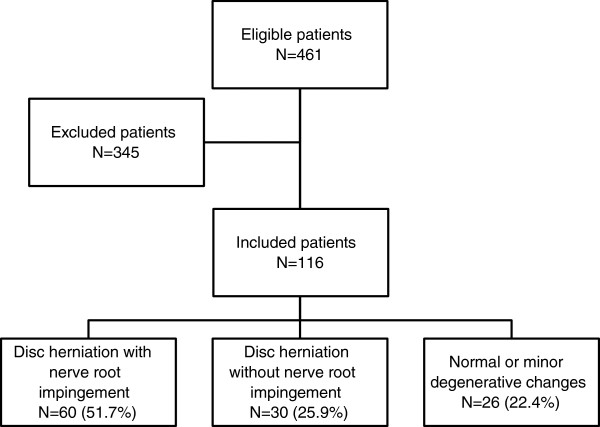
BACKGROUND: Clinical examination of patients with chronic lumbar radiculopathy aims to clarify whether there is nerve root impingement. The aims of this study were to investigate the association between findings at clinical examination and nerve root impingement, to evaluate the accuracy of clinical index tests in a specialised care setting, and to see whether imaging clarifies the cause of chronic radicular pain. METHODS: A total of 116 patients referred with symptoms of lumbar radiculopathy lasting more than 12 weeks and at least one positive index test were included. The tests were the straight leg raising test, and tests for motor muscle strength, dermatome sensory loss, and reflex impairment. Magnetic resonance imaging (n = 109) or computer tomography (n = 7) were imaging reference standards. Images were analysed at the level of single nerve root(s), and nerve root impingement was classified as present or absent. Sensitivities, specificities, and positive and negative likelihood ratios (LR) for detection of nerve root impingement were calculated for each individual index test. An overall clinical evaluation, concluding on the level and side of the radiculopathy, was performed. RESULTS: The prevalence of disc herniation was 77.8%. The diagnostic accuracy of individual index tests was low with no tests reaching positive LR >4.0 or negative LR <0.4. The overall clinical evaluation was slightly more accurate, with a positive LR of 6.28 (95% CI 1.06-37.21) for L4, 1.74 (95% CI 1.04-2.93) for L5, and 1.29 (95% CI 0.97-1.72) for S1 nerve root impingement. An overall clinical evaluation, concluding on the level and side of the radiculopathy was also performed, and receiver operating characteristic (ROC) analysis with area under the curve (AUC) calculation for diagnostic accuracy of this evaluation was performed. CONCLUSIONS: The accuracy of individual clinical index tests used to predict imaging findings of nerve root impingement in patients with chronic lumbar radiculopathy is low when applied in specialised care, but clinicians' overall evaluation improves diagnostic accuracy slightly. The tests are not very helpful in clarifying the cause of radicular pain, and are therefore inaccurate for guidance in the diagnostic workup of the patients. The study population was highly selected and therefore the results from this study should not be generalised to unselected patient populations in primary care nor to even more selected surgical populations.
Overview
The claims and statistics of this paper haven’t been checked yet.
Free: it reads the open-access text and checks the first 5 claims that cite a source we can check. Create a free account to check every claim.
Integrity signals
Registry
Cites
Statistics
Figures
Verification
Claims the paper makes
The claims and statistics of this paper haven’t been checked yet.
Free: it reads the open-access text and checks the first 5 claims that cite a source we can check. Create a free account to check every claim.
Claims other papers make about this one
Each is checked against this paper’s own text: does it say what the citing paper says it does?
The source backs part of the claim, not all of it — or backs it for a different population, condition or comparison.
In the citing paper
“Specifically, L3-L4 lesions affect PTR [19,20], whereas S1 lesions influence ATR [21].”
From The usefulness of deep tendon reflexes in the diagnosis of lumbar spine diseases: a narrative review (2024) · cites this paper as [21]
Experimental — accuracy not yet measured
Self-check
Percentages, sums and reported differences re-computed from the paper’s own numbers.
The self-check needs the paper’s full text.
Citations
Cites
Boden, S. D., McCowin, P. R., Davis, D. O., Dina, T. S., Mark, A. S., & Wiesel, S. (1990) · The Journal of Bone & Joint Surgery · doi:10.2106/00004623-199072080-00008 · Cited by 2,708 · cited 2×
“This confirms that radiculopathy may have other causes, such as neuropathic and inflammatory conditions, or be mimicked by myofascial pain [6,38-40].”
BackgroundInternational Standards For Neurological Classification Of Spinal Cord Injury
Marino, R. J., Barros, T., Biering-Sorensen, F., Burns, S. P., Donovan, W. H., Graves, D. E., Haak, M., Hudson, L. M., & Priebe, M. (2003) · The Journal of Spinal Cord Medicine · doi:10.1080/10790268.2003.11754575 · Cited by 1,141 · cited 1×
“The physical examination was performed according to the recommendations given by the American Spinal Injury Association [20-22].”
MethodJaeschke, R. (1994) · JAMA · doi:10.1001/jama.1994.03510290071040 · Cited by 1,049 · cited 1×
“2) [31].”
Overtreating chronic back pain: time to back off?
Deyo, R. A., Mirza, S. K., Turner, J. A., & Martin, B. I. (2009) · The Journal of the American Board of Family Medicine · doi:10.3122/jabfm.2009.01.080102 · Cited by 796 · cited 1×
“An inaccurate clinical diagnosis may lead to unnecessary imaging and healthcare expenditure, and additional concerns for patients [7-12].”
BackgroundAtlas, S. J., Keller, R. B., Wu, Y. A., Deyo, R. A., & Singer, D. E. (2005) · Spine · doi:10.1097/01.brs.0000158954.68522.2a · Cited by 507 · cited 1×
“An inaccurate clinical diagnosis may lead to unnecessary imaging and healthcare expenditure, and additional concerns for patients [7-12].”
BackgroundAkobeng, A. K. (2007) · Acta Paediatrica · doi:10.1111/j.1651-2227.2006.00179.x · Cited by 440 · cited 1×
“An inaccurate clinical diagnosis may lead to unnecessary imaging and healthcare expenditure, and additional concerns for patients [7-12].”
BackgroundBorenstein, D. G., O'Mara, J. W., Boden, S. D., Lauerman, W. C., Jacobson, A., Platenberg, C., Schellinger, D., & Wiesel, S. W. (2001) · The Journal of Bone and Joint Surgery-American Volume · doi:10.2106/00004623-200109000-00002 · Cited by 434 · cited 2×
“This is not surprising, since the prevalence of disc herniation revealed by MRI in the general population is known to be as high as 30% [3,18,41-44].”
BackgroundMartin, B. I., Turner, J. A., Mirza, S. K., Lee, M. J., Comstock, B. A., & Deyo, R. A. (2009) · Spine · doi:10.1097/brs.0b013e3181b1fad1 · Cited by 419
Physical examination for lumbar radiculopathy due to disc herniation in patients with low-back pain
van der Windt, D. A., Simons, E., Riphagen, I. I., Ammendolia, C., Verhagen, A. P., Laslett, M., Devillé, W., Deyo, R. A., Bouter, L. M., de Vet, H. C., et al. (2010) · Cochrane Database of Systematic Reviews · doi:10.1002/14651858.cd007431.pub2 · Cited by 334 · cited 4×
“Most previous studies have, however, aimed for a generalised understanding of test properties from such selected materials [13].”
BackgroundResultInfluentialJarvik, J. G., Hollingworth, W., Heagerty, P. J., Haynor, D. R., Boyko, E. J., & Deyo, R. A. (2005) · Spine · doi:10.1097/01.brs.0000167536.60002.87 · Cited by 305 · cited 1×
“This is not surprising, since the prevalence of disc herniation revealed by MRI in the general population is known to be as high as 30% [3,18,41-44].”
BackgroundIV HOSPITALS IN THE UNITED STATES
Maitland, C. T. (1948) · The Lancet · doi:10.1016/s0140-6736(48)90145-7 · Cited by 254
Valat, J.-P., Genevay, S., Marty, M., Rozenberg, S., & Koes, B. (2010) · Best Practice & Research Clinical Rheumatology · doi:10.1016/j.berh.2009.11.005 · Cited by 240
Majlesi, J., Togay, H., Ünalan, H., & Toprak, S. (2008) · JCR: Journal of Clinical Rheumatology · doi:10.1097/rhu.0b013e31816b2f99 · Cited by 238 · cited 1×
“It has been a weakness of most previous studies that interpretation of the imaging findings has been limited to categorising the target condition (usually a disc herniation) as present or not, without considering whether a nerve root actually was impinged at the relevant spinal level and side [34].”
ResultWaring, W. P., Biering-Sorensen, F., Burns, S., Donovan, W., Graves, D., Jha, A., Jones, L., Kirshblum, S., Marino, R., Mulcahey, M. J., et al. (2010) · The Journal of Spinal Cord Medicine · doi:10.1080/10790268.2010.11689712 · Cited by 226
Carragee, E. J. (2005) · New England Journal of Medicine · doi:10.1056/nejmcp042054 · Cited by 216
Vroomen, P. C. A. J. (2002) · Journal of Neurology, Neurosurgery & Psychiatry · doi:10.1136/jnnp.72.5.630 · Cited by 214 · cited 1×
“61 for sensory deficits and impaired tendon reflexes [14,15], 0.”
BackgroundClinical prediction rules: What are they and what do they tell us?
Beattie, P., & Nelson, R. M. (2006) · Australian Journal of Physiotherapy · doi:10.1016/s0004-9514(06)70024-1 · Cited by 158 · cited 1×
“First, neuroanatomical overlap between spinal segments influences accuracy when the analysis is done on the level of each single nerve root [35-37].”
BackgroundIversen, T., Solberg, T. K., Romner, B., Wilsgaard, T., Twisk, J. W. R., Anke, A., Nygaard, O., Hasvold, T., & Ingebrigtsen, T. (2011) · BMJ · doi:10.1136/bmj.d5278 · Cited by 157 · cited 3×
“The study was performed as part of a multicentre randomised controlled trial on the treatment effect of caudal epidural injections [19].”
BackgroundSelf-citationNormality and reliability in the clinical assessment of backache.
Waddell, G., Main, C. J., Morris, E. W., Venner, R. M., Rae, P. S., Sharmy, S. H., & Galloway, H. (1982) · BMJ · doi:10.1136/bmj.284.6328.1519 · Cited by 150 · cited 1×
“Typical symptoms are radiating pain, often with numbness, paraesthesia, and/or muscle weakness [1,4].”
BackgroundMagnetic Resonance Imaging in Follow-up Assessment of Sciatica
el Barzouhi, A., Vleggeert-Lankamp, C. L. A. M., Lycklama à Nijeholt, G. J., Van der Kallen, B. F., van den Hout, W. B., Jacobs, W. C. H., Koes, B. W., & Peul, W. C. (2013) · New England Journal of Medicine · doi:10.1056/nejmoa1209250 · Cited by 131
Knutsson, B. (1961) · Acta Orthopaedica Scandinavica · doi:10.3109/ort.1961.32.suppl-49.01 · Cited by 120
▪ History and Physical Examination in Patients With Herniated Lumbar Discs
Andersson, G. B. J., & Deyo, R. A. (1996) · Spine · doi:10.1097/00007632-199612151-00003 · Cited by 110 · cited 1×
“Based on an overall evaluation of the patient history and results of all the index tests, a clinical decision was reached for each patient concerning the suspected level and side of nerve root affection [24-27].”
BackgroundORTHOPÆDIC SIGNS IN THE DIAGNOSIS OF DISC PROTRUSION
Charnley, J. (1951) · The Lancet · doi:10.1016/s0140-6736(51)93353-3 · Cited by 106 · cited 1×
“passive elevation from horizontal, and the femoral nerve stretch test was considered positive when the patient experienced radiating pain [23].”
BackgroundMusculoskeletal Physical Examination: An Evidence-Based Approach
Malanga, G. A., & Mautner, K. (2005) · Medical Entomology and Zoology · Cited by 96
Classification in Nonspecific Low Back Pain: What Methods do Primary Care Clinicians Currently Use?
Kent, P., & Keating, J. L. (2005) · Spine · doi:10.1097/01.brs.0000166523.84016.4b · Cited by 95
Jensen, T. S., Sorensen, J. S., & Kjær, P. (2007) · Acta Radiologica · doi:10.1080/02841850701422112 · Cited by 91 · cited 1×
“All the MRI and CT scans were re-evaluated by two independent neuroradiologists using the Nordic Modic Classification [29].”
MethodSpontaneous regression of a large lumbar disc herniation:
Slavin, K. V., Raja, A., Thornton, J., & Wagner, F. C. (2001) · Surgical Neurology · doi:10.1016/s0090-3019(01)00607-3 · Cited by 80 · cited 1×
“This is not surprising, since the prevalence of disc herniation revealed by MRI in the general population is known to be as high as 30% [3,18,41-44].”
BackgroundScaia, V., Baxter, D. G., & Cook, C. E. (2012) · Journal of Back and Musculoskeletal Rehabilitation · doi:10.3233/bmr-2012-0339 · Cited by 65 · cited 1×
“81 for the straight leg raising test [17].”
BackgroundStankovic, R., Johnell, O., Maly, P. V., & Wilmer, S. (1999) · Manual Therapy · doi:10.1016/s1356-689x(99)80006-x · Cited by 56 · cited 1×
“These results suggest that previous belief in the benefit of combining different neurological tests to accurately diagnose the level of nerve root affection has been exaggerated [45,46].”
ResultCost and use of conservative management of lumbar disc herniation before surgical discectomy
Daffner, S. D., Hymanson, H. J., & Wang, J. C. (2010) · The Spine Journal · doi:10.1016/j.spinee.2010.02.005 · Cited by 54 · cited 1×
“An inaccurate clinical diagnosis may lead to unnecessary imaging and healthcare expenditure, and additional concerns for patients [7-12].”
BackgroundCohen, S. P., Gupta, A., Strassels, S. A., Christo, P. J., Erdek, M. A., Griffith, S. R., Kurihara, C., Buckenmaier, C. C., Cornblath, D., & Vu, T.-N. (2011) · Archives of Internal Medicine · doi:10.1001/archinternmed.2011.593 · Cited by 51
Physical Signs in Lumbar Disc Hernia
Vucetic, N., & Svensson, O. (1996) · Clinical Orthopaedics and Related Research · doi:10.1097/00003086-199612000-00020 · Cited by 51 · cited 1×
“Co-morbidity and imaging findings not related to the symptoms are probably the most important causes for diagnostic inaccuracy in chronic lumbar radiculopathy [3,28,39,47-49].”
BackgroundEvidence-based care for low back pain in workers eligible for compensation
McGuirk, B., & Bogduk, N. (2006) · Occupational Medicine · doi:10.1093/occmed/kql102 · Cited by 43 · cited 1×
“Background Lumbar radiculopathy is a common reason for physician consultations and imaging referrals [1-3].”
BackgroundAlbeck, M. J. (1996) · Acta Neurochirurgica · doi:10.1007/bf01411722 · Cited by 42 · cited 1×
“61 for sensory deficits and impaired tendon reflexes [14,15], 0.”
BackgroundMusculoskeletal Disorders in Referrals for Suspected Lumbosacral Radiculopathy
Cannon, D. E., Dillingham, T. R., Miao, H., Andary, M. T., & Pezzin, L. E. (2007) · American Journal of Physical Medicine & Rehabilitation · doi:10.1097/phm.0b013e31815b614a · Cited by 41 · cited 2×
“The most common clinical diagnostic tests are the straight leg raising test, and tests for tendon reflexes, motor weakness, and sensory deficits [6].”
BackgroundClinical Tests for the Musculoskeletal System
Buckup, K. (2008) · Thieme eBooks · doi:10.1055/b-005-148842 · Cited by 41
Lumbar disk herniation with contralateral symptoms
Sucu, H. K., & Gelal, F. M. (2005) · European Spine Journal · doi:10.1007/s00586-005-0971-x · Cited by 39 · cited 1×
“First, neuroanatomical overlap between spinal segments influences accuracy when the analysis is done on the level of each single nerve root [35-37].”
BackgroundAithala, J. P., Rajagopal, Rao, S. K., & Kamath, A. (2010) · Indian Journal of Orthopaedics · doi:10.4103/0019-5413.65148 · Cited by 38 · cited 1×
“Clinical examination aims to clarify whether there is mechanical impingement of a nerve root [5].”
BackgroundHancock, M. J., Koes, B. W., Ostelo, R., & Peul, W. C. (2011) · Spine · doi:10.1097/brs.0b013e3181ee7f78 · Cited by 35 · cited 14×
“Abbreviations AUC: Area under the curve; CI: Confidence interval; CT: Computer tomography; LR: Likelihood ratio; MRI: Magnetic resonance imaging; ROC: Receiver operating characteristic; SD: Standard deviation.”
BackgroundInfluentialMusculoskeletal disorders that frequently mimic radiculopathy
Lauder, T. D. (2002) · Physical Medicine and Rehabilitation Clinics of North America · doi:10.1016/s1047-9651(02)00007-4 · Cited by 34 · cited 1×
“This confirms that radiculopathy may have other causes, such as neuropathic and inflammatory conditions, or be mimicked by myofascial pain [6,38-40].”
BackgroundMigration of lumbar disc herniation: An unusual case
Mobbs, R. J., & Steel, T. R. (2007) · Journal of Clinical Neuroscience · doi:10.1016/j.jocn.2006.04.002 · Cited by 27 · cited 1×
“First, neuroanatomical overlap between spinal segments influences accuracy when the analysis is done on the level of each single nerve root [35-37].”
BackgroundLi, A. L. K., & Yen, D. (2011) · Canadian Journal of Surgery · doi:10.1503/cjs.001510 · Cited by 26 · cited 3×
“This is not surprising, since the prevalence of disc herniation revealed by MRI in the general population is known to be as high as 30% [3,18,41-44].”
BackgroundClinical Tests for the Musculoskeletal System: Examinations - Signs - Phenomena
Buckup, K., & Buckup, J. (2016) · Cited by 25
Bias in the physical examination of patients with lumbar radiculopathy
Suri, P., Hunter, D. J., Katz, J. N., Li, L., & Rainville, J. (2010) · BMC Musculoskeletal Disorders · doi:10.1186/1471-2474-11-275 · Cited by 23 · cited 2×
“Experienced radiologists evaluated the images, and a written report from the radiologists was available for the clinicians to be able to exclude patients with severe intra-spinal pathology obviously demanding surgery [19,28].”
BackgroundLow Back Pain on Passive Straight Leg Raising
Summers, B., Malhan, K., & Cassar‐Pullicino, V. N. (2005) · Spine · doi:10.1097/01.brs.0000152378.93868.c8 · Cited by 22 · cited 1×
“The locations of the disc herniation were identified in the axial plane, and were categorised as being localised centrally or to the left or right in the spinal canal [30].”
BackgroundLumbar Disk Protrusion Rates of Symptomatic Patients Using Magnetic Resonance Imaging
Gilbert, J. W., Martin, J. C., Wheeler, G. R., Storey, B., Mick, G. E., Richardson, G. B., Herder, S. L., Gyarteng-Dakwa, K., & Broughton, P. G. (2010) · Journal of Manipulative and Physiological Therapeutics · doi:10.1016/j.jmpt.2010.08.010 · Cited by 22 · cited 1×
“This is not surprising, since the prevalence of disc herniation revealed by MRI in the general population is known to be as high as 30% [3,18,41-44].”
BackgroundA web-based computer program to determine the ASIA impairment classification
Linassi, G. A., Shan, R. L. P., & Marino, R. J. (2009) · Spinal Cord · doi:10.1038/sc.2009.98 · Cited by 17 · cited 1×
“The physical examination was performed according to the recommendations given by the American Spinal Injury Association [20-22].”
MethodMusculoskeletal pain - presentations to general practice.
Masters, S., & Lind, R. (2010) · PubMed · Cited by 13
Reihani‐Kermani, H. (2004) · Annals of Saudi Medicine · doi:10.5144/0256-4947.2004.273 · Cited by 11 · cited 1×
“These results suggest that previous belief in the benefit of combining different neurological tests to accurately diagnose the level of nerve root affection has been exaggerated [45,46].”
ResultRiksman, J. S., Williamson, O. D., & Walker, B. F. (2011) · Chiropractic & Manual Therapies · doi:10.1186/2045-709x-19-5 · Cited by 10 · cited 1×
“This confirms that radiculopathy may have other causes, such as neuropathic and inflammatory conditions, or be mimicked by myofascial pain [6,38-40].”
BackgroundIntroduction: An Evidence-based Approach to the Musculoskeletal Physical Examination
Nadler, S. F., & Malanga, G. A. (2006) · Elsevier eBooks · doi:10.1016/b978-1-56053-591-1.50008-1 · Cited by 9
Research works printed but not linked: 1
- Stanley H Orthopaedic Neurology. A Diagnostic Guide to Neurological Levels 1997 Philadelphia: Lippincott-Raven
Cited by
Shanthanna, H., Chan, P., McChesney, J., Paul, J., & Thabane, L. (2014) · Journal of Pain Research · doi:10.2147/jpr.s55749 · Cited by 80
“for inclusion because all of these tests, including the wellknown straight leg raising test, have low diagnostic value.(10) Exclusion criteria included patient refusal to participate, any contraindication to neuraxial injections, a history of predominant back pain over leg pain, significant anatomic deformity (either…”
BackgroundFleischmann, M., & Vaughan, B. (2018) · International journal of osteopathic medicine · doi:10.1016/j.ijosm.2018.03.003 · Cited by 74
Zheng, B., Shuai, X., Guo, C. Y., Jin, L., Liu, C., & Liu, H. (2022) · Frontiers in Surgery · doi:10.3389/fsurg.2022.911914 · Cited by 66
“Therefore, increasing attention is being focused on the search for appropriate treatment (3, 4).”
BackgroundMethodInfluentialMonteros, F. J. G. E. D. L., González-Medina, G., Garrido-Ardila, E. M., Mansilla, J. R., Expósito, J., & Ruiz, P. O. (2020) · International Journal of Environmental Research and Public Health · doi:10.3390/ijerph17197046 · Cited by 55
“Regarding the lack of external validity of this test, we coincide with other studies that are available in the literature [41,42,46,47].”
ResultEkedahl, H., Jönsson, B., Annertz, M., & Frobell, R. B. (2017) · Archives of Physical Medicine and Rehabilitation · doi:10.1016/j.apmr.2017.11.006 · Cited by 56
Metadata
- Authors
- Iversen, T., Solberg, T. K., Romner, B., Wilsgaard, T., Nygaard, Ø., Waterloo, K., Brox, J. I., & Ingebrigtsen, T.
- Affiliations
- University Hospital of North Norway (NO)
- Rigshospitalet (DK)
- UiT The Arctic University of Norway (NO)
- Oslo University Hospital (NO)
- UNSW Sydney (AU)
- Corresponding author
- Iversen, Trond
- Venue
- BMC Musculoskeletal Disorders
- Published
- 2013-07-09
- Volume
- 14
- Issue
- 1
- Pages
- 206-206
- ISSN
- 1471-2474 (ISSN-L)
- PMC
- PMC3716914
- OpenAlex
- W2136920886
- Cited by
- 67
- References
- 53
- Citations by year
- 2026: 6 · 2025: 2 · 2024: 3 · 2023: 5 · 2022: 5 · 2021: 8 · 2020: 7 · 2019: 5 · 2018: 6 · 2017: 4 · 2016: 4 · 2015: 6 · 2014: 4 · 2013: 2
- FWCI
- 3.99
- Type
- journal article
- Language
- en
- Open access
- gold
- doi.org
- Licence
- Locations
- BMC Musculoskeletal Disorders (publishedVersion, cc-by)
- Europe PMC (PubMed Central) (publishedVersion, cc-by)
- PubMed Central (publishedVersion, cc-by)
- PubMed (publishedVersion)
- NORA - Norwegian Open Research Archives (submittedVersion, other-oa)
- NORA - Norwegian Open Research Archives (submittedVersion, cc-by)
- Topics
- Health Sciences › Medicine › Orthopedics and Sports Medicine › Spine and Intervertebral Disc Pathology
- Health Sciences › Health Professions › Physical Therapy, Sports Therapy and Rehabilitation › Musculoskeletal pain and rehabilitation
- Health Sciences › Medicine › Clinical Neurology › Peripheral Nerve Disorders
- Keywords
- nerve root compression, diagnostic accuracy, straight leg raising test, disc herniation, likelihood ratios, reflex impairment, radicular pain, magnetic resonance imaging, computed tomography, clinical evaluation, diagnostic workup
- MeSH terms
- Adult, Chronic Disease, Exercise Test, Female, Humans, Lumbar Vertebrae, Magnetic Resonance Imaging, Male, Middle Aged, Nerve Compression Syndromes, Physical Examination, Radiculopathy, Spinal Nerve Roots, Tomography, X-Ray Computed, Reproducibility of Results, Low Back Pain, Young Adult
About these checks
Registry, retraction, Cites and statistics results are computed, not judged, with one exception: a printed reference that no index lists is read once by a model before it counts as a citation error. Claims are extracted by a model and kept only when their quote appears verbatim in the text; each cited source is then checked, with a model’s help, for whether it says what the claim relies on. Those verdicts can be wrong — read the claim’s quote and the cited source before relying on one.
Statistics and arithmetic are recomputed, not judged.
Confidence bands are shown only for fields calibrated on our annotated test set. None is calibrated yet, so no band is shown.
What counts as a claim ›How we measure confidence ›How we check this ›
Are you an author, or do you see a problem with this page? Request a review
Data sources
Bibliographic data: Semantic Scholar, OpenAlex, Crossref.
Contains information from the Semantic Scholar Academic Graph Datasets, made available under the ODC Attribution License (ODC-BY 1.0).
Semantic Scholar’s data is described in: Kinney, R., et al. (2023). The Semantic Scholar Open Data Platform. arXiv:2301.10140.
