

Comparing lumbo-pelvic kinematics in people with and without back pain: a systematic review and meta-analysis
Open accessThe DOI matches its Crossref record; 93 of the 96 references it cites were found in a registry or an index; 3 of the 29 sources its claims cite were checked for support.
Abstract
BACKGROUND: Clinicians commonly examine posture and movement in people with the belief that correcting dysfunctional movement may reduce pain. If dysfunctional movement is to be accurately identified, clinicians should know what constitutes normal movement and how this differs in people with low back pain (LBP). This systematic review examined studies that compared biomechanical aspects of lumbo-pelvic movement in people with and without LBP. METHODS: MEDLINE, Cochrane Central, EMBASE, AMI, CINAHL, Scopus, AMED, ISI Web of Science were searched from inception until January 2014 for relevant studies. Studies had to compare adults with and without LBP using skin surface measurement techniques to measure lumbo-pelvic posture or movement. Two reviewers independently applied inclusion and exclusion criteria, and identified and extracted data. Standardised mean differences and 95% confidence intervals were estimated for group differences between people with and without LBP, and where possible, meta-analyses were performed. Within-group variability in all measurements was also compared. RESULTS: The search identified 43 eligible studies. Compared to people without LBP, on average, people with LBP display: (i) no difference in lordosis angle (8 studies), (ii) reduced lumbar ROM (19 studies), (iii) no difference in lumbar relative to hip contribution to end-range flexion (4 studies), (iv) no difference in standing pelvic tilt angle (3 studies), (v) slower movement (8 studies), and (vi) reduced proprioception (17 studies). Movement variability appeared greater for people with LBP for flexion, lateral flexion and rotation ROM, and movement speed, but not for other movement characteristics. Considerable heterogeneity exists between studies, including a lack of detail or standardization between studies on the criteria used to define participants as people with LBP (cases) or without LBP (controls). CONCLUSIONS: On average, people with LBP have reduced lumbar ROM and proprioception, and move more slowly compared to people without LBP. Whether these deficits exist prior to LBP onset is unknown.
Overview
CoChat Summary
TL;DR
This systematic review and meta-analysis of 43 studies found that, on average, people with low back pain have reduced lumbar range of motion, slower lumbar movement, and poorer lumbar proprioception than people without low back pain, but no average difference in lordosis, lumbar-versus-hip contribution at end-range flexion, or standing pelvic tilt. Considerable between-study heterogeneity and variable case/control definitions limit interpretation.
Key findings
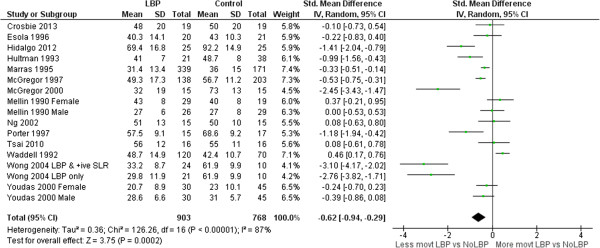
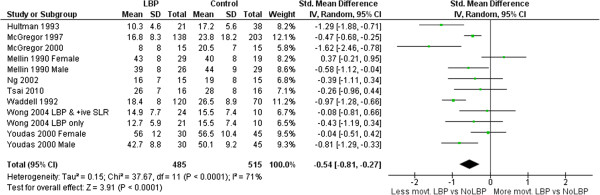
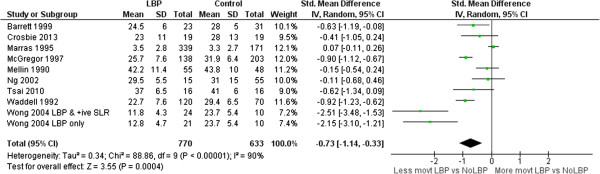
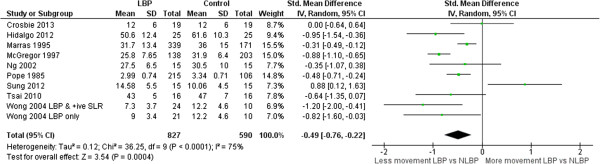
- Pooled analyses showed reduced lumbar ROM in people with LBP versus NoLBP: flexion SMD −0.62 (95% CI −0.94 to −0.29, p < 0.01), extension SMD −0.54 (−0.81 to −0.27, p < 0.01), lateral flexion SMD −0.73 (−1.14 to −0.33, p < 0.01), and rotation SMD −0.49 (−0.76 to −0.22, p = 0.04).
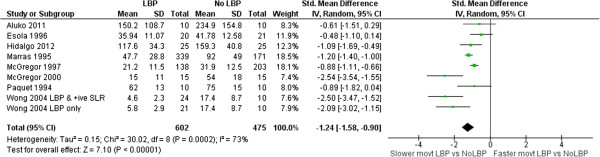
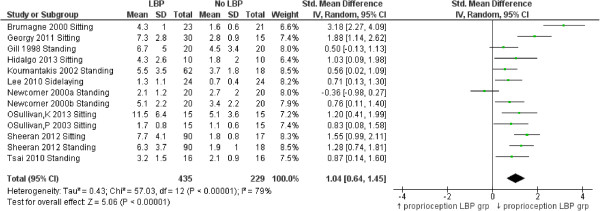
- People with LBP moved more slowly (SMD −1.24, 95% CI −1.58 to −0.90, p < 0.0001) and had poorer proprioception on repositioning accuracy (SMD 1.04, 95% CI 0.64 to 1.45, p < 0.0001).
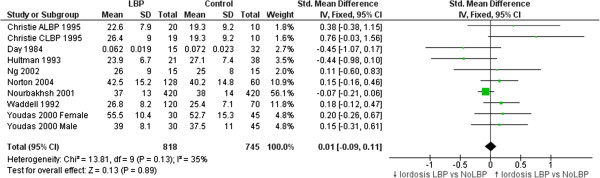
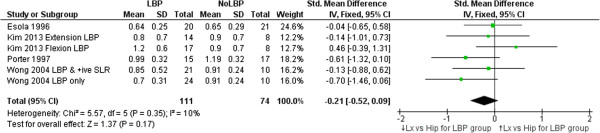
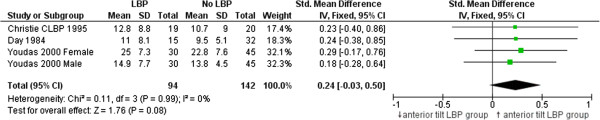
- No significant pooled differences were found for lordosis angle (SMD 0.01, 95% CI −0.09 to 0.11, p = 0.89), lumbar versus hip end-range flexion ROM (SMD −0.21, 95% CI −0.52 to 0.09, p = 0.17), or standing pelvic tilt angle (SMD 0.24, 95% CI −0.03 to 0.50, p = 0.08).
- Within-group variability was significantly greater in the LBP group for flexion, lateral flexion, rotation, and speed/acceleration, with coefficient-of-variation ratios of 1.31 (1.13–1.51), 1.31 (1.17–1.48), 1.20 (1.02–1.40), and 1.28 (1.13–1.46), respectively.
Methods
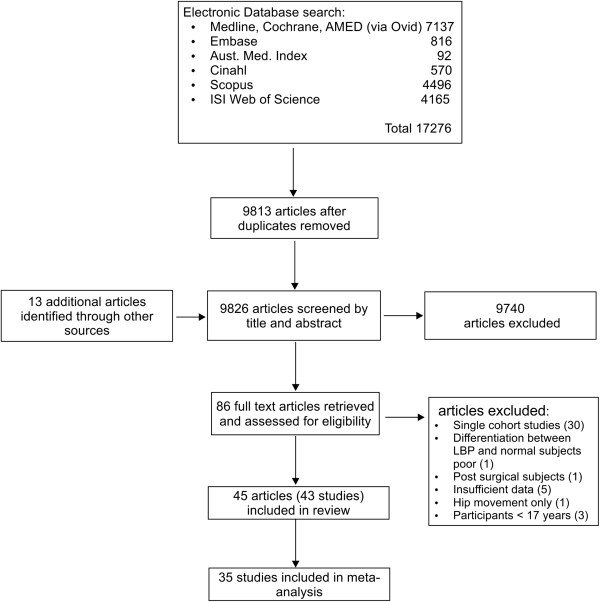
- Systematic review and meta-analysis; eight databases (MEDLINE, Cochrane Central, EMBASE, AMI, CINAHL, Scopus, AMED, ISI Web of Science) were searched from inception until January 2014, yielding 43 eligible studies (45 articles).
- Inclusion required adults >17 years, non-invasive skin-surface measurement, same procedures for LBP and NoLBP groups, and at least one lumbo-pelvic kinematic measure; no specific LBP or control definitions were required.
- Standardised mean differences and 95% confidence intervals were pooled using RevMan, with random-effects models where heterogeneity was indicated; within-group variability was compared using sample-size-weighted coefficients of variation, and Pearson’s r examined effect size versus study quality.
Limitations
- The authors state that they treated people with LBP as a homogeneous group, that findings do not show whether movement changes cause or result from LBP or improve outcomes, that only English-language articles were included, and that broad inclusion criteria likely weakened between-group differences.
- The authors also note considerable heterogeneity across studies, including variable definitions of LBP and NoLBP, and no studies blinded assessors to group status.
- Evident from the text: quality assessment showed only 37% of studies reported standardised movement instructions, 2% reported trained assessors, 17% used the same assessors for both groups, and 0% blinded assessors, which the authors identify as exposing studies to random or systematic error.
Model-written summary. Check it against the paper before relying on it.
Integrity signals
Registry
Cites
Statistics
Figures
Verification
Claims the paper makes
2 Valid · 1 Not valid · 15 Not checked · 61 Own results and interpretations
The cited sources support only part of this claim — read each source’s verdict below.
In the paper
“Astfalk et al. [85] found no differences in average lumbar flexion angle in sitting (reflecting pelvic tilt position) when comparing adolescents with and without LBP (125.3 ± 19.8° vs 130.6° ± 15.7 respectively).”
§ Comparing lumbo-pelvic kinematics in people with and without back pain: a systematic review and meta-analysis > Discussion > Pelvic tilt angle, position and range
What the sources say
- Partly supportedcites [85] Astfalck RG O'Sullivan PB Straker LM Smith AJ Burnett A Caneiro JP Dankaerts W Sitting postures and trunk muscle activity in adolescents with and without nonspecific chronic low back pain: an analysis based on subclassification Spine 2010 35 14 1387 1395 20195206 sourceExperimental — accuracy not yet measured
The Spinal Kinematics section (p. 4) reports no significant difference in sitting spinal posture between adolescents with and without chronic low back pain before the pain group was subdivided. It does not report the cited values of 125.3 ± 19.8° and 130.6 ± 15.7°; it also reports lumbar-angle differences after subgrouping, so the no-difference finding applies to the overall group comparison. (LLM, conf=0.88)
plain- Asserted: passes — The authors put it forward as true.
- Checkable: passes — It can be checked against evidence.
- Load-bearing: passes — The paper’s conclusions depend on it.
- Based: passes — The paper gives a reason why it holds.
- Partly supported
A result the paper reports from its own data — it cites no other source for it, so there is none to check. The quote shows it is in the paper.
In the paper
“A post-hoc meta-analysis of three studies that compared genders indicated that women had greater lordosis angles than men (SMD = 0.92, 95% CI 0.8 to 1.05, p < 0.01).”
§ Comparing lumbo-pelvic kinematics in people with and without back pain: a systematic review and meta-analysis > Results > Movement characteristics
hedgedstates an association- Asserted: passes — The authors put it forward as true.
- Checkable: passes — It can be checked against evidence.
- Load-bearing: unclear — It is unclear whether the paper’s conclusions depend on it.
- Based: passes — The paper gives a reason why it holds.
A result the paper reports from its own data — it cites no other source for it, so there is none to check. The quote shows it is in the paper.
In the paper
“(i) no difference in lordosis angle (8 studies)”
- Also stated in: § Movement characteristics · plain
“The pooled difference (SMD = 0.01, 95% CI -0.09 to 0.11, p = 0.89) was not significant.”
- Also stated in: § Proprioception · plain
“Lordosis*, n = 8 | 0.01 (-0.09 to 0.11), p = 0.89”
§ Comparing lumbo-pelvic kinematics in people with and without back pain: a systematic review and meta-analysis > Abstract > Results
plainn = 8- Asserted: passes — The authors put it forward as true.
- Checkable: passes — It can be checked against evidence.
- Load-bearing: passes — The paper’s conclusions depend on it.
- Based: passes — The paper gives a reason why it holds.
- Also stated in: § Movement characteristics · plain
A result the paper reports from its own data — it cites no other source for it, so there is none to check. The quote shows it is in the paper.
In the paper
“(vi) reduced proprioception (17 studies)”
- Also stated in: § Proprioception · boosted
“A consistent, large and significant reduction in ability to accurately re-position the spine at pre-specified angles for people with LBP compared to those without LBP is shown in Figure 10 (SMD = 1.04, 95% CI 0.64 to 1.45, p < 0.01).”
- Also stated in: § Proprioception · plain
“Proprioception (re-position accuracy)§, n = 12 | 1.04 (0.64 to 1.45), p < 0.0001”
§ Comparing lumbo-pelvic kinematics in people with and without back pain: a systematic review and meta-analysis > Abstract > Results
boostedstates an associationn = 12 ·- Asserted: passes — The authors put it forward as true.
- Checkable: passes — It can be checked against evidence.
- Load-bearing: passes — The paper’s conclusions depend on it.
- Based: passes — The paper gives a reason why it holds.
- Also stated in: § Proprioception · boosted
A result the paper reports from its own data — it cites no other source for it, so there is none to check. The quote shows it is in the paper.
In the paper
“(v) slower movement (8 studies)”
- Also stated in: § Speed/Acceleration · boosted
“A large, significant effect of slower movement in the LBP group was evident (SMD -1.46 95% CI -1.96 to -1.02, p < .01).”
- Also stated in: § Proprioception · plain
“Speed/Acceleration‡, n = 8 | -1.24 (-1.58 to -0.90), p < 0.0001”
§ Comparing lumbo-pelvic kinematics in people with and without back pain: a systematic review and meta-analysis > Abstract > Results
boostedstates an associationn = 8 ·- Asserted: passes — The authors put it forward as true.
- Checkable: passes — It can be checked against evidence.
- Load-bearing: passes — The paper’s conclusions depend on it.
- Based: passes — The paper gives a reason why it holds.
- Also stated in: § Speed/Acceleration · boosted
34 more claims
Create a free account to see all 79 claims and to verify the 2 references still open.
- It may state two separate claims as one. 32
- Probably not a substantial claim. 14
Self-check
Percentages, sums and reported differences re-computed from the paper’s own numbers.
Each contradiction between two passages listed here was confirmed by an independent check.
Rated major: it would touch a result — a value a result rests on, reported and recomputed p-values on opposite sides of the significance level, two passages that conflict with no sign which is right, or a cited work retracted before this paper was published.
In the paper
§ Comparing lumbo-pelvic kinematics in people with and without back pain: a systematic review and meta-analysis > Results > Speed/Acceleration
“A large, significant effect of slower movement in the LBP group was evident (SMD -1.46 95% CI -1.96 to -1.02, p < .01).”
§ Comparing lumbo-pelvic kinematics in people with and without back pain: a systematic review and meta-analysis > Results > Proprioception
“| Speed/Acceleration‡, n = 8 | -1.24 (-1.58 to -0.90), p < 0.0001 |”
Rated major: it would touch a result — a value a result rests on, reported and recomputed p-values on opposite sides of the significance level, two passages that conflict with no sign which is right, or a cited work retracted before this paper was published.
In the paper
§ Comparing lumbo-pelvic kinematics in people with and without back pain: a systematic review and meta-analysis > Results > Lumbar spine versus hip contribution to flexion/extension
“Esola et al. [34] (SMD = -0.86, 95% CI -1.51 to -0.22) and Porter et al. [52] (SMD = -0.71 95% CI -1.43 to 0.00) both found significant reductions of lumbar contribution to mid-range flexion but not at end range.”
§ Comparing lumbo-pelvic kinematics in people with and without back pain: a systematic review and meta-analysis > Discussion > Lumbar versus hip contribution to movement
“This finding is supported by McClure et al. [40], Esola et al. [34] and Porter et al. [52] who all reported relatively greater lumbar through-range contribution in people with LBP on flexion movement.”
Rated minor: it would not touch a result — a value no result rests on, a p-value that stays on the same side of the significance level, or a conflict that is clerical, resolved elsewhere in the paper, or outside its own findings.
In the paper
§ Comparing lumbo-pelvic kinematics in people with and without back pain: a systematic review and meta-analysis > Discussion > Differences in variability between people with and without LBP
“Our assessment of differences in variability between people with and without LBP for nine movement characteristics demonstrated significantly greater variability for four movement characteristics”
§ Comparing lumbo-pelvic kinematics in people with and without back pain: a systematic review and meta-analysis > Results > Differences in variability between groups
“Table 3 presents a summary of the within group variability in movements pooled across studies. Significantly greater variability for people with LBP compared to people without LBP was observed on four of the eight measures: flexion, lateral flexion, rotation and speed/acceleration.”
Rated minor: it would not touch a result — a value no result rests on, a p-value that stays on the same side of the significance level, or a conflict that is clerical, resolved elsewhere in the paper, or outside its own findings.
In the paper
§ Comparing lumbo-pelvic kinematics in people with and without back pain: a systematic review and meta-analysis > Results > Search yield
“No studies attempted blinding of assessors to group status, and only one study reported standardizing instructions to participants.”
§ Comparing lumbo-pelvic kinematics in people with and without back pain: a systematic review and meta-analysis > Results > Search yield
“| 8. | Was a system for standardising movement instructions reported? | 37% |”
Citations
Cites
Preferred Reporting Items for Systematic Reviews and Meta-Analyses: the PRISMA statement
Moher, D., Liberati, A., Tetzlaff, J., Altman, D. G., & for the PRISMA Group (2009) · BMJ · doi:10.1136/bmj.b2535 · Cited by 83,823
Measuring inconsistency in meta-analyses
Higgins, J. P. T., Thompson, S. G., Deeks, J. J., & Altman, D. G. (2003) · BMJ · doi:10.1136/bmj.327.7414.557 · Cited by 63,139 · cited 1×
“A random effects model was used for pooling where fixed effects modeling indicated statistical heterogeneity of the data (Mantel-Haenszel method), as determined by chi-squared and I(2) statistics; otherwise the results of fixed effects modeling was reported [25,26].”
MethodPreferred reporting items for systematic reviews and meta-analyses: The PRISMA statement
Moher, D., Liberati, A., Tetzlaff, J., Altman, D. G., & the PRISMA Group* (2009) · Annals of Internal Medicine · doi:10.7326/0003-4819-151-4-200908180-00135 · Cited by 37,554
Towards complete and accurate reporting of studies of diagnostic accuracy: The STARD Initiative.
Bossuyt, P. M., Reitsma, J. B., Bruns, D. E., Gatsonis, C. A., Glasziou, P. P., Irwig, L. M., Lijmer, J. G., Moher, D., Rennie, D., de Vet, H. C. W., et al. (2003) · Annals of Internal Medicine · doi:10.7326/0003-4819-138-1-200301070-00010 · Cited by 3,219
Towards Complete and Accurate Reporting of Studies of Diagnostic Accuracy: The STARD Initiative
Bossuyt, P. M., Reitsma, J. B., Bruns, D. E., Gatsonis, C. A., Glasziou, P. P., Irwig, L. M., Lijmer, J. G., Moher, D., Rennie, D., & de Vet, H. C. W. (2003) · Radiology · doi:10.1148/radiol.2261021292 · Cited by 3,215
Towards complete and accurate reporting of studies of diagnostic accuracy: the STARD initiative
Bossuyt, P. M., Reitsma, J. B., Bruns, D. E., Gatsonis, C. A., Glasziou, P. P., Irwig, L. M., Lijmer, J. G., Moher, D., Rennie, D., & de Vet, H. C. W. (2003) · BMJ · doi:10.1136/bmj.326.7379.41 · Cited by 3,215
Davis, H. S. (1966) · JAMA: The Journal of the American Medical Association · doi:10.1001/jama.1966.03100200106038 · Cited by 1,719
Diagnosis and Treatment of Movement Impairment Syndromes
Sahrmann, S. A. (2001) · Cited by 1,257
O’Sullivan, P. (2005) · Manual Therapy · doi:10.1016/j.math.2005.07.001 · Cited by 985
Evaluation of QUADAS, a tool for the quality assessment of diagnostic accuracy studies
Whiting, P. F., Weswood, M. E., Rutjes, A. W., Reitsma, J. B., Bossuyt, P. N., & Kleijnen, J. (2006) · BMC Medical Research Methodology · doi:10.1186/1471-2288-6-9 · Cited by 769 · cited 1×
“assessment tools [20-22].”
An Analysis of Sagittal Spinal Alignment in 100 Asymptomatic Middle and Older Aged Volunteers
Gelb, D. E., Lenke, L. G., Bridwell, K. H., Blanke, K., & McEnery, K. W. (1995) · Spine · doi:10.1097/00007632-199520120-00005 · Cited by 714 · cited 2×
“This variability might be associated with the six different measurement methods, but may also reflect biological differences in sample ethnicity [77], age [78] and gender [49,57,58].”
BackgroundNeck Pain: A Long-term Follow-up of 205 Patients
GORE, D. R., SEPIC, S. B., GARDNER, G. M., & MURRAY, M. P. (1987) · Spine · doi:10.1097/00007632-198701000-00001 · Cited by 634
Adams, M. A. (2004) · Acupuncture in Medicine · doi:10.1136/aim.22.4.178 · Cited by 578
Brumagne, S., Cordo, P., Lysens, R., Verschueren, S., & Swinnen, S. (2000) · Spine · doi:10.1097/00007632-200004150-00015 · Cited by 468 · cited 1×
“Included studies were grouped in categories: lordosis [31,32,38,47-49,57,58], range of movement (ROM) [29,30, 34,37-42,44,47,50-54,56-59,69,71], relative hip and lumbar contribution to trunk flexion/extension [34,40,50,52,61,71], pelvic angle/relative position and ROM [31,32,57,58], speed/acceleration of lumbar moveme…”
BackgroundEsola, M. A., McClure, P. W., Fitzgerald, G. K., & Siegler, S. (1996) · Spine · doi:10.1097/00007632-199601010-00017 · Cited by 464 · cited 5×
“Forty three studies (45 articles) met the inclusion criteria [28-70].”
BackgroundInfluentialDiagnosis and treatment of movement system impairment syndromes
Sahrmann, S., Azevedo, D. C., & Dillen, L. V. (2017) · Brazilian Journal of Physical Therapy · doi:10.1016/j.bjpt.2017.08.001 · Cited by 464
Objective Clinical Evaluation of Physical Impairment in Chronic Low Back Pain
Waddell, G., Somerville, D., Henderson, I., & Newton, M. (1992) · Spine · doi:10.1097/00007632-199206000-00001 · Cited by 415 · cited 2×
“Included studies were grouped in categories: lordosis [31,32,38,47-49,57,58], range of movement (ROM) [29,30, 34,37-42,44,47,50-54,56-59,69,71], relative hip and lumbar contribution to trunk flexion/extension [34,40,50,52,61,71], pelvic angle/relative position and ROM [31,32,57,58], speed/acceleration of lumbar moveme…”
BackgroundRuhe, A., Fejer, R., & Walker, B. (2011) · European Spine Journal · doi:10.1007/s00586-010-1543-2 · Cited by 382 · cited 2×
“[17] who found that greater sway excursion and speed were present in people with LBP compared to people without back pain.”
Background(1986) · Elsevier eBooks · doi:10.1016/c2009-0-55727-3 · Cited by 377
Lumbar Repositioning Deficit in a Specific Low Back Pain Population
O’Sullivan, P. B., Burnett, A., Floyd, A. N., Gadsdon, K., Logiudice, J., Miller, D., & Quirke, H. (2003) · Spine · doi:10.1097/01.brs.0000061990.56113.6f · Cited by 341
The Measurement of Lumbar Proprioception in Individuals With and Without Low Back Pain
Gill, K. P., & Callaghan, M. J. (1998) · Spine · doi:10.1097/00007632-199802010-00017 · Cited by 334 · cited 4×
“Included studies were grouped in categories: lordosis [31,32,38,47-49,57,58], range of movement (ROM) [29,30, 34,37-42,44,47,50-54,56-59,69,71], relative hip and lumbar contribution to trunk flexion/extension [34,40,50,52,61,71], pelvic angle/relative position and ROM [31,32,57,58], speed/acceleration of lumbar moveme…”
BackgroundInfluentialThe Effect of Lumbar Fatigue on the Ability to Sense a Change in Lumbar Position: A Controlled Study
Taimela, S., Kankaanpää, M., & Luoto, S. (1999) · Spine · doi:10.1097/00007632-199907010-00009 · Cited by 310 · cited 5×
“Fifteen studies [33,35,45,46,53,55,60,62-68,70,76] measured position/reposition accuracy as a measure of lumbar spine proprioception (see Additional files 3, 4 and 6 for details).”
BackgroundInfluentialGrieve's Modern Manual Therapy: The Vertebral Column
Boyling, J. D., & Jull, G. A. (1994) · Medical Entomology and Zoology · Cited by 302
Hultman, G., Nordin, M., Saraste, H., & Ohls??n, H. (1993) · Journal of Spinal Disorders · doi:10.1097/00002517-199304000-00004 · Cited by 284
Rehabilitation of the spine : a practitioner's manual
Liebenson, C. (1996) · Cited by 258
O’Sullivan, P. B., Mitchell, T., Bulich, P., Waller, R., & Holte, J. (2006) · Manual Therapy · doi:10.1016/j.math.2005.04.004 · Cited by 242
Rehabilitation of the Spine: A Practitioner's Manual
Nadler, S. (1996) · American Journal of Physical Medicine & Rehabilitation · doi:10.1097/00002060-199609000-00018 · Cited by 230
Effects of low back pain on the relationship between the movements of the lumbar spine and hip
Wong, T. K. T., & Lee, R. Y. W. (2004) · Human Movement Science · doi:10.1016/j.humov.2004.03.004 · Cited by 223 · cited 3×
“Included studies were grouped in categories: lordosis [31,32,38,47-49,57,58], range of movement (ROM) [29,30, 34,37-42,44,47,50-54,56-59,69,71], relative hip and lumbar contribution to trunk flexion/extension [34,40,50,52,61,71], pelvic angle/relative position and ROM [31,32,57,58], speed/acceleration of lumbar moveme…”
BackgroundPostural aberrations in low back pain
Christie, H. J., Kumar, S., & Warren, S. A. (1995) · Archives of Physical Medicine and Rehabilitation · doi:10.1016/s0003-9993(95)80604-0 · Cited by 195 · cited 4×
“Included studies were grouped in categories: lordosis [31,32,38,47-49,57,58], range of movement (ROM) [29,30, 34,37-42,44,47,50-54,56-59,69,71], relative hip and lumbar contribution to trunk flexion/extension [34,40,50,52,61,71], pelvic angle/relative position and ROM [31,32,57,58], speed/acceleration of lumbar moveme…”
BackgroundInfluentialPOPE, M. H., BEVINS, T., WILDER, D. G., & FRYMOYER, J. W. (1985) · Spine · doi:10.1097/00007632-198509000-00009 · Cited by 171
McClure, P. W., Esola, M., Schreier, R., & Siegler, S. (1997) · Spine · doi:10.1097/00007632-199703010-00019 · Cited by 164 · cited 5×
“Forty three studies (45 articles) met the inclusion criteria [28-70].”
BackgroundInfluentialThe Classification of Anatomic- and Symptom-based Low Back Disorders Using Motion Measure Models
Marras, W. S., parnianpour, M., Ferguson, S. A., Kim, J.-Y., Crowell, R. R., Bose, S., & Simon, S. R. (1995) · Spine · doi:10.1097/00007632-199512000-00013 · Cited by 163 · cited 3×
“Included studies were grouped in categories: lordosis [31,32,38,47-49,57,58], range of movement (ROM) [29,30, 34,37-42,44,47,50-54,56-59,69,71], relative hip and lumbar contribution to trunk flexion/extension [34,40,50,52,61,71], pelvic angle/relative position and ROM [31,32,57,58], speed/acceleration of lumbar moveme…”
BackgroundDifferences in Repositioning Error Among Patients With Low Back Pain Compared With Control Subjects
Newcomer, K. L., Laskowski, E. R., Yu, B., Johnson, J. C., & An, K.-N. (2000) · Spine · doi:10.1097/00007632-200010010-00011 · Cited by 162
Confidence intervals for the coefficient of variation for the normal and log normal distributions
KOOPMANS, L. H., OWEN, D. B., & ROSENBLATT, J. I. (1964) · Biometrika · doi:10.1093/biomet/51.1-2.25 · Cited by 161 · cited 1×
“To estimate whether variability for each movement characteristic differed between groups with and without LBP, a coefficient of variation (CoV) [27] (standard deviation in measurements divided by the group mean) was calculated for each movement parameter using those studies included in the relevant meta-analysis.”
MethodPaquet, N., Malouin, F., & Richards, C. L. (1994) · Spine · doi:10.1097/00007632-199403000-00016 · Cited by 159 · cited 4×
“Included studies were grouped in categories: lordosis [31,32,38,47-49,57,58], range of movement (ROM) [29,30, 34,37-42,44,47,50-54,56-59,69,71], relative hip and lumbar contribution to trunk flexion/extension [34,40,50,52,61,71], pelvic angle/relative position and ROM [31,32,57,58], speed/acceleration of lumbar moveme…”
BackgroundInfluentialComparison of Trunk Proprioception Between Patients With Low Back Pain and Healthy Controls
Lee, A. S., Cholewicki, J., Reeves, N. P., Zazulak, B. T., & Mysliwiec, L. W. (2010) · Archives of Physical Medicine and Rehabilitation · doi:10.1016/j.apmr.2010.06.004 · Cited by 150 · cited 4×
“Included studies were grouped in categories: lordosis [31,32,38,47-49,57,58], range of movement (ROM) [29,30, 34,37-42,44,47,50-54,56-59,69,71], relative hip and lumbar contribution to trunk flexion/extension [34,40,50,52,61,71], pelvic angle/relative position and ROM [31,32,57,58], speed/acceleration of lumbar moveme…”
BackgroundInfluentialObjective Assessment with Establishment of Normal Values for Lumbar Spinal Range of Motion
Fitzgerald, G. K., Wynveen, K. J., Rheault, W., & Rothschild, B. (1983) · Physical Therapy · doi:10.1093/ptj/63.11.1776 · Cited by 149 · cited 2×
“Similarly, mean scores for extension ranged from 13 ± 8° [13] to 41 ± 10° [15].”
MethodLumbar Lordosis and Pelvic Inclination in Adults With Chronic Low Back Pain
Youdas, J. W., Garrett, T. R., Egan, K. S., & Therneau, T. M. (2000) · Physical Therapy · doi:10.1093/ptj/80.3.261 · Cited by 146
Lumbar Lordosis and Pelvic Inclination of Asymptomatic Adults
Youdas, J. W., Garrett, T. R., Harmsen, S., Suman, V. J., & Carey, J. R. (1996) · Physical Therapy · doi:10.1093/ptj/76.10.1066 · Cited by 137 · cited 6×
“Three studies (four articles) examined usual pelvic tilt angle in standing [31,32,57,58].”
BackgroundMethodInfluentialPorter, J. L., & Wilkinson, A. (1997) · Spine · doi:10.1097/00007632-199707010-00017 · Cited by 135 · cited 5×
“[52] who all reported relatively greater lumbar through-range contribution in people with LBP on flexion movement.”
BackgroundInfluentialNewcomer, K. L., Laskowski, E. R., Yu, B., Larson, D. R., & An, K. (2000) · Spine · doi:10.1097/00007632-200001150-00017 · Cited by 129 · cited 4×
“Included studies were grouped in categories: lordosis [31,32,38,47-49,57,58], range of movement (ROM) [29,30, 34,37-42,44,47,50-54,56-59,69,71], relative hip and lumbar contribution to trunk flexion/extension [34,40,50,52,61,71], pelvic angle/relative position and ROM [31,32,57,58], speed/acceleration of lumbar moveme…”
BackgroundInfluentialDifferences in Measurements of Lumbar Curvature Related to Gender and Low Back Pain
Norton, B. J., Sahrmann, S. A., & Van Dillen, L. R. (2004) · Journal of Orthopaedic & Sports Physical Therapy · doi:10.2519/jospt.2004.34.9.524 · Cited by 125 · cited 2×
“Included studies were grouped in categories: lordosis [31,32,38,47-49,57,58], range of movement (ROM) [29,30, 34,37-42,44,47,50-54,56-59,69,71], relative hip and lumbar contribution to trunk flexion/extension [34,40,50,52,61,71], pelvic angle/relative position and ROM [31,32,57,58], speed/acceleration of lumbar moveme…”
BackgroundDescarreaux, M., Blouin, J., & Teasdale, N. (2004) · European Spine Journal · doi:10.1007/s00586-004-0833-y · Cited by 124 · cited 5×
“Fifteen studies [33,35,45,46,53,55,60,62-68,70,76] measured position/reposition accuracy as a measure of lumbar spine proprioception (see Additional files 3, 4 and 6 for details).”
BackgroundInfluentialMotion Characteristics of the Lumbar Spine in the Normal Population
McGregor, A. H., McCarthy, I. D., & Hughes, S. P. (1995) · Spine · doi:10.1097/00007632-199511001-00009 · Cited by 120 · cited 2×
“Included studies were grouped in categories: lordosis [31,32,38,47-49,57,58], range of movement (ROM) [29,30, 34,37-42,44,47,50-54,56-59,69,71], relative hip and lumbar contribution to trunk flexion/extension [34,40,50,52,61,71], pelvic angle/relative position and ROM [31,32,57,58], speed/acceleration of lumbar moveme…”
BackgroundSheeran, L., Sparkes, V., Caterson, B., Busse, M. E., & Deursen, R. W. M. V. (2011) · Spine · doi:10.1097/brs.0b013e31823b00ce · Cited by 119 · cited 4×
“Included studies were grouped in categories: lordosis [31,32,38,47-49,57,58], range of movement (ROM) [29,30, 34,37-42,44,47,50-54,56-59,69,71], relative hip and lumbar contribution to trunk flexion/extension [34,40,50,52,61,71], pelvic angle/relative position and ROM [31,32,57,58], speed/acceleration of lumbar moveme…”
BackgroundInfluentialEffect of Pelvic Tilt on Standing Posture
Day, J. W., Smidt, G. L., & Lehmann, T. (1984) · Physical Therapy · doi:10.1093/ptj/64.4.510 · Cited by 114 · cited 6×
“Three studies (four articles) examined usual pelvic tilt angle in standing [31,32,57,58].”
BackgroundMethodInfluentialThe effect of age on lumbar range of motion: A systematic review
Intolo, P., Milosavljevic, S., Baxter, D. G., Carman, A. B., Pal, P., & Munn, J. (2009) · Manual Therapy · doi:10.1016/j.math.2009.08.006 · Cited by 107 · cited 3×
“A checklist for data extraction was developed based on those used in a similar review [12] and published quality”
BackgroundMethodHoof, W. V., Volkaerts, K., O’Sullivan, K., Verschueren, S., & Dankaerts, W. (2012) · Manual Therapy · doi:10.1016/j.math.2012.02.012 · Cited by 105 · cited 1×
“Advances in technology are creating new opportunities, available for use in typical clinical settings, that measure comprehensive information about the relationship between movement/posture and pain [8-10].”
BackgroundAveraging Dependent Effect Sizes in Meta-Analysis: a Cautionary Note about Procedures
Marín-Martínez, F., & Sánchez-Meca, J. (1999) · The Spanish Journal of Psychology · doi:10.1017/s1138741600005436 · Cited by 99
Koumantakis, G. Α., Winstanley, J. B., & Oldham, J. A. (2002) · Journal of Orthopaedic and Sports Physical Therapy · doi:10.2519/jospt.2002.32.7.327 · Cited by 92 · cited 4×
“Included studies were grouped in categories: lordosis [31,32,38,47-49,57,58], range of movement (ROM) [29,30, 34,37-42,44,47,50-54,56-59,69,71], relative hip and lumbar contribution to trunk flexion/extension [34,40,50,52,61,71], pelvic angle/relative position and ROM [31,32,57,58], speed/acceleration of lumbar moveme…”
BackgroundInfluentialKim, M.-H., Yi, C.-H., Kwon, O.-Y., Cho, S.-H., Cynn, H.-S., Kim, Y.-H., Hwang, S.-H., Choi, B.-R., Hong, J.-A., & Jung, D.-H. (2013) · Spine · doi:10.1097/brs.0b013e318291b502 · Cited by 89
Amonoo-Kuofi, U. S. (1992) · Cells Tissues Organs · doi:10.1159/000147392 · Cited by 86 · cited 1×
“Increasing age has been associated with reduced lordosis in the sixth decade [78-80] and on average, females have a greater lordosis than males [49,58,80].”
BackgroundNourbakhsh, M. R., Moussavi, S. J., & Salavati, M. (2001) · Journal of Spinal Disorders · doi:10.1097/00002517-200108000-00002 · Cited by 85
Clarke, M. (2006) · Textbook of Clinical Trials · doi:10.1002/9780470010167.ch3 · Cited by 84
Ha, T. H., Saber-Sheikh, K., Moore, A. P., & Jones, M. P. (2012) · Manual Therapy · doi:10.1016/j.math.2012.04.003 · Cited by 81
Precision control of trunk movement in low back pain patients
Willigenburg, N. W., Kingma, I., Hoozemans, M. J. M., et al. (2013) · Human Movement Science · doi:10.1016/j.humov.2012.12.007 · Cited by 81 · cited 5×
“Fifteen studies [33,35,45,46,53,55,60,62-68,70,76] measured position/reposition accuracy as a measure of lumbar spine proprioception (see Additional files 3, 4 and 6 for details).”
BackgroundInfluentialAltered muscle recruitment during extension from trunk flexion in low back pain developers
Nelson-Wong, E., Alex, B., Csepe, D., Lancaster, D., & Callaghan, J. P. (2012) · Clinical Biomechanics · doi:10.1016/j.clinbiomech.2012.07.007 · Cited by 81
Kent, P. M., Keating, J. L., & Taylor, N. F. (2008) · Manual Therapy · doi:10.1016/j.math.2007.12.006 · Cited by 80 · cited 1×
“Clinicians commonly use ROM [81] to assist in identifying patterns of dysfunction, and to monitor change.”
BackgroundSelf-citationAstfalck, R. G., OʼSullivan, P. B., Straker, L. M., Smith, A. J., Burnett, A., Paulo Caneiro, J., & Dankaerts, W. (2010) · Spine · doi:10.1097/brs.0b013e3181bd3ea6 · Cited by 79 · cited 2×
“[85] found no differences in average lumbar flexion angle in sitting (reflecting pelvic tilt position) when comparing adolescents with and without LBP (125.”
BackgroundA comparison of two motion analysis devices used in the measurement of lumbar spinal mobility
Mannion, A. F., & Troke, M. (1999) · Clinical Biomechanics · doi:10.1016/s0268-0033(99)00017-0 · Cited by 79 · cited 1×
“This variability may be due to differences in measurement instruments or methods [11], biological differences in true range of movements, or errors in measurements.”
BackgroundEffects of Fear of Movement on Spine Velocity and Acceleration After Recovery From Low Back Pain
Thomas, J. S., France, C. R., Lavender, S. A., & Johnson, M. R. (2008) · Spine · doi:10.1097/brs.0b013e3181657f1a · Cited by 77
McGregor, A. H., McCarthy, D., Doré, C. J., et al. (1997) · European Spine Journal · doi:10.1007/bf01142676 · Cited by 75 · cited 2×
“Included studies were grouped in categories: lordosis [31,32,38,47-49,57,58], range of movement (ROM) [29,30, 34,37-42,44,47,50-54,56-59,69,71], relative hip and lumbar contribution to trunk flexion/extension [34,40,50,52,61,71], pelvic angle/relative position and ROM [31,32,57,58], speed/acceleration of lumbar moveme…”
BackgroundDecreased Joint and Spinal Mobility Associated with Low Back Pain in Young Adults
Mellin, G. P. (1990) · Journal of Spinal Disorders · doi:10.1097/00002517-199009000-00007 · Cited by 73 · cited 2×
“Included studies were grouped in categories: lordosis [31,32,38,47-49,57,58], range of movement (ROM) [29,30, 34,37-42,44,47,50-54,56-59,69,71], relative hip and lumbar contribution to trunk flexion/extension [34,40,50,52,61,71], pelvic angle/relative position and ROM [31,32,57,58], speed/acceleration of lumbar moveme…”
BackgroundHahne, A. J., Keating, J. L., & Wilson, S. C. (2004) · Australian Journal of Physiotherapy · doi:10.1016/s0004-9514(14)60244-0 · Cited by 71
Self-citationTsai, Y.-S., Sell, T. C., Smoliga, J. M., et al. (2010) · Journal of Orthopaedic and Sports Physical Therapy · doi:10.2519/jospt.2010.3152 · Cited by 67 · cited 3×
“Included studies were grouped in categories: lordosis [31,32,38,47-49,57,58], range of movement (ROM) [29,30, 34,37-42,44,47,50-54,56-59,69,71], relative hip and lumbar contribution to trunk flexion/extension [34,40,50,52,61,71], pelvic angle/relative position and ROM [31,32,57,58], speed/acceleration of lumbar moveme…”
BackgroundMEASUREMENT OF THE RANGE AND COUPLED MOVEMENTS OBSERVED IN THE LUMBAR SPINE
RUSSELL, P., PEARCY, M. J., & UNSWORTH, A. (1993) · Rheumatology · doi:10.1093/rheumatology/32.6.490 · Cited by 61 · cited 2×
“Across studies, the lowest reported group mean score for flexion was 24 ± 7° [13] while the highest was 75 ± 10° [14].”
BackgroundMethodInterrater Reliability in Assessing Quality of Diagnostic Accuracy Studies Using the QUADAS Tool
Hollingworth, W., Medina, L. S., Lenkinski, R. E., Shibata, D. K., Bernal, B., Zurakowski, D., Comstock, B. A., & Jarvik, J. G. (2006) · Academic Radiology · doi:10.1016/j.acra.2006.03.008 · Cited by 58
O’Sullivan, K., Verschueren, S., Hoof, W. V., Ertanir, F., Martens, L., & Dankaerts, W. (2013) · Manual Therapy · doi:10.1016/j.math.2013.05.005 · Cited by 56
Crosbie, J., Negrão, R. D. F., Nascimento, D. P., & Ferreira, P. (2013) · Spine · doi:10.1097/brs.0b013e318281de28 · Cited by 55 · cited 2×
“Included studies were grouped in categories: lordosis [31,32,38,47-49,57,58], range of movement (ROM) [29,30, 34,37-42,44,47,50-54,56-59,69,71], relative hip and lumbar contribution to trunk flexion/extension [34,40,50,52,61,71], pelvic angle/relative position and ROM [31,32,57,58], speed/acceleration of lumbar moveme…”
BackgroundGeorgy, E. E. (2011) · Asian Spine Journal · doi:10.4184/asj.2011.5.4.201 · Cited by 53 · cited 4×
“Included studies were grouped in categories: lordosis [31,32,38,47-49,57,58], range of movement (ROM) [29,30, 34,37-42,44,47,50-54,56-59,69,71], relative hip and lumbar contribution to trunk flexion/extension [34,40,50,52,61,71], pelvic angle/relative position and ROM [31,32,57,58], speed/acceleration of lumbar moveme…”
BackgroundInfluentialHidalgo, B., Gilliaux, M., Poncin, W., & Detrembleur, C. (2012) · Journal of Rehabilitation Medicine · doi:10.2340/16501977-1015 · Cited by 52 · cited 6×
“Youdas [57,58] used a flexible rule measurement technique (mean lumbar flexion angle = 23 ± 10°) while Hidalgo [37] used an opto-electronic system (92 ± 15°); both studies used similar inclusion criteria, and the same starting position.”
BackgroundMethodInfluentialBarrett, C., Singer, K. P., & Day, R. E. (1999) · Manual Therapy · doi:10.1054/math.1999.0175 · Cited by 48 · cited 2×
“Included studies were grouped in categories: lordosis [31,32,38,47-49,57,58], range of movement (ROM) [29,30, 34,37-42,44,47,50-54,56-59,69,71], relative hip and lumbar contribution to trunk flexion/extension [34,40,50,52,61,71], pelvic angle/relative position and ROM [31,32,57,58], speed/acceleration of lumbar moveme…”
BackgroundA Comparison of Actual and Apparent Lumbar Lordosis in Black and White Adult Females
Mosner, E. A., Bryan, J. M., Stull, M. A., & Shippee, R. L. (1989) · Spine · doi:10.1097/00007632-198903000-00011 · Cited by 47 · cited 1×
“This variability might be associated with the six different measurement methods, but may also reflect biological differences in sample ethnicity [77], age [78] and gender [49,57,58].”
BackgroundGomez, T. T. (1994) · Journal of Orthopaedic and Sports Physical Therapy · doi:10.2519/jospt.1994.19.1.42 · Cited by 44 · cited 1×
“Forty three studies (45 articles) met the inclusion criteria [28-70].”
BackgroundIkeda, D. M., & McGill, S. M. (2012) · Spine · doi:10.1097/brs.0b013e31826c97e5 · Cited by 42
Ng, J. K.-F., Richardson, C. A., Kippers, V., & Parnianpour, M. (2002) · Journal of Rehabilitation Medicine · doi:10.1080/165019702753714129 · Cited by 38 · cited 3×
“Included studies were grouped in categories: lordosis [31,32,38,47-49,57,58], range of movement (ROM) [29,30, 34,37-42,44,47,50-54,56-59,69,71], relative hip and lumbar contribution to trunk flexion/extension [34,40,50,52,61,71], pelvic angle/relative position and ROM [31,32,57,58], speed/acceleration of lumbar moveme…”
BackgroundBrumagne, S., Lysens, R., & Spaepen, A. J. (1999) · Clinical Biomechanics · doi:10.1016/s0268-0033(98)00086-2 · Cited by 37 · cited 2×
“Fifteen studies [33,35,45,46,53,55,60,62-68,70,76] measured position/reposition accuracy as a measure of lumbar spine proprioception (see Additional files 3, 4 and 6 for details).”
BackgroundMieritz, R. M., Brønfort, G., Kawchuk, G. N., Breen, A. C., & Hartvigsen, J. (2012) · Journal of Manipulative and Physiological Therapeutics · doi:10.1016/j.jmpt.2012.09.011 · Cited by 35
Hidalgo, B., Gobert, F., Bragard, D., et al. (2013) · Journal of Back and Musculoskeletal Rehabilitation · doi:10.3233/bmr-130396 · Cited by 32 · cited 4×
“Included studies were grouped in categories: lordosis [31,32,38,47-49,57,58], range of movement (ROM) [29,30, 34,37-42,44,47,50-54,56-59,69,71], relative hip and lumbar contribution to trunk flexion/extension [34,40,50,52,61,71], pelvic angle/relative position and ROM [31,32,57,58], speed/acceleration of lumbar moveme…”
BackgroundInfluentialReliability of Three Lumbar Sagittal Motion Measurement Methods
Chen, S. C., Samo, D. G., Chen, E. H., et al. (1997) · Journal of Occupational and Environmental Medicine · doi:10.1097/00043764-199703000-00011 · Cited by 31 · cited 1×
“comprehensiveness, reliability) of simple measurement tools such as goniometers, tape measures and inclinometers [7].”
MethodBoline, P. D., Keating, J. C., Haas, M., et al. (1992) · Spine · doi:10.1097/00007632-199203000-00015 · Cited by 30 · cited 2×
“Included studies were grouped in categories: lordosis [31,32,38,47-49,57,58], range of movement (ROM) [29,30, 34,37-42,44,47,50-54,56-59,69,71], relative hip and lumbar contribution to trunk flexion/extension [34,40,50,52,61,71], pelvic angle/relative position and ROM [31,32,57,58], speed/acceleration of lumbar moveme…”
BackgroundSelf-citationRehabilitation of the Spine – A Practitioner’s Manual, 2nd Ed.
Shearer, H. M. (2007) · PubMed Central · Cited by 29
The influence of occupation on lumbar sagittal motion and posture
Milosavljevic, S., Milburn, P. D., & Knox, B. W. (2005) · Ergonomics · doi:10.1080/00140130500070848 · Cited by 22 · cited 3×
“Across studies, the lowest reported group mean score for flexion was 24 ± 7° [13] while the highest was 75 ± 10° [14].”
BackgroundMethodPrecision control of an upright trunk posture in low back pain patients
Willigenburg, N. W., Kingma, I., & van Dieën, J. H. (2012) · Clinical Biomechanics · doi:10.1016/j.clinbiomech.2012.06.002 · Cited by 22 · cited 5×
“Fifteen studies [33,35,45,46,53,55,60,62-68,70,76] measured position/reposition accuracy as a measure of lumbar spine proprioception (see Additional files 3, 4 and 6 for details).”
BackgroundInfluentialCumulative postural exposure measured by a novel device: a preliminary study
Ribeiro, D. C., Sole, G., Abbott, J. H., & Milosavljevic, S. (2011) · Ergonomics · doi:10.1080/00140139.2011.600776 · Cited by 20 · cited 1×
“Advances in technology are creating new opportunities, available for use in typical clinical settings, that measure comprehensive information about the relationship between movement/posture and pain [8-10].”
BackgroundSung, P. S., Park, W.-H., & Kim, Y. H. (2011) · Journal of Spinal Disorders & Techniques · doi:10.1097/bsd.0b013e3182404b87 · Cited by 19 · cited 2×
“Included studies were grouped in categories: lordosis [31,32,38,47-49,57,58], range of movement (ROM) [29,30, 34,37-42,44,47,50-54,56-59,69,71], relative hip and lumbar contribution to trunk flexion/extension [34,40,50,52,61,71], pelvic angle/relative position and ROM [31,32,57,58], speed/acceleration of lumbar moveme…”
BackgroundMcGregor, A. H., & Hughes, S. P. F. (2000) · Journal of Back and Musculoskeletal Rehabilitation · doi:10.3233/bmr-2000-14304 · Cited by 15 · cited 2×
“Forty three studies (45 articles) met the inclusion criteria [28-70].”
BackgroundTom, Comez, & BSc, P. T. (2005) · Cited by 13
The effect of back injury and load on ability to replicate a novel posture1
Field-Fote, E. C., Abdel-Moty, E., & Loudon, J. K. (1997) · Journal of Back and Musculoskeletal Rehabilitation · doi:10.3233/bmr-1997-8304 · Cited by 11
Evaluation of trunk acceleration in healthy individuals and those with low back pain
Aluko, A., DeSouza, L., & Peacock, J. L. (2011) · International Journal of Therapy and Rehabilitation · doi:10.12968/ijtr.2011.18.1.18 · Cited by 7 · cited 3×
“Included studies were grouped in categories: lordosis [31,32,38,47-49,57,58], range of movement (ROM) [29,30, 34,37-42,44,47,50-54,56-59,69,71], relative hip and lumbar contribution to trunk flexion/extension [34,40,50,52,61,71], pelvic angle/relative position and ROM [31,32,57,58], speed/acceleration of lumbar moveme…”
BackgroundRedwood, D. (2006) · The Journal of Alternative and Complementary Medicine · doi:10.1089/acm.2006.12.937 · Cited by 5
Lumbar spine motion during freestyle lifting and changes in this motion with time
McGregor, A. H., McCarthy, I. D., & Hughes, S. P. F. (1997) · Journal of Back and Musculoskeletal Rehabilitation · doi:10.3233/bmr-1997-9111 · Cited by 4 · cited 1×
“Seven studies measured speed [34,37,39,43,50,71,75] and one measured acceleration [28].”
Background
Research works printed but not linked: 4
- McKenzie R May S Lumbar Spine, Mechanical Diagnosis and Therapy 2003 2 Waikanae, New Zealand: Spinal Publications Ltd
- Schober P The lumbar vertebral column and back ache Munch Med Wochenschr 1937 84 336
- The NCBI Handbook (internet) 2013 2 Betheseda (MD): National Centre for Biotechnology Information (US) http://www.ncbi.nlm.nih.gov/mesh
- The Cochrane Collaboration Review Manager (RevMan) (computer program). Version 5.2 2012 Copenhagen: The Nordic Cochrane Centre, The Cochrane Collaboration
Cited by
O’Sullivan, P. B., Caneiro, J. P., O’Keeffe, M., Smith, A., Dankaerts, W., Fersum, K., & O’Sullivan, K. (2018) · Physical Therapy · doi:10.1093/ptj/pzy022 · Cited by 429
“These behaviors are commonly characterized by stiffer, slower, less variable and more guarded spinal movements, 28,29 higher levels of trunk muscle activity, and an inability to relax the back muscles during movements such as forward bending.”
Motor Control Changes in Low Back Pain: Divergence in Presentations and Mechanisms
van Dieën, J. H., Reeves, N. P., Kawchuk, G., van Dillen, L. R., & Hodges, P. W. (2019) · Journal of Orthopaedic & Sports Physical Therapy · doi:10.2519/jospt.2019.7917 · Cited by 358
Beliefs about the body and pain: the critical role in musculoskeletal pain management
Caneiro, J. P., Bunzli, S., & O'Sullivan, P. (2021) · Brazilian Journal of Physical Therapy · doi:10.1016/j.bjpt.2020.06.003 · Cited by 255
The relationships between low back pain and lumbar lordosis: a systematic review and meta-analysis
Chun, S.-W., Lim, C.-Y., Kim, K., Hwang, J., & Chung, S. G. (2017) · The Spine Journal · doi:10.1016/j.spinee.2017.04.034 · Cited by 248
O'Keeffe, M., O'Sullivan, P., Purtill, H., Bargary, N., & O'Sullivan, K. (2020) · British Journal of Sports Medicine · doi:10.1136/bjsports-2019-100780 · Cited by 217
Metadata
- Authors
- Laird, R. A., Gilbert, J., Kent, P., & Keating, J. L.
- Affiliations
- Monash University (AU)
- University of Southern Denmark (DK)
- Corresponding author
- Laird, Robert A
- Venue
- BMC Musculoskeletal Disorders
- Published
- 2014-07-10
- Volume
- 15
- Issue
- 1
- Pages
- 229-229
- ISSN
- 1471-2474 (ISSN-L)
- PMC
- PMC4096432
- OpenAlex
- W2010688137
- Cited by
- 443
- References
- 96
- Citations by year
- 2026: 30 · 2025: 49 · 2024: 52 · 2023: 50 · 2022: 58 · 2021: 48 · 2020: 36 · 2019: 37 · 2018: 26 · 2017: 28 · 2016: 20 · 2015: 9
- FWCI
- 2.54
- Type
- journal article
- Language
- en
- Open access
- gold
- doi.org
- Licence
- Locations
- BMC Musculoskeletal Disorders (publishedVersion, cc-by)
- PubMed Central (publishedVersion, cc-by)
- PubMed (publishedVersion)
- University of Southern Denmark Research Portal (University of Southern Denmark) (publishedVersion)
- eSpace (Curtin University) (submittedVersion, cc-by)
- Topics
- Health Sciences › Health Professions › Physical Therapy, Sports Therapy and Rehabilitation › Musculoskeletal pain and rehabilitation
- Health Sciences › Medicine › Orthopedics and Sports Medicine › Spine and Intervertebral Disc Pathology
- Health Sciences › Medicine › Obstetrics and Gynecology › Pregnancy-related medical research
- Keywords
- low back pain, lumbar range of motion, lumbar lordosis, pelvic tilt, lumbar proprioception, movement speed, movement variability
- MeSH terms
- Biomechanical Phenomena, Humans, Lordosis, Lumbar Vertebrae, Pelvis, Posture, Proprioception, Chi-Square Distribution, Range of Motion, Articular, Low Back Pain
About these checks
Registry, retraction, Cites and statistics results are computed, not judged, with one exception: a printed reference that no index lists is read once by a model before it counts as a citation error. Claims are extracted by a model and kept only when their quote appears verbatim in the text; each cited source is then checked, with a model’s help, for whether it says what the claim relies on. Those verdicts can be wrong — read the claim’s quote and the cited source before relying on one.
The claim verdicts this report counts are experimental: their accuracy is not yet measured.
A language model drew the claims from the paper on 2026-10-04, under version 3 of the claim definition (model deepseek-v4.1-flash, prompt extract-v3).
A second model labelled each claim on 2026-10-04 (model jev-1.13-20260917, definition revision gold-guideline-v0.2).
Cited sources are checked with a language model’s help (gpt-6-sol).
Statistics and arithmetic are recomputed, not judged.
Confidence bands are shown only for fields calibrated on our annotated test set. None is calibrated yet, so no band is shown.
What counts as a claim ›How we measure confidence ›How we check this ›
Are you an author, or do you see a problem with this page? Request a review
Data sources
Bibliographic data: Semantic Scholar, OpenAlex, Crossref.
Contains information from the Semantic Scholar Academic Graph Datasets, made available under the ODC Attribution License (ODC-BY 1.0).
Semantic Scholar’s data is described in: Kinney, R., et al. (2023). The Semantic Scholar Open Data Platform. arXiv:2301.10140.
